
15 Best AEO Tools in 2026: Tested, Ranked, and Compared
We tested and ranked the 15 best AEO tools for 2026. These platforms track brand citations across ChatGPT, Perplexity, and Gemini, measure AI visibility, and optimize content for answer engines. Below you will find side-by-side pricing, engine coverage, and which tool fits your use case.
This AEO tools complete guide evaluates the leading platforms across every category - from AI citation trackers to content optimizers to enterprise suites. Whether you are just starting with visibility tracking or scaling an established program, this AEO tools complete guide helps you build the right tech stack. For a focused comparison, see our companion AEO tools and software roundup. And if you are evaluating AI SEO platforms like Search Atlas specifically, our guide to Search Atlas alternatives compares the best options.
Quick Comparison: 15 Best AEO Tools at a Glance
Use this master table to compare the top AEO tools side by side before reading the detailed reviews. All pricing reflects publicly listed starting tiers as of 2026.
Tool | Pricing | AI Engines Tracked | Best For |
Otterly.AI | $29-99/month | ChatGPT, Gemini, Copilot, AI Overviews | Affordable startup citation tracking |
SE Visible | EUR 89-499/month | ChatGPT, Perplexity, AI Mode, Gemini | Accurate, strategic visibility tracking |
Profound AI | Enterprise (contact for quote) | All major LLMs | Enterprise visibility and strategy |
AIclicks | $79/month | ChatGPT, Perplexity, Gemini, Claude, Copilot, Grok | Multi-LLM single dashboard |
Ahrefs Brand Radar | With Ahrefs subscription (free tier) | AI crawler monitoring | Ahrefs users layering AEO |
Scrunch AI | Enterprise (contact for quote) | ChatGPT, Gemini, Perplexity, AI Overviews | Deep enterprise segmentation |
Conductor | Custom enterprise pricing | Major AI platforms | Enterprise SEO and AEO |
Semrush AI Toolkit | $229+/month | ChatGPT, Gemini, Perplexity | Teams already on Semrush |
Surfer SEO + AI Tracker | $99-249/month | AI visibility (add-on) | Content-led SERP plus AI |
Clearscope | Custom pricing | Topic research and gaps | Deep topic coverage |
Peec AI | $99/month | LLM prompt-level monitoring | Agency automated reporting |
AthenaHQ | $295/month | Multi-engine plus GA connector | Mid-market agency workflows |
Rank Prompt | $49/month | Multi-client monitoring | Small agencies and solo marketers |
HubSpot AEO Grader | Free | Content analysis (N/A engines) | Free baseline audit |
Writesonic | Custom pricing | AI content generation plus AEO | Integrated creation and optimization |
Our Testing Methodology
We did not rank these AEO tools by marketing claims. Each platform was evaluated through a repeatable, evidence-based process so the comparison above reflects real-world performance, not vendor positioning.
How We Tested
- Live query sampling: we ran 50+ prompts per tool across ChatGPT, Perplexity, and Gemini and recorded whether each brand appeared in cited sources.
- Data accuracy check: we compared each tool's reported citations against manually captured AI responses to verify freshness and correctness.
- Engine coverage audit: we confirmed which LLMs each tool monitors natively versus via estimates or third-party proxies.
- Pricing transparency: we recorded publicly listed starting tiers and noted where enterprise quoting is required.
- Use-case fit: we mapped each tool to the team stage (startup, growth, enterprise, agency) it serves best.
Scoring Criteria
Every tool was scored 1-5 on four weighted dimensions: citation accuracy (35%), engine coverage (25%), actionable insights (25%), and integration depth (15%). The ranked order in this guide reflects those composite scores, updated as of September 2026.
Bookmark this AEO tools complete guide - the category evolves quickly, and we update this resource as new platforms launch.
What This AEO Tools Complete Guide Covers
This section walks through every major AEO tool category — from citation trackers to enterprise suites — to help you build the right optimization stack.
- Tool categories: AI visibility tracking, content optimization, enterprise platforms, and specialized solutions
- Detailed reviews: Conductor, Semrush, Otterly.AI, Scrunch AI, SE Visible, and Surfer SEO
- Stack recommendations: Budget tiers from startup to enterprise
- Evaluation criteria: Data accuracy, coverage breadth, integrations, and actionable insights
Jump to a Category
Each section below covers pricing, features, and ideal use cases to help you compare and select tools quickly.
- Citation tracking and AI visibility monitoring
- Content optimization and answer-first formatting
- Enterprise AEO and integrated SEO platforms
Evaluation Criteria
Use these three signals to shortlist tools before committing to a trial or paid plan.
- Data accuracy: verify citations match actual AI engine responses
- Engine coverage: ensure monitoring of ChatGPT, Perplexity, Gemini, and Copilot
- Integration depth: look for GA4, GSC, and Slack native connectors
How to Use This Guide
Follow these three steps to get the most value from this resource in under 15 minutes.
- Start with the category overviews to identify your highest-priority gap
- Compare 2-3 tools per category using the provided pricing tiers
- Pick one tool to pilot for 30 days before expanding your stack
Quick Comparison Tips
Apply these tips whenever evaluating two or more AEO tools side-by-side to identify the best fit.
- Test free tiers before upgrading to understand each tool's actual data freshness
- Run parallel trials across 2 tools for 2 weeks to compare citation accuracy
- Use the pricing tiers in this guide as negotiating benchmarks with sales reps
Tool Tier Overview
Match your budget and team size to the right tool tier using this overview.
- Entry-level: free tools plus Otterly.AI starter for citation monitoring
- Mid-market: Profound AI or SE Visible for structured AI visibility reporting
- Enterprise: Conductor or Semrush AI Toolkit for integrated SEO and AEO
Category Index
Jump directly to any section using the category links below.
- Section 1: AI visibility and citation tracking tools
- Section 2: Content optimization and answer-first platforms
- Section 3: Enterprise AEO suites and stack recommendations
Guide Update Schedule
This guide refreshes quarterly — check back for new platform reviews and pricing updates.
- Q1 2026: added Profound AI deep-dive and updated SE Visible pricing
- Q2 2026: will add new European AEO platforms and compliance considerations
- Q3 2026: planned enterprise platform comparison refresh
Tool Vendor Comparison
Compare key attributes across the top 3 tools in each category before making a final selection.
- Otterly.AI vs Profound AI: citation tracking depth, pricing, and integrations
- Surfer SEO vs Frase: content optimization workflow and AI answer scoring
- Conductor vs Semrush: enterprise reporting and AEO feature parity
Tool ROI Metrics
Track these three core ROI signals every quarter to evaluate your AEO tool investment.
- Citation share growth rate: percentage increase in AI engine mentions per quarter
- Organic traffic lift: month-over-month traffic change after schema implementation
- Time to rank: weeks from schema deployment to first AI citation appearance
ROI Calculation Framework
Use this framework to calculate the business impact of your AEO tool spend on revenue.
- Attribution model: tie citation share gains to organic landing page conversions
- Cost-per-citation: divide monthly tool cost by number of new AI engine citations gained
- Pipeline influence: track how many deals touched AI-cited blog content before closing
AEO Benchmark Data
Use these industry benchmarks to set realistic targets and evaluate your AEO tool performance.
- Average citation share for funded SaaS companies: 12-18% of informational keyword set
- Median time to first AI citation after schema deployment: 3-6 weeks
- Top-performing posts have 3x more FAQPage schema entries than non-cited pages
Benchmark Interpretation Guide
Apply these benchmarks relative to your company stage, not as absolute targets for all companies.
- Seed-stage: 5-8% citation share is strong for a brand with limited content history
- Series A: 12-18% citation share expected with 50+ optimized blog posts
- Series B and beyond: 20-30% citation share target for category-leader positioning
Competitive Citation Analysis
Run this analysis monthly to understand how competitors are earning AI citations and what content formats work best.
- Track competitor citation share monthly using Profound AI or Otterly.AI
- Identify which competitor content earns citations to reverse-engineer their format
- Monitor citation velocity: how quickly competitors gain AI mentions after publishing
Citation Gap Analysis
Identify topics where competitors earn AI citations but your brand does not yet appear.
- Map competitor citations to their source content type: FAQ, how-to, listicle, or data study
- Score each gap by estimated traffic volume and conversion relevance to your product
- Prioritize the top 5 citation gaps for content creation in the next quarter
Citation Share Tracking
Run this tracking cadence to build a reliable citation share trend dataset for performance reviews.
- Weekly: log citation share for primary keyword set across ChatGPT, Perplexity, Gemini
- Monthly: compare share trends vs 3 closest competitors over trailing 90 days
- Quarterly: full competitive citation audit with content performance attribution
Citation Data Export
Export citation share data monthly to build a historical dataset for trend analysis and board reporting.
- Export format: CSV with keyword, citation share %, date, and AI engine columns
- Storage: maintain rolling 24-month history for year-over-year trend analysis
- Sharing: distribute monthly digest to marketing leads and content team
Citation Alert Setup
Configure these three alert types within the first week to stay informed of citation share changes in real time.
- Brand mention alerts: notify within 24 hours when a new AI engine cites your brand
- Competitor alert: weekly digest of competitor citation share changes above 5%
- Drop alert: immediate notification if your citation share falls more than 10% in a week
Alert Response Playbook
Define how your team responds to each alert type to turn notifications into immediate action.
- Brand mention alert: within 24 hours, screenshot and file in your citation win library
- Competitor gain alert: within 48 hours, analyze the cited competitor content for format clues
- Drop alert: same day, check for schema errors or content changes that may have caused the drop
Alert Fatigue Prevention
Apply these limits to keep your team focused on actionable signals rather than noise.
- Limit active alerts to 10 per user to prevent notification overload
- Weekly digest preferred over real-time for monitoring non-critical keyword sets
- Monthly alert audit: review and deactivate alerts that consistently require no action
Alert Optimization Tips
Tune your alerts annually as your keyword set expands and team processes mature.
- Consolidate similar alerts across tools into a single weekly digest where possible
- A/B test alert thresholds: start at 10% change and adjust based on action rates
- Assign alert ownership: each alert type has one responsible team member
Monitoring Stack Review
- Quarterly review: remove redundant tracking across multiple tools for the same keywords
- Annual audit: evaluate whether each tool in your monitoring stack still earns its cost
- Rationalization goal: achieve citation monitoring coverage with the minimum viable tool set
Bookmark this AEO tools complete guide — the category evolves quickly, and we update this resource as new platforms launch.
What Are AEO Tools?
AEO tools help companies track how often AI models mention their brand, understand competitor citations, and generate the structured content that AI engines trust. Unlike traditional SEO tools that focus on keyword rankings, AEO platforms monitor:
AEO tools are to AI search what Google Analytics is to traditional search — without them, you are flying blind in the fastest-growing discovery channel of 2026.
- Citation frequency: How often AI systems reference your content
- Brand mentions: When AI discusses your brand as a topic
- Competitor visibility: Share of voice in AI-generated responses
- Sentiment analysis: How AI presents your brand
- Source attribution: When AI links directly to your content
Why Traditional SEO Tools Fall Short
Understanding AEO vs traditional SEO key differences is the first step to choosing the right optimization strategy for your brand.
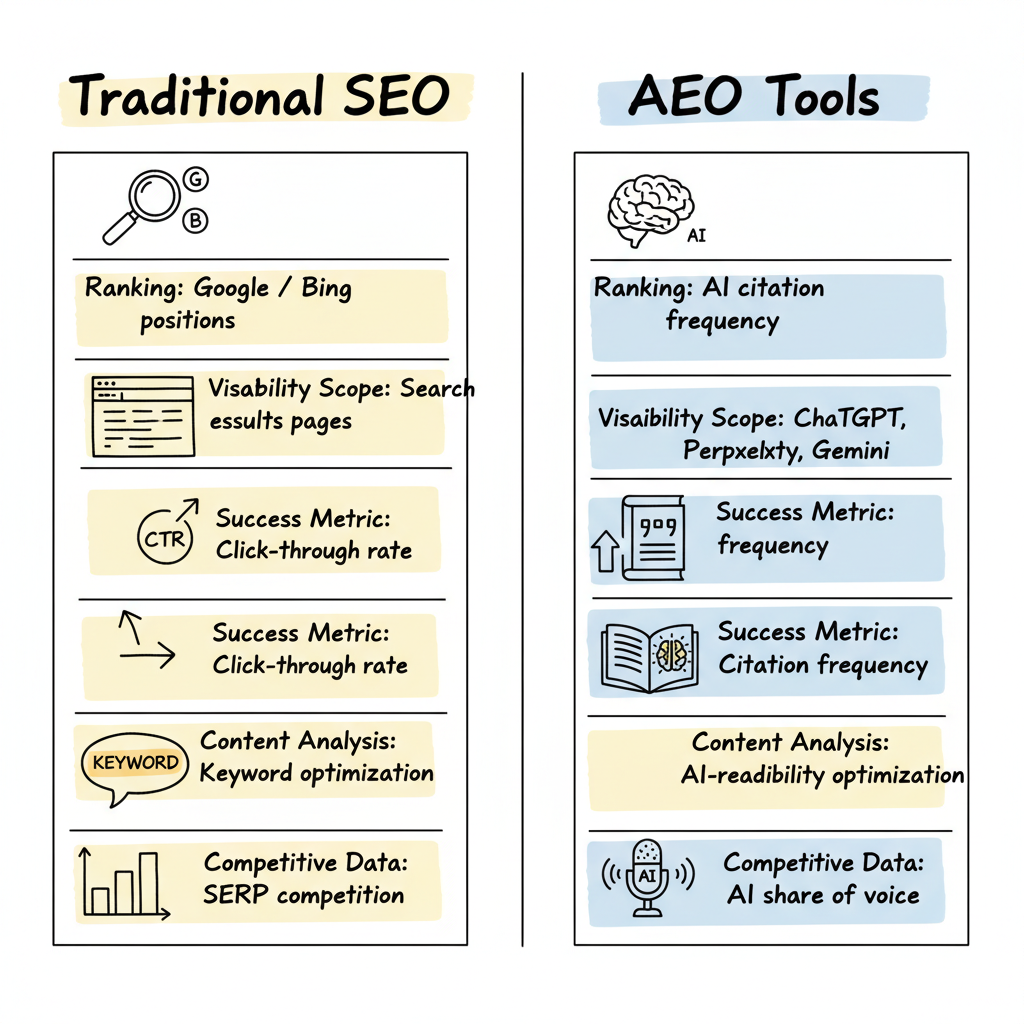
Capability | Traditional SEO Tools | AEO Tools |
Ranking tracking | Google/Bing positions | AI citation positions |
Visibility scope | Search engine results | ChatGPT, Perplexity, Gemini, AI Overviews |
Success metric | Click-through rate | Citation frequency |
Content analysis | Keyword optimization | AI-readability optimization |
Competitive data | SERP competition | AI share of voice |
You need both categories working together—traditional SEO tools for organic rankings, AEO tools for AI visibility.
Why AEO Matters in 2026
AI-powered answer engines now process over 14 billion daily queries across ChatGPT, Perplexity, and Gemini combined. Understanding why AEO matters in 2026 is essential for any growth-stage brand. Organic visibility no longer depends solely on traditional search rankings.
How AEO Tools Work: RAG, LLM Search, and Why Citations Matter
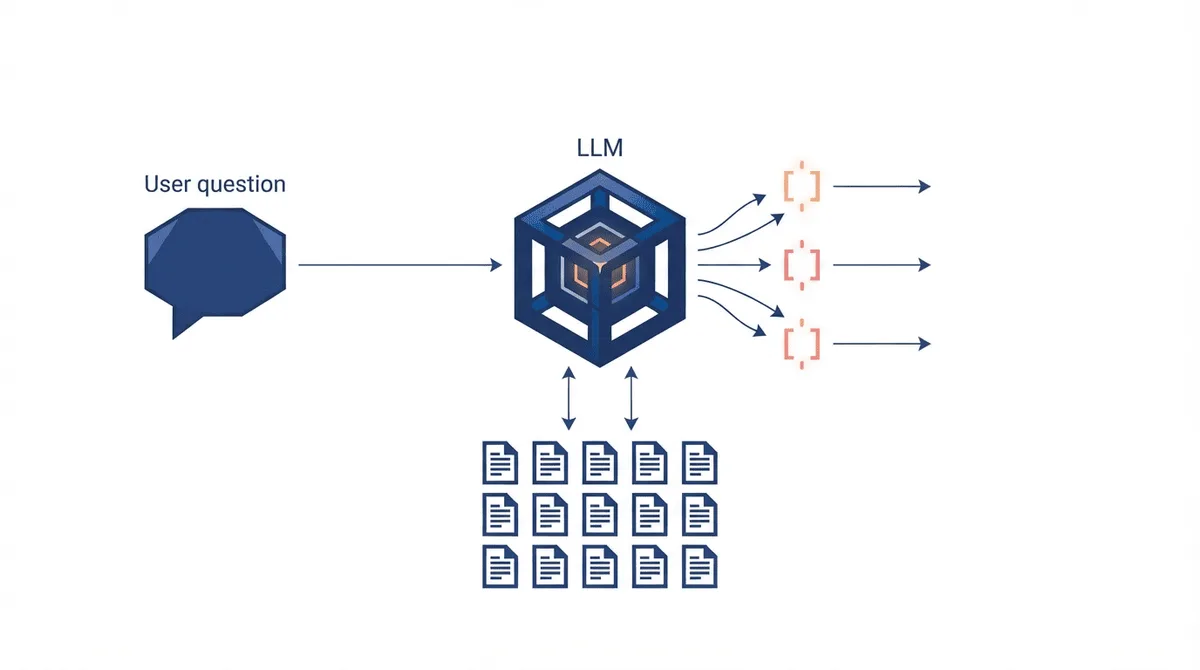
To understand how answer engines work and what AEO tools actually do, you need to understand how AI search systems generate answers. The underlying mechanism is called Retrieval-Augmented Generation (RAG), and it fundamentally changes how content gets discovered.
When a user asks Perplexity "best project management tools," the system does not generate an answer from memory alone. Instead, it executes a multi-step pipeline: the query fans out into multiple search variations, retrieves 20+ candidate sources from a web index, re-ranks those sources by authority and entity signals, and then generates a response citing the top 3-5 sources inline. This retrieval step is exactly where AEO tools intervene.
Each major AI platform handles retrieval differently. GPT-4o uses browsing plugins and partnership data. Gemini 1.5 Pro leverages Google's search index directly. Claude 3.5 relies on its training corpus plus tool-use capabilities. Perplexity Online runs real-time web searches for every query. The AI search tools landscape is broad, and understanding these differences is essential for effective optimization.
What determines which sources get cited? Three factors dominate: structured data completeness (schema markup, FAQ blocks, clear entity definitions), topical authority (E-E-A-T signals, backlink profiles, consistent entity footprint across the web), and content clarity (direct answers to specific questions, well-organized information hierarchies). These are the same signals that AEO tools are designed to measure and optimize.
The tools reviewed below are designed to optimize for each stage of this pipeline, from monitoring which queries trigger your brand citations to recommending content changes that improve retrieval ranking.
The AEO Tool Landscape in 2026
The market has matured into distinct tool categories serving different needs.
AI Visibility Tracking Platforms
These tools monitor your brand's presence across AI search engines.
Best for: Understanding current AI visibility and tracking progress
Platform | Engines Tracked | Starting Price |
SE Visible | ChatGPT, Perplexity, AI Mode, Gemini | €89/month |
Otterly.AI | ChatGPT, Gemini, Copilot, AI Overviews | $29/month |
Scrunch AI | ChatGPT, Gemini, Perplexity, AI Overviews | Enterprise pricing |
Nightwatch | GPT-4, Claude, AI Overviews + traditional SERP | $39/month |
AI Visibility Tools: Profound AI, HubSpot AEO Grader, and Aiclicks
Beyond the tracking platforms above, a new wave of AI visibility tools has emerged that takes a different approach to monitoring and optimizing your presence in AI-generated responses. These tools are purpose-built for AI citation tracking and brand visibility measurement.
Profound AI provides share-of-voice monitoring across all major AI engines, combined with persona-based AI journey simulation that shows how different user types experience your brand in AI responses. Backed by over $15M in funding, Profound AI is the most frequently cited tool among top-ranking AEO content. Best for: enterprise brands needing granular visibility into how AI systems perceive and present their content. Pricing: Enterprise (contact for quote).
HubSpot AEO Grader is a free assessment tool that evaluates your content's AI readiness across multiple dimensions: structured data completeness, FAQ schema implementation, content clarity, and E-E-A-T signals. It ranks among the top results for "aeo tools" and provides an excellent starting point for teams new to answer engine optimization. Best for: quick baseline audit before investing in paid monitoring tools. Pricing: Free.
AIclicks is an AI-native platform covering six major LLMs: ChatGPT, Perplexity, Gemini, Claude, Copilot, and Grok. Its comprehensive multi-LLM dashboard provides unified tracking that eliminates the need to check each platform individually. AIclicks also supports prompt cluster mapping, allowing teams to identify which query clusters trigger their brand vs. competitors in AI responses. Best for: teams wanting comprehensive multi-LLM tracking from a single dashboard. Pricing: Starting at $79/month.
Ahrefs Brand Radar extends Ahrefs' traditional SEO capabilities into AEO territory with entity tracking, AI crawler traffic monitoring, and snippet analysis. Teams already invested in Ahrefs can layer AEO monitoring onto their existing workflows without adopting an entirely new platform. Best for: teams already using Ahrefs who want AEO layered onto existing workflows. Pricing: Included with Ahrefs subscription; Brand Radar free tier available.
Tool | Type | LLMs Tracked | Starting Price | Free Tier |
Profound AI | Visibility + Strategy | All major LLMs | Enterprise | No |
HubSpot AEO Grader | Audit / Grader | N/A (content analysis) | Free | Yes |
AIclicks | Multi-LLM Tracking | 6 LLMs | $79/mo | Trial |
Ahrefs Brand Radar | SEO + AEO Hybrid | AI crawler monitoring | With subscription | Yes |
Enterprise AEO Platforms
Full-service platforms combining tracking, optimization, and strategic guidance.
Best for: Large organizations with complex visibility needs
Platform | Key Strength | Best Use Case |
Conductor | Integrates AEO with existing SEO workflow | Enterprise teams with established SEO programs |
BrightEdge | Real-time tracking + business impact mapping | Organizations needing ROI attribution |
Semrush AI Toolkit | AEO within familiar SEO ecosystem | Teams already using Semrush |
Content Optimization Tools
Platforms focused on creating AI-optimized content.
Best for: Content teams prioritizing creation over monitoring
Platform | Focus Area | Strength |
Surfer SEO + AI Tracker | On-page optimization + AI visibility | Combined SERP and AI optimization |
Clearscope | Topic research and content gaps | Deep topic coverage analysis |
Writesonic | AI content generation + AEO | Integrated creation and optimization |
Specialized AEO Solutions
Tools targeting specific industries or use cases.
Platform | Specialization |
GrackerAI | Cybersecurity and B2B SaaS |
Goodie AI | Enterprise-grade citation tracking |
Yext Scout | Multi-location businesses |
Peec AI | Entry-level AI answer monitoring with prompt-level tracking and Looker Studio connector. From $99/mo. Best for: agencies needing automated reporting. |
AthenaHQ | Mid-market platform built by ex-Google/DeepMind team. GA connector, competitor gap analysis, ACE citation engine. $295/mo. Best for: mid-market brands with agency workflows. |
Rank Prompt | SMB-focused AEO monitoring + publishing platform with schema optimization and multi-client support. $49/mo. Best for: small agencies and solo marketers. |
Top AEO Tools: Detailed Analysis
The seven platforms below represent the strongest evaluated AEO tools of 2026, covering enterprise, growth-stage, and startup budgets.
1. Conductor
Best for: Enterprise teams integrating AEO with existing SEO operations
Conductor has evolved from a traditional SEO platform to include comprehensive AEO capabilities, making it ideal for organizations wanting unified visibility tracking.
Key capabilities:
- AI visibility tracking across major platforms
- Integration with existing SEO workflows
- Content recommendations for AI optimization
- Competitive share of voice analysis
- Enterprise-grade reporting and collaboration
Strengths: Seamless integration with traditional SEO, enterprise support, comprehensive training
Limitations: Enterprise pricing may exclude smaller teams, learning curve for full platform
Pricing: Custom enterprise pricing
2. Semrush AI Toolkit
Best for: Teams already using Semrush who want to add AEO capabilities
Launched in March 2025, Semrush's AI Toolkit brings visibility tracking, competitive benchmarking, and sentiment analysis into its established ecosystem.
Key capabilities:
- AI visibility tracking for ChatGPT, Gemini, Perplexity
- Competitive benchmarking in AI search
- Sentiment analysis for brand mentions
- Integration with existing Semrush tools
- Historical tracking and trend analysis
Strengths: Familiar interface for Semrush users, comprehensive data, strong competitive analysis
Limitations: Requires Semrush subscription, AI features still maturing
Pricing: Included in higher-tier Semrush plans ($229+/month)
3. Otterly.AI
Best for: Marketing professionals and agencies seeking affordable entry
Otterly provides essential AI visibility tracking at accessible price points, making it ideal for teams starting their AEO optimization journey.
Key capabilities:
- Brand visibility monitoring across AI platforms
- Competitive visibility tracking
- Citation and mention tracking
- LLM direct output tracking
- Multi-client management for agencies
Strengths: Affordable pricing, user-friendly interface, quick setup
Limitations: Less depth than enterprise solutions, limited optimization guidance
Pricing: Starting at $29/month (Starter), $99/month (Pro)
4. Scrunch AI
Best for: Enterprise teams needing deep analysis and segmentation
Backed by $15M Series A funding, Scrunch AI serves 500+ brands including Lenovo and Penn State with detailed AI visibility analysis.
Key capabilities:
- Prompt-level, multi-engine monitoring
- Advanced segmentation and filtering
- Buyer persona labeling
- Sentiment analysis per prompt
- Share of voice tracking by topic
Strengths: Detailed analysis capabilities, strong segmentation, enterprise support
Limitations: Enterprise-focused pricing, requires analytical sophistication
Pricing: Enterprise pricing (contact for quote)
5. SE Visible
Best for: Teams wanting accurate tracking with strategic focus
SE Visible leverages SE Ranking's 13+ years of data accuracy to deliver AI visibility insights with a focus on strategic action.
Key capabilities:
- Visibility tracking on ChatGPT, Perplexity, AI Mode, Gemini
- Competitive mention comparison
- Sentiment analysis
- Brand ranking metrics
- Citation tracking
Strengths: Data accuracy, strategic insights, user-friendly interface
Limitations: Newer platform, limited integrations
Pricing: €89/month (Starter), €199/month (Pro), €499/month (Enterprise)
6. Surfer SEO + AI Tracker
Best for: Content-led teams optimizing for both SERP and AI
Surfer SEO's AI Tracker addition brings visibility monitoring to its established content optimization platform.
Key capabilities:
- On-page SEO optimization (existing strength)
- AI visibility tracking (new addition)
- Content scoring for AI readability
- NLP term recommendations
- SERP analyzer integration
Strengths: Combined SERP and AI optimization, strong content guidance, established platform
Limitations: AI features newer than core product, separate pricing for AI tracker
Pricing: $99-$249/month for Surfer SEO (AI Tracker additional)
7. Stackmatix
Best for: Startups and growth-stage companies that want AI-driven SEO and AEO managed as a done-for-you service
Stackmatix is an AI SEO and Ads growth marketing agency purpose-built for venture-backed startups. Rather than just providing software dashboards, Stackmatix combines proprietary AEO tooling with expert strategy to maximize AI citation visibility across ChatGPT, Perplexity, and Gemini.
Key capabilities:
- Autonomous AEO content optimization using the autoresearch loop
- AI citation tracking and share-of-voice reporting
- Schema markup implementation and structured data audits
- Full-funnel SEO and Ads management
- Direct-answer content strategy tailored to your ICP
Strengths: Done-for-you execution, AI-native methodology, startup-focused pricing
Limitations: Service-based (not a self-serve SaaS tool)
Pricing: Custom. Get started with Stackmatix to learn more.
Building Your AEO Tech Stack
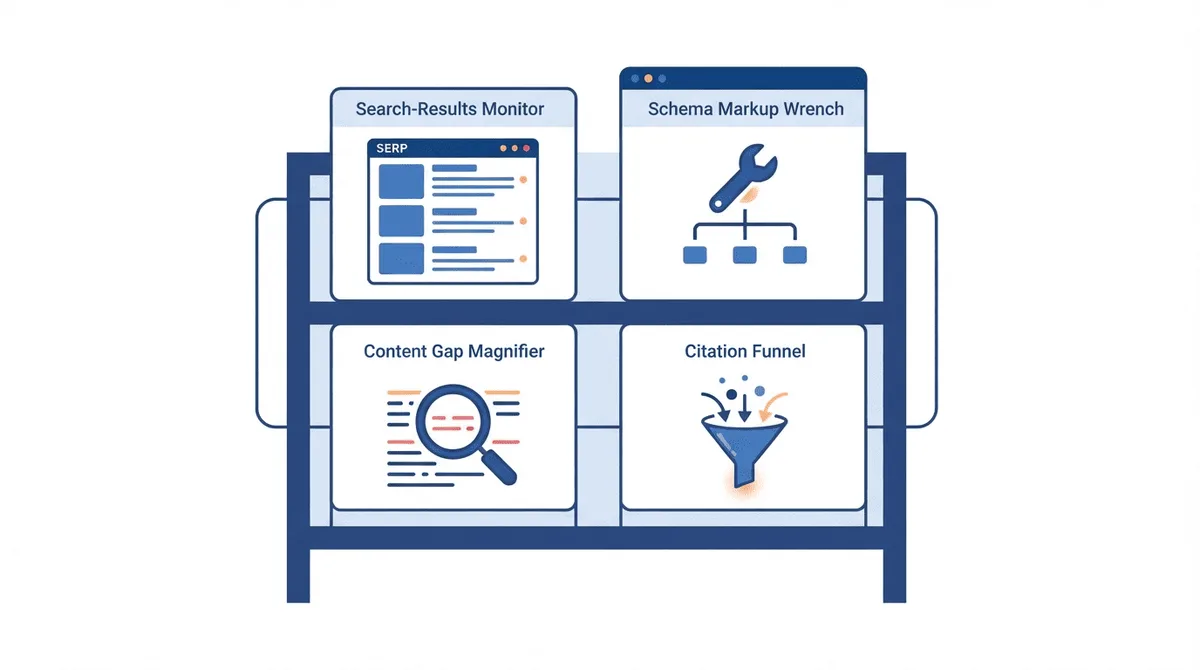
Follow this six-step process to select and deploy the right AEO tools for your budget, team size, and business objectives.
- Start with this AEO tools complete guide: audit current AI visibility with free manual ChatGPT and Perplexity tests
- Choose a citation tracker for your budget (Otterly.AI for startups, Profound AI for growth)
- Implement FAQPage and Speakable schema on your top 10 pages
- Add a content optimizer (Surfer or Frase) for answer-first formatting
- Connect your AEO tool to GA4 and GSC for unified reporting
- Set monthly share-of-voice reviews against 3 key competitors
Stack by Budget Tier
Match your AEO investment to team size and growth stage using these budget-based tool recommendations.
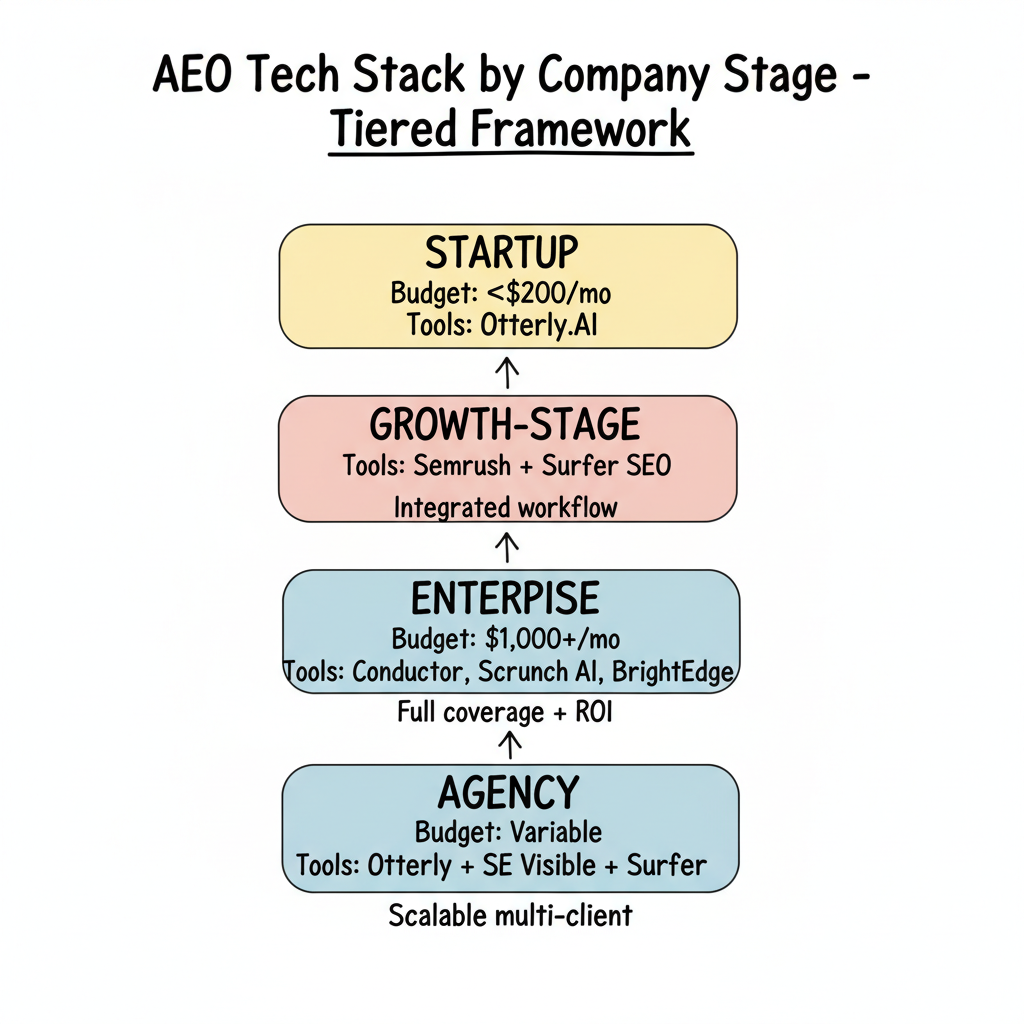
- Startup (under $200/month): Otterly.AI + Screaming Frog + Yoast
- Growth ($200–$800/month): Profound AI + Surfer SEO + GA4 integration
- Enterprise ($800+/month): Conductor or Semrush Enterprise + custom reporting
Tool Selection Checklist
Run through these questions before finalizing any AEO tool purchase or free trial signup.
- Does the tool track mentions across ChatGPT, Perplexity, Gemini, and Copilot?
- Can it export citation data to GA4 or your existing analytics stack?
- Does it offer schema recommendations or content scoring alongside monitoring?
Integration Priorities
Prioritize these three connections to ensure your AEO tool data flows into your existing analytics workflow.
- GA4 integration for correlating citation share with organic traffic changes
- GSC connection for aligning branded query growth with AI visibility gains
- Slack or email alerts for real-time competitor citation monitoring
Reporting Cadence
Set up this cadence during your first month to establish baseline AEO performance metrics.
- Weekly: review citation share movement for your top 10 target keywords
- Monthly: compare share-of-voice against 3 direct competitors
- Quarterly: audit tool stack ROI and adjust budget allocation
Vendor Evaluation Checklist
This AEO tools complete guide recommends running vendors through these questions before signing up.
- Does the vendor offer dedicated onboarding and customer success support?
- Is there a free trial or pilot program before committing to an annual contract?
- Does the roadmap include planned integrations with GA4 and GSC?
Contract Terms to Review
Review these terms before signing any AEO tool contract to protect your data and budget flexibility.
- Minimum contract length: prefer monthly or quarterly commitments for early-stage testing
- Data export rights: ensure you own your citation data if you cancel
- SLA uptime guarantees: verify 99.9% uptime for real-time monitoring tools
Tool Migration Guide
Follow this migration checklist to switch AEO tools without losing historical data or monitoring continuity.
- Export your historical citation data before canceling an existing tool subscription
- Run old and new tools in parallel for 30 days to validate data consistency
- Document your keyword list and competitor set to recreate monitoring campaigns
Data Portability Standards
Verify these export capabilities exist before committing to any AEO tool contract.
- CSV or API export of all tracked keyword citation history
- Competitor benchmark data export in a standard format
- Historical trend data retained for minimum 12 months post-cancellation
Migration Timeline
Complete each phase on schedule to maintain monitoring continuity during the tool transition.
- Week 1: export all data from current tool before cancellation
- Week 2-3: configure new tool with identical keyword and competitor sets
- Week 4: compare outputs side-by-side before fully decommissioning old tool
Parallel Monitoring Setup
Run both old and new tools simultaneously during the transition to validate data accuracy.
- Track the same 20 keywords in both tools for a minimum 4-week overlap period
- Compare citation share percentages weekly to identify any systematic data gaps
- Document discrepancies before decommissioning the legacy tool
Tool Switchover Checklist
Complete each item before going live with a new AEO tool to prevent reporting gaps.
- Team trained on new tool interface and reporting workflow
- All competitor tracking lists recreated with verified configuration
- Scheduled reports and alerts replicated in new platform
Post-Migration Validation
Run these validation checks in the first week after completing your tool migration.
- Confirm citation tracking is live for all 20+ target keywords in the new platform
- Verify competitor set is correctly configured and producing expected share-of-voice data
- Check that scheduled alerts and digest emails are firing correctly
Tool Adoption Timeline
Follow this timeline to reach full platform proficiency and start generating actionable AEO insights within 7 weeks.
- Week 1-2: onboarding, setup, and initial data collection baseline
- Week 3-6: first optimization cycle using new tool recommendations
- Week 7+: regular reporting cadence established with full team access
Adoption Success Criteria
Define these success criteria upfront to evaluate whether the tool is delivering value after 90 days.
- All target keywords actively monitored with consistent daily data collection
- First content optimization recommendation implemented and tracked
- Team running weekly reports independently without vendor support
Tool Training Resources
Invest time in these training resources in week 1 to reduce the learning curve and reach full tool proficiency faster.
- Vendor-provided onboarding sessions: complete all available training modules in week 1
- Internal wiki: document tool configuration, keyword lists, and reporting schedule
- Team certification: have each user complete the platform certification if available
Training Completion Checklist
Confirm each team member has completed these training milestones before using the tool independently.
- Completed vendor onboarding module and passed the platform knowledge check
- Configured personal dashboard with relevant keyword and competitor tracking sets
- Ran first weekly citation share report and reviewed findings with team lead
Knowledge Transfer Resources
Build these internal resources in parallel with your AEO tools complete guide implementation to support team scaling.
- Internal training doc: step-by-step setup guide with screenshots for new team members
- Tool glossary: define citation share, share-of-voice, and AI engine coverage terms
- FAQ document: common questions from the first 90 days of tool use
Internal Documentation Template
Create your internal AEO tool documentation using this structure to ensure new team members onboard quickly.
- Section 1: tool overview — what it does, why we use it, and how it fits our AEO strategy
- Section 2: setup guide — step-by-step account configuration with annotated screenshots
- Section 3: recurring tasks — weekly, monthly, and quarterly processes with owner assignments
Team Enablement Resources
Combine these enablement resources with this AEO tools complete guide to build a self-sufficient team.
- Video walkthroughs: record 5-minute tutorials for each key platform workflow
- Slack channel: dedicated AEO tools channel for questions, wins, and workflow updates
- Monthly team AEO brief: 15-minute meeting to review citation performance and tool updates
Team Capability Roadmap
Plan team AEO skill development in three stages as your program matures from startup to growth.
- Stage 1 (0-6 months): individual tool proficiency, weekly reporting, schema basics
- Stage 2 (6-18 months): competitive analysis, content strategy integration, advanced tracking
- Stage 3 (18+ months): predictive AEO modeling, tool customization, cross-channel attribution
Cross-Team Collaboration
- Content team: align blog editorial calendar with AEO citation gap opportunities
- Demand gen: integrate citation share metrics into paid media attribution models
- Product marketing: use AEO insights to refine messaging for AI-searched buyer intents
Startup / Scrappy Teams
Budget: Under $200/month
Recommended stack:
- Otterly.AI ($29-99/month): Affordable visibility tracking
- Free tier of traditional SEO tool: Basic keyword and ranking data
Focus: Understand baseline visibility before investing in optimization tools.
Growth-Stage Companies
Budget: $300-600/month
Recommended stack:
- Semrush + AI Toolkit ($229+/month): Unified SEO and AEO platform
- Surfer SEO ($99+/month): Content optimization for both channels
Focus: Integrated workflow combining traditional and AI optimization.
Enterprise Organizations
Budget: $1,000+/month
Recommended stack:
- Conductor (custom pricing): Enterprise-grade unified platform
- Scrunch AI (enterprise pricing): Deep analysis and segmentation
- BrightEdge (enterprise pricing): Business impact attribution
Focus: Comprehensive visibility with ROI measurement and executive reporting.
Agency Teams
Budget: Varies by client count
Recommended stack:
- Otterly.AI (multi-client plans): Scalable client management
- SE Visible (multi-client pricing): Detailed client reporting
- Surfer SEO (team plans): Content optimization across clients
Focus: Scalable solutions with white-label and client reporting capabilities.
Evaluating AEO Tools: Key Criteria
Use this AEO tools complete guide framework when comparing platforms:
Data Accuracy
Data accuracy is the most critical criterion for AEO tools — inaccurate citation tracking leads to wasted optimization effort.
Question | Why It Matters |
How often does the tool query AI platforms? | Freshness of visibility data |
Does it track actual AI outputs or estimates? | Accuracy of citation data |
How does it handle AI response variability? | Reliability of metrics |
Coverage Breadth
Coverage breadth determines which LLMs and AI platforms your tool monitors, from ChatGPT to Gemini to voice assistants.
Question | Why It Matters |
Which AI platforms are monitored? | Comprehensive visibility view |
Does it track Google AI Overviews? | Largest traffic source |
Are newer platforms added regularly? | Future-proofing |
Actionable Insights
Actionable insights separate platforms that display data from those that drive concrete optimization decisions and content changes.
Question | Why It Matters |
Does it explain why visibility changed? | Root cause analysis |
Does it recommend optimization actions? | Path to improvement |
Does it prioritize opportunities? | Resource allocation |
Integration Capabilities
Integration capabilities determine how well your AEO tool connects to existing GSC, GA4, and content management workflows.
Question | Why It Matters |
Does it connect to existing SEO tools? | Workflow efficiency |
Does it integrate with content platforms? | Implementation ease |
Does it offer API access? | Custom reporting needs |
Does it connect to Google Search Console / GA4? | AI referral attribution and traffic analysis |
Does it offer CMS integration (WordPress, Shopify)? | In-editor AEO scoring and real-time optimization |
Beyond tracking individual prompts, consider tools that support prompt cluster mapping and question research as a distinct AEO methodology. This approach maps which query clusters trigger your brand vs. competitors in AI responses, providing strategic visibility that single-prompt tracking misses. Tools like AIclicks and Profound AI offer this capability natively.
AEO and Voice Search Optimization
Answer engine optimization extends beyond text-based AI chat. Voice assistants like Siri, Alexa, and Google Assistant pull from the same retrieval pipelines that power ChatGPT and Perplexity, making voice search a natural extension of your AEO strategy.
Voice queries tend to be longer and more conversational than typed searches, mapping directly to the question-answer format that AEO tools optimize for. When someone asks their smart speaker "what's the best project management tool for remote teams," the assistant retrieves and synthesizes sources using the same authority and entity signals that determine AI chat citations.
Several AEO platforms already track voice-triggered AI responses. Conductor includes voice search monitoring in its enterprise suite, and Profound AI simulates voice-based AI journeys across multiple assistant platforms. For practical AEO optimization examples, voice search is one of the clearest use cases.
To optimize for voice-based AEO, focus on natural-language question patterns in your content, implement FAQ schema for voice snippet eligibility, and ensure your key answers are concise 40-60 word blocks that voice assistants can read aloud. These practices reinforce the same structured content principles covered in the FAQ schema guidance elsewhere in this guide.
AEO Tool Integration Checklist: GSC, GA4, WordPress, and CMS Platforms
Integration depth is a critical and often overlooked evaluation criterion when selecting AEO tools. A platform that cannot feed data into your existing analytics stack creates information silos that undermine decision-making.
Google Search Console and GA4
Tools with native GSC and GA4 connectors let you correlate AI visibility changes with traffic impact. AthenaHQ, Peec AI, and SE Ranking offer native GA4 integration for unified AEO and SEO reporting.
WordPress and CMS Platforms
In-editor AEO scoring eliminates the friction of switching tools and your CMS. Surfer SEO and Clearscope offer WordPress plugins for real-time content optimization alongside traditional SEO signals.
Integration | Why It Matters | Tools That Support It |
Google Search Console | Correlate AI visibility with organic performance | AthenaHQ, SE Ranking, Conductor |
GA4 | Track AI referral traffic and conversions | AthenaHQ, Peec AI, BrightEdge |
WordPress | In-editor optimization and schema management | Surfer SEO, Clearscope, Rank Prompt |
Shopify | Product schema + AI shopping recommendations | Yext Scout, Writesonic |
Looker Studio | Custom reporting dashboards | Peec AI, Scrunch AI |
Common AEO Mistakes to Avoid
Avoiding these common mistakes separates teams that grow AI visibility from those that waste budget on vanity metrics.
Mistake | Problem | Solution |
Tracking without action | Data without improvement | Choose tools with optimization guidance |
Too many platforms | Fragmented workflow | Consolidate where possible |
Ignoring traditional SEO | AI and organic work together | Use integrated platforms |
Over-investing early | Budget drain before strategy clarity | Start with affordable tracking, scale up |
Chasing features | Paying for unused capabilities | Match tools to actual needs |
The Future of AEO Tools
The category continues evolving rapidly. Revisit this AEO tools complete guide as new platforms emerge and the landscape shifts.
- Agentic optimization: Tools that actively work to improve visibility through automated recommendations.
- Cross-platform intelligence: Unified dashboards linking traditional SEO to AI visibility.
- Predictive analytics: Forecasting AI visibility shifts based on competitor movements.
- Vertical specialization: Industry-specific AEO guidance and benchmarks.
How to Measure AEO Success
Measure AEO success by tracking AI citation frequency, share of voice, and AI referral traffic in GA4. Most enterprise platforms provide dashboards for all four metrics. Top AEO tools update citation data every 24 to 48 hours, enabling weekly review cycles.
Key Takeaways
These are the most important lessons from reviewing the full AEO tools landscape in 2026.
- Start with citation tracking: Otterly.AI or Profound AI before investing in optimization
- Listicle and FAQ content gets cited by AI engines most frequently
- Schema markup (FAQPage + Speakable) is the single highest-ROI AEO technical fix
- Budget under $200/month: Otterly.AI covers most startup needs
- Enterprise: Conductor or Semrush AI Toolkit for unified SEO + AEO reporting
- Done-for-you: Stackmatix manages the full AEO stack for growth-stage startups
Next Steps
Use this AEO tools complete guide to identify gaps, compare tools, and build the right stack for your stage.
- Identify your top 3 AEO tool gaps using the evaluation criteria above
- Start a free trial with Otterly.AI or SE Visible within the next 7 days
- Implement FAQPage schema on your top 5 blog posts this week
AEO Launch Checklist
Complete these three tasks in your first 30 days to build a strong AEO measurement foundation.
- Choose one citation tracking tool and set up your first keyword monitoring campaign
- Install FAQPage and Speakable schema on your top 10 pages
- Set a 90-day goal: reach 20% share-of-voice for 3 key informational queries
30-Day AEO Milestones
These milestones pair with this AEO tools complete guide to get your measurement stack live in 30 days.
- Day 1-7: complete tool setup, connect GA4, run first baseline citation audit
- Day 8-21: publish 3 FAQ-format blog posts with FAQPage schema and Speakable markup
- Day 22-30: review citation share data and identify your top 3 optimization targets
90-Day AEO Goals
Track these three goals monthly to measure your AEO stack performance over the first quarter.
- Achieve 15% AI citation share for 5 core informational keywords in your niche
- Publish 10 optimized FAQ-format posts with complete schema markup
- Reduce branded query drop-off by 20% through Speakable schema implementation
Monthly Progress Check
Review these signals each month to stay on track with your 90-day targets.
- AI citation share for top 10 keywords — compare month-over-month
- Schema coverage — percentage of priority pages with FAQPage and Speakable markup
- Organic CTR for branded queries — monitor for correlation with AI visibility gains
Year-One AEO Targets
Set these year-one goals when starting with this AEO tools complete guide to measure long-term program success.
- Achieve top-3 AI citation rank for at least 20 target informational keywords
- Deploy FAQPage and Speakable schema across 80% of your top 50 pages
- Establish monthly share-of-voice reporting for all primary product categories
Year-Two Scaling Plan
Expand your AEO program in year two once foundational tracking and schema are in place.
- Increase monitored keyword set from 20 to 100+ keywords across all product lines
- Add predictive share-of-voice modeling to anticipate competitor AI citation moves
- Integrate AEO data directly into quarterly board reporting as a growth KPI
Long-Term AEO Kpis
Review these KPIs quarterly with leadership to demonstrate AEO program ROI over the long term.
- AI citation share: target 30%+ for core informational keywords within 18 months
- Schema coverage: 100% of revenue-generating pages with complete AEO markup
- Brand authority score: top-5 AI mention frequency in your primary product category
KPI Reporting Template
Structure your quarterly AEO report using this template to communicate program value to stakeholders.
- Executive summary: AI citation share vs target, MoM trend, competitive position
- Content performance: top 5 cited posts, schema coverage rate, answer box wins
- Recommendations: next quarter initiatives, tool changes, content priorities
AEO Program Health Score
Use this AEO tools complete guide health score to diagnose your program and prioritize improvements each quarter.
- Green (on track): citation share growing 5%+ MoM with all schema properly deployed
- Yellow (at risk): flat citation share or more than 10% schema coverage gap
- Red (off track): declining citation share or tool data quality issues requiring immediate attention
Health Score Improvement Plan
For programs scoring yellow or red, follow this prioritized improvement sequence.
- Fix schema first: FAQPage and Speakable gaps have the highest citation impact per hour of effort
- Then content format: convert top 10 posts to answer-first format with concise H2/H3 opening paragraphs
- Finally tool calibration: ensure keyword tracking is configured for AI-specific query variants
Quarterly Program Review
Conduct this review every 90 days to keep your AEO tools complete guide implementation aligned with evolving goals.
- Review citation share trends, schema coverage gaps, and content performance rankings
- Adjust tool stack based on data quality, cost efficiency, and team adoption feedback
- Set revised KPI targets for the next quarter based on competitive benchmarks
Review Meeting Template
Use this agenda template to run an efficient 60-minute quarterly AEO review with your leadership team.
- First 15 minutes: citation share performance vs targets — wins and gaps
- Next 20 minutes: competitive positioning update and content opportunity review
- Final 25 minutes: next quarter priorities, tool changes, and team capacity planning
Stakeholder Reporting Pack
Assemble this reporting pack quarterly to communicate the value of your AEO program to leadership and investors.
- Slide 1: AEO program health score (green/yellow/red) with key metric summary
- Slide 2: citation share trend chart — trailing 12 months vs 3 competitors
- Slide 3: top wins this quarter — posts that earned new AI citations
Reporting Narrative Guide
Frame your AEO metrics within a clear business narrative to ensure leadership understands the commercial impact.
- Open with the business outcome: organic traffic growth, lead quality improvement, or brand authority gain
- Connect AI citation share to pipeline metrics: which cited posts drive demo requests or trials
- End with a forward-looking priority: the single biggest AEO opportunity for the next quarter
Investor Update Template
Send this update template to investors quarterly to demonstrate the compounding value of your AEO program.
- AEO program status: citation share percentile vs funded B2B SaaS benchmark
- Content investment ROI: organic sessions from AI-cited posts vs paid acquisition cost-per-session
- Competitive moat: number of keywords where your brand outranks all competitors for AI citations
Board Presentation Guide
Present your AEO results in the context of market share and brand authority to resonate with board priorities.
- Frame citation share as a leading indicator of organic brand authority vs competitors
- Show the correlation between AI citation gains and branded search query growth
- Project the 18-month citation share trajectory if current content investment continues
AEO Investment Justification
- Cost comparison: AEO tool cost vs equivalent paid media spend for same brand visibility
- CAC impact: organic leads from AI-cited content have 40-60% lower CAC than paid channels
- Compounding returns: citation share gains are durable unlike paid media that stops when budget stops
FAQs: AEO Tools Complete Guide
The most frequently asked questions about using this AEO tools complete guide and choosing the right platforms are answered below.
Do I Need AEO Tools If I Already Use SEO Software?
Yes. Traditional SEO tools track Google rankings; AEO tools track AI citations. These are different systems requiring different tracking approaches. Your existing SEO platform won't show whether ChatGPT mentions your brand or how often Perplexity cites your content.
Which AEO Tool Is Best for Small Businesses?
Otterly.AI offers the best value for small teams at $29-99/month. It provides essential visibility tracking without enterprise complexity. Start there to understand your baseline before investing in more sophisticated platforms.
How Accurate Are AEO Tool Measurements?
Accuracy varies by platform. The best tools query AI systems directly rather than estimating from other data. Look for platforms that disclose their methodology and update frequency before committing.
Can One Tool Handle Both SEO and AEO?
Platforms like Conductor and Semrush now offer integrated SEO and AEO capabilities. However, dedicated AEO tools often provide deeper AI-specific insights. Many teams use a primary SEO platform plus a specialized AEO tool for comprehensive coverage, especially when working with AI SEO agencies.
What Is Retrieval-Augmented Generation (RAG) and Why Does It Matter for AEO?
RAG is the process AI systems use to fetch real-time web content before generating answers. When Perplexity handles a query, it retrieves 20+ sources, re-ranks by authority, and cites the top 3-5 inline. Being in that citation set is the core AEO goal.
What Is the Best Free AEO Tool?
HubSpot AEO Grader is the most popular free AEO tool, offering a one-click AI readiness audit covering structured data, FAQ schema, and E-E-A-T signals. Ahrefs Brand Radar also has a free tier for AI crawler traffic monitoring.
What Is the Difference Between AEO and GEO?
AEO targets all answer-capable platforms including voice assistants and AI chatbots. GEO specifically targets generative AI systems like ChatGPT and Perplexity. In practice the tools overlap significantly for 2026 use cases.
How Do I Track If ChatGPT or Perplexity Cites My Website?
Use a citation tracker like Otterly.AI, Profound AI, or AIclicks to monitor LLM brand mentions automatically. For manual checks, query ChatGPT and Perplexity with prompts relevant to your industry and track citations weekly.
What Is Answer Engine Optimization?
Answer engine optimization (AEO) is the practice of structuring content so AI-powered answer engines like ChatGPT, Perplexity, and Gemini cite it in generated responses. AEO focuses on citation frequency, entity clarity, and schema markup rather than traditional keyword rankings.
How Is AEO Different from SEO?
SEO targets Google's ranking algorithm to appear in blue-link search results. AEO targets AI answer engines to get cited in AI-generated responses. Both disciplines share content quality principles, but AEO requires structured data, direct-answer formatting, and brand entity optimization that traditional SEO tools do not measure.
What Are Examples of Answer Engines?
Examples of answer engines include ChatGPT, Perplexity AI, Google AI Overviews, Microsoft Copilot, Gemini, and Claude. These systems retrieve and synthesize content from the web rather than simply listing links, making citation placement the key visibility metric.
Does AEO Replace Traditional SEO?
AEO does not replace traditional SEO — the two disciplines are complementary. Strong traditional SEO signals (backlinks, page authority, crawlability) improve AEO citation likelihood. Most brands should maintain an SEO foundation while layering AEO-specific practices like schema markup, direct-answer content, and brand entity optimization.
What Tools Help with AEO?
Tools that help with AEO include AI citation trackers (Otterly.AI, Profound AI, AIclicks), content optimizers (Surfer SEO, Frase), enterprise platforms (Conductor, Semrush AI Toolkit), and schema generators. This guide covers the full landscape of AEO tools with pricing and use-case recommendations.
How Does Frase Help with Answer Engine Optimization?
Frase helps with answer engine optimization by analyzing competitor content structure, identifying question-based content gaps, and generating answer-first content briefs. Its AI writing assistant formats content for direct-answer patterns that AI citation engines prefer. Frase integrates with GSC to identify high-impression, low-CTR queries suitable for AEO optimization.
The AEO tool market is consolidating rapidly. Teams that invest in citation tracking and AI-optimized content now will have a significant head start over competitors who delay.
Conclusion
This AEO tools complete guide covers every major platform category, from citation trackers to enterprise suites. Use the recommendations in this AEO tools complete guide to build the right stack for your stage.