
15 Best AEO Tools Software for AI Search Optimization (2026)
The Answer Engine Optimization (AEO) tool landscape has matured rapidly since 2024. AEO tools software — also called LLM visibility tools — track how often and how accurately AI systems like ChatGPT and Perplexity cite your brand. What started as manual tracking—running queries in ChatGPT and documenting citations—has evolved into sophisticated platforms that monitor AI visibility across multiple engines in real time.
AEO tools software that tracks AI citations can reveal brand visibility gaps invisible to traditional SEO analytics — turning AI search from a black box into a measurable channel.
For marketing teams navigating this new terrain, the right tools can mean the difference between flying blind and having actionable data on your AI search presence. This guide covers the leading AEO optimization software available in 2026, from enterprise platforms to free options, helping you build an effective AEO technology stack.
Want to benchmark your current AEO performance? Try our free AEO grader tool to get an instant score and actionable recommendations.
Introduction: The AEO Tool Landscape
The AEO tool market emerged to solve a fundamental problem: traditional SEO tools don't track AI visibility. Google Search Console shows rankings and clicks, but it doesn't tell you when ChatGPT cites your content or when Perplexity references your brand.
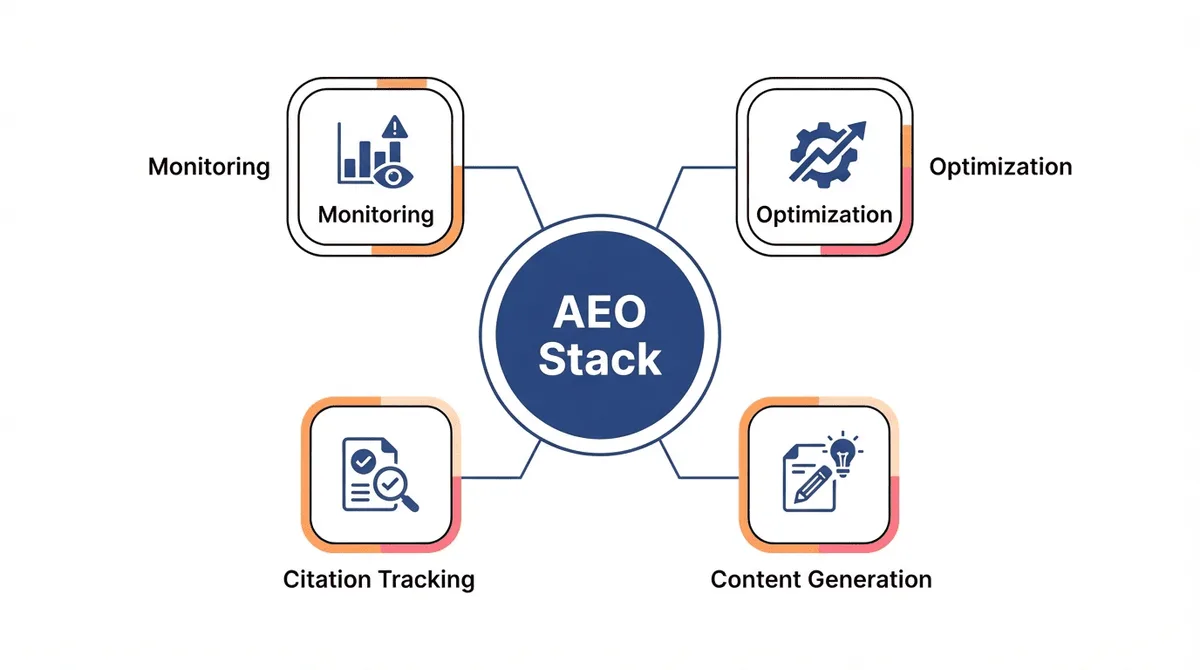
AEO tools software is a category of marketing technology platforms that monitor, analyze, and optimize how brands appear in AI-generated responses across ChatGPT, Perplexity, Google AI Overviews, and other answer engines. The category spans 200+ platforms as of 2026.
The Fragmented Terminology Challenge
According to LLMrefs' directory of over 200 AEO/GEO platforms, the market suffers from fragmented terminology. Tools variously describe themselves as:
- AEO (Answer Engine Optimization) tools
- GEO (Generative Engine Optimization) platforms
- LLMO (Large Language Model Optimization) software
- AI SEO tools
- AI Visibility trackers
Despite different labels, these tools address the same core need: understanding and improving how your brand appears in AI-generated responses. Many organizations complement their tool stack with AEO services packages to ensure proper implementation.
Core Tool Categories
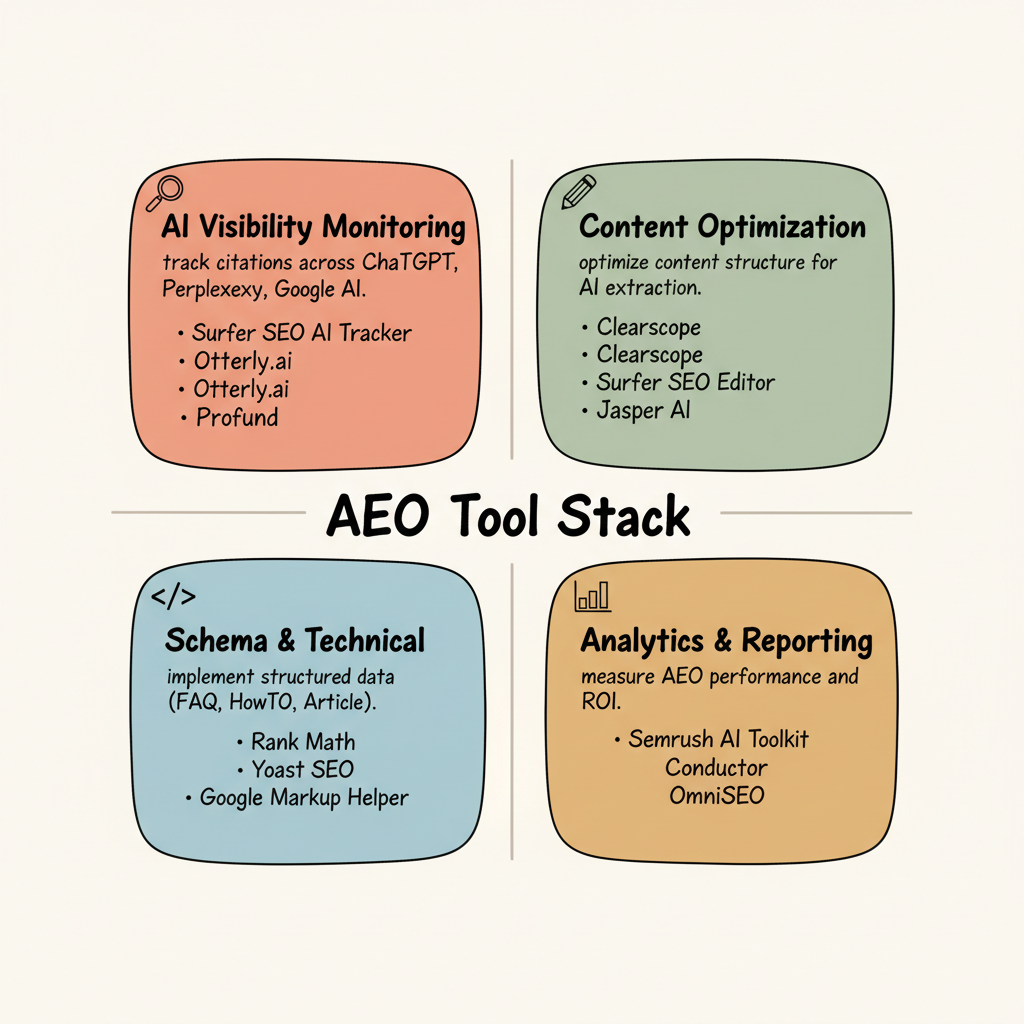
- AI Visibility Monitoring — tracks brand citations across ChatGPT, Perplexity, and Gemini
- Content Optimization — improves content structure for AI extraction
- Schema & Technical AEO — implements structured data for AI readiness
- Analytics & Reporting — measures AEO performance over time
The AEO tool ecosystem breaks into four functional categories:
Category | Purpose | Example Tools |
AI Visibility Monitoring | Track citations across AI platforms | Surfer SEO AI Tracker, Otterly.ai |
Content Optimization | Optimize content for AI extraction | Clearscope, Surfer SEO |
Schema & Technical | Implement structured data for AI | Schema.org tools, rank math |
Analytics & Reporting | Measure AEO performance | Semrush AI Toolkit, Conductor |
Most organizations need tools from multiple categories for a complete AEO capability.
Surfer SEO AI Tracker: AEO Monitoring Platform
Surfer SEO, known for its content optimization tools, launched AI Tracker as an add-on feature specifically designed for AEO monitoring.
Core Capabilities
Multi-platform tracking: AI Tracker monitors your visibility across:
- Google AI Overviews
- SearchGPT
- Perplexity
- ChatGPT
- Claude
Citation monitoring: The platform tracks when and how AI systems cite your content, including citation position and context. This capability is particularly valuable for teams running Perplexity AI optimization strategy campaigns.
Competitor analysis: See how competitors appear in AI responses for your target queries.
Alert system: Get notified when your AI visibility changes significantly.
Pricing and Value
According to industry analysis, Surfer SEO's AI Tracker is available as an add-on to existing Surfer subscriptions:
- Base Surfer subscription: Starting at $89/month
- AI Tracker add-on: Additional cost for 25+ prompts/month
- Combined cost: Approximately $95-150/month depending on tier
Best Use Cases
- Content teams already using Surfer for optimization
- Organizations wanting integrated content + monitoring workflows
- Mid-market companies needing comprehensive but affordable tracking
Limitations
- Requires existing Surfer subscription
- Prompt-based pricing can get expensive at scale
- Learning curve for full platform utilization
HubSpot AEO Grader: Free Assessment Tool
HubSpot offers a free AEO assessment tool that audits your website's readiness to appear in AI-generated answers. No account required for basic use.
How It Works
The HubSpot AEO Grader evaluates five key dimensions:
- Structured data completeness — checks for FAQ schema, Article schema, and Organization markup
- FAQ schema implementation — verifies question-and-answer pairs are properly marked up for AI extraction
- Content clarity — assesses whether answers are concise, direct, and formatted for AI extraction
- E-E-A-T signals — reviews author credentials, publication dates, and expertise indicators
- Content structure — evaluates heading hierarchy, list formatting, and answer-first organization
This assessment complements a comprehensive AEO marketing audit by identifying technical gaps.
How to Run a Grader Analysis
Follow these steps to audit your site using the HubSpot AEO Grader tool in under five minutes.
- Navigate to the HubSpot AEO Grader tool (free, no login required)
- Enter your website URL or a specific page URL
- Review the score across each dimension (0-100 scale)
- Prioritize fixes by score gap — focus on dimensions below 60 first
- Re-run after implementing changes to track improvement
A score below 50 on structured data or FAQ schema typically indicates the page is unlikely to be cited by AI systems. A score above 80 signals strong AI readiness.
Strengths
Free access: No subscription required for basic assessment.
Educational value: Good for teams new to AEO who want to understand their baseline.
Quick insights: Fast analysis without complex setup.
Alternative free checker: ProductRank.ai offers a similar free brand visibility check across major LLMs — useful for validating your AI citation presence beyond technical readiness scores.
Limitations
Point-in-time analysis: Single assessment rather than ongoing monitoring. It does not track competitor citations or show how your brand appears in specific LLM responses.
Limited depth: Doesn't track actual AI citations or competitive positioning.
Basic recommendations: General guidance rather than specific optimization paths.
Best Use Cases
HubSpot AEO Grader suits:
- Teams evaluating their AEO readiness before investing in paid AEO tools software
- Small businesses with limited budgets
- Organizations wanting a quick baseline assessment before running a full AEO audit
AEO Checking and Audit Tools: How to Audit Your AI Readiness
“AEO checking” refers to the diagnostic and audit phase of optimization — understanding your current AI visibility posture before committing to an ongoing monitoring platform. It’s distinct from continuous monitoring: checking tools give you a snapshot; monitoring tools track changes over time.
The queries that bring users to this topic — “aeo checking software,” “aeo analysis tools,” “aeo checker” — reflect a specific intent: I want to know where I stand right now. The following tools address that need directly.
AEO Checking Tool Comparison
Use this comparison to choose the right AEO checking tool based on your budget and technical requirements.
Tool | Type | Best For | Starting Price | Free Option |
HubSpot AEO Grader | Technical audit | Quick readiness baseline | $0 | Yes (fully free) |
ProductRank.ai | Brand visibility check | LLM citation presence | $0 | Yes |
Gumshoe AI | Persona-based audit | One-off deep audits | Pay-per-report | First report free |
HubSpot AEO Grader — Free, no account required. Evaluates structured data, FAQ schema, content clarity, and E-E-A-T signals. Best as a first-pass audit before investing in paid tools. See the expanded section above for full details.
ProductRank.ai — Free brand visibility checker that queries major LLMs (ChatGPT, Perplexity, Gemini, Claude) with your brand name and topic keywords. It returns a visibility score and shows which prompts trigger a citation. Ideal for validating whether your brand is being cited at all before diagnosing why it isn’t.
Gumshoe AI — Pay-per-report platform ($0.10/conversation) that runs persona-based AEO audits. You define a target buyer persona and set of queries; Gumshoe simulates LLM conversations from that persona’s perspective and reports which brands appear and how often. First reports are free. Best for one-off deep audits, competitive benchmarking, or agency deliverables where you need qualitative citation context — not just a score.
What does an “AEO score” actually measure? Across checking tools, scores typically reflect some combination of: citation rate (% of queries where your brand appears), share of voice (your citations vs. competitors’), and AI visibility score (composite of technical readiness + actual citation presence). No industry-standard scoring methodology exists yet — each tool weights these factors differently.
AI Visibility Tools: Track Where Your Brand Appears in LLM Responses
AI visibility tools are the ongoing monitoring phase of AEO — tracking which LLMs cite your brand, how often, and in what context, on an automated daily or weekly basis.
AI visibility tools are the ongoing monitoring phase of AEO — tracking which LLMs cite your brand, how often, and in what context, on an automated daily or weekly basis. Unlike traditional SEO rank trackers that poll Google’s index, AI visibility tools actively query language models with prompt sets and record whether your brand appears in the generated responses.
The distinction from AEO checking tools: checking tools give you a one-time audit; AI visibility tools give you a time-series. You need both — a check to establish your baseline, and a monitoring tool to track whether your optimization work is producing results.
LLMs to track in 2026: ChatGPT, Perplexity, Google AI Overviews, Gemini, Claude, Copilot, DeepSeek, and Grok (xAI). DeepSeek and Grok are emerging platforms to monitor — Cairrot currently tracks DeepSeek, and Grok coverage is expanding across several platforms in 2026.
AI Visibility Tool Comparison
Compare leading AI visibility tools by LLM coverage, pricing, and standout features.
Tool | LLMs Tracked | Price | Key Feature |
Cairrot | 5 LLMs incl. DeepSeek | $39/mo | Free API, LLMS.txt generator |
Hall AI | Multiple LLMs | $199/mo | Slack alerts, heatmaps |
Peec AI | Multiple LLMs | €89/mo (~$97) | Real-time monitoring, Looker Studio connector |
Ahrefs Brand Radar | AI crawler traffic | Free tier | AI bot traffic monitoring |
Cairrot — $39/month. Tracks 5 LLMs including DeepSeek — one of the few tools with DeepSeek coverage. Free API access on all plans enables custom dashboard integrations. Includes a built-in LLMS.txt generator. Best for agencies wanting a cost-effective multi-LLM tracker with developer-friendly API access.
Hall AI — $199/month. Differentiates on real-time alerting: Slack notifications fire when your brand appears or disappears from AI responses. Heatmap visualization shows which prompt clusters generate your citations vs. competitors’. Best for in-house teams that need immediate notification of AI visibility changes without manual dashboard checking.
Peec AI — €89/month (~$97 USD). European-built platform with real-time monitoring and a native Looker Studio connector — the only tool in this tier with out-of-the-box Looker Studio integration, making it the top choice for agencies that report to clients via Google Data Studio. Also provides strategy recommendations alongside monitoring data. Best for agencies managing client reporting workflows.
Ahrefs Brand Radar — Free tier available. Tracks AI crawler traffic (GPTBot, ClaudeBot, PerplexityBot) to your site rather than monitoring citations directly. Useful for understanding whether LLM crawlers are discovering your content — a prerequisite for being cited. Best as a free addition to any AI visibility stack.
Two additional tools already covered in this post — Surfer SEO AI Tracker and Otterly.ai — also serve the AI visibility monitoring use case and are worth reviewing in the context of your existing tech stack.
Share of voice in AI responses: The key metric AI visibility tools measure is what percentage of relevant queries mention your brand versus competitors. Tools like Hall AI and Peec AI surface this metric explicitly.
Prompt cluster mapping: Rather than tracking individual prompts in isolation, advanced tools map which query clusters reliably trigger AI citations for your brand. AIclicks.io offers this feature — identifying the prompt categories where you have citation momentum versus the gaps where competitors dominate.
Schema Markup Tools for AEO
Schema markup helps AI systems understand your content structure. Several tools simplify schema implementation for AEO purposes, particularly when implementing generative AI for structured data.
Schema.Org Generators
Schema Markup Generator (Technical SEO)
- Free tool for generating JSON-LD schema
- Supports FAQ, HowTo, Article, and other types
- Copy-paste implementation
Google's Structured Data Markup Helper
- Free tool from Google
- Visual interface for tagging content
- Generates structured data code
WordPress Schema Plugins
Rank Math
- Comprehensive SEO plugin with schema features
- Automatic schema generation for posts/pages
- FAQ and HowTo schema blocks
- Free tier available; Pro starts at $59/year
Yoast SEO
- Popular SEO plugin with schema support
- Article and organization schema
- Integrates with Yoast's broader SEO features
- Free tier available; Premium at $99/year
Schema Validation Tools
Google Rich Results Test
- Free validation tool
- Shows which rich results your markup enables
- Identifies errors and warnings
Schema.org Validator
- Tests any schema markup
- Detailed error reporting
- Useful for debugging complex implementations
Schema Best Practices for AEO
According to industry research, implementing these schema types improves AI citation potential:
Schema Type | AEO Benefit | Priority |
FAQ | Direct answer extraction | High |
HowTo | Process/tutorial citations | High |
Article | Author and publication signals | High |
Organization | Brand entity recognition | Medium |
Person | Author authority signals | Medium |
Product | E-commerce AI visibility | Medium |
Teams exploring HowTo schema AI search optimization should prioritize these implementations.
Technical AEO Tools: LLMS.Txt, AI Crawlers, and Site Readiness
Beyond schema markup, a growing set of technical AEO tools software addresses how AI systems discover and access your content in the first place.
LLMS.txt is an emerging standard — an AI-friendly index file that tells language model crawlers what content on your site is most relevant and how it should be accessed. Think of it like robots.txt, but additive rather than restrictive: instead of blocking crawlers, LLMS.txt guides them to your best content. Cairrot includes a free LLMS.txt generator on all plans — one of the few tools to automate this file’s creation.
To create a basic LLMS.txt manually: list your most important pages with a one-sentence description of what each covers, structured as a flat markdown file at yourdomain.com/llms.txt. Update it whenever you publish significant new content.
AI bot crawl tracking: Verifying that LLM crawlers — GPTBot (OpenAI), ClaudeBot (Anthropic), PerplexityBot — are actually crawling your site is a prerequisite for being cited. Check your server access logs for these user agent strings. Ahrefs Brand Radar provides a free dashboard view of AI crawler traffic to your site.
AI Readiness Audit: An automated assessment of your site’s technical optimization for LLM discovery — combining crawl accessibility, structured data coverage, content formatting, and citation rate signals into a single score. HubSpot AEO Grader approximates this for individual pages; more comprehensive site-wide assessments are available via enterprise platforms like AthenaHQ.
Content Optimization Tools for AEO
Content optimization tools help structure content for AI extraction, improving E-E-A-T signals that drive LLM citations.
Content optimization tools help structure and improve content for AI extraction. These tools existed before AEO but have added AI-specific features. E-E-A-T signals (author credentials, original research, first-hand experience) influence whether LLMs cite your content as an authoritative source — so content optimization for AEO is not just about structure, but about demonstrated expertise.
Clearscope
Overview: Enterprise content optimization platform with AI visibility features.
AEO-Relevant Features:
- Content grading against AI-optimized benchmarks
- Topic and entity coverage analysis
- Competitive content comparison
- Real-time optimization suggestions
Pricing: Custom enterprise pricing (typically $170+/month)
Best For: Enterprise teams with substantial content budgets
Surfer SEO Content Editor
Overview: Content optimization tool with integrated AI tracking.
AEO-Relevant Features:
- Content structure optimization
- NLP-based term suggestions
- Outline builder for AI-friendly structure
- Integration with AI Tracker for monitoring
Pricing: Starting at $89/month
Best For: Mid-market content teams practicing DIY AEO optimization
Jasper AI
Overview: AI writing assistant with SEO optimization features.
AEO-Relevant Features:
- AI-generated content drafts
- SEO templates and workflows
- Brand voice customization
- Integration with Surfer SEO
Pricing: Starting at $39/month
Best For: Teams seeking AI writing assistance alongside optimization
Writesonic
Overview: AI content platform with SEO features.
AEO-Relevant Features:
- AI content generation
- Article rewriting and optimization
- SEO-focused templates
- Bulk content capabilities
Pricing: Free tier available; paid plans from $19/month
Best For: Budget-conscious teams needing AI writing support
Analytics and Tracking for AEO
Beyond content optimization, organizations need analytics tools to measure AEO performance over time. Proper AEO analytics setup is critical for tracking ROI.
Prompt cluster mapping: Rather than tracking individual prompts in isolation, effective AEO analytics maps which query clusters reliably trigger AI citations for your brand. AIclicks.io offers prompt cluster mapping as a core feature.
GA4 attribution for AI referral traffic: AI-sourced traffic from platforms like Perplexity (perplexity.ai) and ChatGPT (chat.openai.com) shows up as referral traffic in GA4. SE Ranking AI Search Toolkit automates this attribution, pulling AI referral data alongside traditional organic metrics in a single dashboard.
Semrush AI Toolkit
Overview: According to industry analysis, Semrush has positioned itself as an industry leader in AI-powered SEO with comprehensive AI features. Their Semrush AEO enterprise AIO offering provides advanced capabilities.
Key Capabilities:
- AI-prioritized site audits
- Predictive ranking forecasting
- Competitor AI visibility monitoring
- Brand mention tracking in AI responses
- Content gap analysis for AI queries
Pricing: AI features included in higher tiers, starting at $99+/month
Strengths:
- Integrated with broader Semrush SEO platform
- Extensive database and historical data
- Comprehensive competitor analysis
Best For: Enterprise and mid-market teams already using Semrush
Conductor
Overview: Enterprise SEO platform with dedicated AEO/GEO analytics. SOC 2 Type II compliant.
Key Capabilities:
- AI Overview appearance tracking
- Share of voice measurement in AI responses
- Content performance in AI search
- Competitive intelligence for AI visibility
- MCP server integration for enterprise workflows
Pricing: Custom enterprise pricing
Best For: Large enterprises requiring comprehensive AI visibility data with compliance requirements
SE Ranking AI Search Toolkit
Overview: Combines traditional SEO tracking with AI search monitoring in one platform.
Key Capabilities:
- AI search citation tracking alongside organic rank tracking
- GA4 integration for AI referral traffic attribution
- Competitor monitoring across AI and traditional search
Pricing: Starting at $89/month
Best For: Mid-market teams wanting unified SEO + AEO tracking without managing multiple platforms
Profound
Overview: Dedicated AI visibility monitoring platform.
Key Capabilities:
- Citation tracking across AI platforms
- Brand mention monitoring
- Competitive AI visibility analysis
- Alert and reporting systems
Pricing: Starting at approximately $99/month
Best For: Teams wanting focused AI monitoring without broader SEO platform costs
Omniseo (Free Option)
Overview: According to Vertu's analysis, OmniSEO offers free comprehensive AI visibility tracking. It's one of the most popular free AI SEO tools available.
Key Capabilities:
- Multi-platform AI visibility monitoring
- Basic citation tracking
- Free tier available
Strengths: Cost-effective entry point for AI monitoring
Limitations: Less comprehensive than paid alternatives
Best For: Small businesses and startups with limited budgets
Otterly.AI
Overview: AI visibility platform focused on brand monitoring in AI responses.
Key Capabilities:
- Track brand mentions across ChatGPT, Perplexity, Google AI
- Monitor competitors in AI responses
- Citation quality scoring
- Automated reporting
Pricing: Tiered pricing based on query volume
Best For: Teams prioritizing brand monitoring in AI search
Tool Selection Framework
Choosing the right AEO tools software depends on your organization's size, budget, existing tech stack, and specific needs. Many teams benefit from reviewing AEO services reviews before making purchasing decisions.
AEO Tools Software vs. Manual Citation Tracking: When to Upgrade
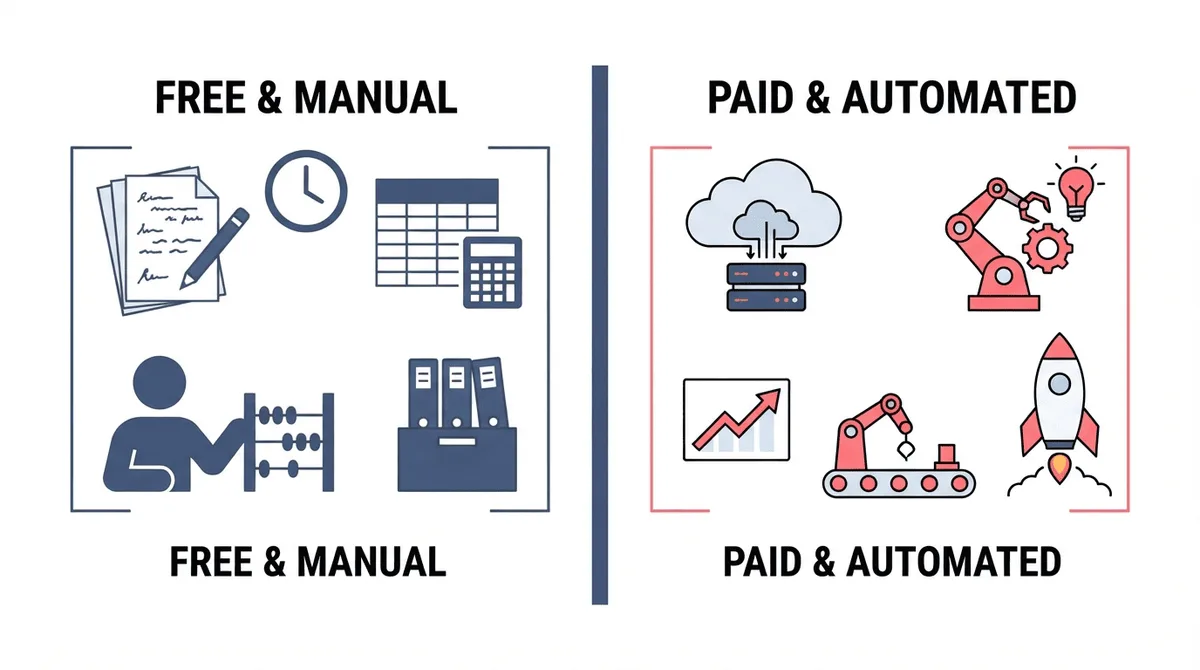
Manual tracking — maintaining a Google Sheets log of LLM query prompts and responses — is where most teams start. It requires no budget, and for early-stage brands tracking 1-2 LLMs with a small prompt set, it’s entirely sufficient.
Capability | Manual (Spreadsheet) | Entry Tool ($0-$49) | Mid-Tier ($79-$199) | Enterprise ($295+) |
LLMs tracked | 1-2 (manual) | 3-5 | 5-8 | 8+ |
Historical trend data | No | Limited | Yes | Yes (deep) |
Competitor tracking | No | Basic | Yes | Yes (advanced) |
Automated polling | No | Yes | Yes | Yes |
Client reporting | Manual export | Basic export | Dashboard/PDF | White-label/API |
Upgrade to a paid tool when: you’re tracking 3+ LLMs, managing client reporting, need historical trend data, or monitoring competitor citations.
By Organization Size
Startups and Small Businesses:
- Primary: OmniSEO (free) or Otterly.ai (affordable)
- Schema: Free generators + Google's tools
- Content: Writesonic or free Surfer tier
- Budget: $0-100/month
Mid-Market Companies:
- Primary: Surfer SEO with AI Tracker
- Schema: Rank Math or Yoast Pro
- Analytics: Semrush AI Toolkit
- Budget: $200-500/month
Enterprise Organizations:
- Primary: Conductor or Semrush Enterprise
- Content: Clearscope
- Schema: Custom implementation
- Analytics: Full Semrush or Conductor suite
- Budget: $1,000+/month
By Primary Need
If you need citation monitoring: → Surfer SEO AI Tracker, Otterly.ai, or Profound
If you need content optimization: → Clearscope, Surfer SEO Content Editor, or Writesonic
If you need schema implementation: → Rank Math (WordPress) or Schema.org generators
If you need competitive intelligence: → Semrush AI Toolkit or Conductor
If you need a free starting point: → OmniSEO, HubSpot AEO Grader, Google's tools
Integration Considerations
Consider how tools integrate with your existing stack:
If You Use | Consider Adding |
Semrush | Semrush AI Toolkit (native) |
Surfer SEO | AI Tracker add-on |
HubSpot | HubSpot AEO Grader (native) |
WordPress | Rank Math or Yoast |
Nothing yet | Start with free tools to evaluate |
Evaluation Checklist
Before purchasing any AEO tool, verify:
- Covers the AI platforms you care about (ChatGPT, Perplexity, Google AI)
- Provides actionable data, not just vanity metrics
- Integrates with your existing workflows
- Offers reasonable pricing for your scale
- Has track record and positive reviews
- Provides adequate support and documentation
- Allows trial or demo before commitment
AEO Tools Software for Agencies vs. In-House Teams: Buyer Guide
The criteria for selecting AEO tools software differ substantially depending on whether you’re managing one brand or many. Agencies and in-house teams have distinct requirements — and so do enterprise organizations with compliance needs.
For Agencies
Agency-specific criteria: multi-client dashboard management, white-label reporting, API access for custom client dashboards, per-report billing for ad-hoc deliverables, and Looker Studio connectors for Google Data Studio integration.
Top agency picks:
- Cairrot ($39/mo) — Free API on all plans enables custom dashboard builds. Agency dashboard for managing multiple client accounts. LLMS.txt generator included. Best value for agencies needing API access without enterprise pricing.
- Rank Prompt ($49/mo) — Multi-client management with schema optimization tracking. Compact pricing suitable for agencies managing SMB clients.
- Peec AI (€89/mo, ~$97 USD) — Native Looker Studio connector is the standout feature for agencies reporting via Google Data Studio. Real-time monitoring with strategy recommendations.
For in-House Teams
In-house criteria: Slack or notification integrations for real-time alerts, content workflow integration, single-brand focus with deep per-brand analytics, and total cost of ownership over a 12-month period.
Top in-house picks:
- Hall AI ($199/mo) — Slack alert integration fires when your brand appears or disappears from AI responses. Heatmap visualization helps prioritize which prompt clusters to optimize.
- Conductor (custom pricing) — End-to-end platform covering content creation, optimization, and AI visibility tracking. MCP server integration for enterprise workflow automation.
- SE Ranking AI Toolkit ($89/mo) — Combines SEO and AEO tracking, making it the most cost-efficient option for in-house teams managing both disciplines.
For Enterprise
Enterprise criteria: SOC 2 Type II compliance, dedicated customer success management, MCP server integration, and support for large prompt portfolios.
Top enterprise picks:
- AthenaHQ ($295/mo) — Built by ex-Google and DeepMind engineers. The ACE (AI Citation Engine) proprietary citation analysis identifies the specific content signals that drive LLM citation. SOC 2 compliant.
- Scrunch AI ($300-500/mo) — SOC 2 Type II certified. The AXP (AI Experience Platform) handles enterprise-scale multi-client and multi-brand workflows.
Summary Table
This table summarizes AEO tools software recommendations by use case, team type, and key selection criteria.
Use Case | Recommended Tools | Key Criteria |
Agency (SMB clients) | Cairrot, Rank Prompt, Peec AI | Multi-client, API, Looker Studio |
In-house team | Hall AI, SE Ranking, Conductor | Slack alerts, workflow integration |
Enterprise | AthenaHQ, Scrunch AI, Conductor | SOC 2, MCP server, deep analytics |
Core Tool Categories
AEO tools software spans four core categories: AI visibility monitoring, content optimization, schema and technical AEO, and analytics and reporting. Most organizations need tools across all four categories for complete coverage.
Building Your AEO Tools Software Stack
A complete AEO capability requires tools across multiple categories. Here’s how to build your stack incrementally, similar to a complete AEO optimization tutorial. For discovering additional AEO platforms, LLMrefs.com maintains a directory of 200+ indexed AEO tools software — a useful reference when evaluating options beyond this guide.
Need expert help selecting and implementing the right AEO tools software for your stack? Stackmatix AEO services combine best-in-class tools with hands-on implementation, helping venture-backed startups achieve measurable AI citation growth.
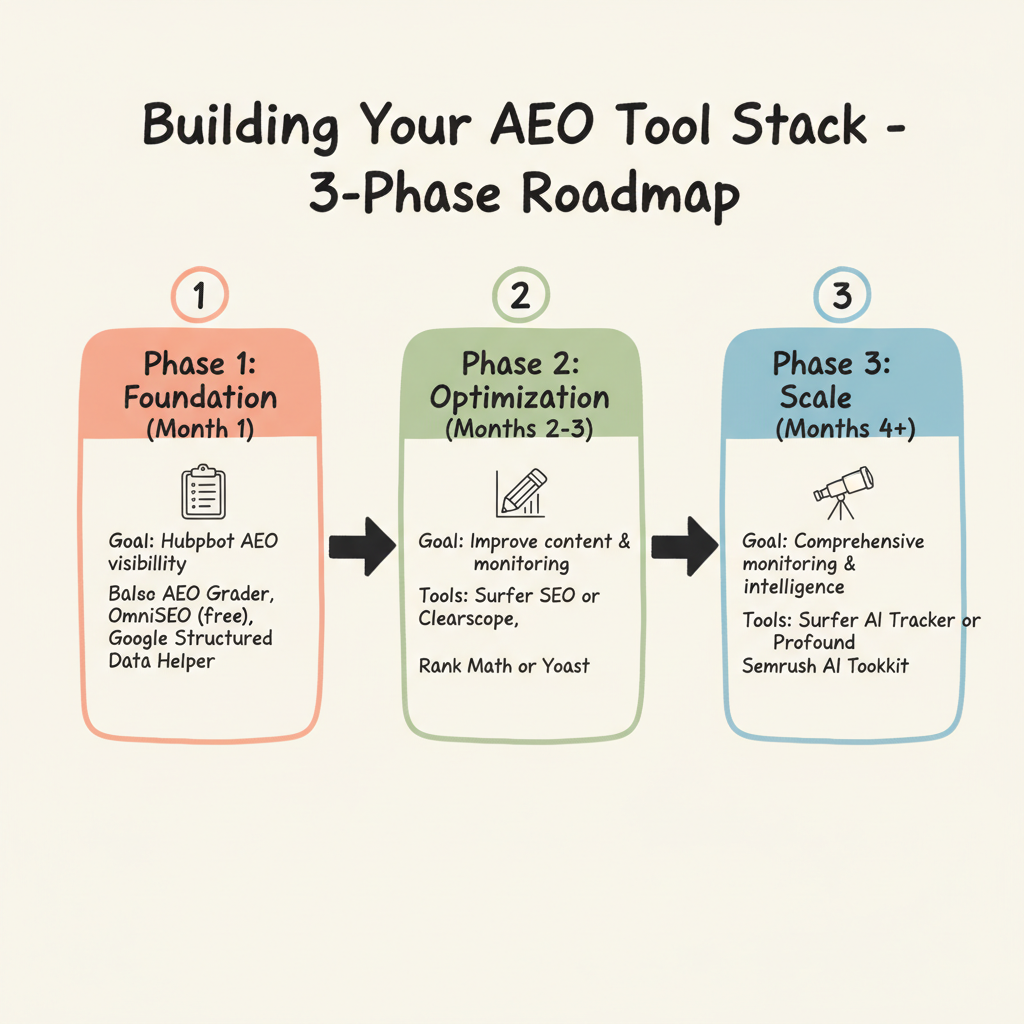
Phase 1: Foundation (Month 1)
Start with free AEO tools software to establish your baseline measurement and foundational optimization.
- Free AEO checker: HubSpot AEO Grader
- Basic monitoring: OmniSEO free tier
- Schema validation: Google Rich Results Test
Goal: Establish baseline visibility and implement basic optimization.
Tools:
- Free assessment: HubSpot AEO Grader
- Basic monitoring: OmniSEO (free tier)
- Schema: Google Structured Data Markup Helper
Actions:
- Run initial AEO assessment
- Set up basic citation monitoring
- Implement FAQ and Article schema on key pages
Phase 2: Optimization (Months 2-3)
Goal: Improve content and begin systematic monitoring.
Tools (add to Phase 1):
- Content optimization: Surfer SEO or Clearscope
- Enhanced schema: Rank Math or Yoast
Actions:
- Optimize top 10-20 pages for AI extraction
- Expand schema coverage site-wide
- Track citation improvements
Phase 3: Scale (Months 4+)
Goal: Comprehensive monitoring and competitive analysis.
Tools (add to Phase 2):
- Advanced monitoring: Surfer AI Tracker or Profound
- Competitive intel: Semrush AI Toolkit
Actions:
- Monitor full keyword portfolio
- Track competitive positioning
- Report on AEO ROI
Organizations that invest in AEO tools software report 2-3x improvement in AI citation rates within 90 days of implementing structured data and direct-answer content formats.
FAQs
Common questions about AEO tools software, pricing, and implementation for marketing teams and agencies.
Which AEO Tools Software Is Best for Beginners?
Start with free tools: HubSpot AEO Grader for assessment, OmniSEO for basic monitoring, and Google's structured data tools for schema. These provide foundational capabilities without cost while you learn what features matter most for your needs.
Do I Need Separate Tools for AEO and Traditional SEO?
Not necessarily. Many SEO platforms (Semrush, Surfer SEO, Conductor) have added AEO features. If you’re already using one of these platforms, start by exploring their AI capabilities before adding specialized AEO tools software. Understanding ChatGPT SEO integration can help maximize existing tool investments.
How Much Should I Budget for AEO Tools Software?
Startups can start with $0-100/month using free and entry-level tools. Mid-market companies typically spend $200-500/month for comprehensive capabilities. Enterprise organizations may invest $1,000+/month for full-featured platforms with support.
Can I Track AI Citations Without Paid Tools?
Yes, but it’s time-intensive. You can manually query ChatGPT, Perplexity, and Google AI for your target keywords and document citations in a spreadsheet. Free tools like OmniSEO can automate some of this, but paid tools provide more comprehensive coverage and alerting.
How Often Should I Check AEO Tool Data?
Weekly monitoring works for most organizations. Set up automated alerts for significant changes so you don’t miss important shifts. Monthly reporting provides the right cadence for stakeholder communication.
What Is an AEO Checker?
An AEO checker is a tool that audits your website’s readiness to appear in AI-generated answers. It evaluates signals like structured data implementation, FAQ schema, content clarity, and E-E-A-T factors. Free options include HubSpot’s AEO Grader and ProductRank.ai; paid checkers like Gumshoe AI offer per-report persona-based audits.
What AEO Tools Software Is Free?
Several AEO tools software options offer free tiers. HubSpot AEO Grader audits AI readiness for free. Ahrefs Brand Radar has a free tier. ProductRank.ai provides free brand visibility checks across major LLMs.
Several AEO tools software options offer free tiers or free standalone checks. HubSpot AEO Grader is fully free and audits your content’s AI readiness. Ahrefs Brand Radar has a free tier for AI crawler traffic monitoring. ProductRank.ai provides free brand visibility checks across major LLMs. Gumshoe AI offers free first reports with pay-per-report pricing thereafter.
Is AEO the Same as GEO (Generative Engine Optimization)?
AEO and GEO are closely related: AEO targets all answer-capable platforms including voice assistants; GEO focuses specifically on generative AI systems like ChatGPT and Perplexity.
AEO (Answer Engine Optimization) and GEO (Generative Engine Optimization) are closely related but differ in scope. AEO focuses on appearing in structured AI answers across all answer-capable platforms — including voice assistants and traditional featured snippets. GEO specifically targets generative AI systems like ChatGPT, Perplexity, and Google’s AI Overviews. Most tools marketed as AEO tools software in 2026 cover both disciplines; some platforms explicitly combine both under AEO/GEO software.
How Do I Track AI Citations in Google Analytics?
Track AI referral traffic in GA4 by monitoring source domains like perplexity.ai and chat.openai.com. Tools like SE Ranking AI Search Toolkit automate this attribution automatically.
AI referral traffic from platforms like Perplexity and ChatGPT can be tracked in GA4 by monitoring referral source domains (e.g., perplexity.ai, chat.openai.com). Tools like SE Ranking AI Search Toolkit and Peec AI automate this attribution. For manual tracking, create a custom GA4 segment filtering sessions where the source matches known AI platform domains and monitor trends monthly.
What AEO Tool Is Best for Agencies?
Agencies should prioritize AEO tools software with multi-client dashboards, white-label reporting, and API access. Top picks: Cairrot, Rank Prompt, and Peec AI.
Agencies managing multiple clients should prioritize tools with multi-client dashboards, white-label reporting, and API access. Top picks include Cairrot ($39/mo, free API on all plans, LLMS.txt generator), Rank Prompt ($49/mo, schema optimization, multi-client management), and Peec AI (€89/mo, Looker Studio connector, strategy recommendations). For larger agency operations, Scrunch AI’s AXP platform supports enterprise-scale multi-client workflows.