
Build internal expertise in Answer Engine Optimization to future-proof your marketing team's capabilities.
The rise of AI-powered search has created a critical skills gap in marketing departments worldwide. While traditional SEO expertise remains valuable, the unique demands of Answer Engine Optimization require specialized training that most teams lack. Organizations that invest in AEO training now position themselves to capture visibility across ChatGPT, Perplexity, Google AI Overviews, and emerging AI platforms.
AEO Training Programs
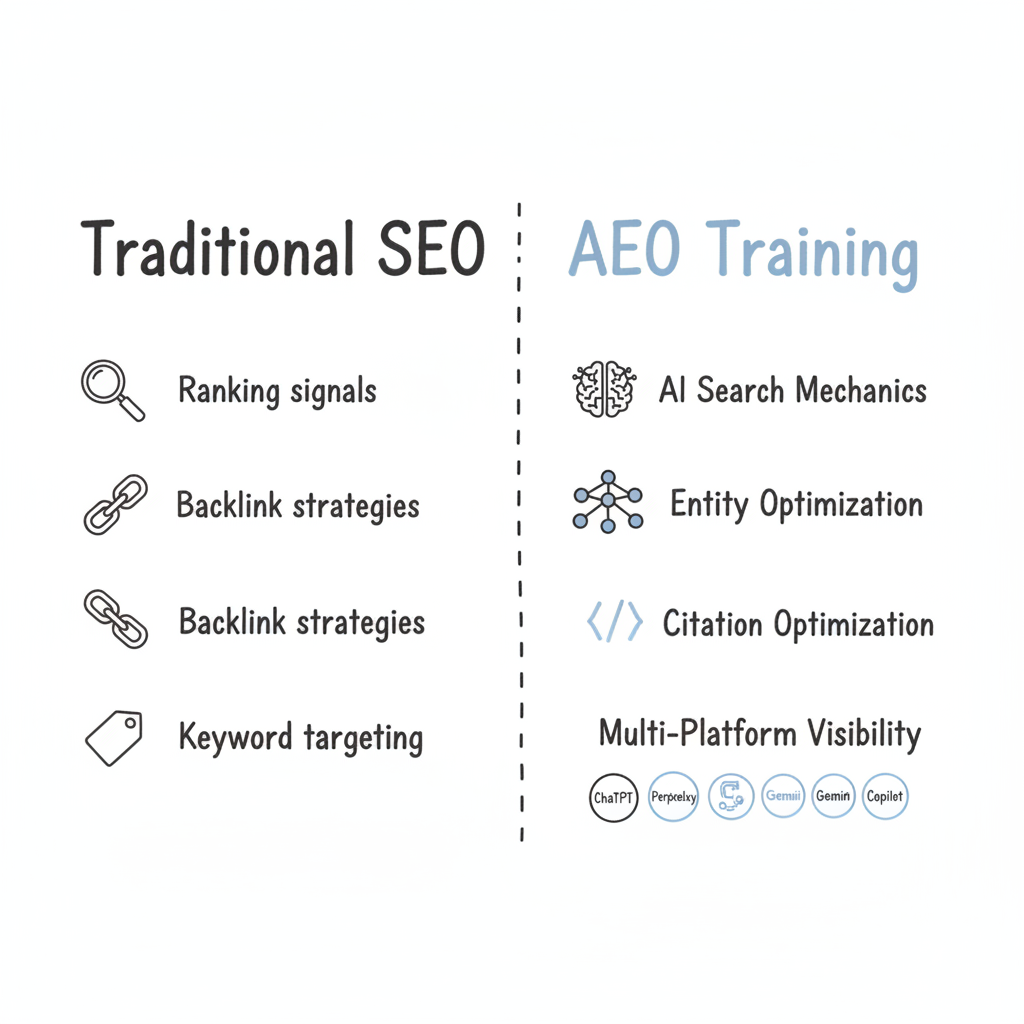
Effective AEO training programs differ fundamentally from traditional SEO courses. Where SEO focuses on ranking signals and backlink strategies, AEO training emphasizes content structure, entity optimization, and citation-worthy formatting that AI systems prefer.
With over 60% of searches now resulting in zero-click outcomes, and AI Overviews appearing at the top of an increasing share of queries, teams that lack AEO skills risk losing organic visibility entirely. This zero-click trend makes AEO training not a nice-to-have but a competitive necessity for any team managing organic search performance.
Core AEO training components include:
- AI search mechanics - Understanding how large language models retrieve and synthesize information
- Entity optimization - Building topical authority through comprehensive entity coverage
- Structured data implementation - Schema markup strategies that enhance AI comprehension
- Citation optimization - Creating content formats that AI engines prefer to reference
- Multi-platform visibility - Optimizing for ChatGPT, Perplexity, Gemini, and Copilot simultaneously
According to industry research, organizations with trained AEO specialists see measurably higher AI citation rates compared to those relying solely on traditional SEO approaches. The training investment pays dividends as AI search continues capturing market share from traditional search engines.
AEO vs. GEO: What Your Training Should Cover
As AI search matures, two distinct but overlapping disciplines have emerged: Answer Engine Optimization (AEO) and Generative Engine Optimization (GEO). While AEO focuses on positioning your content as the direct answer to user queries, GEO is the practice of being cited as a source in AI-generated responses. Understanding the distinction is critical when selecting a training program for your team.
Top training programs from providers like CXL, Jellyfish, and Coursera now cover both disciplines, recognizing that comprehensive AI search visibility requires competency in each. The key difference lies in curriculum emphasis: GEO training prioritizes citation signals, brand mentions, and co-occurrence optimization, while AEO training centers on content structure and entity coverage.
The urgency behind mastering both is clear. The zero-click search trend continues accelerating, with over 60% of Google searches now ending without a click to an external site. Meanwhile, Deep Research capabilities in newer LLMs are changing how content is surfaced and synthesized, making it essential for teams to understand both how to be the answer (AEO) and how to be the cited source (GEO). For a detailed breakdown, see the full AEO vs GEO vs SEO comparison.
How AI Search Engines Select Answers: What Trainees Must Understand
Effective AEO training must go beyond surface-level tactics and ground learners in the mechanics of how AI search engines actually select and present answers. At the core of modern AI search is Retrieval Augmented Generation (RAG), a process where large language models first retrieve relevant documents from an index, then generate answers by synthesizing those sources.
Trainees should understand query fan-out, the technique AI search engines use to issue multiple sub-queries simultaneously, gathering comprehensive information across different facets of a topic before generating a unified response. This explains why thorough, entity-rich content outperforms thin pages in AI search results.
On the technical retrieval side, AI engines use vector embeddings to represent content as numerical arrays and cosine similarity to match queries against stored content. While teams do not need to build these systems, understanding the matching mechanism helps them write content that aligns closely with target query intent.
A critical ranking signal in AI search is information gain -- the degree to which a piece of content adds unique value beyond what other sources provide. Training programs should teach teams to audit their content for originality and differentiated insights rather than simply restating widely available information.
Teams should also be aware of AI hallucinations and the importance of brand monitoring for AI-generated misinformation. As AI engines sometimes fabricate or misattribute information, organizations need processes for detecting and correcting inaccurate AI-generated references to their brand. Emerging technical implementations like LLMs.txt and structured markdown files offer ways to signal AI-friendliness and improve content discoverability by large language models. To build on these concepts, review the full AEO strategy framework for practical application guidance.
Workshop Formats
AEO workshops can be delivered through multiple formats depending on team size, budget, and learning objectives. When planning your training program, consider reviewing AEO services packages to understand which format aligns with your organizational needs.
Intensive Boot Camps
Two to three-day immersive sessions covering AEO fundamentals through advanced implementation. Boot camps work best for teams needing rapid skill development before major content initiatives.
Modular Training Series
Weekly sessions spread across four to eight weeks, allowing teams to implement learnings between modules. This format supports knowledge retention while enabling real-world application of concepts.
Executive Briefings
Half-day sessions designed for marketing leadership, focusing on strategic implications of AI search rather than tactical implementation. Executive briefings help align organizational priorities with AEO opportunities.
Hands-On Workshops
Interactive sessions where teams work on actual company content, receiving real-time feedback on AEO optimization techniques. According to training effectiveness studies, hands-on workshops produce higher skill retention than lecture-based formats.
Top AEO Courses and Training Platforms Compared
The AEO training landscape has expanded significantly, with multiple platforms now offering dedicated courses. Here is a comparison of the leading options to help your team select the right program:
Platform | Course | Price | Format |
Jellyfish | From SEO to AEO | $549 | Self-paced |
UCSC Extension | Search and AI Engine Optimization | $700 | University-accredited |
Maven | AEO Masterclass by Mostafa ElBermawy (NoGood) | Varies | Cohort-based |
Coursera | Mastering Generative Engine Optimization (GEO) | Subscription | Self-paced |
CXL Institute | AI SEO courses | Subscription | Practitioner-level |
Udemy | AEO Mastery | $20-50 | Self-paced |
Webflow University | AEO course | Free | Self-paced |
The Jellyfish course stands out for its comprehensive coverage of RAG mechanics, query fan-out, LLMs.txt implementation, semantic markup, and multi-modal content optimization. For teams seeking university credentials, the UCSC Extension program provides accredited training spanning SEO, SEM, and AEO disciplines. The Coursera GEO course is a strong choice for teams prioritizing generative engine optimization course guide content and AI citation strategy.
For budget-conscious learners, free options like Webflow University and Yoast Academy provide solid introductory foundations, while Udemy offers affordable self-paced alternatives. Many courses cover essential tools including Ubersuggest, SE Ranking, Yoast, Google Analytics, and Google Business Profile integration.
Recognized AEO thought leaders like Steve Toth and Neil Patel (NP Digital) also produce supplementary content that complements formal coursework. Their insights on emerging AEO certification programs compared help teams stay current between formal training cycles.
Training Curriculum
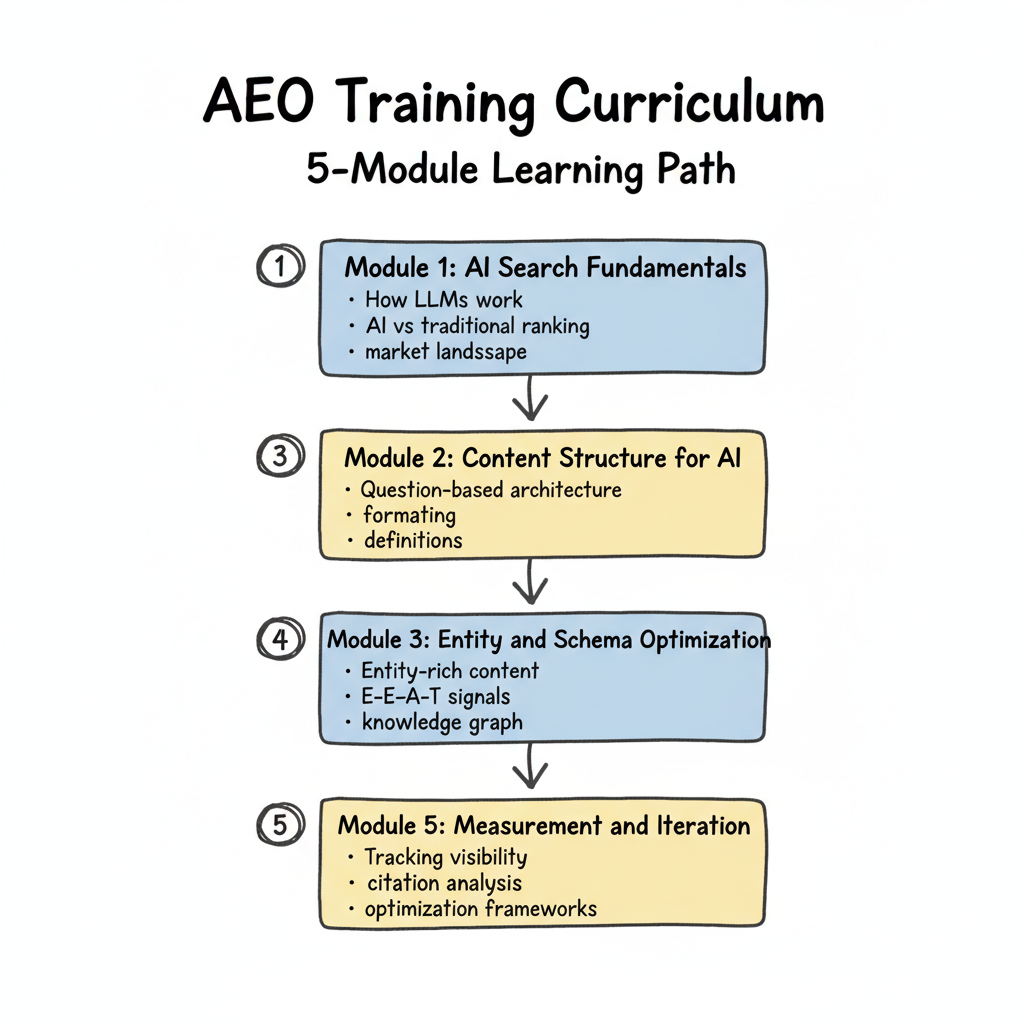
A comprehensive AEO curriculum should progress from foundational concepts to advanced implementation:
Module 1: AI Search Fundamentals
- How LLMs process and retrieve information
- Differences between traditional and AI search ranking factors
- Current AI search market landscape and growth projections
- Retrieval Augmented Generation (RAG) and how AI engines retrieve, rank, and synthesize source material
- Understanding AI hallucinations and strategies for monitoring and correcting brand misinformation in AI-generated responses
Module 2: Content Structure for AI
- Question-based content architecture
- Optimal content formatting for AI extraction
- The role of definitions, lists, and structured explanations
Module 3: Entity and Schema Optimization
- Building entity-rich content
- Implementing schema markup for enhanced AI visibility
- Knowledge graph optimization strategies
- Implementing LLMs.txt and structured markdown files to signal AI-friendliness and improve content discoverability by large language models
Module 4: Citation Building
- Creating citation-worthy content assets
- E-E-A-T signals that AI systems recognize
- Authority building across AI platforms
Module 5: Measurement and Iteration
- Tracking AI search visibility
- Analyzing citation patterns and sources
- Continuous optimization frameworks
Voice Search and Multi-Modal AEO Skills
Training programs increasingly include voice search optimization as an essential AEO competency. Voice queries tend to be longer and more conversational, requiring content structured around natural language patterns. Multi-modal content -- including video, images, and audio -- is weighted differently by AI engines, and teams should understand how to optimize across formats.
Featured Snippets and People Also Ask boxes remain high-value surfaces where AEO-optimized content appears prominently. Training should also cover NAP (Name, Address, Phone) optimization for local AEO applications and Google Business Profile integration, ensuring teams can execute across both national and local AI search contexts.
Research from SEO training providers indicates that structured curricula with progressive skill-building produce stronger outcomes than ad-hoc training approaches. Organizations looking for practical tools to support their training efforts can explore best AEO tools reviews to identify platforms that complement educational programs. For a hands-on companion to measurement training, use the AEO optimization checklist as a practical reference during Module 5 exercises.
Team Certification
Certification programs validate AEO competencies and create standardized skill benchmarks within organizations:
Internal Certification Benefits:
- Establishes clear competency standards across team members
- Creates accountability for ongoing skill development
- Provides career development pathways for marketing professionals
- Enables skills-based project assignments
Certification Assessment Components:
- Written examinations on AEO principles and best practices
- Practical projects demonstrating implementation capabilities
- Portfolio reviews of optimized content samples
- Ongoing continuing education requirements
Organizations implementing certification programs report more consistent content quality and clearer skills development trajectories for team members. Consider partnering with recognized SEO certification bodies to add external validation to internal programs.
Several external certification paths complement internal programs effectively. CXL Institute offers practitioner certifications in AI SEO, while platforms like Coursera and Udemy provide completion certificates that validate foundational AEO knowledge. For teams seeking recognized credentials, the Jellyfish AEO certification and Maven cohort completions carry industry weight. Pair internal benchmarks with these external validations to create a comprehensive credentialing framework.
Custom Training Options
Off-the-shelf AEO training rarely addresses industry-specific challenges or organizational content systems. Custom training options include:
Industry-Specific Modules Training tailored to vertical-specific content types, competitive landscapes, and audience search behaviors. Healthcare, finance, technology, and e-commerce each present unique AEO optimization challenges.
Platform Integration Training Sessions focused on implementing AEO within existing content management systems, marketing automation platforms, and analytics tools. Custom integrations reduce friction between training and implementation.
Competitive Analysis Workshops Deep-dive sessions analyzing competitor AEO performance and identifying differentiation opportunities. These workshops produce actionable gap analyses alongside skill development.
Content Audit Training Hands-on sessions teaching teams to evaluate existing content libraries for AEO optimization opportunities. Audit training accelerates the transition from learning to implementation.
Training Pricing
AEO training investments vary based on format, customization level, and team size:
Training Format | Typical Investment | Best For |
Free online courses (Webflow University, Yoast Academy) | $0 | Individual learners, introductory level |
Self-paced online courses | $200-500 per person | Individual skill development |
University/accredited programs (UCSC Extension, Coursera) | $500-$700 per person | Career development, formal credentials |
Group workshops (1-2 days) | $3,000-8,000 total | Small teams, foundational training |
Intensive boot camps | $5,000-15,000 total | Rapid skill development needs |
Custom enterprise programs | $15,000-50,000+ | Large teams, specialized requirements |
Ongoing coaching retainers | $2,000-5,000 monthly | Continuous improvement programs |
When evaluating training ROI, consider using an AEO ROI calculator to quantify the opportunity cost of delayed AEO implementation. Organizations that train teams earlier capture AI search visibility while competitors remain focused on traditional SEO alone.
Knowledge Transfer Guarantee
Effective training programs should include knowledge transfer guarantees ensuring skills translate to organizational capability:
Post-Training Support Elements:
- 30-60 day follow-up sessions addressing implementation questions
- Access to trainer support channels for ongoing guidance
- Template libraries and resource documentation
- Refresher training options as AI search evolves
Measuring Knowledge Transfer Success:
- Pre and post-training competency assessments
- Content quality metrics before and after implementation
- AI search visibility tracking over time
- Team confidence surveys on AEO implementation
The goal of AEO training extends beyond individual skill development to building sustainable organizational capability. Knowledge transfer guarantees ensure training investments produce lasting competitive advantages rather than temporary skill bumps. Teams can accelerate this process by utilizing AEO content templates during the implementation phase.
Building Your AEO Training Roadmap
Start with an honest assessment of current team capabilities against AEO requirements. Identify skill gaps, prioritize training modules accordingly, and establish clear success metrics before beginning any program.
For organizations seeking comprehensive AEO training solutions, consider partnering with agencies that offer both strategic consultation and hands-on skill development. The combination of external expertise and internal capability building creates sustainable competitive advantages as AI search continues transforming digital marketing.
Frequently Asked Questions About AEO Training
What Does AEO Stand For?
AEO stands for Answer Engine Optimization. It refers to the practice of optimizing content so that AI-powered search engines like ChatGPT, Perplexity, Google AI Overviews, and Gemini select it as a direct answer or cited source. AEO differs from traditional SEO by focusing on entity coverage, structured data, and citation-worthy content formatting rather than backlinks and keyword density.
Is AEO Replacing SEO?
AEO is not replacing SEO but expanding it. Traditional SEO skills like technical optimization, content quality, and site architecture remain essential. AEO adds a layer focused on how AI systems retrieve and present information. The most effective teams train in both disciplines. With over 60% of searches now ending in zero-click results and AI Overviews appearing on more queries, AEO competency is becoming a necessary complement to existing SEO expertise rather than a replacement.
How to Learn AEO?
Start with free resources like Webflow University and Neil Patel's AEO guides to build foundational knowledge. For structured learning, platforms like Jellyfish ($549), UCSC Extension ($700), and Coursera offer accredited courses covering RAG mechanics, entity optimization, and AI search strategy. Budget-friendly options on Udemy provide self-paced alternatives. For teams, consider group workshops or boot camps that include hands-on practice with real content. Supplement formal training with tools like Ubersuggest and SE Ranking for practical application.
Is AEO Worth It?
AEO training delivers measurable ROI as AI search captures an increasing share of information queries. Organizations with trained AEO specialists report higher citation rates across ChatGPT, Perplexity, and AI Overviews. The investment is especially worthwhile given that AEO skills are scarce -- most marketing teams still lack AI search competency, creating a competitive window for early adopters. Use an AEO ROI calculator to quantify the opportunity cost of delayed investment. For guidance on tracking AEO performance, see the AEO analytics setup guide.