
Digital marketing has expanded beyond traditional channels. Answer Engine Optimization (AEO) represents a fundamental shift in how brands reach audiences - optimizing for AI-powered systems that provide direct answers rather than link lists. Understanding how AEO differs from traditional digital marketing helps you allocate resources effectively and stay visible across all discovery channels.
Traditional Digital Marketing Channels
Traditional digital marketing encompasses established channels that have driven online growth for decades.
Search Engine Optimization (SEO) focuses on ranking web pages in search engine results. Success is measured by position, traffic, and conversions from organic search. SEO targets users who browse search result pages and click through to websites.
Pay-Per-Click Advertising (PPC) delivers immediate visibility through paid placements on search engines and display networks. Advertisers pay for each click, with costs varying by keyword competition and targeting parameters.
Social Media Marketing builds brand presence across platforms like LinkedIn, Facebook, Instagram, and TikTok. Organic social builds community while paid social enables precise audience targeting.
Email Marketing nurtures leads and customers through direct communication. Permission-based email lists remain valuable owned media assets with predictable reach.
Content Marketing creates valuable content that attracts and engages target audiences. Blogs, videos, podcasts, and downloadable resources support other channels while building thought leadership.
These channels share common characteristics: they drive traffic to your properties, support measurable conversion paths, and require ongoing investment to maintain visibility.
How AEO Differs from Traditional Channels
AEO optimizes for a different discovery mechanism entirely. Rather than driving users to click through to your site, AEO ensures AI systems cite your brand when generating answers to user queries.
Different User Behaviors
Traditional digital marketing targets users who browse, click, and evaluate options. They see search results, ad placements, or social posts and choose what to engage with.
AEO targets users who ask AI assistants questions and expect synthesized answers. These users may never see a list of options - they receive direct recommendations. Research shows 44% of AI search users now rely on AI as their primary information source.
Different Success Metrics
Traditional channels measure success through clicks, traffic, conversions, and revenue attribution. You know exactly how many people visited your site from each source.
AEO success is measured by citation frequency, brand mentions, and recommendation context. Did the AI system recommend your brand? Was it the primary suggestion or mentioned among alternatives? These metrics require different tracking approaches, and ab-testing-for-ai-search-optimization helps refine strategies based on which content variations perform best.
Different Optimization Approaches
Traditional SEO optimizes pages for rankings using keywords, backlinks, and technical factors. The goal is appearing in result listings.
AEO optimizes content for extraction and citation. This means structuring information so AI systems can cleanly quote and attribute your content when generating responses. Question-answer formats, direct statements, and clear expertise signals matter more than keyword density. Implementing platform-specific-content-strategies-format-structure ensures your content meets the unique requirements of different AI systems.
Key Comparison: AEO vs Traditional Digital Marketing
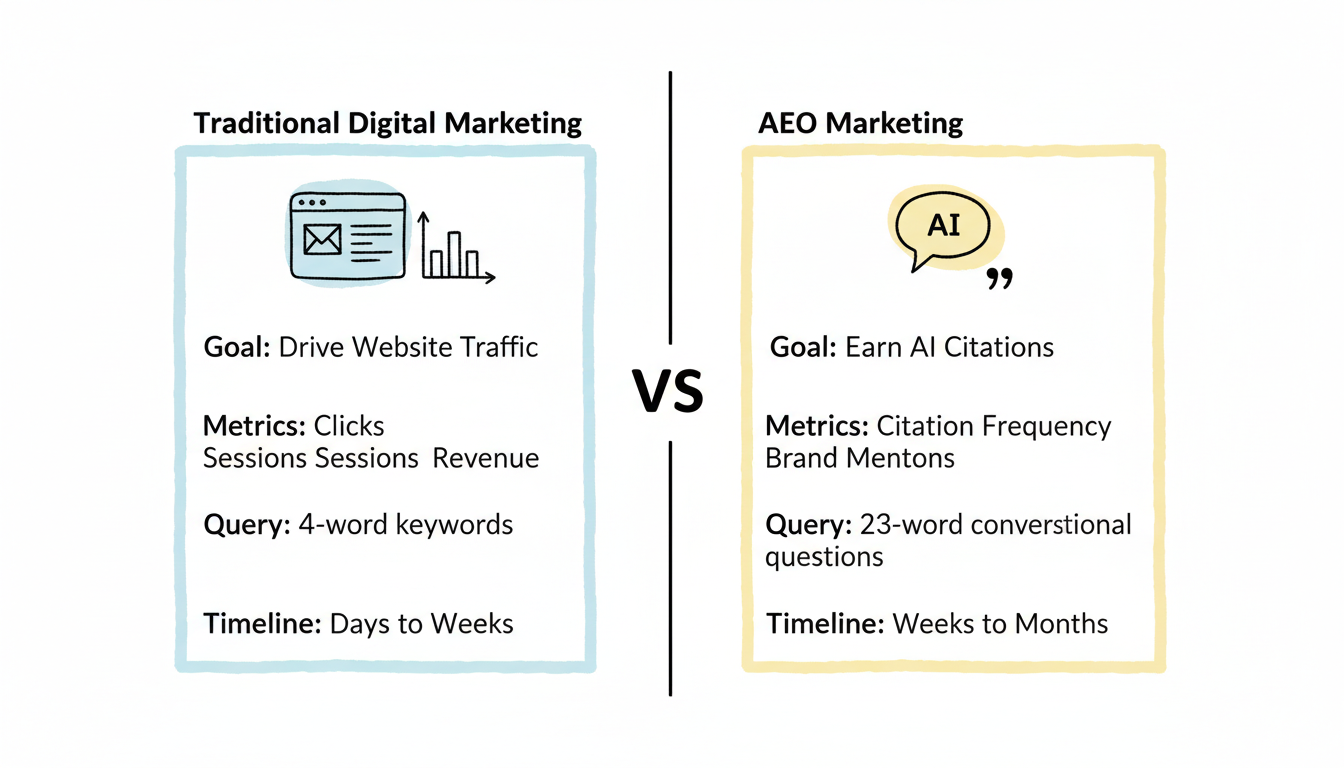
Factor | Traditional Digital Marketing | AEO Marketing |
Primary Goal | Drive traffic to website | Earn AI citations and recommendations |
User Interaction | Click-based engagement | Zero-click AI responses |
Success Metrics | Traffic, conversions, revenue | Citation frequency, brand mentions |
Content Format | Comprehensive pages for browsing | Extractable segments for AI citation |
Query Types | Keyword phrases (4 words average) | Conversational questions (23 words average) |
Measurement Tools | Mature analytics (GA4, Search Console) | Emerging platforms (Scrunch, Otterly) |
Results Timeline | Days to weeks for changes | Weeks to months for AI training cycles |
Does AEO Replace Traditional Marketing?
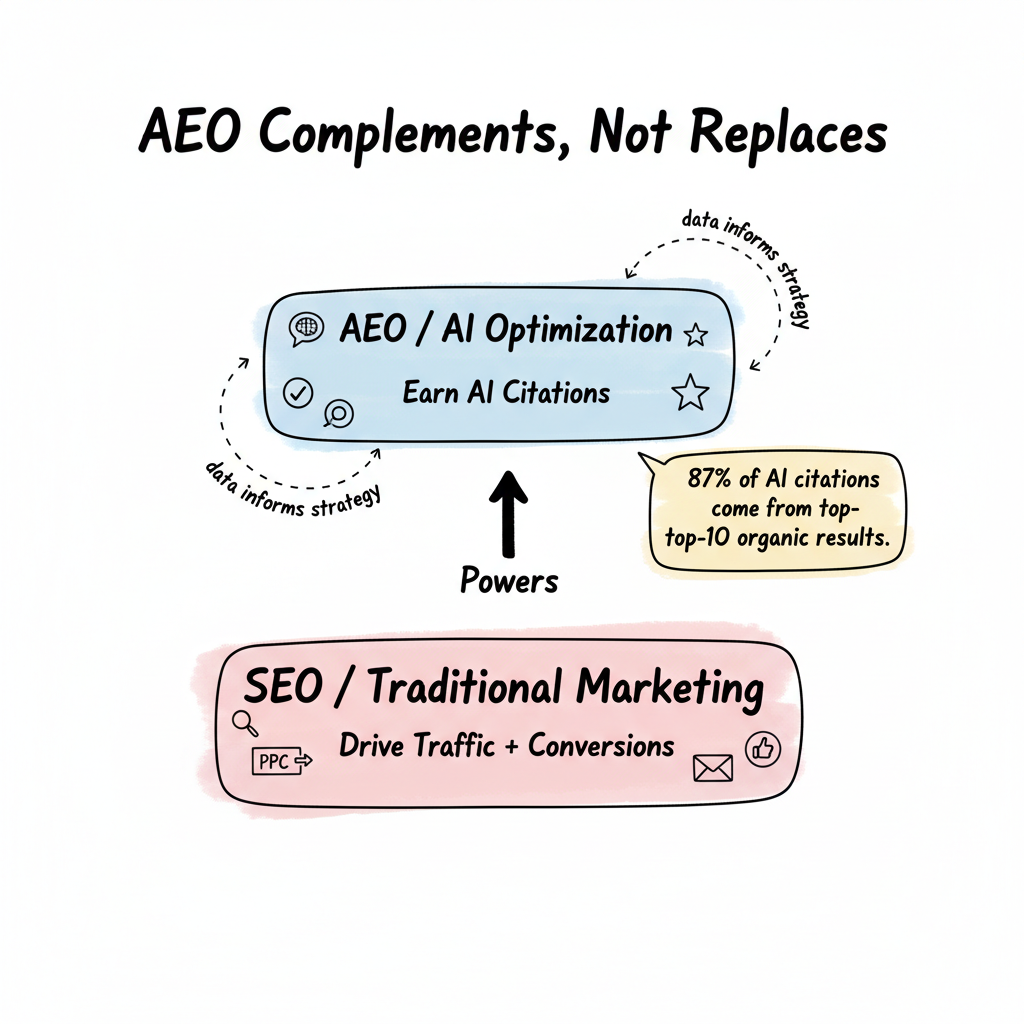
AEO complements rather than replaces traditional digital marketing. Each serves different user behaviors that will coexist.
Why traditional channels remain essential:
- E-commerce requires users on your site to complete purchases
- Lead generation needs form submissions and contact information
- Not all users have adopted AI assistants for research
- AI systems often cite content that performs well in traditional search
Research indicates 87% of AI citations come from content ranking in organic search positions 1-10. Strong traditional SEO foundations directly support AEO success.
Why AEO has become essential:
- ChatGPT has over 400 million weekly active users
- AI assistants handle an increasing share of informational queries
- Users trust AI recommendations as implicit endorsements
- Early AEO investment creates competitive advantages before markets saturate
The brands performing best in 2026 integrate both approaches rather than choosing between them. Understanding the aeo-optimization-timeline helps set realistic expectations for when results will materialize.
Budget Allocation Considerations
How much to invest in AEO versus traditional channels depends on your business model and audience.
Invest more in traditional channels when:
- Your business requires website conversions
- Your audience primarily uses traditional search
- You have strong existing rankings to maintain
- Measurement precision and attribution matter most
Invest more in AEO when:
- Brand awareness and trust drive long sales cycles
- Your audience has adopted AI research tools
- You compete in crowded markets where traditional rankings are difficult
- Complex products benefit from AI recommendations
A balanced approach typically allocates 70-80% to traditional channels with proven ROI while dedicating 20-30% to AEO for emerging visibility. As AI adoption grows, this balance will shift. For enterprises evaluating costs, reviewing enterprise-ai-search-pricing provides insight into investment levels at scale.
Integration Strategies
The most effective strategies connect AEO and traditional marketing.
Content serves both channels. Well-structured content with clear answers, expert attribution, and comprehensive coverage performs well for traditional SEO and earns AI citations.
Authority building compounds. Backlinks, brand mentions, and thought leadership strengthen both traditional domain authority and AI trust signals.
Data informs strategy. Traditional analytics reveal what topics and content types resonate with your audience. Apply those insights to AEO-focused content.
Technical foundations support both. Fast, crawlable, well-structured sites serve both search engine crawlers and AI systems analyzing your content.
How to Pilot AEO Beside Existing Channels
Do not rip budget from channels that work to fund a test you cannot measure. Run AEO as a small parallel program on the pages that already perform, and watch whether citation presence moves assisted conversions. A pilot with a fixed query list and a control gives you a real read instead of a guess.
Keep the pilot time-boxed. Thirty to ninety days is enough to see whether answers are being earned and whether they correlate with downstream interest. A bounded test protects the rest of the plan while you learn, and it ends with a decision rather than an open-ended experiment.
Skills Your Team Needs for AEO
AEO reuses writing and analytics but adds a new lens: structuring content so a model can extract it. The team needs someone who thinks in questions and schema, not just in keywords and links. That skill is teachable from within if the content and SEO people already own the pages.
The missing piece in most teams is the measurement habit. Checking citation presence manually on a set list is cheap but rarely done, so assigning that task explicitly is often the difference between an AEO program and a pile of optimized posts nobody verifies. Name the owner and the cadence.
Common Misconceptions to Avoid
The biggest misconception is that AEO replaces paid and organic channels. It does not; it adds a discovery moment those channels do not cover, the generated answer. Treating it as a replacement leads to cutting spend that still drives clicks, which hurts more than it helps.
The second is that AEO is pure technical markup. Schema helps, but the deciding factor is whether the page answers the question clearly and with evidence a model can trust. Over-investing in tags while the writing stays thin produces markup around content no system will cite.
FAQs
Is AEO Only for Large Brands?
No. AI systems cite content based on quality and relevance, not brand size alone. Small brands with excellent, authoritative content in specific niches can earn citations even against larger competitors.
Should I Stop Investing in PPC If I Focus on AEO?
No. PPC delivers immediate, controllable results while AEO builds over time. Most businesses need both - PPC for predictable lead generation and AEO for emerging discovery channels.
How Do I Measure AEO ROI Compared to Traditional Marketing?
AEO ROI is harder to measure directly. Track citation frequency using specialized tools, monitor brand search volume increases, and watch for AI-referred traffic in analytics. Correlate these signals with business outcomes over time.