
AEO gets you cited as the direct answer. GEO gets you woven into AI-generated narratives. Both matter in 2026—but they solve different problems and require different tactics.
Answer Engine Optimization (AEO) focuses on providing the single best answer AI systems extract and quote. Generative Engine Optimization (GEO) focuses on building the authority that makes AI systems include you when they synthesize comprehensive responses.
Understanding when to prioritize each—and how to make them work together—determines your AI search visibility strategy.
What Is Answer Engine Optimization (AEO)?
AEO is the practice of structuring content so AI platforms can extract and cite it as a direct answer. When someone asks a specific question, AEO-optimized content provides the quotable response.
AEO targets deterministic queries: Questions with definitive answers that AI systems resolve with a single response. "How much does X cost?" "What is the difference between Y and Z?" These queries have right answers, and AEO positions you as the source.
Key AEO characteristics:
- Short, precise content: Answers within 50-150 words
- Highly structured formatting: FAQs, definitions, lists, tables
- Query-matching headers: Headlines that mirror how users ask questions
- Snippet-ready blocks: Self-contained answers that stand alone
- Schema markup: FAQ and HowTo structured data for explicit machine parsing
Where AEO works best:
- Featured snippets and position zero
- Voice assistant responses (Siri, Alexa, Google Assistant)
- Google AI Overviews for simple queries
- Perplexity answers for direct questions
Companies with established AEO strategy frameworks see significantly higher conversion rates from answer engine referrals compared to traditional search traffic, according to internal benchmarks. The ROI comes from being the trusted answer at the exact moment users need information.
What Is Generative Engine Optimization (GEO)?
GEO is the practice of building the authority and content depth that makes generative AI systems reference your brand when constructing comprehensive responses. GEO focuses on influence during synthesis, not just citation.
GEO targets exploratory queries: Research questions, comparison requests, and strategic questions where AI systems pull from multiple sources to build answers. "What's the best approach for X?" "How do I improve Y?" These queries require synthesized insight.
Key GEO characteristics:
- Long-form, comprehensive content: Deep coverage that AI can draw from
- Topical authority clusters: Multiple interconnected pages demonstrating expertise
- E-E-A-T signals: Demonstrated experience, expertise, authoritativeness, trustworthiness
- Brand entity consistency: Uniform identity across web properties
- Contextual depth: Content that supports interpretation and reuse
Where GEO works best:
- ChatGPT browsing responses
- Claude extended answers
- Perplexity research queries
- Google AI Overviews for complex topics
- Any AI-generated summary that synthesizes multiple sources
GEO success means your brand appears in the narrative AI tells—even when users never click through to your site. The visibility comes from being recognized as a credible source AI systems trust.
Key Differences: AEO vs GEO
Dimension | AEO | GEO |
Primary goal | Be the direct answer | Be cited in synthesized responses |
Content format | Short, structured answers | Long-form, comprehensive coverage |
Query type | Specific, deterministic | Exploratory, research-driven |
Success metric | Featured snippet inclusion | Brand mentions in AI narratives |
Content structure | FAQs, definitions, lists | Topic clusters, analysis, depth |
Optimization focus | Clarity and extractability | Authority and trustworthiness |
User behavior | Quick answer seeking | Research and evaluation |
Alternative terms | Also called: AIO (AI Optimization) | Also called: GSO (Generative Search Optimization), LLMO (Large Language Model Optimization) |
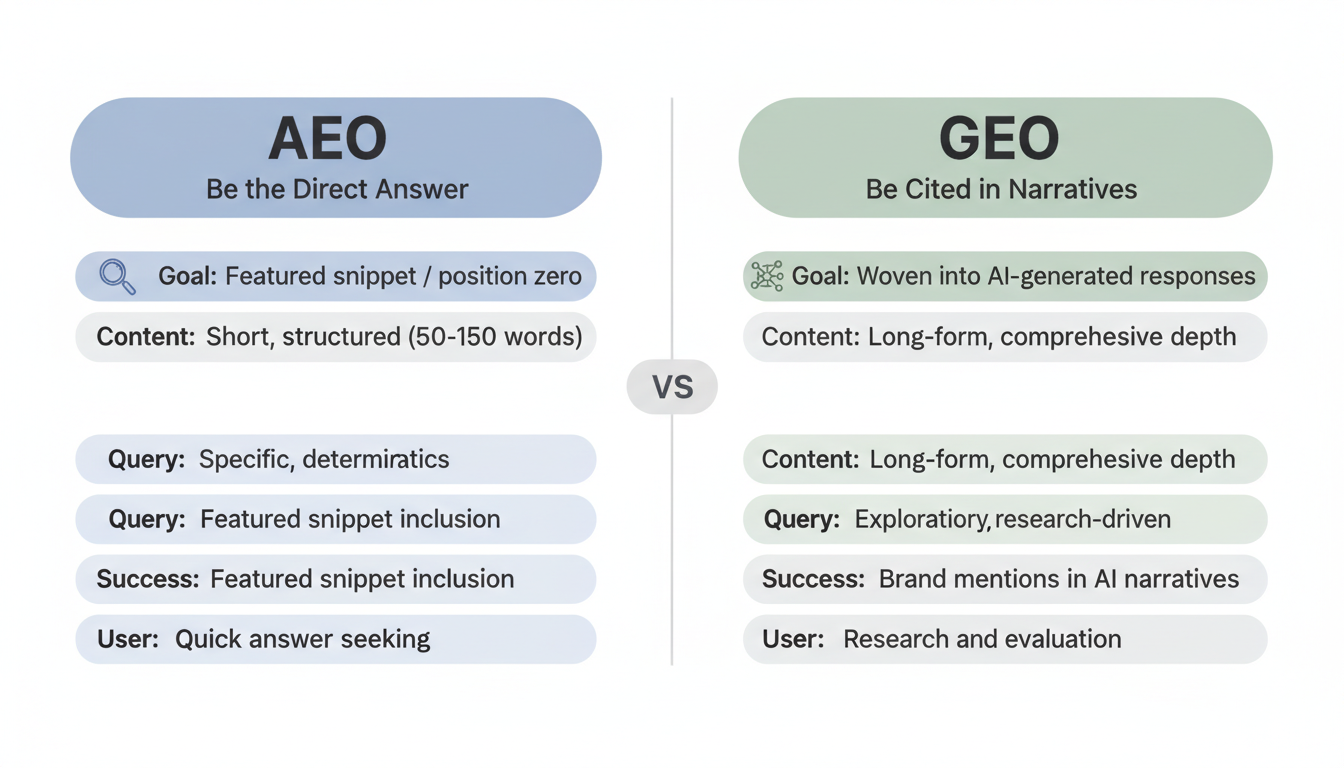
The Fundamental Strategic Difference
AEO aims at position zero: Being the single answer extracted and displayed.
GEO aims at answer integration: Being woven into the comprehensive response AI constructs.
This distinction matters because the same content can succeed at one and fail at the other. A concise FAQ answer that wins featured snippets may lack the depth GEO requires. A comprehensive guide that earns AI narrative inclusion may be too long for snippet extraction.
The Full Taxonomy: AEO, GEO, GSO, LLMO, and AIO Explained
Practitioners use at least five overlapping terms to describe AI search optimization -- AEO, GEO, GSO, LLMO, and AIO -- and the terminology is still consolidating. Here is the simple map.
Term | Full Name | Core Focus | Key Platforms |
AEO | Answer Engine Optimization | Optimizing for direct-answer surfaces (featured snippets, People Also Ask, voice assistants) | Google, Siri, Alexa, Google Assistant |
GEO | Generative Engine Optimization | Optimizing for AI-generated responses where multiple sources are synthesized | ChatGPT, Perplexity, Gemini, Bing Copilot |
GSO | Generative Search Optimization | Essentially synonymous with GEO; used more often in agency contexts | Same as GEO |
LLMO | Large Language Model Optimization | Focuses on influencing LLM training data and retrieval-augmented generation (RAG) pipelines | ChatGPT, Claude, Gemini |
AIO | AI Optimization | Umbrella term covering all of the above plus agentic engine optimization for autonomous AI agents | All AI platforms including autonomous agents |
Regardless of which label your team prefers, the underlying tactics overlap significantly. A solid generative engine optimization strategy covers most of the ground across all five terms. Focus on outcomes -- visibility in AI answers -- rather than terminology wars.
AI Platforms You Need to Optimize For
Understanding which platforms matter for AEO versus GEO helps you allocate effort correctly. Each surface has distinct citation behavior, so an effective strategy must be multi-platform.
AEO Surfaces
AEO targets three primary answer-engine surfaces:
Featured Snippets and Position Zero. The original answer engine surface. Google extracts a direct answer from your page and displays it above organic results. Structured content with clear headers and concise 40-60 word answers wins here.
People Also Ask (PAA) Boxes. Google expands PAA dynamically based on user behavior, generating new questions as users click. Concise 40-60 word answers optimized for question-format queries win PAA placement. Importantly, PAA feeds voice-assistant responses from Siri, Alexa, and Google Assistant, making it a high-leverage AEO target.
Knowledge Panels. Verified entity data in Google's knowledge graph powers knowledge panels. Claiming and enriching your Google Knowledge Panel -- through consistent structured data, verified business profiles, and authoritative third-party references -- is an AEO quick-win that establishes your brand as a recognized entity.
GEO Surfaces
GEO targets four major generative engines:
AI Overviews optimization (formerly SGE). Google rebranded Search Generative Experience to AI Overviews in 2024. These AI-generated summaries appear at the top of search results and cite sources inline. Citation selection favors authoritative, well-structured content with strong E-E-A-T signals.
Bing Copilot. Microsoft's integration of GPT-4 into Bing search surfaces AI-generated answers with citations. Bing index signals differ from Google, so content that ranks well in Google may not appear in Copilot responses. Optimizing for Bing's index separately is essential for GEO coverage.
Gemini. Google's standalone LLM interface shares some but not all ranking signals with AI Overviews. Gemini draws from a broader knowledge base and may cite sources differently than AI Overviews, making it a distinct optimization target.
ChatGPT with browsing and Perplexity. Both platforms use real-time web retrieval to source citations. Citation selection in these tools differs from traditional search ranking -- recency, source diversity, and content clarity carry more weight than domain authority alone.
Each platform has distinct citation behavior. A GEO strategy must be multi-platform, not Google-only.
Technical GEO: Entity Building, Digital PR, and AI Crawler Access
Beyond content quality, technical factors determine whether AI systems can find, parse, and trust your content.
Entity SEO and Knowledge Graph Optimization
Entity SEO is the practice of building a machine-readable identity for your brand, people, and products across structured data, Wikidata, and third-party databases. LLMs resolve ambiguous queries by mapping them to entities in their training data and knowledge graph lookups. If your brand lacks a clear entity footprint, AI systems may overlook you even when your content is relevant.
Actionable steps for entity optimization:
- Claim your Google Knowledge Panel through Google's verification process
- Ensure consistent NAP (Name, Address, Phone) data and add schema markup best practices with Organization structured data across your site
- Contribute to relevant Wikidata entries for your brand and key personnel
- Maintain consistent brand entity information across all web properties
Digital PR as a GEO Signal
Generative engines weight third-party mentions heavily because they signal consensus and authority. When multiple independent sources reference your brand, AI systems treat you as a more credible citation candidate.
Effective digital PR tactics for GEO:
- Earn mentions in industry publications, trade press, and analyst reports
- Get quoted as an expert in roundup posts and industry surveys
- Pursue unlinked brand mention outreach to convert mentions into citations
Digital PR simultaneously strengthens E-E-A-T signals for traditional SEO and citation likelihood for GEO -- making it one of the highest-leverage activities for AI visibility.
AI Crawler Accessibility
AI crawlers -- GPTBot (OpenAI), Google-Extended (Gemini), and Anthropic's ClaudeBot -- are distinct from Googlebot. Many sites inadvertently block AI crawlers while allowing search crawlers, creating a blind spot in GEO strategy.
Key actions for AI crawler access:
- Audit your robots.txt for GPTBot, ClaudeBot, and Google-Extended directives. Ensure you are not unintentionally blocking AI crawlers that could index and cite your content.
- Consider creating an LLMs.txt file -- a proposed standard (similar to robots.txt) hosted at your domain root that provides a structured, plain-text summary of your site content specifically for LLM ingestion. While not yet an official standard, early adopters report improved content parsing by AI crawlers.
- Set accurate
last-modifiedHTTP headers anddateModifiedin schema markup so AI systems prefer your up-to-date content over stale competitors. Content freshness and SEO signals are increasingly important as AI platforms prioritize recent, accurate information.
Measuring AEO and GEO Performance
Tracking the right metrics for each approach ensures you can measure progress and justify investment in AI search optimization.
AEO Metrics
Google Search Console is the primary tool for AEO measurement. Track featured snippet impressions, People Also Ask appearances, and position-zero queries by filtering the "Search Appearance" report. Monitor question-format queries (who, what, where, how) in the GSC query report as a proxy for voice search visibility. Tracking zero-click search trends helps quantify AEO impact on overall search presence.
GEO Metrics and LLM Visibility Audits
An LLM visibility audit involves systematically prompting ChatGPT, Perplexity, Gemini, and Bing Copilot with your target queries and tracking whether your brand is cited in the responses. Emerging tools like Profound, Otterly, and Peec AI can automate this monitoring at scale.
The key GEO metric is "share of voice in AI answers" -- the GEO equivalent of organic share of voice. Track how often your brand appears relative to competitors across AI platforms for your target query set, and report this monthly to measure progress.
The Future: Paid AI Placements
Microsoft Ads already offers sponsored AI answers within Bing Copilot results, and Google is testing ad placements inside AI Overviews. Paid AI placements are emerging as a new channel that may become significant by late 2026. Teams should monitor this space and consider allocating test budget to stay ahead of competitors.
When to Prioritize AEO
Choose AEO-first strategies when your audience asks specific questions with definitive answers.
AEO priority situations:
- Factual queries: "What is AEO?" "How much does enterprise SEO cost?"
- Comparison questions: "AEO vs GEO which is better?" "ChatGPT vs Perplexity?"
- Definition requests: "What does E-E-A-T stand for?"
- Process questions: "How do I implement schema markup?"
Industries that benefit most from AEO:
- Professional services (legal, financial, healthcare)
- SaaS and technology companies
- E-commerce (product specifications, shipping policies)
- Any business competing for featured snippets
If a single question determines whether someone moves forward with your business, AEO agency services should lead your strategy.
When to Prioritize GEO
Choose GEO-first strategies when your audience conducts research or evaluates options through AI.
GEO priority situations:
- Strategic queries: "What's the best marketing approach for B2B?"
- Research questions: "How do top companies handle customer retention?"
- Comparison evaluation: "Which CRM should I choose for my business?"
- Expert guidance: "How do I build a content strategy?"
Industries that benefit most from GEO:
- Agencies and consultancies
- Thought leadership organizations
- B2B services with complex buying journeys
- Any business where expertise drives trust
When decisions form through explanation and context, GEO optimization trends carry more weight.
How AEO and GEO Work Together
The most effective AI visibility strategies combine both approaches. AEO captures users seeking specific answers. GEO influences users during research and evaluation.
The integrated approach:
- AEO builds initial trust: Quick answers establish credibility
- GEO deepens influence: Comprehensive content shapes decisions
- Both reinforce authority: Presence across query types builds brand recognition
Practical implementation:
- Create FAQ sections (AEO) within comprehensive guides (GEO)
- Structure definitive answers (AEO) within topic cluster content (GEO)
- Use schema markup (AEO) on authoritative long-form content (GEO)
- Build snippet-ready summaries (AEO) for research-depth pages (GEO)
The user journey increasingly moves between quick questions and deeper exploration. Understanding SEO AEO GEO AIO relationships helps brands capture attention throughout the journey.
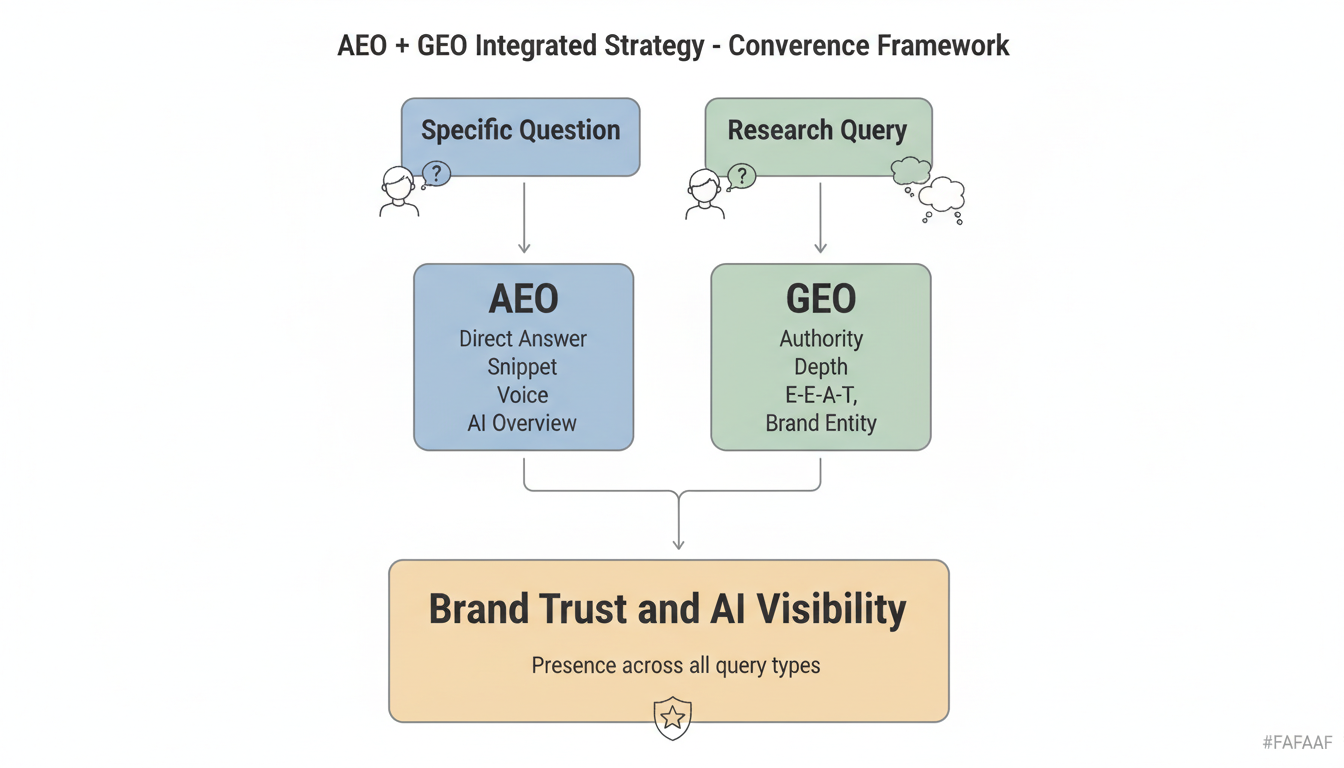
Implementation Roadmap
Starting from Zero
If you're new to AI optimization:
Weeks 1-4: AEO Foundation
- Implement FAQ schema on key pages
- Restructure content with answer-first formatting
- Target specific questions your audience asks
- Monitor featured snippet opportunities
- Audit robots.txt for AI crawler directives (GPTBot, ClaudeBot, Google-Extended) and publish an LLMs.txt file at your domain root
Weeks 5-12: GEO Layer
- Build topic clusters around core expertise
- Add E-E-A-T signals (author bios, credentials, experience)
- Develop comprehensive resources AI can draw from
- Track brand mentions in AI responses
- Launch a digital PR campaign targeting 3-5 industry publications to earn third-party brand mentions that strengthen GEO citation likelihood
Already Ranking Well
If you have strong traditional SEO:
Phase 1: Assess AI Visibility
- Check current presence in AI Overviews
- Monitor citations in ChatGPT, Perplexity, Claude
- Identify gaps between search rankings and AI inclusion
Phase 2: Expand Existing Content
- Add GEO-focused depth to ranking pages
- Structure AEO-ready summaries within long content
- Reinforce authority signals across your domain
Professionals exploring AEO marketing jobs should understand both optimization approaches to remain competitive in the evolving search landscape.
Enterprise Scale
If you're optimizing across large content libraries:
Tiered approach:
- Tier 1 pages: Full AEO + GEO optimization
- Tier 2 pages: AEO focus with GEO elements
- Tier 3 pages: Basic structured formatting
- New content: Build both approaches from start
Organizations seeking best AEO services should prioritize vendors that demonstrate expertise in both answer engine and generative engine optimization.
Measuring AEO vs GEO Success
Different metrics matter for each approach:
AEO metrics:
- Featured snippet appearances
- Voice search visibility
- AI Overview inclusion for specific queries
- Zero-click presence
GEO metrics:
- Citation frequency in AI responses
- Brand mentions in generated content
- Source attribution across AI platforms
- Share of voice in AI narratives
Track both separately. AEO success doesn't guarantee GEO success, and vice versa. Comprehensive visibility requires monitoring across both dimensions using AI SEO implementation checklists.
Common Mistakes
Treating AEO and GEO as Either/Or
They complement each other. AEO captures quick wins. GEO builds lasting influence. Ignoring either creates gaps in your AI visibility.
Optimizing Content Length Without Strategy
Long content isn't automatically GEO-optimized. Short content isn't automatically AEO-ready. Structure and authority matter more than word count. Understanding AI Overview content requirements helps avoid this trap.
Ignoring Query Type Analysis
Match optimization to how users actually ask questions. Specific queries need AEO treatment. Research queries need GEO depth. Analyze your target queries to prioritize correctly. Long-tail keywords for featured snippet success often reveal query intent patterns.
FAQs
Do I Need Both AEO and GEO?
Most businesses benefit from both. AEO captures users with specific questions. GEO influences users during research. The optimal balance depends on your industry, audience behavior, and the types of queries you target.
Which Is More Important in 2026?
Neither is universally more important. AEO matters for businesses that answer specific questions (professional services, e-commerce, SaaS support). GEO matters for businesses where expertise drives decisions (agencies, consultants, B2B services). Most need both.
Can the Same Content Serve AEO and GEO?
Yes, with proper structure. Comprehensive content (GEO) can include structured summaries and FAQ sections (AEO). The key is creating extractable answers within authoritative depth.
How Quickly Can I See Results from Each?
AEO results can appear within weeks as AI systems extract your structured answers. GEO results build more gradually as AI systems recognize your topical authority. Both require ongoing optimization. For AEO specifically, voice search results and People Also Ask boxes often reflect changes faster than traditional organic rankings.
What Is the Difference Between GEO, GSO, and LLMO?
GEO (Generative Engine Optimization), GSO (Generative Search Optimization), and LLMO (Large Language Model Optimization) all describe strategies for increasing brand visibility in AI-generated answers. GEO is the most widely adopted term and covers optimization for tools like ChatGPT, Bing Copilot, and Gemini. GSO is functionally synonymous with GEO. LLMO focuses specifically on influencing how large language models reference your content during inference.
Is AEO Replacing SEO?
AEO is not replacing SEO -- it extends it. Traditional SEO drives organic traffic through blue links, while AEO focuses on earning direct answers in featured snippets, People Also Ask boxes, and voice search results. The best approach in 2026 is an integrated strategy: strong technical SEO provides the foundation, AEO captures zero-click visibility, and GEO ensures your brand appears in AI-generated responses.
How Do You Track AI Search Visibility and GEO Performance?
Start with LLM visibility audits -- systematically query ChatGPT, Perplexity, Gemini, and Bing Copilot for your target keywords and record whether your brand is cited. Tools like Profound and Otterly can automate this. For AEO, use Google Search Console to track featured snippet impressions and People Also Ask appearances. Combine both datasets into a monthly "AI share of voice" report to measure progress against competitors.
What Is Llms.Txt and Should I Create One?
LLMs.txt is a proposed standard file (hosted at your domain root, like robots.txt) that provides a structured, plain-text summary of your site content specifically for LLM consumption. While not yet an official standard, early adopters report improved content parsing by AI crawlers. Creating an LLMs.txt file is low-effort and signals to AI systems that your site is optimized for machine readability -- a useful GEO tactic.