
The search landscape has splintered. Traditional SEO now shares the stage with two distinct but related disciplines: Answer Engine Optimization (AEO) and Generative Engine Optimization (GEO). While these terms sometimes get used interchangeably, they represent fundamentally different approaches to AI search visibility—and understanding the distinction matters for building an effective 2026 strategy.
This comprehensive guide breaks down AEO vs GEO, explaining what each discipline optimizes for, when to prioritize one over the other, and how they work together in a unified AI search strategy.
AEO, GEO, GSO, AIO: Clearing Up the Acronym Confusion
Before diving into the core AEO vs GEO comparison, it helps to untangle the growing alphabet soup of AI search optimization terms. Several acronyms circulate in the industry, and understanding what each refers to prevents confusion when evaluating strategies.
GEO (Generative Engine Optimization) was formalized in a 2023 research paper from Carnegie Mellon University (Aggarwal et al.) and has become the dominant term for optimizing content to earn citations in AI-generated responses. GSO (Generative Search Optimization) is an alternate term some practitioners and agencies use interchangeably with GEO, describing the same core discipline. AIO (AI Overviews) refers specifically to Google's implementation of AI-generated answer summaries at the top of search results—a platform feature, not a strategy. Agentic Engine Optimization is a forward-looking concept addressing a future where AI agents autonomously search, compare, and transact on behalf of users, requiring content optimized for machine-to-machine discovery.
Term | Definition |
AEO | Optimizing to become the extracted answer in snippets, PAA, and voice search |
GEO | Optimizing to be cited by generative AI systems (ChatGPT, Perplexity, AI Overviews) |
GSO | Alternate term for GEO used by some practitioners |
AIO | Google AI Overviews—a specific platform feature, not a strategy |
SEO | Traditional search engine optimization for organic rankings |
For a deeper three-way comparison, see our AEO vs SEO vs GEO complete guide.
What Is Answer Engine Optimization (AEO)?
Answer Engine Optimization focuses on making your content the direct answer to user questions. AEO strategy targets the mechanisms that extract and display answers directly in search results—featured snippets, People Also Ask boxes, voice search responses, and knowledge panels.
The AEO Mindset
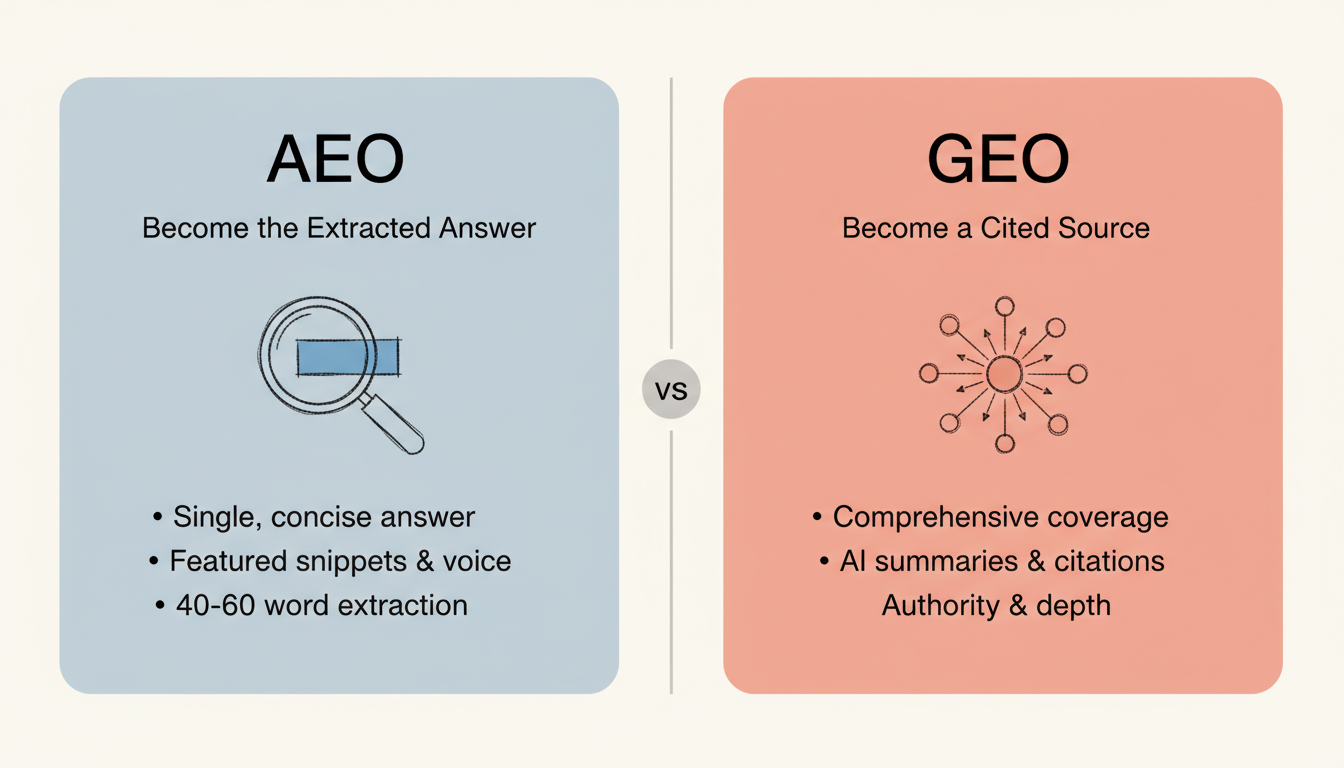
AEO asks: “How do I become the extracted answer?”
When someone searches “what temperature kills salmonella,” Google doesn’t want them to click through multiple sites. It wants to display the answer immediately. AEO optimizes content to be that extracted answer.
What AEO Optimizes For
Target | Description |
Featured snippets | The “Position Zero” boxes displaying direct answers |
People Also Ask | Expandable question/answer boxes in search results |
Voice search | Responses from Alexa, Siri, Google Assistant |
Knowledge panels | Structured information boxes for entities |
Quick answers | Direct responses in search result pages |
Core AEO Techniques
Question-answer formatting: Structure content with clear questions as headers and concise answers immediately following. The answer should be extractable in 40-60 words.
Structured data markup: Implement FAQ, HowTo, and QAPage schema to signal answer-ready content to search engines.
Concise, definitive statements: AEO rewards content that provides clear, authoritative answers without hedging or burying information.
List and table optimization: Numbered steps and comparison tables get extracted more frequently than prose paragraphs.
AEO Success Metrics
- Featured snippet captures
- Voice search answer rate
- People Also Ask appearances
- Zero-click search visibility
- Direct answer extractions
What Is Generative Engine Optimization (GEO)?
Generative Engine Optimization focuses on making your content citable, synthesizable, and reference-worthy for AI systems that generate responses. Rather than extracting a single answer, generative AI systems like ChatGPT, Perplexity, and Google’s AI Overviews synthesize information from multiple sources into comprehensive responses, as well as Bing Copilot, Google Gemini, and Claude. The term GEO was formalized in a 2023 research paper from Carnegie Mellon University (Aggarwal et al.), which demonstrated that specific content optimizations could increase visibility in generative search results by up to 40%.
The GEO Mindset
GEO asks: “How do I become a trusted source that AI systems cite and draw from?”
When someone asks ChatGPT “what’s the best project management methodology for startups,” the AI doesn’t extract one answer—it synthesizes information from many sources, potentially citing several. Generative engine optimization (GEO) optimizes for inclusion in that synthesis.
What GEO Optimizes For
Target | Description |
AI Overview citations | Sources linked in Google AI Overview responses |
ChatGPT references | Mentions and citations in ChatGPT responses |
Perplexity citations | Direct source links in Perplexity answers |
AI summary inclusion | Being synthesized into AI-generated summaries |
LLM training influence | Contributing to AI model knowledge |
Core GEO Techniques
Comprehensive topic coverage: AI systems favor sources that provide thorough, complete information they can draw from for various aspects of a topic.
Authoritative external citations: Content that references studies, research, and expert sources gets cited more frequently by AI systems that value verifiability.
Brand and entity establishment: Building clear entity identity helps AI systems recognize and reference your brand accurately across queries.
Unique data and insights: Original research, proprietary statistics, and novel perspectives give AI systems reasons to cite your content specifically.
Content freshness: AI systems weight recency, particularly for topics where information changes frequently. Structured data also plays a critical role—see our guide to AEO schema markup priority types for the most impactful markup patterns shared across AEO and GEO.
Long-tail and conversational query targeting: AI users tend to ask multi-sentence, conversational prompts rather than short keyword queries. GEO content should address these natural-language patterns, including question variations and follow-up queries that AI systems commonly process.
GEO Success Metrics
- AI Overview citation frequency
- ChatGPT/Perplexity mention rates
- Brand accuracy in AI responses
- Cross-platform AI visibility
- Citation share vs competitors
AEO vs GEO: Key Differences
Understanding the fundamental differences between AEO and GEO clarifies when each approach applies.
Primary Goal Comparison
Aspect | AEO | GEO |
Primary goal | Become the extracted answer | Become a cited source |
Target format | Single, concise answer | Comprehensive, citable content |
Success indicator | Answer extraction | Citation inclusion |
Optimization focus | Featured snippets, voice | AI summaries, chatbots |
Content style | Concise, definitive | Thorough, authoritative |
Measurement | Snippet captures | AI citations |
Technical Implementation Differences
AEO technical requirements:
- FAQ and HowTo schema markup
- Clear question/answer HTML structure
- Concise paragraph formatting
- Voice-search-friendly language
- Mobile optimization for quick answers
GEO technical requirements:
- Comprehensive schema (Organization, Person, Article)
- Entity establishment signals
- Cross-platform brand consistency
- Citation-worthy content structure
- Authority and trust signals
Content Strategy Differences
AEO content approach:
- Target specific questions with direct answers
- Format answers for extraction (40-60 words ideal)
- Use definition-style opening sentences
- Prioritize list and table formats
- Optimize for one clear answer per query
GEO content approach:
- Create comprehensive, in-depth resources
- Include multiple perspectives and angles
- Reference authoritative external sources
- Provide unique data and insights
- Build topical authority across content clusters
E-E-A-T, Entity SEO, and YMYL: The Trust Foundation for AEO and GEO
Both AEO and GEO depend on a shared trust infrastructure. Without strong credibility signals, content struggles to earn either featured snippet selection or AI citations—regardless of how well it is formatted or structured.
E-E-A-T (Experience, Expertise, Authoritativeness, Trustworthiness) is Google’s quality framework that underpins both AEO snippet selection and GEO citation decisions. AI systems evaluate whether content demonstrates firsthand experience, subject-matter expertise, authoritative sourcing, and overall trustworthiness before selecting it as a response source.
Entity SEO (Entity Optimization) is the practice of building a clear, machine-readable identity for your brand, authors, and topics so AI systems can confidently attribute and cite content. This involves consistent use of structured data, author bios with verifiable credentials, and cross-platform brand signals that reinforce entity recognition in Knowledge Graphs and LLM training data.
YMYL (Your Money Your Life) categories—health, finance, legal, and safety topics—face especially strict evaluation from both traditional search algorithms and AI systems. In YMYL verticals, AI platforms apply heightened citation standards, making E-E-A-T signals and entity clarity even more critical for AEO and GEO success. Neglecting these trust signals is one of the most common AEO marketing mistakes teams make when entering AI search optimization.
E-E-A-T Signal | AEO Application | GEO Application |
Experience | First-person examples increase snippet selection | Case studies and original data earn AI citations |
Expertise | Credential schema for knowledge panels | Author authority signals boost citation trust |
Authoritativeness | Domain authority improves snippet capture rate | Backlink profile influences AI source ranking |
Trustworthiness | Accurate, well-sourced answers get extracted | Transparent sourcing increases citation frequency |
LLM Visibility Audits can reveal where your entity signals are weak across AI platforms, identifying gaps where competitors earn citations that your content currently misses.
When to Prioritize AEO
AEO delivers strongest results for specific use cases.
Best AEO Applications
Definitional queries: “What is” and “definition of” searches where users want quick, clear answers.
How-to questions: Step-by-step queries where numbered processes get extracted as featured snippets.
Voice search optimization: Queries commonly asked via smart speakers and voice assistants require AEO-optimized answers.
Quick reference content: Specifications, conversions, formulas, and factual lookups benefit from AEO formatting.
Local business queries: “Near me” and local intent questions often trigger direct answer boxes.
AEO Priority Indicators
Consider prioritizing AEO when:
- Target queries have existing featured snippets
- Your audience uses voice search frequently
- Questions have single, definitive answers
- Quick reference value exceeds in-depth exploration
- Mobile users dominate your traffic
When to Prioritize GEO
GEO proves more valuable for different scenarios.
Best GEO Applications
Complex research queries: Multi-faceted questions where AI systems synthesize information from multiple sources.
Comparison and evaluation: “Best,” “vs,” and comparison queries where AI systems aggregate perspectives.
Strategic and advisory topics: Business, health, and financial topics where AI systems cite authoritative sources.
Brand visibility goals: When AI mention frequency and brand accuracy matter for reputation.
Emerging topic authority: New subject areas where establishing citation presence builds long-term visibility.
GEO Priority Indicators
Consider prioritizing GEO when:
- AI Overviews appear frequently for target queries
- Your audience uses ChatGPT, Perplexity, or AI assistants
- Topics require comprehensive coverage rather than quick answers
- Brand mentions in AI responses impact business outcomes
- Competitors are capturing AI citations you’re missing
AEO and GEO Together: Integrated Strategy
The most effective 2026 AI search strategies don’t choose between AEO and GEO—they integrate both approaches based on content type and user intent.
The Convergence Reality
Industry analysis suggests AEO and GEO are converging. The techniques that win featured snippets increasingly overlap with those that earn AI citations. By 2027, the distinction may matter less as AI systems unify answer extraction and citation patterns.
However, understanding the difference between SEO vs AEO today helps optimize content for current platform behaviors.
External citations and E-E-A-T signals accelerate this convergence. Content that demonstrates real-world experience, cites authoritative research (such as the CMU GEO study or Search Engine Land reporting), and maintains transparent authorship earns both snippet selection and AI citations. Tools like Forbes, industry analyst reports, and peer-reviewed research serve as trust amplifiers across both disciplines.
Layered Implementation Approach
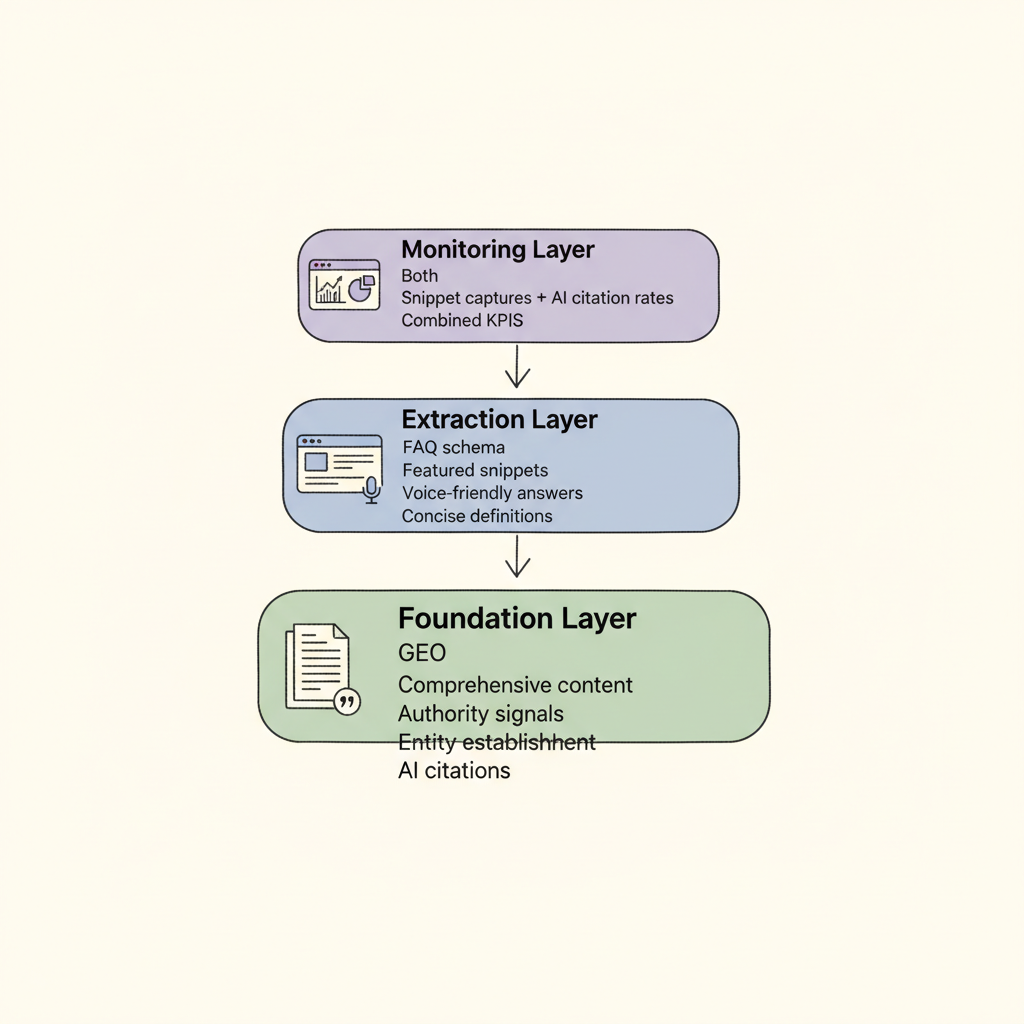
Foundation layer (GEO): Build comprehensive, authoritative content that AI systems trust and cite. Establish entity identity, topical authority, and citation-worthy depth.
Extraction layer (AEO): Within comprehensive content, format specific sections for answer extraction. Include FAQ sections, clear definitions, and step-by-step processes.
Monitoring layer: Track both featured snippet captures and AI citation mentions to measure combined effectiveness.
Content Template: AEO + GEO Hybrid
Effective content serves both AEO and GEO goals:
- Clear, extractable definition (AEO): Open with a concise 40-60 word definition that can be extracted as a featured snippet
- Comprehensive exploration (GEO): Expand with thorough coverage, multiple angles, and authoritative sources that AI systems can synthesize
- Structured sections (AEO): Include FAQ schema and question-formatted headers for snippet capture
- Original insights (GEO): Add unique data, research, or perspectives that give AI systems reasons to cite specifically
- Entity signals (GEO): Include author credentials, company information, and trust signals throughout
Platform-Specific Considerations
Different AI platforms weight AEO and GEO factors differently.
Google AI Overviews
Google’s AI Overviews maintain strongest correlation with traditional organic rankings (93.67%). Powered by Google’s Search Generative Experience (SGE) technology and the Gemini model family, AI Overviews now appear in approximately 47% of Google searches. This represents a significant expansion from their limited rollout in 2024. Sites performing well in traditional SEO have advantages, but citation patterns increasingly diverge from ranking positions. Understanding Google AI Overview SEO impact requires balanced AEO + GEO with strong traditional SEO foundation.
ChatGPT
ChatGPT relies heavily on parametric knowledge plus Bing integration. Citations match Bing’s top 10 results 87% of the time. Focus: Bing optimization plus comprehensive, authoritative content for training data influence. With Bing Copilot serving as Microsoft’s own AI-powered search interface, optimizing for the Bing index now pays dividends across both ChatGPT and Copilot simultaneously. This makes Bing optimization a high-leverage GEO tactic often overlooked by teams focused exclusively on Google.
Perplexity
Perplexity indexes over 200 billion URLs with heavy Reddit citation patterns (46.5% of citations). Focus: GEO emphasis with real-time content freshness and community presence.
Bing Copilot, Claude, and Gemini: The Expanding GEO Landscape
The GEO landscape extends well beyond ChatGPT and Perplexity. Three additional platforms now command significant attention from AI search strategists, and each processes and surfaces content differently.
Bing Copilot integrates directly with Microsoft’s search index, blending Bing organic results with GPT-4 synthesis to produce cited, conversational responses. Because Copilot draws from the same Bing index that powers ChatGPT’s web browsing, optimizing for Bing organic rankings effectively serves two major AI platforms simultaneously. Content that ranks well in Bing has a structural advantage in both Copilot and ChatGPT citation selection.
Claude (Anthropic) processes web content through tool use and retrieval mechanisms, with a strong emphasis on well-structured, clearly sourced material. Content that uses explicit section headings, provides verifiable claims, and maintains consistent entity references performs well in Claude-powered applications and retrieval-augmented generation (RAG) systems.
Gemini operates as both a standalone AI assistant and the model powering Google AI Overviews. Gemini-powered results may weight Google’s Knowledge Graph more heavily than other platforms, making entity SEO and structured data especially important for visibility in Gemini responses. With 47% of Google searches now featuring AI Overviews (Search Engine Land), the scale of the Gemini-driven GEO opportunity is substantial.
For a detailed breakdown of how each platform handles citations, see our AEO platform comparison across ChatGPT, Perplexity, Gemini, and Copilot.
Voice Assistants
Google Assistant, Alexa, and Siri primarily extract single answers. Focus: AEO techniques—concise, structured, voice-friendly formatting.
Measuring AEO vs GEO Performance
Track distinct metrics for each discipline.
AEO Metrics Dashboard
Metric | Tool |
Featured snippet captures | SEMrush, Ahrefs |
PAA appearances | SERP tracking tools |
Voice search rankings | Voice search audits |
Zero-click visibility | Search Console |
GEO Metrics Dashboard
Metric | Tool |
AI Overview citations | Otterly AI, Scrunch AI |
ChatGPT mentions | Brand monitoring tools |
Perplexity citations | Manual tracking, APIs |
AI mention sentiment | Brand accuracy audits |
Combined Kpis
- Total AI search visibility (snippets + citations)
- Brand mention accuracy across platforms
- Click-through from AI-assisted searches
- Conversion rate from AI-referred traffic
Building Your 2026 Strategy
Start with these practical steps to implement both AEO and GEO.
Immediate Actions
- Audit current visibility: Check existing featured snippet captures and AI citation presence
- Identify gaps: Find queries where competitors appear in snippets or AI citations you’re missing
- Prioritize by opportunity: Focus first on high-volume queries where you have content but lack visibility
- Implement schema: Add FAQ, HowTo, Organization, and Person markup where relevant
Ongoing Optimization
- Monitor both channels: Track featured snippet and AI citation changes weekly
- Update for freshness: Refresh content regularly to maintain AI citation eligibility
- Build authority signals: Expand brand presence across authoritative platforms
- Test and iterate: Experiment with content structures and measure impact on both AEO and GEO metrics
Frequently Asked Questions
What Is the Difference Between AEO and GEO in Digital Marketing?
AEO (Answer Engine Optimization) focuses on making your content the direct extracted answer in featured snippets, People Also Ask boxes, and voice search results. GEO (Generative Engine Optimization) targets AI citation inclusion across platforms like ChatGPT, Perplexity, Bing Copilot, and Google AI Overviews. AEO optimizes for concise, extractable answers while GEO builds comprehensive, authoritative content that AI systems cite during response synthesis.
Is GEO the Same as GSO (Generative Search Optimization)?
GEO and GSO refer to essentially the same discipline. GEO was formalized in a 2023 Carnegie Mellon University research paper and has become the more widely adopted term. GSO is used by some agencies and practitioners interchangeably. Both describe the practice of optimizing content to be cited and referenced by generative AI systems rather than simply ranked in traditional search results.
Do I Need Both AEO and GEO, or Can I Choose One?
Most businesses benefit from both. AEO captures visibility in featured snippets and voice search, which still drive significant traffic. GEO addresses the growing share of queries answered by AI systems, where 47% of Google searches now trigger AI Overviews. A layered strategy using GEO for comprehensive content foundations and AEO for extractable answer formatting within that content delivers the broadest AI search coverage. For real-world examples, see our AEO and GEO case studies with real results.
How Do E-E-A-T and Entity SEO Affect AEO and GEO Performance?
E-E-A-T (Experience, Expertise, Authoritativeness, Trustworthiness) is foundational to both disciplines. For AEO, strong E-E-A-T signals help Google select your content for featured snippets over competitors. For GEO, AI systems prioritize citing sources with clear entity signals, author credentials, and verifiable expertise. Entity SEO, which builds machine-readable identity through structured data and consistent brand signals, helps AI platforms accurately attribute and recommend your content.
The Future of AEO and GEO
Gartner predicts conventional search traffic will decline 50% by 2028 as AI systems capture more queries. Whether that traffic shifts toward answer extraction (AEO) or AI synthesis (GEO), businesses optimizing for both disciplines now build advantages that compound over time.
The distinction between AEO and GEO may blur, but the underlying principle remains: make your content the most authoritative, useful, and accessible source for whatever mechanism delivers answers to your audience. In 2026, that means mastering both the art of the extractable answer and the science of AI citation worthiness.
LLMS.Txt, AI Crawlers, and the Future of Content Access
As AI search optimization matures, a new challenge emerges: controlling how AI systems access and use your content. LLMS.txt is an emerging protocol, analogous to robots.txt, that lets publishers specify which content AI crawlers can access for training and retrieval purposes. While robots.txt controls traditional search engine crawlers, it was not designed to address LLM training data collection—a gap that LLMS.txt aims to fill.
This creates a strategic tension for content publishers. Maximizing GEO visibility requires making content accessible and citable by AI systems, while protecting intellectual property may require restricting access to uncompensated training. Organizations must balance the citation benefits of open access against the risk of content being ingested without attribution or compensation.
Paid AI results and sponsored AI answers represent an emerging monetization model where brands may pay for verified placements within AI-generated responses. Platforms including Google and Perplexity are testing sponsored AI placements in 2026, signaling that the advertising layer of AI search is beginning to take shape. For more on where AI search is heading, explore our analysis of AEO future trends and platform evolution.