
Every marketing team faces the same question: with limited resources, where should search visibility investments go? AEO, GEO, and SEO each promise results, but pursuing all three equally rarely makes sense. The right prioritization depends on your specific situation—audience behavior, competitive dynamics, and business goals.
This framework helps you decide which strategy deserves primary focus and how to sequence your investments effectively.
The Three Strategies Defined
Before comparing, let's clarify what each approach optimizes for.
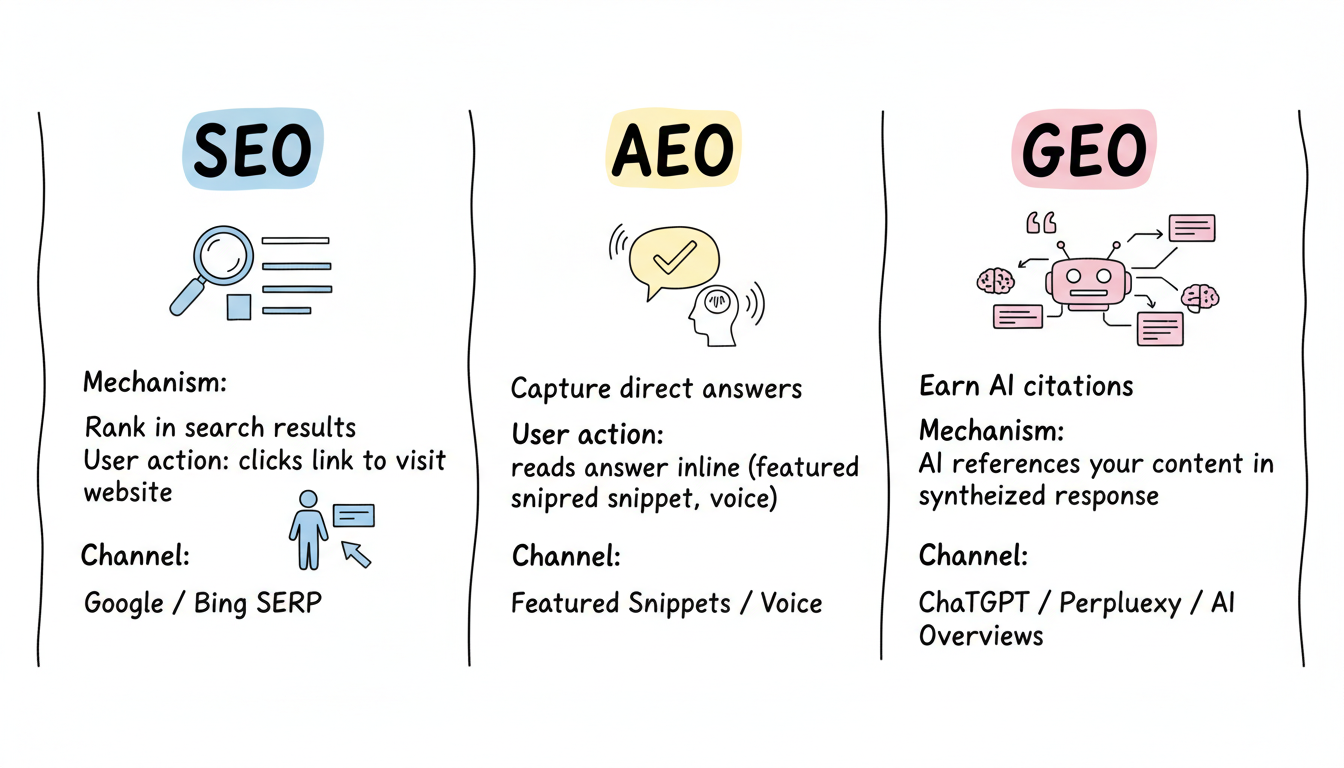
SEO (Search Engine Optimization): Improving organic rankings in traditional search results. Users click through to your website from search engine results pages.
AEO (Answer Engine Optimization): Capturing featured snippets, knowledge panels, and voice assistant responses. Users get answers directly without clicking through.
GEO (Generative Engine Optimization): Earning citations in AI-generated responses from ChatGPT, Perplexity, and Google AI Overviews. AI systems reference your content when synthesizing answers.
Each targets a different user behavior pattern and delivers visibility through different mechanisms. Understanding these distinctions is critical when deciding which strategy aligns with your business goals.
The Decision Framework
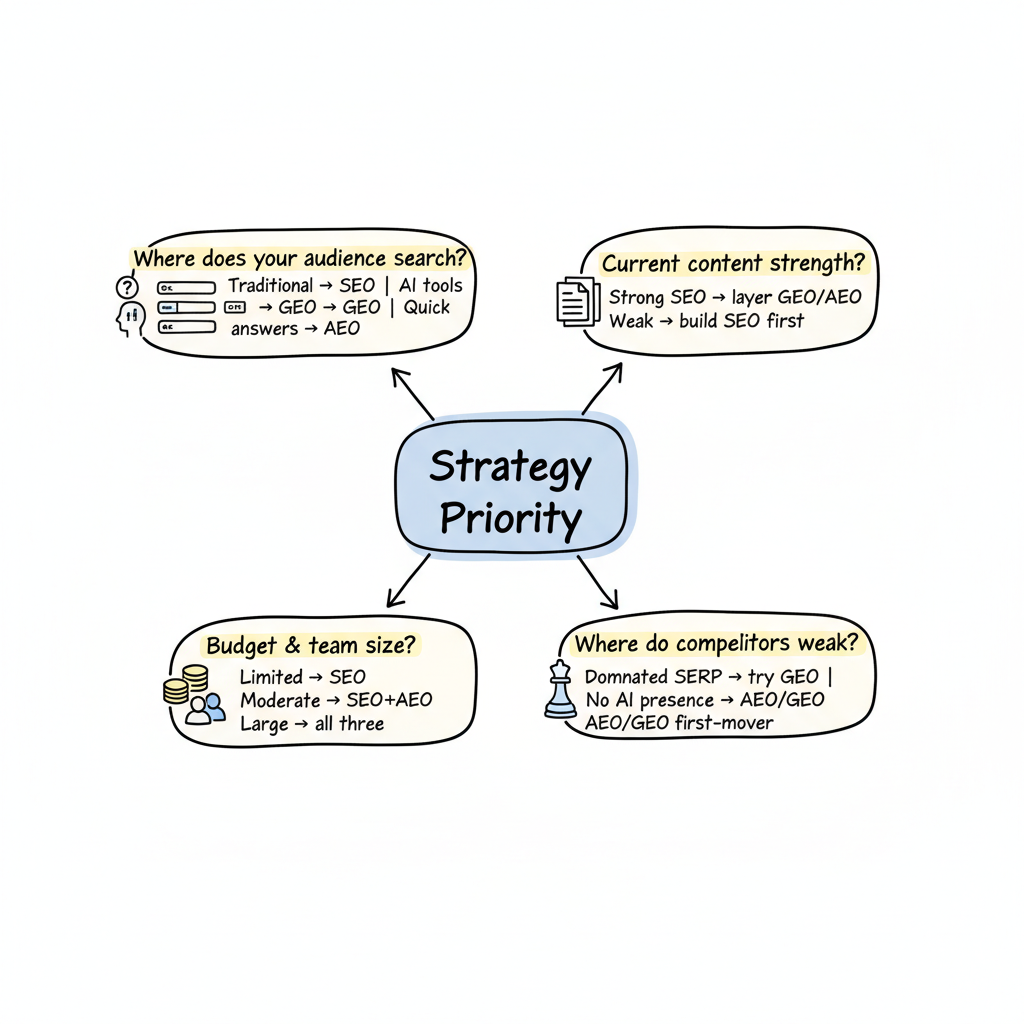
Factor 1: Where Does Your Audience Search?
Start with audience behavior. Where do your potential customers actually look for information?
Prioritize SEO when:
- Your audience primarily uses traditional Google search
- They browse multiple results before deciding
- Your industry hasn't seen significant AI search adoption
- Users need to compare options before converting
Prioritize AEO when:
- Your audience asks specific, answerable questions
- Voice search is common in your industry
- Quick answers drive awareness (users research further elsewhere)
- Mobile search dominates your traffic sources
Prioritize GEO when:
- Your audience actively uses ChatGPT, Perplexity, or similar tools
- They research complex topics requiring synthesized information
- Professional or technical audiences predominate
- Users trust AI recommendations for initial direction
Research your audience directly. Survey customers about their research habits. Check analytics for AI referral traffic. Understanding actual behavior beats assumptions.
Factor 2: What'S Your Content Position?
Your current content strength affects which strategy delivers fastest returns.
Strong SEO foundation exists:
- Already ranking well for target keywords
- Solid domain authority established
- Technical site health optimized
→ Best path: Layer GEO and AEO onto existing assets. Your SEO investment creates the foundation AI systems trust. Restructure high-ranking content for extractability.
Limited current visibility:
- Few first-page rankings
- Domain authority below competitors
- Technical issues unresolved
→ Best path: Build SEO fundamentals first. GEO and AEO success correlate with traditional ranking strength. Attempting AI visibility without SEO foundation wastes effort.
Content-rich but poorly structured:
- Lots of quality content published
- Lacks optimization and structure
- Good information buried in poor formatting
→ Best path: Focus on AEO restructuring. Answer-first formatting helps featured snippet capture while improving general readability. Quick wins available.
Factor 3: What'S the Competitive Landscape?
Competitive dynamics affect where opportunity exists.
Competitors dominate traditional rankings:
- First page saturated with established players
- Domain authority gaps difficult to close
- Years of backlink investment by competitors
→ Consider: GEO may offer faster visibility gains. AI citations don't directly correlate with domain authority. Authority and accuracy can win citations even against SEO-dominant competitors.
Competitors haven't optimized for AI:
- Traditional SEO competition intense
- Few competitors appear in AI responses
- Featured snippets owned by non-competitors
→ Opportunity: First-mover advantage available in AEO and GEO. Establish AI visibility before competitors recognize the opportunity.
You already lead in rankings:
- Strong organic presence established
- Featured snippets already captured
- Competitor threat limited
→ Protect: Expand to GEO to maintain visibility as user behavior shifts. Don't let AI search growth erode your position.
Factor 4: What Resources Can You Commit?
Resource constraints shape realistic priorities.
Limited budget and team:
→ Focus: SEO fundamentals. Build the foundation that supports all three approaches. SEO improvements cascade to AEO and GEO performance.
Moderate resources available:
→ Sequence: SEO first, then AEO optimization of existing content. AEO restructuring has relatively low marginal cost once content exists.
Significant investment possible:
→ Integrate: Pursue all three simultaneously with proper resource allocation. Typically: 50% SEO, 25% AEO, 25% GEO as starting distribution. Adjust based on results.
SEO vs AEO vs GEO: Side-By-Side Comparison
The following comparison breaks down how each strategy differs across key dimensions. Use this table to quickly assess which approach aligns with your current priorities.
| Dimension | SEO | AEO | GEO |
|---|---|---|---|
| Primary Goal | Rank in organic search results | Capture featured snippets and voice answers | Earn citations in AI-generated responses |
| Key Tactics | Keyword optimization, backlinks, technical SEO | Question-answer formatting, schema markup, concise definitions | Entity optimization, authoritative sourcing, citation-friendly structure |
| Core KPIs | Organic traffic, rankings, CTR | Featured snippet ownership, voice search impressions | AI citations, brand mentions in AI responses |
| Primary Tools | Google Search Console, Ahrefs, Semrush | Schema validators, SERP feature trackers | AI monitoring tools, citation trackers |
| Time to Results | 3-6 months | 1-3 months (on existing content) | 2-4 months |
| Resource Intensity | High (ongoing) | Low-Medium (restructuring) | Medium (content + authority building) |
Note that these strategies are not mutually exclusive. Many tactics overlap, and a strong SEO foundation enhances both AEO and GEO performance. Consider AI-immune keywords as well—local queries, service-specific searches, and navigational terms that rarely trigger AI Overviews still depend heavily on traditional SEO.
Beyond Google, search behavior now spans multiple surfaces. TikTok, Instagram, Reddit, and Maps all function as discovery platforms. Your strategy should account for where your audience searches across all these channels, not just traditional search engines.
Common Prioritization Scenarios
Scenario: B2B SaaS Company
Professional audience, complex buying process, significant research phase.
Recommended priority: GEO > SEO > AEO
Professional users increasingly use AI tools for research. ChatGPT and Perplexity adoption runs high in tech-savvy B2B audiences. GEO visibility influences the research phase before vendors even get considered.
Scenario: Local Service Business
Geographic constraints, immediate needs, mobile-first users.
Recommended priority: SEO > AEO > GEO
Traditional local search remains dominant. Featured snippets for "plumber near me" queries capture immediate-need traffic. GEO matters less when location and immediacy drive decisions.
Scenario: E-Commerce Brand
Product comparisons, shopping intent, competitive landscape.
Recommended priority: SEO > GEO > AEO
Product searches still flow through traditional search. However, AI-assisted shopping research grows rapidly. GEO helps capture "best X for Y" queries increasingly asked to AI assistants.
Scenario: Professional Services Firm
Expertise-driven, trust essential, complex decisions.
Recommended priority: GEO > AEO > SEO
AI citations function as trust signals. Being cited by ChatGPT or Perplexity implies authority that influences professional decisions. Featured snippets capture specific question traffic.
Implementation Sequencing
Once you've prioritized, sequence implementation logically.
If SEO Is Priority:
- Fix technical foundations (speed, mobile, crawlability)
- Build content around priority keywords
- Develop backlink authority
- Monitor rankings and iterate
→ Then layer AEO formatting onto successful content → Then add GEO optimization for AI citation
If AEO Is Priority:
- Identify question-based queries in your space
- Restructure existing content for answer extraction
- Add FAQ schema and structured data
- Target featured snippet opportunities
→ Ensure SEO fundamentals support AEO pages → Apply same structure for GEO extractability
If GEO Is Priority:
- Audit current AI visibility across platforms
- Ensure entity consistency across web properties
- Structure content for AI extraction
- Build authority through external validation
→ Maintain SEO fundamentals as foundation → AEO formatting naturally supports GEO
Avoiding Common Mistakes
Mistake: Treating all three as separate projects Reality: They share foundations. Integrated optimization serves all three.
Mistake: Abandoning SEO for newer approaches Reality: SEO strength predicts GEO and AEO success. The foundation matters.
Mistake: Copying competitor strategy Reality: Your audience, resources, and position differ. Prioritize based on your situation.
Mistake: Expecting immediate results from any approach Reality: All three build visibility over months. Quick wins are rare and temporary.
Making Your Decision
Use this quick filter:
- Where does your audience actually search? (Determines which channels matter)
- What's your current content position? (Determines what's buildable)
- Where are competitors weak? (Determines where opportunity exists)
- What resources can you commit? (Determines what's realistic)
The intersection of these answers reveals your priority. Start there. Build foundation. Expand to other approaches as resources allow. If you need professional guidance, consider working with AEO consulting services to develop a customized strategy.
For teams looking to understand these approaches more deeply, our comprehensive answer engine optimization guide provides detailed implementation frameworks for each strategy.
The Data Behind AI Search: Key Statistics
Understanding the scale of AI search adoption helps contextualize why AEO and GEO matter alongside traditional SEO. The data points below reflect the rapid shift in how users discover and consume information.
Google AI Overviews have reduced click-through rates by an average of 34.5% for queries where they appear, according to Ahrefs research. This means traditional organic rankings deliver fewer clicks than they did even a year ago for informational queries.
At the same time, AI referral traffic has grown 357% year-over-year according to Similarweb data. Platforms like ChatGPT, Perplexity, and Claude are sending meaningful traffic to websites they cite in their responses. This traffic is still a fraction of Google's volume, but the growth trajectory demands attention.
Conversion rates from AI referral traffic outperform traditional organic by 4.4x based on Semrush analysis. Users arriving via AI citations tend to be further along in their research and more intent-qualified, making each visit more valuable.
Zero-click searches now account for a growing share of all Google queries. Featured snippets, knowledge panels, and AI Overviews satisfy user intent without requiring a click. This trend accelerates the case for AEO—if users get answers directly on the search results page, your content needs to be the source they see.
These statistics don't mean SEO is obsolete. They mean the search landscape is fragmenting, and strategies need to account for multiple visibility channels. The businesses seeing the strongest results are those treating SEO, AEO, and GEO as complementary investments rather than competing priorities.
Platform-Specific Optimization Tactics
Each AI platform has distinct preferences for how it selects and cites content. Optimizing broadly helps, but platform-specific adjustments improve citation rates significantly.
Google AI Overviews
Google's AI Overviews pull from content that already ranks well organically, but they favor pages with strong structured data, clear E-E-A-T signals, and concise answer formatting. Pages that provide direct, well-sourced answers to specific questions earn AI Overview citations more consistently.
ChatGPT
ChatGPT favors authoritative, well-structured content that it can easily cite. Include clear attributions, data points with sources, and well-organized sections. Content that reads as a definitive resource on a topic performs well. ChatGPT increasingly links to sources, making citation-friendly formatting valuable.
Perplexity
Perplexity emphasizes third-party validation and community discussion. Content referenced on Reddit, industry forums, and independent review sites gets cited more frequently. Building presence on community platforms alongside your primary content strengthens Perplexity visibility.
Bing Copilot
Bing Copilot leans heavily on structured data and Bing's own index. Ensure your site is properly indexed in Bing Webmaster Tools and uses comprehensive schema markup. Product, FAQ, and HowTo schemas receive particular attention from Copilot's citation algorithm.
Claude
Claude prioritizes comprehensive, well-sourced content with balanced perspectives. Thorough coverage of a topic—including nuances, counterpoints, and practical details—aligns with how Claude selects reference material for its responses.
| Platform | Key Priority | Best Content Format | Optimization Focus |
|---|---|---|---|
| Google AI Overviews | E-E-A-T + structured data | Concise, direct answers | Schema markup, existing rankings |
| ChatGPT | Authoritative sourcing | Definitive resource pages | Citation-friendly structure, data points |
| Perplexity | Third-party validation | Community-referenced content | Reddit presence, external reviews |
| Bing Copilot | Structured data | Schema-rich pages | Bing indexing, comprehensive markup |
| Claude | Comprehensive sourcing | Balanced, thorough analysis | Depth, nuance, practical detail |
How to Measure Success: Kpis for Each Strategy
Measuring effectiveness differently across SEO, AEO, and GEO prevents misallocating resources based on the wrong metrics.
SEO Kpis
- Organic traffic: Total visits from search engines, tracked in Google Analytics
- Keyword rankings: Position tracking for target terms via Ahrefs, Semrush, or similar
- Click-through rate: Percentage of impressions that result in clicks, monitored in Google Search Console
- Conversions from organic: Lead submissions, purchases, or signups attributed to organic search
AEO Kpis
- Featured snippet ownership: Number of target queries where your content holds the featured snippet
- AI Overview appearances: Frequency of inclusion in Google AI Overviews for relevant queries
- Brand mentions in answer boxes: How often your brand appears in knowledge panels and direct answer features
- Voice search visibility: Responses attributed to your content via smart speakers and voice assistants
GEO Kpis
- AI referral traffic: Visits from ChatGPT, Perplexity, and other AI platforms (identifiable in analytics)
- Citation rate: How frequently AI systems cite your content when answering relevant queries
- Share of voice in AI responses: Your brand's presence relative to competitors in AI-generated answers
- Sentiment in AI citations: Whether AI platforms reference your content positively or neutrally
Measurement Tools
Google Search Console remains essential for SEO and AEO tracking. For GEO measurement, newer tools are emerging—platforms like Otterly.ai, Profound, and Peec AI track AI citations across multiple platforms. Monitor AI referral traffic in Google Analytics by filtering for referral sources containing "chat.openai", "perplexity.ai", and similar domains.
E-E-A-T: The Foundation Across All Three Strategies
Experience, Expertise, Authoritativeness, and Trustworthiness (E-E-A-T) is not just a Google ranking factor. It functions as the shared foundation that determines success across SEO, AEO, and GEO. AI systems evaluate content credibility through similar lenses, even if their specific algorithms differ.
E-E-A-T for SEO
Google explicitly uses E-E-A-T as a quality signal in its ranking systems. Pages with demonstrated author expertise, first-hand experience, and strong trust signals rank more consistently. This means author bios, credentials, editorial standards, and transparent sourcing directly impact organic performance.
E-E-A-T for AEO
Featured snippets and knowledge panels disproportionately pull from content that Google considers highly trustworthy. Answer boxes rarely feature content from low-authority sources. Strengthening E-E-A-T signals increases the likelihood your content gets selected as the definitive answer.
E-E-A-T for GEO
AI models like ChatGPT and Perplexity are trained on and reference content that demonstrates clear expertise and authority. When multiple sources cover the same topic, AI systems preferentially cite the source with stronger credentials, more thorough analysis, and better external validation.
Practical E-E-A-T Implementation
- Author credentials: Display author bios with relevant qualifications and experience on every piece of content
- Expert schema markup: Use Person schema with sameAs links to author profiles across professional platforms
- Trust signals: Include editorial policies, fact-checking processes, and transparent correction procedures
- First-hand experience: Incorporate original data, case studies, and practitioner insights rather than only aggregating secondary sources
- External validation: Earn citations and references from authoritative third-party publications in your industry
Schema Markup for SEO, AEO & GEO
Structured data helps search engines and AI systems understand your content's meaning, relationships, and authority. While schema markup alone does not guarantee visibility, it provides the machine-readable context that improves content selection across all three strategies.
Key Schema Types
FAQPage schema: Marks up question-and-answer content for featured snippet eligibility and AI extraction. Each question-answer pair becomes independently extractable, increasing the surface area for AEO and GEO citation.
HowTo schema: Structures step-by-step content that search engines display as rich results. Particularly effective for process-oriented queries where AI systems need to provide sequential instructions.
Product schema: Essential for e-commerce brands competing in AI-assisted shopping. Provides price, availability, review, and specification data that AI systems use when answering product comparison queries.
Knowledge Graph and Entity Management
Beyond page-level schema, managing your entity presence in knowledge graphs improves how AI systems identify and reference your brand. Use Organization schema with consistent NAP (name, address, phone) data. Link to authoritative profiles using sameAs properties—Wikipedia, LinkedIn, Crunchbase, and industry directories.
Entity consistency across your web presence (your website, social profiles, directory listings, and third-party mentions) helps AI systems build a confident representation of your brand, increasing the likelihood of accurate citations.
Implementation Guidance
- Validate all schema using Google's Rich Results Test and Schema.org validator
- Prioritize FAQ and HowTo schema for informational content targeting AEO
- Use Article and BlogPosting schema with full author and publisher details for GEO credibility
- Implement breadcrumb schema to clarify site structure for crawlers and AI systems
- Test AI extraction by querying platforms with your target questions and checking whether structured content gets cited
Content Format Recommendations
The format of your content influences how effectively it gets extracted and cited across search and AI platforms. Different formats serve different strategic purposes.
Case studies and original research: These content types carry outsized weight in GEO. AI systems preferentially cite content with unique data, proprietary research, or documented real-world results because they cannot generate this information independently.
Video content: Video complements text-based optimization. While AI systems primarily process text today, video presence on YouTube (the second-largest search engine) builds authority signals that AI models recognize. Transcripts from video content provide additional text for AI extraction.
FAQ pages: Purpose-built FAQ content serves both AEO and GEO simultaneously. Well-structured question-answer pairs with FAQPage schema are among the easiest content types to optimize for AI visibility.
Comprehensive guides: Long-form, definitive resources function as citation magnets for AI systems. When a single page thoroughly covers a topic with expert depth, AI platforms reference it repeatedly across related queries.
It is also worth noting the emergence of AIO (AI Optimization) as a broader term that encompasses aspects of both AEO and GEO. As AI-powered search continues to evolve, the strategies discussed here may increasingly converge under this umbrella, but the tactical distinctions between answer engine and generative engine optimization remain relevant for implementation purposes.
Frequently Asked Questions
What Is AEO vs SEO vs GEO?
SEO (Search Engine Optimization) focuses on ranking in traditional search results to drive click-through traffic. AEO (Answer Engine Optimization) targets featured snippets, knowledge panels, and voice assistant responses where users receive answers directly on the search page. GEO (Generative Engine Optimization) aims to earn citations in AI-generated responses from platforms like ChatGPT, Perplexity, and Google AI Overviews. While all three improve search visibility, they optimize for different user behaviors and platform mechanics.
Is AEO Just a New Name for SEO?
No. While AEO builds on SEO foundations, it requires distinct tactics. SEO focuses on earning clicks from organic rankings, while AEO specifically targets zero-click features—featured snippets, knowledge panels, and voice results. AEO emphasizes question-answer formatting, concise definitions, and FAQ schema that make content extractable by answer engines. A page can rank well in organic results (good SEO) but fail to capture featured snippets (poor AEO) if the content is not structured for direct answer extraction.
What Are the 4 Types of SEO?
The four main types of SEO are: (1) Technical SEO, which covers site speed, crawlability, mobile optimization, and structured data; (2) On-page SEO, which includes keyword optimization, content quality, headings, and internal linking; (3) Off-page SEO, which focuses on backlinks, brand mentions, and external authority signals; and (4) Local SEO, which targets geographic-specific search results through Google Business Profile optimization, local citations, and location-based content. All four types support both AEO and GEO performance when implemented together.
How Do AEO, GEO, and SEO Work Together?
The three strategies form a layered approach to search visibility. SEO builds the foundational authority and rankings that both AEO and GEO depend on—AI systems and answer engines disproportionately cite content that already performs well in traditional search. AEO formatting (structured answers, FAQ schema, concise definitions) makes content extractable for both featured snippets and AI citations. GEO adds entity optimization, citation-friendly sourcing, and cross-platform authority building that strengthens all three. The most effective approach treats them as complementary layers rather than competing strategies, with SEO as the base, AEO as the structural layer, and GEO as the authority and distribution layer.