
Last Updated: March 2026
Search optimization in 2026 requires understanding two complementary disciplines: SEO (Search Engine Optimization) and AEO (Answer Engine Optimization). While they share common foundations, they serve different purposes in how your content gets discovered.
According to recent studies, approximately 60% of Google searches now result in zero clicks, meaning the user gets their answer directly from the SERP or an AI-generated response without visiting a website. Google processes over 8.5 billion searches daily, and this zero-click search trend makes AI-surface visibility critical for any brand investing in search.
This guide explains the key differences between AEO, SEO, and GEO, and why successful brands need all three.
What Is AEO?
Answer Engine Optimization (AEO) prepares your content to appear in direct responses generated by AI-powered search systems. Unlike traditional SEO, which aims to rank pages in search results, AEO focuses on making your content easy for AI systems to extract, understand, and present as answers.
AEO targets visibility across:
- Google AI Overviews: AI-generated summaries appearing above traditional results
- ChatGPT and other LLMs: Conversational AI platforms with search capabilities
- Perplexity: AI-native search engine that cites sources directly
- Claude (Anthropic): AI assistant capable of web search and citation
- Gemini (Google): Multimodal AI with integrated search
- Voice assistants: Alexa, Siri, and Google Assistant responses
As of 2026, the major AI answer platforms include Google AI Overviews, Google AI Mode, ChatGPT, Perplexity, Claude, Gemini, and Microsoft Copilot.
The core goal: become the source AI systems select when generating answers to user questions.
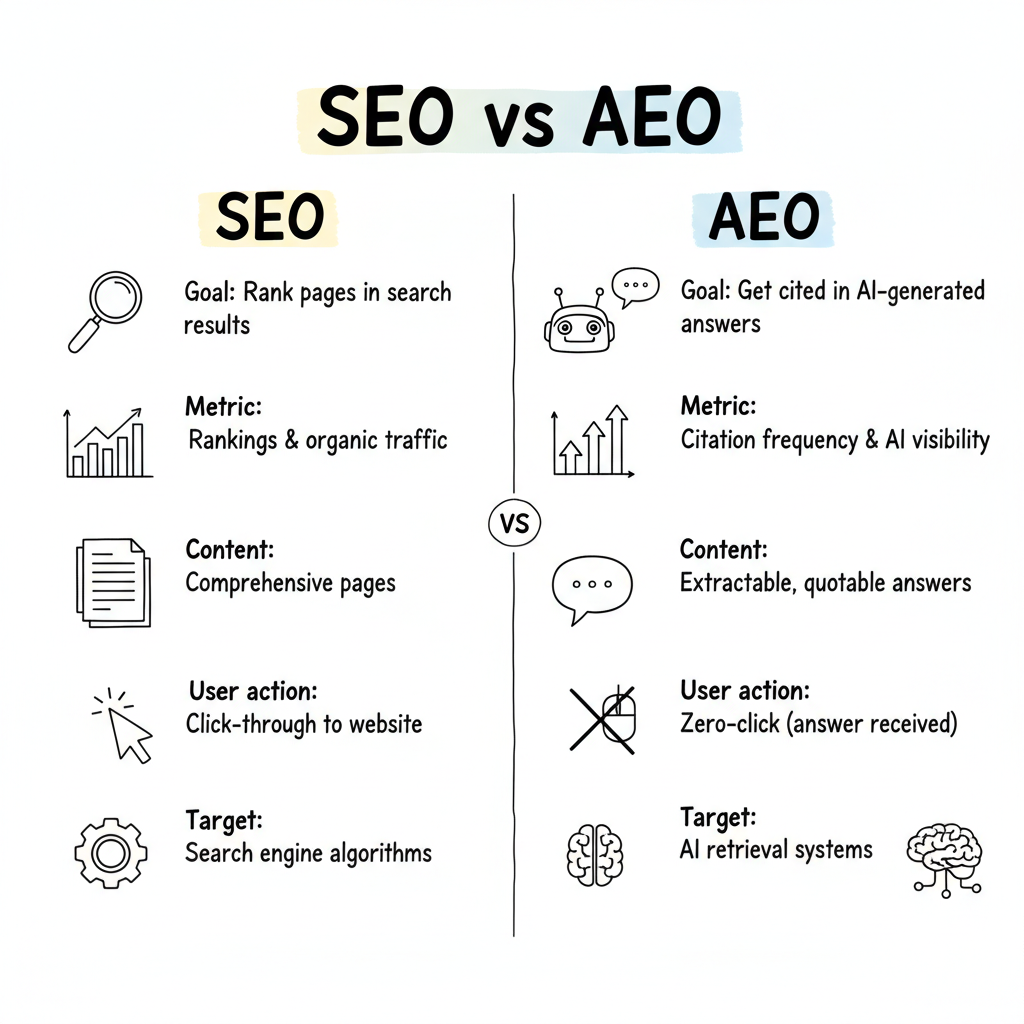
SEO vs AEO: Key Differences
Understanding where these disciplines diverge helps prioritize your optimization efforts.
Factor | SEO | AEO | GEO |
Primary Goal | Rank pages in search results | Get cited in AI-generated answers | Get referenced in AI-synthesized summaries |
Primary Surface | Organic search listings (Google, Bing) | Answer boxes, featured snippets, voice results | AI Overviews, ChatGPT, Perplexity responses |
Success Metric | Rankings, clicks, organic traffic | Citation frequency, AI visibility | Brand mentions, source citations in AI outputs |
Content Focus | Comprehensive pages that rank | Extractable answers AI can quote | Authoritative, citable content with clear entity signals |
User Action | Click through to website | May receive answer without clicking | Brand exposure within generated narrative |
Key Technique | Keyword optimization and link building | Structured data and direct answers | Entity optimization and topical authority |
How SEO Works
Traditional SEO optimizes content for search engine algorithms. The process involves:
- Keyword research to identify target terms
- On-page optimization (titles, headers, content structure)
- Technical SEO (site speed, mobile-friendliness, crawlability)
- Link building to establish authority
- Content quality that satisfies user intent
Success means ranking on page one, earning clicks, and driving organic traffic.
How AEO Works
AEO optimizes content for AI extraction. The approach involves:
- Structuring content as clear, quotable answers
- Using FAQ formats that match how users ask questions
- Providing specific facts and data AI can cite
- Building entity authority across platforms
- Maintaining freshness (content updated within 13 weeks is 50% more likely to be cited)
Success means getting selected as the source when AI generates answers.
Entity-Based Optimization: Why AI Needs More Than Keywords
AI systems do not just match keywords -- they map concepts to entities in knowledge graphs. An "entity" is a distinct, well-defined concept such as a person, brand, topic, or product that AI can disambiguate from similar terms.
Knowledge graphs like Google Knowledge Graph and Wikidata serve as the backbone of AI answer selection. Content that is connected to recognized entities is more likely to be cited because AI systems can verify the information against known facts and relationships.
Semantic markup is the bridge between your content and these knowledge graphs. Using Schema.org vocabulary makes entity relationships machine-readable, helping AI systems understand not just what your content says, but what it means and how concepts relate to each other.
Topical authority reinforces entity signals. Building topical authority through content clusters around core entities signals depth to AI systems. A single post about AEO is less authoritative than a cluster covering AEO, GEO, schema markup, and AI visibility metrics. Each piece strengthens the others.
Practical takeaway: audit your content for entity clarity. Does every key concept map to a recognizable entity? Are entity relationships explicit in your markup and your prose? If not, AI systems may overlook your content in favor of competitors with clearer entity signals.
What About GEO? The Third Discipline
GEO, or Generative Engine Optimization, is the practice of optimizing content specifically for AI-generated summaries. While AEO focuses on being selected as the direct answer, GEO focuses on being cited or referenced within generative AI responses produced by tools like Google AI Overviews, ChatGPT, Perplexity, Claude, and Gemini.
The distinction matters. AEO targets answer boxes and voice results where your content becomes THE answer. GEO targets AI-synthesized summaries where your content is woven into a broader narrative as a cited source. Both are valuable, but they require different optimization approaches.
GEO differs from traditional SEO in a fundamental way: SEO drives clicks from organic listings, while GEO drives brand mentions and citations in AI outputs, often without generating a direct click. This means GEO success is measured by visibility and authority rather than traffic alone.
An emerging umbrella term gaining traction is AIO (AI Optimization), which encompasses SEO, AEO, and GEO under a single framework. As AI continues to reshape how users find information, the lines between these disciplines will continue to blur.
The key insight: all three disciplines are complementary, not competing. The most effective strategy layers SEO for organic traffic, AEO for direct answer selection, and GEO for generative AI citation. Brands that treat them as an integrated system will outperform those optimizing for only one channel.
How to Measure AEO and GEO Success
Traditional SEO metrics like rankings, click-through rates, and organic sessions do not fully capture AEO and GEO performance. As AI-generated responses become a primary way users consume information, you need new metrics to track your visibility.
Key metrics to monitor:
- AI visibility score: How often your brand or content appears in AI-generated responses across platforms. Track this by measuring AI visibility for your brand across Google AI Overviews, ChatGPT, Perplexity, and other AI surfaces.
- Citation count: The number of times AI engines reference your content as a source. Higher citation counts indicate stronger entity authority and content trustworthiness.
- Share of voice in AI results: Your brand's share of AI mentions relative to competitors for target queries. This reveals competitive positioning in the AI answer landscape.
- AI exposure rate: The percentage of your target queries where AI generates a response that references you. This shows breadth of coverage across your keyword universe.
- AI referral traffic: Sessions originating from AI platforms, trackable via UTM parameters or referrer data in GA4. This connects AI visibility to actual website engagement.
With roughly 60% of Google searches now ending without a click, AI-surface visibility is a critical complement to organic traffic. Brands that only measure traditional SEO metrics are missing a significant portion of their actual search presence.
Recommended measurement approach: combine manual auditing of AI responses for your target queries, third-party AI visibility tracking tools, and GA4 referral source monitoring to build a complete picture of your AEO and GEO performance.
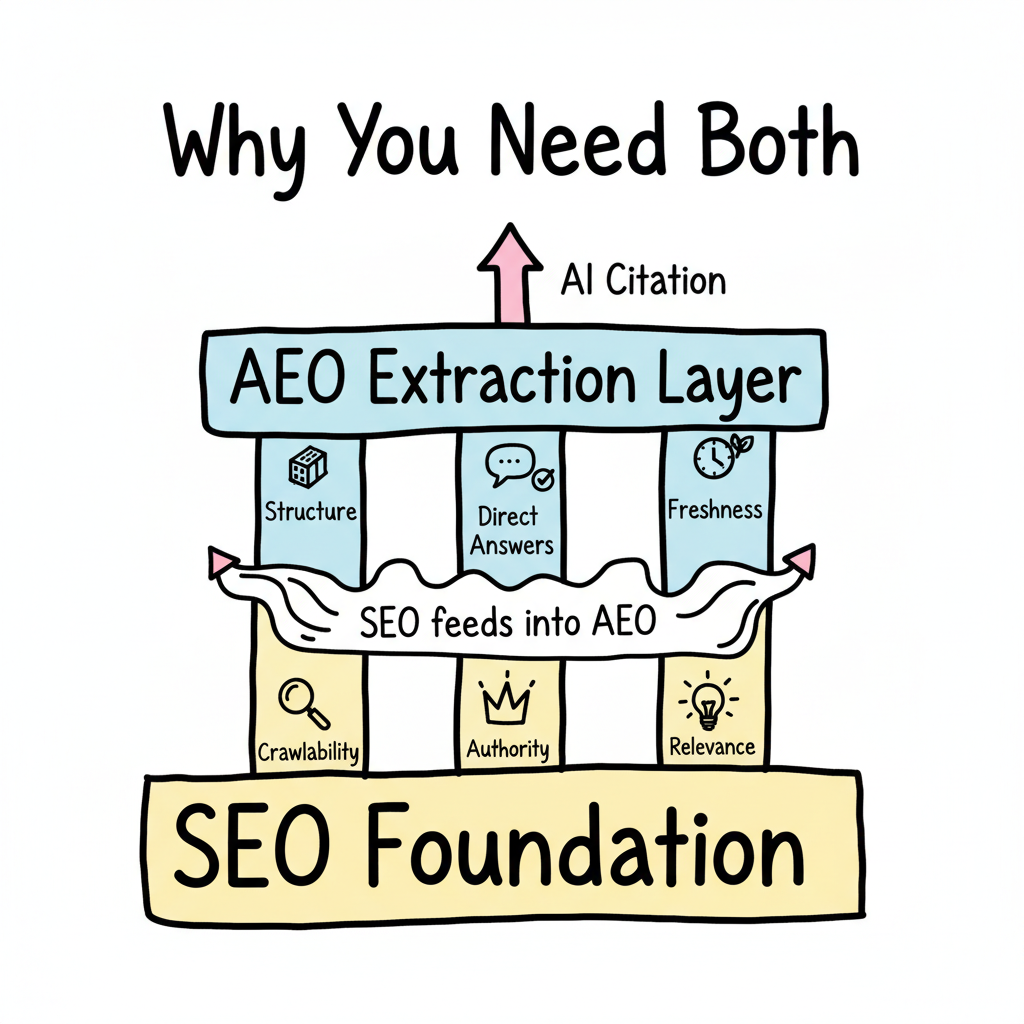
Why You Need Both AEO and SEO
AEO doesn't replace SEO—it depends on it. Research shows that Google AI Overviews maintain significant overlap with organic results. Pages that rank well traditionally have higher chances of appearing in AI responses.
SEO provides the foundation:
- Crawlability ensures AI systems can access your content
- Authority signals help AI determine trustworthiness
- Relevance matching helps AI understand what your content covers
AEO adds the extraction layer:
- Clear structure makes content quotable
- Direct answers match what AI systems seek
- Freshness signals improve citation likelihood
Think of it this way: SEO earns relevance. AEO earns selection.
Quick Wins for AEO
If you already have strong SEO, these AEO optimizations build on that foundation:
Structure content for extraction
- Lead each section with the key point
- Keep paragraphs under 80 words
- Write standalone statements that make sense without context
Add FAQ sections
- Use questions that match how users actually ask
- Provide direct, specific answers
- Keep answers concise but complete
Include specific data
- Statistics with sources
- Concrete numbers over vague claims
- Updated information with clear dates
Optimize URLs
- Natural language URLs (4-7 words) outperform keyword-stuffed URLs by approximately 11% in AI citations
Use structured data strategically
- Prioritize FAQ schema for question-and-answer sections, Article or BlogPosting schema for editorial content, and HowTo schema for instructional guides. These specific Schema.org types are the most commonly extracted by AI systems when selecting answer sources. Go beyond generic structured data to signal exactly what type of content each page contains.
Technical AEO Checklist
Ensure your site meets these technical prerequisites for AEO readiness:
- Allow AI crawlers: Check your robots.txt to ensure GPTBot (OpenAI), ClaudeBot (Anthropic), and CCBot (Common Crawl, used by many LLM training pipelines) are not blocked. These user agents must be able to access your content for AI systems to index and cite it.
- Implement specific schema types: Go beyond generic structured data. Use FAQ schema for Q&A content, Article or BlogPosting schema for editorial content, and HowTo schema for step-by-step guides. Refer to the schema markup implementation guide for detailed examples.
- Validate schema markup: Use Google Rich Results Test and Schema.org validator to confirm your markup is error-free. Invalid schema is worse than no schema -- it can confuse AI systems about your content's structure.
- Optimize for conversational queries: Structure content around natural-language questions. Voice search now accounts for over 1 billion queries per month globally, and voice queries tend to be 3-5x longer than typed searches, making conversational optimization essential. Explore voice search optimization strategies to capture this growing segment.
- Name AI platforms explicitly: Mention Google AI Overviews, ChatGPT, Perplexity, Claude, and Gemini by name in relevant content so AI systems associate your content with their ecosystems.
- Build knowledge graph presence: Claim and optimize your Google Business Profile, ensure Wikipedia and Wikidata entries are accurate if applicable, and maintain consistent entity data (name, description, relationships) across the web.
Key Takeaways
AEO and SEO serve different but complementary purposes. SEO gets your pages ranked; AEO gets your content cited in AI responses.
Neither replaces the other. Strong SEO foundations support AEO success. Without crawlability and authority, AI systems won't find or trust your content.
The shift is real. With Google AI Mode reaching over 2 billion monthly users, optimizing only for traditional rankings means missing significant visibility opportunities.
Start with structure. Most AEO improvements involve restructuring existing content rather than creating new pages. Focus on making your best content more extractable. Consider working with an AEO marketing consultant to identify quick wins in your existing content library.
FAQs
Is SEO Dead in 2026?
No. SEO remains essential for visibility in traditional search results and provides the foundation that AEO builds upon. Without SEO fundamentals like crawlability, indexing, and relevance signals, AI systems won't surface your content. SEO and AEO work together rather than one replacing the other.
Is AEO Only for Big Brands?
No. AEO rewards content clarity and answer quality over brand size. Smaller sites with well-structured, authoritative content can earn AI citations even when competing against larger competitors. The key is providing clear, trustworthy answers rather than having the biggest domain. AEO marketing for startups offers a level playing field against established competitors.
How Long Does AEO Take to Show Results?
Results vary by platform. Answer engines pick up new and updated content faster than traditional search—content updated within 13 weeks shows significantly higher citation rates. Initial improvements to structure and formatting can impact AI visibility within weeks, while building full authority takes longer.
Should I Prioritize AEO or SEO?
Start with SEO if you don't have it. AEO depends on SEO fundamentals. If you already rank well, add AEO optimizations to capture AI visibility. For most brands, the approach isn't either/or—it's SEO first, then AEO layered on top.
Will AEO Replace SEO?
No. AEO complements SEO rather than replacing it. SEO drives organic traffic through search engine rankings, while AEO focuses on getting your content selected as the direct answer by AI platforms like ChatGPT, Perplexity, and Google AI Overviews. The strongest strategy combines both: SEO for click-through traffic and AEO for AI visibility. As zero-click searches grow beyond 60% of all queries, both disciplines become essential.
What Is the Difference Between AEO and GEO?
AEO (Answer Engine Optimization) targets AI-powered answer engines that provide direct responses to user queries, such as voice assistants and featured snippets. GEO (Generative Engine Optimization) targets generative AI systems that synthesize information from multiple sources into narrative responses, like Google AI Overviews and ChatGPT. The key difference: AEO aims to be THE answer, while GEO aims to be cited as a source within a generated response.
What Is AEO in Digital Marketing?
AEO, or Answer Engine Optimization, is a digital marketing strategy focused on optimizing content so AI-powered platforms select it as their answer source. This includes structuring content for featured snippets, voice assistants, and AI chatbots. Key AEO tactics include entity-based optimization, schema markup implementation, conversational content formatting, and building topical authority through content clusters.
How Do You Measure AEO Success?
Measure AEO success through AI-specific metrics: AI visibility score (how often you appear in AI responses), citation count (how frequently AI engines reference your content), share of voice in AI results, and AI referral traffic in your analytics. Traditional metrics like featured snippet capture rate and People Also Ask appearances remain relevant. Track these alongside standard SEO metrics to get a complete picture of search performance.