
For two decades, digital visibility meant one thing: ranking higher on Google. That mental model no longer holds. In 2026, search is no longer just a competition for page positions—it’s a competition for who gets to answer the question.
The urgency behind AEO is quantifiable: over 65% of Google searches now result in zero clicks, meaning the user gets their answer directly from the SERP or an AI-generated response without visiting any website. If your content is not optimized for these zero-click environments, you are invisible to a growing majority of searchers.
Answer Engine Optimization (AEO) has emerged as the complementary discipline to traditional SEO, designed to ensure your content appears in AI-generated answers, featured snippets, and voice search results. Understanding how AEO differs from SEO—and when to prioritize each—determines whether your brand stays visible or disappears into algorithmic obscurity.
This guide breaks down the complete comparison between AEO and SEO, including practical strategies for building an integrated approach.
Introduction: The SEO Evolution Challenge
Search behavior has fundamentally shifted. Users increasingly ask questions like:
- “What’s the best way to do X?”
- “What tools should I use for Y?”
- “Explain Z like I’m not technical.”
They expect direct answers, not lists of links to explore. Google’s AI Overviews now appear in over 60% of informational queries. ChatGPT handles over 100 million weekly active users asking questions that previously drove Google searches. Perplexity, Claude, and other AI assistants continue capturing query volume.
The result: ranking #1 organically no longer guarantees traffic. If an AI-generated answer satisfies the user’s query, they may never click through to your content. Worse, if your competitor’s content gets cited in that AI answer while yours doesn’t, you’ve lost visibility at the moment of highest intent.
This evolution doesn’t make SEO obsolete. It makes SEO insufficient alone. Enter Answer Engine Optimization.
What Is SEO? (Traditional Search Engine Optimization)
Search Engine Optimization focuses on improving website visibility in traditional search engine results pages (SERPs). The discipline has evolved over 25+ years but maintains core principles:
Primary Goal: Drive organic traffic by ranking higher for target keywords.
Core Tactics:
- Keyword research and targeting
- On-page optimization (titles, meta descriptions, headers, content)
- Technical SEO (site speed, mobile optimization, crawlability)
- Link building and authority development
- Content creation aligned with search intent
Success Metrics:
- Keyword rankings
- Organic traffic volume
- Click-through rates
- Conversions from organic search
Typical Timeline: 3-6 months to see meaningful ranking improvements; 6-12 months for competitive keywords.
SEO remains foundational because search engines still process billions of queries daily. Google alone handles over 8.5 billion searches per day. Traditional organic results still drive significant traffic, particularly for transactional and navigational queries.
However, SEO’s limitation becomes clear when users don’t need to visit a website to get their answer. That’s where AEO optimization strategies enter.
What Is AEO? (Answer Engine Optimization)
Answer Engine Optimization focuses on structuring content to appear in AI-generated answers, featured snippets, and direct response formats. AEO recognizes that modern search increasingly delivers answers rather than links.
Primary Goal: Become the source that AI systems extract and cite when answering user queries.
Core Tactics:
- Question-based content structuring (Q&A formats)
- Schema markup implementation (FAQ, HowTo, Article)
- Concise, extractable answer formatting
- Entity optimization for Knowledge Graph inclusion
- Natural language optimization for voice search
- Authority building for AI citation trust
Beyond ChatGPT, Perplexity, and Claude, your AEO strategy must also account for Google Gemini, Microsoft Copilot, and Google AI Mode—the newest AI-powered SERP feature that synthesizes answers directly in a sidebar alongside traditional results. For a broader look at how these platforms fit into your overall strategy, see our guide on AEO best practices for 2026.
Success Metrics:
- Featured snippet appearances
- AI Overview citations
- Voice search answer selections
- Brand mentions in ChatGPT/Perplexity responses
- Knowledge Panel presence
Featured snippets are closely related to People Also Ask (PAA) boxes, which serve as another high-value AEO format. Structuring content to answer PAA questions concisely (40-60 words) increases your chances of appearing in both features.
Typical Timeline: 2-4 months for featured snippet gains; 3-6 months for consistent AI citations.
The key distinction: SEO brings users to your content, while AEO brings your content into the answers users see. You need both motion paths to compete effectively in 2026. Understanding the fundamental differences between GEO and AEO approaches helps refine your strategy.
Visual Comparison Table: SEO vs AEO
Aspect | SEO | AEO |
Primary Goal | Rank higher in SERPs | Appear in direct answers |
Target Platforms | Google, Bing organic results | AI Overviews, ChatGPT, Perplexity, voice assistants |
Content Focus | Comprehensive, keyword-optimized pages | Concise, extractable answers |
Query Types | All query types | Question-based, informational queries |
Keyword Strategy | Volume-based, long-tail variations | Intent-based, conversational phrasing |
Success Metric | Rankings and traffic | Citations and answer presence |
Technical Focus | Site speed, crawlability, mobile | Schema markup, structured data, entity signals |
Link Building | High importance for authority | Moderate; authority matters but differently |
Content Structure | Headers, keywords, internal links | Q&A format, direct answers, bullet points |
User Journey | Click to website required | Answer delivered without click |
Timeline | 3-6 months typical | 2-4 months typical |
Measurement Tools | Google Search Console, rank trackers | AI citation trackers, featured snippet monitors |
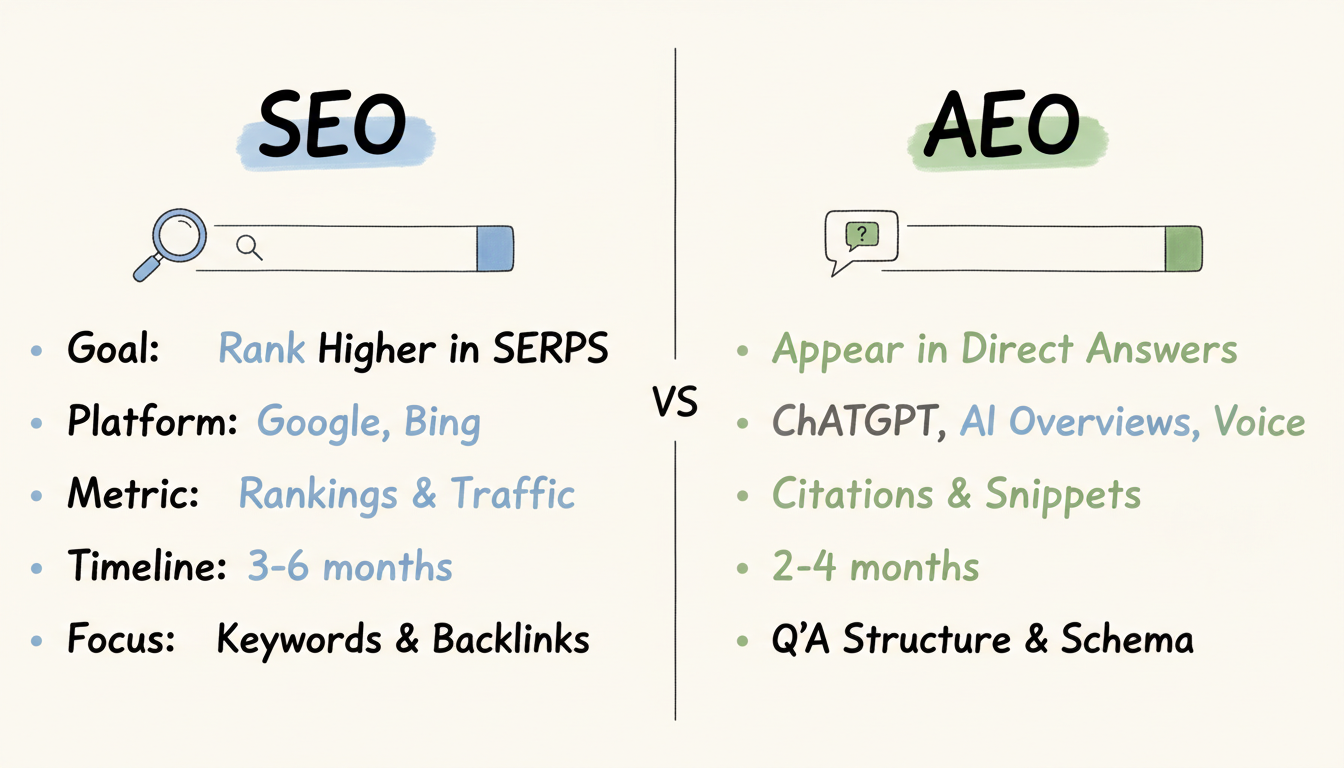
AEO vs SEO vs GEO: The Triple Comparison
While the AEO vs SEO comparison captures the primary strategic divide, a third discipline has emerged that completes the picture: Generative Engine Optimization (GEO). GEO focuses specifically on optimizing content for generative AI outputs—the synthesized responses produced by Google AI Mode, Gemini, Microsoft Copilot, ChatGPT, and Perplexity.
The distinction between AEO and GEO is subtle but important. AEO targets direct-answer features like featured snippets, People Also Ask boxes, and voice search optimization guide responses where your content is extracted and displayed. GEO targets LLM-generated responses where the model synthesizes information from multiple sources and may or may not cite you directly. For deeper tactics, explore our guide on advanced GEO optimization tactics.
Dimension | SEO | AEO | GEO |
Goal | Rank higher in organic SERPs | Appear in direct-answer features | Get cited in AI-generated responses |
Primary Platforms | Google, Bing organic results | Featured snippets, PAA, voice assistants | Google AI Mode, Gemini, ChatGPT, Copilot, Perplexity |
Key Tactics | Keywords, backlinks, technical optimization | Schema markup, Q&A formatting, concise answers | Entity authority, citation-worthy content, topical depth |
Success Metrics | Rankings, organic traffic, CTR | Snippet ownership, answer presence | AI citations, brand mentions in LLM outputs |
Content Format | Long-form, keyword-optimized pages | Extractable answers, structured data | Authoritative, entity-rich, original research |
Answer engines don’t just mean chatbots. Reddit and YouTube have become critical discovery surfaces that LLMs and AI overviews frequently cite. Brands referenced in Reddit discussions or YouTube transcripts gain indirect AEO authority, as platforms like HubSpot and G2 have demonstrated.
An emerging umbrella term—“OmniSEO” or “Search Everywhere Optimization”—encompasses all three disciplines. The core insight is practical: most businesses need SEO, AEO, and GEO working in concert, not a choice between them. The brands that treat all three as an integrated system will capture visibility across every surface where their audience searches for answers.
When to Use SEO vs AEO
Neither strategy universally outperforms the other. The right choice depends on your goals, audience, and query types you’re targeting.
Prioritize SEO When:
Transactional Queries Dominate Users searching “buy [product]” or “[service] pricing” typically need to visit a website to complete their transaction. SEO drives these high-intent visitors to conversion pages.
Brand Discovery Matters For companies building awareness, ranking for industry terms puts your brand in front of prospects researching solutions. SEO visibility at the top of the funnel feeds your pipeline.
Content Depth Is Your Advantage Long-form guides, detailed comparisons, and comprehensive resources benefit from SEO. Users actively seeking depth will click through to consume your expertise.
Local Business Focus Local SEO remains critical for businesses serving geographic markets. Google Business Profile optimization, local citations, and map pack rankings drive foot traffic and calls.
Prioritize AEO When:
Informational Queries Are Your Battleground “What is [topic]?” and “How do I [task]?” queries increasingly receive AI-generated answers. AEO ensures your content gets cited as the source.
Voice Search Relevance Voice assistants deliver single answers, not ten blue links. If your audience uses Alexa, Siri, or Google Assistant, voice search optimization determines whether you’re the answer.
AI Platform Visibility Users asking ChatGPT or Perplexity for recommendations won’t see your website unless those platforms cite you. AEO builds the authority and structure that earns citations.
Featured Snippet Opportunities For queries with clear “position zero” potential, AEO tactics—concise answers, proper formatting, schema markup—directly improve featured snippet capture.
The Reality: You Usually Need Both
Most businesses benefit from integrated SEO + AEO strategies. SEO builds the foundation—crawlable, authoritative, keyword-relevant content. AEO layers on the optimization that makes that content extractable and citable by answer engines.
Trying to do AEO without SEO fundamentals is like building a house without a foundation. Answer engines rely on traditional search signals (authority, relevance, trust) to determine which sources to cite.
The Integrated Approach: SEO + AEO Strategy
The most effective 2026 search strategies treat SEO and AEO as complementary disciplines, not competing priorities.
Foundation: Strong SEO Fundamentals
Before layering AEO, ensure your SEO basics are solid:
- Technical health (fast load times, mobile optimization, clean crawlability)
- Keyword-aligned content covering your core topics
- Authority signals (quality backlinks, brand mentions, domain age)
- User experience that supports engagement metrics
Without these fundamentals, answer engines have no reason to trust or cite your content.
Layer 1: Content Structure for Answers
Transform existing SEO content to be more AEO-friendly:
Add Q&A Sections Every comprehensive guide should include explicit question-and-answer formatting. Use the actual questions people ask (check People Also Ask boxes and keyword research tools).
Lead with Direct Answers Don’t bury your answer after four paragraphs of introduction. Open sections with concise, quotable answers, then elaborate with supporting detail. This approach aligns with schema markup best practices for AI search visibility.
Implement Schema Markup FAQPage schema, HowTo schema, and Article schema help answer engines understand and extract your content. This isn’t optional in 2026—it’s table stakes. When implementing schema markup, reference the schema.org vocabulary directly. The FAQPage and HowTo schemas you implement should validate against schema.org specifications to ensure both traditional search engines like Google and Bing (as well as Yahoo) can parse them correctly.
Layer 2: Entity Optimization
Answer engines increasingly understand entities—people, companies, concepts, products—rather than just keywords.
- Ensure your brand has consistent entity signals across authoritative sources
- Build Knowledge Graph presence through structured data and authoritative mentions
- Connect related entities (founders to companies, products to brands)
Entity-Based Optimization: The Shared Foundation of AEO and SEO
Entity-based optimization is the practice of structuring content around named entities—people, places, concepts, and brands—that search engines and LLMs recognize via their knowledge graphs. Rather than targeting isolated keywords, this approach builds a web of semantically connected concepts that both traditional search algorithms and AI answer engines can parse and evaluate.
Natural Language Processing (NLP) models decompose your content into entities and relationships. When Google’s systems or an LLM like Gemini processes a page, they identify which entities are discussed, how they relate to each other, and whether the page adds meaningful context. This entity-relationship map directly influences both traditional Knowledge Panel eligibility and LLM citation selection.
Practical tactics for entity-based optimization include:
- Implement schema.org structured data to explicitly declare entities on your pages. Use Organization, Person, Article, and FAQPage schemas to make entity relationships machine-readable.
- Build topical authority around entity clusters. If your core entity is “answer engine optimization,” ensure your content also covers closely related entities like “featured snippets,” “schema.org,” “Knowledge Panel,” and “AI citations.”
- Define your brand entity clearly across authoritative surfaces: Google Business Profile, Wikipedia, Wikidata, LinkedIn, and industry directories.
Domain authority and page authority serve as trust signals that reinforce entity credibility. A page with strong authority signals discussing a well-defined entity is far more likely to earn both traditional rankings and AI citations.
Semantic relevance scoring is the mechanism LLMs use to decide which sources to cite. If your page discusses “answer engine optimization” but never mentions related entities like “featured snippets” or “schema.org,” search engines may not fully understand your topical coverage—and AI answer engines will look elsewhere for comprehensive sources.
Building E-E-A-T for Answer Engines: Trust Signals That Matter
E-E-A-T (Experience, Expertise, Authoritativeness, Trustworthiness) has always mattered for SEO, but it matters even more for AEO. When LLMs select which content to cite or synthesize into an answer, they evaluate source credibility through multiple trust signals. Pages that demonstrate genuine expertise get cited; thin or unattributed content gets ignored.
Actionable E-E-A-T tactics for answer engine optimization:
- Add author bios with credentials and links to professional profiles (LinkedIn, industry publications). AI systems increasingly factor authorship signals into citation decisions.
- Incorporate original research and proprietary data. AI systems preferentially cite unique data points that cannot be found elsewhere. Surveys, case studies, and first-party benchmarks give LLMs a reason to reference your content specifically.
- Include expert interviews or co-branded content with recognized authorities in your field. Content that references or features known experts inherits their entity authority.
- Maintain content freshness through regular audits. Update statistics, add new platform mentions, refresh publication dates. AI systems weigh recency when selecting sources—stale content loses citation priority. For a systematic approach, use an AEO content audit checklist to keep your pages current.
- Use your CMS to implement structured author metadata and content update timestamps programmatically. This ensures freshness signals are always accurate without manual intervention.
The key insight: E-E-A-T is not just a Google ranking factor. It directly influences whether LLMs trust and cite your content. Building genuine authority through expertise, original data, and transparent authorship is the most sustainable path to answer engine visibility. Ready to put this into action? Follow our AEO implementation roadmap to build your strategy step by step.
Layer 3: Citation Authority Building
AI platforms cite sources they trust. Building that trust requires:
- Coverage in authoritative publications (not press releases—actual editorial)
- Consistent expertise signals across your content
- Author credibility for bylined content
- Brand mentions from recognized industry sources
Many businesses find that working with specialized AEO services accelerates this authority-building process.
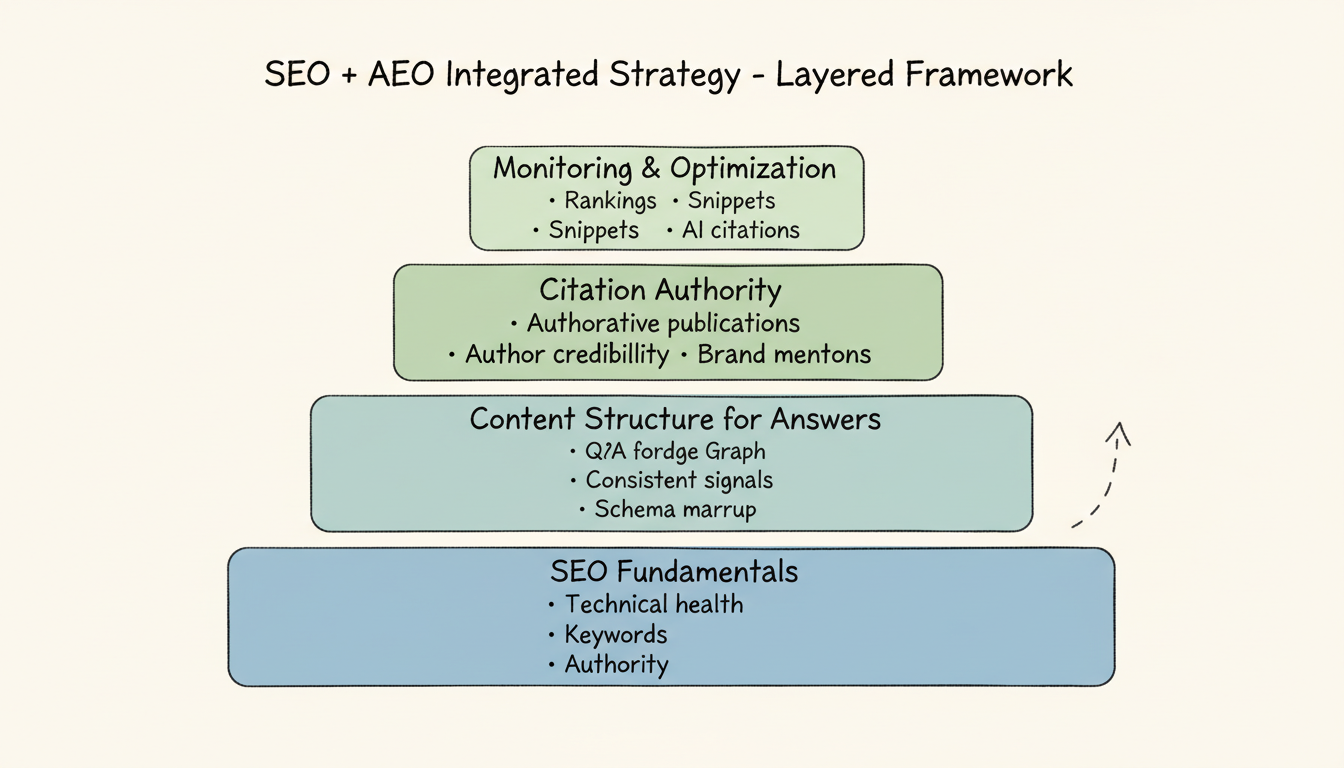
Layer 4: Monitoring and Optimization
Track performance across both SEO and AEO metrics:
- Traditional rankings and organic traffic (SEO)
- Featured snippet appearances (AEO)
- AI Overview citations for target queries (AEO)
- Brand monitoring in ChatGPT/Perplexity responses (AEO)
Adjust strategy based on where you’re winning and where gaps exist. Consider implementing Google Analytics 4 tracking for AI search to measure comprehensive performance.
Measuring AEO Success: Metrics, Tools, and Emerging Kpis
Traditional SEO has mature KPIs—rankings, traffic, click-through rate—that have been refined over decades. AEO introduces a new measurement challenge: how do you track visibility inside an AI-generated answer? The metrics are still evolving, but several key indicators have emerged as standard practice in 2026.
AI Visibility Score
Your AI Visibility Score measures how frequently your brand appears in AI-generated answers across target queries. Tools like Semrush’s AI Visibility Toolkit now track this metric, giving you a quantified view of your presence in AI Overviews, Gemini responses, and other generative outputs. Think of it as the AEO equivalent of your domain’s organic visibility score.
AI Exposure Rate
AI Exposure Rate represents the percentage of your target queries where an AI overview or answer engine response appears at all. This metric helps you understand how much of your keyword landscape is affected by AI answers—and therefore how urgently you need AEO optimization for each query cluster.
Citation Tracking
Citation tracking monitors when AI systems cite your content as a source and which specific pages earn those citations. This is the most direct measure of AEO success: if an LLM references your page when answering a user’s question, your content has achieved answer engine visibility. For a deeper dive into tooling and methodology, see our AEO measurement and tracking guide.
Brand Mention Monitoring
Tracking unlinked brand mentions across AI platforms, Reddit, YouTube, and other discovery surfaces provides a leading indicator of AEO authority. Brands that are frequently discussed—even without direct links—build the kind of entity recognition that LLMs rely on when selecting citation sources. Monitoring tools that scan AI outputs for your brand name reveal visibility that traditional rank trackers miss entirely.
The zero-click reality reinforces why these metrics matter: with over 65% of Google queries resulting in zero clicks, visibility inside the answer itself has become the new conversion point. A recommended measurement stack combines Google Search Console (for traditional SEO baselines) with AI visibility tracking, citation monitoring, and brand mention tools to capture the full picture of your search presence.
Budget Allocation Between SEO and AEO
For most businesses, budget allocation follows this general framework:
Early-Stage Companies (Limited Budget)
- 70% SEO / 30% AEO
- Rationale: Build organic foundation first; layer AEO on proven content
Growth-Stage Companies
- 50% SEO / 50% AEO
- Rationale: Maintain ranking momentum while capturing answer engine visibility
Established Brands
- 40% SEO / 60% AEO
- Rationale: Strong SEO foundation exists; focus on emerging AI search channels
Specific Scenarios That Shift Allocation:
High informational query volume in your industry: Increase AEO allocation to 60-70%
E-commerce with transactional focus: Maintain 60-70% SEO allocation
B2B with long consideration cycles: Balance 50/50; both channels influence decisions
Local business: 70% SEO (local SEO specifically) / 30% AEO
These aren’t rigid rules. Track performance and reallocate based on which channel delivers better ROI for your specific situation. Startups often benefit from tailored AEO marketing strategies that balance budget constraints with growth objectives.
Timeline Expectations: SEO vs AEO
Understanding realistic timelines prevents frustration and enables proper planning.
SEO Timeline (3-6 Months for Results)
Month 1-2: Technical audits, keyword research, content planning, initial optimizations
Month 3-4: Content publication, link building initiation, ranking movement begins
Month 5-6: Meaningful ranking improvements, traffic growth becomes measurable
Month 6-12: Competitive keywords start ranking, compounding traffic gains
SEO is a long game. The investment compounds over time, but patience is required.
AEO Timeline (2-4 Months for Results)
Month 1: Schema implementation, content restructuring for Q&A format, baseline tracking
Month 2: Featured snippet targeting, answer optimization, initial snippet captures
Month 3-4: AI citation monitoring shows improvements, voice search testing validates progress
Month 4-6: Consistent featured snippet presence, measurable AI platform citations
AEO typically shows faster initial results because you’re optimizing existing content for new formats rather than building authority from scratch. However, sustained AEO success requires the SEO foundation.
Combined Strategy Timeline
When running integrated SEO + AEO:
Month 1-3: SEO fundamentals + AEO quick wins (schema, featured snippets)
Month 4-6: SEO momentum building + AEO expansion to AI platforms
Month 6-12: Both channels delivering measurable traffic and visibility
Common Misconceptions: Is AEO Replacing SEO?
The most persistent myth in search marketing: “AEO is replacing SEO.” Let’s address this directly.
Myth 1: SEO Is Dead
Reality: SEO remains the foundation of visibility in traditional search engines. Google processes 8.5+ billion searches daily. Organic traffic still drives significant business results. Without SEO fundamentals, answer engines won’t trust or cite your content.
Myth 2: AEO Makes Rankings Irrelevant
Reality: Studies consistently show that sources cited by AI platforms typically rank in top positions for traditional search. The sources ChatGPT cites tend to rank in the top 5 on Google. Understanding how search engine optimization works with AI reveals this correlation.
Myth 3: You Must Choose One or the Other
Reality: AEO builds on SEO, not instead of it. The disciplines share foundational elements (authority, relevance, trust) while differing in tactical execution. Successful strategies layer AEO onto SEO foundations.
Myth 4: AEO Only Matters for Voice Search
Reality: AEO impacts Google’s AI Overviews (visible to billions), ChatGPT citations, Perplexity answers, and featured snippets—far beyond voice assistants alone. Optimizing for Google AI Overviews represents just one component of comprehensive AEO.
Myth 5: Small Businesses Don’t Need AEO
Reality: Small businesses often benefit most from AEO because featured snippets and AI citations can level the playing field against larger competitors with bigger SEO budgets. A local accounting firm optimizing for “how to file small business taxes” can capture the featured snippet regardless of domain authority.
Myth 6: AEO Requires Completely New Content
Reality: Most AEO success comes from restructuring and optimizing existing content rather than creating new assets. Adding Q&A sections, implementing schema markup, and reformatting answers within current pages often delivers faster results than building from scratch.
The Accurate Frame:
SEO ensures you’re visible, crawlable, and competitive. AEO ensures that when someone asks a question—whether to Google, ChatGPT, or their smart speaker—your content provides the answer.
You need both. The question isn’t which to choose, but how to balance investment based on your specific situation. Many organizations find value in comparing different AI search platforms to understand where their audience searches for answers.
FAQs
What does AEO stand for? AEO stands for Answer Engine Optimization. It refers to strategies that help content appear in AI-generated answers, featured snippets, and direct response formats across search engines and AI platforms.
Is AEO the same as GEO? Not exactly. AEO (Answer Engine Optimization) focuses on appearing in direct answers and featured snippets. GEO (Generative Engine Optimization) specifically targets visibility in AI-generated content from large language models like ChatGPT, Claude, and Gemini. The distinctions are covered in detail in our GEO engine optimization guide.
How do I know if I need AEO? If your target audience asks informational questions that AI platforms can answer directly, you need AEO. Check whether AI Overviews appear for your target keywords, monitor if competitors get cited in ChatGPT responses, and assess voice search relevance for your industry.
Can I do AEO without SEO? Not effectively. AEO depends on SEO fundamentals like crawlability, authority, and relevance. Answer engines cite sources they trust—and trust signals come from traditional SEO factors. Build SEO first, then layer AEO optimization.
How long does AEO take to work? Featured snippet improvements often appear within 2-4 months of implementing AEO tactics. AI platform citations take 3-6 months as algorithms recognize your authority and content structure improvements.
What’s more important for 2026: SEO or AEO? Both are essential. SEO drives organic traffic through traditional rankings. AEO ensures visibility in AI-generated answers. The optimal balance depends on your industry, audience, and query types, but most businesses need integrated strategies covering both disciplines.
Does AEO require different tools than SEO? Partially. Traditional SEO tools (Search Console, rank trackers, technical auditors) remain relevant. AEO adds AI citation monitoring tools, featured snippet trackers, and voice search testing platforms. Reviews of the best AEO tools can help identify the right stack for your needs.
Should I hire separate teams for SEO and AEO? Not necessarily. The skill sets overlap significantly. Most experienced SEO practitioners can learn AEO tactics quickly since they build on existing knowledge. However, dedicated AEO specialists can accelerate results for organizations prioritizing AI search visibility. If you’re considering external support, our guide on how to choose an AEO agency outlines key evaluation criteria.
What Is the Difference Between AEO, SEO, and GEO?
SEO optimizes content for traditional search engine rankings on Google and Bing. AEO (answer engine optimization) focuses on earning visibility in direct-answer formats like featured snippets, People Also Ask boxes, and voice assistant responses. GEO (generative engine optimization) targets AI-generated answers from LLMs like Gemini, ChatGPT, and Microsoft Copilot. Most effective digital strategies now integrate all three approaches.
How Do You Measure AEO Performance?
Track AEO performance using a combination of traditional and emerging metrics. Monitor featured snippet ownership and People Also Ask appearances in Google Search Console. Use AI visibility tools like Semrush’s AI Visibility Toolkit to track your AI Visibility Score and citation frequency. Monitor brand mentions across AI platforms, and measure your AI Exposure Rate—the percentage of target queries triggering AI-generated responses.
What Is Entity-Based Optimization and Why Does It Matter for AEO?
Entity-based optimization structures your content around recognized concepts, people, and brands that search engines and LLMs store in knowledge graphs. By aligning your content with schema.org markup, building topical authority, and ensuring semantic relevance, you help both traditional search engines and AI answer engines understand what your content covers and whether it deserves to be cited.
Does E-E-A-T Affect AEO Rankings?
Yes. E-E-A-T (Experience, Expertise, Authoritativeness, Trustworthiness) directly influences whether AI systems cite your content. LLMs evaluate source credibility through signals like author bios, original research, domain authority, and content freshness. Pages with strong E-E-A-T signals are more likely to appear in AI overviews, Gemini responses, and other answer engine outputs compared to thin or unattributed content.