
The marketing industry loves new acronyms. When AI search exploded in 2024-2025, "Answer Engine Optimization" (AEO) emerged as the supposed successor to traditional SEO. Agencies launched AEO services. Consultants rebranded as "AEO specialists." Industry publications declared SEO dead—again.
Then Google spoke up.
In December 2025, Google's Danny Sullivan and John Mueller addressed the AEO vs SEO debate directly on their Search Off the Record podcast. Their message was unambiguous: optimizing for AI search is the same as optimizing for traditional search.
This guide examines Google's official position on AEO, what it means for marketers, and why good SEO has always been—and remains—the foundation for visibility in any search format.
Danny Sullivan'S Official Position: "It'S the Same"
On December 18, 2025, Search Engine Roundtable reported on the Search Off the Record podcast episode where Danny Sullivan and John Mueller directly addressed the AEO terminology and whether businesses need to optimize differently for AI search features.
Their conclusion? There's no meaningful distinction between AEO and SEO.
Key Quotes from the Podcast
Danny Sullivan, Google's Search Liaison, explained that the fundamentals haven't changed:
"The same things that help you with traditional search—quality content, expertise, good user experience—those are exactly what help you appear in AI Overviews and AI Mode."
John Mueller echoed this sentiment, questioning the need for new terminology:
"If you're doing SEO well, you're already doing what you need to do for AI search. Adding new acronyms doesn't change the underlying principles."
The podcast specifically cautioned against treating AI search optimization as a separate discipline requiring different strategies, different teams, or different approaches.
The January 2026 Warning
Just weeks later, on January 8, 2026, Sullivan went further in a follow-up podcast appearance. He explicitly warned against fragmenting content into "bite-sized chunks for LLMs"—a common recommendation from the AEO consulting industry.
According to industry reporting on the January podcast, Sullivan stated clearly: "We don't want you to do that."
Sullivan explained that Google's engineers had confirmed this guidance. Creating artificial content structures specifically designed for AI extraction doesn't improve your chances of appearing in AI responses—and may actually harm overall content quality.
What AEO Actually Means (and Why Google Rejects It)
Answer Engine Optimization emerged as a concept to describe optimization for AI-powered search systems that generate direct answers rather than links. The term gained traction as tools like ChatGPT, Perplexity, and Google's own AI Overviews began reshaping search behavior.
The AEO Premise
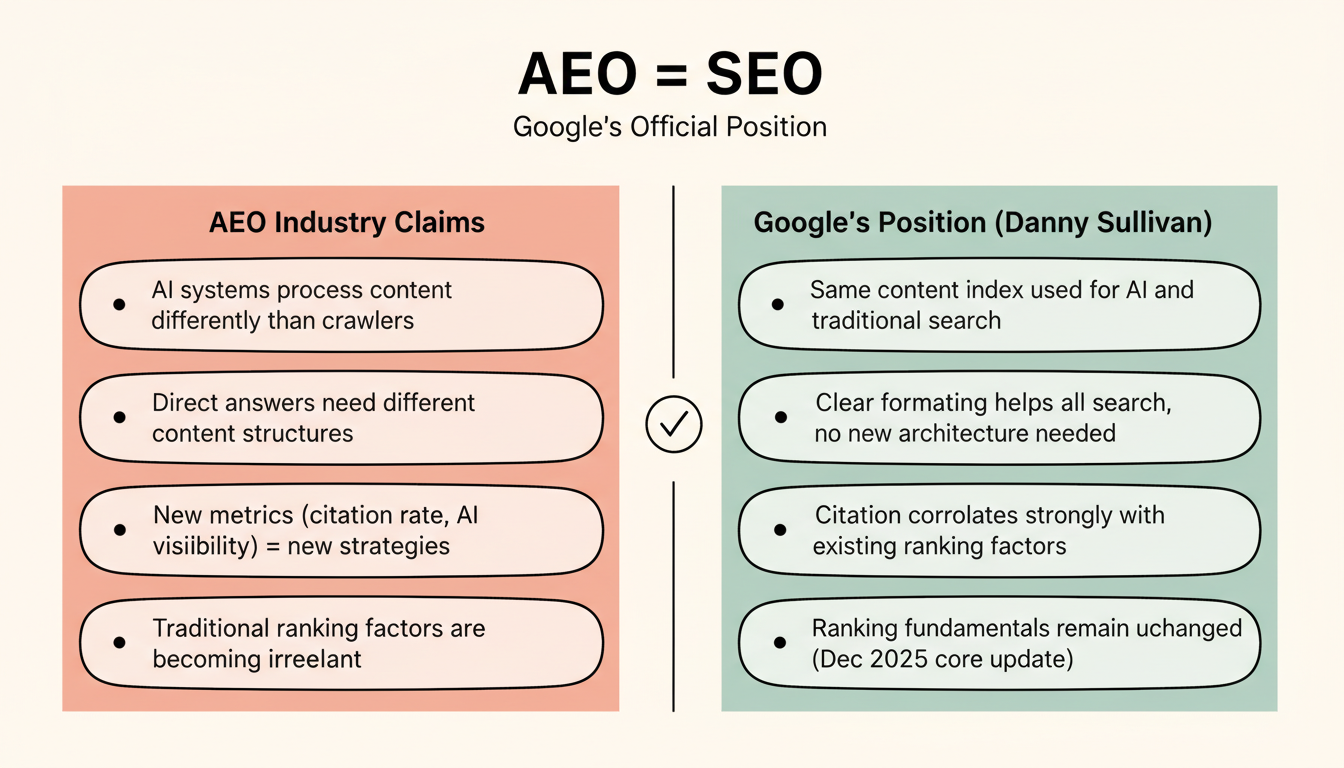
AEO proponents typically argue that:
- AI systems process content differently than traditional crawlers
- Direct answer generation requires different content structures
- New metrics (citation rate, AI visibility) require new strategies
- Traditional ranking factors are becoming irrelevant
These same claims also underpin GEO (Generative Engine Optimization), the latest acronym targeting optimization for generative AI outputs from platforms like ChatGPT, Perplexity, and Gemini. The proliferation of acronyms—AEO, GEO, AIO—itself illustrates the rebadging problem that Google's Search Liaison has repeatedly cautioned against.
Why Google Disagrees
Google's position undermines each of these claims:
On content processing: Google's AI systems use the same underlying content index as traditional search. Content that ranks well organically is the same content that gets cited in AI Overviews.
On content structure: While structured data and clear formatting help all search systems, Google isn't asking for fundamentally different content architecture for AI features.
On metrics: Citation in AI Overviews correlates strongly with traditional ranking factors—authority, relevance, E-E-A-T signals. New metrics are interesting but not indicative of new optimization requirements.
On ranking factors: The December 2025 core update analysis showed that sites ranking well in traditional search also performed well in AI Overviews. The ranking fundamentals remain unchanged.
AEO vs SEO vs GEO: What Google Actually Says About All Three
As the AEO vs SEO debate intensified through 2025, a third acronym entered the conversation: GEO, or Generative Engine Optimization. GEO refers specifically to optimizing content for generative AI outputs—the responses produced by ChatGPT, Perplexity, Gemini, and Microsoft Copilot. While AEO focuses on answer engines broadly, GEO narrows the lens to generative AI platforms that synthesize information into original responses rather than returning ranked links.
The search interest in "aeo vs seo vs geo" has surged over 2500% year-over-year, reflecting a growing segment of marketers who are fragmenting their strategy into three separate buckets—each with its own tools, teams, and budget allocations. This fragmentation is exactly what Google has warned against.
Sullivan's guidance from the December 2025 and January 2026 podcasts applies equally to GEO. Google's AI Overviews and AI Mode draw from the same content index that powers traditional search results. The quality signals—authority, relevance, E-E-A-T, comprehensive coverage—are identical. There is no separate "generative optimization" algorithm within Google's ecosystem. For a deeper dive into all three disciplines, see our full AEO vs SEO vs GEO comparison.
Where GEO does have a legitimate distinction is outside Google's walls. Perplexity indexes the web in real time and weights source recency heavily. ChatGPT uses Bing's index for web browsing and draws from its training data for non-browsing queries. These platforms may weight signals differently than Google does. However, the optimization overlap across all three acronyms is roughly 90%: create authoritative, well-structured, expert-driven content, and you cover AEO, SEO, and GEO simultaneously.
The conclusion remains consistent with Google's position: three acronyms, one discipline. Do SEO well—comprehensive content, strong E-E-A-T signals, solid technical foundations—and you effectively optimize for all three.
AEO vs SEO Comparison Table: Industry Claims vs Google'S Position
Every competitor in the SERP uses a comparison table to break down AEO and SEO differences. Here is one grounded in Google's actual statements rather than marketing claims, covering the dimensions that matter most to practitioners.
| Dimension | AEO Industry Claim | Google's Official Position | Practical Takeaway |
|---|---|---|---|
| Content Structure | Content must be restructured into concise, LLM-friendly chunks | Sullivan: "We don't want you to do that." Comprehensive content serves all formats. | Write thorough, well-organized content. Do not fragment pages for AI extraction. |
| Ranking Signals | AI search uses fundamentally different ranking signals | AI Overviews draw from the same index and quality signals as traditional search. | Continue optimizing for authority, relevance, and E-E-A-T. |
| Team Organization | Dedicated AEO teams or specialists are needed | Sullivan cautioned against restructuring teams around "algorithmic manipulation strategies." | Keep unified SEO teams. Add AI monitoring to existing workflows. |
| Metrics | Entirely new KPI frameworks required for AEO | Citation correlates with traditional ranking factors. New metrics supplement, not replace. | Extend existing dashboards with AI citation tracking. No separate AEO dashboard needed. |
| Schema / Structured Data | AEO requires special schema markup beyond standard SEO | Standard schema.org markup (Article, FAQ, Organization) serves all search surfaces. | Implement comprehensive schema markup as part of standard technical SEO. |
| Content Strategy | Separate content calendars for AEO and SEO | One content strategy, well-executed, serves both traditional and AI search. | Maintain a single content strategy focused on user intent and quality. |
| Platform Scope | AEO is specifically for AI platforms, SEO is for Google | Good SEO practices serve visibility across Google's traditional and AI features alike. | Optimize for quality once. Monitor visibility across all platforms. |
What This Means for Your SEO Strategy
If Google says AEO equals SEO, what should marketers actually do? The answer is both simple and challenging: execute traditional SEO better.
Focus on Fundamentals
Content Quality: Create genuinely useful content that answers user questions comprehensively. Understanding how to optimize content for AI Overview starts with the same quality principles that have always mattered.
E-E-A-T Signals: Expertise, Experience, Authoritativeness, and Trustworthiness matter for AI citations just as they matter for traditional rankings. Build author profiles, demonstrate credentials, cite authoritative sources. To strengthen E-E-A-T in practice, add author schema markup that includes professional credentials and links to verified profiles on LinkedIn or industry publications. Include first-hand case data and original research rather than relying solely on secondary reporting. Cite primary sources—official documentation, peer-reviewed studies, direct quotes from authoritative figures. Display clear editorial standards and publication dates on every page. Each of these signals serves both traditional ranking algorithms and AI citation selection, reinforcing why a unified approach works.
Technical Excellence: Site speed, mobile optimization, structured data, crawlability—these technical foundations serve both traditional and AI search. For structured data specifically, implement Article or BlogPosting schema on editorial content, FAQ schema on pages with question-and-answer sections, Organization schema to strengthen knowledge graph presence, and HowTo schema for step-by-step instructional content. These schema.org markup types help Google's AI systems extract structured facts from your pages—directly reinforcing the "good SEO = good AEO" thesis. See our guide on schema markup priority types for AI search for implementation details.
User Experience: Pages that users engage with, share, and return to signal quality to all of Google's systems, including AI features.
What Not to Do
Based on Google's guidance, avoid these common AEO recommendations:
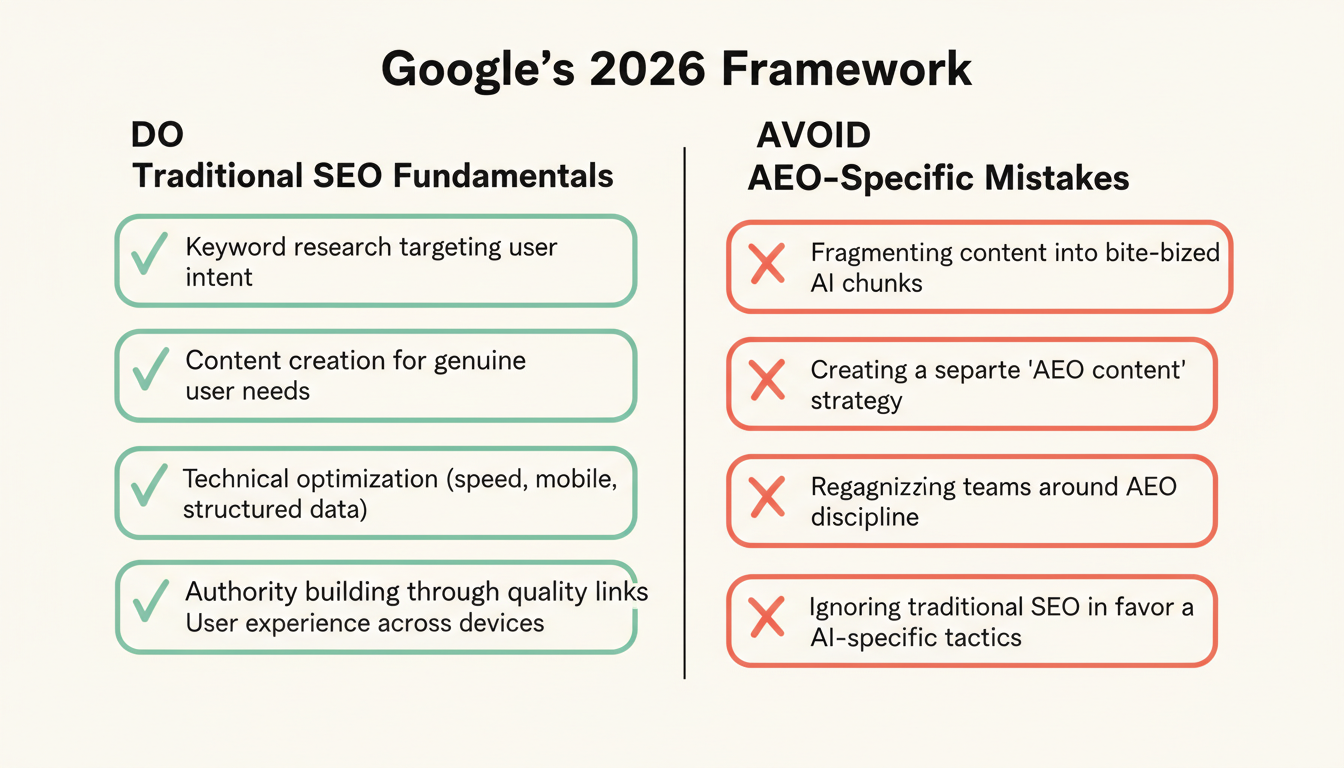
Don't fragment content for AI extraction: Creating artificial "bite-sized" content chunks optimized for LLM parsing goes against Google's explicit guidance.
Don't create separate "AEO content": Building a parallel content strategy for AI search wastes resources. Your existing content strategy, well-executed, serves both purposes.
Don't reorganize teams around AEO: Sullivan specifically questioned the value of restructuring organizations around "algorithmic manipulation strategies" for AI.
Don't ignore traditional SEO in favor of AEO: Some marketers have deprioritized traditional ranking factors to focus on AI-specific tactics. Google's position suggests this is counterproductive.
The Broader Context: Why the AEO Industry Emerged
Understanding why AEO became a marketing term helps explain Google's pushback.
Market Dynamics
When AI search features launched, an opportunity gap emerged:
- Businesses wanted guidance on the new landscape
- Traditional SEO agencies needed differentiation
- New specialists saw an opening to establish authority
- Industry publications needed fresh angles
AEO as terminology served all these needs. It created a sense of newness and urgency that traditional SEO advice lacked.
The Reality Gap
The problem? Practical AEO advice often recycled existing SEO best practices under new branding:
- "Optimize for questions" → FAQ optimization (existed for years)
- "Create authoritative content" → E-E-A-T (Google's existing framework)
- "Use structured data" → Schema markup (standard SEO practice since 2011)
- "Build topical authority" → Content clusters (established SEO strategy)
- "Track AI citations" → Brand monitoring (standard PR/SEO practice)
Even the "AEO-specific" measurement recommendations—tracking AI mentions, monitoring citation rates—are extensions of existing SEO analytics rather than a fundamentally new discipline. The tools may be newer, but the practice of monitoring where and how your brand appears in search results is as old as SEO itself.
Google's intervention essentially called out this rebadging exercise.
Where AEO and SEO Do Differ (Slightly)
Google's "AEO = SEO" position doesn't mean AI search features are identical to traditional rankings. Some nuances exist:
Citation vs. Ranking
Traditional SEO aims for rankings—positions in search results that drive clicks. AI search introduces citation—being named as a source within AI-generated responses.
The optimization approaches are the same, but the success metrics differ. You can track both ranking positions and citation frequency using tools like Google Analytics 4 AI search tracking.
Zero-Click Dynamics
AI responses often provide complete answers, reducing click-through to source pages. According to industry statistics, zero-click searches have increased with AI Overviews.
This doesn't change how you optimize, but it does change how you measure success and value. Brand visibility in AI responses carries value even without clicks.
Platform Specificity
Google's guidance applies to Google's ecosystem—AI Overviews, AI Mode, and related features. It doesn't necessarily extend to:
- ChatGPT (which uses different content signals)
- Perplexity (which has its own ranking algorithm)
- Other AI search tools
Optimization for non-Google AI platforms may require different approaches. Google is specifically saying that for their AI features, traditional SEO suffices.
Voice Search and AI Assistants: Same Fundamentals Apply
Voice search through AI assistants like Alexa, Siri, and Google Home is frequently cited as a reason AEO requires a different approach than SEO. Voice queries tend to be longer, more conversational, and more question-oriented than typed searches—leading some practitioners to argue that voice optimization is a distinct discipline.
However, Google's position holds here as well. Content that answers questions clearly and comprehensively for traditional search also performs well for voice queries. The content structure that earns featured snippets—concise definitions, logical organization, direct answers to specific questions—is the same structure that voice assistants pull from when responding to spoken queries.
This ties directly back to Sullivan's warning against fragmenting content strategies. Voice-optimized snippets are not a separate content type; they are the natural result of good content structure applied consistently across your site.
Practical Recommendations for 2026
Based on Google's official position, here's a practical framework:
Continue Investing in Traditional SEO
The fundamentals remain unchanged:
- Keyword research targeting user intent
- Content creation addressing genuine user needs
- Technical optimization ensuring discoverability
- Authority building through quality links and mentions
- User experience optimization across devices
Add AI-Specific Monitoring
While optimization approaches don't change, monitoring should expand:
- Track AI Overview appearances for target queries using an AI Overview app
- Monitor brand mentions in AI responses
- Measure citation frequency alongside rankings
- Compare click-through rates with and without AI features
How to Measure AI Search Visibility Without Separate AEO Metrics
Competitors in the AEO space often position detailed measurement frameworks as a reason to treat AEO as its own discipline. In practice, a unified measurement approach works better: extend your existing SEO metrics with three targeted additions rather than building a parallel analytics stack. For a comprehensive walkthrough, see our guide on measuring answer engine optimization performance.
First, track your AI Overview citation rate. Google Search Console now surfaces AI Overview impression data, and third-party tools like Semrush, Ahrefs, and specialized AI tracking platforms can show how often your domain appears as a cited source. Second, monitor zero-click rate changes for your target queries. Industry data shows that over 65% of Google searches now result in zero clicks, and AI Overviews accelerate this trend. Understanding which queries drive clicks versus brand impressions helps you allocate content resources effectively. Third, measure brand mention frequency in AI responses through manual sampling or tool-assisted monitoring across ChatGPT, Perplexity, and Gemini.
These are SEO metric extensions, not a new discipline. They belong in your existing analytics dashboards alongside traditional ranking and traffic data. No separate AEO reporting infrastructure is needed. Additionally, knowledge graph and entity SEO presence serves as a leading indicator of AI citation likelihood—if Google's Knowledge Graph recognizes your brand as an entity, generative AI systems are more likely to reference you as an authoritative source.
Avoid AEO-Specific Overhauls
Don't restructure content, teams, or budgets around AEO as a separate discipline. Instead:
- Integrate AI monitoring into existing SEO workflows
- Apply the same quality standards to all content
- Use existing SEO resources for AI optimization
- Evaluate AEO-specific tools on their actual utility, not marketing
Before investing in enterprise AEO services, consider whether your needs are better served by strengthening traditional SEO fundamentals.
Stay Informed, Stay Skeptical
The AI search landscape continues evolving. Stay current on developments, but maintain healthy skepticism toward:
- Claims that traditional SEO is obsolete
- New frameworks requiring different strategies
- Expensive tools promising AEO-specific insights
- Agencies selling AEO as fundamentally different from SEO
What About Other AI Platforms?
Google's "AEO = SEO" position specifically addresses Google's own AI features. But businesses also want visibility in ChatGPT, Perplexity, Claude, and other AI systems.
Platform Differences
Non-Google AI platforms may weight different signals:
- ChatGPT: Uses Bing's index for web browsing mode, making Bing SEO relevant for real-time queries. For non-browsing interactions, ChatGPT draws from its training data, which means established domain authority and widely-cited content carry disproportionate weight. The distinction between browsing mode and training data responses is important for understanding where your content appears.
- Perplexity: Indexes the web in real time and weights source recency heavily, making fresh content and regular publishing cadence more impactful than on other platforms. Its citation-first UX prominently displays source links, meaning Perplexity can drive meaningful referral traffic unlike most AI answer engines.
- Claude: Draws from training data with a knowledge cutoff and does not have real-time web access, meaning optimization for Claude depends on long-term content authority and widespread indexing rather than recency signals.
- Gemini: As Google's own AI assistant, Gemini is powered by the same content index as Google Search—making Sullivan's "AEO = SEO" argument strongest here. Content that ranks well in traditional Google search is highly likely to surface in Gemini responses.
- Reddit and Quora: Forum presence increasingly feeds AI training data across multiple platforms. Authoritative answers on these sites can influence how AI systems reference your brand and expertise, making community engagement a legitimate SEO signal for AI visibility.
See our detailed AEO platform comparison for signal differences across all major AI search tools.
The Practical Overlap
Despite platform differences, the practical optimization advice largely converges:
- Create authoritative, comprehensive content
- Build brand recognition and online presence
- Publish on sites that AI systems can access and trust
- Structure content clearly with logical organization
This overlap is why Google can credibly claim that good SEO serves AI visibility broadly—not just within Google's ecosystem. Whether you're targeting traditional search or optimizing content for generative AI, the core principles remain consistent.
The Future of AEO vs SEO Terminology
Will AEO persist as a term? Probably, regardless of Google's position.
Why AEO Won'T Disappear
- Marketing differentiation drives terminology
- Agencies benefit from perceived specialization
- Some AEO-specific tools and metrics provide genuine value
- AI search is different enough to warrant discussion
Why Google'S Position Matters
Even if AEO persists as terminology, Google's guidance matters because:
- It prevents unnecessary strategy fragmentation
- It protects businesses from overinvestment in rebadged services
- It clarifies that fundamentals remain paramount
- It provides cover to resist AEO-specific pressure
Understanding what is AEO in marketing helps clarify why Google's position is both accurate and important for preventing strategic missteps.
Frequently Asked Questions: AEO vs SEO
Will AEO Replace SEO?
No. Google's Danny Sullivan confirmed in December 2025 that optimizing for AI search features uses the same principles as traditional SEO. The fundamentals—quality content, E-E-A-T signals, technical excellence, and strong user experience—drive visibility across both traditional results and AI Overviews. AEO as a separate discipline does not replace SEO because, according to Google, they are the same practice with the same optimization requirements.
What Is AEO in Digital Marketing?
AEO stands for Answer Engine Optimization—the practice of optimizing content for AI-powered search systems like Google AI Overviews, ChatGPT, and Perplexity that generate direct answers. While the concept highlights real changes in search behavior, Google's official position is that AEO tactics are identical to SEO best practices. The term gained traction in 2024-2025 as agencies sought to differentiate services, but the underlying optimization work remains traditional search engine optimization. For a practical AEO content strategy that aligns with Google's guidance, the starting point is always strong SEO fundamentals.
Is AEO a Part of SEO?
According to Google, AEO is not merely a part of SEO—it IS SEO. Danny Sullivan and John Mueller stated that the same content quality, authority signals, and technical foundations that drive traditional rankings also determine AI Overview citations. Rather than viewing AEO as a subset or extension of SEO, Google's position is that they are the same discipline requiring the same strategies.
What Is the Difference Between AEO, SEO, and GEO?
AEO (Answer Engine Optimization) targets AI answer systems, GEO (Generative Engine Optimization) targets generative AI outputs, and SEO (Search Engine Optimization) targets traditional search rankings. In practice, Google says all three rely on the same fundamentals: quality content, authority, structured data, and user experience. The optimization overlap is roughly 90%. The main practical difference is measurement—tracking AI citations and generative mentions alongside traditional rankings—not the optimization work itself.
Conclusion
Google's message through Danny Sullivan and John Mueller is clear: AEO is not a replacement for SEO, not a separate discipline, and not a new strategic imperative. It's the same work, serving the same goals, measured with some additional metrics.
For marketers and businesses, this is liberating. You don't need to reinvent your approach for AI search. You need to execute traditional SEO fundamentals better—with awareness of how AI features change visibility and user behavior. Whether you're conducting an AEO marketing audit or planning your strategy, focus on proven SEO principles rather than chasing new acronyms.
The AEO vs SEO debate will continue in marketing circles. But Google has weighed in definitively: focus on quality content, user experience, and established best practices. That's what works for traditional rankings, AI Overviews, and every other way Google surfaces content to users.