
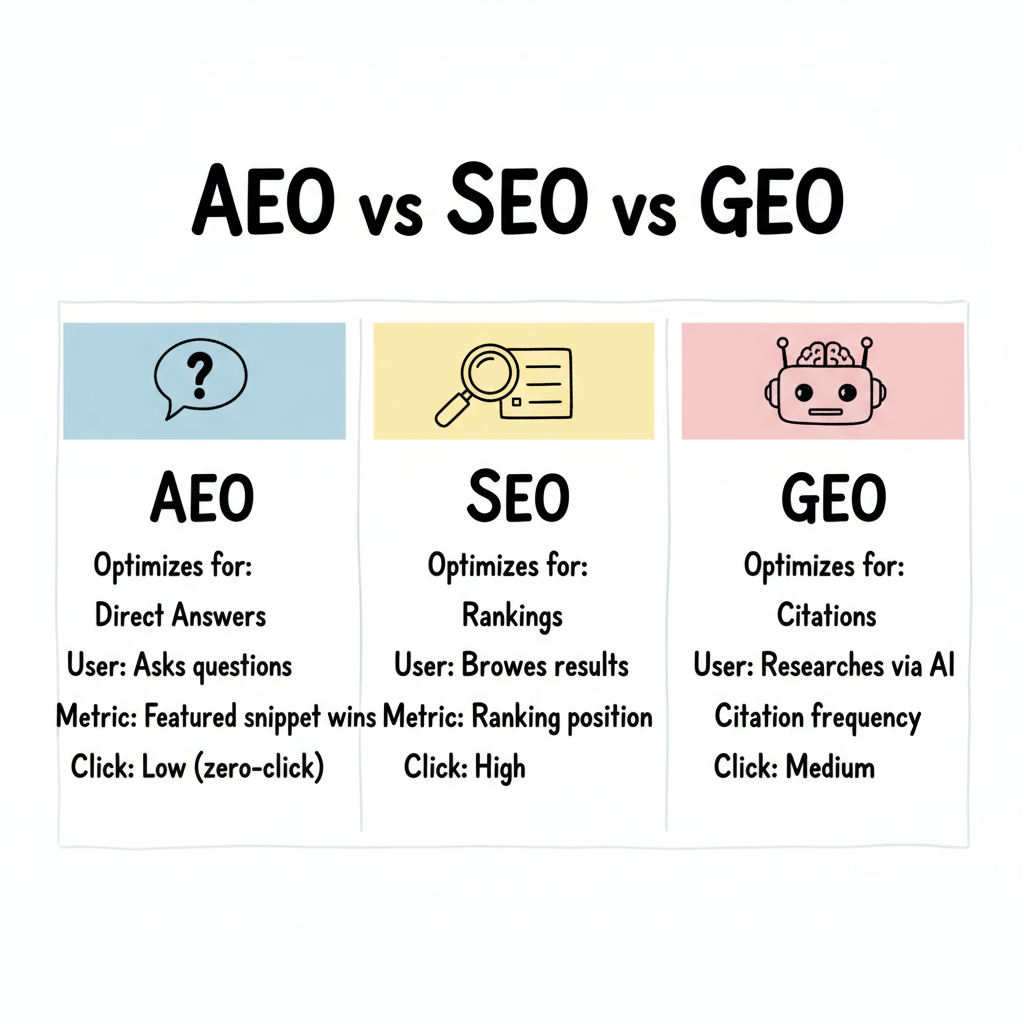
AEO optimizes content for direct answers in featured snippets and voice assistants, SEO optimizes for traditional search rankings, and GEO optimizes for citations in AI-generated responses from ChatGPT, Perplexity, and Google AI Overviews.
Search behavior has fragmented. Users no longer just "search"—they ask questions, conduct research, and expect immediate answers. Three distinct optimization strategies have emerged to match these behaviors: AEO focuses on being the direct answer, SEO focuses on ranking in results, and GEO focuses on getting cited by AI.
The core question isn't which one matters most. It's which one matters most for how your specific audience discovers information.
The Fundamental Difference
Each strategy optimizes for a different user behavior:
AEO (Answer Engine Optimization): Optimizes for users who ask specific questions and want immediate, direct answers. Success means being selected as THE answer—in featured snippets, voice responses, or AI-generated summaries.
SEO (Search Engine Optimization): Optimizes for users browsing search results to find relevant resources. Success means ranking high enough to earn clicks from users scanning result pages.
GEO (Generative Engine Optimization): Optimizes for users who ask AI systems to research and synthesize information. Success means being cited when ChatGPT, Perplexity, or AI Overviews construct comprehensive responses.
Technical Foundations All Three Strategies Share
AEO, SEO, and GEO all depend on the same technical base. Crawlability, site speed, and mobile-friendliness are prerequisites for visibility, not optional extras. Without these foundations in place, none of the three strategies can perform at their potential.
Crawlability, Speed & Mobile-First Indexing
Search engines and large language models (LLMs) alike need fast, accessible pages to process your content. Core Web Vitals serve as the shared performance baseline across all three strategies. Pages that load slowly, shift layout unexpectedly, or fail on mobile devices get deprioritized by Google's crawlers and are less likely to be selected by AI systems assembling answers. Mobile-first indexing means the mobile version of your site is the primary version search engines evaluate, making responsive design non-negotiable.
Schema Markup Beyond FAQ
Structured data is the shared language that helps both traditional crawlers and AI systems interpret your content. While FAQ schema gets the most attention, Article, HowTo, BreadcrumbList, Organization, and Product schema types each provide context that machines use to understand what your page covers and how authoritative it is. Implementing comprehensive AI content optimization through structured data feeds Google's Knowledge Graph and helps AI models build entity relationships around your brand.
Semantic markup matters too. Proper heading hierarchy, descriptive alt text on images, and semantic HTML elements (like <article>, <section>, and <nav>) enable AI content extraction. When an LLM or search engine parses your page, clean semantic structure makes it far easier to identify and extract the most relevant passages.
Optimizing for Conversational & Voice Queries
Conversational queries differ structurally from traditional keyword queries. A user typing into ChatGPT might ask "What's the best CRM for a 10-person sales team?" while the same user in Google might search "best CRM small business." These two query types require different optimization approaches.
Natural-language phrasing in headers and body text helps match how users speak to voice assistants and type into AI chat interfaces. Headers framed as questions ("How does AEO differ from traditional SEO?") perform better for both featured snippet selection and LLM query matching than keyword-stuffed alternatives. Understanding what is AEO vs SEO clarifies why conversational optimization requires distinct tactics for each strategy.
Voice search is growing rapidly, with over 1 billion voice searches occurring monthly across devices. Voice-optimized content naturally aligns with AEO goals because voice assistants select concise, direct answers from content that mirrors spoken language patterns. Terms like LLM (large language model) and SGE (Search Generative Experience, now evolved into AI Overviews) are important to understand and reference, as they represent the platforms where conversational queries live.
Conversational optimization strengthens both AEO (voice and snippet selection) and GEO (LLM query matching), making it a high-leverage investment that pays dividends across multiple strategies simultaneously.
AEO: Winning the Answer
Answer Engine Optimization positions your content to be selected as the definitive response to user questions. When someone asks "What is the best time to post on Instagram?" AEO determines whether your answer gets quoted.
Where AEO matters:
- Featured snippets (position zero)
- People Also Ask boxes
- Voice assistant responses (Siri, Alexa, Google Assistant)
- AI Overview answer sections
- Zero-click search results
AEO success requires:
- Direct answers in the first 50-100 words
- Structured data (FAQ, HowTo, Article schema) that AI systems can parse
- Question-matching headers
- Concise, quotable responses
- Clear formatting AI can extract
- Conversational, natural-language phrasing that matches voice and chat queries
The AEO mindset: "Can an AI quote me accurately?"
Research shows AEO depends on clicks less than traditional SEO. Instead, AEO wins without clicks by appearing directly in the answer. Visibility comes from being selected, not from being listed.
SEO: Earning the Ranking
Search Engine Optimization focuses on appearing prominently in traditional search results. When users browse Google results for "marketing automation platforms," SEO determines whether your page appears on page one.
Where SEO matters:
- Organic search rankings
- Traditional keyword queries
- Navigational searches
- Commercial research queries
- Long-tail informational searches
SEO success requires:
- Keyword research and targeting
- Technical site optimization (crawlability, Core Web Vitals, mobile-first indexing)
- Quality backlink profiles
- Comprehensive content coverage
- Strong domain authority
- Semantic HTML structure and schema markup for enhanced SERP features
The SEO mindset: "Can I rank for this term?"
SEO still fuels discovery. Most web traffic flows through traditional search results. Abandoning SEO eliminates the largest source of organic visibility.
GEO: Securing the Citation
Generative Engine Optimization focuses on earning citations when AI systems synthesize answers from multiple sources. When ChatGPT explains "how to choose a CRM," GEO determines whether your brand gets mentioned.
Where GEO matters:
- ChatGPT and Claude responses
- Perplexity answer synthesis
- Google AI Overviews
- Any AI-generated summary drawing from multiple sources
GEO success requires:
- Entity-based optimization — consistent entity descriptions across all web properties so LLMs build accurate associations
- Content AI can easily extract
- Regular freshness updates
- Third-party authority signals
- Original data and statistics worth citing
- Digital PR and off-site authority signals (news mentions, industry citations)
- Presence in community forums (Reddit, Quora) where LLMs source training data
The GEO mindset: "Will AI trust me enough to cite me?"
GEO fuels long-term relevance. As AI search grows, brands invisible to generative engines lose influence during the research phase of buyer journeys.
E-E-A-T, Digital PR & The Role of Off-Site Signals
Google's E-E-A-T framework — Experience, Expertise, Authoritativeness, Trustworthiness — is the cross-cutting quality standard that underpins all three strategies. Whether you are optimizing for featured snippets, organic rankings, or AI citations, demonstrating E-E-A-T signals determines how much trust search engines and LLMs place in your content.
Digital PR as a GEO Accelerator
Earning mentions and links from reputable news outlets, industry blogs, and research publications signals authority to both search engines and LLMs. Digital PR is not just a link-building tactic for SEO — it directly accelerates GEO performance by increasing the likelihood that AI models encounter and trust your brand during training and retrieval. Examining GEO SEO examples reveals how top brands use digital PR campaigns to earn both backlinks and AI citations simultaneously.
Forums & Community Presence
Reddit, Quora, and niche industry forums serve as training data for LLMs and as real-time sources for AI retrieval systems. Active, helpful participation in these communities increases the likelihood of AI citation because LLMs weight content from high-engagement discussion threads. Brands that provide genuine value in forum discussions build entity associations that AI models reference when generating answers.
This points to a broader concept: Search Everywhere Optimization. AEO, SEO, and GEO are parts of a broader strategy to be visible wherever your audience searches — traditional engines, voice assistants, AI chat, forums, and social platforms. Entity-based optimization ties it all together, ensuring your brand, products, and key concepts are consistently described across all web properties so AI models build accurate entity associations.
Side-By-Side Comparison
Factor | AEO | SEO | GEO |
Optimizes for | Direct answers | Rankings | Citations |
User behavior | Asking questions | Browsing results | Researching via AI |
Success metric | Featured snippet wins | Ranking position | Citation frequency |
Content focus | Concise Q&A pairs | Comprehensive pages | Authoritative depth |
Key technical element | FAQ schema | Backlinks | Entity signals |
Click dependency | Low (zero-click) | High | Medium |
Speed to results | Weeks | Months | Days to months |
Key Tactics | Structured data, direct answers, voice optimization | Backlinks, technical health, keyword targeting | Digital PR, entity authority, forum presence |
E-E-A-T Lever | Expertise (accurate answers) | Authority (backlinks, domain trust) | Trustworthiness (citations, third-party validation) |
Which Strategy Matters Most?
The answer depends entirely on how your audience finds information.
Prioritize AEO When:
- Your audience asks specific questions with definitive answers
- Voice search matters for your customer base
- Featured snippets dominate your target queries
- You want visibility without requiring website visits
- Your business answers questions people ask repeatedly
AEO matters most for informational queries where being the answer builds trust. Professional services, SaaS support content, and educational resources benefit most. Understanding what is AEO vs SEO helps determine when to emphasize direct answers over rankings.
Prioritize SEO When:
- Your audience browses search results before deciding
- Commercial keywords drive your business
- Long-tail content captures diverse intent
- Organic traffic volume determines success
- Traditional search behavior dominates your market
SEO remains essential for most businesses. Despite changes in search, traditional rankings still drive the majority of website traffic.
Prioritize GEO When:
- Your audience researches through AI platforms
- B2B buyers use ChatGPT or Perplexity for evaluation
- AI Overviews appear for your target queries
- Thought leadership drives trust in your market
- Being cited matters more than being clicked
GEO grows increasingly important as AI adoption accelerates. Companies targeting early adopters, researchers, and sophisticated buyers should invest early. Examining GEO SEO examples reveals how top brands balance citation optimization with traditional search visibility.
The Integrated Approach
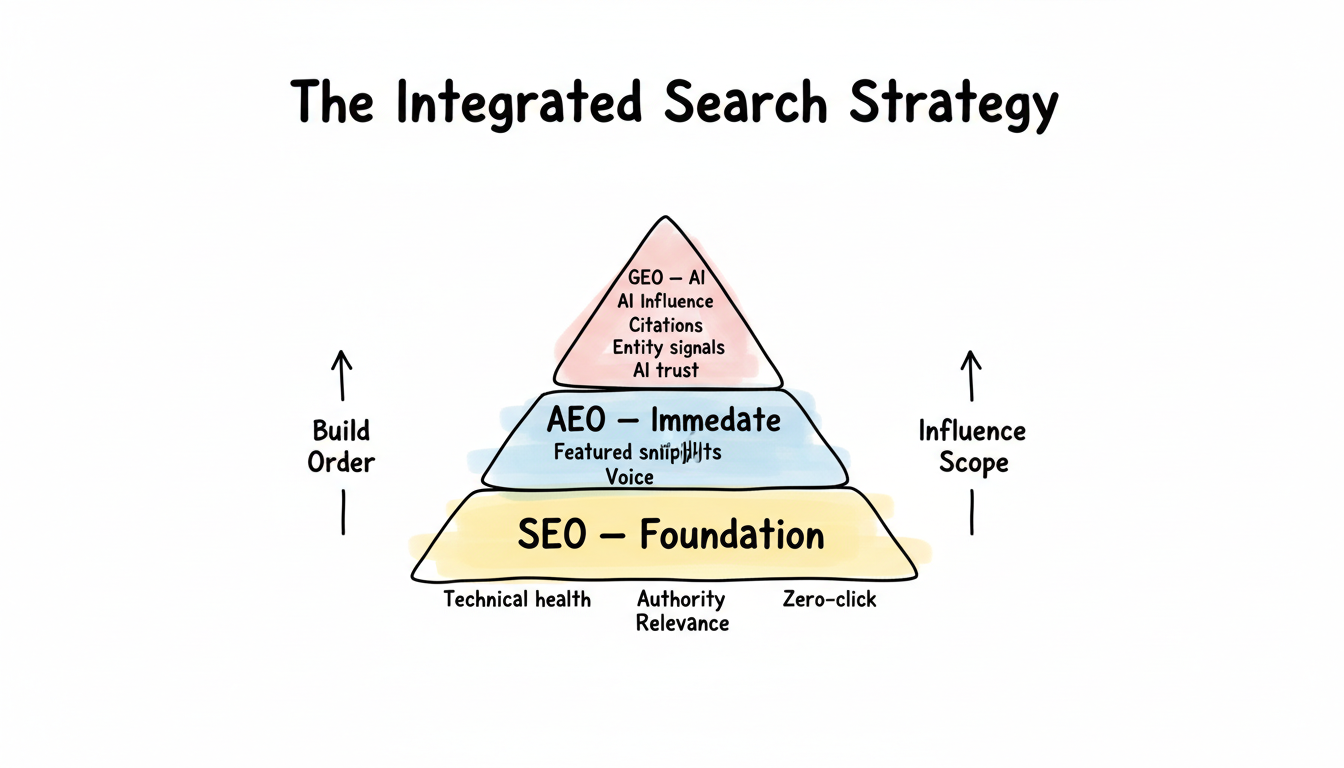
Most businesses need all three strategies working together:
SEO provides the foundation. Technical excellence, content authority, and backlink profiles support both AEO and GEO success. Without strong SEO fundamentals, the other strategies struggle.
AEO captures immediate opportunities. For queries with clear answers, AEO-optimized content earns featured snippets and voice results. This visibility builds brand awareness even without clicks.
GEO extends influence into AI. For research queries where AI synthesizes multiple sources, GEO ensures your brand appears in the narrative. This influences buyers before they reach traditional search.
Practical integration:
- Build SEO fundamentals (technical health, authority, relevance)
- Add AEO elements to high-value pages (FAQ sections, direct answers, schema)
- Layer GEO tactics for competitive categories (entity consistency, freshness, extractability)
Content created with all three approaches captures visibility across the full spectrum of modern search behavior. Effective AI content optimization combines principles from all three strategies to maximize discoverability across traditional and AI-powered search platforms.
This integrated model is increasingly described as Search Everywhere Optimization — the umbrella framework that positions AEO, SEO, and GEO as complementary layers of a unified visibility strategy. A related emerging term is AIO (AI Optimization), which encompasses both AEO and GEO under a single discipline focused on optimizing for AI-powered discovery. As AI adoption grows, AIO is gaining traction as the shorthand for the AI-facing side of search strategy.
Common Strategic Mistakes
Abandoning SEO for Newer Approaches
AI search is growing, but traditional search isn't disappearing. Companies that abandon SEO for AEO or GEO exclusively lose access to billions of queries.
Treating Strategies as Identical
Each approach requires different tactics. Long-form SEO content isn't automatically AEO-ready. Concise answers aren't automatically GEO-optimized. Match your approach to your goals.
Ignoring Measurement
Different strategies require different metrics. Track featured snippet appearances for AEO, rankings for SEO, and AI-specific metrics like AI Visibility Score and Citation Count for GEO. Combined dashboards show complete visibility across all three strategies. Organizations investing in AEO metrics KPIs gain clarity on which strategy delivers the highest return for their specific audience. See the measurement section below for a complete breakdown of strategy-specific KPIs.
How to Measure AEO, SEO & GEO Performance
Each strategy demands different KPIs, and most teams default to ranking position alone. That approach misses the majority of visibility signals that AEO and GEO generate. Building a measurement framework for each strategy ensures you can track progress and allocate resources effectively.
SEO Metrics
SEO measurement is well-established: organic traffic volume, keyword rankings, click-through rate from SERPs, domain authority trends, and Core Web Vitals scores. These metrics remain the foundation of search performance tracking and are available through standard tools like Google Search Console and analytics platforms.
AEO Metrics
AEO requires tracking visibility in answer formats: featured snippet win rate, People Also Ask appearances, voice search impressions, and zero-click visibility rate. Over 1 billion voice searches occur monthly, making voice-specific tracking increasingly important. Monitoring which queries trigger your content as a direct answer reveals AEO performance more accurately than traditional ranking data. For a detailed breakdown, see our guide to AEO metrics and KPIs.
GEO Metrics
GEO measurement is the newest frontier: AI Visibility Score tracks how often your brand appears in AI-generated responses, Citation Count measures how frequently AI platforms reference your content, Share of Voice in AI responses benchmarks you against competitors, and AI Referral Traffic monitors visits originating from AI chat interfaces. Semantic Relevance scoring evaluates how closely your content aligns with the topics AI models associate with your brand. Prompt-based tracking — regularly querying LLMs for your brand and competitors — provides qualitative insight into your GEO positioning and is an emerging monitoring method gaining adoption.
Build a combined dashboard that tracks all three layers side by side. This unified view reveals how improvements in one strategy create spillover benefits for the others and helps identify where to invest next.
Getting Started
If you're building a search strategy from scratch:
Start with SEO. Technical foundation, content quality, and authority building support everything else. Most immediate opportunities exist in traditional search.
Add AEO for question content. Restructure pages that answer specific questions. Add FAQ schema. Create direct, quotable answers.
Build GEO for competitive differentiation. Monitor AI platforms for your brand. Optimize content for citation. Develop entity authority.
The goal isn't choosing one approach—it's building integrated visibility that captures your audience wherever they search.
Frequently Asked Questions
Will AEO Replace SEO?
AEO will not replace SEO. Answer Engine Optimization handles direct-answer queries where users want a single, definitive response. SEO still drives the majority of organic web traffic through traditional search results. The two strategies serve different user behaviors — AEO captures zero-click visibility while SEO captures click-through traffic. Most businesses need both working together.
What Is the Difference Between GEO and SEO?
GEO (Generative Engine Optimization) focuses on earning citations when AI platforms like ChatGPT, Perplexity, and Google AI Overviews synthesize answers from multiple sources. SEO focuses on ranking in traditional search engine results pages. GEO relies on entity authority, digital PR, and content extractability, while SEO depends on backlinks, keyword targeting, and technical site health.
What Is AEO in Digital Marketing?
AEO stands for Answer Engine Optimization. In digital marketing, AEO is the practice of structuring content so it gets selected as the direct answer in featured snippets, People Also Ask boxes, voice assistant responses, and AI Overviews. AEO prioritizes concise, quotable answers, structured data like FAQ and HowTo schema, and natural-language phrasing that matches conversational queries.
How Do You Measure GEO Success?
GEO success is measured through AI-specific metrics: AI Visibility Score tracks how often your brand appears in AI-generated responses, Citation Count measures how frequently AI platforms reference your content, and AI Referral Traffic monitors visits from AI chat interfaces. Prompt-based tracking — regularly querying LLMs about your brand and competitors — provides qualitative insight into your GEO positioning.