
Marketing has entered a new era. While traditional AI tools wait for prompts and follow instructions, agentic AI takes action autonomously. These systems don't just analyze data or generate content—they plan, execute, and refine strategies on their own. For marketers seeking competitive advantage, understanding and implementing agentic AI tools has become essential.
This guide explains what agentic AI is, how it differs from the AI tools you're already using, and which platforms lead the market in 2026.
What Are Agentic AI Tools?
Agentic AI tools are software platforms that use autonomous AI agents capable of independent decision-making and action. Unlike traditional AI that responds to specific prompts, agentic systems operate through continuous perception-reasoning-action loops. They observe their environment, analyze context, plan strategies, take action, and learn from results—all without constant human direction. Technologies like RAG (Retrieval-Augmented Generation) and MCP (Model Context Protocol) are what enable these agents to access real-time data and connect to external tools, distinguishing them from static chatbots. For a deeper look at where agentic AI sits in the broader landscape, see our comparison of agentic AI vs. generative AI vs. predictive AI.
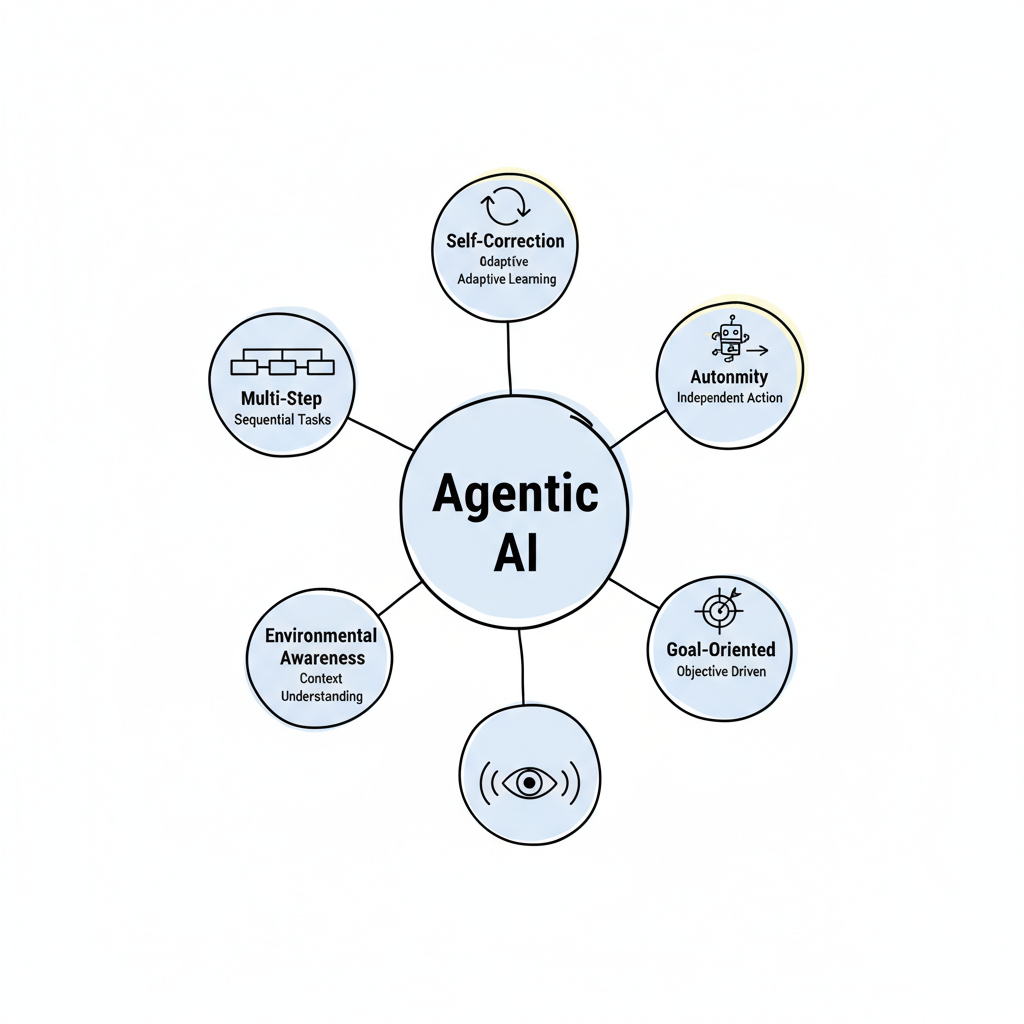
The key characteristics that define agentic AI:
- Autonomy: Operates independently after receiving goals, not step-by-step instructions
- Goal-oriented behavior: Works toward objectives rather than completing isolated tasks
- Environmental awareness: Senses and adapts to changing conditions
- Multi-step execution: Handles complex workflows requiring multiple sequential actions
- Self-correction: Evaluates results and adjusts approach based on outcomes
In practical terms, a traditional AI tool might generate a blog post when asked. An agentic AI tool would research topics, identify content gaps, plan a content calendar, write articles, optimize them for search, schedule publication, monitor performance, and adjust strategy based on results—autonomously managing the entire workflow.
How Agentic AI Differs from Traditional AI
Understanding the distinction helps clarify where agentic tools fit in your marketing stack.
Traditional AI Tools
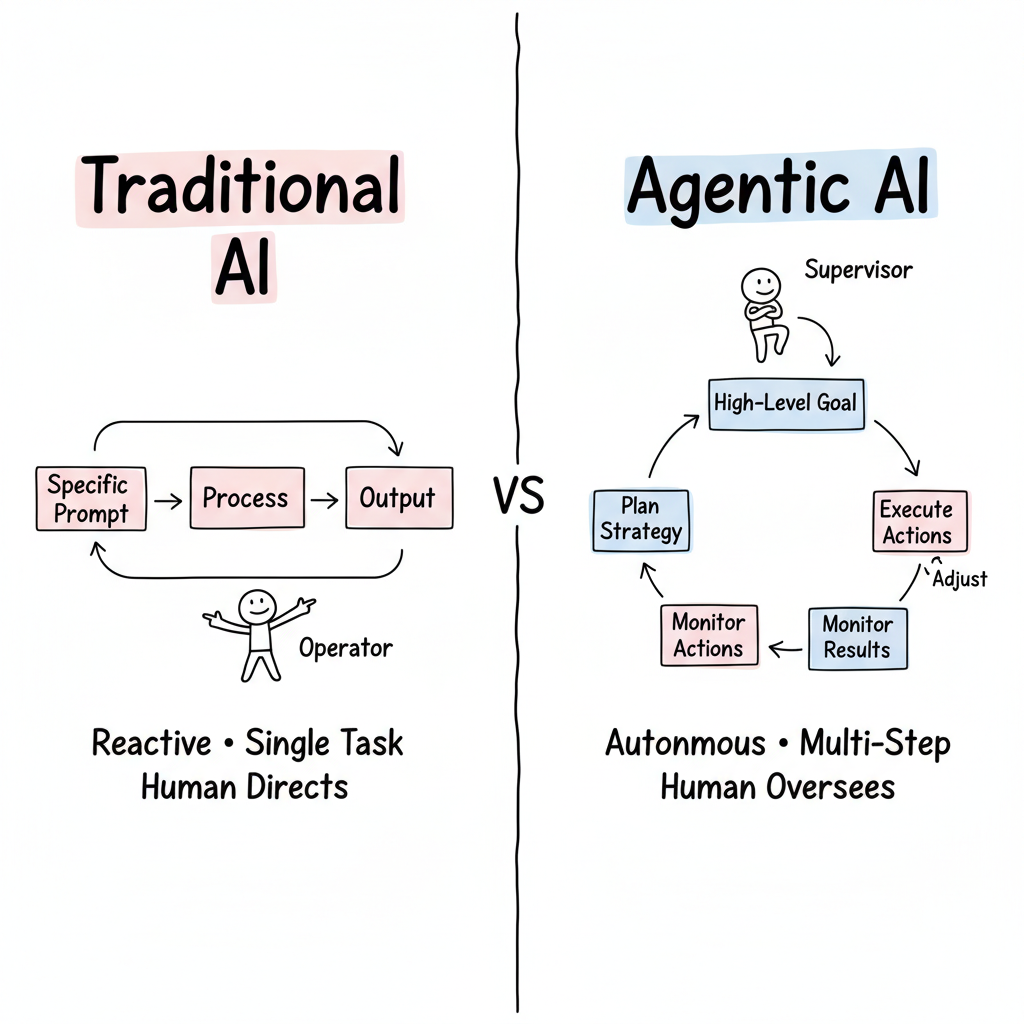
Traditional AI responds to explicit instructions:
- Receives a prompt or query
- Processes information
- Returns an output
- Waits for the next instruction
Examples include ChatGPT answering questions, Jasper generating copy, or Surfer SEO analyzing content. These tools enhance productivity but require constant human direction.
Agentic AI Systems
Agentic AI operates through autonomous workflows:
- Receives a goal or objective
- Assesses the current situation
- Plans a strategy to achieve the goal
- Executes actions across multiple systems
- Monitors results and adjusts approach
- Continues until the goal is achieved or stopped
This fundamental difference means agentic AI, including vertical AI agents built for one industry, can handle end-to-end processes that previously required teams of people coordinating multiple tools. The shift toward agentic AI represents a transformation in how we approach AI-powered search engines and SEO strategies.
Comparison Matrix
Aspect | Traditional AI | Agentic AI |
Input Required | Specific prompts for each action | High-level goals and constraints |
Decision Making | Human decides next steps | AI decides and executes autonomously |
Task Scope | Single tasks | Multi-step workflows |
Learning | Improves through fine-tuning | Learns and adapts in real-time |
Human Role | Operator | Supervisor |
Best For | Specific content/analysis tasks | End-to-end process automation |
Top Agentic AI Tools for Marketing
Several platforms have emerged as leaders in agentic AI for marketing applications.
Multi-Agent Platforms
Gumloop A visual AI agent builder designed for marketing automation. Gumloop excels at creating workflow automations that connect multiple AI capabilities into cohesive processes. Marketers can build agents for content production, data analysis, and campaign management without coding.
Best for: Marketing teams wanting to automate specific workflows with visual, no-code tools.
Relay.app Combines human-in-the-loop capabilities with autonomous AI agents. Relay lets teams build workflows where AI handles routine decisions while humans approve high-stakes actions. This balance makes it suitable for marketing teams not ready for fully autonomous systems.
Best for: Teams requiring human approval checkpoints in automated workflows.
AirOps Purpose-built for SEO and content teams. AirOps enables marketers to create AI agents that handle keyword research, content optimization, and programmatic SEO at scale. The platform integrates with existing SEO tools and databases, making it particularly effective for teams focused on local AEO optimization.
Best for: SEO teams scaling organic content production.
It is worth noting that CrewAI has emerged as the leading open-source alternative to commercial multi-agent platforms, with adoption by major consultancies including Deloitte, Accenture, and KPMG. For deeper coverage of open-source options, see the frameworks section below.
Enterprise Agentic Platforms
Google Ads AI Agents Google has integrated agentic capabilities directly into Google Ads. These agents autonomously manage advertising operations—analyzing customer behavior across touchpoints, adjusting budget allocation, and optimizing creative strategies in real-time. E-commerce companies report 30%+ ROAS improvements from autonomous campaign management.
Best for: Advertisers managing significant paid media budgets on Google platforms.
Adobe AI Agents Adobe's creative cloud now includes AI agents that autonomously generate campaign creative variations, optimize visual content for different channels, and maintain brand consistency across thousands of assets. These agents understand brand guidelines and apply them without manual oversight.
Best for: Brands with high-volume creative production needs.
Salesforce Agentforce Salesforce's agentic AI platform creates agents for sales, service, and marketing workflows. Marketing teams use Agentforce to build autonomous lead nurturing, personalization engines, and campaign optimization systems that operate within the Salesforce ecosystem.
Best for: Organizations already using Salesforce CRM and Marketing Cloud.
IBM watsonx IBM's enterprise agentic platform supports building and deploying intelligent agents at scale. WatsonX provides the orchestration layer for multi-agent systems with enterprise-grade governance, making it suitable for large organizations with compliance requirements.
Best for: Large enterprises requiring robust governance and compliance controls.
Specialized Marketing Agents
HockeyStack Focuses specifically on B2B marketing attribution and analytics. HockeyStack's AI agents autonomously track customer journeys, attribute revenue, and identify optimization opportunities across marketing channels.
Best for: B2B marketers needing sophisticated attribution and analytics.
OpenAI Operator OpenAI's agentic offering enables autonomous web browsing and task execution. Marketers can deploy Operator to research competitors, gather market intelligence, and complete online tasks that previously required manual effort.
Best for: Research-heavy marketing functions and competitive intelligence.
Use Cases for Agentic AI in SEO
Agentic AI transforms SEO workflows by handling complete processes autonomously.
Content Production at Scale
Agentic systems manage the entire content lifecycle:
- Research trending topics and keyword opportunities
- Analyze top-ranking content for target terms
- Generate content briefs and outlines
- Create draft content optimized for search
- Review and refine based on optimization scores
- Schedule publication and monitor performance
- Update content when rankings decline
What previously required content strategists, writers, editors, and SEO specialists can now run autonomously with human oversight at key approval points. Understanding the AEO optimization timeline helps set realistic expectations for implementation. Teams focused on content production at scale are also leveraging AI content optimization tools to streamline these agentic workflows even further.
Technical SEO Monitoring
Agentic tools continuously monitor site health:
- Crawl sites on scheduled intervals
- Identify technical issues as they emerge
- Prioritize fixes by impact
- Implement certain fixes automatically (meta tags, redirects)
- Alert teams to issues requiring manual intervention
- Track fix implementation and verify resolution
These systems work particularly well when combined with schema markup for AI search optimization to ensure structured data remains accurate.
Competitive Intelligence
Autonomous agents track competitive landscapes:
- Monitor competitor content publication
- Track ranking changes for target keywords
- Analyze competitive backlink acquisition
- Identify content gaps and opportunities
- Generate reports and strategic recommendations
When evaluating AEO vs digital marketing approaches, competitive intelligence becomes crucial for staying ahead.
Link Building Automation
Some organizations deploy agentic systems for outreach:
- Identify link prospects based on criteria
- Research contact information
- Personalize outreach messages
- Send and follow up on emails
- Track responses and manage relationships
This remains an area where human oversight is particularly important to maintain authenticity.
While these marketing use cases demonstrate immediate ROI, agentic AI tools are equally transforming customer service, IT operations, and financial workflows—see expanded use cases below.
Tool Comparison & Capabilities
Platform | Primary Use | Autonomy Level | Price Range |
Gumloop | Marketing workflow automation | High | $50-500/mo |
Relay.app | Human-AI hybrid workflows | Medium | $30-300/mo |
AirOps | SEO and content | High | $99-999/mo |
Google Ads AI | Paid advertising | High | Included with Ads spend |
Adobe AI Agents | Creative production | High | Enterprise pricing |
Salesforce Agentforce | CRM marketing | Medium-High | Custom pricing |
HockeyStack | B2B analytics | Medium | $1,000+/mo |
OpenAI Operator | Web tasks and research | High | $200+/mo |
Claude (Anthropic) | Agentic coding, tool use, computer use | High | $20-100/mo (API usage-based) |
When considering costs, many teams find value in using an AEO ROI calculator to justify investment in these advanced platforms.
Open-Source Agentic AI Frameworks for Developers
While the commercial platforms above offer turnkey solutions, open-source agentic AI frameworks provide developers with the building blocks to create highly customized autonomous systems. Frameworks like CrewAI and LangChain power many of the commercial tools listed above, and choosing the right framework can dramatically reduce development time.
Crewai
CrewAI is a multi-agent orchestration framework built around role-based agent design. Each agent is assigned a specific role, goal, and backstory, enabling teams of AI agents to collaborate like a real-world crew. CrewAI has been adopted by Fortune 500 companies including Deloitte, Accenture, and KPMG for internal automation projects. The framework is Python-first with YAML configuration files for defining agent roles and task workflows, making it accessible to developers who prefer declarative setup.
Langchain and Langgraph
LangChain is the foundational LLM application framework that provides composable building blocks for connecting language models to tools, data sources, and APIs. LangGraph extends LangChain for stateful, cyclical agent workflows with built-in support for human-in-the-loop checkpoints. The key distinction is that LangChain chains handle linear pipelines, while LangGraph graphs handle the branching, looping, and conditional logic that true agentic behavior requires. For teams already using LangChain, LangGraph is the natural upgrade path to agentic architecture.
Autogen by Microsoft
AutoGen is Microsoft's open-source multi-agent conversation framework designed for building applications where multiple AI agents interact through structured conversations. It supports customizable conversation patterns, role-based agent design, and both fully autonomous and human-in-the-loop modes. AutoGen's tight integration with Azure services makes it a strong choice for enterprises already invested in the Microsoft ecosystem, though it works with any LLM provider.
Autogpt
AutoGPT holds historical significance as the project that popularized the concept of autonomous AI agents in early 2023. It demonstrated that LLMs could be given goals and autonomously plan and execute multi-step tasks. While newer frameworks like CrewAI and LangGraph have surpassed it in production readiness and flexibility, AutoGPT remains an important reference point in the evolution of agentic AI.
When deciding between a framework and a platform, consider your team's resources. Frameworks suit organizations with engineering capacity that need deep customization. Platforms suit marketing and operations teams that need to move fast without writing code. Many organizations use both—frameworks for core infrastructure and platforms for end-user workflows.
Core Technologies Powering Agentic AI
Understanding the foundational technologies behind agentic AI tools helps explain why they are so much more capable than traditional AI assistants. These core innovations are what separate autonomous agents from simple chatbots, and understanding the distinction between agentic AI vs. generative AI is essential for choosing the right approach.
RAG (Retrieval-Augmented Generation)
RAG is the technique that allows AI agents to pull information from external knowledge bases, databases, and live data sources before generating a response. Instead of relying solely on training data that may be months or years old, a RAG-enabled agent queries your company's documentation, CRM records, or product catalog in real time. This dramatically reduces hallucinations and ensures agent outputs are grounded in current, accurate information. Most enterprise agentic AI tools listed in the comparison above use RAG under the hood. Understanding how RAG and agentic tools influence visibility is closely related to AI search ranking factors that determine how content surfaces in AI-powered search.
Model Context Protocol (MCP)
Introduced by Anthropic, MCP is an open standard for connecting AI models to external tools and data sources. Think of MCP as the USB standard for AI agents—just as USB gave any peripheral a universal way to connect to any computer, MCP gives any AI model a universal way to connect to any tool or data source. The growing ecosystem of MCP servers means that an agent built today can instantly access databases, APIs, file systems, and web services through a single protocol. This matters enormously for tool interoperability: teams no longer need to build custom integrations for every data source their agents need to access.
From RPA to Agentic AI
Robotic Process Automation (RPA) was the predecessor technology that paved the way for agentic AI. RPA handles structured, rule-based tasks like data entry, form filling, and file transfers—processes that follow predictable paths. Agentic AI picks up where RPA leaves off, handling unstructured tasks that require reasoning, judgment, and adaptation to unexpected situations. Companies like UiPath are bridging both worlds by combining RPA's reliability with agentic AI's intelligence, allowing enterprises to automate end-to-end processes that span both structured and unstructured work. Computer vision capabilities further extend agentic tools, enabling agents that can interact with user interfaces and interpret visual information.
Agentic AI Use Cases Beyond Marketing
While the SEO and marketing use cases above demonstrate immediate ROI, agentic AI is transforming every department across the enterprise. The breadth of applications is particularly evident when evaluating enterprise AI SEO platforms that extend their agentic capabilities beyond marketing alone.
Customer Service Automation
AI agents now handle the full lifecycle of customer support. An agentic customer service system autonomously triages incoming tickets, resolves L1 issues like password resets and order status inquiries, and routes complex cases to the right human specialist with full context attached. Over time, these agents learn from resolution patterns to handle increasingly sophisticated issues. Platforms like Kore.ai and Salesforce Agentforce, already covered in the comparison table above, are leading this space with agents that reduce average resolution time by 40-60% while improving customer satisfaction scores.
IT Service Management
Agentic AI tools are automating IT operations by monitoring infrastructure in real time, auto-diagnosing issues like server overload or network latency, and executing remediation playbooks without human intervention. When an agent encounters an issue beyond its authority or expertise, it escalates to the on-call engineer with a detailed diagnostic report, saving hours of initial investigation.
Finance and Procurement
In finance departments, agentic systems process invoices, evaluate vendor proposals, and analyze contracts for risk clauses and compliance issues. Platforms like Adept AI and Orby AI specialize in enterprise software automation with built-in auditability, making them well-suited for financial workflows where every action must be traceable. These agents can process hundreds of invoices per hour with accuracy rates exceeding 99%, compared to the 96-97% typical of manual processing.
Workflow Automation
Zapier has evolved from a simple trigger-based automation tool into an agentic platform, with AI agent features that go beyond connecting apps. Zapier's agents can now interpret intent, choose which tools to use, and handle multi-step processes that previously required manual decision-making at each step. UiPath combines RPA reliability with agent intelligence for hybrid workflows—using traditional automation for the structured portions and AI agents for the unstructured decisions in between. This hybrid approach is proving especially effective in industries like healthcare and logistics where processes mix predictable steps with judgment calls.
Implementation Guide
Successful agentic AI implementation follows a deliberate approach.
Start with Clear Boundaries
Define exactly what agents can and cannot do:
- Specify approval requirements for different action types
- Set budget limits for autonomous spending
- Establish content guidelines and brand voice parameters
- Create kill-switches for stopping agent activity
Following AEO content guidelines ensures your autonomous systems align with best practices from the start.
Evaluate Build vs. Buy
Before selecting a tool, assess whether your team should build with open-source frameworks or buy a commercial platform. For teams with engineering resources, open-source frameworks like LangChain and AutoGen offer deeper customization, lower per-unit costs at scale, and full control over agent behavior. For operations-focused teams that need to move fast, commercial platforms reduce time-to-value from months to days. Many organizations adopt a hybrid approach—using frameworks for core infrastructure and platforms for end-user-facing workflows.
Begin with Low-Risk Workflows
Test agentic systems on processes where errors are recoverable:
- Internal reporting and analysis
- Content research and briefs
- Performance monitoring
- Data aggregation
Build Human-In-The-Loop Checkpoints
Even mature agentic systems benefit from human oversight:
- Approve significant budget allocations
- Review content before publication
- Validate strategic recommendations
- Monitor for unexpected behavior
This approach becomes particularly important when implementing FAQ schema for AI overviews, where accuracy directly impacts search visibility.
Measure and Iterate
Track agent performance against clear metrics:
- Time saved versus manual processes
- Quality of outputs compared to human work
- Error rates and required corrections
- ROI on automation investment
Consider consulting generative engine optimization companies for expert guidance during initial implementation.
AI Governance and Security for Agentic Deployments
As agentic AI systems gain autonomy, governance becomes not just important but essential. The more an agent can do independently, the more guardrails it needs to operate safely within enterprise environments. Organizations that get governance right will scale their agentic deployments faster and with more confidence. Ensuring proper structured data for AI search compliance is one piece of a broader governance strategy.
Access Controls and RBAC
Role-based access control (RBAC) should be applied to AI agents just as it is to human users. Each agent should operate under the principle of least privilege—only accessing the data, systems, and actions necessary for its specific role. For example, a content optimization agent should not have access to billing systems, and a customer service agent should not be able to modify product pricing. Among the tools in the comparison above, enterprise platforms like IBM watsonx and Salesforce Agentforce offer granular permission systems designed for this purpose.
Audit Trails and Explainability
Every action an agentic AI system takes should be logged with full context: what decision was made, what data informed it, and what the outcome was. This is not just a best practice—it is a compliance requirement under frameworks like SOC 2, GDPR, and HIPAA. Audit trails also enable teams to debug agent behavior, identify drift over time, and demonstrate to stakeholders exactly how autonomous systems are operating.
Human-In-The-Loop Checkpoints
Even the most capable agents should require human approval before taking high-stakes actions: publishing content to production, sending external communications, making financial commitments, or modifying access permissions. Frameworks like CrewAI and LangGraph provide built-in mechanisms for configuring approval gates at specific points in agent workflows, making it straightforward to enforce these checkpoints without disrupting the overall autonomous flow.
Before deploying an agentic AI tool in production, teams should answer these governance questions: What is the maximum scope of autonomous action? Who reviews agent outputs and how often? What happens when an agent encounters an edge case outside its training? How are agent permissions audited and updated? What is the rollback process if an agent makes a harmful decision?
The Future of Agentic AI
Agentic AI adoption is accelerating across enterprises:
- By 2030, Gartner predicts 50% of supply chain solutions will use intelligent agents for autonomous decision-making
- AI-powered logistics could reduce costs by 15% and boost service levels by 65%
- Multi-agent orchestration—multiple AI agents working together—is becoming the standard architecture
For marketers, this means:
More autonomous operations: Routine marketing tasks will increasingly run without human intervention.
Strategic human roles: Marketing professionals will shift from task execution to goal-setting, oversight, and strategic direction. Understanding AEO specialist salary trends can help with workforce planning.
New skill requirements: Understanding how to configure, manage, and optimize AI agents becomes as important as traditional marketing skills. Those seeking expertise can learn through an AEO optimization tutorial.
Competitive differentiation: Early adopters of agentic AI will operate faster and more efficiently than competitors relying on manual processes.
When those agentic tools are pointed at a specific marketing job -- research, personalization, ad testing, reporting -- they become an AI marketing agent running the perceive-reason-act-observe loop on its own.
Frequently Asked Questions
What Is the Difference Between Agentic AI and Generative AI?
Generative AI creates content—text, images, code—in response to prompts. Agentic AI acts autonomously to achieve goals, potentially using generative AI as one of its capabilities. An agentic system might use generative AI to write content, but it also decides what to write, when to publish, and how to optimize based on performance.
Are Agentic AI Tools Safe for Business Use?
With proper implementation, yes. Key safety practices include defining clear boundaries, implementing human approval checkpoints, monitoring agent actions, and maintaining ability to stop agent activity. Enterprise platforms include governance features designed for business-critical applications.
How Much Do Agentic AI Platforms Cost?
Pricing varies dramatically. Point solutions for specific workflows start around $50/month. Enterprise platforms with full agentic capabilities range from $1,000 to $10,000+ monthly depending on scale and features. Many platforms price based on agent actions or compute usage. For comparison, review AI SEO agency pricing to understand professional service costs.
Do I Need Technical Skills to Use Agentic AI?
Many modern agentic platforms offer no-code or low-code interfaces. Building basic workflow automations requires no programming. More sophisticated multi-agent systems benefit from technical expertise, particularly for custom integrations and complex logic.
Will Agentic AI Replace Marketing Jobs?
Agentic AI will transform marketing roles rather than eliminate them. Routine execution tasks will automate, but strategic thinking, creative direction, and human oversight remain essential. Marketers who learn to work with agentic systems will be more valuable than those who don't.
What Is the Best Open-Source Agentic AI Framework?
CrewAI and LangGraph are the two most popular open-source agentic AI frameworks in 2026. CrewAI excels at multi-agent orchestration with role-based design, while LangGraph provides fine-grained control over stateful agent workflows. AutoGen by Microsoft is a strong alternative for teams invested in the Azure ecosystem. The best choice depends on whether you need multi-agent collaboration (CrewAI) or single-agent workflow complexity (LangGraph).
How Does Agentic AI Differ from RPA?
Robotic Process Automation (RPA) follows predefined rules to automate structured, repetitive tasks like data entry and form filling. Agentic AI tools go further by handling unstructured tasks that require reasoning, judgment, and adaptation. While RPA breaks when a UI changes, an agentic AI tool can interpret the change and adjust. Many enterprises use both—platforms like UiPath now combine RPA reliability with agentic AI intelligence.
What Is RAG and Why Does It Matter for AI Agents?
RAG (Retrieval-Augmented Generation) is a technique that lets AI agents pull information from external knowledge bases, databases, and documents before generating a response. This reduces hallucinations and keeps agent outputs grounded in current, accurate data. Most enterprise agentic AI tools use RAG to connect agents to company-specific information, making them far more useful than general-purpose chatbots.
What Security Features Should I Look for in Agentic AI Tools?
Look for role-based access control (RBAC) to limit what agents can access, comprehensive audit logs that record every action, and human-in-the-loop approval gates for high-stakes decisions. For regulated industries, verify compliance certifications (SOC 2, GDPR, HIPAA). Strong AI governance features are essential—the more autonomous an agent becomes, the more critical these guardrails are for safe enterprise deployment.