
Artificial intelligence has evolved beyond a single technology category. Two distinct paradigms now shape how businesses use AI: Generative AI, which creates content based on prompts, and Agentic AI, which autonomously plans, decides, and takes actions to achieve goals. Understanding the difference between these approaches is essential for choosing the right AI strategy.
According to Omdena's analysis of AI paradigms, the difference between generative AI and agentic AI shapes what your systems can actually achieve. Generative AI excels at creation and assistance, while agentic AI focuses on execution, automation, and goal completion.
What Is Generative AI?
Generative AI refers to models that create new content based on patterns learned from training data. When you ask for a blog post, code snippet, email draft, image, or summary, you're using generative AI.
According to Medium's analysis of AI types, generative AI produces content—text, images, audio, video, and code—in response to prompts. It can be conversational but doesn't inherently act in the real world unless connected to tools.
Generative AI characteristics:
- Produces content based on prompts
- Requires human input for each task
- Outputs depend on prompt quality
- Does not take autonomous actions
- Focuses on creation, not execution
What Is Agentic AI?
Agentic AI goes beyond generation to operate autonomously toward defined goals. These systems don't just create content—they plan, execute, monitor, and adapt workflows with minimal human supervision.
According to Coursera's AI comparison guide, agentic AI systems can take initiative, adapt to changes, and carry out workflows using a four-step process: perceiving data, reasoning to generate solutions, acting with available tools, and learning from feedback.
Agentic AI characteristics:
- Operates autonomously toward goals
- Makes decisions based on context
- Executes multi-step workflows
- Learns and adapts from outcomes
- Requires less human intervention
Key Differences at a Glance
According to Wald.ai's 2025 guide to AI types, generative AI and agentic AI play different but connected roles in business operations, which is why more companies are appointing a Chief AI Officer to own AI strategy.
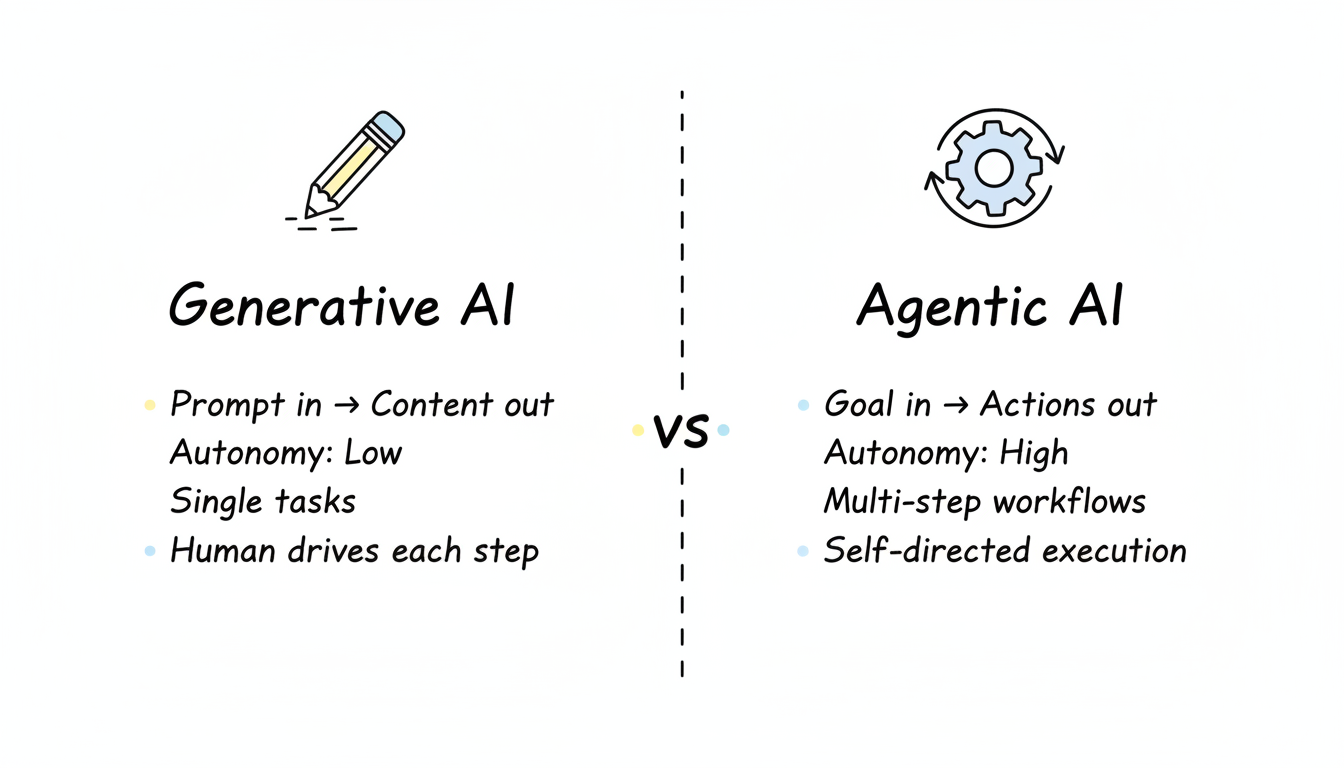
Feature | Generative AI | Agentic AI |
Autonomy | Low—requires prompts | High—operates independently |
User input | Direct prompts per task | Overarching goals |
Task complexity | Single tasks | Multi-step workflows |
Primary use | Generate content | Achieve outcomes |
Learning | Based on training data | Continuous from experience |
Implementation | Simpler setup | More complex architecture |
Core engine | LLM (text/image generation) | LLM + tool calling + planning loop |
How Large Language Models Power Both Paradigms
Large language models (LLMs) such as GPT-4, Claude, and Gemini serve as the shared reasoning engine underneath both generative and agentic AI. Understanding how LLMs operate clarifies why the two paradigms behave so differently despite sharing a common foundation.
On the generative side, LLMs leverage pattern recognition across massive training datasets to produce text, images, code, and synthetic data. When you prompt ChatGPT or any other OpenAI model for a blog draft, the LLM predicts the most likely next token based on learned statistical relationships. The output is new content, but the model itself takes no action beyond generation.
Agentic AI layers autonomy on top of this same LLM capability. The model becomes the "brain" that plans multi-step workflows, reasons about intermediate results, and decides which external tools to invoke. Rather than producing a single output and stopping, an agentic system loops: it generates a plan, executes a step, observes the outcome, and revises its approach as needed.
Reinforcement learning from human feedback (RLHF) is the training technique that bridges these paradigms. RLHF fine-tunes LLMs to follow instructions reliably, which is a prerequisite for both high-quality content generation and dependable agent behavior. Without instruction-following ability, an agent cannot reliably execute a multi-step plan.
ChatGPT and OpenAI's GPT family remain the most recognized generative AI products globally. Yet the same GPT-4 model that powers ChatGPT also serves as the reasoning core inside agentic wrappers—demonstrating that the leap from generative to agentic is less about the model itself and more about the orchestration layer built around it. This is also why understanding generative engine optimization matters: as LLMs increasingly mediate how users discover information, optimizing for their retrieval and generation patterns becomes a strategic priority.
How Agentic AI Builds on Generative AI
According to Invoca's analysis of AI evolution, agentic AI doesn't replace generative AI—it builds on it. Generative models remain an essential capability inside agentic systems, providing reasoning, language understanding, and content creation. The difference is that agentic AI uses that output as fuel for decisions, actions, and multi-step workflows. Unlike stateless generative AI queries, agentic systems maintain state tracking across multi-step workflows, remembering prior actions and their outcomes to inform subsequent decisions.
The relationship:
- Generative AI provides intelligence
- Agentic AI turns intelligence into execution
- Both technologies complement each other
- Agentic systems often include generative capabilities
Agentic AI Frameworks and Protocols
The growing adoption of agentic AI has produced a rich ecosystem of agentic AI tools and frameworks designed to simplify agent development. These frameworks handle the complex orchestration, memory management, and tool integration that differentiate agentic systems from simple generative prompts.
Key Frameworks
LangChain provides composable tool-calling chains that let developers wire LLMs to external APIs, databases, and services in a modular fashion. LangGraph extends LangChain with stateful, graph-based multi-agent orchestration—ideal for complex workflows where multiple agents collaborate and maintain shared state. AutoGen, developed by Microsoft, takes a conversational multi-agent approach where agents communicate through structured dialogue to solve tasks collaboratively. crewAI organizes agents into role-based teams, assigning each agent a specific persona and set of responsibilities that mirror how human teams operate.
Tool Calling and API Integration
Tool calling (also known as function calling) is the mechanism that separates agentic AI from pure generative AI. When an LLM supports tool calling, it can decide mid-conversation to invoke an external function—querying a CRM API, running a database query, or triggering a workflow in a third-party system. This capability turns the model from a content generator into an actor that can read data, modify state, and interact with the real world through API integration.
Emerging Standards: MCP and A2A
Two emerging protocols are standardizing how agents connect to tools and to each other. The Model Context Protocol (MCP), introduced by Anthropic, provides a universal interface for agents to discover and invoke tools regardless of the underlying framework. The Agent2Agent (A2A) protocol, developed by Google, enables cross-platform agent interoperability so that agents built with different frameworks can communicate and collaborate. Both are 2025-2026 developments that signal the industry's move toward mature, interoperable agentic infrastructure.
Use Cases: Where Each Technology Excels
Generative AI Applications
According to Triple Whale's AI comparison, generative AI excels at content-heavy tasks.
Best use cases:
- Content creation (blog posts, ads, social media)
- Image and video generation
- Code generation and documentation
- Summarization and analysis
- Customer support chatbots
- Translation and localization
Agentic AI Applications
According to Boomi's analysis of agentic AI examples, AI agents are being used in 78% of organizations in some form. Companies are using agentic AI vs generative AI examples to automate IT support, financial operations, and customer service.
Best use cases:
- Autonomous workflow execution
- Complex decision-making processes
- Multi-system task coordination
- Real-time monitoring and response
- Supply chain optimization
- Fraud detection and prevention
Agentic AI in Marketing and SEO
According to Content Marketing Institute's analysis of agentic AI in marketing, agentic AI systems are autonomous programs that can plan, reason, and take action toward complex goals with minimal human intervention—behaving less like passive tools and more like proactive digital co-workers.
Marketing applications:
- Campaign optimization across channels
- Automated content distribution
- Real-time bid management
- Customer journey orchestration
- Competitive monitoring and response
According to ALM Corp's guide to AI agents for SEO, AI agents are transforming SEO through autonomous keyword identification, competitor analysis, content optimization, and continuous strategy adjustment. Case studies show businesses improving rankings from page 5 to page 1 in 60 days using AI agent-driven approaches. For instance, an agentic AI system might use tool calling to pull real-time bid data from Google Ads via API integration, analyze performance patterns through pattern recognition, and autonomously adjust bids—a workflow that would require manual intervention with generative AI alone. This kind of AI search optimization is becoming table stakes for competitive teams.
For businesses implementing AI content optimization strategies, understanding how agentic systems can autonomously manage campaigns becomes critical to staying competitive in 2026.
Agentic AI vs Generative AI vs Predictive AI
While the generative-versus-agentic distinction captures the most important divide in modern AI, a third paradigm—predictive AI—completes the picture. For a deeper exploration of all three, see our full comparison of agentic AI vs generative AI vs predictive AI.
Paradigm | Core Function | Example |
Generative AI | Creates new content | Draft a blog post from a prompt |
Predictive AI | Forecasts outcomes | Predict customer churn next quarter |
Agentic AI | Takes autonomous action | Monitor churn signals and trigger retention campaigns |
Predictive AI encompasses statistical and machine learning models built for forecasting—demand planning, churn prediction, dynamic pricing, and risk scoring. Unlike generative AI, predictive models do not create new content. Unlike agentic AI, they do not take autonomous action. They analyze historical patterns and output probabilities or numerical forecasts.
The AI copilot represents a middle ground between generative and fully agentic systems. Products like GitHub Copilot and Salesforce Einstein Copilot assist humans with real-time suggestions but stop short of acting autonomously. Understanding AI copilot adoption trends helps contextualize where the industry sits on the spectrum from passive generation to full autonomy.
Traditional Robotic Process Automation (RPA) follows rigid, rule-based scripts that break when interfaces change. Agentic AI offers a fundamentally different approach: LLM-driven reasoning that adapts to new situations, calls APIs dynamically, and makes judgment calls. Where RPA automates predictable, repetitive tasks, agentic AI handles ambiguous workflows that require planning and context.
A fourth emerging paradigm—physical AI—extends agentic capabilities into robotics, where autonomous agents operate in the physical world through sensors and actuators rather than purely digital interfaces.
Agent Types and Human-In-The-Loop Patterns
Types of AI Agents
AI agent architectures fall along a spectrum of sophistication:
- Simple reflex agents react to the current input using predefined condition-action rules, with no memory of past interactions.
- Model-based agents maintain an internal model of the world through state tracking, allowing them to handle partially observable environments.
- Goal-based agents plan sequences of actions to achieve specified objectives, evaluating multiple paths before committing.
- Utility-based agents optimize a utility function to choose the best action among alternatives, balancing competing objectives like cost, speed, and quality.
Human-In-The-Loop Controls
Production agentic AI systems require human oversight at critical decision points. Effective human-in-the-loop patterns include approval gates that pause execution before high-stakes actions such as financial transactions, data deletion, or external communications. Confidence thresholds route uncertain decisions to human reviewers when the agent's internal confidence score falls below a defined level. Comprehensive audit logging records every agent action, tool invocation, and decision rationale for compliance and post-incident analysis.
Agentic RAG
Agentic RAG (retrieval-augmented generation) enhances standard RAG pipelines with agent autonomy. Instead of following a fixed retrieve-then-generate pipeline, an agentic RAG system decides when to search, which sources to query, whether the retrieved information is sufficient, and how to synthesize results across multiple retrieval steps. This produces more accurate and comprehensive answers for complex questions and is a key pattern driving enterprise adoption of agentic AI. When agents retrieve information, having well-implemented structured data for AI search on your pages significantly improves retrieval accuracy.
The Evolution: 2024 to 2026
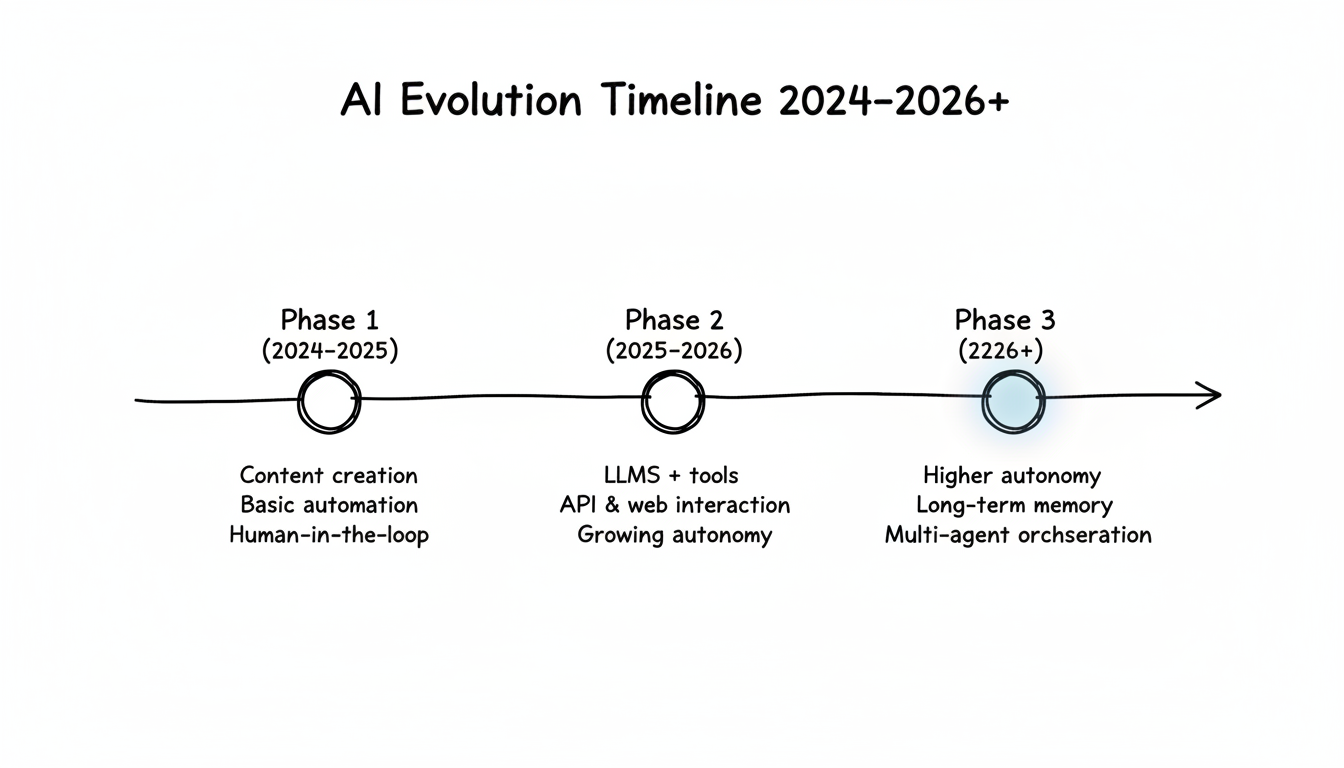
According to LinkedIn's agentic AI roadmap, the transition from generative to agentic AI follows a clear pattern.
Phase 1 (2024-2025): Generative AI dominance
- Content creation and summarization
- Basic task automation
- Human-in-the-loop for review
Phase 2 (2025-2026): Emergent agentic capabilities
- LLMs paired with tools
- API and web interaction
- Growing autonomy with supervision
Phase 3 (2026 onwards): Fully agentic systems
- Higher autonomy and reasoning
- Long-term memory and learning
- Multi-agent orchestration
According to Daffodil Software's AI trends guide, agentic AI systems understand high-level goals and autonomously break them down into actionable tasks—operating with initiative, much like proactive team members who notice gaps and fill them. Generative AI also plays a growing role in producing synthetic data—realistic but artificial datasets used to train downstream models when real data is scarce, sensitive, or expensive to collect.
Implementation Considerations
According to Wald.ai, implementation requirements differ significantly between these AI types.
Generative AI implementation:
- Less complex setup
- Fewer specialized resources
- Faster time to value
- Lower initial investment
Agentic AI implementation:
- More sophisticated architecture
- Perception modules and reasoning engines
- Specialized tools and integrations
- Higher resource requirements
Combining Both Technologies
According to Omdena, the real challenge isn't choosing one over the other—it's understanding your goals well enough to design the right solution. The strongest outcomes often come from combining creative generation with autonomous action.
Integration approaches:
- Generative AI creates marketing materials
- Agentic AI determines optimal distribution
- Generative AI drafts communications
- Agentic AI handles execution and follow-up
- Both work toward unified business goals
According to Triple Whale, for a product launch, generative AI might create marketing materials while agentic AI determines optimal pricing, inventory allocation, and advertising channels. Organizations developing an AEO marketing strategy template should consider how both AI paradigms integrate to maximize campaign effectiveness.
The Future: Multi-Agent Systems
According to Demand Gen Report's 2026 outlook, 2026 marks an inflection point where AI systems deploy specialized agents for specific roles—product marketing agents, customer marketing agents, brand marketing agents—amplifying team capabilities rather than replacing general tasks. Frameworks like LangGraph and crewAI make multi-agent orchestration practical by providing state management, role assignment, and inter-agent communication out of the box.
Gartner predicts that by 2026, up to 40% of enterprise applications will embed task-specific agents, signaling practical integration of agentic capabilities across business systems. Understanding future platform-specific AI search 2026 trends helps businesses prepare for this shift.
Frequently Asked Questions
What Is the Main Difference Between Agentic AI and Generative AI?
Generative AI creates content—text, images, code—by predicting the most likely next token using large language models. Agentic AI goes further: it uses the same LLM foundation but adds planning, tool calling, and autonomous decision-making to execute multi-step workflows without constant human input. Think of generative AI as the brain and agentic AI as the brain plus hands.
What Are the Best Frameworks for Building Agentic AI Systems?
The most widely adopted agentic AI frameworks in 2026 include LangChain and LangGraph for tool-calling chains and stateful agent graphs, AutoGen from Microsoft for multi-agent conversations, and crewAI for role-based agent teams. These frameworks handle orchestration, memory, and tool integration so developers can focus on defining agent goals rather than building infrastructure from scratch.
How Does Agentic AI Differ from RPA?
Robotic Process Automation follows rigid, rule-based scripts that break when interfaces change. Agentic AI uses LLM-powered reasoning to adapt to new situations, call APIs dynamically, and make judgment calls. While RPA automates predictable tasks, agentic AI handles ambiguous workflows that require planning and context—making it better suited for complex, variable business processes.
What Is Agentic RAG and Why Does It Matter?
Agentic RAG combines retrieval-augmented generation with autonomous agent behavior. Instead of following a fixed retrieve-then-generate pipeline, the agent decides when to search, which sources to query, and whether the retrieved information is sufficient. This produces more accurate, comprehensive answers for complex questions and is a key pattern driving enterprise adoption of agentic AI in 2026.
Key Takeaways
Understanding the difference between generative and agentic AI guides strategic technology choices:
- Generative AI creates - Produces content based on prompts and training data
- Agentic AI executes - Autonomously plans and takes actions toward goals
- Both complement each other - Agentic systems often include generative capabilities
- Implementation differs - Agentic AI requires more complex architecture
- Marketing impact is significant - Both technologies reshape SEO and content strategies
- Integration delivers results - Combining both approaches maximizes business value
- Evolution continues - 2026 marks shift toward multi-agent orchestration
The distinction matters for business strategy: generative AI is a powerful tool for creation, while agentic AI represents a shift toward AI as an autonomous executor of complex workflows.