
Three distinct AI paradigms now shape business technology: Predictive AI forecasts what will happen, Generative AI creates new content, and Agentic AI executes autonomous actions. Each solves different problems. Confusing them leads to misapplied tools and missed opportunities.
Understanding these distinctions helps you choose the right AI approach for specific challenges.
The Three Paradigms Defined
Predictive AI: Forecasting Outcomes
Predictive AI analyzes historical data to forecast future events. It answers "what will likely happen?" based on patterns in past information.
How it works: Predictive models learn relationships between variables in training data. When given new data, they estimate probable outcomes based on learned patterns.
Core capabilities:
- Forecasting sales, demand, and revenue
- Scoring leads by conversion probability
- Predicting customer churn risk
- Identifying fraud likelihood
- Estimating ad performance
Limitations: Predictive AI tells you what might happen but doesn't create content or take action. It requires quality historical data and struggles with unprecedented situations.
Generative AI: Creating Content
Generative AI produces new content—text, images, code, audio—based on prompts and training data. It answers "what content should exist?" for a given request.
How it works: Generative models learn patterns from vast content libraries. When prompted, they produce new content that follows learned patterns while meeting prompt requirements.
Core capabilities:
- Writing articles, emails, and marketing copy
- Generating images and visual content
- Producing code and technical documentation
- Creating summaries and translations
- Drafting responses and communications
Limitations: Generative AI creates but doesn't act autonomously. Output quality depends on prompt quality. It can produce plausible-sounding incorrect information.
Agentic AI: Executing Actions
Agentic AI operates autonomously to achieve goals. It answers "how do I accomplish this objective?" by planning and executing multi-step workflows.
How it works: Agentic systems perceive their environment, reason about goals, take actions using available tools, and learn from outcomes to improve future performance.
Core capabilities:
- Executing multi-step marketing workflows
- Managing campaigns with minimal oversight
- Coordinating complex processes
- Adapting strategies based on real-time data
- Handling exceptions and edge cases
Limitations: Agentic AI requires clear goal definition and appropriate tool access. Autonomous operation demands trust in system decisions.
Side-By-Side Comparison
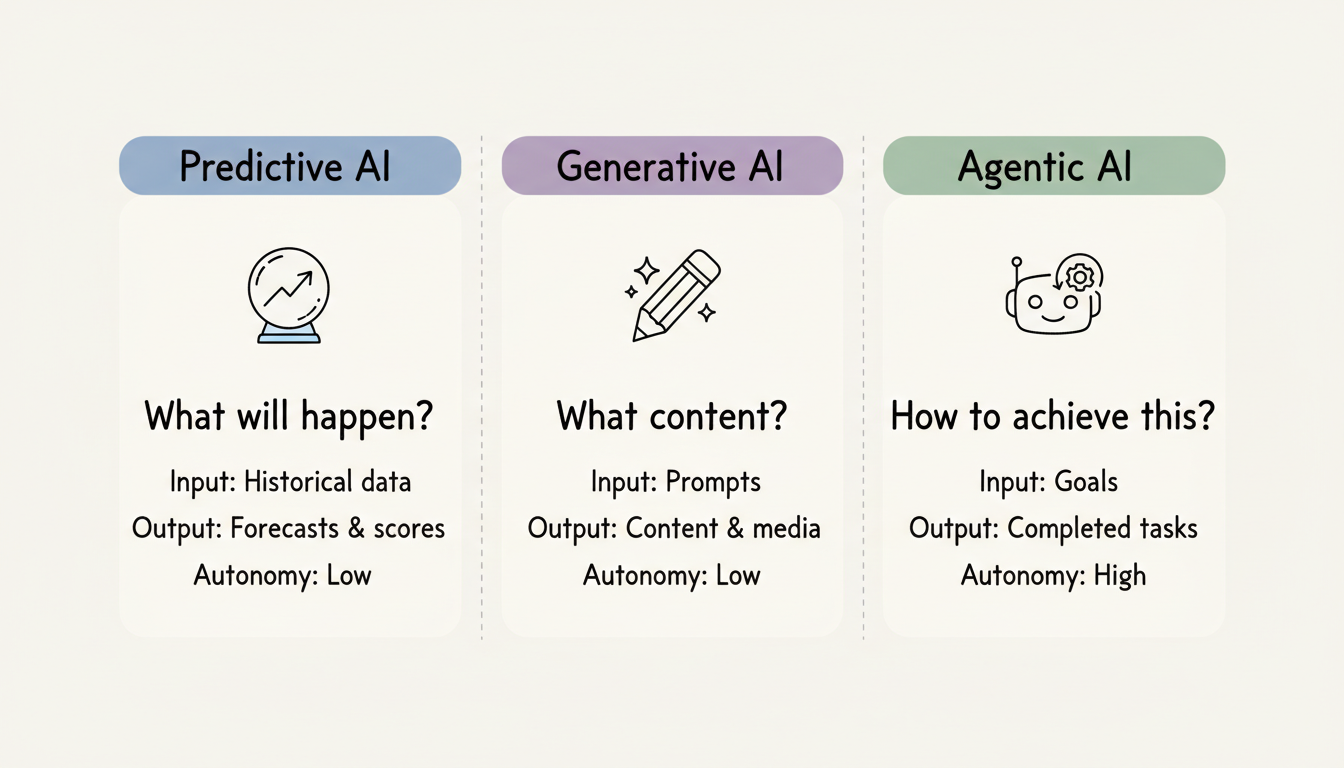
Aspect | Predictive AI | Generative AI | Agentic AI |
Primary function | Forecast outcomes | Create content | Execute actions |
Core question | "What will happen?" | "What content?" | "How to achieve this?" |
User input | Historical data | Prompts | Goals |
Output | Predictions, scores | Content, media | Completed tasks |
Autonomy level | Low | Low | High |
Human involvement | Interprets results | Reviews output | Sets goals |
Where Each Excels
Predictive AI Best Uses
Lead scoring: Assign conversion probability to leads, enabling sales teams to prioritize high-value prospects.
Demand forecasting: Predict product demand to optimize inventory, staffing, and marketing spend.
Customer segmentation: Identify behavioral patterns that predict customer value, churn risk, or purchase timing.
Budget allocation: Forecast channel performance to distribute marketing budget optimally. Effective aeo-marketing-budget strategies often rely on predictive models to allocate resources across traditional search and answer engines.
Generative AI Best Uses
Content production: Draft blog posts, social content, email campaigns, and ad copy at scale. Modern approaches to generative-ai-search-optimization leverage these capabilities to create content tailored for AI-powered search experiences.
Personalization: Generate customized content variations for different audience segments.
Creative ideation: Produce concepts, headlines, and variations for testing.
Documentation: Create product descriptions, help content, and technical documentation.
Agentic AI Best Uses
Campaign management: Autonomously adjust bids, budgets, and targeting based on performance.
Workflow automation: Execute complex processes spanning multiple tools and platforms.
Anomaly response: Detect issues and take corrective action without human intervention.
Research and analysis: Gather information, synthesize findings, and produce insights independently. Understanding copilot-market-adoption-trends reveals how businesses are deploying agentic systems to automate knowledge work.
How They Work Together
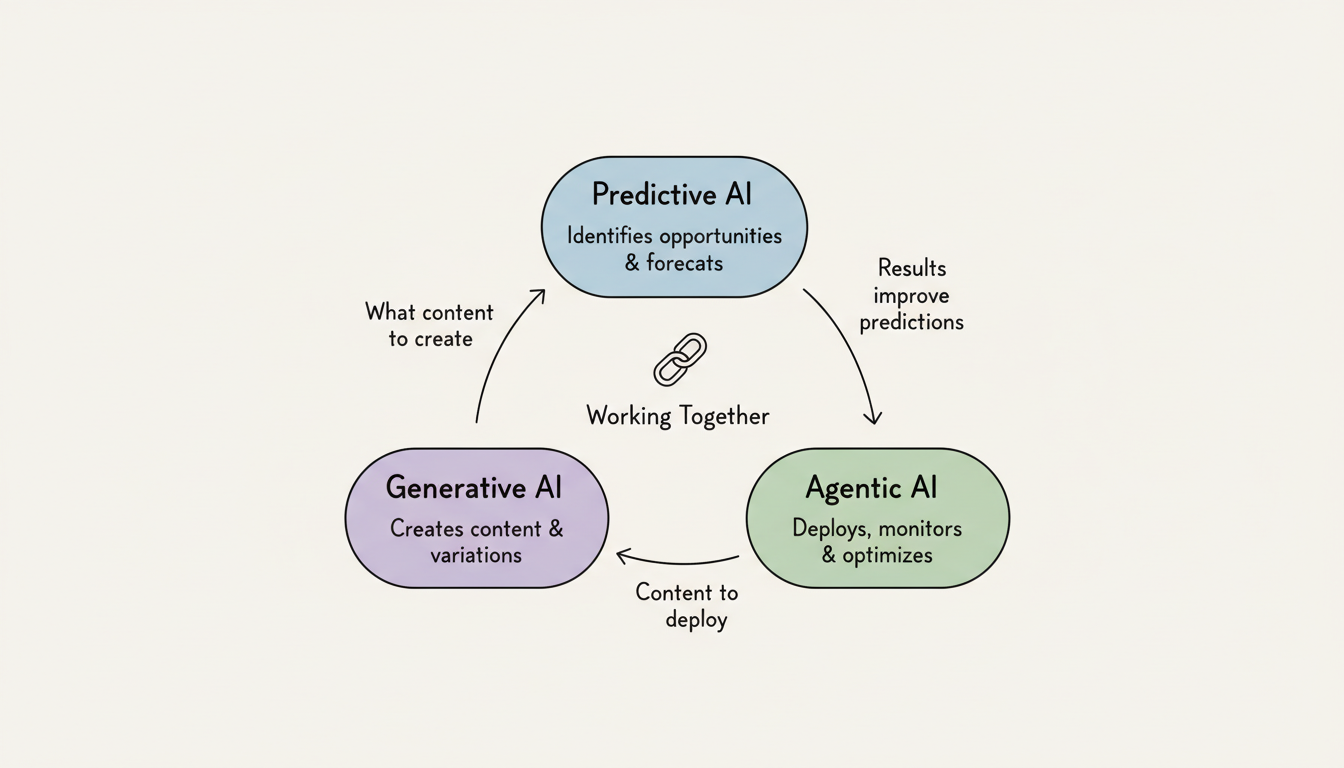
The three paradigms complement rather than compete.
Prediction Informs Generation
Predictive AI identifies what content to create. Generative AI produces it.
Example workflow:
- Predictive model identifies high-converting topic clusters
- Generative AI produces content targeting those topics
- Results feed back to improve predictions
Generation Enables Agency
Generative AI produces content that agentic systems deploy.
Example workflow:
- Agentic system identifies campaign need for new ad variations
- Generative AI produces the variations
- Agentic system deploys, monitors, and optimizes
Prediction Guides Agents
Predictive AI informs agentic decision-making.
Example workflow:
- Predictive model forecasts budget allocation scenarios
- Agentic system implements recommended allocation
- Results improve future predictions
Choosing the Right Paradigm
When to Use Predictive AI
- You have historical data with clear patterns
- You need to prioritize or score items
- Decisions depend on future probabilities
- You're optimizing allocation across options
When to Use Generative AI
- You need content at volume
- Tasks involve creation or transformation
- Output requires human review before use
- Quality matters more than full automation
When to Use Agentic AI
- Processes require multi-step execution
- Real-time adaptation improves outcomes
- Human oversight creates bottlenecks
- Goals are clear but paths vary
Common Misconceptions
"Generative AI Can Predict Outcomes"
Generative AI produces plausible outputs but doesn't model probability. Asking ChatGPT to predict conversion rates gives confident-sounding but statistically meaningless answers. Use predictive models for forecasting.
"Predictive AI Can Create Content"
Predictive models forecast but don't generate. They might predict which content topics perform well but can't write the content. Use generative AI for creation.
"All AI Is Becoming Agentic"
Not all applications need autonomy. Many tasks work better with human-in-the-loop workflows. Agentic AI fits specific use cases, not everything.
"These Paradigms Are Mutually Exclusive"
Modern applications often combine paradigms. A sophisticated marketing system might use predictive AI to identify opportunities, generative AI to create content, and agentic AI to deploy and optimize. This integration mirrors how ai-and-search-engine-optimization combines multiple AI capabilities to improve search visibility.
Practical Application Framework
When evaluating AI solutions, ask:
What problem am I solving?
- Need to know what will happen → Predictive AI
- Need to create something new → Generative AI
- Need to accomplish a goal autonomously → Agentic AI
What inputs do I have?
- Historical data → Predictive AI can help
- Creative briefs → Generative AI can help
- Clear objectives → Agentic AI can help
What outputs do I need?
- Scores, forecasts, probabilities → Predictive AI
- Content, media, code → Generative AI
- Completed tasks, achieved goals → Agentic AI
How much autonomy is appropriate?
- Human interprets and decides → Predictive AI fits
- Human reviews and approves → Generative AI fits
- AI operates within guardrails → Agentic AI fits
The Converging Future
The boundaries between paradigms continue blurring. Advanced systems increasingly combine prediction, generation, and agency into unified platforms. Understanding each paradigm's strengths helps you evaluate these integrated solutions effectively.
Start by identifying your specific needs. Match paradigms to problems. Combine approaches where synergies exist. The goal isn't using the most advanced AI—it's solving your actual business challenges.
Causal AI: The Fourth Paradigm
Beyond prediction, generation, and agency lies a fourth approach: causal AI. While predictive models identify correlations, causal AI models cause-and-effect relationships using directed acyclic graphs, structural equation models, and counterfactual reasoning.
Causal AI answers a fundamentally different question: "Why did this happen, and what would change if we intervened?" This moves beyond pattern recognition into genuine understanding of mechanisms.
Aspect | Predictive | Generative | Agentic | Causal |
Core question | What will happen? | What to create? | How to act? | Why did it happen? |
Reasoning type | Correlation | Pattern synthesis | Goal-directed | Counterfactual |
Key strength | Accuracy at scale | Creative output | Autonomous execution | Intervention design |
Key use cases for causal AI include:
- Uplift modeling: Determine which customers will respond to a specific intervention rather than converting on their own
- Policy simulation: Model the downstream effects of business decisions before implementing them
- Root-cause analysis: Identify the true drivers behind performance changes rather than confounding correlates
Causal AI is particularly valuable when you need to move from "what happened" to "what should we do about it." Combined with predictive models, it transforms forecasts into actionable intervention strategies.
Technical Foundations: How Each AI Type Works
Predictive AI Technical Stack
Predictive AI builds on established statistical and machine learning methods. Core techniques include linear and logistic regression for baseline modeling, decision trees and random forests for non-linear relationships, gradient boosting (XGBoost, LightGBM) for high-accuracy tabular predictions, and AutoML platforms that automate model selection and hyperparameter tuning. Training requires structured, labeled datasets. Models optimize for metrics like accuracy, precision, recall, or AUC depending on the task. Feature engineering remains critical for performance.
Generative AI Technical Stack
Generative AI relies on deep learning architectures designed to produce new content. Large language models (LLMs) use transformer architectures with self-attention mechanisms to generate text. Generative adversarial networks (GANs) pit generator and discriminator networks against each other to produce realistic images. Variational autoencoders (VAEs) learn compressed latent representations for generating variations. Diffusion models iteratively denoise random inputs to produce high-fidelity images and audio. These models require massive training datasets and significant compute resources, typically measured in GPU-hours.
Agentic AI Technical Stack
Agentic AI combines multiple techniques into autonomous systems. Reinforcement learning enables agents to learn optimal action sequences through trial and reward signals. Tool use and function calling allow LLM-based agents to interact with external APIs and databases. Multi-agent coordination frameworks enable specialized agents to collaborate on complex tasks. Vector memory stores give agents persistent context across interactions, enabling long-term planning and learning from past executions.
Causal AI Technical Stack
Causal AI formalizes cause-and-effect reasoning mathematically. Do-calculus provides the mathematical framework for computing interventional distributions from observational data. Causal graphs (DAGs) encode assumptions about which variables influence others. Structural equation models (SEMs) quantify the strength and direction of causal relationships. These methods separate genuine causal effects from spurious correlations that confound traditional predictive models.
Use Cases Beyond Marketing
Healthcare Applications
Predictive AI powers hospital readmission prediction models that flag high-risk patients within 30 days of discharge, enabling preventive interventions. Insurance companies use predictive models for claims cost estimation and resource allocation.
Generative AI accelerates drug discovery by generating novel molecular structures with desired properties, reducing the candidate screening timeline from years to months. It also produces synthetic medical records for research while preserving patient privacy.
Agentic AI drives autonomous diagnostic systems that continuously monitor patient vitals, interpret lab results, cross-reference medical literature, and escalate to clinicians when intervention thresholds are met.
Financial Services Applications
Predictive AI underpins credit risk scoring, fraud detection systems that flag suspicious transactions in real time, and portfolio risk assessment models used by institutional investors.
Generative AI creates synthetic financial data for stress testing and model validation, produces automated analyst reports, and generates personalized client communications at scale.
Agentic AI manages algorithmic trading systems that execute complex multi-leg strategies, rebalance portfolios based on market conditions, and autonomously hedge positions across asset classes.
Manufacturing Applications
Predictive AI enables demand forecasting that optimizes supply chains, predictive maintenance that schedules equipment servicing before failures occur, and quality control models that catch defects early in production.
Generative AI powers generative design systems that produce thousands of component design variations optimized for weight, strength, and manufacturability constraints that human engineers would never consider.
Agentic AI runs autonomous quality control systems that inspect products, identify defects, adjust manufacturing parameters in real time, and coordinate with supply chain systems to manage material flow without human intervention.
Ethics, Limitations, and Explainability
The Explainability Spectrum
AI types vary significantly in how easily humans can understand their decisions. Predictive AI sits at the most explainable end: decision trees and linear models produce interpretable outputs where you can trace exactly which features drove a prediction. Causal AI offers strong explainability through its explicit graphical models of cause and effect. Generative AI is less transparent, with transformer architectures operating as effective black boxes despite attention visualization efforts. Agentic AI presents the greatest explainability challenge, as autonomous multi-step reasoning makes it difficult to audit why an agent chose a particular action sequence.
Bias and Fairness
Each paradigm carries distinct bias risks. Predictive models amplify historical biases present in training data, potentially encoding discrimination into credit, hiring, and healthcare decisions. Generative models reproduce and sometimes amplify stereotypes from their training corpora. Agentic systems can compound bias through autonomous decision chains where small biases in individual steps cascade into significant unfair outcomes. Causal AI offers a partial remedy by explicitly modeling protected attributes and their causal pathways, enabling fairer intervention design.
Hallucination and Reliability
Generative AI produces confident-sounding but fabricated outputs, a problem known as hallucination. This risk escalates in agentic systems where hallucinated reasoning can trigger real-world actions. Retrieval-augmented generation (RAG) and grounding techniques reduce but do not eliminate this risk. Organizations deploying generative or agentic systems need robust validation layers and human oversight for high-stakes decisions.
Environmental and Resource Impact
Training large generative models consumes substantial energy. GPT-4 class models require thousands of GPU-hours and produce significant carbon emissions. Predictive models are generally far more resource-efficient. Organizations should weigh the environmental cost against the marginal performance gain when selecting model scale.
Copyright and Privacy
Generative AI raises unresolved questions about intellectual property. Models trained on copyrighted content may reproduce protected material. Privacy concerns arise when training data includes personal information. Agentic systems that access and process data autonomously require careful data governance to prevent unauthorized information exposure.
Multi-Agent Systems: The Future of Agentic AI
The next evolution of agentic AI moves beyond single agents to coordinated multi-agent systems where specialized agents collaborate to accomplish complex objectives.
Multi-Agent Coordination
Multi-agent systems assign distinct roles to specialized agents. A research agent gathers information, an analysis agent interprets findings, a writing agent produces reports, and a review agent validates quality. This division of labor mirrors human team structures and produces higher-quality outcomes than monolithic agents attempting every task.
Agent Communication Patterns
Agents coordinate through several established patterns. Hierarchical orchestration uses a supervisor agent that delegates tasks and synthesizes results. Peer-to-peer collaboration allows agents to negotiate and share information directly. Blackboard architectures provide shared workspaces where agents contribute partial solutions. Message-passing systems enable asynchronous coordination across distributed agent networks.
Real-World Multi-Agent Deployments
Enterprise multi-agent systems are already operational across industries. Salesforce deploys digital workers, autonomous agent teams that handle customer service escalations, process returns, and manage account updates without human intervention. Autonomous driving platforms coordinate perception, planning, and control agents that must make real-time decisions in safety-critical environments. Software development teams use multi-agent coding systems where agents specialize in writing, testing, reviewing, and deploying code.
The trajectory is clear: as individual agents become more capable, orchestrating them into collaborative teams amplifies their impact exponentially. Organizations investing in multi-agent infrastructure today are positioning themselves for the next wave of autonomous business operations.
Frequently Asked Questions
What Are the 4 Main Types of AI?
The four main types of AI in modern business applications are predictive AI (forecasts outcomes from historical data), generative AI (creates new content like text, images, and code), agentic AI (executes autonomous multi-step actions toward goals), and causal AI (models cause-and-effect relationships for intervention design). Each type addresses fundamentally different business needs and operates on distinct technical foundations.
What Is the Difference Between Predictive AI and Generative AI and Agentic AI?
Predictive AI analyzes historical patterns to forecast what will likely happen next, such as which customers will churn or which ads will convert. Generative AI creates new content, including text, images, code, and audio, based on prompts and learned patterns. Agentic AI operates autonomously to achieve goals by planning and executing multi-step workflows, using tools, and adapting to changing conditions. The key distinction is output: predictions versus content versus completed actions.
What Are the 7 Types of AI Agents?
AI agent taxonomy includes seven types arranged by increasing sophistication: simple reflex agents (react to current conditions), model-based reflex agents (maintain internal state), goal-based agents (plan toward objectives), utility-based agents (optimize for best outcomes), learning agents (improve from experience), hierarchical agents (coordinate sub-agents in layers), and multi-agent systems (teams of specialized agents collaborating on complex tasks).
What Are the 4 Types of Intelligence in AI?
The four types of AI intelligence map to capability levels: narrow AI (excels at specific tasks like image recognition or language translation), general AI (hypothetical human-level reasoning across domains), super AI (theoretical intelligence surpassing all human cognitive abilities), and artificial superintelligence (self-improving systems that could recursively enhance their own capabilities). Currently, all commercial AI systems operate at the narrow AI level, though rapid advances in agentic and generative AI are pushing toward broader capabilities.