
Last Updated: March 2026
Artificial intelligence has fundamentally changed search engine optimization. The relationship between AI and search engine optimization goes beyond simple automation—AI now powers how search engines understand queries, rank content, and deliver results.
Understanding this shift is essential for any business that depends on organic search visibility.
How AI Changed Search Engines
Search engines no longer just match keywords to pages. AI systems like Google's BERT and RankBrain analyze the meaning behind queries, understanding context and intent in ways that weren't possible a few years ago. Today, modern search is powered by large language models (LLMs) that go far beyond BERT and RankBrain—these systems generate full narrative answers rather than simply matching documents to queries. Google Gemini, the LLM backbone behind AI Overviews, represents the latest evolution in this trajectory, enabling search to understand and respond to complex, multi-part questions with unprecedented accuracy.
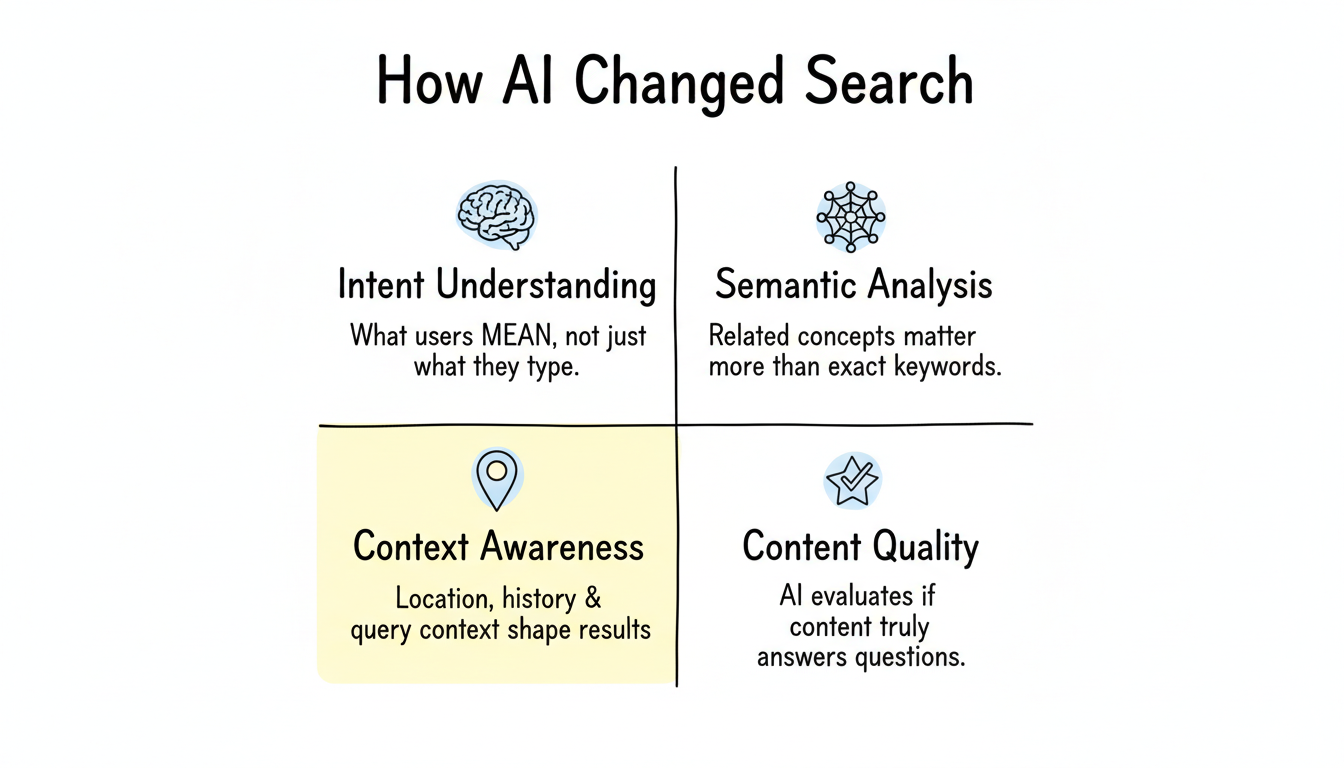
Key changes AI brought to search:
- Intent understanding: Search engines now interpret what users actually want, not just what words they type
- Semantic analysis: Related concepts and topics matter more than exact keyword matches
- Context awareness: Location, search history, and query context influence results
- Content quality assessment: AI evaluates whether content genuinely answers questions
These changes mean traditional keyword-focused SEO isn't enough. Search engines evaluate content quality, expertise signals, and whether pages actually satisfy user needs.
The Rise of Zero-Click Search
One of the most significant impacts of AI on SEO is the growth of zero-click searches. AI-powered features like Google AI Overviews answer queries directly on the search results page—users get answers without clicking through to any website.
What this means for SEO:
Traditional traffic metrics become less meaningful when AI synthesizes your content into direct answers. Visibility and brand mentions matter even when clicks don't follow.
Businesses must optimize not just for rankings but for how AI systems extract and present their information. Content structure, clear factual statements, and authoritative positioning influence whether your brand appears in AI-generated responses. Implementing an effective aeo strategy framework helps ensure your content performs well across both traditional search and AI-powered platforms.
GEO and AIO: The New Language of AI Search Optimization
As AI reshapes how search results are generated and displayed, new disciplines have emerged to address these changes. Generative Engine Optimization (GEO) is the practice of optimizing content specifically for AI-generated search results—a distinct discipline from traditional SEO that focuses on how content is selected, extracted, and cited by AI systems.
A related umbrella term gaining traction is AI Optimization (AIO), which encompasses the broader set of strategies for maximizing visibility across all AI-powered platforms and interfaces.
The distinction matters: traditional SEO focuses on ranking in blue links, while GEO focuses on being cited or summarized by LLMs in AI Overviews, ChatGPT Search, Perplexity, and other AI-powered search experiences. Notably, the AI Overview for queries about AI and search engine optimization itself references GEO and AIO terminology, signaling Google's recognition of these emerging concepts.
A practical GEO framework involves three core principles: (1) structure content for extraction by using clear claims, data points, and direct answers that LLMs can easily identify and pull; (2) provide citable statistics, quotes, and original research that give AI systems concrete material to reference; and (3) match the conversational query patterns that LLMs are trained on, since users increasingly phrase searches as natural-language questions. For a deeper exploration of related optimization strategies, understanding generative AI and SEO dynamics provides valuable context for implementing GEO alongside your existing SEO efforts.
AI Tools for SEO
AI has also transformed the tools available to SEO professionals. Modern AI SEO tools help with:
Content optimization: Platforms like Clearscope, Surfer SEO, and MarketMuse use NLP to analyze top-ranking content and recommend improvements. These tools identify semantic patterns and help writers create comprehensive content that addresses user intent.
Keyword research: AI analyzes search patterns to identify opportunities traditional research might miss. Tools can predict emerging topics and cluster related keywords more effectively.
Technical SEO: AI-powered crawlers identify issues faster and prioritize fixes based on impact. Machine learning helps predict how changes might affect rankings.
Content generation: AI writing assistants accelerate content production, though human editing remains essential for quality and accuracy.
Additional AI-powered tools worth considering:
- Jasper AI: An AI content generation platform that helps teams produce SEO-optimized content at scale, with brand voice controls and campaign-level workflows
- Frase: Combines AI-powered content briefs with real-time optimization scoring, using NLP to analyze top-ranking pages and guide writers toward comprehensive coverage
- Semrush: Offers AI-powered keyword research, competitive analysis, and content optimization features that leverage machine learning to surface opportunities and track rankings across platforms
- Google Gemini: Useful for multimodal content ideation—it can analyze images, video, and text together to generate content strategies that span multiple formats and channels
The key is using AI tools to enhance human expertise, not replace it. AI excels at data analysis and pattern recognition; humans provide strategy, creativity, and quality judgment.
AI-Powered Search Platforms
Beyond Google, new AI-native search platforms have emerged that require different optimization approaches:
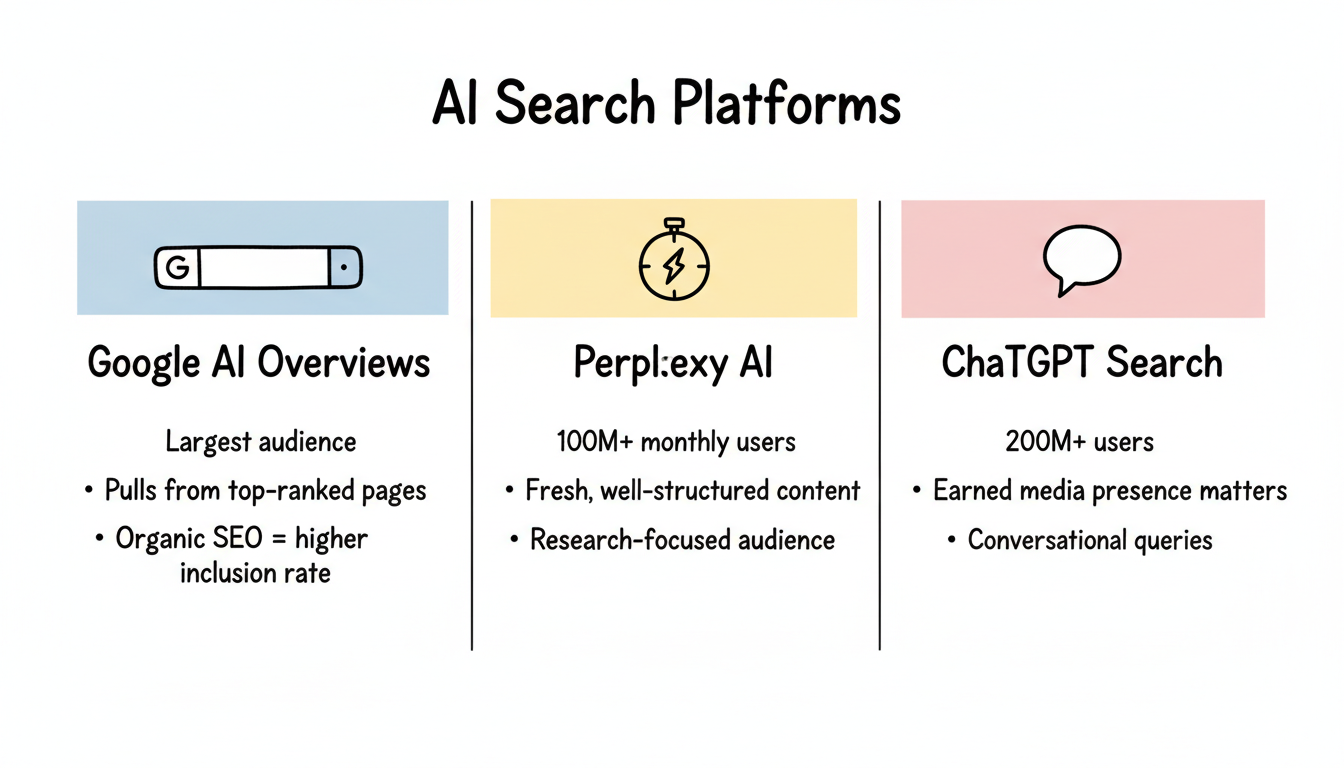
Perplexity AI: An answer engine that synthesizes information from multiple sources with inline citations. Over 100 million monthly active users rely on Perplexity for research.
ChatGPT Search: OpenAI's search feature reaches 200+ million users, pulling from the web to answer queries conversationally. Learning chatgpt seo optimization guide techniques helps maximize your visibility in this growing platform.
Microsoft Copilot: Integrated across Microsoft's ecosystem, Copilot is built on large language model (LLM) technology and is particularly important for B2B audiences using enterprise tools.
Google Gemini: In addition to powering Google AI Overviews, Gemini is available as a standalone conversational search interface. It represents Google's most advanced AI search experience, capable of processing complex queries across text, images, and code—making it a significant platform for content visibility beyond traditional organic results.
You.com is another emerging AI search platform worth monitoring as the landscape continues to expand.
Each platform weights different signals. Perplexity favors fresh, well-structured content. ChatGPT citations correlate heavily with earned media presence. Google AI Overviews primarily pull from pages that already rank well organically.
Multi-platform optimization has become necessary as users spread across these different AI search tools. Tracking performance requires specialized ai search analytics tracking to measure visibility across all these platforms.
Optimizing for AI and Traditional Search
The good news: AI optimization builds on traditional SEO foundations rather than replacing them. Core principles still apply.
What remains important:
- Quality content that serves user intent
- Technical accessibility for crawlers
- Authority signals (backlinks, expertise, trust)
- Mobile-friendly, fast-loading pages
What's become more important:
- Clear content structure that AI can easily parse
- Factual accuracy with supporting evidence
- Schema markup to help AI understand content
- Fresh content with regular updates
- Cross-platform presence and earned media
The most effective approach combines solid traditional SEO with AI-specific enhancements. Pages that rank well organically have significantly higher chances of appearing in AI Overviews and earning citations from other AI platforms. Achieving strong ai search optimization now requires a dual strategy: maintaining rigorous traditional technical SEO while layering on GEO-specific tactics designed for AI extraction and citation. E-E-A-T serves as the bridge between both worlds—the same trust signals that boost organic rankings also determine whether AI platforms select your content as a source. Understanding generative ai and seo dynamics helps you adapt your strategy to these evolving search behaviors. For practical guidance on tracking your performance across AI platforms, explore ai search analytics tracking methodologies.
E-E-A-T: Why Trust Signals Matter More in AI Search
E-E-A-T—Experience, Expertise, Authoritativeness, and Trustworthiness—is Google's quality framework for evaluating content. While E-E-A-T has been a ranking consideration for years, its importance has intensified as AI systems increasingly rely on these signals to determine which sources to cite in generated responses.
Large language models (LLMs) that power AI search platforms evaluate content quality when selecting sources to reference. Content that demonstrates real-world experience, genuine domain expertise, and verifiable authority is far more likely to be extracted and cited by AI Overviews, ChatGPT Search, and Perplexity AI. These platforms are designed to surface the most trustworthy information available, making E-E-A-T signals the primary filter for AI citation eligibility.
Practical steps to strengthen E-E-A-T for AI search:
- Add author bios with verifiable credentials, professional affiliations, and links to published work
- Include first-hand data, case studies, or original research that demonstrates direct experience with the topic
- Earn backlinks from topically relevant, authoritative domains to reinforce domain authority
- Keep content factually accurate and regularly updated—AI platforms favor recency and correctness
- Use schema markup (author, organization, article) to surface trust signals in a machine-readable format
- Build topical authority through content clusters—publishing comprehensive coverage of related subtopics reinforces E-E-A-T signals across your entire domain
For YMYL topics (Your Money or Your Life)—covering health, finance, and legal subject matter—AI platforms apply even stricter quality filters. In these verticals, E-E-A-T is non-negotiable: content without clear expertise signals and authoritative sourcing will be systematically excluded from AI-generated responses.
Building strong E-E-A-T also benefits ChatGPT SEO optimization efforts, as LLM-based search engines across all platforms weight these trust indicators heavily. Investing in multi-format content like YouTube SEO for AI search further strengthens your authority by demonstrating expertise across channels.
Key Takeaways
AI has changed what search engines value. Intent understanding, content quality, and topical expertise matter more than keyword density or link quantity alone.
Zero-click search is growing. Optimize for visibility and citation, not just clicks. Your brand can benefit from AI mentions even without direct traffic.
Multiple AI platforms need attention. Google AI Overviews, Perplexity, ChatGPT, and Copilot each have different audiences and ranking signals.
Traditional SEO remains foundational. AI optimization layers on top of—not instead of—established SEO best practices.
AI tools can help. Content optimization platforms, keyword research tools, and technical SEO crawlers leverage AI to improve efficiency and effectiveness.
E-E-A-T signals (experience, expertise, authority, trust) are the common thread between traditional SEO rankings and AI search citations—strengthening these signals improves performance across all search platforms simultaneously.
FAQs
Does AI make traditional SEO obsolete? No. Research shows that Google AI Overviews maintain significant overlap with traditional organic results—pages ranking well in standard search have higher AI Overview inclusion rates. AI optimization builds on SEO fundamentals.
How do I optimize for AI search engines? Focus on content structure (clear headings, direct answers), factual accuracy with citations, schema markup, and regular updates. Build authority through earned media and cross-platform presence.
Which AI search platform matters most? For most businesses, Google AI Overviews reach the largest audience. Perplexity and ChatGPT are growing rapidly and valuable for thought leadership. B2B companies should also consider Microsoft Copilot.
Can AI write SEO content for me? AI can assist with drafts and ideation, but human editing is essential. AI-generated content without human refinement often lacks accuracy, originality, and the expertise signals that both search engines and users value.
What is E-E-A-T and why does it matter for AI SEO? E-E-A-T stands for Experience, Expertise, Authoritativeness, and Trustworthiness. It is Google's quality framework for evaluating content. In AI search, LLMs prioritize citing sources that demonstrate real-world experience and domain expertise. Strengthening E-E-A-T signals—through author credentials, original data, and authoritative backlinks—increases the likelihood of being featured in AI Overviews and other AI search results.
What is Generative Engine Optimization (GEO)? GEO is the practice of optimizing content specifically for AI-powered search engines like Google AI Overviews, ChatGPT Search, and Perplexity AI. Unlike traditional SEO that targets blue-link rankings, GEO focuses on making content easily extractable and citable by large language models. Key tactics include structured data, clear factual claims, and conversational formatting.
How do large language models (LLMs) choose which sources to cite? LLMs evaluate sources based on relevance, authority, recency, and structural clarity. Content that provides direct answers to specific questions, includes verifiable data points, and comes from domains with strong E-E-A-T signals is more likely to be cited. Formatting also matters—well-structured content with clear headings, lists, and concise paragraphs makes it easier for LLMs to extract and attribute information in their responses.
What is the difference between SEO and AI search optimization? Traditional SEO focuses on ranking in organic blue links through keyword optimization, backlinks, and technical performance. AI search optimization (also called GEO) targets visibility within AI-generated answers and summaries. The two overlap significantly—strong E-E-A-T, quality content, and structured data benefit both. The main difference is that AI search optimization also requires content formatted for easy extraction by LLMs.