
Last Updated: March 2026
AI content optimization focuses on structuring your content so AI search platforms can find, understand, and cite it. As ChatGPT, Perplexity, and Google AI Overviews become primary information sources, content that AI systems can easily extract gains visibility over content they struggle to parse. Within the broader SEO landscape, this discipline is increasingly known as Generative Engine Optimization (GEO) -- the practice of making your content discoverable and citable by AI-powered search engines.
This guide covers practical techniques for optimizing content structure, format, and elements for AI search visibility.
Generative Engine Optimization (GEO): The Emerging Framework
Generative Engine Optimization (GEO) is the practice of optimizing content specifically for AI-powered search engines -- including ChatGPT, Perplexity, Google AI Overviews, and Anthropic's Claude. While traditional SEO targets ranking positions in organic search results, and Answer Engine Optimization (AEO) focuses on featured snippets and voice search, GEO zeroes in on citation probability, extractability, and entity coverage within AI-generated responses.
Recent research into AI search ranking factors has identified several key GEO signals: source credibility, content freshness, structured data completeness, and entity coverage. AI models evaluate these factors when deciding which sources to cite in their generated answers. A page that scores well across all four dimensions is far more likely to appear as a referenced source.
Importantly, GEO is not a replacement for SEO but an extension of it. Both disciplines share on-page SEO fundamentals, E-E-A-T principles, and structured data best practices. Think of GEO as an additional optimization layer that ensures your already well-optimized content is also formatted for AI extraction and citation. For a deeper exploration of these techniques, see our guide on advanced GEO optimization strategies.
The rest of this article serves as a practical GEO playbook -- covering the content structure, technical elements, and strategic approaches that maximize your visibility across both traditional and AI-powered search engines.
Why Content Structure Matters for AI
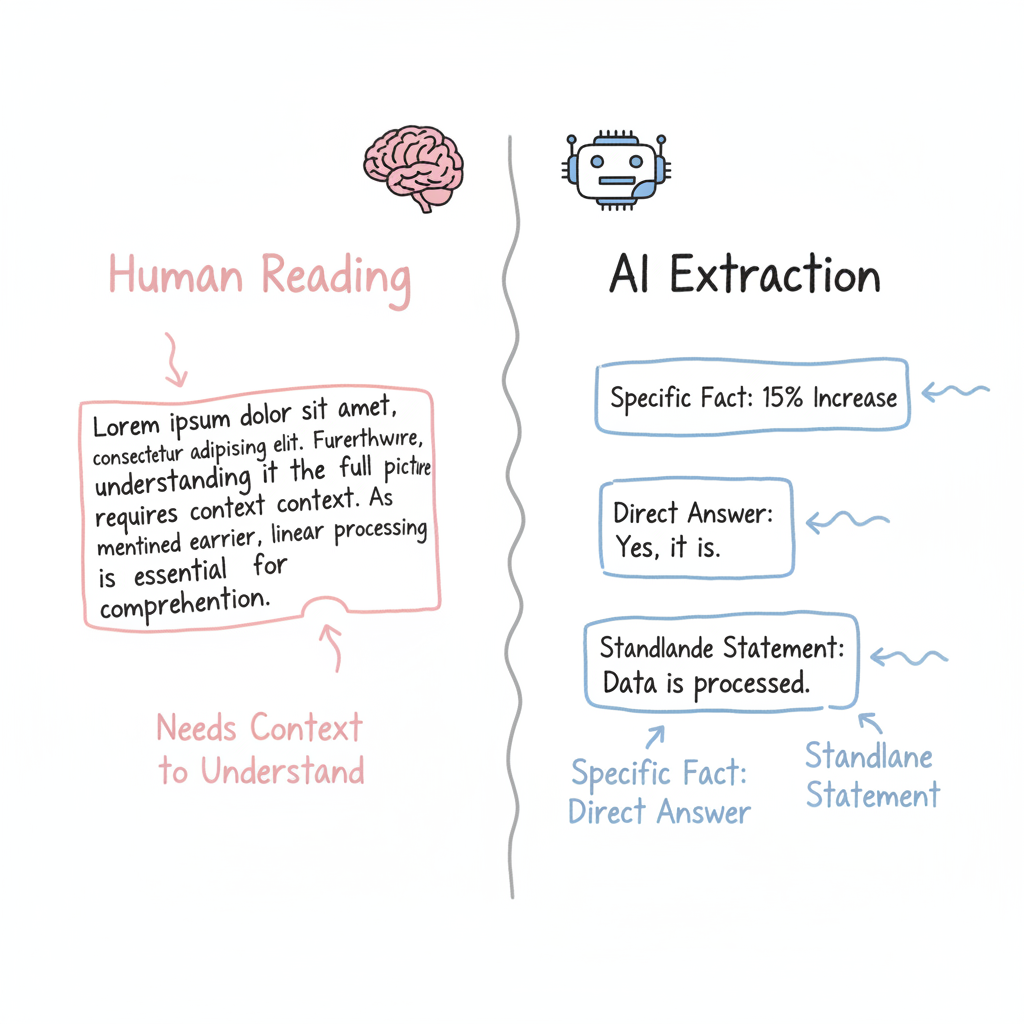
AI systems don't read content the way humans do. They extract specific passages to include in generated responses. A well-written article that lacks clear structure may rank well in traditional search but never get cited by AI platforms.
The extraction process favors:
- Clear, standalone statements
- Specific facts with attribution
- Direct answers to questions
- Short, quotable paragraphs
- Front-loaded information
Content optimized for AI extraction serves both purposes -- it reads well for humans while being easily quotable by AI systems.
Core Content Optimization Techniques
Write Extractable Paragraphs
AI systems pull content at the paragraph level. Each paragraph should work as a standalone statement when extracted from surrounding context.
Before optimization:
"There are many factors to consider when thinking about this topic, and experts have debated various approaches over the years. Some believe one method works best while others prefer different techniques. The reality is that it depends on your specific situation."
After optimization:
"AI content optimization requires structuring paragraphs as standalone statements. Each paragraph should convey a complete idea that makes sense even when quoted independently from surrounding text."
The optimized version:
- Makes a specific claim
- Stands alone without context
- Can be directly quoted
- Stays under 80 words
Front-Load Key Information
Place the most important information immediately after each heading. AI systems often extract opening sentences when generating responses, similar to how to optimize content for AI Overview strategies.
Structure pattern:
- Heading (question or topic)
- Direct answer or key point (first sentence)
- Supporting details (remaining paragraph)
- Specific examples or data
This pattern ensures that even if AI only extracts the first sentence, users receive valuable information.
Use Question-Based Headers
Match headers to how users actually query AI systems. Research shows AI platforms favor content that directly addresses user questions.
Less effective:
"## Considerations for Implementation"
More effective:
"## How Do You Implement AI Content Optimization?"
Question-based headers signal to AI systems that the following content answers that specific query. Additionally, internal linking between related posts strengthens the topical cluster signal that AI models use to assess domain expertise.
Include Specific Data Points
AI systems prefer citing content with specific, verifiable information over vague claims.
Vague:
"AI search is growing rapidly and becoming more important."
Specific:
"ChatGPT processes over 1 billion weekly searches, while Google AI Overviews now appear on an increasing percentage of informational queries."
Specific data with clear attribution earns more AI citations than generic statements. Understanding aeo-statistics-trends helps you identify which metrics matter most to AI platforms.
Structural Elements That Improve AI Visibility
FAQ Sections
FAQ sections directly match the question-answer format AI systems seek. Implement FAQs that:
- Use actual questions users ask
- Provide complete answers in 50-100 words
- Include specific information
- Cover logical follow-up questions
Implement FAQ schema markup to help AI systems identify these sections.
Comparison Tables
Tables provide structured data AI systems can easily parse and reference. Use tables for:
- Feature comparisons
- Pricing information
- Process steps
- Platform differences
Tables also improve human readability while signaling clear data relationships to AI.
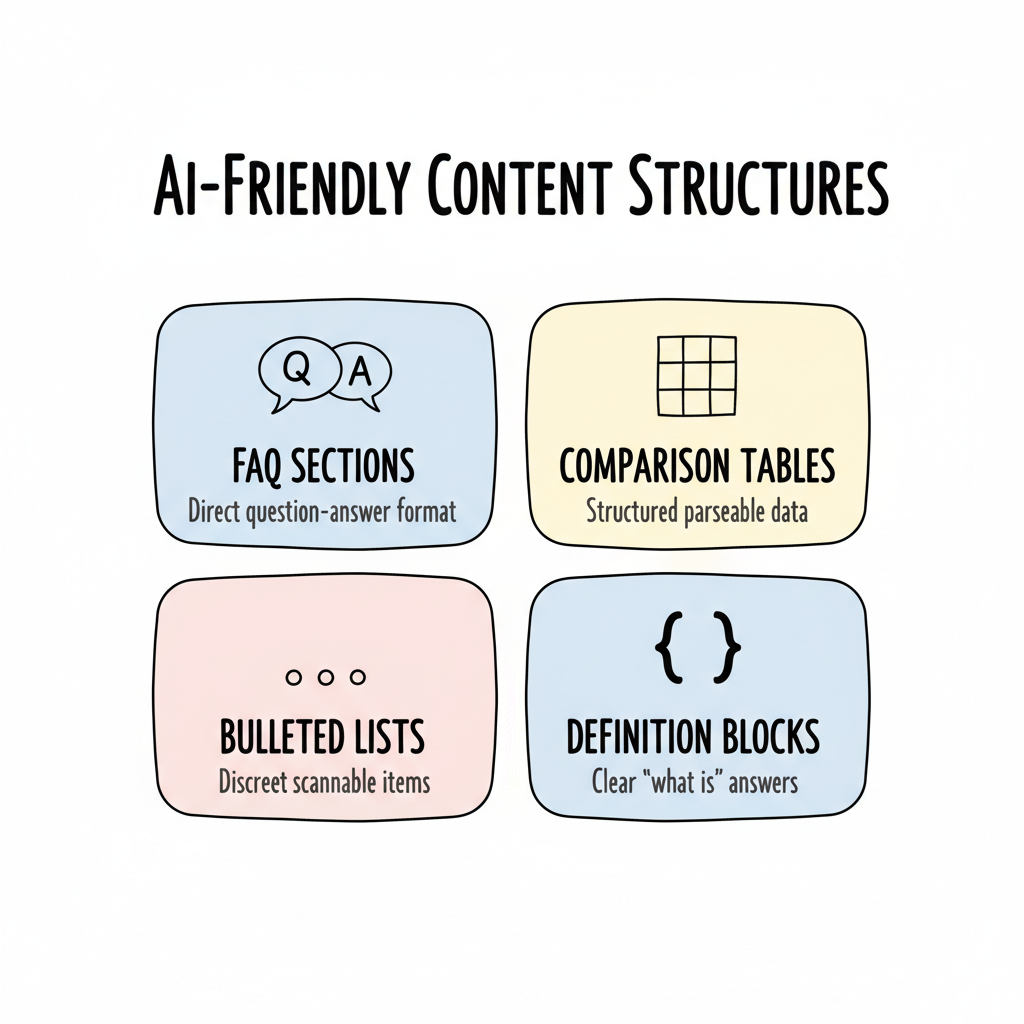
Bulleted Lists
Lists help AI systems identify discrete items and options. Use lists for:
- Steps in a process
- Features or benefits
- Options to consider
- Requirements or criteria
Keep list items parallel in structure and complete enough to stand alone.
Definition Blocks
Clear definitions earn AI citations when users ask "what is" questions. Structure definitions as:
[Term]: [Clear, complete definition in one to two sentences.]
Place definitions near the beginning of relevant sections.
E-E-A-T Signals That Drive AI Citations
E-E-A-T stands for Experience, Expertise, Authoritativeness, and Trustworthiness -- the quality framework that AI models like ChatGPT, Perplexity, and Anthropic's Claude use when evaluating which sources to cite in generated responses. Content that scores highly on E-E-A-T dimensions is significantly more likely to be selected as a citation source by AI search engines.
Experience: AI systems look for signals of first-hand knowledge. Content that includes original case studies, proprietary benchmarks, real-world screenshots, and first-person observations demonstrates genuine experience. LLMs scanning for citation-worthy content can distinguish between regurgitated advice and insights drawn from actual practice. Adding original data points to your content is one of the most effective ways to earn AI citations.
Expertise and Authoritativeness: Author bios with verifiable credentials, a consistent publishing cadence, and deep topical coverage built through content clusters all signal expertise to AI systems. These models map entity-based SEO and topical authority relationships across a domain to assess how comprehensively a source covers a subject area. Domains that publish regularly on a focused set of topics build stronger authority signals than those covering broad, unrelated subjects.
Trustworthiness: HTTPS, transparent sourcing, citing primary research, and maintaining factual accuracy are table-stakes trust signals. AI models are designed to penalize hallucination-prone sources, so content that clearly attributes claims to verifiable data earns higher trust scores. Linking to primary sources and maintaining a track record of accuracy strengthens your position as a citable resource.
E-E-A-T signals directly influence whether your content appears in AI Overviews, ChatGPT citations, and Perplexity source panels. Strengthening these signals is not optional -- it is foundational to any effective AI content optimization strategy.
Technical Optimization for AI
Schema Markup
Implement schema to help AI systems understand your content:
- Article schema: Establishes authorship and publication dates
- FAQ schema: Makes Q&A pairs explicitly identifiable
- HowTo schema: Structures instructional content
- Organization schema: Builds entity recognition
Understanding json-ld-vs-microdata-knowledge-graph differences helps you choose the right implementation approach. Keyword clustering also informs which entities to declare in structured data for AI search, ensuring your schema aligns with the topical cluster the page belongs to.
Content Freshness
AI platforms favor recent content. Optimize freshness by:
- Including clear "last updated" timestamps
- Updating high-priority content regularly
- Removing outdated information promptly
- Covering current developments in your topics
Research suggests content updated within the last 3 months receives significantly more AI citations than older content on similar topics.
Crawler Access
Ensure AI crawlers can access your content:
- Allow GPTBot, PerplexityBot, and ChatGPT-User in robots.txt
- Ensure content renders without JavaScript where possible
- Maintain fast page load speeds
- Use clean URL structures
Title tags and meta descriptions are the first HTML elements AI crawlers parse when evaluating a page. Descriptive, keyword-front-loaded titles help AI systems categorize content, while well-crafted meta descriptions serve as summary candidates for citations. Running a periodic site audit can catch missing or duplicate tags across your domain, ensuring no optimization opportunities are missed.
On-Page SEO Fundamentals for AI Search
Traditional on-page SEO and AI search optimization share the same HTML foundation. AI crawlers parse the same signals that Googlebot uses -- title tags, meta descriptions, header hierarchies, and image alt text. Optimizing these elements improves your visibility across both traditional and AI-powered search engines simultaneously.
Title tags: Descriptive, keyword-front-loaded titles help AI systems categorize and cite your content accurately. A title that clearly states the topic and includes primary entities gives AI models the context they need to match your page to user queries.
Before: "Content Tips and Tricks for Better Results"
After: "AI Content Optimization: How to Structure Content for AI Search Citations"
Meta descriptions: AI models frequently use meta descriptions as summary candidates when generating citations. Include a clear value proposition and your primary entity within 155 characters. Think of the meta description as the elevator pitch AI systems use to decide whether your page deserves a citation.
Header hierarchy: Maintain a clean H1 > H2 > H3 structure with target entities embedded in subheadings. AI systems use header hierarchy to understand content organization and identify the most relevant section for a given query. Each H2 should represent a distinct subtopic, with H3s providing supporting detail.
Image alt text: Multimodal AI models like GPT-4o and Gemini reference alt text when processing pages. Use descriptive, entity-rich alt attributes that accurately describe the image content and its relevance to the surrounding text.
The following table summarizes how key on-page elements serve dual roles:
| Element | Traditional SEO Role | AI Search Role |
|---|---|---|
| Title Tag | Ranking signal, click-through rate | Content categorization, citation matching |
| Meta Description | SERP snippet, user intent signal | Summary candidate for AI citations |
| Header Tags | Content structure, keyword relevance | Section identification, query matching |
| Image Alt Text | Accessibility, image search ranking | Multimodal context for AI models |
A periodic site audit using tools like Semrush Site Audit can validate that on-page elements are consistent and complete across your entire domain, catching issues at scale that manual review would miss.
Internal Linking Strategy for AI Visibility
Internal links play a critical role in AI search visibility because LLM crawlers follow link graphs to discover related content and assess topical depth. A well-linked content cluster signals domain expertise on a topic, making it more likely that AI systems will cite pages from your site. For a comprehensive overview, see our guide on internal linking and its SEO benefits.
Keyword clustering: Group related keywords into pillar and supporting content, then link them in a hub-and-spoke model. For example, this AI content optimization guide serves as a pillar page, with supporting articles covering specific subtopics like structured data, E-E-A-T signals, GEO strategies, and on-page SEO fundamentals. Each supporting page links back to the pillar, and the pillar links out to each spoke -- creating a tightly connected topical cluster.
Anchor text best practices: Use descriptive, entity-rich anchor text rather than generic phrases like "click here" or "learn more." AI systems extract semantic meaning from anchor context, so anchors like "AI content optimization techniques" or "structured data for AI search" provide far more signal than vague link text. Every internal link is an opportunity to reinforce your topical relevance.
Audit your internal links: Conduct periodic reviews -- either manually or using site audit tools -- to identify orphan pages (pages with no internal links pointing to them) and broken links that weaken your crawl graph. Orphan pages are effectively invisible to AI crawlers that rely on link discovery, so ensuring every important page is connected to the broader site structure is essential.
Internal links also help AI Overviews discover supporting evidence across your domain. When Google's AI Overview cites your content, it often pulls from multiple related pages -- a strong internal linking structure makes it easier for the system to find and cross-reference your supporting content.
Measuring AI Content Optimization
Track whether optimization efforts improve AI visibility:
- Citation monitoring: Are you being cited more frequently?
- AI referral traffic: Is traffic from AI platforms increasing?
- Citation accuracy: Is AI representing your information correctly?
- Share of voice: How do you compare to competitors?
Tools like Otterly.AI and Profound track AI visibility metrics that traditional analytics miss. For platforms like WordPress, implementing wordpress-aeo-optimization techniques can streamline your measurement process. Semrush is also worth monitoring for tracking AI Overview appearances, and Anthropic's Claude is emerging as a growing citation source alongside ChatGPT and Perplexity. Consider AB testing for AI search optimization as a next step for validating which optimization changes have the greatest impact on your AI visibility metrics.
Key Takeaways
Structure for extraction. Every paragraph should work as a standalone quote. Front-load information and keep paragraphs under 80 words.
Match user queries. Use question-based headers that align with how users actually ask AI systems questions.
Add specific data. Statistics, facts, and concrete information earn more citations than vague claims.
Implement structure elements. FAQs, tables, lists, and clear definitions help AI systems identify quotable content.
Maintain freshness. Regular updates signal current relevance to AI platforms.
FAQs
Does AI Content Optimization Conflict with Traditional SEO?
No. Most AI content optimization techniques -- clear structure, specific information, quality content -- align with SEO best practices. The main addition is paragraph-level extractability and question-based formatting. Content optimized for AI typically performs well in traditional search too.
How Often Should I Update Content for AI Visibility?
Update high-priority content at least quarterly. More frequent updates benefit time-sensitive topics. Include clear timestamps showing when content was last reviewed or updated.
Which Content Should I Optimize First?
Prioritize pages that already rank well in traditional search and cover topics users frequently ask AI systems about. High-performing SEO content with extractability improvements often sees the fastest AI visibility gains.
What Is the Difference Between GEO and Traditional SEO?
GEO (Generative Engine Optimization) focuses on making content citable by AI search engines like ChatGPT, Perplexity, and Google AI Overviews. Traditional SEO targets ranking positions in organic search results. Both share foundational practices -- on-page SEO, E-E-A-T signals, and structured data -- but GEO adds emphasis on extractable content blocks, entity coverage, and source credibility signals that LLMs evaluate when selecting citations.
How Does E-E-A-T Affect AI Content Optimization?
AI models prioritize sources that demonstrate Experience, Expertise, Authoritativeness, and Trustworthiness. Content backed by original data, written by credible authors, and published on domains with topical authority is more likely to be cited in AI-generated answers. Strengthening E-E-A-T signals -- such as author bios, first-party research, and transparent sourcing -- directly improves your AI search visibility.
Why Is Internal Linking Important for AI Search Visibility?
Internal links help AI crawlers discover and map the relationships between your content pages. A strong internal linking structure built around keyword clusters signals topical depth, which AI systems interpret as domain expertise. Pages with more contextual internal links pointing to them are more likely to be crawled, indexed, and ultimately cited by generative search engines.
What on-Page SEO Elements Should I Optimize for AI Search Engines?
Focus on title tags with front-loaded target entities, meta descriptions that summarize your unique value proposition, descriptive header hierarchies (H1-H3), and entity-rich image alt text. AI crawlers parse these HTML elements to categorize and evaluate content. Running a periodic site audit ensures these elements are consistent and complete across your domain.
Pair prompt structure with an optimization workflow: see our prompt engineering for marketers guide for reusable prompt patterns.