
Last Updated: March 2026
AI content optimization tools have transformed how marketers create search-optimized content. These platforms analyze top-ranking pages, identify semantic patterns, and guide writers to produce content that ranks—and increasingly, content that AI systems cite in their responses.
This guide covers the leading AI content optimization tools, comparing features, pricing, and use cases to help you choose the right solution.
What Are AI Content Optimization Tools?
AI content optimization tools use natural language processing (NLP) and machine learning to analyze search results and provide data-driven recommendations for content creation. Rather than relying on keyword density or intuition, these tools:
- Analyze SERP competitors to identify patterns in high-ranking content
- Recommend semantic keywords and topics to cover
- Score content based on optimization factors
- Generate briefs and outlines from SERP data
- Track content performance over time
The core value proposition: write content that matches what search engines (and AI systems) expect to see for a given topic.
Modern content optimization tools have evolved beyond traditional SEO. Many now include AI search analytics tracking capabilities, answer engine optimization features, content scoring for AI discoverability, and visibility tracking across ChatGPT, Perplexity, and Google AI Overviews.
What'S New in Content Optimization Tools for 2026
The content optimization landscape has shifted significantly in 2026. Several trends are reshaping how these tools work and what they measure:
- AI search visibility tracking: Tools like Clearscope, Rankability, and Rankscale now track whether your content appears in AI-generated answers from ChatGPT, Perplexity, and Google AI Overviews—not just traditional organic rankings.
- Answer Engine Optimization (AEO) scoring: Platforms are adding dedicated AEO scores that measure how well content is structured for extraction by large language models, moving beyond traditional SEO metrics alone.
- Real-time SERP volatility alerts: Surfer SEO, SE Ranking, and Semrush now offer alerts when SERP features change for tracked keywords, helping teams react faster to algorithm shifts.
- Generative engine optimization (GEO) features: Tools like SEO.ai and Writesonic SEO AI Agent are integrating GEO-specific workflows that optimize content for citation by AI systems, not just ranking in traditional search results.
- Brand visibility in AI responses: Ahrefs Brand Radar and Siteimprove have introduced features that track how often—and how accurately—your brand is mentioned in AI-generated responses across multiple platforms.
- Multi-model content testing: Some platforms now let you test how your content is interpreted by different LLMs (GPT-4, Gemini, Claude) to ensure consistent visibility across AI engines.
These developments mean that choosing a content optimization tool in 2026 involves evaluating not just traditional SEO capabilities, but also how well the platform supports visibility in the growing AI search ecosystem.
Top Content Optimization Tools
The market includes several established players and emerging platforms. Here are the leading tools for 2026:
Clearscope
Best For: Enterprise teams and agencies focused on content depth and topical relevance
Clearscope has evolved from a pure content optimizer into a "discoverability platform" that tracks visibility across Google Search and AI engines including ChatGPT, Gemini, and Perplexity.
Key Features:
- Semantic keyword modeling and NLP-based content grading
- A-F grade content evaluation system
- SERP intent analysis
- AI engine visibility tracking (ChatGPT, Gemini, Perplexity)
- Topic exploration and planning
Integrations: Google Docs, WordPress
Pricing:
- Essentials: $129/month (20 AI Tracked Topics, 20 Topic Explorations)
- Business: $399/month (50 Topics, dedicated account manager)
- Enterprise: Custom pricing
Strengths:
- Best-in-class semantic recommendations
- Clear optimization targets
- Strong editorial alignment
- Now includes AI search visibility
Limitations:
- Premium pricing
- No native publishing features
- Limited AI writing support
Surfer SEO
Best For: Content teams needing real-time optimization scoring
Surfer SEO provides real-time content scoring as you write, analyzing top-ranking pages and recommending specific improvements. It's one of the most popular platforms when comparing seo-ai-vs-search-atlas and other enterprise solutions.
Key Features:
- Real-time content scoring
- SERP analyzer with correlation data
- Content brief generation
- AI writing assistant (additional cost)
- NLP term suggestions
Integrations: Google Docs, WordPress, Jasper
Pricing:
- Essential: $89/month (30 articles)
- Scale: $129/month (100 articles)
- Scale AI: $219/month (includes AI writing)
Strengths:
- Excellent real-time feedback loop
- Strong correlation analysis
- Popular integrations
- Active feature development
Limitations:
- AI writing costs extra
- Can feel prescriptive
- Learning curve for full utilization
Marketmuse
Best For: Large websites and enterprise content strategists building topical authority
MarketMuse focuses on content strategy and planning, helping teams identify what to create, update, and consolidate across large content libraries.
Key Features:
- Content inventory modeling
- Topical authority scoring
- AI-generated briefs and outlines
- Content gap analysis
- Personalized difficulty scores
Integrations: CMS platforms, Google Docs
Pricing:
- Free tier (limited)
- Standard: $149/month
- Team: $399/month
Strengths:
- Best-in-class topic modeling
- Excellent for content roadmaps
- Strategic approach to content
Limitations:
- Steep learning curve
- Higher pricing
- Overkill for small teams or simple needs
Frase
Best For: Lean teams needing fast research-to-outline workflows
Frase combines SERP research with content brief generation at an accessible price point, making it popular with solo creators and small teams.
Key Features:
- SERP-driven content briefs
- AI answer extraction
- Outline generation
- Built-in AI writing assistant
- Question research (People Also Ask)
Integrations: Google Docs, WordPress
Pricing:
- Solo: $15/month
- Basic: $45/month
- Team: $115/month
Strengths:
- Fast briefing workflow
- Excellent value for price
- Good balance of AI and SEO features
- Strong question research
Limitations:
- Content optimization less sophisticated than Surfer
- AI drafts require significant editing
- Smaller feature set than enterprise tools
Neuronwriter
Best For: Budget-conscious teams wanting semantic SEO optimization
NeuronWriter provides semantic analysis and content optimization at one of the lowest price points in the market.
Key Features:
- NLP-based content optimization
- SERP analysis
- AI writing assistance included
- Content scoring
- Competitor content analysis
Pricing:
- Bronze: $19/month
- Silver: $37/month
- Gold: $57/month
Strengths:
- Excellent value
- Solid semantic analysis
- AI writing included
- Low barrier to entry
Limitations:
- Less sophisticated than premium tools
- Smaller integration ecosystem
- Less robust support
Jasper AI
Best For: Marketing teams creating brand-consistent content at scale
Jasper focuses on AI content generation with brand voice controls, making it strong for marketing copy and brand content rather than pure SEO optimization.
Key Features:
- AI content generation with brand voice
- SEO optimization mode
- Marketing campaign templates
- Team collaboration features
- Multi-channel content
Pricing:
- Creator: $49/month
- Pro: $69/month
- Business: Custom
Strengths:
- Strong brand voice controls
- Marketing-focused templates
- Good for content variety
- Active development
Limitations:
- Less SEO-specific than dedicated tools
- Content requires editing
- Better for generation than optimization
Scalenut
Best For: Teams producing SEO content at high volume
Scalenut combines AI writing with SEO optimization, featuring "Cruise Mode" for largely automated content creation.
Key Features:
- Cruise Mode for automated content
- SERP-based content research
- AI writing with optimization
- Keyword clustering
- Content calendar
Pricing:
- Essential: $39/month
- Growth: $79/month
- Pro: $149/month
Strengths:
- Strong automation capabilities
- Good for high-volume production
- Reasonable pricing
- All-in-one approach
Limitations:
- Automated content needs review
- Less nuanced than premium tools
- Newer platform with evolving features
Rankability
Best For: Teams wanting a comprehensive AI-driven content optimization workflow grounded in SERP data
Rankability has emerged as one of the top-cited content optimization tools in 2026, earning the #1 organic position for "ai content optimization tools." The platform combines SERP analysis with AI-powered content grading and a structured optimization workflow.
Key Features:
- AI content scoring based on SERP analysis of top-ranking pages
- Semantic keyword recommendations with relevance weighting
- Content brief generation with competitor gap analysis
- Optimization checklists and actionable recommendations
- Content performance tracking and ranking monitoring
Integrations: Google Docs, WordPress, API access
Pricing:
- Starter: $49/month
- Pro: $99/month
- Agency: $199/month
Strengths:
- Data-driven optimization grounded in real SERP analysis
- Clear, actionable recommendations
- Growing community and documentation
- Competitive pricing for feature depth
Limitations:
- Newer platform with a smaller user base than Surfer or Clearscope
- Integration ecosystem still expanding
- Limited AI writing generation compared to Jasper or Scalenut
Semrush Writing Assistant
Best For: Teams already using Semrush who want content optimization integrated into their existing SEO workflow
Semrush Writing Assistant (also called SEO Writing Assistant) is part of the broader Semrush platform, providing content optimization scoring alongside keyword research, site audits, and competitive analysis. It is frequently cited in AI Overviews as an all-in-one SEO and content optimization solution.
Key Features:
- Real-time content scoring for SEO, readability, originality, and tone of voice
- Target keyword optimization with semantic recommendations
- Plagiarism checking via Copyleaks integration
- Readability scoring and sentence-level suggestions
- Brand voice consistency checks
Integrations: Google Docs, WordPress, MS Word
Pricing:
- Included with Semrush Pro ($139.95/month), Guru ($249.95/month), and Business ($499.95/month) plans
Strengths:
- Deeply integrated with Semrush's keyword and competitive data
- Multi-dimensional scoring (SEO + readability + originality + tone)
- No additional cost if already a Semrush subscriber
- Broad integration support
Limitations:
- Requires a Semrush subscription (expensive as a standalone content tool)
- Content optimization depth is less specialized than Clearscope or Surfer
- AI writing capabilities are limited compared to dedicated generators
Pageoptimizer Pro
Best For: SEO professionals wanting granular, SERP-based on-page optimization recommendations
PageOptimizer Pro (POP) takes a data-driven approach to on-page SEO, analyzing the specific ranking factors of your target SERP and providing actionable, page-level optimization instructions. It is cited in AI Overviews for its precision in SERP-based content scoring.
Key Features:
- SERP-based content scoring with per-term usage targets
- Page-level optimization recommendations (title, headings, body, alt text)
- TF-IDF and NLP analysis for semantic term coverage
- Content brief generation from SERP competitor data
- Split-testing framework for on-page changes
Integrations: Chrome extension, Google Docs
Pricing:
- Basic: $34/month (12 POP reports)
- Premium: $52/month (40 POP reports)
- Unlimited: $97/month (unlimited reports)
Strengths:
- Highly actionable, granular optimization recommendations
- Strong for on-page SEO specialists and agencies
- Affordable entry point
- Built-in split-testing for validating changes
Limitations:
- Focused on on-page optimization; less suited for content strategy or topic modeling
- Interface is functional but less polished than competitors
- No native AI writing assistant
Ahrefs AI Content Helper
Best For: SEO teams using Ahrefs who want content optimization and AI visibility tracking in one platform
Ahrefs has expanded beyond backlink analysis and keyword research into content optimization with its AI Content Helper and Brand Radar features. Brand Radar tracks how your brand appears in AI-generated responses across ChatGPT, Perplexity, and other LLMs.
Key Features:
- AI Content Helper for semantic content grading and optimization
- Brand Radar for tracking brand mentions in AI-generated responses
- Content gap analysis powered by Ahrefs' keyword database
- Integration with Ahrefs Site Explorer and Keywords Explorer
- Competitive content analysis with backlink context
Integrations: Native within Ahrefs platform
Pricing:
- Lite: $129/month
- Standard: $249/month
- Advanced: $449/month
- Enterprise: $14,990/year
Strengths:
- Combines content optimization with Ahrefs' industry-leading backlink and keyword data
- Brand Radar provides unique AI visibility tracking
- Familiar interface for existing Ahrefs users
- Strong competitive analysis context
Limitations:
- Content optimization features are newer and less mature than dedicated tools
- Premium pricing (though bundled with full Ahrefs suite)
- AI Content Helper is still evolving in feature depth
SE Ranking
Best For: Agencies and SMBs wanting an affordable all-in-one SEO platform with content optimization
SE Ranking offers a comprehensive SEO toolkit that includes content optimization alongside rank tracking, site audits, and backlink monitoring. It is featured in Zapier's top content optimization tool reviews and provides strong value for teams needing broad SEO capabilities at a lower price point.
Key Features:
- Content optimization module with semantic term recommendations
- AI-powered content brief generation
- Rank tracking with SERP feature monitoring
- On-page SEO audit and recommendations
- Competitive analysis and keyword research
Integrations: API access, Zapier, Looker Studio
Pricing:
- Essential: $65/month
- Pro: $119/month
- Business: $259/month
Strengths:
- Comprehensive SEO suite at competitive pricing
- Content optimization integrated with rank tracking and audits
- White-label reporting for agencies
- Strong keyword and competitive research
Limitations:
- Content optimization is one module among many—less specialized depth
- AI writing features are basic compared to Jasper or Scalenut
- No dedicated AI search visibility tracking
Writesonic SEO AI Agent
Best For: Teams wanting AI-generated, SEO-optimized content with real-time search data integration
Writesonic's SEO AI Agent combines generative AI writing with live search data, producing content that is optimized for current SERP conditions. It is cited in AI Overviews for its ability to integrate real-time SEO data into the content generation process.
Key Features:
- AI content generation informed by real-time SERP data
- Automated keyword research and semantic term integration
- Content scoring and optimization suggestions
- Bulk content generation for high-volume workflows
- Multi-language support
Integrations: WordPress, Zapier, API access
Pricing:
- Free tier (limited)
- Individual: $16/month
- Standard: $79/month
- Enterprise: Custom
Strengths:
- Strong AI writing quality with SEO context
- Real-time search data integration
- Affordable entry point with free tier
- Good for scaling content production
Limitations:
- AI-generated content still requires editorial review
- Less depth in semantic analysis compared to Clearscope or Surfer
- Best suited for generation rather than optimizing existing content
Growthbar
Best For: Bloggers and small teams wanting a streamlined AI writing and SEO tool
GrowthBar focuses on making AI-powered SEO content creation accessible, combining content generation with keyword research and optimization in a clean interface. It is referenced by InLinks and other sources in AI Overview citations.
Key Features:
- AI blog post generation with SEO optimization
- Keyword research and difficulty scoring
- Content optimization scoring and recommendations
- Competitor analysis and content gap identification
- Chrome extension for on-the-fly SERP insights
Integrations: Chrome extension, WordPress
Pricing:
- Standard: $36/month
- Pro: $74.25/month
- Agency: $149.25/month
Strengths:
- Simple, intuitive interface
- Good balance of AI writing and SEO optimization
- Competitive pricing
- Useful Chrome extension
Limitations:
- Less sophisticated semantic analysis than Surfer or Clearscope
- Smaller feature set than enterprise platforms
- Limited AI search visibility features
SEO.AI
Best For: Teams prioritizing AI-native content creation with built-in semantic SEO and GEO optimization
SEO.ai is a dedicated AI content platform that emphasizes generative engine optimization (GEO) alongside traditional SEO. It is featured in feedthebot's top content optimization tool reviews and focuses on creating content that performs well in both organic search and AI-generated responses.
Key Features:
- AI content generation with semantic SEO scoring
- GEO-specific optimization workflows for AI engine visibility
- NLP-driven keyword and topic recommendations
- Content scoring against top-ranking SERP competitors
- Multi-language content generation and optimization
Integrations: WordPress, API access
Pricing:
- Basic: $49/month
- Plus: $99/month
- Premium: $199/month
Strengths:
- Strong GEO and AI search optimization features
- Purpose-built for the AI search era
- Good semantic analysis depth
- Active development of AI-native features
Limitations:
- Newer platform; smaller user community
- Less established integration ecosystem
- Traditional SEO depth trails more mature platforms like Surfer or Semrush
How AI Content Optimization Works
Understanding the mechanics helps you use these tools effectively, whether you're implementing llm-optimization-best-practices or traditional search optimization.
SERP Analysis
Tools analyze the top 10-30 results for your target keyword, extracting:
- Common topics and subtopics covered
- Semantic terms and phrases used
- Content structure patterns
- Word count ranges
- Question coverage
This analysis forms the basis for optimization recommendations.
NLP Processing
Natural language processing identifies semantic relationships between terms. Rather than focusing on exact-match keywords, tools identify:
- Related concepts
- Entity relationships
- Topic clusters
- User intent signals
This helps create content that covers topics comprehensively rather than stuffing keywords. Understanding these relationships is crucial for effective geo-content-optimization and broader content strategy.
Content Scoring
Most tools provide optimization scores based on:
- Term coverage (recommended terms used)
- Content depth (topics covered)
- Structure (headings, lists, tables)
- Readability metrics
- Competitive comparison
Scores typically range from 0-100 or letter grades (A-F).
AI Writing Integration
Many tools now include AI writing features that:
- Generate first drafts from briefs
- Expand outlines into full content
- Suggest sentence improvements
- Add missing sections
AI-generated content requires editing but accelerates production, especially when combined with principles from seo-and-generative-ai strategies.
AEO & Generative Engine Optimization Tools
Answer Engine Optimization (AEO) and Generative Engine Optimization (GEO) represent the next frontier in content optimization. With AI-powered search engines like ChatGPT, Perplexity, and Google Gemini reshaping how users find information, content teams need tools that optimize for AI engine visibility—not just traditional search rankings.
What Is AEO?
AEO focuses on structuring content so that AI systems can extract, cite, and surface it in their responses. Unlike traditional SEO, where the goal is a blue-link ranking, AEO aims for your content to be the source that AI engines reference when answering user queries. With "aeo tools" seeing 590 monthly searches at a keyword difficulty of just 7, this is a rapidly growing area of interest.
How AEO Tools Differ from Traditional SEO Tools
- Citation optimization: AEO tools analyze how AI engines select and cite sources, helping you structure content for extraction (clear definitions, structured data, concise answers followed by depth).
- Multi-engine tracking: Instead of tracking Google rankings alone, AEO tools monitor visibility across ChatGPT, Perplexity, Gemini, and Google AI Overviews.
- Entity-centric optimization: AEO tools prioritize entity coverage and knowledge graph alignment, ensuring your content is recognized as authoritative on specific topics.
- Structured data emphasis: FAQ schema, HowTo schema, and other structured data formats are weighted more heavily in AEO workflows because AI engines rely on structured signals for answer extraction.
Tools with Strong AEO Capabilities
Tool | AEO Feature | AI Engines Tracked |
Clearscope | AI visibility tracking & topic discoverability | ChatGPT, Gemini, Perplexity |
Ahrefs Brand Radar | Brand mention tracking in AI responses | ChatGPT, Perplexity, others |
Rankscale | AI search engine visibility tracking | Multiple AI engines |
SEO.ai | GEO-specific optimization workflows | AI Overviews, ChatGPT |
Writesonic SEO AI Agent | Real-time SERP + AI data integration | Google AI Overviews |
Siteimprove | Enterprise AI SEO & accessibility optimization | Google AI Overviews |
For a deeper comparison of AEO versus traditional SEO strategies, see our guide on AEO vs SEO comparison. To understand how GEO fits into this picture, read what is GEO (generative engine optimization).
Tool Comparison & Features
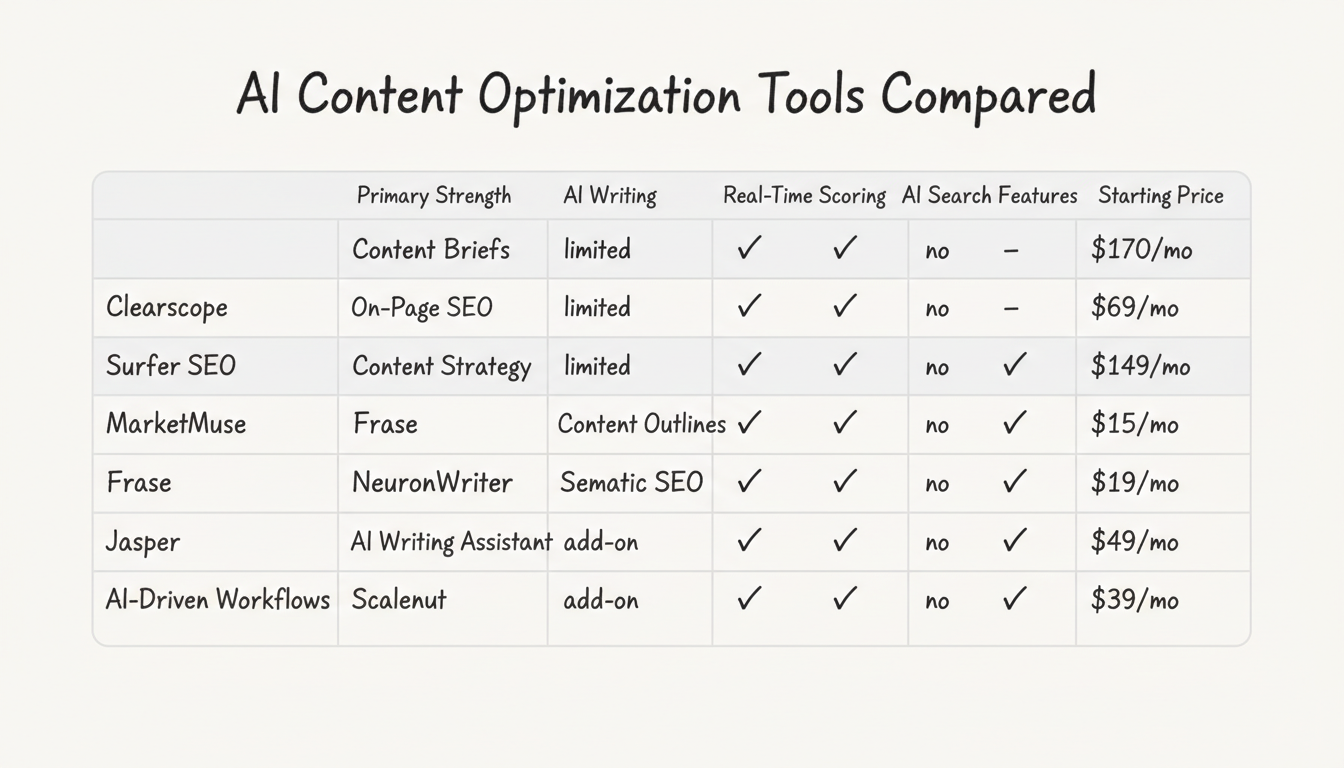
Tool | Primary Strength | AI Writing | Real-Time Scoring | AI Search Features | Starting Price |
Clearscope | Semantic depth | Limited | Yes | Yes | $129/mo |
Surfer SEO | Real-time optimization | Add-on | Yes | Limited | $89/mo |
MarketMuse | Content strategy | Yes | No | Limited | $149/mo |
Frase | Research & briefs | Yes | Yes | Limited | $15/mo |
NeuronWriter | Budget optimization | Yes | Yes | No | $19/mo |
Jasper | Brand content | Yes | No | No | $49/mo |
Scalenut | Volume production | Yes | Yes | Limited | $39/mo |
Rankability | SERP-driven optimization | Limited | Yes | Limited | $49/mo |
Semrush Writing Assistant | All-in-one SEO suite | Limited | Yes | Limited | $139.95/mo |
PageOptimizer Pro | On-page optimization | No | Yes | No | $34/mo |
Ahrefs AI Content Helper | Backlink + content data | Limited | No | Yes (Brand Radar) | $129/mo |
SE Ranking | Affordable all-in-one | Basic | Yes | No | $65/mo |
Writesonic SEO AI Agent | AI writing + live SERP | Yes | Yes | Limited | $16/mo |
GrowthBar | Blogger-friendly SEO | Yes | Yes | No | $36/mo |
SEO.ai | GEO-native optimization | Yes | Yes | Yes | $49/mo |
Surfer SEO vs Clearscope vs Frase vs Marketmuse vs Neuronwriter
This is one of the most searched comparisons for content optimization tools. Here is how the five most compared platforms stack up head-to-head:
Feature | Surfer SEO | Clearscope | Frase | MarketMuse | NeuronWriter |
Best For | Real-time writing | Semantic depth | Fast research | Content strategy | Budget teams |
Starting Price | $89/mo | $129/mo | $15/mo | Free (limited) | $19/mo |
AI Writing | Add-on ($219/mo) | Limited | Included | Included | Included |
Real-Time Scoring | Yes (live editor) | Yes (grade system) | Yes | No (batch analysis) | Yes |
AI Search Tracking | Limited | Yes (ChatGPT, Gemini, Perplexity) | Limited | Limited | No |
Content Briefs | Yes | Yes | Yes (strongest) | Yes | Yes |
Topic Modeling | Good | Excellent | Good | Best-in-class | Basic |
Google Docs Integration | Yes | Yes | Yes | Yes | No |
Best Value For | Active writers | Enterprise teams | Solo/small teams | Large content ops | Budget-conscious |
If you are comparing Surfer SEO vs Clearscope specifically, the choice comes down to workflow preference: Surfer excels at real-time writing optimization with a live content editor, while Clearscope offers deeper semantic analysis and now leads in AI search visibility tracking. For teams on a tighter budget, Frase and NeuronWriter provide strong optimization at a fraction of the cost, though with less depth in semantic modeling. MarketMuse is the strategic choice for large-scale content operations where topical authority planning matters more than individual article optimization.
Feature Priorities by Use Case
For SEO-focused content teams: Surfer SEO or Clearscope For content strategists: MarketMuse For solo creators on budget: Frase or NeuronWriter For high-volume production: Scalenut or Writesonic For brand/marketing content: Jasper For on-page SEO specialists: PageOptimizer Pro For all-in-one SEO platforms: Semrush Writing Assistant or SE Ranking For AI search visibility: Clearscope, Ahrefs Brand Radar, or SEO.ai
How to Choose the Right Content Optimization Tool
With 15+ tools on the market, selecting the right content optimization platform requires a structured evaluation. Follow these steps to match a tool to your team's specific needs:
Step 1: Define Your Primary Goal
Start by identifying what matters most to your team:
- Improving existing content rankings: Choose tools with strong SERP analysis and content scoring (Surfer SEO, Clearscope, PageOptimizer Pro).
- Scaling new content production: Prioritize AI writing capabilities and content brief generation (Scalenut, Writesonic, Frase).
- Building topical authority: Focus on content strategy and topic modeling (MarketMuse).
- Optimizing for AI search visibility: Select platforms with AEO/GEO features and AI engine tracking (Clearscope, SEO.ai, Ahrefs Brand Radar).
Step 2: Assess Your Budget and Team Size
- Solo creators / tight budget ($15-40/mo): Frase, NeuronWriter, GrowthBar, PageOptimizer Pro
- Small teams ($50-150/mo): Surfer SEO, Rankability, SEO.ai, Writesonic
- Agencies and mid-market ($150-400/mo): Clearscope, MarketMuse, SE Ranking, Semrush
- Enterprise ($400+/mo): Clearscope Enterprise, MarketMuse Team, Ahrefs Advanced
Step 3: Evaluate Integration Needs
Check whether the tool integrates with your existing workflow:
- Google Docs: Surfer, Clearscope, Frase, Semrush Writing Assistant
- WordPress: Most tools offer WordPress plugins or integrations
- Existing SEO platform: Semrush Writing Assistant (if using Semrush), Ahrefs AI Content Helper (if using Ahrefs), SE Ranking (if using SE Ranking)
- API access: Writesonic, SE Ranking, SEO.ai for custom workflows
Step 4: Test Before Committing
- Use free trials or free tiers (MarketMuse, Writesonic, Frase) to evaluate fit
- Run the same article through 2-3 tools to compare recommendation quality
- Assess how actionable the recommendations are for your team's skill level
- Check content scoring consistency—does the tool's guidance align with actual SERP performance?
Step 5: Plan for Growth
Consider where your content operation is headed:
- Will you need AI search visibility tracking in the next 6 months?
- Are you scaling content volume and need bulk generation features?
- Do you need white-label reporting for clients (agencies)?
- Will you need multi-language support?
Choosing a tool that supports your next stage—not just your current one—avoids costly platform migrations later.
Content Optimization Workflow
An effective workflow using AI content optimization tools:
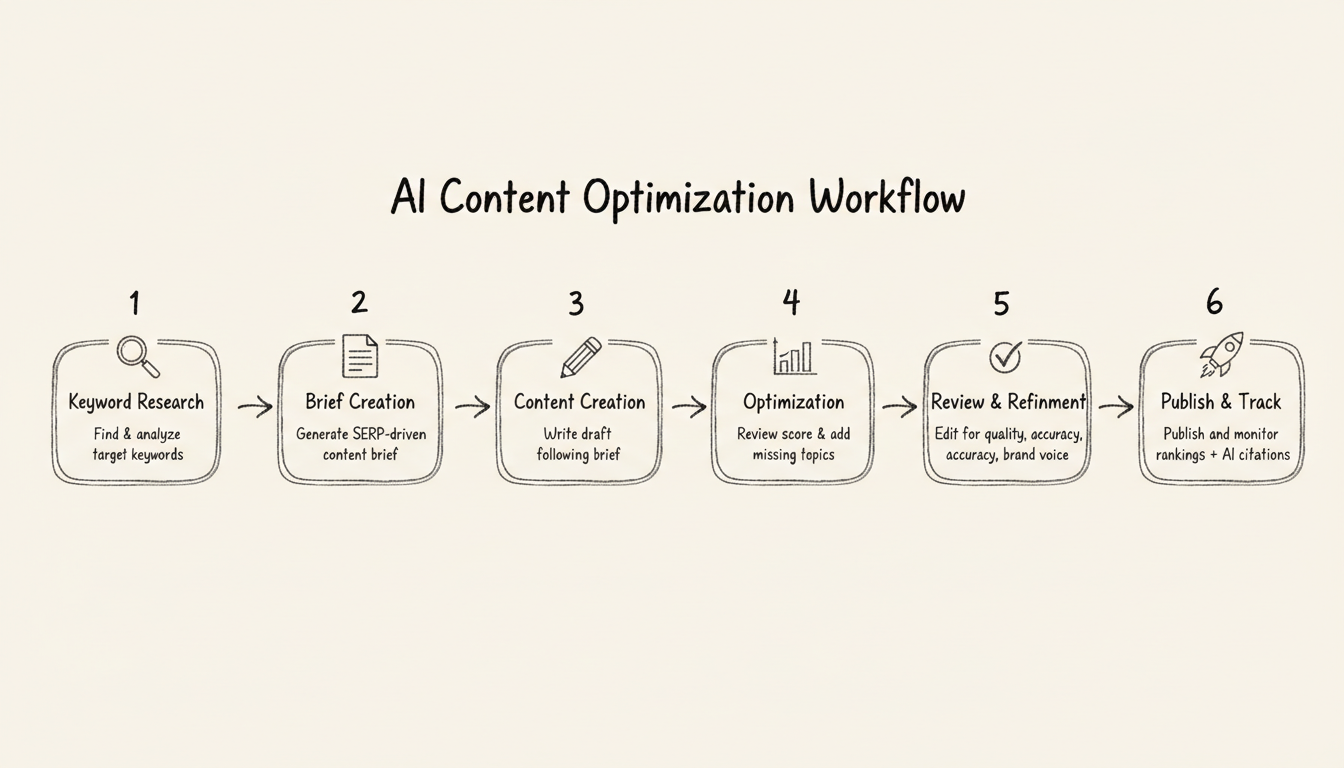
Step 1: Keyword and Topic Research
- Identify target keyword and related terms
- Run SERP analysis in your optimization tool
- Review top-ranking content patterns
- Identify content gaps and opportunities
Understanding the difference between aeo-vs-seo-comparison helps inform your keyword selection and optimization strategy.
Step 2: Brief Creation
- Generate or build content brief from SERP data
- Include recommended topics and questions
- Define target word count range
- Specify structure requirements (headings, sections)
Step 3: Content Creation
- Write or generate draft following brief
- Use real-time scoring for guidance
- Cover recommended topics comprehensively
- Include semantic terms naturally
Step 4: Optimization
- Review content score and recommendations
- Add missing topics or terms
- Improve structure based on feedback
- Verify competitor parity
Step 5: Review and Refinement
- Edit AI-generated sections for quality
- Ensure brand voice consistency
- Verify factual accuracy
- Check readability and flow
Step 6: Publication and Tracking
- Publish optimized content
- Monitor rankings and performance
- Track AI citation visibility (if applicable)
- Update based on performance data
Consider using google-analytics-4-ai-search-tracking to measure performance across both traditional and AI-powered search channels.
Pricing & ROI Analysis
Pricing Summary
Tool | Entry Level | Mid-Tier | Enterprise |
Clearscope | $129/mo | $399/mo | Custom |
Surfer SEO | $89/mo | $129/mo | $219/mo |
MarketMuse | Free (limited) | $149/mo | $399/mo |
Frase | $15/mo | $45/mo | $115/mo |
NeuronWriter | $19/mo | $37/mo | $57/mo |
Jasper | $49/mo | $69/mo | Custom |
Scalenut | $39/mo | $79/mo | $149/mo |
Rankability | $49/mo | $99/mo | $199/mo |
Semrush (w/ Writing Assistant) | $139.95/mo | $249.95/mo | $499.95/mo |
PageOptimizer Pro | $34/mo | $52/mo | $97/mo |
Ahrefs (w/ AI Content Helper) | $129/mo | $249/mo | $449/mo |
SE Ranking | $65/mo | $119/mo | $259/mo |
Writesonic | Free / $16/mo | $79/mo | Custom |
GrowthBar | $36/mo | $74.25/mo | $149.25/mo |
SEO.ai | $49/mo | $99/mo | $199/mo |
ROI Calculation Framework
Time Savings
- Research time reduction: 50-70% compared to manual SERP analysis
- Brief creation: Hours to minutes
- Content scoring: Instant versus manual competitor review
Quality Improvements
- More comprehensive topic coverage
- Better alignment with search intent
- Consistent optimization standards
Performance Gains
- Higher initial rankings for optimized content
- Improved featured snippet capture
- Better AI citation probability
Example ROI: A team creating 20 articles monthly at $500/article average cost:
- Tool cost: $150/month
- Time savings: 30 hours/month x $50/hour = $1,500/month
- Quality improvement: 10% better performance = additional value
- Net ROI: 10x+ tool cost
For comprehensive ROI analysis across multiple platforms, review strategies for cross-platform-ai-search-roi-analysis.
Hidden Costs to Consider
- AI writing add-ons (Surfer charges extra)
- Per-article limits requiring plan upgrades
- Training time for team adoption
- Integration setup costs
Best Practices
Do: Start with Clear Intent
Understand search intent before optimizing. Tools provide data, but interpreting intent requires human judgment. Commercial and informational queries need different content approaches.
Do: Use Scores as Guides, Not Goals
A perfect score doesn't guarantee rankings. Use recommendations to improve comprehensiveness while maintaining quality and readability. Balancing multiple optimization approaches, including aeo-seo-geo strategies, yields better long-term results.
Do: Edit AI-Generated Content
AI drafts accelerate production but require editing for accuracy, tone, and brand alignment. Never publish AI content without review.
Do: Combine Tools Strategically
No single tool does everything. Pair optimization tools with keyword research (Ahrefs, Semrush) and technical SEO tools for comprehensive coverage. Many teams also leverage best-free-ai-seo-tools-2026 to supplement paid platforms.
Don'T: Over-Optimize
Hitting every recommended term can create unnatural content. Prioritize readability and user value over perfect scores.
Don'T: Ignore Your Expertise
Tools analyze what exists in SERPs. Original insights, proprietary data, and expert perspectives create content that stands out beyond optimization scores.
Don'T: Skip Updates
Rankings change, competitors improve, and algorithms evolve. Schedule regular content refreshes using updated SERP analysis.
FAQs
Which content optimization tool is best for beginners? Frase offers the best balance of capabilities and accessibility at $15/month. Its interface is intuitive, and the brief generation workflow is easy to learn. NeuronWriter at $19/month is another beginner-friendly option.
Do I need both Clearscope and Surfer SEO? Generally no—they serve similar purposes. Choose based on your workflow preference: Clearscope for strategic topic planning and AI visibility tracking, Surfer for real-time writing optimization. Most teams use one or the other.
Can AI content optimization tools replace writers? No. These tools enhance writer productivity and content quality but don't replace human creativity, expertise, and editorial judgment. AI-generated drafts consistently require editing.
How accurate are content scores? Scores correlate with ranking patterns but aren't guarantees. A high-scoring article that misses user intent will underperform. Use scores as one input among several, including quality judgment.
Should I optimize for AI search or traditional SEO? Both, but traditional SEO remains foundational. Google AI Overviews heavily weight existing rankings—pages in top positions have higher AI Overview inclusion rates. Optimize for search first, then enhance for AI discoverability using what-is-geo-generative-engine-optimization principles.
How often should I re-optimize content? Quarterly reviews for high-value content, annually for evergreen pieces. Re-run SERP analysis to identify changes in ranking patterns and competitor content.
Are free tiers worth using? For testing, yes. MarketMuse's free tier provides limited but useful analysis. Free trials from Frase, Surfer, and others help evaluate fit before committing.
What are AEO tools and do I need them? AEO (Answer Engine Optimization) tools help optimize content for visibility in AI-generated responses from ChatGPT, Perplexity, and Google Gemini. If your audience uses AI search tools, adding AEO capabilities—available in Clearscope, Ahrefs Brand Radar, Rankscale, and SEO.ai—can help ensure your content is cited in AI answers, not just ranked in traditional search results.