
Google's AI Overviews don't simply summarize top-ranking content—they evaluate authority and trust signals to determine which sources merit citation. In 2026, becoming an AI-cited source requires demonstrating credibility through specific signals that AI systems recognize and value.
This guide explains the authority signals that AI Overviews prioritize and how to build the trust factors that earn citations.
The Authority Framework for AI Overviews
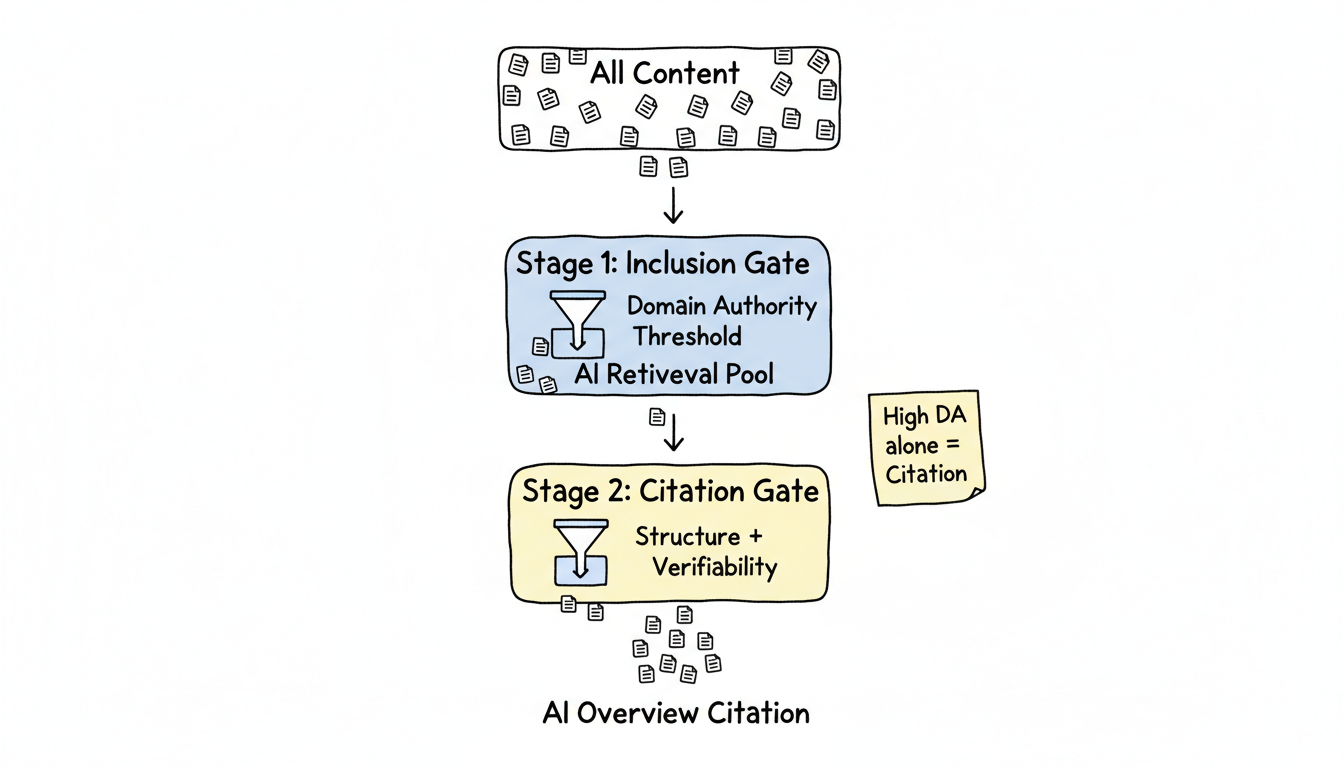
AI systems evaluate content through a two-stage filter before granting citations:
Stage 1: Inclusion Gate
Domain Authority still matters as a prerequisite. If your domain authority is too low, content may never enter the AI retrieval layer. Traditional SEO factors remain important for initial visibility.
Stage 2: Citation Gate
Once included in the retrieval pool, structure and verifiability become deciding factors. Well-structured, transparent content is far more likely to be cited than higher-DA content that's poorly formatted.
Key insight: High domain authority alone doesn't guarantee citations. Structure and credibility signals determine actual citation.
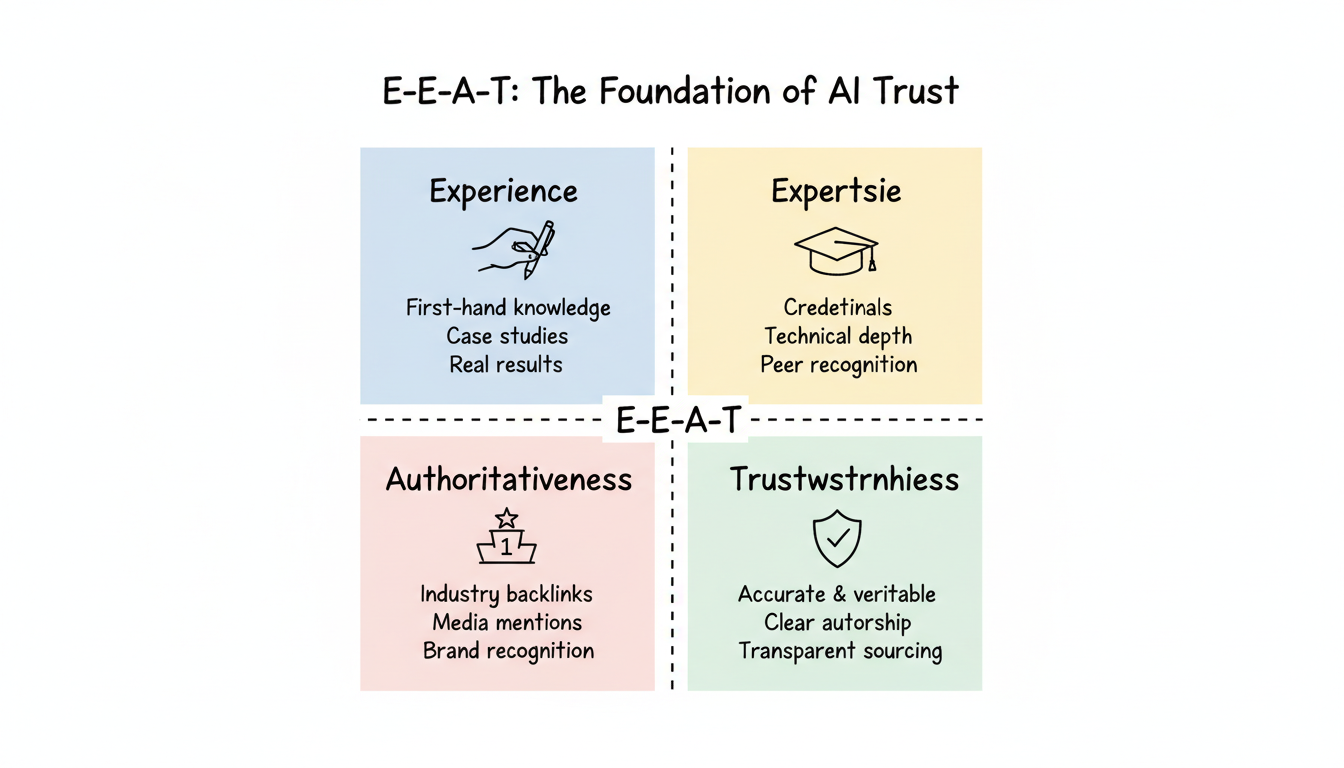
E-E-A-T: The Foundation of AI Trust
Google's E-E-A-T framework—Experience, Expertise, Authoritativeness, and Trustworthiness—has become critical for AI Overview visibility. Notably, E-E-A-T signals are now evaluated by Large Language Models during both training and retrieval phases, not just by Google's quality raters. Authors with consistent schema markup across publications receive stronger authority attribution from AI systems.
Experience Signals
AI systems look for evidence of first-hand knowledge:
Strong experience indicators:
- Personal case studies with specific results
- Real product tests with screenshots or data
- Process documentation from actual implementation
- Results with measurable metrics
- Unique insights only available through direct experience
Weak experience signals:
- Generic summaries of other sources
- Theoretical descriptions without practical application
- Content that could be written without topic experience
Expertise Signals
Credentials and specialized knowledge matter:
Expertise demonstration:
- Author credentials relevant to the topic
- Professional certifications and qualifications
- Technical depth appropriate to complexity
- Industry-specific terminology used correctly
- Recognition by peers in the field
Expert content example:
Weak (No Expertise) | Strong (Clear Expertise) |
"Many people find meditation helpful for stress." | "According to a peer-reviewed study in JAMA Internal Medicine, mindfulness meditation reduces stress markers by 38% among participants practicing daily for 15+ minutes." |
This transformation shows expertise through citation of authoritative research and specific data.
Authoritativeness Signals
Recognition as a go-to source matters:
Authority indicators:
- Backlinks from reputable industry sites
- Citations in other authoritative content
- Media mentions and coverage
- Industry awards or recognition
- Speaker invitations at recognized events
The authority shift: Brand mentions appear to play a larger role in AI-driven citation than links alone. Trust and brand recognition have become differentiators for inclusion.
Trustworthiness Signals
Accuracy and transparency build trust:
Trust factors:
- Factual accuracy verifiable against other sources
- Transparent sourcing with proper attribution
- Clear authorship and organizational identity
- Regular content updates maintaining accuracy
- Security indicators (HTTPS, privacy policy)
Specific Authority Signals AI Overviews Value
Research has identified specific factors that improve AI citation likelihood.
Data and Statistics
Including vetted data points significantly improves visibility:
- +65% visibility improvement for content with authoritative statistics
- Data must be current and verifiable
- Source attribution increases credibility
- Proprietary data performs exceptionally well
Source Citations
Proper attribution dramatically impacts citation likelihood:
- +132% visibility improvement for content citing trusted sources
- Link to primary sources when possible
- Cite peer-reviewed research for YMYL topics
- Reference recognized industry authorities
When developing your AI SEO strategy, proper citation practices become even more critical as search engines increasingly rely on verifiable data sources.
Authoritative Tone
Writing style affects AI perception:
- +89% visibility improvement for authoritative (not commanding) tone
- Confident expert voice performs better than hedged language
- Clear, definitive statements over vague qualifications
- Factual presentation over opinion-based content
AI search engines also favor content with clear entity definitions, structured data, and quotable summary blocks—aligning with Generative Engine Optimization (GEO) best practices that make content more parseable for LLMs.
Content Transformation Example
Before optimization:
"There are various ways to improve website speed, and some experts believe these can help with rankings."
After optimization:
"According to Google's Core Web Vitals documentation, websites loading in under 2.5 seconds (LCP threshold) see significantly higher search visibility. Key speed improvements include image optimization, efficient caching, and minimizing JavaScript execution time."
The revised version demonstrates authority through specific metrics, source citation, and confident factual presentation.
Building Authority for AI Citations
Strategic authority building improves citation likelihood over time.
Own Your Data
Proprietary data serves as a citation magnet:
High-value data assets:
- Original research and surveys
- Industry benchmarks from your customer base
- Case study compilations with aggregate insights
- Trend analysis based on unique datasets
When you're the only source for specific data, AI systems must cite you to include that information.
Strategic Link Building
Links still matter, but quality and relevance are paramount:
Modern link value:
- Direct SEO value (traditional ranking factor)
- AI citation signals (links indicate authority to AI)
- E-E-A-T validation from respected sources
- Industry relationship demonstration
E-E-A-T link quality checklist:
- Does the linking site show first-hand knowledge?
- Does the author have verified credentials?
- Is the site recognized by industry peers?
- Is the source transparent and credible?
Beyond traditional link building, Digital PR has emerged as a distinct authority-building discipline. Digital PR generates branded mentions on high-authority news sites and industry publications, which LLMs treat as citation evidence even without a dofollow link. These earned media placements create the citation trail that AI systems use to assess brand credibility.
Author Authority Development
Build recognizable expertise through:
- Consistent bylines on authoritative publications
- Speaking at industry conferences
- Professional profiles with credentials
- Social media presence demonstrating expertise
- Wikipedia mentions (for notable individuals)
Authority Signals by Content Type
Different content types require different authority approaches.
YMYL Content (Your Money or Your Life)
Financial, health, and safety content requires heightened authority:
Signal | Importance | Implementation |
Author credentials | Critical | Display relevant qualifications prominently |
Source citations | Critical | Link to peer-reviewed research |
Medical/legal review | Important | Note professional review where applicable |
Update frequency | Important | Show last-reviewed dates |
Commercial Content
Product and service content authority signals:
- Real customer testimonials with attribution
- Third-party reviews and ratings
- Industry certifications and partnerships
- Performance data and case studies
For businesses offering answer engine optimization services, demonstrating proven results through case studies becomes particularly important for establishing commercial authority.
Informational Content
Educational content authority requirements:
- Topic expertise demonstration
- Comprehensive coverage with citations
- Clear explanations appropriate to audience
- Supporting visuals and examples
Measuring Authority Progress
Track authority development over time:
Metric | Measurement | Target |
Domain Authority | Third-party tools | Gradual increase |
Brand mentions | Media monitoring | Growing frequency |
Citation appearances | AEO tracking tools | Increasing rate |
Backlink quality | Link analysis | Higher authority sources |
E-E-A-T signals | Content audit | Comprehensive coverage |
It is worth noting that while LLMs do not directly use PageRank, the same link-graph signals that inform PageRank also influence which sources appear in LLM training corpora. Domain authority metrics remain a useful proxy for understanding how AI systems perceive source credibility.
Common Authority Gaps
Identify and address these common weaknesses:
Missing author information:
- Add detailed author bios with credentials
- Link to author profiles and social presence
- Display relevant qualifications prominently
Lack of citations:
- Add references to authoritative sources
- Include specific data with attribution
- Link to primary research when available
Weak E-E-A-T signals:
- Demonstrate first-hand experience
- Add case studies and real examples
- Include expert review or contribution
Inconsistent information:
- Audit content for accuracy
- Update outdated statistics
- Ensure factual consistency across site
Understanding how Google AI Overview SEO strategy differs from traditional approaches helps identify these gaps more effectively.
Beyond Google: Authority Signals Across AI Search Engines
Google AI Overviews are only one piece of the AI search landscape. ChatGPT, Perplexity AI, and Bing Copilot each evaluate source authority through distinct mechanisms, and optimizing for all four platforms requires understanding their differences. For tools to monitor your presence across these platforms, see our guide on AI citation tracking tools.
ChatGPT Search Authority Signals
ChatGPT Search favors domains that appear frequently in its training data and prioritizes recently published or updated content. Sites with high citation density across the web—meaning they are referenced often by other authoritative sources—receive stronger weighting. Brand recognition and topical consistency also influence whether ChatGPT surfaces a source in its responses. For a deeper dive into platform-specific tactics, see our ChatGPT SEO optimization guide.
Perplexity AI Authority Signals
Perplexity AI emphasizes primary sources with clear attribution. Content that provides original research, named authors, and transparent methodology receives priority. Perplexity's real-time indexing means freshness carries more weight than on platforms relying on periodic training data updates. Direct citations and structured attribution patterns are particularly effective for earning Perplexity citations.
Bing Copilot Authority Signals
Bing Copilot leverages Microsoft Graph signals alongside the Bing search index to evaluate authority. Sites with strong Bing index presence, LinkedIn entity connections, and Microsoft ecosystem integrations receive favorable treatment. Bing Copilot also weighs traditional Bing ranking factors more heavily than other AI search engines.
Authority Signal Comparison Across Platforms
Authority Signal | Google AI Overviews | ChatGPT Search | Perplexity AI | Bing Copilot |
Domain Reputation | High | High | Medium | High |
Structured Data | High | Medium | Medium | High |
Content Freshness | Medium | High | Very High | Medium |
Training Data Frequency | N/A | Very High | Low | Medium |
Backlink Quality | High | Medium | Medium | High |
Source Attribution | Medium | Medium | Very High | Medium |
Optimizing for one AI search engine increasingly transfers to others because all platforms rely on overlapping trust indicators: domain reputation, structured data, and topical depth. A broad authority footprint across these signals ensures visibility regardless of which AI engine a user chooses.
Schema Markup as an Authority Signal for AI Citations
Structured data serves as a parsing shortcut for LLMs, helping AI systems identify authoritative content faster than unstructured HTML alone. Implementing the right schema types reinforces your authority signals and increases the likelihood of AI citation. For a comprehensive implementation guide, see our resource on structured data for AI search.
Highest-Impact Schema Types for AI Authority
Five schema types deliver the strongest authority signals for AI citation:
- Article / BlogPosting — Establishes authorship, publication date, and publisher identity. AI systems use these fields to verify content provenance and recency.
- FAQPage — Enables direct answer extraction. AI engines can pull structured Q&A pairs directly, increasing citation probability for informational queries.
- HowTo — Supports step-based citation for procedural content. LLMs favor clearly structured processes they can reference or summarize.
- Organization — Provides entity disambiguation so AI systems can correctly attribute content to a specific organization rather than a generic topic.
- Person — Links author credentials and E-E-A-T signals to content. Named authors with Person schema receive stronger authority attribution across AI platforms.
Schema Implementation Checklist
- Add Article or BlogPosting schema with author, datePublished, and dateModified fields
- Implement FAQPage schema for all pages with question-and-answer content
- Use HowTo schema for any step-by-step guides or tutorials
- Include Organization schema on your site to establish entity identity
- Add Person schema for author pages linking credentials and publications
How Llms Evaluate Authority Differently Than Traditional Search
Traditional search crawlers rely on link graphs and PageRank to assess authority. Large Language Models take a fundamentally different approach: they evaluate authority through training data frequency, citation patterns across the web, entity consistency, and content structure clarity. Understanding this distinction is essential for optimizing across both traditional and AI-powered search.
Generative Engine Optimization (GEO)
Generative Engine Optimization (GEO) is the emerging discipline focused on making content more citable by generative AI systems. GEO emphasizes structured, quotable content blocks—concise paragraphs that LLMs can extract and reference directly. Entity clarity, consistent terminology, and explicit definitions all improve GEO performance. For a complete guide to this discipline, see our Generative Engine Optimization resource.
Answer Engine Optimization (AEO)
Answer Engine Optimization (AEO) focuses on formatting content for direct-answer delivery. While GEO targets generative citation, AEO targets answer box and featured snippet extraction. AEO best practices include placing concise definitions at the start of sections, using list formatting for multi-step answers, and structuring headings as questions. The most effective authority strategy combines GEO, AEO, and traditional SEO. For a detailed comparison of these three disciplines, see our guide on AEO vs GEO vs SEO.
Entity Validation: Knowledge Panels, Google Business Profile, and Digital PR
Entity validation strengthens your authority footprint by confirming your brand identity across the platforms that AI systems use to assess credibility.
Knowledge Panels
Having a Knowledge Panel signals entity authority to AI systems—it confirms that Google recognizes your brand or person as a distinct, verified entity. To trigger a Knowledge Panel, ensure your organization has consistent profiles on Wikidata, Crunchbase, LinkedIn, and other authoritative directories. Consistent NAP (Name, Address, Phone) data across these profiles accelerates entity recognition. For step-by-step guidance, see our article on how to get a Google Knowledge Panel.
Google Business Profile
Google Business Profile is essential for local authority signals that AI Overviews use for location-aware queries. Maintaining accurate business information, responding to reviews, and keeping your profile updated sends strong local authority signals. AI systems increasingly incorporate local context into their responses, making GBP optimization a prerequisite for location-relevant AI citations.
Digital PR for Entity Authority
Digital PR is distinct from traditional link building. Earned media mentions on authoritative publications—news outlets, industry journals, and recognized blogs—create the citation trail that LLMs use to assess brand authority. Even unlinked brand mentions contribute to entity authority because LLMs process text content, not just hyperlinks. Tools like Semrush and Moz can help monitor your entity authority metrics and track mention growth over time.
FAQs
How Long Does It Take to Build AI Citation Authority?
Authority building is gradual. Initial improvements from E-E-A-T optimization can show results in weeks, but significant citation presence typically takes 6-12 months of consistent authority development.
Can Small Sites Earn AI Overview Citations?
Yes. While domain authority provides baseline visibility, smaller sites with exceptional E-E-A-T signals, original data, or unique expertise can earn citations. Focus on demonstrating genuine authority rather than competing on domain metrics.
Do Backlinks Still Matter for AI Visibility?
Yes. Quality backlinks remain important both for traditional SEO and as authority signals to AI systems. Links from E-E-A-T-validated sites act as external confirmation of credibility.
What'S the Most Important Authority Signal for AI?
No single signal dominates. AI systems evaluate holistic authority—combining E-E-A-T factors, citation patterns, content quality, and structural signals. Comprehensive authority building outperforms optimization of any single factor.
How Do You Rank in AI Overviews?
Ranking in AI Overviews requires building strong E-E-A-T signals, implementing schema markup (particularly Article, FAQPage, and Organization types), earning authoritative backlinks from reputable sources, and creating concise answer-ready content. Google AI Overviews prioritize sources with demonstrated topical authority and clear structured data. Optimizing for traditional SEO fundamentals remains the foundation, supplemented by GEO-specific formatting that makes your content easier for AI systems to parse and cite.
Do ChatGPT and Perplexity Use the Same Authority Signals as Google AI Overviews?
While all AI search engines value source reputation and content depth, they weigh signals differently. ChatGPT relies heavily on training data prevalence—how often your content appears in its training corpus—while Perplexity emphasizes real-time source quality and direct citations with clear attribution. Google AI Overviews leverage their existing search index authority and traditional ranking factors. Optimizing across all three requires building a broad authority footprint that covers domain reputation, content freshness, structured data, and citation density.
What Schema Markup Helps You Get Cited in AI Search Results?
The highest-impact schema types for AI citation are Article (establishes authorship and publication dates), FAQPage (enables direct answer extraction), HowTo (supports step-based citation), Organization (provides entity disambiguation), and Person (links author E-E-A-T credentials to content). Structured data helps AI systems parse content faster and attribute authority to specific authors and organizations. However, schema alone is insufficient—it must be backed by genuinely authoritative, well-researched content to drive meaningful citation improvements.
What Is the Difference Between GEO and Traditional SEO for AI Authority?
Generative Engine Optimization (GEO) focuses on optimizing content specifically for generative AI citation, while traditional SEO targets search engine ranking positions. GEO emphasizes structured answers, entity clarity, and quotable content blocks that LLMs can extract and reference directly. Traditional SEO focuses on keywords, backlinks, and technical performance. The most effective strategy combines both disciplines—using traditional SEO to build domain authority and indexation, while applying GEO principles to make content maximally citable by AI systems.
As AI search continues to evolve, authority signals will increasingly converge across Google AI Overviews, ChatGPT, Perplexity, and Bing Copilot as all platforms refine their source-selection algorithms toward similar trust indicators.