
The brands winning in AI Overviews aren't relying on luck—they're executing specific strategies that earn citations systematically. As AI-generated search results become the default for informational queries, understanding what works has become essential for SEO success.
This guide examines real-world case studies and the strategies behind AI Overview wins, providing actionable insights you can apply to your own optimization efforts.
The Shift from Rankings to Citations
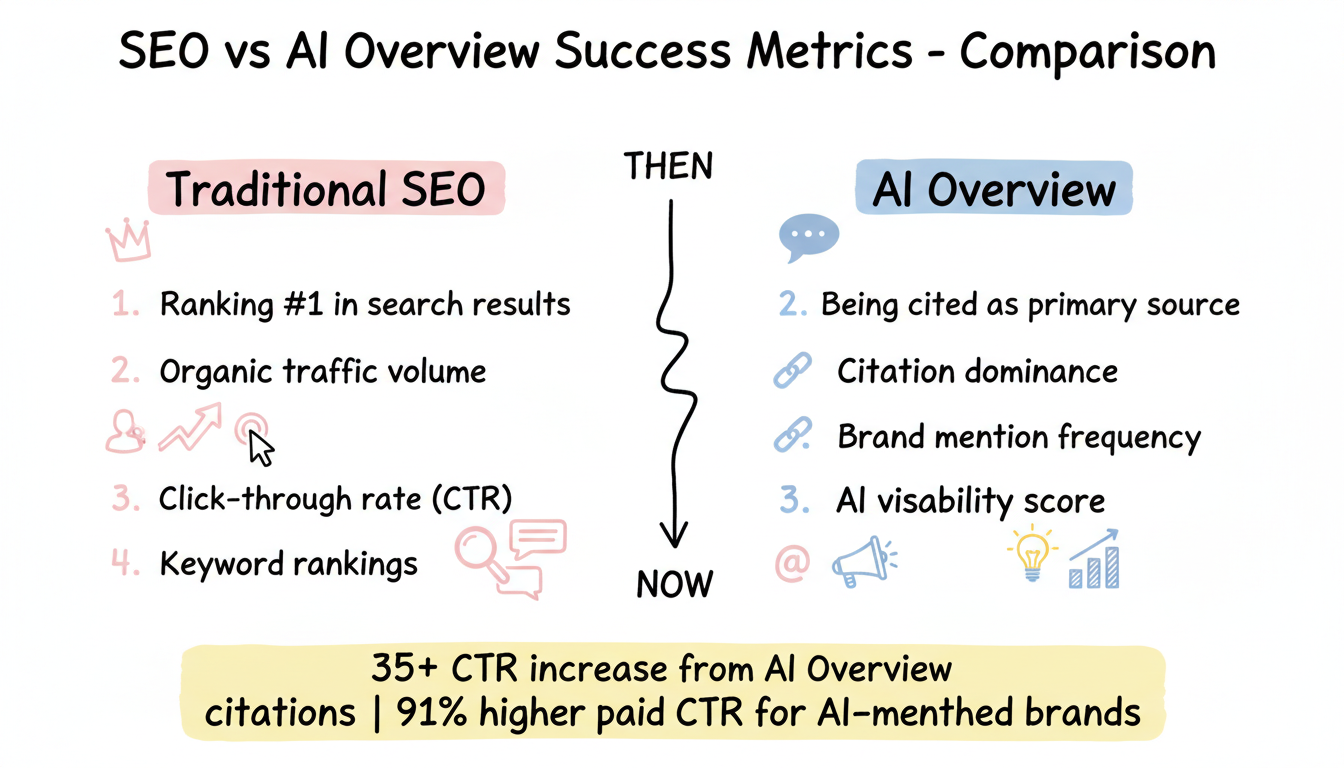
Traditional SEO measured success by ranking position. AI Overview optimization measures success by citation frequency and brand mentions. The fundamental metric has changed.
Old Success Metric | New Success Metric |
Ranking #1 | Being cited as primary source |
Organic traffic volume | Citation dominance |
Click-through rate | Brand mention frequency |
Keyword rankings | AI visibility score |
Research shows sites cited in AI Overviews see 35%+ CTR increases, while brands mentioned in AI responses experience 91% higher paid CTR. The winners are those who've adapted to this new reality.
How AI Overviews Select and Cite Sources
Understanding how AI Overviews work under the hood explains why certain brands consistently earn citations while others remain invisible. The process follows a four-stage pipeline: query interpretation, document retrieval, fact-checking and grounding, and response generation with citations.
Google's AI does not select sources based purely on PageRank or traditional ranking signals. Instead, the system evaluates topical authority, entity clarity, and content structure. Pages that clearly define entities, provide verifiable facts, and organize information in extractable formats are prioritized during the retrieval and grounding stages. This is why entity-based SEO and topical authority have become foundational to AI visibility.
Not all queries trigger AI Overviews equally. Ngram analysis of triggering queries reveals clear patterns: informational queries trigger AIOs at the highest rate, while navigational and branded queries trigger them far less often. Multi-word informational phrases—such as "how to," "best way to," and "what is"—are the strongest triggers. Understanding these query trigger patterns helps you focus optimization efforts where AI Overviews actually appear.
The case studies below succeed precisely because they align content with how this selection pipeline works—clear entities, structured facts, and content optimized for the types of queries that trigger AI responses.
Case Study 1: E-Commerce Entity Optimization
Challenge: Declining traffic and flat sales despite solid traditional SEO rankings.
Strategy implemented:
- Entity optimization to establish clear brand identity
- Comprehensive structured data implementation
- Semantic authority building across product categories
- E-E-A-T signal enhancement
Results achieved:
- 472% organic traffic growth
- 482% position improvement
- Cited as primary source in most product category AI queries
- Established category leadership in AI responses
Key insight: Entity clarity and structured data drove AI systems to recognize the brand as authoritative in its space. This approach aligns with broader entity-based SEO and topical authority principles that help search engines understand your brand's expertise.
Case Study 2: Google AI Overview Optimization
Challenge: Zero AI Overview appearances despite quality content.
Strategy implemented:
- Added FAQ, Article, and HowTo schema markup
- Reorganized content structure for extraction
- Enhanced E-E-A-T signals across the site
- Created clear, citable factual statements
Results achieved:
- AI Overview appearances increased from 0 to 47
- 63% organic traffic growth
- 28% higher click-through rates
- 23 new featured snippet positions
Key insight: Structured content combined with strong authority signals creates a compounding effect across both AI Overviews and traditional SERP features. Implementing structured data for AI search was the catalyst that moved this brand from zero AI visibility to consistent citation placement.
Branded vs. Non-Branded Query Performance in AI Overviews
One of the most important distinctions in AI Overview optimization is the difference between branded and non-branded query performance. The data reveals a stark contrast: branded queries trigger AI Overviews approximately 4.9% of the time, while non-branded informational queries trigger them at 12.4-16.9% for top-10 keywords. This means non-branded queries are 2.5-3.4x more likely to surface an AI Overview.
Query Type | AIO Trigger Rate | Citation Volatility | Strategic Implication |
Branded | ~4.9% | Low | Relatively safe; users already intend to visit you |
Non-branded (top 10) | 12.4-16.9% | High | Primary battleground for organic discovery |
Informational long-tail | Highest | Moderate | Greatest opportunity for citation wins |
The strategic takeaway is clear: branded terms are relatively safe because users already intend to visit your site. But non-branded informational queries—where most organic discovery happens—are the real battleground. Brands that do not optimize for non-branded AIO citations risk losing top-of-funnel traffic as AI Overviews expand. The full scope of this disruption is detailed in our analysis of Google AI overview SEO impact on organic traffic patterns.
The case studies above succeeded precisely because they focused entity optimization on non-branded category terms, not just their own brand name.
Industry Leaders by AI Citation Market Share
Research analyzing 17 million AI-generated responses and 100 million citations reveals which brands dominate their industries.
Real Estate AI Leaders
Rank | Domain | Key Success Factor |
1 | Hines | Brand authority exceeds domain citations |
2 | Public Storage | Consistent topical coverage |
3 | CBRE | Industry thought leadership |
4 | Zillow | Brand recognition in residential queries |
5 | Colliers | Commercial real estate expertise |
Notable finding: Zillow's brand is mentioned constantly even when its domain isn't directly cited—AI models recognize it as the go-to authority for residential real estate queries.
Utilities AI Leaders
Rank | Domain | Key Success Factor |
1 | newfortressenergy.com | LNG infrastructure expertise |
2 | denverwater.org | Regional authority |
3 | constellation.com | Energy market coverage |
4 | energysage.com | Consumer-focused content |
5 | gevernova.com | Energy transition topics |
Notable finding: New Fortress Energy's brand mention market share exceeds 35%—significantly higher than its domain citation share, indicating AI models actively discuss the company as a subject, not just cite it as a source.
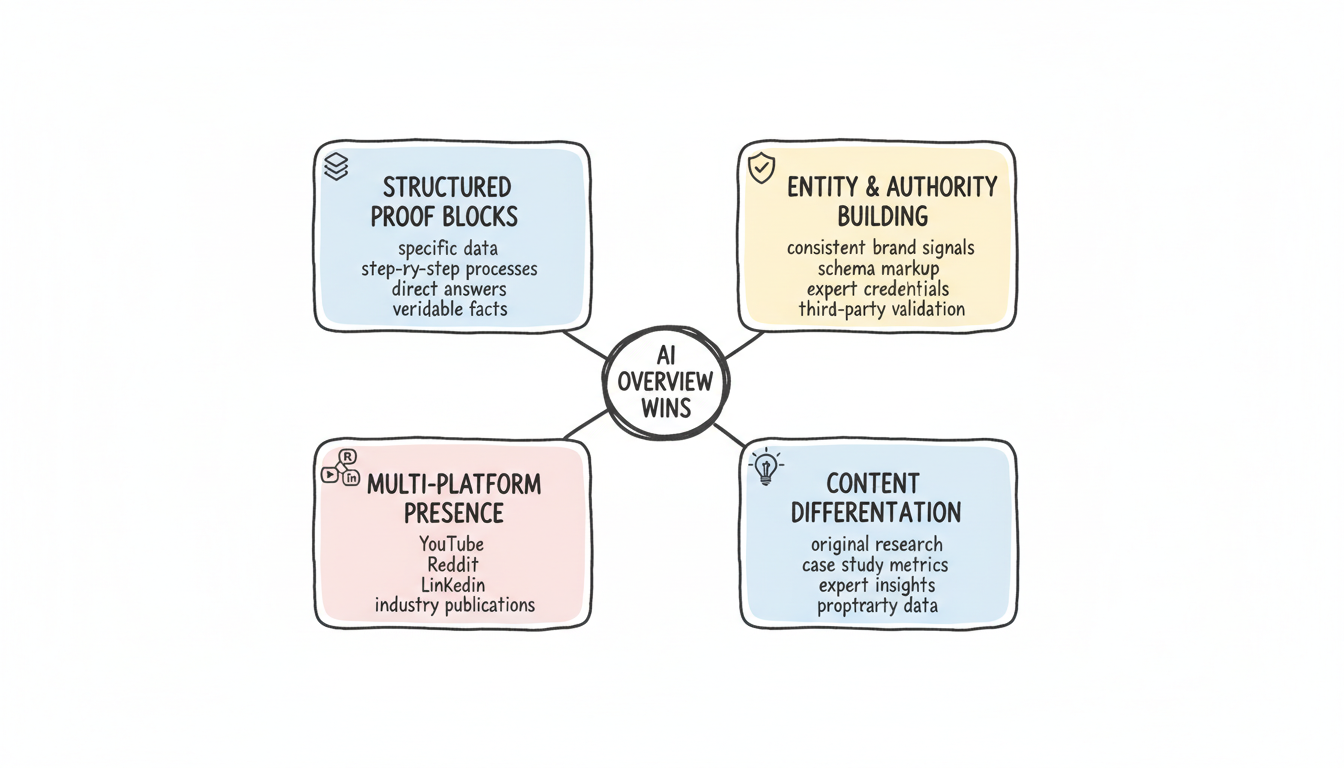
Common Strategies Among Winners
Analysis of successful AI Overview optimization reveals consistent patterns.
Strategy 1: Structured Proof Blocks
Winners create content with clear, extractable statements:
- Specific data with sources
- Step-by-step processes
- Direct answers to questions
- Verifiable facts and figures
Strategy 2: Entity and Authority Building
Successful brands establish clear identity signals by implementing comprehensive entity-based SEO topical authority frameworks:
- Consistent brand information across platforms
- Schema markup defining organizational entities
- Industry recognition and third-party validation
- Expert authorship with verified credentials
Strategy 3: Multi-Platform Presence
Citation dominance requires visibility beyond your website. Understanding AEO in digital marketing helps you optimize for AI-powered discovery across multiple channels:
- YouTube content for video queries
- Reddit presence for community discussions
- LinkedIn thought leadership
- Industry publication contributions
Strategy 4: Content Differentiation
Winners create value AI cannot replicate:
- Original research and proprietary data
- Case studies with specific metrics
- Expert insights from practitioners
- Templates, tools, and calculators
Strategy 5: People Also Ask (PAA) Optimization
A frequently overlooked winning strategy is People Also Ask optimization. PAA inclusion is strongly correlated with AIO citation—brands appearing in PAA for a query are significantly more likely to be cited in the AI Overview for that same query. PAA boxes signal to Google that your content provides direct, structured answers to common questions, which are the same signals AI Overviews use when selecting sources.
To leverage PAA for AI Overview visibility:
- Identify PAA questions for your target keywords using Ahrefs or Semrush SERP feature tracking
- Answer each question directly within your content using clear Q&A formatting
- Use FAQ schema markup to structure these answers for machine readability
- Monitor PAA inclusion and track correlation with AI Overview citations over time
What Losers Have in Common
Understanding failure patterns is equally instructive.
Losing Pattern | Why It Fails |
Generic content rewrites | No unique value for AI to cite |
Buried answers | AI cannot extract key information |
Keyword stuffing | Modern AI detects manipulation |
Vague statistics | Unverifiable claims get skipped |
Thin author profiles | E-E-A-T signals absent |
The brands losing AI visibility share a common trait: they optimized for search engines of the past, not AI systems of the present.
Another critical losing pattern is ignoring non-branded query vulnerability. Brands that only monitor branded search miss the fact that non-branded informational queries are 2.5-3x more likely to trigger AI Overviews. Losers tend to optimize their brand pages but neglect category-level and informational content—the exact content types where AI citations determine discovery. Without visibility on non-branded terms, these brands cede top-of-funnel traffic to competitors who have invested in entity optimization and structured content across their entire topic domain.
Measuring AI Overview Success
Winners track different metrics than traditional SEO. Using specialized AI search optimization tools helps monitor these evolving performance indicators.
Metric | What It Indicates |
Citation frequency | How often AI references your content |
Brand mention rate | AI discussions of your brand as a topic |
AI visibility score | Share of voice in AI responses |
Source attribution | When AI links directly to your content |
Competitive citation share | Your citations vs. competitors |
The AI referral traffic benchmark currently sits at 1.08% of total site traffic. Businesses exceeding this level do so by earning citations in AI-generated answers.
However, traditional analytics miss AI-driven traffic entirely without explicit configuration. Current benchmarks show AI referral traffic averaging roughly 1.08% of total organic traffic, but this number is growing quarterly as AI Overview coverage expands. Most analytics platforms do not distinguish AI referrals from standard organic sessions by default, which means the impact of your optimization work remains invisible without proper tracking infrastructure. The GA4 setup detailed in the next section is the minimum infrastructure needed to capture these signals.
How to Track AI Overview Performance in GA4
Without dedicated tracking, the results from the case studies above would be invisible in standard analytics. Setting up AI referral tracking in GA4 is essential for measuring the impact of your optimization efforts.
Step 1: Create a GA4 Exploration Report. Navigate to Explore in GA4 and create a new free-form exploration. Add source/medium as a dimension and sessions, engagement rate, and conversions as metrics. This gives you the foundation for isolating AI-driven traffic from traditional organic sessions.
Step 2: Apply the AI Referral Regex Filter. In your traffic acquisition report, create a custom filter on the source dimension using this regex pattern: (chatgpt|chat\.openai|openai|perplexity|gemini|bard|copilot|bing\.com\/chat|claude). This captures traffic from all major AI platforms that may cite your content. For a more permanent solution, create a custom channel group called "AI Referral" using this same regex so AI traffic appears as its own channel in all standard reports.
Step 3: Configure Tool-Specific Monitoring Workflows. GA4 shows you traffic after the click, but you also need to monitor where your content appears in AI responses before users click. Dedicated AI citation tracking tools provide this pre-click visibility.
Tool | Feature | What It Tracks |
Ahrefs Brand Radar | Brand mention monitoring | Citation frequency and brand mentions across AI responses |
Ahrefs Site Explorer | AI Overview SERP filter | Which of your pages appear in AI Overview results |
Semrush Position Tracking | AI Overview inclusion | Keyword-level AI Overview monitoring for tracked terms |
Monitoring Your Brand Across AI Platforms
AI Overviews are just one surface where your brand appears—or is misrepresented. Brands also show up in ChatGPT, Gemini, Microsoft Copilot, and Perplexity responses. A complete monitoring strategy checks all four platforms. For a comprehensive comparison of monitoring solutions, see our guide to AI search tools and software.
Conduct a monthly brand audit by querying your brand name and top five non-branded category terms in each AI platform. Document whether your brand is cited, the accuracy of the information presented, and how you compare to competitors in each response. This manual process takes roughly 30 minutes per month but surfaces critical issues that automated tools cannot yet detect.
For competitive benchmarking, track which brands each AI platform cites for your target keywords, your citation share percentage versus competitors, and whether the trend is increasing or decreasing month-over-month. Some tools from the previous section—particularly Ahrefs Brand Radar—also surface cross-platform data, but manual audits remain necessary for ChatGPT and Perplexity where no comprehensive API-based tracking exists yet.
Building Your Own Success Story
Apply these lessons from successful case studies:
Start with technical foundation:
- Implement comprehensive schema markup
- Ensure clear site architecture
- Establish author and organization entities
Create citable content:
- Lead with direct answers
- Include specific, verifiable data
- Structure for easy extraction
- Update regularly for freshness
Build authority systematically:
- Pursue earned media coverage
- Contribute to industry publications
- Develop multi-platform presence
- Engage in industry discussions
Measure and iterate:
- Track citation appearances
- Monitor brand mentions
- Compare competitive positioning
- Refine based on results
Beyond structure and authority, content readability directly impacts AI extractability. Add TL;DR summaries at the top of long-form posts so AI systems can quickly parse your core message. Use key takeaways sections with bullet points that provide citable statements. Write in direct, concise language that avoids unnecessary qualifiers—AI models favor clear, factual prose they can confidently attribute and cite. Structure content with clear H2/H3 hierarchies that map to specific questions users ask. Leveraging generative engine optimization tools can help audit your content's readability and extractability. This mirrors exactly how the winning case studies above structured their content for maximum AI citation potential.
FAQs
How Do I Track AI Overview Traffic in Google Analytics?
GA4 does not segment AI referral traffic by default—you need to configure it manually. Create a custom channel group or exploration report using a regex filter on source/medium that captures chatgpt, openai, perplexity, gemini, bard, copilot, and claude domains. The pattern (chatgpt|chat\.openai|openai|perplexity|gemini|bard|copilot|bing\.com\/chat|claude) covers the major AI platforms. Once configured, you can see AI-driven sessions, engagement rate, and conversion data alongside traditional organic metrics.
What Percentage of Google Searches Trigger AI Overviews?
AI Overview trigger rates vary significantly by query type. Branded queries trigger AIOs approximately 4.9% of the time, while non-branded informational queries trigger them at 12.4-16.9% for top-10 keywords. Highly informational, multi-word queries such as "how to," "what is the best," and similar phrases have the highest trigger rates. These rates have been increasing quarter-over-quarter as Google expands AIO coverage across more query categories and languages.
Which Tools Can Monitor AI Overview Citations for My Website?
Three primary tools lead the market: Ahrefs Brand Radar tracks brand mentions and citation frequency across AI responses, Ahrefs Site Explorer lets you filter by AI Overview SERP feature to see which of your pages appear, and Semrush Position Tracking monitors AI Overview inclusion for your tracked keywords. For cross-platform monitoring across ChatGPT, Perplexity, and Microsoft Copilot, manual audits are still required as comprehensive API-based tracking for these platforms remains limited.
Does Appearing in People Also Ask Help with AI Overview Inclusion?
Yes—PAA inclusion is strongly correlated with AI Overview citation. Content that ranks for PAA boxes demonstrates to Google that it provides direct, structured answers to common questions, which are the same signals AI Overviews use when selecting sources. Optimizing for PAA by answering questions directly with concise, factual statements and using FAQ schema markup improves your chances of being cited in AIOs. Think of PAA as a proving ground: if your content earns PAA placement, it has the structural qualities AI systems look for.
How Long Before AI Overview Optimization Shows Results?
Most case studies show initial results within 3-6 months. Technical improvements like schema markup can show faster impact; authority building takes longer. Consistency matters more than speed.
Can Smaller Sites Win AI Overview Citations?
Yes. The case studies show that E-E-A-T signals and content quality matter more than domain size. Smaller sites with genuine expertise and proper optimization can outperform larger competitors in specific topic areas.
What Industries See the Most AI Overview Success?
Industries with clear informational queries—technology, finance, real estate, and utilities—show the most citation activity. However, success is possible in any industry where authoritative expertise can be demonstrated.
Is Traditional SEO Still Relevant?
Yes. Winning case studies show that technical SEO fundamentals remain important for entering the AI retrieval pool. AI Overview optimization builds on traditional SEO rather than replacing it.