
Google's AI Overviews have transformed how search results appear—compressing multiple sources into synthesized answers that directly address user queries. For content creators, this shift demands understanding not just how to rank, but how to become citable by AI systems.
This guide covers the specific content requirements that make your pages more likely to appear in AI Overview citations, based on current patterns and Google's guidance.
How Google AI Overviews Actually Work: Gemini and Query Fan-Out
Understanding how to optimize for AI Overviews starts with understanding the technology behind them. AI Overviews are powered by Gemini, Google's multimodal large language model, which processes queries differently than traditional search algorithms.
When a user enters a complex query, Google employs a technique called query fan-out. Rather than matching keywords against indexed pages, Gemini decomposes the query into multiple sub-queries, retrieves relevant sources for each, and synthesizes a unified response from the combined results. This means your content does not need to answer an entire query alone—it needs to be the best source for at least one facet of the user's question.
This architecture evolved from the Search Generative Experience (SGE), Google's 2023 experimental rollout of AI-generated answers in search. SGE has since matured into the current AI Overviews feature that appears across standard search results, along with the newer AI Mode—a conversational interface where users can ask follow-up questions and explore topics in multi-turn dialogues.
According to Google's official developer documentation, content eligible for AI Overview citation must be crawlable, indexable, and structured in ways that allow Gemini to extract and attribute specific claims. The fan-out retrieval process means that concise, well-organized content targeting specific subtopics often outperforms broad, unfocused pages.
Technical Prerequisites: Crawlability, Indexability, and Page Experience
Before optimizing content for AI Overview citation, ensure the technical foundation is sound. Even the most authoritative, well-structured content cannot be cited if Google's systems cannot access it.
Start with crawlability: verify that your robots.txt configuration allows Googlebot to access all pages you want cited. A single disallow rule targeting a content directory can silently exclude your best pages from AI Overview consideration. Similarly, avoid applying noindex or nosnippet meta directives to content you want cited—nosnippet explicitly prevents Google from using your content in any generated snippet, including AI Overviews.
Page experience signals also influence source selection during the fan-out retrieval process. Core Web Vitals—Largest Contentful Paint (LCP), Interaction to Next Paint (INP), and Cumulative Layout Shift (CLS)—serve as quality indicators. Pages with strong performance scores are more likely to be selected as citation sources when multiple pages provide comparable content.
On-page SEO fundamentals remain critical. Title tags should front-load the primary topic keyword, and meta descriptions should contain a concise, citable summary of the page's core content. These elements help Google's systems quickly assess relevance during the retrieval phase.
Technical Requirement | What to Check | Tool |
Crawlability | robots.txt not blocking target pages | Google Search Console URL Inspection |
Indexability | No noindex or nosnippet directives | Site audit tools, manual review |
Core Web Vitals | LCP under 2.5s, INP under 200ms, CLS under 0.1 | PageSpeed Insights, CrUX |
Structured Data | Valid schema markup without errors | Rich Results Test |
Mobile Usability | Responsive layout, no mobile errors | Google Search Console Mobile Usability |
How AI Overviews Select Content
AI Overviews don't simply pull from the top-ranking result. Google's systems evaluate content for:
- Factual accuracy: Claims that can be verified across sources
- Citability: Content structured in ways AI can easily extract
- Authority signals: E-E-A-T indicators and source reputation
- Query alignment: Direct relevance to the specific question asked
The Citation vs. Ranking Distinction
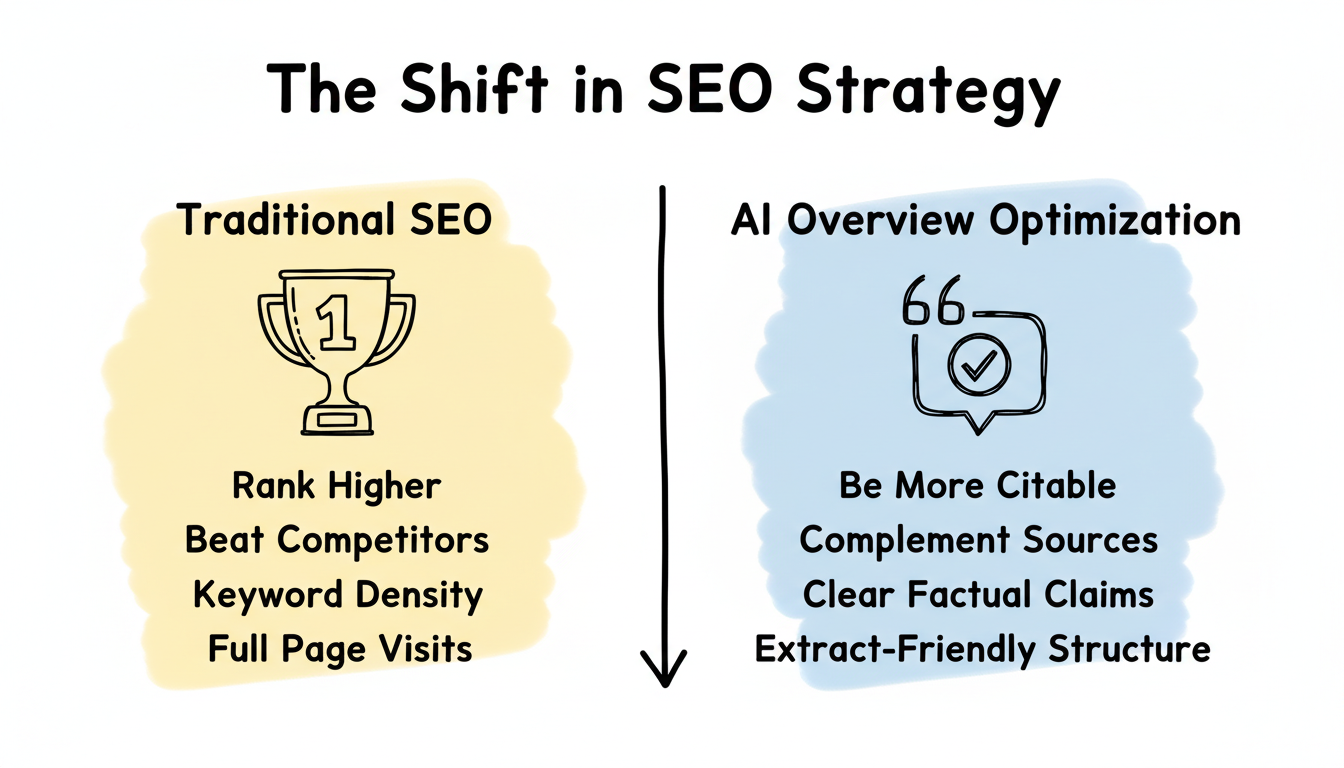
Traditional SEO focuses on ranking position. AI Overview optimization focuses on citability—being useful as a source matters more than being first.
Traditional SEO | AI Overview Optimization |
Rank higher | Be more citable |
Beat competitors | Complement other sources |
Full page visits | Extract-friendly structure |
Keyword density | Clear, factual claims |
Content Structure Requirements
AI systems favor content structured for easy information extraction. Similar to how table featured snippets optimization requires precise formatting, AI Overviews benefit from clear structural signals.
Strong Heading Hierarchy
Clear, descriptive headings help AI identify relevant sections:
Effective headings:
- Use question-based H2s that match search queries
- Include specific terms AI can parse
- Create logical information flow
- Signal what each section delivers
Heading example:
H1: AI Overview Content Requirements
  H2: How AI Overviews Select Content
  H2: Content Structure Requirements
    H3: Strong Heading Hierarchy
    H3: Clear Factual Claims
  H2: Content Types That Perform Best
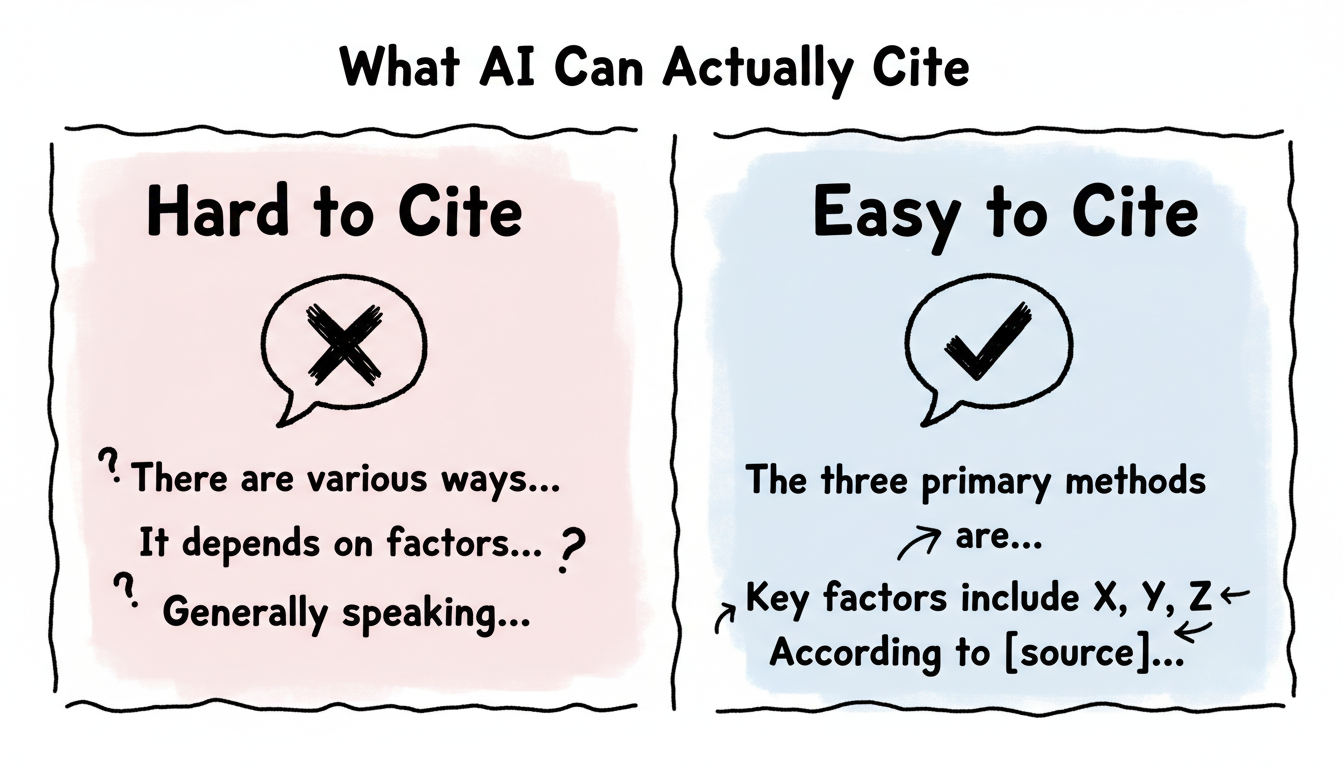
AI Overviews extract definitive statements. Vague or hedged content gets passed over.
Citable content patterns:
Weak (Hard to Cite) | Strong (Easy to Cite) |
"There are various ways to..." | "The three primary methods are..." |
"It depends on many factors" | "Key factors include X, Y, and Z" |
"Generally speaking..." | "According to [source], specifically..." |
"Many experts believe..." | "[Expert] states that..." |
Title tags should front-load the primary topic keyword, and meta descriptions should contain a concise, citable summary sentence. Google's Gemini model uses these on-page signals when selecting citation sources during the query fan-out process, making them essential elements of AI overview SEO beyond their traditional ranking function.
Citable Content Formatting
Formatting content for citability means writing statements that Gemini can extract and attribute during the query fan-out process. Consider the difference between vague prose and citable content:
Before (vague): "There are a lot of things that can affect whether AI picks up your content, and it really depends on a variety of factors related to how you write."
After (citable): "Three primary factors determine AI Overview citation eligibility: content structure with clear heading hierarchy, factual specificity with verifiable claims, and source authority demonstrated through E-E-A-T signals."
The second version gives Gemini a concrete, extractable statement it can attribute to your page.
Scoped Steps and Processes
For how-to content, break processes into numbered, discrete steps:
Structure example:
- Step name: Brief description
- Step name: Brief description
- Step name: Brief description
Each step should be extractable as a standalone instruction while contributing to the complete process.
Content Length and Depth
Content length requirements vary by query type and intent.
Length Guidelines by Content Type
Content Type | Recommended Length | AI Overview Likelihood |
Quick answers | 400-800 words | High for simple queries |
Standard guides | 1,200-1,800 words | High for moderate complexity |
Comprehensive guides | 2,500-5,000+ words | High for complex topics |
Reference content | Variable | High for factual queries |
Depth vs. Breadth
AI Overviews favor comprehensive coverage. Thin content covering many topics superficially performs worse than deep content on specific subjects.
Depth indicators AI recognizes:
- Multiple supporting examples
- Data and statistics with sources
- Expert quotes and citations
- Practical applications
- Common variations addressed
Schema Markup Support
Structured data helps AI understand your content, though schema alone won't guarantee citation. Many SEO automation tools include schema generation capabilities to streamline this process.
Beyond specific schema types, structured data as a broader concept helps Google's systems parse and attribute content during the fan-out retrieval process. While schema markup such as FAQPage, HowTo, and Article provides explicit machine-readable signals, well-structured HTML with semantic heading hierarchy also serves as implicit structured data. Implementing both explicit schema and clean semantic HTML gives your content the best chance of being correctly interpreted and cited. For a deeper dive, see how structured data for AI search amplifies citation eligibility.
Priority Schema Types
FAQ Schema: Mark up frequently asked questions with direct answers. AI Overviews often pull from FAQ-structured content.
{
  "@type": "FAQPage",
  "mainEntity": [{
    "@type": "Question",
    "name": "What content requirements apply to AI Overviews?",
    "acceptedAnswer": {
      "@type": "Answer",
      "text": "AI Overviews favor content with clear headings, factual claims..."
    }
  }]
}
HowTo Schema: For instructional content, HowTo schema makes steps explicit:
{
  "@type": "HowTo",
  "name": "How to Optimize Content for AI Overviews",
  "step": [{
    "@type": "HowToStep",
    "name": "Structure content with clear headings",
    "text": "Use descriptive H2 and H3 headings..."
  }]
}
Organization and Author Schema: E-E-A-T signals from Organization and Person schema support content authority.
Schema as Support, Not Shortcut
Schema markup supports AI understanding but doesn't replace content quality. Implement schema to clarify what your content covers—not to manipulate what AI extracts.
Content Types That Perform Best
Certain content formats consistently earn AI Overview citations.
High-Performance Content Types
Comprehensive guides (2,500+ words): Deep coverage of topics with multiple sections, examples, and expert insights.
Original research: Proprietary data, surveys, and analysis that other sources cite. AI values unique information, particularly AI-powered search engine statistics that provide concrete metrics.
Comparison content: Side-by-side evaluations with clear criteria and conclusions. AI Overviews often synthesize comparison data.
Case studies: Real examples with specific metrics and outcomes. Concrete data performs better than general claims.
Expert roundups: Multiple expert perspectives compiled with attribution. Diverse viewpoints increase citability.
Content That Underperforms
- Thin listicles: Surface-level coverage without depth
- Aggregated content: Repackaged information without new value
- Opinion-heavy pieces: Subjective content without factual grounding
- Outdated information: Content with stale data or obsolete guidance
E-E-A-T and AI Citations
Experience, Expertise, Authoritativeness, and Trustworthiness signals influence AI citation likelihood.
Demonstrating E-E-A-T
Experience indicators:
- First-hand examples and case studies
- Process documentation from real implementation
- Results with specific metrics
Expertise indicators:
- Author credentials and background
- Technical depth appropriate to topic
- Industry-specific terminology used correctly
Authoritativeness indicators:
- Citations from other authoritative sources
- Backlinks from reputable domains
- Brand recognition in the space
Trustworthiness indicators:
- Accurate, verifiable claims
- Transparent sourcing
- Regular content updates
According to Semrush research, AI Overviews appear on approximately 12.95% of search result pages, making citation optimization a significant opportunity for content that meets E-E-A-T standards. Google Search Console now provides dedicated reporting for AI Overview impressions, allowing you to track which pages earn citations and measure the impact of E-E-A-T improvements over time. For detailed measurement workflows, explore AI citation tracking tools that integrate with your existing analytics stack.
Optimization Checklist
Use this checklist to evaluate content for AI Overview citability:
Structure
- Clear heading hierarchy (H1 → H2 → H3)
- Question-based headings where appropriate
- Logical information flow
- Scannable formatting (lists, tables, bold text)
Content Quality
- Clear, factual claims (not hedged language)
- Specific examples and data
- Expert citations with attribution
- Comprehensive topic coverage
Technical
- Relevant schema markup implemented
- Fast page load times
- Mobile-friendly formatting
- No indexing issues
Authority
- Author credentials displayed
- Sources cited and linked
- Content freshness maintained
- E-E-A-T signals present
Beyond backlinks, unlinked brand mentions across authoritative domains contribute to entity recognition in Google's Knowledge Graph, which influences AI Overview source selection. Building a consistent brand presence through industry publications, conference mentions, and expert commentary strengthens the authority signals that Gemini evaluates during citation selection. For strategies on building entity recognition, see how to get a Google Knowledge Panel as an authority foundation.
AI Overview Optimization in the Broader AI Search Landscape
AI Overviews are one component of a broader shift toward AI-powered search experiences. ChatGPT's integrated search, Perplexity's answer engine, and Microsoft Copilot in Bing all represent parallel developments in how users access information—and each selects sources using similar criteria.
The rise of these answer engines has accelerated the zero-click search phenomenon. As AI Overviews and other SERP features answer queries directly within the results page, organic click-through rates decline for informational queries. This makes citation within the AI Overview itself the new visibility goal—your content may never receive a click, but being cited establishes authority and brand recognition.
The strategic implication for AI overview SEO is significant: content optimized for Google AI Overview citation is also well-positioned for citation by Perplexity and Copilot, since all generative AI search systems reward structured, authoritative, citable content. Rather than optimizing separately for each platform, focus on the shared requirements—clear factual claims, strong E-E-A-T signals, and extract-friendly formatting. To understand the Google AI Overview SEO impact on click-through rates and visibility, monitor your performance across all AI search surfaces. For platform-specific tactics, see our Perplexity AI optimization strategy guide.
Building Topical Authority with Long-Tail Keyword Clusters
AI Overviews favor sources with demonstrated topical authority—sites that cover a topic cluster comprehensively rather than publishing isolated pages on disconnected subjects. Building this authority requires a deliberate long-tail keyword strategy.
Start by identifying question-based queries that trigger AI Overviews in your niche. These long-tail keywords reveal the specific sub-topics Gemini decomposes queries into during fan-out. Create dedicated content for each sub-topic, ensuring each piece provides depth that matches the user intent behind the query—whether that intent is informational (how-to, definition), comparative (vs., alternatives), or transactional (tools, services).
Internal linking is the structural signal that ties your topic cluster together and reinforces topical authority for Googlebot. Each piece of content in the cluster should link to related pages using descriptive anchor text, creating a network that demonstrates comprehensive coverage. This interconnected structure signals to Gemini that your site is a complete resource, not a single isolated page.
Off-page authority signals—including link building from relevant domains and brand mentions across industry publications—further increase citation likelihood. These signals validate the topical authority your content cluster establishes. For workflows that support this strategy, explore the best generative engine optimization tools available for AI search optimization.
Frequently Asked Questions About AI Overview Content Requirements
How Do You Write Content That Gets Cited in Google AI Overviews?
Focus on creating concise, factual statements that directly answer specific queries. Structure content with clear heading hierarchy, use definition-style sentences at the start of each section, and back claims with data or authoritative sources. Google's Gemini model selects sources through query fan-out, retrieving content that best matches each sub-query—so format answers to be extractable, not buried in long paragraphs.
What Is the Difference Between AI Overviews and AI Mode in Google Search?
AI Overviews appear automatically at the top of standard search results for qualifying queries. AI Mode is a separate conversational interface where users can ask follow-up questions and get multi-turn responses. Both are powered by Gemini, but AI Mode allows deeper exploration. Content optimized for AI Overview citation is also well-positioned for AI Mode responses, since both rely on similar source-selection criteria.
Does Technical SEO Affect Whether Your Content Appears in AI Overviews?
Yes. If Googlebot cannot crawl and index your pages, they cannot be cited. Ensure your robots.txt does not block critical pages, avoid noindex and nosnippet directives on content you want cited, and maintain strong Core Web Vitals scores. Pages with fast load times and good page experience are more likely to be selected as citation sources during the AI Overview generation process.
How Do You Track AI Overview Citations in Google Search Console?
Google Search Console now reports impressions and clicks from AI Overviews as a separate search appearance filter. Navigate to Performance > Search Results, then filter by "AI Overview" appearance type. Monitor which queries trigger your citations, track CTR trends over time, and compare AIO performance against standard organic results. This data helps you identify which content formats and topics earn the most AI Overview visibility.
FAQs
Do AI Overviews Always Cite the Top-Ranking Result?
No. AI Overviews synthesize from multiple sources, prioritizing citability and relevance over ranking position. Content at position 5 can be cited while position 1 is not.
How Long Does Content Need to Be for AI Overviews?
There's no minimum, but comprehensive content (1,200+ words) generally performs better. Quick answers for simple queries can be shorter if sufficiently authoritative.
Does Schema Markup Guarantee AI Overview Inclusion?
No. Schema helps AI understand your content but doesn't guarantee citation. Content quality, accuracy, and authority remain primary factors.
How Often Should I Update Content for AI Overviews?
Review and update content quarterly at minimum. AI systems favor current information, and outdated content loses citation potential over time. Understanding content freshness signals answer engines use can help prioritize update schedules.