
AI Overviews have fundamentally changed how users interact with Google search results—and the click-through rate data tells a complex story. While overall organic CTR has declined for queries showing AI Overviews, being cited within those overviews can actually increase traffic. Understanding these dynamics is essential for modern SEO strategy.
This guide compiles the latest CTR research and explains what the data means for your visibility strategy.
The Zero-Click Search Problem: What the Data Really Shows
Before diving into individual studies, it is important to understand the broader context: the zero-click search phenomenon is accelerating. A zero-click search occurs when a user’s query is fully answered on the search results page itself, with no click to any external website. According to SparkToro, approximately 58% of all Google searches now end without a click to any website—a figure that has grown steadily as AI Overviews expand across more query types.
Gartner predicts that organic click-through rates will decline by 25% by the end of 2026, driven largely by AI-generated answers consuming prime screen real estate. Research from Botify confirms this displacement: AI Overviews consume 42% of the visible desktop viewport and up to 48% on mobile devices, pushing traditional organic results below the fold.
This shift demands a new KPI framework. Rather than tracking raw CTR alone, SEO teams are adopting share of voice as the primary metric—measuring how often a brand appears across all SERP features, including AI Overviews. As Kevin Indig documented in Growth Memo, monitored sites are experiencing greater than 50% CTR declines across both branded and non-branded informational queries, reinforcing the urgency of this strategic pivot.
The Current State of AI Overview CTR
Multiple studies have documented how AI Overviews affect click behavior, with findings that reveal both challenges and opportunities.
Key CTR Statistics (2025-2026)
Metric | Finding | Source |
Overall CTR decline | 34.5% → 58% decrease for top-ranking pages | Ahrefs study (updated Feb 2026) |
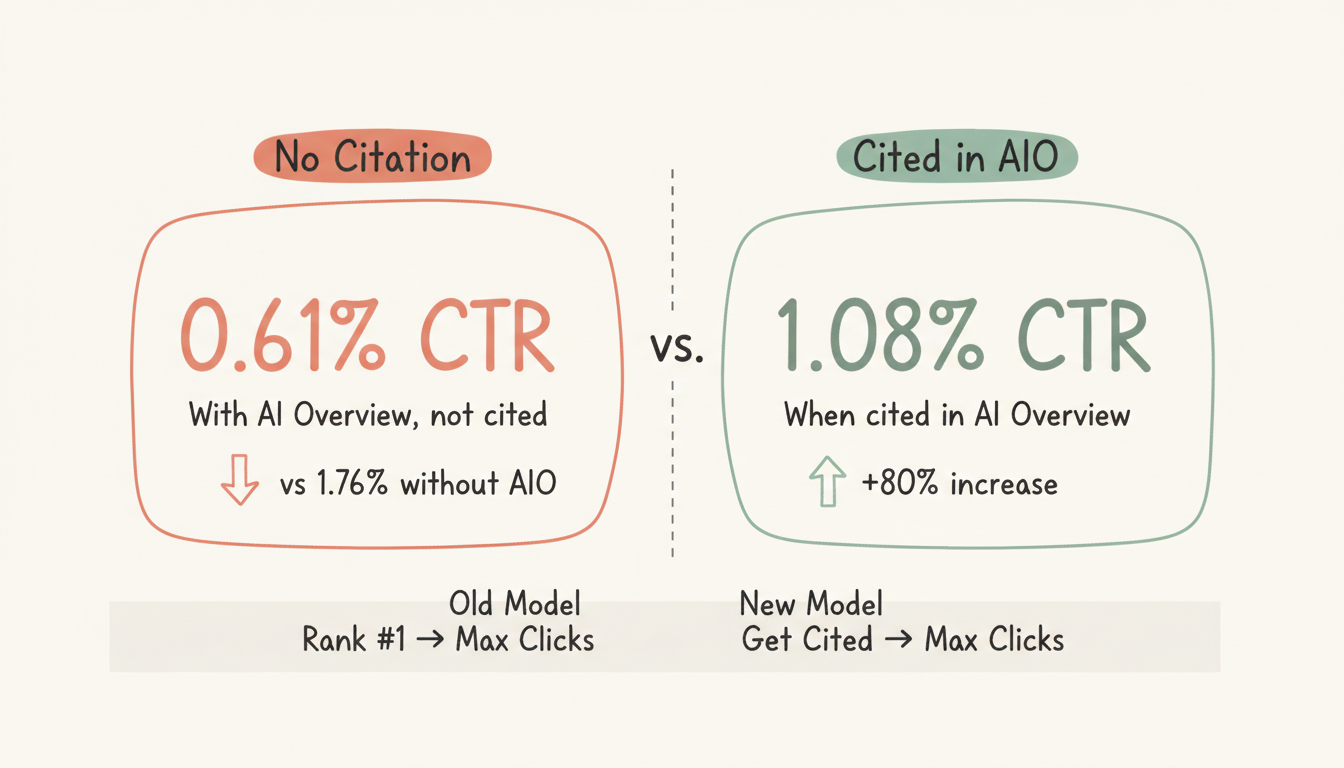
Organic CTR with AIO | 0.61% (down from 1.76% without) | Seer Interactive |
Citation CTR boost | +80% increase for cited sources | Semrush analysis |
Zero-click rate | 58% of Google searches end without clicks | SparkToro |
The CTR Collapse for Non-Cited Content
Research from Seer Interactive found organic CTR plummeted 61% when AI Overviews appear—from 1.76% to 0.61%. This represents a dramatic shift in user behavior, making AEO optimization strategies increasingly critical for maintaining visibility.
Critically, the Seer Interactive September 2025 study revealed that non-AIO queries also declined 41% in organic CTR during the same period, suggesting broader behavioral shifts beyond just AI Overview displacement. Paid search CTR was equally devastated, crashing from 19.7% to 6.34%—a 68% decline—when AI Overviews appeared. This finding, derived through query segmentation methodology, underscores the need for cross-functional alignment between SEO and paid search teams when responding to AIO-driven changes. Tracking performance in Google Ads performance tracking dashboards alongside organic data is now essential.
CTR comparison by study:
Study | Without AIO | With AIO | Change |
Seer Interactive | 1.76% | 0.61% | -65.3% |
Amsive | 2.13% | 0.89% | -58.2% |
Ahrefs (Position 1) | Varies | Varies | -34.5% (Apr 2025) → -58% (Feb 2026) |
The Ahrefs data trajectory is particularly telling: Ryan Law’s original April 2025 analysis of 300,000 US keywords found a 34.5% CTR decline for position 1 results when AI Overviews appeared. By February 2026, that figure had been revised upward to 58%—with position 1 losing roughly 62% of its expected clicks, position 2 losing 74%, and positions 3+ losing over 80%. This accelerating decline demonstrates how quickly the AI Overview landscape is evolving.
These declines reflect user behavior changes—when AI provides a synthesized answer, many users don’t need to click through.
The Citation Advantage
The data reveals a critical opportunity: being cited within AI Overviews significantly increases click-through rates.
Citation impact:
- Pages cited in AI Overviews see up to 35% more clicks
- Citation CTR rises from 0.6% to 1.08%—an 80% increase
- Brands mentioned in AI responses see 91% higher paid CTR
This creates a new optimization priority: earning citations matters more than traditional ranking position for many queries. Understanding the fundamental differences between SEO vs AEO key differences helps prioritize which approach to emphasize for different query types.
How AI Overviews Change Click Behavior
Understanding user behavior helps explain the CTR patterns.
User Actions After AI Overviews
According to recent research:
- 26% take no action: One in four users stops at the AI summary
- 70% don’t scroll past: Most readers never see results below the AI Overview
- 8% vs 15% click rate: AI summaries cut traditional clicks roughly in half
Zero-Click Dominance
Zero-click searches now dominate for informational intent queries—the category most heavily affected by AI Overviews:
- 58% of Google searches end without a click to any website (SparkToro)
- 88% of AI Overview triggers are informational queries
- Long-tail queries (68% receive fewer than 100 monthly searches) trigger most AI Overviews
This suggests that simple informational queries increasingly result in no website visits—the answer appears directly in search. The shift is compounded by the fact that keyword difficulty is changing: previously easy-to-rank informational queries now face zero-click barriers that no amount of traditional optimization can overcome. The March core update further reshuffled rankings alongside AIO expansion, creating a compounding effect on organic visibility. Leveraging long-tail keywords featured snippets remains an effective tactic for capturing these high-intent, low-volume searches. Pairing this with a solid keyword research strategy helps identify queries where AIOs are less prevalent.
SERP Feature Displacement: What Aios Replace
AI Overviews do not simply add a new element to the search results page—they actively displace existing SERP features at alarming rates. According to WordStream data, when AI Overviews appear, 96% fewer sitelinks are displayed, 84% fewer video carousels appear, and 75% fewer Knowledge Panels are shown. This displacement fundamentally reshapes the above-the-fold landscape.
People Also Ask (PAA) boxes are the exception, co-occurring alongside AIOs in 81% of SERPs. However, Local Pack and Top Stories features also see significantly reduced visibility when AI Overviews are present. The practical implication is stark: even if your site holds the coveted position 1 organic ranking, you are likely pushed well below the fold, behind both the AI Overview and any remaining SERP features.
CTR Variation by Industry
AI Overview impact varies significantly by industry and query type.
Industries Most Affected
Industry | AIO Presence | CTR Impact |
Science | 25.96% | High decline |
Computers & Electronics | 17.92% | High decline |
People & Society | 17.29% | Moderate decline |
B2B Technology | 70% (up from 36%) | Significant decline |
Insurance | 63% (up from 17%) | Significant decline |
Industries Less Affected
Some sectors see minimal AI Overview presence:
- Ecommerce: Only 4% of queries trigger AIOs (down from 29% at launch)
- Real Estate: Less than 3% of keywords show AIOs
- Shopping: Minimal AIO presence
- Arts & Entertainment: Less than 3% of keywords
The pattern suggests Google is more cautious with commercial and transactional queries—where user intent involves purchasing.
What This Means for SEO Strategy
The CTR data points to strategic shifts required for modern SEO.
Priority Shift: Citation Over Ranking
Traditional SEO focused on ranking position—higher rankings meant more clicks. The new equation:
Old Model | New Model |
Rank #1 for maximum CTR | Get cited in AIO for maximum CTR |
Beat all competitors | Be the most citable source |
Optimize for position | Optimize for inclusion |
For informational queries, being cited in the AI Overview can drive more traffic than ranking #1 in traditional results.
Content Strategy Implications
High-value approaches:
- Create citable content with clear, factual claims
- Target queries where AI Overviews cite sources
- Build expertise signals that earn citations
- Monitor citation appearances, not just rankings
Declining value approaches:
- Thin content targeting simple informational queries
- Pure ranking-focused optimization
- Content that competes with rather than complements AI summaries
Teams should also be aware of content decay risk. AIO data shifts rapidly—Ahrefs revised its CTR decline figure from 34.5% to 58% within just 10 months. Content referencing outdated statistics loses authority and citation eligibility. Quarterly data audits are recommended to keep statistics current. Maintaining structured data and schema markup is equally essential, as properly implemented schema helps AI systems identify and cite your content reliably.
Traffic Diversification
Given zero-click trends, diversifying traffic sources becomes essential. Many B2B companies are rethinking their approach—explore how SearchGPT B2B companies strategy addresses these challenges.
- Direct traffic: Build brand recognition for navigational queries
- Email lists: Capture audiences independent of search
- Social platforms: YouTube, LinkedIn, and Reddit provide alternative visibility
- AI platform visibility: Optimize for ChatGPT, Perplexity, and other AI tools
GEO — Generative Engine Optimization: The New SEO Playbook
As AI Overviews reshape search behavior, a new optimization discipline has emerged: generative engine optimization (GEO). Where traditional SEO targets blue-link rankings and AEO focuses on answer-box inclusion, GEO represents the next evolution—optimizing specifically to earn citations within AI-generated answers across Google AI Overviews, AI Mode, ChatGPT, and Perplexity.
The fundamental shift is strategic: rather than competing for clicks, GEO prioritizes brand visibility inside AI-generated responses. When your content is cited as a source in an AI Overview, you gain both the direct CTR benefit (the 80% increase documented above) and a downstream branded search lift as users who see your brand in AI answers later search for you directly.
Key ranking factors for GEO differ from traditional SEO. Domain authority and brand authority carry outsized weight—AI systems preferentially cite sources they assess as trustworthy and authoritative. Building E-E-A-T and brand authority is therefore not just a best practice but a prerequisite for GEO success. As Ryan Law (Ahrefs) and Aja Frost have noted, the sites earning the most AI citations tend to be those with strong editorial standards, original research, and established topical authority.
Measuring GEO performance requires new tooling. ZipTie has emerged as the leading AI Overview tracking tool, monitoring whether your content appears in AI-generated responses across queries. SeerSignals, Seer Interactive’s proprietary tracker, provides similar capabilities with deeper integration into their analytics stack. Both tools track brand visibility across AI surfaces including the newer AI Mode—Google’s next evolution beyond standard AI Overviews. For a comprehensive approach, explore our guide to AI search optimization strategies.
Tracking AI Overview CTR
Measuring your AI Overview performance requires specific monitoring.
What to Track
Metric | How to Measure |
Citation appearances | ZipTie, SeerSignals, or manual monitoring |
Click changes | Google Search Console data for AIO-affected queries |
Traffic trends | Compare periods with/without AIO presence |
Brand mentions | Monitor AI responses for brand references |
Paid CTR impact | Google Ads data segmented by AIO presence |
Tools for Monitoring
Several tools now track AI Overview visibility:
- Semrush (AI Overview tracking features)
- Ahrefs (SERP feature monitoring via Keywords Explorer and Site Explorer)
- ZipTie (dedicated AIO citation tracking)
- SeerSignals (Seer Interactive’s proprietary AIO tracker)
- Specialized AEO platforms (citation tracking)
The Opportunity in the Data
Despite concerning CTR declines, the data reveals significant opportunities.
Citation CTR Advantage
The 80% CTR increase for cited content means:
- Earning citations can offset ranking-based CTR losses
- Citation optimization represents a competitive advantage
- Content that AI systems trust gets preferential traffic
Higher Conversion Rates
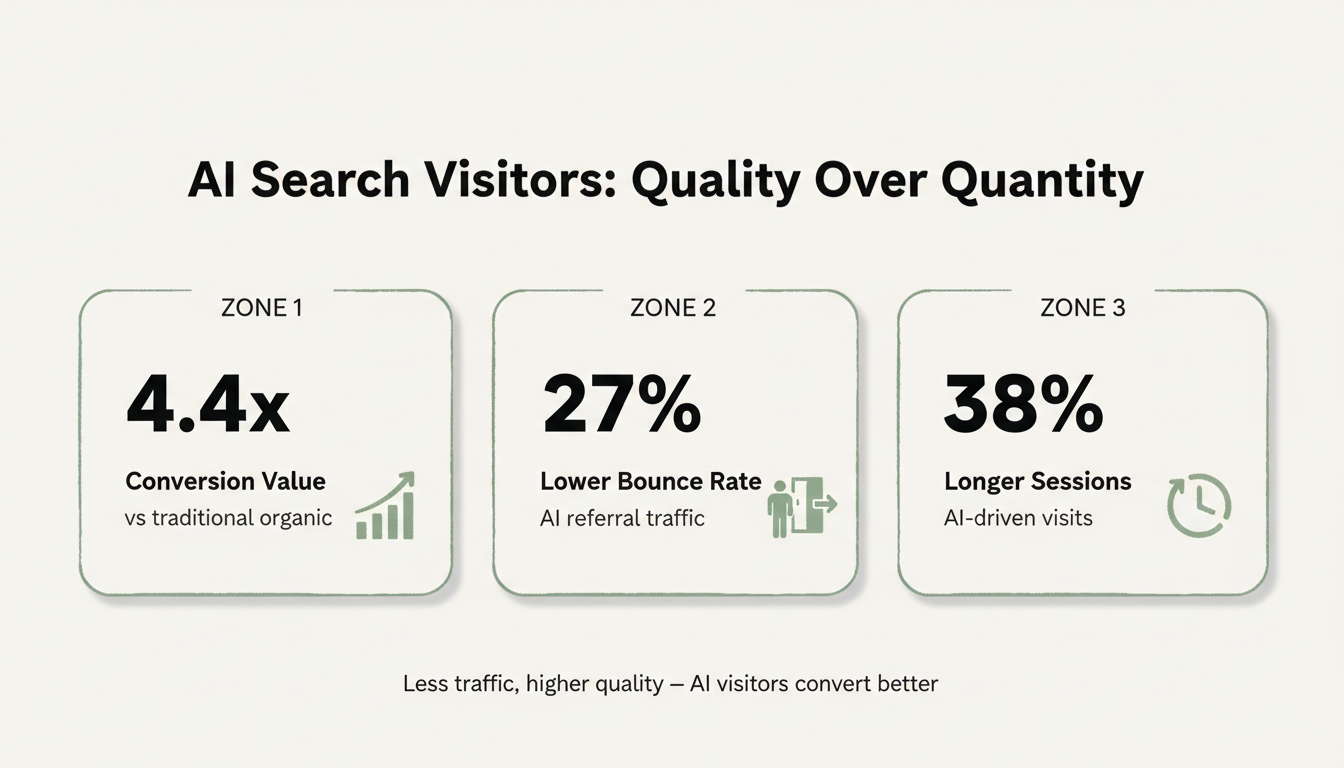
AI search visitors convert at dramatically higher rates:
- 4.4x conversion value compared to traditional organic
- 27% lower bounce rates for AI referral traffic
- 38% longer session duration from AI-driven visits
Less traffic but higher quality can maintain or improve business outcomes.
Commercial Query Protection
Ecommerce and shopping queries remain largely unaffected by AI Overviews. For commercial content:
- Traditional ranking factors still dominate
- CTR patterns remain more predictable
- Product and transactional content faces less AIO competition
About the Data: Sources and Methodology
This article synthesizes findings from multiple independent studies, each using different methodologies and sample sizes. Understanding how each dataset was collected helps contextualize the findings.
Source | Sample Size | Period | Method |
Seer Interactive | 10,000+ queries | 15-month longitudinal | Retrospective cohort analysis via Google Search Console + Google Ads data |
Ahrefs (Ryan Law) | 300,000 US keywords | Apr 2025, updated Feb 2026 | Position-by-position CTR via Keywords Explorer |
SparkToro | Aggregate web data | Ongoing | Clickstream panel analysis |
Authoritas | Varies by report | 2025-2026 | SERP monitoring and feature detection |
Botify | Enterprise crawl data | 2025-2026 | Viewport analysis and SERP rendering |
Readers should note that methodology differences account for some variation in reported CTR figures. Seer Interactive’s retrospective cohort analysis tracks the same queries over time, while Ahrefs’ cross-sectional approach via Site Explorer compares different query sets. Both approaches are valid but measure slightly different phenomena. For a comprehensive review of your own site’s performance, consider following our SEO audit checklist.
FAQs
Do AI Overviews Always Reduce Website Traffic?
Not necessarily. While overall CTR declines for most queries with AI Overviews, sites cited within the overview can see traffic increases up to 35%. The impact depends on whether you’re cited.
Is Ranking #1 Still Valuable with AI Overviews?
Yes, but less so for informational queries. For commercial and transactional queries where AI Overviews rarely appear, ranking position remains critical. For informational queries, citation in the AI Overview may matter more.
How Can I Improve My AI Overview CTR?
Focus on earning citations by creating authoritative, factual content that AI systems trust. Implement schema markup, build E-E-A-T signals, and structure content for easy extraction.
Which Queries Should I Target Given CTR Changes?
Consider focusing on commercial intent queries (lower AIO presence), long-form content opportunities where citations add value, and brand-building content that drives direct traffic.
What Is Generative Engine Optimization (GEO) and How Does It Differ from Traditional SEO?
GEO focuses on earning citations within AI-generated answers rather than ranking for blue links. While traditional SEO targets click-through from SERPs, GEO prioritizes brand visibility inside AI Overviews and AI Mode. Key tactics include structured data markup, authoritative sourcing, and building domain authority. Tools like ZipTie track whether your content appears in AI-generated responses.
What Percentage of Google Searches Result in Zero Clicks?
According to SparkToro, approximately 58% of Google searches end without a click to any website. With AI Overviews expanding, Gartner predicts organic CTR will decline 25% by the end of 2026. Botify research shows AIOs consume 42-48% of visible screen real estate, pushing traditional results below the fold and further reducing click probability.
How Do AI Overviews Affect Paid Search CTR and Google Ads Performance?
Seer Interactive found paid CTR crashed from 19.7% to 6.34%—a 68% decline—when AI Overviews appear. This impacts Google Ads ROI significantly. Advertisers should monitor query-level CTR in Google Search Console alongside Google Ads data and consider shifting budget toward branded terms and high-commercial-intent queries where AIOs appear less frequently.
Which SERP Features Are Most Affected by AI Overviews?
AI Overviews dramatically reduce other SERP features. WordStream data shows 96% fewer sitelinks, 84% fewer video results, and 75% fewer Knowledge Panels when AIOs are present. People Also Ask boxes co-occur with AIOs in 81% of searches. Local Pack and Top Stories also see reduced visibility, making the above-the-fold landscape increasingly AI-dominated.