
Technical SEO has evolved from a ranking factor to an absolute prerequisite for AI visibility. In 2026, Google's AI Overviews rely on structured data, site performance, and technical signals to understand, trust, and cite content. Without solid technical foundations, even excellent content remains invisible to AI systems. Understanding how google ai overview seo works at a technical level is critical for any site aiming to earn citations in AI-generated answers. Research shows that approximately 80% of AI Overview sources come from the top 10 organic results, reinforcing the importance of technical SEO fundamentals as the gateway to how Google AI Overviews affect organic traffic.
This guide covers the essential technical requirements for AI Overview optimization.
How AI Overviews Actually Work: RAG, Query Fan-Out, and Gemini
To optimize for AI Overviews, you first need to understand the machinery behind them. Google's AI Overview pipeline is built on RAG (Retrieval-Augmented Generation) -- a pattern where the system retrieves relevant web documents, re-ranks them for quality and relevance, then feeds the top candidates to a large language model that synthesizes a cited answer.
When a user submits a complex or multi-faceted query, the system employs query fan-out: it decomposes the original question into multiple sub-queries, retrieves results for each independently, and then merges and deduplicates the candidate set. Google's own documentation on multi-step reasoning confirms this approach for queries requiring information from several domains.
The language model layer powering the final synthesis is Google's family of Gemini models. Gemini decides which retrieved passages best answer the query, generates the overview text, and selects which sources to cite with inline links.
Critically, AI Overviews rely on semantic search rather than purely lexical matching. Instead of matching exact keywords, the system converts both queries and documents into vector embeddings -- numerical representations of meaning -- and finds the closest matches in embedding space. In production, Google uses hybrid retrieval, combining traditional lexical signals (BM25) with semantic vector similarity to get the best of both worlds.
The tactical takeaway for technical SEOs: structured data, clear heading hierarchies, and entity-rich content make your pages easier for the RAG pipeline to chunk, retrieve, and cite. If the system cannot parse your page into clean passages, it will select a competitor's page instead.
AI Mode vs AI Overviews: What Technical Seos Need to Know
AI Mode is Google's opt-in conversational search experience, distinct from the auto-triggered AI Overview snippet that appears above organic results. While AI Overviews provide a single synthesized answer panel, AI Mode supports follow-up questions, deeper multi-step reasoning, and agentic search behaviors -- browsing multiple sites, comparing products, and building itineraries within the conversation.
Both experiences draw from the same search index, but AI Mode may weight brand mentions and topical authority differently because conversations run longer and involve more refinement. Sites with strong brand signals and comprehensive topical coverage tend to surface repeatedly across multi-turn exchanges.
AI Mode also introduces multimodal search signals. Images with descriptive alt text, video structured data, and product imagery can all contribute to richer AI Mode responses. The risk of fragmented visibility -- ranking in organic results but being excluded from AI-generated answers -- is even more pronounced in AI Mode, where citations rotate across turns.
The practical implication: sites optimized for AI Overviews are well-positioned for AI Mode, but should also ensure their visual and structured media assets are discoverable and properly annotated.
GEO: Generative Engine Optimization as a Discipline
GEO (Generative Engine Optimization) is the emerging practice of optimizing content for all generative-AI answer engines -- not just Google AI Overviews, but also Bing Copilot, Perplexity, and ChatGPT search. While traditional SEO and AEO focus on Google's ecosystem, GEO recognizes that multiple AI systems now compete to answer user queries.
Technical SEO (schema, Core Web Vitals, crawlability) provides the shared foundation for GEO. On top of that foundation, GEO adds relevance engineering -- structuring content so that LLMs can extract, attribute, and cite it reliably. This includes content synthesis patterns such as concise definitions, comparison tables, and cited statistics, all of which increase citation probability across AI engines.
For a deeper dive into GEO tactics, see our guide on generative engine optimization strategies.
Why Technical SEO Matters More Than Ever
The relationship between technical SEO and AI visibility has fundamentally changed:
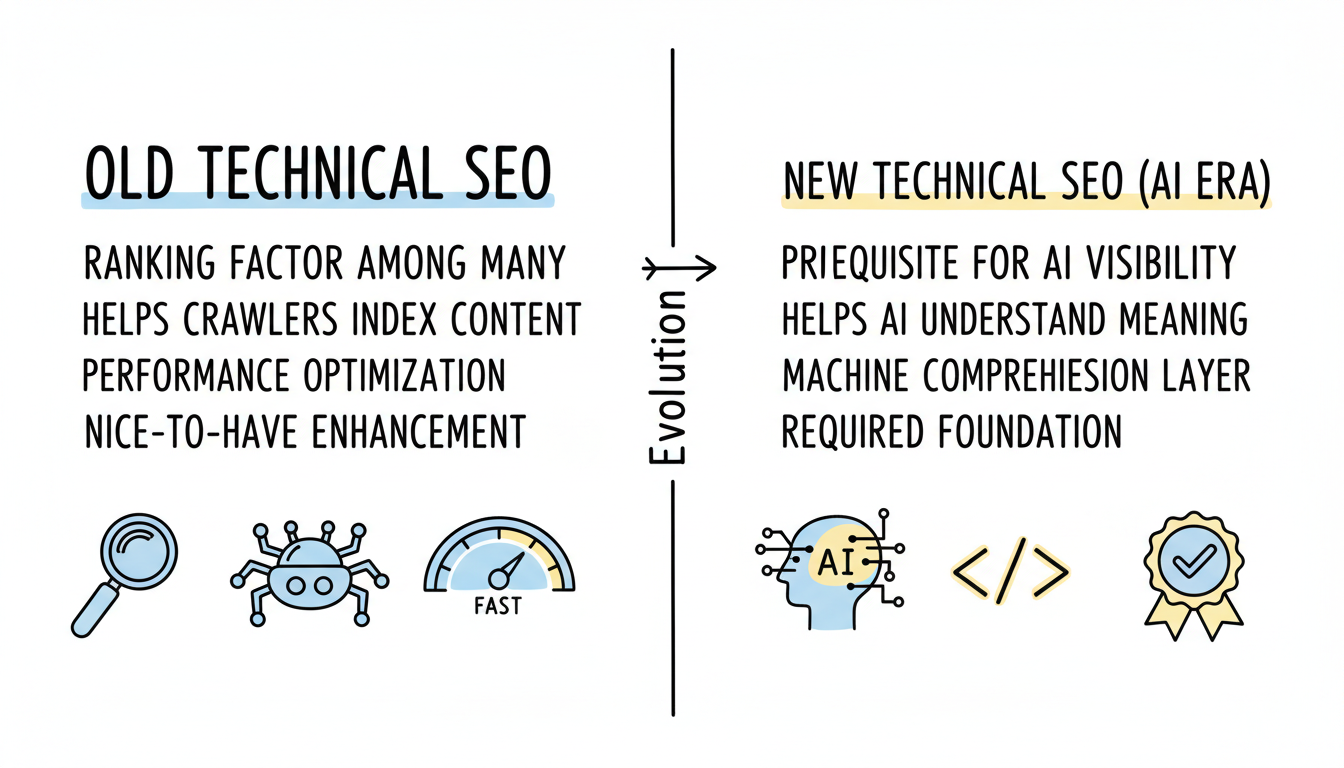
Old Technical SEO | New Technical SEO |
Ranking factor among many | Prerequisite for AI visibility |
Helps crawlers index content | Helps AI understand meaning |
Performance optimization | Machine comprehension layer |
Nice-to-have enhancement | Required foundation |
Google now pulls approximately 80% of AI Overview sources from the top 10 organic results, with citation preference for sites demonstrating technical excellence. Technical SEO isn't just about ranking -- it's about being understood, as detailed in our guide on how Google selects AI Overview sources.
Core Technical Requirements
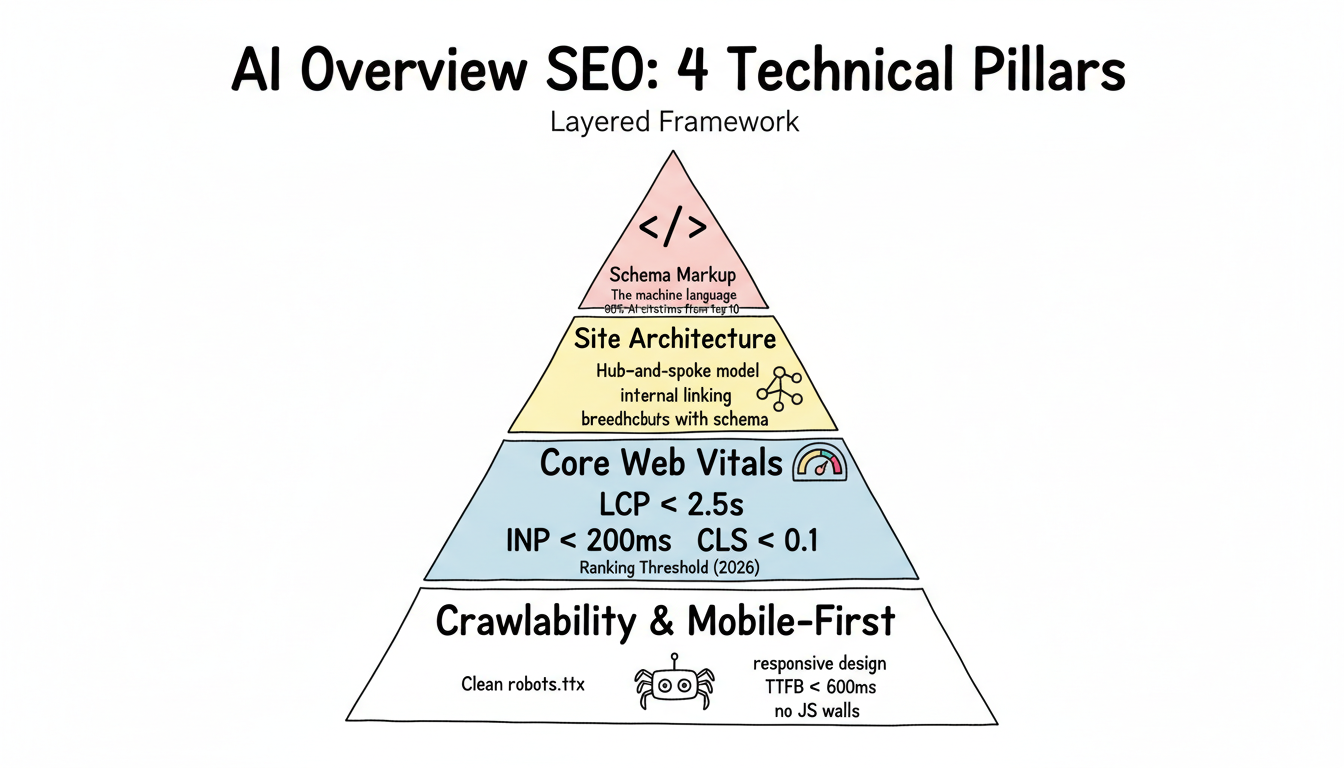
Schema Markup: The Machine Language
Schema markup has become the universal language between human content and AI understanding. In 2026, it's not optional -- it's foundational.
Priority schema types for AI Overviews:
Schema Type | Purpose | AI Impact |
Organization | Establishes entity identity | Brand recognition in AI responses |
Person | Author credentials and expertise | E-E-A-T signal for citations |
Article | Content type and metadata | Proper content categorization |
FAQ | Question-answer pairs | Direct extraction for AI answers |
HowTo | Step-by-step processes | Process-based query matching |
Product | Product details and attributes | Commercial query inclusion |
LocalBusiness | Location and service area | Local AI visibility |
Implementation example (Organization schema):
{
  "@context": "https://schema.org",
  "@type": "Organization",
  "name": "Your Company",
  "url": "https://yoursite.com",
  "sameAs": [
    "https://linkedin.com/company/yourcompany",
    "https://twitter.com/yourcompany"
  ],
  "description": "Brief company description with key expertise",
  "contactPoint": {
    "@type": "ContactPoint",
    "telephone": "+1-xxx-xxx-xxxx",
    "contactType": "customer service"
  }
}
Key implementation principles:
- Use JSON-LD format (Google's preference)
- Include sameAs links to verified properties
- Nest related schemas for entity relationships
- Validate with Google's Rich Results Test
You can also use the data-nosnippet HTML attribute as a preview control to exclude specific page sections from being quoted in AI Overviews. The max-snippet meta tag lets you cap how many characters Google can extract, while the nosnippet directive provides full opt-out (though it also removes regular search snippets). For more on managing AI Overview inclusion, see our guide on opting out of AI Overviews.
Entity Mapping and the Knowledge Graph
Entity mapping is the process of connecting on-page entities -- people, organizations, products -- to nodes in Google's knowledge graph via schema properties like @id, sameAs, and owl:sameAs references. When your JSON-LD includes these identifiers, search engines can resolve your content to known entities rather than treating mentions as ambiguous strings.
The knowledge graph is built on semantic triples -- subject-predicate-object relationships extracted from structured data. For example, the triple (Stackmatix, offers, SEO services) connects your organization entity to a service entity. The richer your schema graph, the more triples Google can extract, and the stronger your entity resolution becomes.
To strengthen entity mapping, add sameAs links to Wikidata, LinkedIn, and Crunchbase profiles. Use consistent @id URIs across all schema blocks on your site so that Google can merge entity references into a single node. For more on building entity authority, see our guide on Google Knowledge Panel optimization, and explore how structured data for AI search engines accelerates entity resolution.
Core Web Vitals: Performance as Trust Signal
Google's December 2025 Core Update elevated Core Web Vitals from ranking factor to ranking threshold. Sites failing these metrics are filtered before AI citation consideration. Poor Core Web Vitals can cause fragmented visibility -- where a site ranks well in organic results but is systematically excluded from AI Overview citations due to performance issues.
Current Core Web Vitals requirements (2026):
Metric | Target | Measurement |
LCP (Largest Contentful Paint) | Under 2.5 seconds | Loading speed |
INP (Interaction to Next Paint) | Under 200 milliseconds | Interactivity |
CLS (Cumulative Layout Shift) | Under 0.1 | Visual stability |
INP has become critical. Sites that load quickly but feel "laggy" when users interact lose ranking potential. Google now prioritizes interactivity over pure loading speed.
Optimization priorities:
- Optimize images with modern formats (WebP, AVIF)
- Implement lazy loading for below-fold content
- Minimize JavaScript blocking
- Preload critical resources
- Use content delivery networks (CDN)
On-Page SEO Baseline for AI Visibility
Before diving into advanced technical requirements, ensure your on-page SEO fundamentals are solid. Optimized title tags with primary keywords, compelling meta descriptions that earn clicks, and site-wide HTTPS encryption are baseline trust signals. AI systems evaluate these on-page SEO elements as part of their quality assessment before selecting citation sources.
Site Architecture: AI Navigation Pathways
AI systems crawl and understand sites through their architecture. Clear structure improves both indexation and comprehension.
Architecture requirements:
Element | Requirement | AI Benefit |
URL structure | Descriptive, hierarchical | Context understanding |
Internal linking | Logical content connections | Entity relationship mapping |
Navigation | Clear hierarchy | Topic authority signals |
Sitemaps | Complete and current | Crawl efficiency |
Breadcrumbs | Implemented with schema | Category understanding |
Hub-and-spoke model: Create hub pages that link to all related content. This helps AI systems understand topic relationships and establish your authority in content clusters.
Mobile-First Technical Requirements
With mobile-first indexing standard, mobile experience directly impacts AI visibility.
Mobile technical checklist:
- Responsive design (not separate mobile site)
- Touch targets minimum 48x48 pixels
- No horizontal scrolling required
- Readable text without zooming
- Fast mobile page speed
- No intrusive interstitials
Crawlability and Indexation
AI systems can only cite content they can access and understand.
Crawlability essentials:
- No critical content behind JavaScript that requires rendering
- Clean robots.txt allowing AI crawler access
- Proper canonical tags preventing duplicate content confusion
- Minimal redirect chains (none over 3 hops)
- Fast server response times (TTFB under 600ms)
- XML sitemap including all valuable pages
New for 2026: Consider implementing llms.txt files and MCP server protocols to guide AI crawlers to important content efficiently. These emerging standards help AI systems understand site structure and content priorities.
Technical Setup Checklist
Phase 1: Foundation Audit (Week 1-2)
Task | Tool | Action |
Core Web Vitals assessment | PageSpeed Insights | Identify failing pages |
Schema audit | Rich Results Test | Find markup gaps |
Crawl analysis | Search Console | Review coverage issues |
Mobile testing | Mobile-Friendly Test | Verify responsive design |
Site speed testing | GTmetrix, WebPageTest | Baseline performance |
Phase 2: Schema Implementation (Week 3-4)
Priority order:
- Organization/LocalBusiness schema (identity establishment)
- Person schema for authors (E-E-A-T signals)
- Article schema for content pages
- FAQ schema for relevant pages
- Product/Service schema for commercial content
Validation process:
- Test each schema type individually
- Check for errors and warnings
- Verify relationships between nested schemas
- Monitor rich results in Search Console
Phase 3: Performance Optimization (Week 5-6)
Quick wins:
- Image optimization (compression, modern formats)
- Browser caching implementation
- CSS and JavaScript minification
- Critical CSS inlining
- Render-blocking resource elimination
Advanced optimization:
- Server-side rendering for JavaScript-heavy sites
- Preloading and prefetching implementation
- Third-party script audit and optimization
- Database query optimization
Phase 4: Architecture Refinement (Week 7-8)
Content structure:
- Implement breadcrumb navigation with schema
- Create topic hub pages linking to related content
- Establish clear internal linking patterns
- Remove orphan pages or integrate them properly
Monitoring and Maintenance
Technical SEO requires ongoing attention. Establish these monitoring practices:
Weekly checks:
- Core Web Vitals in Search Console
- Crawl errors and coverage issues
- Mobile usability reports
- Page indexing status
Monthly audits:
- Full schema validation
- Site speed testing across key pages
- Internal linking analysis
- Competitor technical benchmarking
AI-specific monitoring:
- Track AI Overview appearances (new Search Console "AI Mode" filter) and monitor "ai overview ranking" queries
- Monitor citation frequency
- Analyze which pages receive AI citations
- Compare technical metrics on cited vs. non-cited pages
- Use embedding graphs as an advanced technique to visualize topical coverage gaps and identify entity clusters where your site lacks representation
For comprehensive tracking of your AEO optimization efforts, consider implementing dedicated AEO analytics setup to measure both technical performance and AI visibility metrics across platforms. For iterative testing approaches, explore A/B testing for AI search performance to validate which technical changes drive the most citation improvements.
Common Technical Mistakes
Mistake | Problem | Solution |
Schema without validation | Errors prevent parsing | Always validate before deployment |
Orphaned pages | No internal links | Create clear navigation paths |
JavaScript-dependent content | AI may not render | Use server-side rendering |
Slow server response | Crawl budget wasted | Optimize hosting and caching |
Mobile-only issues | Mobile-first indexing suffers | Test regularly on actual devices |
Duplicate content | Confuses AI attribution | Implement proper canonicalization |
FAQs
Does Schema Markup Directly Improve AI Overview Visibility?
Schema markup doesn't guarantee AI Overview inclusion, but it significantly improves how AI systems understand your content. Without schema, AI must guess meaning -- with schema, you provide direct answers. Most AI-cited sources have comprehensive schema implementation. This structured data approach is fundamental to what is AEO vs SEO strategy differences.
How Important Are Core Web Vitals for AI Overviews?
Critical. Google's 2025 updates made Core Web Vitals a ranking threshold rather than just a factor. Sites failing these metrics are filtered before AI citation consideration, regardless of content quality.
Can I Optimize for AI Overviews Without Technical Changes?
Limited success is possible through content quality alone, but technical optimization dramatically increases chances. Schema markup, in particular, has become essential for AI systems to properly understand and cite content.
How Often Should I Audit Technical SEO for AI?
Monthly audits are recommended for key metrics. Google updates its systems regularly, and new technical requirements emerge. The December 2025 update, for example, significantly elevated INP importance -- sites that weren't monitoring this metric were caught off guard.
What Is RAG and How Does It Power Google AI Overviews?
RAG (Retrieval-Augmented Generation) is the pipeline Google uses to build AI Overview answers. It retrieves relevant web pages using semantic search and vector embeddings, re-ranks them for relevance, then feeds the top candidates to a Gemini language model that synthesizes a cited response. Pages with clear structure, schema markup, and entity-rich content are easier for the RAG pipeline to parse and cite.
What Is the Difference Between AI Overviews and AI Mode?
AI Overviews are automatic answer panels that appear above organic results for select queries. AI Mode is an opt-in conversational experience where users can ask follow-up questions and receive deeper, multi-step reasoning. Both draw from the same index, but AI Mode supports agentic search behaviors like comparison shopping and itinerary planning, making brand authority and structured data even more critical.
How Does Generative Engine Optimization (GEO) Relate to Technical SEO?
GEO is the practice of optimizing content for all AI-powered answer engines, not just Google. Technical SEO provides the foundation -- schema markup, fast load times, crawlable architecture -- while GEO adds strategies like concise claim-evidence formatting, statistical citations, and entity-rich headers that increase the probability of being retrieved and cited by large language models.
How Can I Control Which Content Appears in AI Overviews?
Use the data-nosnippet HTML attribute to exclude specific page sections from being quoted in AI Overviews. The max-snippet meta tag lets you cap how many characters Google can extract. For full opt-out, apply the nosnippet directive, though this also removes regular search snippets. Balance visibility goals against the risk of competitors being cited instead.