
Google AI Overviews now appear in approximately 13% of all searches, and their impact on organic traffic varies dramatically across industries. Some sectors face 79% traffic declines while others experience relatively modest losses. Understanding these industry-specific patterns helps businesses prepare realistic expectations and allocate resources appropriately. According to Gartner, traditional search engine volume is projected to drop 25% by 2026 as users shift to AI-native platforms, while SparkToro's latest zero-click data shows over 60% of Google searches now end without a click -- underscoring the urgency of adapting to this new reality.
This data-driven analysis breaks down AI Overview impact by industry, revealing which sectors face the greatest disruption and why.
The Overall Traffic Picture
Before examining industry specifics, the aggregate data establishes the baseline challenge. Research from multiple studies in 2025 documents consistent patterns across millions of queries.
CTR Decline Statistics
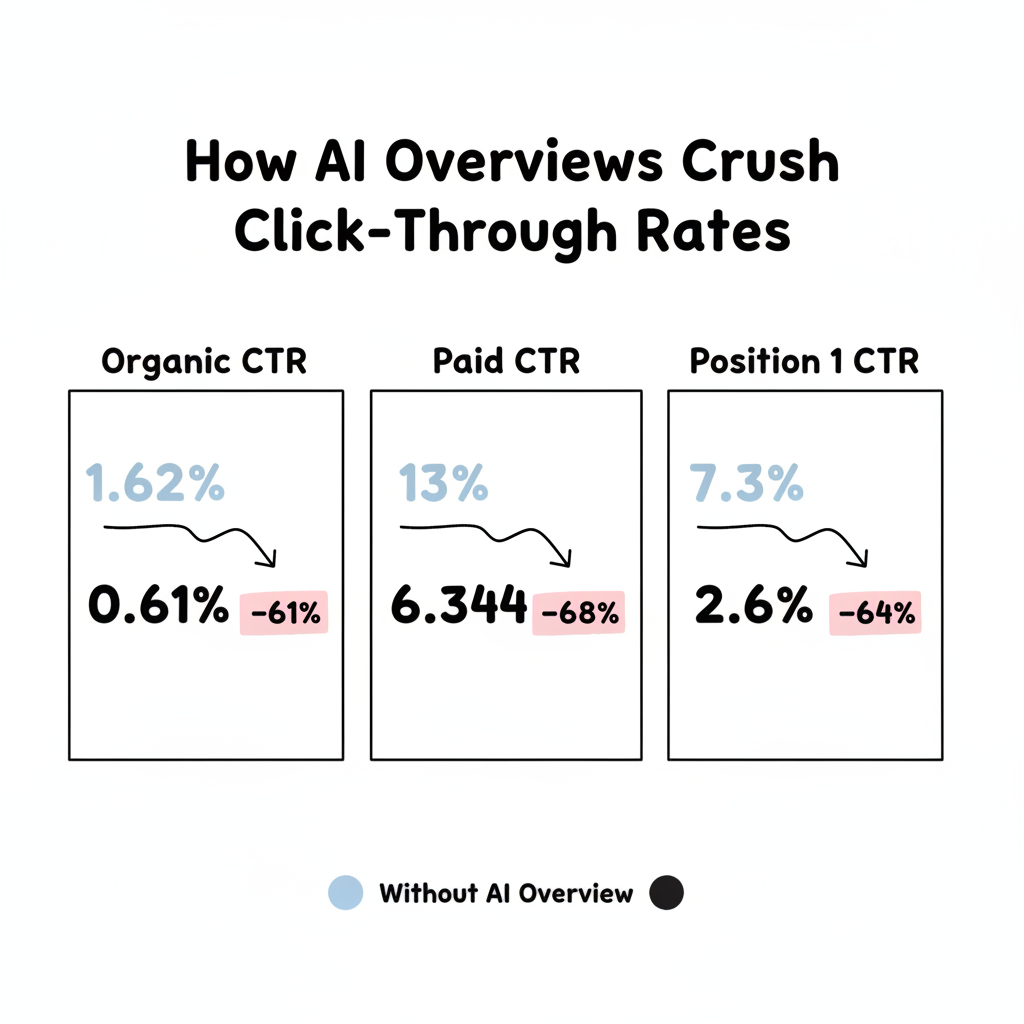
The numbers paint a stark picture:
Metric | Without AI Overview | With AI Overview | Decline |
Organic CTR | 1.62% | 0.61% | -61% |
Paid CTR | 13% | 6.34% | -68% |
Position 1 CTR | 7.3% | 2.6% | -64% |
These aren't marginal shifts -- AI Overviews reduce click-through rates by more than half across virtually all query types. The first organic result, which historically earned the lion's share of clicks, now captures barely a quarter of its previous traffic when an AI Overview appears.
Citation Doesn'T Fully Compensate
Even when your content gets cited in an AI Overview, the traffic impact remains significant:
- Cited sources experience 49% organic CTR decline (vs. 65% for non-cited)
- Only 1% of users click through to sources cited in AI Overviews
- The visibility gain doesn't translate to proportional traffic
Being cited is better than being ignored, but it's not the traffic recovery solution many hoped for.
Industries Most Affected by AI Overviews
Science and Technical Content
Science-related queries show the highest AI Overview saturation at approximately 26% of searches. The sector faces unique challenges:
Why science is vulnerable:
- Scientific information typically has consensus answers
- AI can synthesize research findings effectively
- Users often seek factual information without needing to visit sources
Science publishers, educational institutions, and research organizations face the greatest AI Overview disruption. Content that answers "what is" and "how does" questions gets summarized comprehensively, eliminating the need for click-throughs. Notably, HubSpot has reported 70-80% organic traffic declines in informational content categories -- a pattern that mirrors the challenges facing science publishers whose content is predominantly informational in nature.
Food and Drink
The food and drink industry experienced the fastest AI Overview growth -- a 7.25 percentage point increase since early 2025. Recipe sites and food bloggers built entire business models around organic search traffic that's now evaporating.
Impact factors:
- Recipe queries generate complete AI-synthesized answers
- Ingredient lists and cooking instructions display without clicks
- Visual-heavy content loses appeal when text summaries suffice
Food bloggers report traffic declines of 40-60% on recipe content. The industry's reliance on advertising revenue makes these losses particularly devastating.
Healthcare
Healthcare websites face approximately 16% AI Overview saturation. While E-E-A-T requirements provide some protection, the sector isn't immune:
Healthcare-specific dynamics:
- General health queries trigger comprehensive AI summaries
- Symptom and condition information appears directly in results
- Local healthcare providers retain some advantage for service queries
Healthcare content that answers informational queries faces significant impact. However, content requiring professional trust signals -- treatment recommendations, medical advice, provider evaluations -- retains more traffic as users seek authoritative sources. Research from the Pew Research Center indicates a growing share of users now trust AI-generated health answers over traditional search results, adding pressure on healthcare publishers to reinforce credibility signals.
YMYL Industries: Why Healthcare & Finance Behave Differently
YMYL stands for "Your Money or Your Life" -- Google's classification for queries involving health, finance, safety, or legal topics. Google applies stricter quality thresholds to YMYL queries, resulting in lower AI Overview trigger rates for sensitive medical and financial searches.
The Google March 2025 core update expanded AI Overview availability broadly but simultaneously tightened YMYL guardrails. This created a divergent pattern: most industries saw increased AI Overview saturation while Healthcare and Finance remained partially shielded. The update represents a deliberate calibration -- Google recognizing that AI-generated summaries for health diagnoses or financial advice carry higher liability than summaries for recipe ingredients or tech specs.
NavBoost, Google's user-interaction signal system, plays a role here as well. When user behavior indicates dissatisfaction with AI Overviews -- for example, users clicking through to authoritative medical sources rather than accepting AI summaries -- NavBoost deprioritizes AI Overviews for those query clusters. This creates a self-correcting mechanism that disproportionately protects YMYL content where users demand authoritative, verified information.
The actionable insight for YMYL publishers: double down on E-E-A-T signals including author credentials, citations, and peer review mentions. These are the exact signals that keep your content surfaced even as AI Overviews expand. Understanding the contrast between AI Overviews and traditional featured snippets helps clarify why YMYL content behaves differently in the new search landscape.
Computers and Electronics
Technology content experiences roughly 18% AI Overview coverage, with the sector showing continued growth. Technical documentation, how-to guides, and product comparisons all face substantial AI summarization.
Tech sector vulnerabilities:
- Technical specifications display directly in AI Overviews
- Troubleshooting steps get synthesized from multiple sources
- Product comparisons appear as AI-generated summaries
Technology publishers and software documentation sites report significant traffic declines, particularly for informational and tutorial content.
Industries with Lower AI Overview Impact
Real Estate
Real estate shows only 2.14% AI Overview saturation -- among the lowest of any sector. However, the industry experienced the fastest growth rate at 258% increase in early 2025.
Why real estate is protected:
- Transactions require human interaction
- Location-specific queries need local expertise
- High-value decisions drive users to authoritative sources
Real estate professionals should monitor AI Overview expansion but currently face less disruption than information-heavy sectors.
Shopping and Ecommerce
Shopping queries trigger AI Overviews in roughly 2.7% of searches, though the impact varies by query type:
Ecommerce impact patterns:
- Product research queries face increasing AI summarization
- Transactional queries retain click-through intent
- Comparison shopping content experiences moderate decline
- Product reviews get synthesized into AI summaries
Ecommerce sites with strong brand recognition maintain direct navigation traffic, while sites dependent on informational queries face greater pressure.
Local Services
Local businesses -- lawyers, plumbers, contractors -- experience relatively less AI Overview disruption for service queries:
Local service advantages:
- Users still need to contact, compare, and locate businesses
- Transactional intent drives clicks beyond information
- Google Business Profile presence maintains local visibility
However, informational content from local service providers faces the same challenges as other industries.
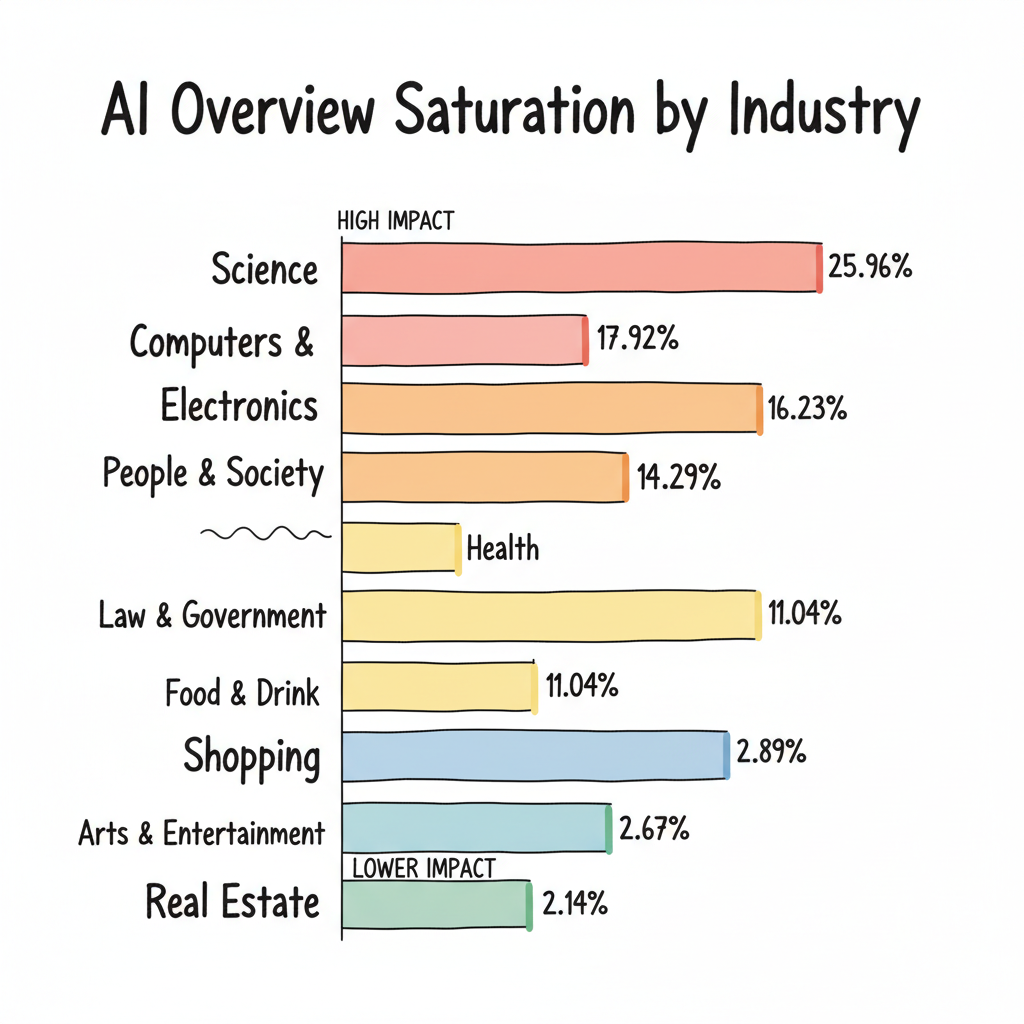
AI Overview Saturation by Industry
Research from the Semrush / Datos study analyzing 11,000 domains across 20+ industries, alongside Ahrefs' CTR research, reveals the current landscape:
Industry | AI Overview % | Trend |
Science | 25.96% | Stable |
Computers & Electronics | 17.92% | Growing |
People & Society | 17.29% | Declining |
Health | 16.23% | Declining |
Law & Government | 14.87% | Growing |
Food & Drink | 11.04% | Rapidly Growing |
Arts & Entertainment | 2.89% | Stable |
Shopping | 2.67% | Growing |
Real Estate | 2.14% | Growing |
Note: AI Overview trigger rates shifted after the Google March 2025 core update, with most industries seeing increased saturation while YMYL categories (Health, Finance) saw tightened guardrails. The data above reflects post-update trends.
The pattern reveals Google's strategic approach: high-trust, information-dense categories where users seek authoritative answers receive priority AI treatment.
Beyond Google: How ChatGPT, Perplexity & Gemini Fragment Search Traffic
Google AI Overviews are only one dimension of the AI-driven traffic disruption. A parallel shift is underway as users migrate to AI-native search platforms that bypass traditional search engines entirely.
Gartner projects that traditional search engine volume will drop 25% by 2026 as users adopt AI-first information retrieval. ChatGPT, with over 100 million weekly active users, now handles a significant share of informational queries -- particularly in Tech, Science, and Healthcare verticals where users seek detailed explanations rather than link lists. OpenAI's integration of web browsing and source citation has positioned ChatGPT as a direct competitor to Google for research-oriented searches.
Perplexity AI operates as a direct-answer engine that synthesizes information from multiple sources, often without driving any clicks to publishers. Its growth in B2B research verticals is notable: enterprise users increasingly prefer Perplexity's citation-backed summaries over traditional search for market research, competitive analysis, and technical documentation queries.
SparkToro's zero-click search data quantifies the broader trend: over 60% of Google searches now end without a click to any external website. AI search platforms accelerate this pattern beyond Google alone, creating a compounding effect. Industries with high informational intent -- Science, Healthcare, Technology -- face losses not just from Google AI Overviews but from users who never reach Google in the first place, opting instead for ChatGPT or Perplexity as their starting point.
The strategic implication is clear: measuring only Google AI Overview impact understates the total traffic disruption. Businesses need visibility into AI platform referral traffic alongside traditional organic metrics to understand the full picture.
AI Overview Impact on Paid Search: What Advertisers Need to Know
AI Overviews don't just affect organic results -- they fundamentally reshape the paid search landscape as well. Research from Adthena and Search Engine Land documents how AI Overviews push paid advertisements below the fold, reducing ad visibility and increasing cost-per-click by 12-18% in affected verticals.
The impact varies by industry. Healthcare and Finance queries, classified as YMYL, see fewer AI Overviews but face intensified CPC competition as advertisers bid more aggressively for limited above-the-fold inventory. Shopping and Local Services verticals encounter a different challenge: AI Overviews that embed product carousels and local business information directly cannibalize Shopping ads and Local Service Ads.
People Also Ask (PAA) boxes interact with AI Overviews in ways that compound the problem. AI Overviews frequently absorb PAA content, further reducing organic real estate on the page and pushing both organic and paid results lower. This forces brands toward paid placements as the primary mechanism for maintaining SERP visibility -- driving up auction competition and costs.
An emerging concern: Reddit threads now appear frequently in AI Overview citations, creating an uncontrolled brand mention environment. User-generated Reddit content about your brand can surface prominently in AI Overviews, and paid search alone cannot offset reputational impact from negative or inaccurate community discussions.
When traffic volume declines, the strategic response extends beyond bidding adjustments. Conversion Rate Optimization becomes essential -- optimizing the traffic you do receive for maximum value. Pair paid strategy recalibration with CRO audits to ensure declining traffic volumes don't translate proportionally into declining revenue.
Industry-Specific Response Strategies
For High-Impact Industries (Science, Food, Health)
- Shift metrics from traffic to visibility and share of voice
- Focus on content AI systems cite rather than content users click
- Develop direct traffic channels (email, social, community)
- Create content formats AI can't easily summarize (video, interactive)
- Implement Schema.org markup -- specifically FAQ, HowTo, and Article schema -- to increase the likelihood of rich results and AI citation inclusion
Understanding the difference between GEO and SEO becomes critical as traditional optimization tactics prove less effective in AI-mediated search environments. Additionally, following AEO schema markup best practices ensures your structured data signals align with how AI systems parse and cite content.
For Moderate-Impact Industries (Technology, B2B)
- Monitor AI Overview expansion into your query categories
- Optimize for featured snippet and AI citation inclusion
- Maintain technical documentation that requires detailed reading
- Build brand recognition that drives direct navigation
Many businesses considering their AI search platform selection framework need to evaluate which platforms best serve their industry's specific search patterns. Answer Engine Optimization (AEO) -- the discipline of optimizing content specifically for AI-driven answer engines -- complements traditional GEO and SEO efforts by focusing on how AI systems extract, attribute, and present your content as direct answers.
For Lower-Impact Industries (Local, Ecommerce)
- Prepare for eventual AI Overview expansion
- Strengthen Google Business Profile optimization
- Develop content strategies that emphasize transaction facilitation
- Focus on queries with inherent click-through intent
Measuring Industry Impact on Your Business
Generic industry statistics provide context, but your specific situation requires measurement:
Track these metrics:
- AI Overview appearance rate for your target queries
- CTR trends segmented by AI Overview presence
- Traffic changes to informational vs. transactional content
- Citation frequency in AI-generated summaries
Compare your data against industry benchmarks to understand whether you're performing above or below sector averages. Avoiding common AEO marketing mistakes requires continuous measurement and adaptation as AI Overview patterns evolve.
How to Track AI Overview Impact: Tools & Measurement Framework
Quantifying AI Overview impact requires a structured approach across multiple tools. Here is a practical framework for ongoing measurement.
Google Search Console provides the most direct visibility into AI Overview impact on your properties. Use the Search Appearance filter to isolate queries where AI Overviews appear, then track impressions versus clicks over time. This reveals CTR erosion per keyword cluster and identifies which content categories face the steepest declines. Set up weekly exports to track trends before and after major algorithm updates.
Google Analytics 4 complements GSC with page-level session data. Create custom explorations comparing organic landing page sessions before and after AI Overview rollout dates. Flag pages experiencing greater than 20% session decline as AIO-impacted and prioritize them for content optimization or format changes.
Third-party tools provide the competitive context GSC and GA4 cannot. Ahrefs' SERP Features filter identifies which of your target keywords trigger AI Overviews across competitors. Semrush's Sensor tool, powered by Datos data, monitors AI Overview volatility at scale -- useful for detecting sudden changes in AIO saturation across your industry vertical. Similarweb offers competitive traffic benchmarking to quantify how your traffic losses compare to industry peers. For enterprise-level analysis, Botify's log file analysis detects crawl behavior changes correlated with AIO expansion -- a leading indicator of future ranking shifts.
Establish a monthly measurement cadence: track keyword-level CTR in Google Search Console, page-level sessions in Google Analytics, and competitive share-of-voice in Ahrefs or Semrush. Layer in structured data for AI search monitoring and AI overview impact analysis tools to build a comprehensive measurement stack.
The statistics referenced throughout this article -- including the CTR decline data and industry saturation figures -- originate from the Semrush / Datos 11,000-domain study and Ahrefs' CTR research. Readers can replicate and extend this analysis using the tools and methodology described above.
Frequently Asked Questions About AI Overview Traffic Impact
How Much Has AI Overview Reduced Organic CTR Across Industries?
Studies from Ahrefs and Semrush show organic CTR declines of 8-30% for queries where AI Overviews appear, depending on industry. Science and informational queries see the steepest drops (25-30%), while local service and navigational queries experience smaller declines (8-12%). The impact compounds when factoring in traffic lost to alternative AI search platforms like ChatGPT and Perplexity.
What Is YMYL and Why Does It Affect AI Overview Behavior?
YMYL stands for "Your Money or Your Life" -- Google's classification for queries involving health, finance, safety, or legal topics. Google applies stricter quality thresholds to YMYL queries, which means AI Overviews appear less frequently for sensitive medical or financial searches. This partially shields Healthcare and Finance publishers from the traffic declines other industries experience.
How Do I Track AI Overview Impact on My Website Traffic?
Use Google Search Console's Search Appearance filter to identify queries triggering AI Overviews, then compare click-through rates over time. In Google Analytics 4, create custom explorations to track organic session changes on affected landing pages. Third-party tools like Semrush Sensor and Ahrefs SERP Features provide broader competitive monitoring of AI Overview volatility.
Does AI Overview Affect Paid Search Performance?
Yes. AI Overviews push paid ads further down the page, reducing ad visibility and increasing cost-per-click by 12-18% in affected verticals according to Adthena research. Shopping and Local Services verticals see additional cannibalization from AI Overview product carousels. Advertisers should pair paid strategy adjustments with Conversion Rate Optimization to maximize value from reduced traffic volume.
The Evolving Industry Landscape
AI Overview impact continues evolving. Industries currently experiencing low saturation may face rapid expansion, as real estate's 258% growth demonstrates. Industries with high saturation may see stabilization as AI Overview effectiveness reaches natural limits. The Google March 2025 core update represents the most recent major inflection point, expanding AI Overview availability while recalibrating YMYL guardrails -- a pattern likely to repeat with future updates.
The consistent finding across all research: relying solely on traditional organic search traffic creates business risk regardless of industry. Diversification -- across traffic sources, content formats, and business models -- provides the resilience that industry-specific optimization alone cannot deliver.
Understanding your industry's AI Overview exposure helps prioritize response strategies. But the underlying trend -- AI-mediated search reducing website traffic -- affects every sector eventually. Those exploring GEO optimization tactics can adapt proven strategies to their industry's specific challenges. The question isn't whether AI Overviews will impact your industry, but how quickly and severely. Audit your AI Overview exposure today using the tools and measurement framework outlined above to stay ahead of the curve.