
Google's search results have evolved dramatically. Featured snippets—those highlighted answer boxes that dominated position zero for years—now share the SERP with AI Overviews, Google's generative AI summaries. Understanding the differences between these two features is essential for SEO strategy in 2026.
This guide explains how each feature works, why they matter differently for traffic and visibility, and how to optimize for both.
What Are Featured Snippets?
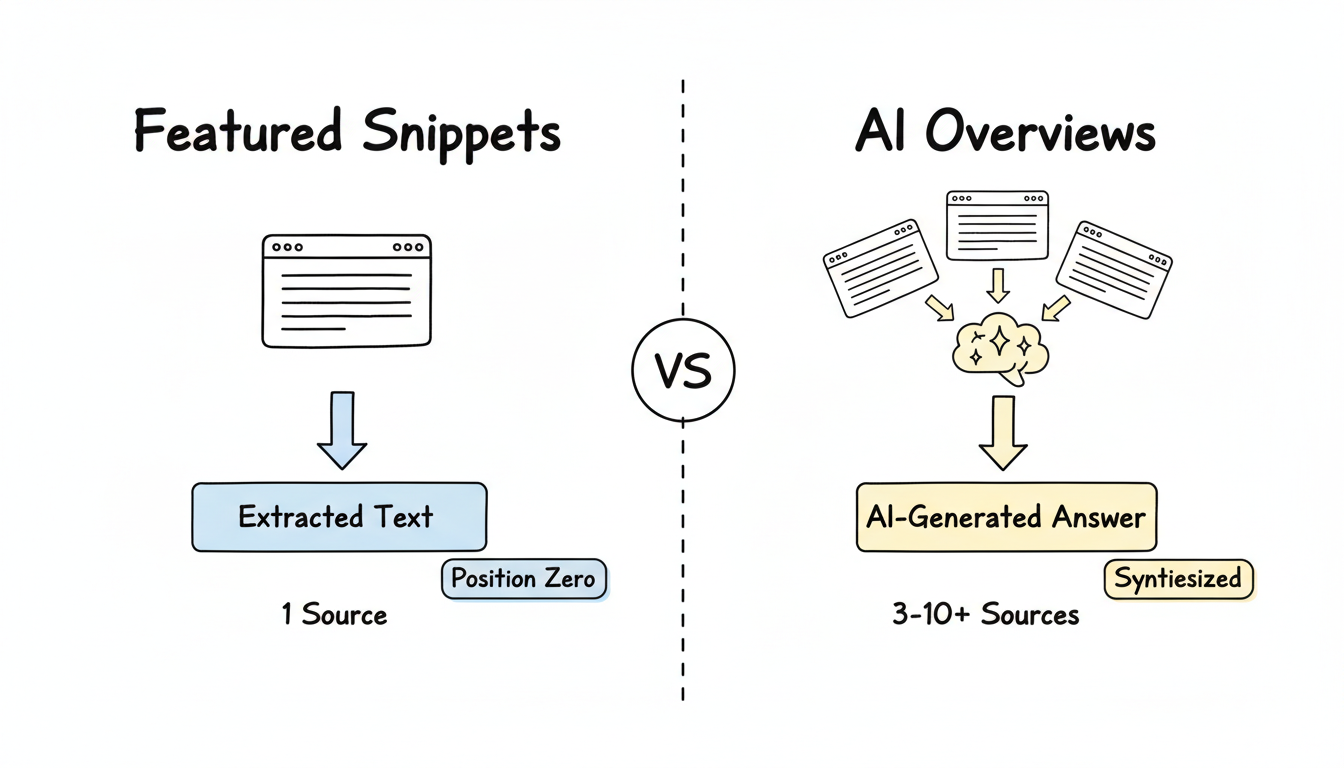
Featured snippets extract content directly from a single webpage to answer search queries. According to Search Engine Land's featured snippet guide, featured snippets pull content directly from a single source—you see a block of text or a list, and it's attributed to one specific page. If your content gets featured, you own that snippet.
Featured snippet characteristics:
- Extracted from one source webpage
- Displays exact content from the page
- Includes direct link to the source
- Formats: paragraph snippets, list snippets (ordered and unordered), table snippets, and video snippets
- Appears above organic results (position zero)
Common featured snippet formats:
Format | Best For | Example Queries |
Paragraph | Definitions, explanations | "What is..." queries |
List | Steps, rankings, collections | "How to..." queries |
Table | Comparisons, data, specifications | "Best..." or comparison queries |
What Are AI Overviews?
AI Overviews (formerly Search Generative Experience) use generative AI to synthesize information from multiple sources into original summaries. Unlike featured snippets, they don't excerpt existing content—they create new text based on information gathered across the web.
According to Semrush's AI Overviews study, AI Overviews consolidate knowledge from multiple sources to present a unified answer, turning Google into both a search engine and an answer engine. This shift has fundamentally changed how Google selects AI Overview sources and determines which content appears in these generative summaries.
AI Overview characteristics:
- AI-generated original text
- Synthesizes information from 3-10+ sources
- Provides multiple citation links
- Longer and more comprehensive than snippets
- Handles complex, multi-faceted queries
How Google'S Gemini Powers AI Overviews
AI Overviews are generated by Google's Gemini large language model, which synthesizes information from multiple web sources into a single answer block displayed at the top of the search results page. Unlike featured snippets that extract text from one page, Gemini actively reads, evaluates, and combines information from across the web to produce an original summary.
Gemini evaluates source quality using E-E-A-T signals—Experience, Expertise, Authoritativeness, and Trustworthiness. Pages that demonstrate first-hand experience and deep expertise are more likely to be cited in AI Overviews. This means content from recognized subject matter experts, backed by original research or real-world application, has a significant advantage in the source selection process. For a deeper look at these selection criteria, see our analysis of how Google selects sources for AI Overviews.
This contrasts with featured snippets, which pull from a single source based on direct query-answer matching. While E-E-A-T matters for both features, AI Overviews weigh it more heavily because Gemini cross-references multiple signals across sources to determine which information is most reliable and comprehensive.
The rise of both features has contributed to a growing trend: approximately 60% of Google searches now end without a click—a phenomenon known as zero-click searches. Both AI Overviews and featured snippets contribute to this trend, but in different ways. Featured snippets sometimes satisfy the query outright with a direct excerpt, while AI Overviews synthesize comprehensive answers that may reduce click-through even further by eliminating the need to visit any source page.
Understanding Gemini's selection criteria is the foundation of any AI Overview SEO strategy. Content that is well-structured, authoritative, and demonstrates genuine expertise stands the best chance of being cited.
Key Differences: Side-By-Side Comparison
Understanding the distinctions helps inform optimization strategy.
Factor | Featured Snippets | AI Overviews |
Content Source | Single webpage | Multiple webpages |
Content Type | Extracted text | AI-generated synthesis |
Attribution | One prominent link | Multiple citation links |
Query Complexity | Simple, direct questions | Complex, multi-part queries |
User Behavior | Often clicks for context | May satisfy query without clicks |
Appearance Frequency | Declining | Expanding (27-32% of queries) |
Source Attribution Differences
According to Maria Espie Vidal's analysis, with featured snippets, users still rely on the cited page to complete their research—the snippet acts like a preview with the website remaining the destination. AI Overviews shift that dynamic: the answer becomes a blended response with several links that carry less individual weight.
Featured snippet attribution:
- Single source prominently displayed
- Clear path to click through
- Source "owns" the answer
AI Overview attribution:
- Multiple sources cited
- Links appear as supporting references
- No single source dominates
Content Generation Differences
Featured snippets reproduce your exact words. AI Overviews paraphrase and combine information.
According to ALMCORP's AI Overviews analysis, featured snippets extract 1-3 sentences from a single webpage, always linking back to the source. AI Overviews synthesize information from multiple sources—typically 3-10+ websites—to create an original AI-generated response.
The Broader AI Search Landscape: Beyond Google
Google is not the only player in AI-powered search. ChatGPT Search, Perplexity, and Microsoft Copilot now provide AI-generated answers that compete directly with Google's AI Overviews and featured snippets. Each platform has its own approach to sourcing and synthesizing information, but the underlying principle is the same: well-structured, authoritative content gets cited more often.
Optimizing for featured snippets and AI Overviews is part of a broader content marketing strategy for AI visibility. If your content is well-structured enough for Google to feature, it is also more likely to be cited by ChatGPT and Perplexity. The same qualities that win SERP features—clear answers, strong E-E-A-T signals, and comprehensive coverage—make content attractive to all AI search systems. For a detailed comparison of optimization approaches across platforms, see our guide on GEO vs AEO optimization strategies.
People Also Ask (PAA) boxes are another SERP feature that interacts with both snippets and AI Overviews. PAA questions often become sources for AI Overview content, so targeting PAA queries is a dual-benefit tactic: you improve your chances of appearing in both traditional SERP features and AI-generated summaries. Monitoring which PAA questions appear for your target keywords can reveal optimization opportunities that serve both goals.
This is why the optimization advice in this guide matters beyond just Google—it is an AI search readiness strategy that positions your content for visibility across the entire evolving search ecosystem.
Are They Replacing Each Other?
The data suggests AI Overviews are gradually replacing featured snippets for many query types.
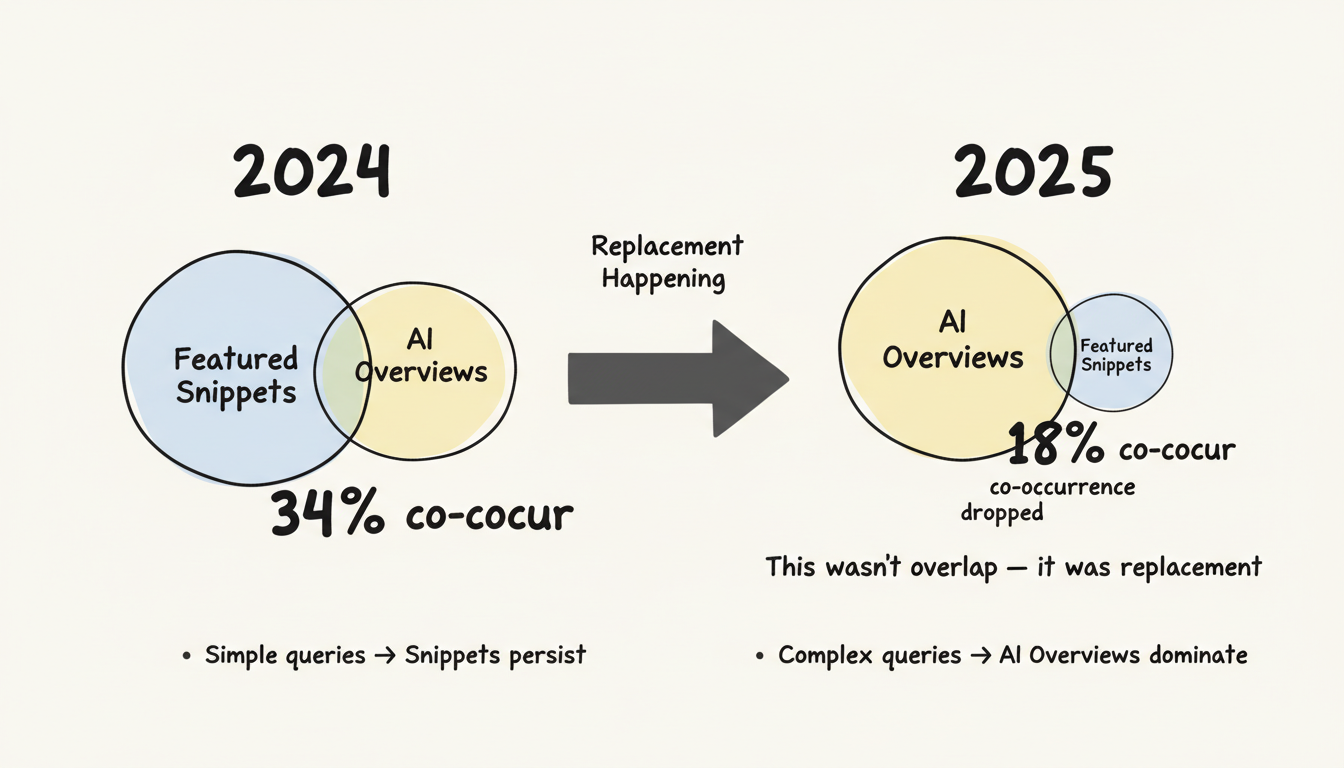
According to Medium's analysis of Google's search evolution, by late 2025, Google largely stopped showing featured snippets and AI Overviews together—co-occurrence dropped from 34% to just 18%. The analysis notes: "This wasn't overlap—it was replacement."
Replacement trends:
- Simple informational queries: Featured snippets persisting
- Complex queries: AI Overviews dominating
- Multi-source answers: AI Overviews preferred
- Definition queries: Both still compete
According to Marketermilk's 2026 SEO trends analysis, we now have AI Overviews instead of featured snippets for many query types, representing one of the major SEO developments of recent years.
SEO Implications: Traffic and Clicks
Each feature affects traffic differently, and understanding AI Overview CTR data has become critical for forecasting organic traffic impact.
Featured Snippet Traffic Impact
Featured snippets historically captured significant clicks. According to Search Engine Land, in 2022, featured snippets captured 35.1% of all clicks for queries where they appeared—demonstrating the power of position zero placement.
Featured snippet click behavior:
- Users click for expanded context
- High CTR for complex topics
- Lower CTR for simple questions answered in snippet
AI Overview Traffic Impact
AI Overviews reduce clicks more significantly because they provide comprehensive answers.
According to NoGood's future of search analysis, 60% of searches now end without a click—between AI Overviews dominating Google's SERPs, featured snippets answering questions immediately, and LLM responses providing comprehensive answers.
AI Overview click behavior:
- Users often satisfied without clicking
- Citations receive distributed (not concentrated) clicks
- Branded queries maintain better CTR
Technical SEO Prerequisites for SERP Feature Visibility
Before optimizing content, the technical foundation must be solid. Without these prerequisites in place, even the best content may not be selected for featured snippets or cited by AI Overviews.
Core Web Vitals and Page Speed: Google has confirmed Core Web Vitals as a ranking signal. Pages that fail LCP, CLS, or INP thresholds are less likely to be selected for featured snippets or cited by AI Overviews. Use Google Search Console's Core Web Vitals report to identify and resolve performance issues before focusing on content optimization.
Crawlability and Indexing: Ensure your pages are crawlable and properly indexed. Accidental noindex tags, misconfigured robots.txt rules, or canonicalization errors can prevent pages from being considered for any SERP feature. Use Google Search Console's URL Inspection tool to verify that your target pages are indexed and eligible for enhanced search results.
Internal Linking Architecture: Strong internal linking helps Google understand topical relationships and distributes authority to key pages. Use internal linking to connect related content and build topical clusters. Link related posts together—such as your AI Overview sources analysis and your CTR data post—to signal depth of coverage and expertise to Google's algorithms.
A strategic link building campaign to earn quality backlinks from authoritative sites also remains critical. Top-ranking competitors for AI Overview and featured snippet queries average 130-168 referring domains. A technical SEO audit combined with strategic link building creates the conditions for SERP feature selection.
Optimization Strategy: How to Win Both
The good news: optimization strategies overlap significantly, and many generative AI SEO software tools now help optimize for both features simultaneously.
Featured Snippet Optimization
According to ClickRank's featured snippet guide, featured snippets are the "seed data" for AI Overviews—if you win the featured snippet, you have a 75% higher chance of being the primary citation in the AI-generated summary.
Featured snippet tactics:
- Answer questions directly in first paragraph
- Use clear formatting (lists, tables, headers)
- Target question-based queries
- Keep answers concise (40-60 words for definitions)
- Match existing snippet formats
- Demonstrate E-E-A-T (Experience, Expertise, Authoritativeness, Trustworthiness) by including author credentials, citing primary sources, and showing first-hand experience with the topic
AI Overview Optimization
According to Revv Growth's AI Overview ranking guide, the key to AI Overview inclusion is creating content that answers questions directly, is easy to read and scan, and demonstrates expertise—qualities AI systems prioritize.
AI Overview tactics:
- Structure content for extractability
- Cover topics comprehensively
- Build authoritative backlinks and mentions
- Use schema markup for entity clarity
- Create content that synthesizes multiple aspects
- Demonstrate E-E-A-T (Experience, Expertise, Authoritativeness, Trustworthiness) by including author credentials, citing primary sources, and showing first-hand experience with the topic
Unified Approach
According to SEO.com's AI search optimization guide, the featured snippet approach works for both: provide direct, succinct answers without fluff, as both AI engines and users want fast, clear answers rather than digging through paragraphs. Understanding the broader context of GEO vs AEO can help inform your unified optimization strategy.
Combined strategy checklist:
- Answer primary question within first 100 words
- Use clear headers and formatting
- Include structured data markup
- Build topical authority through comprehensive coverage
- Earn authoritative backlinks through strategic link building
- Target question-based queries
- Use internal linking to connect related content and build topical clusters—link to and from related posts on your site to signal depth of coverage to Google
How to Track AI Overview and Featured Snippet Performance
Optimization without measurement is guesswork. Tracking your SERP feature performance is essential for understanding what is working and where to focus next.
Google Search Console: Use the Search Appearance filter to see which queries trigger featured snippets for your site. Monitor impressions and CTR changes when you gain or lose a snippet. While Google Search Console does not yet have a dedicated AI Overview filter, monitoring position changes and CTR drops can indicate AI Overview impact on your traffic. For detailed benchmarks, review our AI Overview click-through rate data analysis.
Semrush and Ahrefs: Track SERP feature ownership across your keyword portfolio. Semrush (referenced earlier in this guide) has a "SERP Features" filter in Position Tracking that shows which snippets you hold. Ahrefs shows which snippet format types—paragraph, list, table, or video—your pages currently own, helping you identify format gaps and opportunities.
Manual SERP Checks: For high-value queries, periodically search and document whether your content appears in AI Overviews, featured snippets, or People Also Ask boxes. This hands-on approach catches changes that automated tools may miss or report with a delay.
Set up a monthly review cadence: check which snippets you hold, which you have lost, and whether AI Overviews have displaced any of your featured snippets. The co-occurrence data in this post (34% dropped to 18%) suggests this displacement is ongoing, making regular monitoring essential for adjusting your strategy.
Which Should You Prioritize?
The answer depends on your query targets and goals.
Prioritize featured snippets when:
- Targeting simple definition queries
- Seeking position zero visibility
- Queries still showing snippet (not AI Overview)
- Building foundation for AI Overview inclusion
Prioritize AI Overview optimization when:
- Targeting complex, multi-faceted queries
- Building comprehensive topical coverage
- Establishing entity authority
- Optimizing for emerging AI search platforms
Realistically: Optimize for both. Featured snippet wins often translate to AI Overview citations. The underlying principles—clarity, authority, structure, directness—serve both goals.
Frequently Asked Questions
What Is the Difference Between a Featured Snippet and an AI Overview?
A featured snippet pulls a direct answer from a single web page and displays it at the top of Google's search results (position zero). An AI Overview, powered by Google's Gemini model, synthesizes information from multiple sources into a generated summary. Featured snippets link to one source; AI Overviews may cite several. Both aim to answer queries directly on the SERP, contributing to the rise of zero-click searches.
Has Google'S AI Overview Replaced Featured Snippets?
No. Featured snippets and AI Overviews coexist, though their co-occurrence has dropped from 34% to 18% of SERPs. Google shows AI Overviews primarily for complex, multi-faceted queries, while featured snippets still appear for straightforward factual questions. Optimizing for both remains a sound SEO strategy because the selection criteria overlap significantly—strong E-E-A-T signals and clear, well-structured content benefit both features.
What Is the Difference Between AI Overviews and Rich Snippets?
Rich snippets are enhanced search results that display extra information (star ratings, prices, recipe times) using structured data markup. They do not provide a direct answer. AI Overviews are AI-generated answer summaries powered by Gemini that synthesize content from multiple pages. Featured snippets (position zero answers) are closer in function to AI Overviews, while rich snippets are a distinct structured data enhancement.
What Is the Difference Between Google AI Mode and AI Overview?
Google AI Mode is a dedicated conversational search interface (similar to ChatGPT) where users can ask follow-up questions in a chat-like experience. AI Overviews appear automatically within standard Google search results as a summary block. AI Mode requires the user to opt in, while AI Overviews are shown proactively by Google. Both are powered by Gemini, but they serve different user interaction patterns.
Key Takeaways
Understanding AI Overviews vs featured snippets shapes modern SEO strategy:
- Different mechanisms, similar goals - Featured snippets extract from one source; AI Overviews synthesize from many—but both aim to answer queries directly in SERPs
- Replacement is happening - AI Overviews increasingly replace featured snippets, especially for complex queries—co-occurrence has dropped significantly
- Traffic implications differ - Featured snippets drive concentrated clicks to one source; AI Overviews distribute citations with lower overall click rates
- Optimization overlaps - Clear, structured, authoritative content wins both features—featured snippet success correlates with AI Overview inclusion
- Featured snippets remain valuable - Even as AI Overviews expand, winning featured snippets increases your odds of AI Overview citation by 75%
When you start earning AI Overview citations, the next question is whether competitors are winning them instead of you. Our guide on AEO tracking tools covers how to measure your brand's share of voice across ChatGPT, Perplexity, and Google's AI answers.
The strategic response isn't choosing between them—it's building content that serves both while preparing for an increasingly AI-mediated search landscape.