
Google's AI Overviews have introduced distinctive visual elements that signal AI-generated content to users. Understanding this visual language helps marketers recognize how Google frames AI responses—and how users perceive them in search results.
This guide examines the branding elements, iconography, and design choices that define Google's AI Overview presentation. But AI Overviews branding has two dimensions: Google's own visual identity—the sparkle icon, Gemini styling, and SERP positioning—and the strategies brands use to achieve visibility within AI-generated answers. This guide covers both.
The Sparkle Icon: AI'S Universal Symbol
The four-pointed sparkle has become the defining visual marker for AI features across Google products and the broader tech industry.
According to NPR's analysis of AI iconography, Google initiated the sparkle icon trend in the mid-2010s, and it has since become ubiquitous across AI products. The sparkle now appears as part of Google's Gemini logo and throughout their AI feature suite.
Where the sparkle appears:
- AI Overviews in search results
- Gemini AI branding and logo
- Google Workspace AI features
- Gmail and Docs AI assistants
- Chrome's AI-powered features
Why Google Chose the Sparkle
The sparkle icon carries specific symbolic meaning. According to design analysis from UX Collective, the four-pointed star represents "emergence" and "magic"—conveying that AI creates something from nothing, seemingly by magical means.
Symbolic associations:
- Magic and wonder
- Creation and emergence
- Newness and innovation
- Intelligence and insight
This framing positions AI as mysterious and powerful rather than algorithmic and mechanical.
User Recognition Challenges
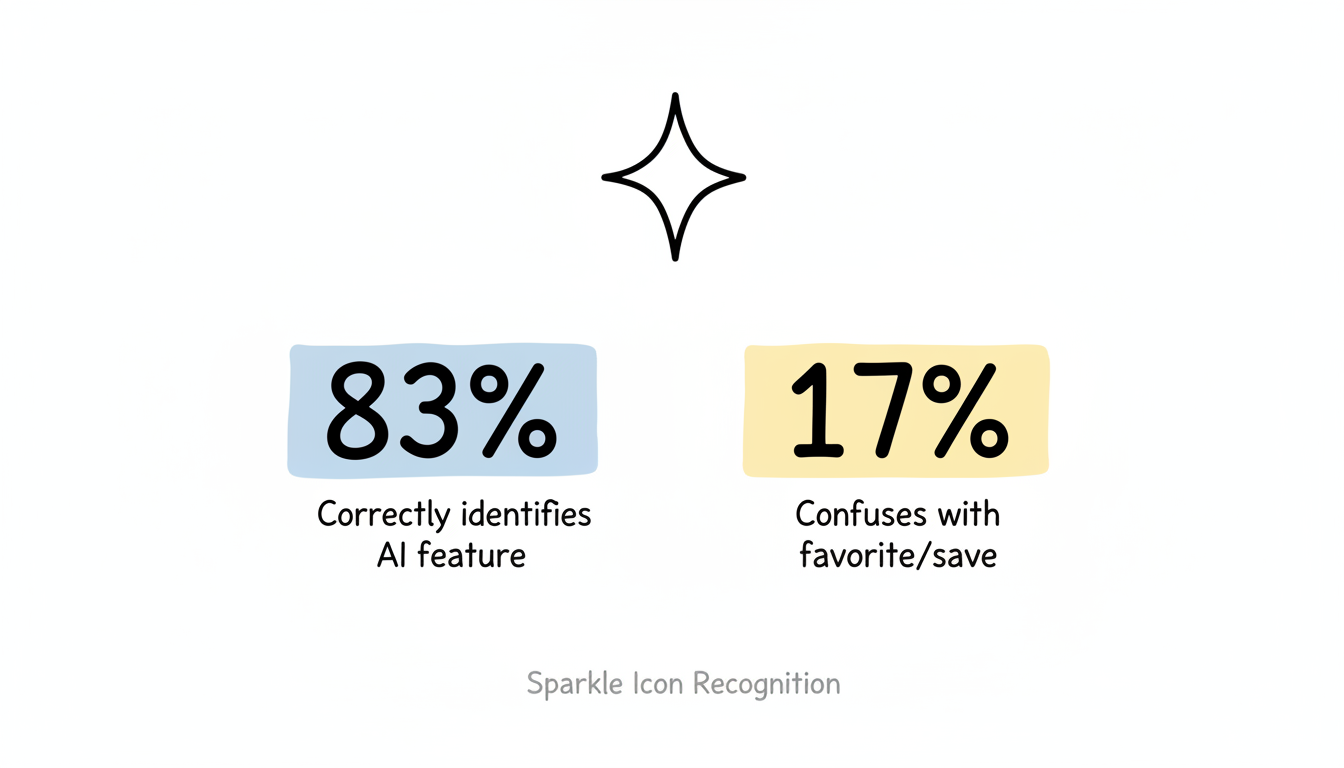
Despite widespread adoption, the sparkle icon faces recognition issues. According to research on AI iconography, approximately 17% of users still confuse the sparkle with favoriting or saving functionality because it resembles a star icon.
Icon Interpretation | User Percentage |
Correctly identifies AI feature | 83% |
Confuses with favorite/save | 17% |
This recognition gap highlights the challenge of establishing new visual conventions in digital interfaces.
AI Overviews Visual Presentation
Google has made specific design choices for how AI Overviews appear in search results, distinguishing them from traditional organic listings and featured snippets. AI Overviews represent an evolution from featured snippets—and as thought leaders like Kevin Indig have documented, many featured snippet optimization strategies partially transfer to AI Overview visibility, though the ranking signals differ substantially.
SERP Positioning: The "Penthouse" Location
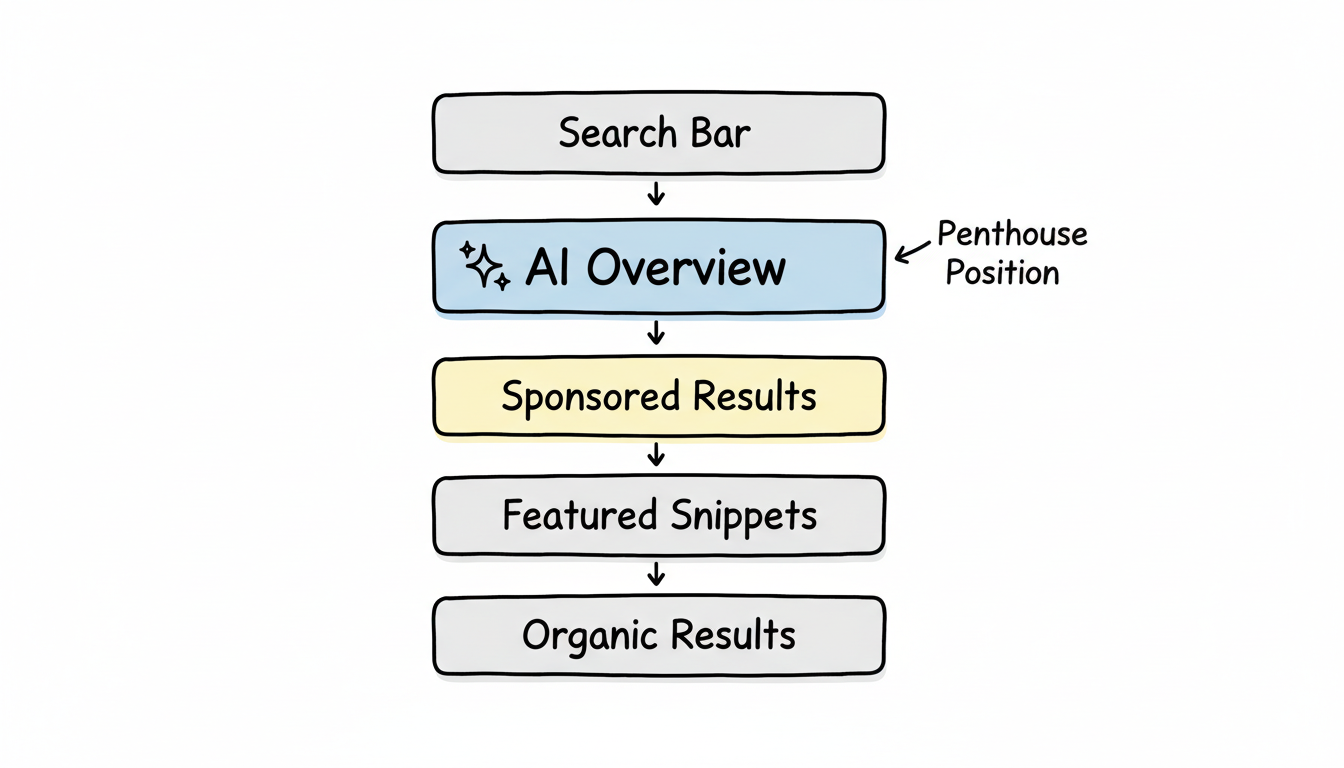
AI Overviews occupy what designers call the "penthouse" position—the premium real estate at the top of search results.
According to Google's own documentation on AI Overviews, AI Overviews appear above traditional organic results, pushing conventional blue links further down the page. This positioning reflects Google's prioritization of AI-synthesized answers and represents a fundamental shift in how answer engines work.
Visual hierarchy:
- Search bar and controls
- AI Overview (penthouse position)
- Sponsored results (when present)
- Featured snippets (if not replaced by AI Overview)
- Organic results
Static "Snapshot" Aesthetic
Unlike ChatGPT's streaming text or animated responses, Google AI Overviews use a distinctly static presentation.
According to analysis of Google's AI design language, AI Overviews render as complete, static "snapshots" of information rather than streaming tokens. This creates a more authoritative, document-like feel compared to the conversational streaming of other AI interfaces.
Design characteristics:
- Complete text blocks (not streaming)
- Clean card-based layout
- Collapsible sections for longer responses
- Integrated source citations
- Consistent typography with Google Search
Source Citation Design
AI Overview citations appear as compact reference links integrated into the response, typically showing domain names with small favicons.
Citation design elements:
- Small site favicon
- Domain name display
- Grouped at relevant paragraphs
- Expandable to show more sources
- Visual distinction from main text
Importantly, being cited as a source in AI Overviews depends on the brand visibility factors covered later in this guide—particularly web mentions and topical authority—which determine whether AI systems surface your content in the first place.
Gemini Branding Elements
Google's Gemini AI brand, which powers AI Overviews, has its own distinct visual identity that influences how AI features appear across Google products.
The Gemini Logo
The Gemini logo combines typography with sparkle elements, incorporating gradient colors that suggest sophistication and intelligence.
Logo characteristics:
- Gradient color scheme (blues, purples, pinks)
- Sparkle element integration
- Clean, modern sans-serif typography
- Responsive design that scales across contexts
Color Language
According to Google's design documentation, Gemini uses a distinctive color palette that signals AI functionality:
- Gradient purples and blues: Primary brand colors
- Subtle pastels: Background treatments
- Accent colors: Interactive elements and highlights
These colors create visual separation between AI-generated content and traditional search results.
Visual Trust Signals
Google's AI Overview design incorporates specific elements intended to build user trust in AI-generated content.
Transparency Indicators
Elements that signal AI generation:
- Sparkle icon marking AI content
- "AI Overview" label (when visible)
- Source citations throughout
- "Show more" expandable sections
- Feedback mechanisms (thumbs up/down)
Authority Design
The static, comprehensive presentation style suggests authority and completeness. Unlike conversational AI that feels tentative, AI Overviews present information with document-like finality.
According to UX analysis of AI interfaces, Google's design choices represent "trust us" signaling rather than outcome-based design that proves value through results. The sparkle essentially asks users to trust that AI is helping them.
Mobile vs Desktop Presentation
AI Overview visual presentation adapts across devices while maintaining consistent branding.
Mobile Design
- Full-width card layouts
- Larger tap targets for citations
- Collapsible by default (saves screen space)
- Prominent sparkle indicator
Desktop Design
- Wider layout with sidebar potential
- More visible source citations
- Expanded by default
- Integrated with Knowledge Panel positioning
Implications for Marketers
Understanding Google's AI visual language helps marketers in several ways.
Brand Visibility in AI Results
When your content gets cited in AI Overviews, your brand appears through:
- Domain name in citation links
- Favicon display
- Potential for multiple citations
Unlike featured snippets where a single source dominates, AI Overview citations share visual space with multiple sources. Understanding these SearchGPT ranking factors helps optimize for visibility.
Visual branding and citation design also intersect with the broader brand visibility strategy: when your site earns a citation in AI Overviews, your favicon appears alongside the response, reinforcing brand recognition at the exact moment users consume AI-generated answers. This makes the visual trust signals covered above directly relevant to the brand visibility optimization strategies explored in the sections below.
User Behavior Patterns
The penthouse positioning and static design influence how users interact with AI Overviews:
- High visibility but competing citations
- Users may not scroll to traditional results
- Source links receive distributed attention
- Brand recognition happens at favicon/domain level
Design Alignment
Content that matches Google's visual preferences for AI extraction:
- Clean, scannable formatting
- Clear section breaks
- Data presented in structured formats
- Mobile-friendly layouts
Many marketers now leverage free AI content optimization tools to ensure their content aligns with these presentation requirements.
Beyond Visual Branding: How Brands Appear in AI Overviews
While the visual branding of AI Overviews matters—as covered in the sections above—the bigger question for marketers is how to get their own brand mentioned inside AI Overviews. The answer lies in understanding how Large Language Models (LLMs) power these responses.
LLMs rely on text-based signals, not logos or visual assets, to determine which brands to surface. This means brand visibility in AI search is fundamentally different from traditional SERP visibility, where backlinks and on-page optimization dominate.
The most comprehensive data on AI brand visibility comes from Ahrefs' study of 75,000 brands, which identified the strongest correlation factors for AI Overview inclusion:
- Brand web mentions across the internet: 0.664 correlation
- Branded anchors from authoritative sites: 0.527 correlation
- Branded search volume (people searching your brand name): 0.392 correlation
These numbers reveal that brand presence across the web—not just on your own site—drives AI visibility. The urgency is real: zero-click search behavior continues to accelerate, with studies showing 15-25% organic traffic declines for queries where AI Overviews appear. Brands that fail to adapt risk losing visibility in the Google AI Overview SEO impact era.
GEO and AEO: The New Optimization Frameworks
Generative Engine Optimization (GEO) is the discipline of optimizing content specifically for AI-generated search results like Google AI Overviews, ChatGPT, and Perplexity. Unlike traditional SEO that focuses on rankings and click-through rates, GEO emphasizes creating content that AI systems can extract, synthesize, and cite accurately.
Key GEO tactics include:
- Structuring content with clear claims and supporting evidence that LLMs can extract
- Using statistics and citations that AI systems can verify and attribute
- Building topical authority across content clusters so AI associates your brand with specific expertise
- Maintaining consistent brand messaging across all web properties
The related discipline of Ask Engine Optimization (AEO) targets conversational query formats—optimizing for how users phrase questions to AI tools like ChatGPT, Google AI Mode, and Perplexity. While GEO focuses on content structure, AEO focuses on matching natural language query patterns. For deeper tactical guidance, explore advanced GEO optimization strategies.
The differences between traditional SEO and these new frameworks are significant:
Factor | Traditional SEO | GEO/AEO |
Primary signal | Backlinks + on-page | Web mentions + entity associations |
Content format | Keyword-optimized pages | Structured claims with cited evidence |
Success metric | Rankings + CTR | Brand mentions in AI responses |
Key strategy | Link building | Digital PR + topical authority |
Digital PR and Brand Messaging for AI Visibility
Digital PR is the primary lever for earning brand web mentions—the factor with the strongest correlation (0.664) for AI Overview inclusion. Unlike traditional link building, which focuses on acquiring backlinks, digital PR aims to generate widespread brand mentions across news outlets, industry publications, podcasts, and social platforms.
The PESO model (Paid, Earned, Shared, Owned media) provides a useful framework for understanding where AI Overviews pull brand information from. A Northwestern/Medill study that analyzed over 1,000 AI Overview sources found that AI systems draw from a diverse media mix, with earned media mentions carrying particular weight for brand authority signals.
Effective brand messaging strategy for AI visibility requires maintaining a consistent brand narrative across all web properties. When LLMs encounter the same brand associated with the same topics and expertise across multiple sources, they build stronger entity associations. This is where entity-based SEO with structured data for AI search becomes a technical enabler—Schema.org markup helps AI systems connect brand names to Knowledge Graph entities, reinforcing those associations programmatically. For brands looking to strengthen their Knowledge Graph presence, understanding how to get a Google Knowledge Panel is a foundational step.
It is worth noting that Domain Rating (DR) has a lower but still meaningful correlation (0.326) with AI Overview inclusion, meaning traditional site authority helps but is less important than brand mentions and entity signals.
Tracking Brand Visibility in AI Search
Monitoring AI brand visibility requires specialized tools beyond traditional rank trackers. Ahrefs Brand Radar tracks how often brands appear in AI Overviews across keyword sets, providing the closest equivalent to traditional rank tracking for AI search. Semrush tracks AI search traffic trends and has published forecasts predicting that AI search visitors will surpass traditional search referrals by 2028.
Dedicated AI citation tracking tools monitor brand mentions across ChatGPT, Perplexity, and Google AI Mode responses in real time. Additionally, Performance Max (PMax) campaigns now integrate with AI-generated responses, offering a paid pathway to brand visibility within AI Overviews for advertisers. For a broader comparison of monitoring platforms, see the best generative engine optimization tools available today.
The Evolving AI Visual Language
Google's AI branding continues to evolve as the technology matures and user expectations develop.
Emerging trends:
- More prominent AI labeling (regulatory pressure)
- Enhanced source attribution
- User controls for AI visibility
- Personalization indicators
According to analysis of AI interface design trends, the sparkle icon's dominance may eventually give way to more explicit, text-based AI indicators as users demand clearer communication about when they're viewing AI-generated content. Companies exploring AI-powered search features face similar transparency challenges.
Frequently Asked Questions
How Do You Get Your Company to Show Up in AI Overviews?
The strongest factor is brand web mentions across the web, with a 0.664 correlation to AI Overview inclusion according to Ahrefs' study of 75,000 brands. Build mentions through digital PR campaigns, earn branded anchors from authoritative sites, and grow branded search volume. Implement entity-based SEO with Schema.org markup so AI systems can connect your brand to relevant topics and Knowledge Graph entities.
What Is Generative Engine Optimization (GEO)?
Generative Engine Optimization is the practice of optimizing content to appear in AI-generated search results like Google AI Overviews, ChatGPT, and Perplexity. Unlike traditional SEO that focuses on rankings, GEO emphasizes structured claims with cited evidence, topical authority, and consistent brand messaging. The related discipline of Ask Engine Optimization (AEO) specifically targets conversational query formats.
Is AI Overview Hurting Advertisers?
AI Overviews contribute to zero-click search behavior, with studies showing 15-25% organic traffic declines for affected queries. However, Google has introduced advertising integrations including Performance Max campaigns that appear within AI-generated responses. Brands with strong branded search volume actually see positive CTR effects when their name appears in AI Overviews, creating a bifurcated impact.
What Tools Track Brand Visibility in AI Search?
Ahrefs Brand Radar monitors how often brands appear in AI Overviews across keyword sets. Semrush tracks AI search traffic trends and forecasts that AI-referred visitors will surpass traditional search by 2028. Dedicated AI citation tracking tools monitor brand mentions across ChatGPT, Perplexity, and Google AI Mode responses in real time.
Key Takeaways
Understanding Google AI Overview branding informs both user experience expectations and optimization strategy—spanning visual design and brand visibility:
- The sparkle icon is AI's universal symbol - Google initiated this trend and it now appears across all AI products, signaling AI-generated content to users
- AI Overviews occupy the "penthouse" position - Top-of-SERP placement pushes traditional organic results down, making AI visibility critical
- Static "snapshot" design creates authority - Unlike streaming AI interfaces, Google presents AI Overviews as complete, document-like responses
- Brand web mentions drive AI visibility - With a 0.664 correlation, mentions across the web matter more than traditional backlinks for appearing in AI Overviews
- GEO and AEO are the new optimization frameworks - Structured claims, cited evidence, and topical authority replace keyword-focused strategies for AI search
- Digital PR is the primary lever - Earning widespread brand mentions through the PESO model is the strongest path to AI Overview inclusion
The visual design of AI Overviews reflects Google's strategic choices about how to present AI-generated content—as authoritative, trustworthy, and informative. For marketers, understanding both the visual language and the brand visibility optimization strategies behind AI Overviews is essential for maintaining search presence as Google AI Mode and other AI-powered search experiences continue to evolve.