
AI-powered search assistants have evolved from simple chatbots to sophisticated, context-aware systems that understand intent, synthesize information, and deliver actionable answers. In 2026, these assistants are transforming how businesses and individuals discover and use information—making traditional keyword-based search feel increasingly dated.
This guide explores the capabilities that define modern AI search assistants and practical approaches to implementation. Behind the scenes, these tools are powered by Large Language Models (LLMs) and a pattern called Retrieval Augmented Generation (RAG) that grounds their responses in real-time data—concepts we explore in detail below. Companies like OpenAI (the maker of ChatGPT) and Google (both a traditional search incumbent and an AI search innovator with AI Mode and AI Overviews) are driving this transformation forward.
What AI Search Assistants Do Differently
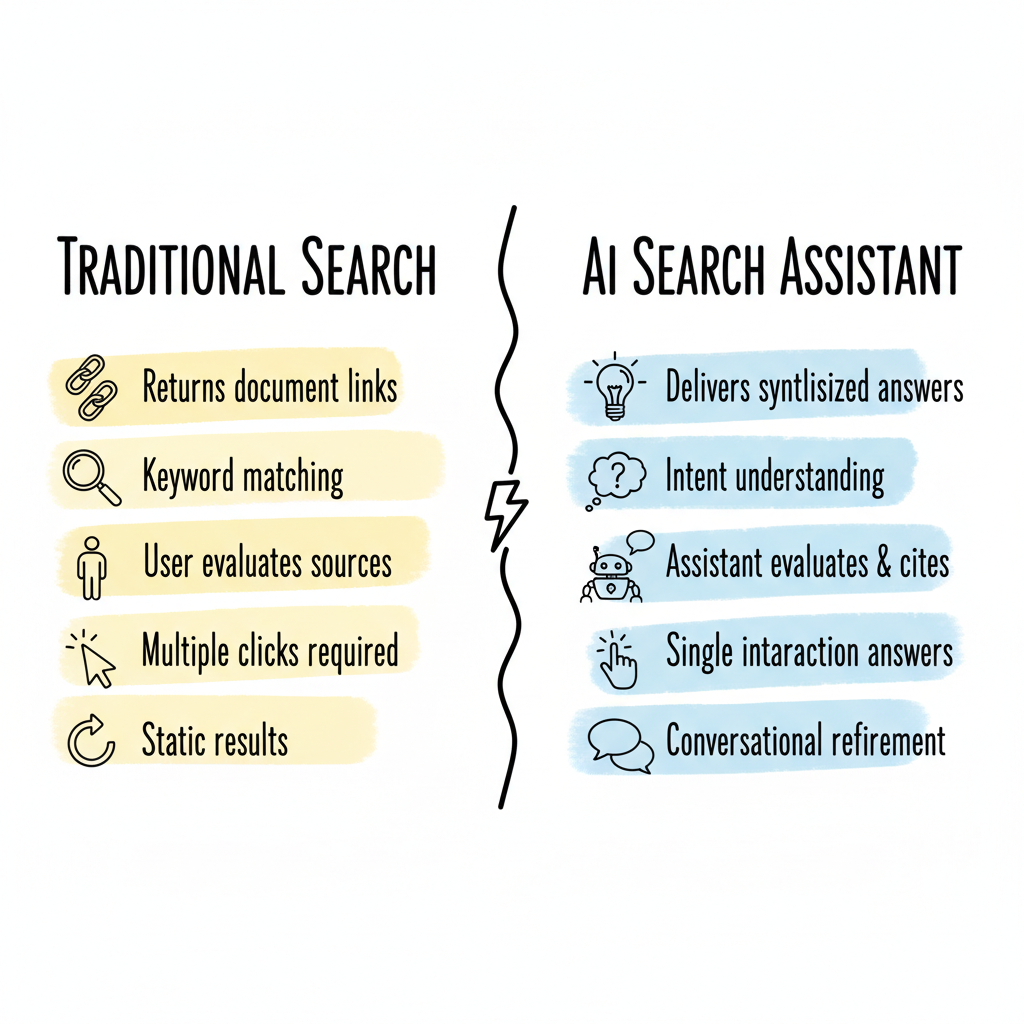
Traditional search returns a list of links. AI-powered search assistants return answers—synthesized, contextualized, and ready to use.
The Core Capability Shift
Traditional Search | AI Search Assistant |
Returns document links | Delivers synthesized answers |
Keyword matching | Intent understanding |
User evaluates sources | Assistant evaluates and cites |
Multiple clicks required | Single interaction answers |
Static results | Conversational refinement |
Key Capabilities in 2026
According to enterprise research, AI search assistants now offer capabilities that redefine information discovery:
Conversational interaction: Natural language queries replace keyword strings. Ask questions the way you'd ask a colleague.
Context awareness: Assistants remember previous queries, understand your role, and tailor responses to your specific needs.
Multi-source synthesis: Instead of showing ten links, assistants pull from dozens of sources to create comprehensive answers.
Citation and transparency: Quality assistants show their sources, allowing verification and deeper exploration.
Task completion: Beyond answering questions, assistants can execute actions—scheduling, drafting, analyzing data.
How AI Search Assistants Work Under the Hood
Understanding the technology stack behind AI search assistants reveals why they outperform traditional keyword-based engines—and why structured data for AI search matters more than ever.
Large Language Models: The Reasoning Layer
At the core of every modern AI search assistant sits a Large Language Model (LLM). Models like OpenAI GPT-4o, Google Gemini, and Anthropic Claude power the query understanding and answer generation process. These LLMs parse natural language queries, identify intent, and generate coherent, human-readable responses by drawing on patterns learned during training on massive text corpora.
Retrieval Augmented Generation: Grounding in Real Data
Retrieval Augmented Generation (RAG) is the architectural pattern that prevents LLMs from hallucinating. Rather than relying solely on what the model memorized during training, RAG systems first retrieve relevant documents from live data sources—web pages, internal knowledge bases, databases—and pass those documents to the LLM along with the user's query. The model then synthesizes retrieved information into an accurate, cited answer. This is the same pattern powering tools like Perplexity, Google AI Mode, and enterprise search platforms.
Vector Search and Semantic Matching
The retrieval step in RAG relies on vector search. Queries and documents are converted into numerical representations called embeddings, then matched by semantic similarity rather than exact keyword overlap. This means a query about "reducing employee turnover" will match documents discussing "staff retention strategies" even without shared keywords. Traditional engines like Elasticsearch, Solr, and Algolia are now augmenting their keyword-based indexes with vector capabilities to keep pace.
Machine Learning Ranking
Machine learning ranking models add a final layer of intelligence. After vector search retrieves candidate passages, ML models re-rank them by relevance, recency, source authority, and contextual fit before the LLM synthesizes the final answer. This multi-stage pipeline—retrieve, re-rank, generate—is what gives AI search assistants their edge in delivering precise, trustworthy responses. Understanding this pipeline is essential for answer engine optimization strategies.
Types of AI Search Assistants
The market has segmented into distinct assistant categories, each serving different needs.
Consumer AI Assistants
General-purpose assistants accessible to anyone:
Examples: ChatGPT, Claude, Perplexity, Gemini, DuckDuckGo AI Chat, Andi, and Komo
Strengths:
- Broad knowledge base
- Multi-modal capabilities (text, image, voice)
- Accessible interfaces
- Continuous improvement
Best for: General research, content creation, learning, personal productivity
Google Search AI Mode represents Google's direct answer to Perplexity-style conversational search, offering an opt-in conversational layer that replaces traditional blue links with AI-synthesized responses powered by Gemini. This is distinct from AI Overviews—the auto-generated summary boxes that appear passively at the top of search results. For a deeper look at how AI Overviews affect organic traffic, see our guide on AI Overviews and their impact on SEO.
AI Search Assistants You Should Know in 2026
The AI search landscape has expanded dramatically. Here are the key players reshaping how people find information:
Assistant | Parent Company | Key Differentiator | Free Tier |
Perplexity | Perplexity AI | Citation-first answers with Pro research mode | Yes |
Google AI Mode | Conversational search integrated into Google Search | Yes | |
Andi | Andi Search | Privacy-focused visual reader view with cited sources | Yes |
Komo | Komo AI | Speed-focused with journey and chat modes | Yes |
DuckDuckGo AI Chat | DuckDuckGo | Anonymous AI chat powered by multiple LLMs | Yes |
DeepSearch | Various | Agentic multi-step research across dozens of sources | Varies |
ChatGPT | OpenAI | Broad reasoning with web browsing and plugins | Yes |
Claude | Anthropic | Long-context analysis and careful reasoning | Yes |
Andi has seen a surge in adoption (trending +400% year-over-year) as users seek privacy-focused alternatives that present results as a clean reader view with fully cited sources rather than ad-laden pages. Komo appeals to users who value exploration through its unique "journey" and "chat" modes. DuckDuckGo AI Chat offers anonymous access to multiple LLMs without storing conversations or linking queries to user profiles. For optimization strategies around these platforms, see our Perplexity AI optimization strategy guide.
Enterprise Search Assistants
Purpose-built for organizational knowledge:
Examples: Kore.ai, Microsoft Copilot, Google Workspace Gemini, Glean, Algolia
Strengths:
- Internal data integration
- Security and compliance
- Role-based access
- Workflow integration
Best for: Organizations needing AI search across proprietary data
Enterprise platforms like Glean, Kore.ai, and Algolia are now incorporating AI-powered semantic search alongside traditional keyword matching. These platforms use vector search and RAG to search internal knowledge bases across tools like Confluence, Notion, and Jira—moving beyond the limitations of Elasticsearch and Solr that have traditionally served as the backbone of enterprise search infrastructure.
Specialized Search Assistants
Focused on specific domains or tasks:
Examples: Legal research assistants, medical information systems, code assistants
Strengths:
- Deep domain expertise
- Specialized training data
- Industry-specific compliance
- Precision in narrow fields
Best for: Professional applications requiring specialized accuracy
AI Research Assistants: Deep Research and Multi-Step Reasoning
While standard AI search assistants excel at answering individual questions, a new category of AI research assistants is emerging to handle complex, multi-faceted investigations that require synthesizing information from dozens or even hundreds of sources.
What Is Deep Research?
Deep research refers to multi-step agentic search where the AI plans a research strategy, executes multiple queries across different sources, cross-references findings for consistency, and produces a structured, comprehensive report. Unlike a single-turn Q&A interaction, deep research may involve 10-50 sequential search operations orchestrated by the AI agent.
Leading Deep Research Tools
Several platforms now offer deep research capabilities:
- Gemini Deep Research — Google's implementation that creates research plans, browses dozens of sites, and generates comprehensive reports with citations
- Perplexity Pro deep research mode — executes multi-step research with real-time web access and academic source integration
- OpenAI's deep research — uses o3-level reasoning to conduct extended research sessions that can run for minutes, producing analyst-grade reports
- DeepSearch — purpose-built agentic search assistants that specialize in thorough, multi-source investigation
Deep Research Use Cases
Deep research capabilities transform AI search from a Q&A tool into a full research workflow. Common applications include academic literature review, competitive analysis, market research, technical due diligence, and policy analysis. For content teams, deep research enables comprehensive topic coverage that supports AI search ranking factors by producing authoritative, well-sourced content.
Voice Assistants Evolving into Research Companions
Traditional voice assistants like Siri and Alexa are evolving beyond simple command-response interactions. With Apple Intelligence and Alexa+ integrations, these platforms are gaining AI-powered research capabilities—enabling users to ask complex questions and receive synthesized, multi-source answers through voice search optimization patterns that increasingly mirror the deep research paradigm.
Enterprise Implementation Considerations
For organizations implementing AI search assistants, several factors determine success. Understanding how these systems differ from traditional approaches—much like how aeo-vs-geo-vs-seo frameworks differ in their optimization targets—is essential for strategic deployment.
Data Integration Requirements
Enterprise AI search requires connecting to your existing knowledge:
Integration Type | Examples | Complexity |
Document stores | SharePoint, Google Drive, Dropbox | Moderate |
Business systems | CRM, ERP, HRIS | High |
Databases | SQL, data warehouses | High |
Communication tools | Slack, Teams, email | Moderate |
Custom applications | Internal tools, APIs | Variable |
According to enterprise search analysis, platforms must integrate deeply across structured and unstructured systems—from file stores and intranets to CRMs, ERPs, and custom applications.
Security and Governance
Enterprise deployment demands robust security:
Access controls: Ensure users only see information they're authorized to access Data privacy: Maintain compliance with regulations (GDPR, HIPAA, etc.) Audit trails: Track queries and responses for compliance AI governance: Manage autonomous actions and decision boundaries
Relevance and Quality
Implementation success depends on response quality:
Behavioral relevance tuning: Systems that learn from user interactions improve over time Source prioritization: Weighting authoritative internal sources appropriately Freshness management: Ensuring answers reflect current information Accuracy validation: Methods for identifying and correcting errors
The Shift to Agentic Capabilities
2026 marks a significant evolution: AI assistants becoming AI agents.
From Assistant to Agent
Assistant Capability | Agent Capability |
Answers questions | Takes actions |
Responds to requests | Anticipates needs |
Single-step tasks | Multi-step workflows |
Human-directed | Autonomous operation |
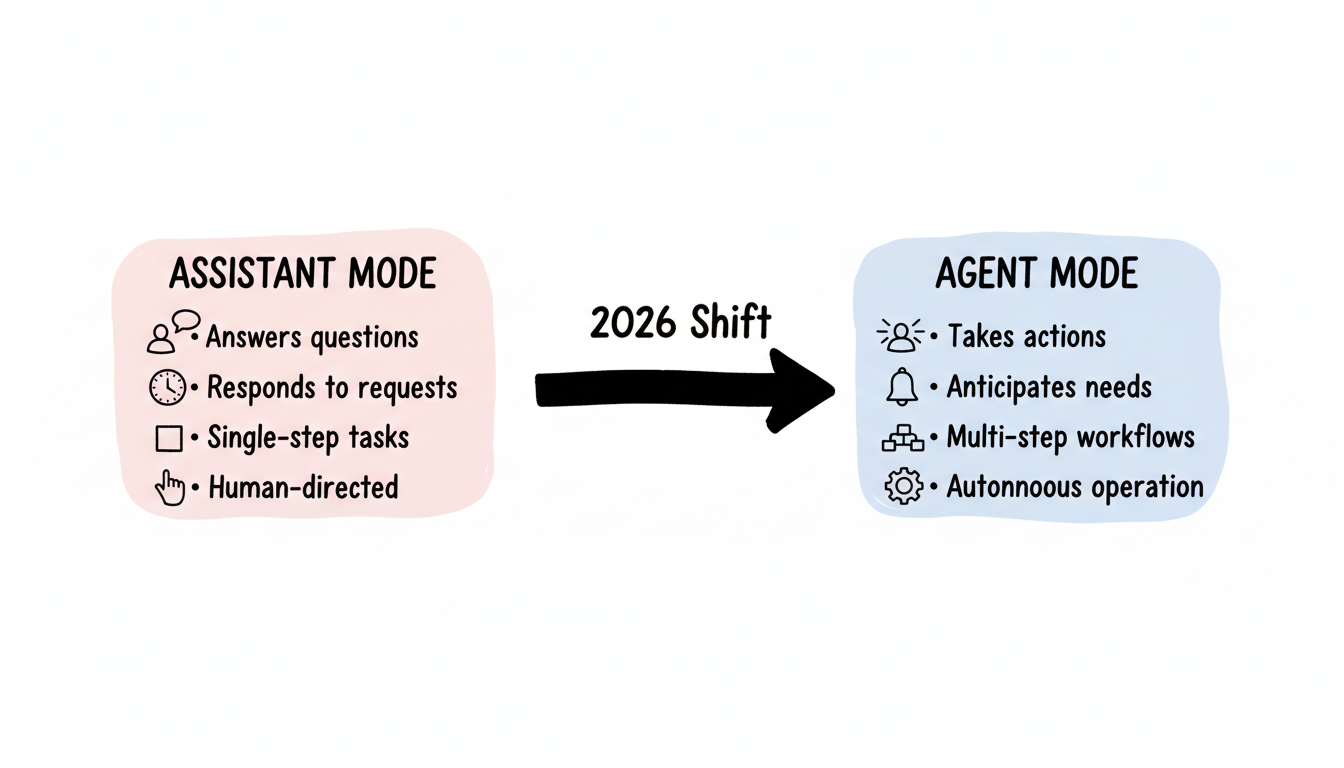
As industry analysis notes, AI is shifting from individual usage to team and workflow orchestration—coordinating entire workflows, connecting data across departments, and moving projects from idea to completion.
Practical Agent Applications
Automated research: Agents that monitor topics and compile reports without prompting Process automation: End-to-end workflows requiring minimal human intervention Real-time optimization: Systems monitoring and adjusting processes continuously Predictive assistance: Anticipating needs before explicit requests
Implementation Approaches
Organizations can implement AI search assistants through several paths.
Buy: Commercial Platforms
Advantages:
- Faster deployment
- Vendor support and updates
- Pre-built integrations
- Lower technical requirements
Considerations:
- Ongoing licensing costs
- Less customization
- Vendor dependency
- Data sovereignty concerns
Build: Custom Development
Advantages:
- Full customization
- Data control
- Unique competitive advantage
- No licensing fees
Considerations:
- Significant development investment
- Technical expertise required
- Ongoing maintenance burden
- Slower initial deployment
Hybrid: Platform + Customization
Advantages:
- Balance of speed and customization
- Leverage vendor improvements
- Extend with specific needs
- Manageable complexity
Considerations:
- Integration complexity
- Multiple vendor relationships
- Requires clear architecture planning
Measuring Success
Track these metrics to evaluate AI search assistant effectiveness, similar to how you would track aeo-metrics-kpis for answer engine optimization:
Metric | What It Measures | Target |
Query resolution rate | Percentage of queries answered satisfactorily | 80%+ |
Time to answer | Speed of response delivery | Seconds |
User adoption | Active users relative to potential users | Growing |
Task completion | Actions successfully completed via assistant | High |
User satisfaction | Feedback scores and repeat usage | Positive trend |
Establishing a robust ai-search-measurement-framework ensures you can demonstrate ROI and identify areas for improvement as your implementation matures.
Future Capabilities
AI search assistants continue evolving rapidly:
Multi-modal expansion: Voice, video, and image understanding becoming standard, with voice-search-aeo-optimization becoming increasingly critical for natural interaction patterns
Deeper reasoning: Complex problem-solving and analysis capabilities, powered by deep research workflows that enable AI to conduct multi-step investigations autonomously. As AI Overviews in Google Search have normalized AI-generated answers, user comfort with AI search assistants continues to grow—accelerating adoption across both consumer and enterprise contexts.
Proactive intelligence: Assistants that surface relevant information automatically Ecosystem integration: Seamless operation across tools and platforms
As AI search assistants increasingly rely on RAG pipelines to generate answers, structured data and authoritative sourcing become even more critical for appearing in AI-generated results.
FAQs
How Do AI Search Assistants Differ from Traditional Search?
AI search assistants understand natural language queries, synthesize information from multiple sources, and deliver direct answers rather than lists of links. They can engage in conversational refinement and remember context from previous interactions.
What Data Do AI Search Assistants Need Access To?
For consumer assistants, they access publicly available web data. Enterprise assistants require integration with internal systems—documents, databases, communication tools, and business applications—to search organizational knowledge.
Are AI Search Assistants Secure for Business Use?
Enterprise-grade assistants include security features like access controls, data encryption, and audit logging. Consumer assistants vary in their handling of data privacy. Evaluate security capabilities carefully before implementation.
How Long Does Enterprise Implementation Take?
Basic deployment can take weeks for platforms with pre-built integrations. Complex implementations involving multiple systems, custom development, and governance requirements may take months. Start with pilot programs to learn before broad rollout.
What Is the Difference Between AI Overviews and AI Mode in Google Search?
AI Overviews are automatically generated summary boxes that appear at the top of Google search results for certain queries. They provide a brief AI-synthesized answer without requiring user interaction. Google AI Mode, by contrast, is an opt-in conversational search experience where users can ask follow-up questions and get detailed, multi-turn responses powered by Gemini. AI Overviews are passive; AI Mode is interactive and resembles tools like Perplexity.
How Do AI Search Assistants Use RAG to Generate Answers?
RAG, or Retrieval Augmented Generation, is the core architecture behind most AI search assistants. When you ask a question, the system first retrieves relevant documents using vector search and semantic matching. Those documents are then passed to a large language model along with your query. The LLM synthesizes the retrieved information into a coherent answer with citations, reducing hallucinations compared to pure generative approaches.
What Is Deep Research in AI Search?
Deep research is an advanced capability where an AI search assistant performs multi-step investigation rather than answering in a single pass. The AI creates a research plan, executes multiple searches across different sources, cross-references findings, and produces a comprehensive report. Tools like Gemini Deep Research, Perplexity Pro, and DeepSearch offer this feature for complex queries that require synthesizing information from dozens of sources.
Are Privacy-Focused AI Search Assistants Available?
Yes. DuckDuckGo AI Chat lets users interact with LLMs like GPT-4o and Claude without storing conversations or linking queries to user profiles. Andi is another privacy-focused AI search engine that does not track users or sell data. Komo also emphasizes user privacy. These alternatives appeal to users who want AI-powered search capabilities without the data collection practices of larger platforms like Google or OpenAI.