
The AI search landscape has transformed dramatically. What was once ChatGPT's near-monopoly has evolved into a competitive ecosystem where Google Gemini, Perplexity, Claude, and emerging platforms now capture meaningful market share.
For businesses optimizing their digital presence, understanding these statistics isn't optional—it's essential for strategic planning. This comprehensive guide presents the latest 2026 data on AI search market share, user adoption, and the trends reshaping how people discover information online.
AI Search Market Overview: Growth & Adoption Rates
AI search adoption has reached unprecedented scale in 2026. According to Netguru's AI adoption research, the global AI user base now exceeds 378 million people, with 64 million new users added since 2024 alone—the largest year-over-year jump ever recorded.
Key adoption metrics for 2026:
Metric | Value | Source |
Global AI tool users | 378 million | Netguru |
Weekly ChatGPT active users | 800 million | Similarweb |
Daily ChatGPT prompts processed | 2.5 billion | Omnius GEO Report |
US adults using AI daily | ~20% | Netguru |
Enterprise AI adoption rate | 78% | Netguru |
The enterprise adoption story is equally compelling. According to Netguru, 78% of organizations now use AI in at least one business function, up from 55% just one year earlier. Generative AI usage specifically jumped from 33% in 2023 to 71% in 2024.
Perhaps most significant for marketers: according to the Omnius GEO Industry Report, AI marketing spend is projected to grow from $20.4 billion in 2024 to $82.2 billion by 2030, representing a compound annual growth rate of approximately 25%. Understanding generative engine optimization strategies is becoming crucial for capturing this growing market.
AI Sessions vs Traditional Search: The Graphite.Io Study
The most widely cited data point in the 2026 AI search conversation comes from the Graphite.io study conducted by Ethan Smith. According to this research, AI platforms now generate approximately 45 billion sessions per month globally—a figure that equals 56% of worldwide traditional search engine volume. This single statistic, cited by Search Engine Land, Semrush, and Position.digital among others, has become the consensus benchmark for measuring AI search scale.
In the United States specifically, AI platforms produce 5.4 billion monthly sessions, representing 34% of US search volume. Year-over-year, US AI session volume grew by 300%, underscoring how rapidly AI-driven discovery is displacing traditional search behavior.
ChatGPT dominates this landscape with 89% of all AI sessions globally. However, the distribution channel matters: 83% of AI usage occurs via mobile apps rather than web browsers, according to Graphite.io's analysis. This mobile-app dominance means that traditional web analytics tools significantly undercount AI search activity—most AI sessions never appear in server logs or referral traffic reports.
The acceleration trend is corroborated by multiple independent sources. Pew Research Center data shows that the share of US adults who have used AI tools at least once doubled between early 2024 and late 2025. Bain & Company's technology report similarly found that enterprise AI adoption outpaced internal forecasts at 68% of surveyed organizations, suggesting that both consumer and business AI search usage are growing faster than most projections anticipated. For brands tracking AI assistant adoption trends, the Graphite.io study provides the clearest baseline for strategic planning.
Market Share by Platform (Perplexity, ChatGPT, You.Com, Gemini)
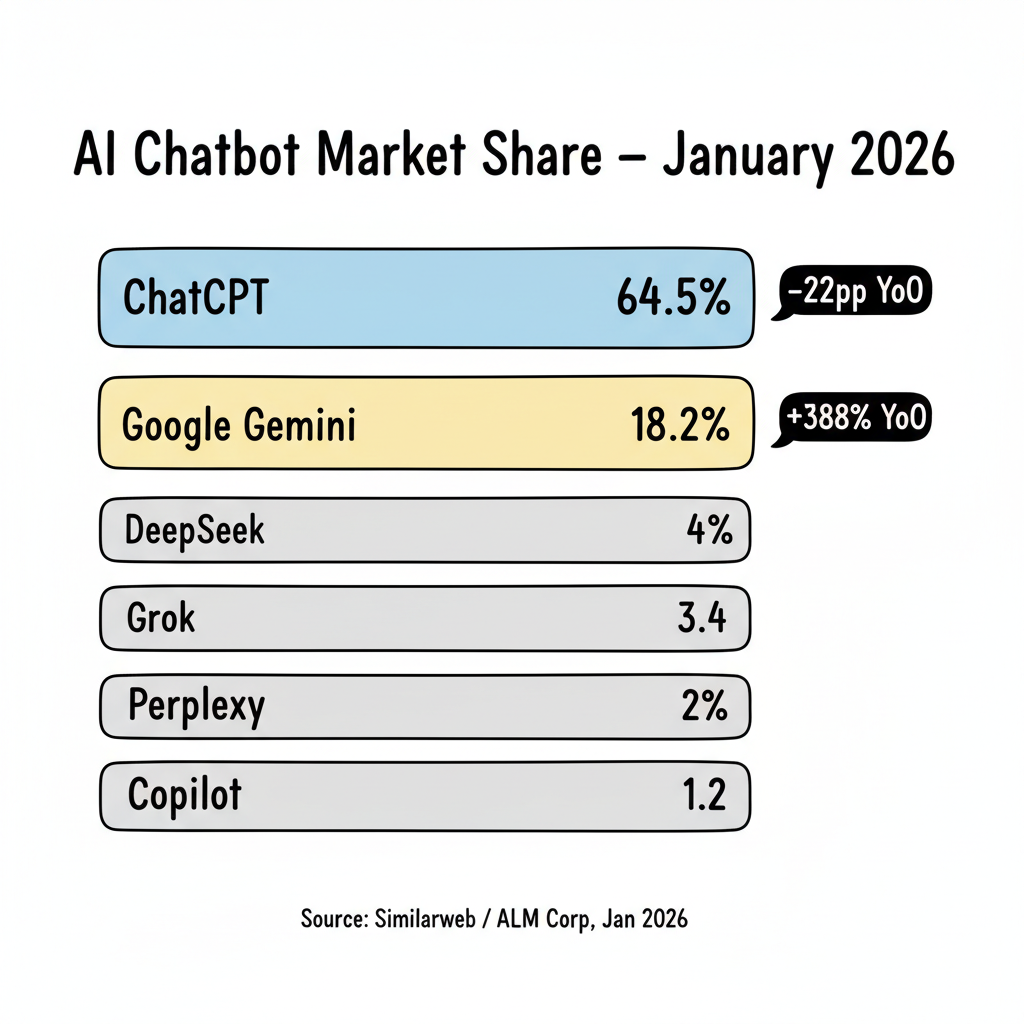
The AI chatbot market has undergone radical redistribution in early 2026. According to Similarweb data analyzed by ALM Corp, ChatGPT's traffic share dropped from 86.7% in January 2025 to 64.5% in January 2026—a staggering 22.2 percentage point decline.
To put these AI platform shares in context, Google still holds 71% of the traditional search engine market as of Q4 2025, according to Graphite.io data. The AI chatbot market share figures above represent competition within the AI segment itself—not the broader search market, where Google's dominance remains firmly intact.
AI Chatbot Market Share (January 2026):
Platform | Market Share | YoY Growth | Monthly Active Users |
ChatGPT | 64.5-68% | -19.2pp | 800M weekly |
Google Gemini | 18.2-21.5% | +237-388% | 650M monthly |
DeepSeek | 3.7-4% | Strong | N/A |
Grok (X.AI) | 2.9-3.4% | Moderate | N/A |
Perplexity | 2.0% | +370% | N/A |
Claude | 2.0% | +190% | N/A |
Microsoft Copilot | 1.1-1.2% | Stable | N/A |
According to Vertu's market analysis, Perplexity has demonstrated the most impressive growth trajectory at 370% year-over-year by positioning itself as an AI-first search engine rather than a general chatbot. Claude from Anthropic also showed strong growth at 190% year-over-year, with projected 2025 revenue of $2.2 billion.
The key takeaway: while ChatGPT remains dominant, the trajectory clearly favors competitors. Brands implementing search engine optimization using ai can no longer optimize for a single AI platform.
User Demographics & Behavior Patterns
AI search adoption varies significantly by age group and use case. According to First Page Sage's market share report, younger demographics are substantially more likely to use AI search tools.
Google vs ChatGPT Usage by Age Group (2025):
Age Group | Google Share | ChatGPT Share |
13-24 | 74% | 17% |
25-44 | 80% | 13% |
45-64 | 86% | 8% |
65+ | 89% | 5% |
This demographic divide presents both opportunities and challenges. Brands targeting younger audiences must prioritize AI search optimization, while those serving older demographics can maintain focus on traditional search while gradually expanding AI presence.
Regional adoption patterns also differ substantially. According to the Omnius GEO Report:
- United States: Leads ChatGPT adoption at 16.18% of global users
- Europe: ChatGPT Search users jumped from 11.2M to 41.3M in early 2025 (270% increase)
- Asia-Pacific: China developing its own ecosystem with Baidu's ERNIE (52% domestic share)
- Latin America: Google dominates at 93.1% in South America
- Africa: South Africa and Morocco among top ChatGPT-using countries
Query Types & Intent Distribution in AI Search
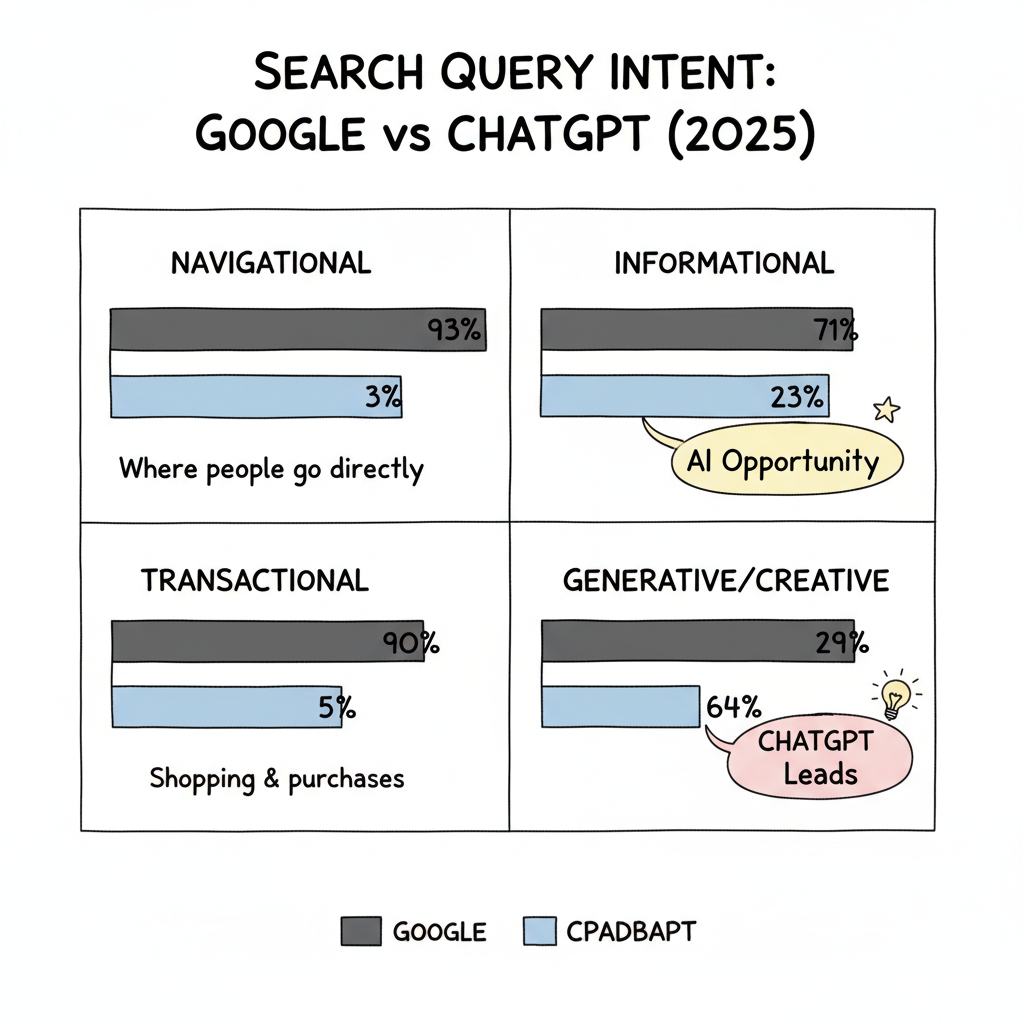
AI search platforms are capturing different types of queries compared to traditional search engines. According to First Page Sage, user intent dramatically affects platform choice.
Market Share by User Intent (2025):
Intent Category | Google Share | ChatGPT Share |
Navigational | 93% | 3% |
Informational | 71% | 23% |
Transactional | 90% | 5% |
Generative/Creative | 29% | 64% |
This data reveals critical strategic insights:
- Navigational queries (finding specific websites) remain overwhelmingly Google-dominated
- Informational queries represent the biggest AI search opportunity at 23% ChatGPT share
- Transactional queries still favor Google due to richer ecommerce integration
- Generative/creative tasks have flipped—ChatGPT now leads at 64%
For what is geo in search engine optimization strategy, this means prioritizing informational and educational content that AI search users are actively seeking.
AI Search vs Google: Traffic & Usage Comparison
Despite rapid AI search growth, Google maintains overwhelming dominance in overall digital queries. According to First Page Sage's analysis:
Google vs ChatGPT Overall Comparison (Q4 2025):
Platform | Monthly Active Users | Share of Digital Queries | Avg Session Duration |
Google Search | 5 billion | 77.9% | 6m 12s |
ChatGPT | 858 million | 17.1% | 13m 09s |
Other (Bing, Perplexity) | 580 million | 5.8% | 4m 33s |
The session duration difference is significant: ChatGPT users spend more than double the time per session compared to Google users, indicating deeper engagement with AI-generated responses.
AI referral traffic growth tells another story. According to Digiday's analysis:
- ChatGPT referrals increased 52% year-over-year (September-November 2025)
- Gemini referral traffic grew 388% in the same period
- AI platforms drove over 1.1 billion referral visits in 2025
- AI "user action" crawling increased by over 15x in 2025
According to the Conductor AEO/GEO Benchmarks Report, 87.4% of all AI referral traffic across key industries comes from ChatGPT—but this dominance is shifting. Implementing aeo-seo-geo strategies helps businesses capture traffic across multiple platforms.
Google AI Mode: Usage Statistics & Impact
Google AI Mode represents the next evolution beyond AI Overviews, and its adoption statistics reveal a significant shift in how Google delivers search results. Launched as a dedicated AI-powered search interface, Google AI Mode now serves between 75 and 100 million users—a figure that continues to grow as Google expands availability across markets.
The most striking statistic: 93% of Google AI Mode sessions end without a single click to an external website, according to Seer Interactive research. This makes AI Mode the most aggressive zero-click environment in search history. Each AI Mode response includes an average of 12.6 links, yet users overwhelmingly find the AI-generated summary sufficient for their needs.
Critically, there is only 10.7% URL overlap between traditional AI Overviews and AI Mode results. This means that ranking well in AI Overviews does not guarantee visibility in AI Mode—brands must treat them as distinct optimization targets. Meanwhile, 88% of informational queries now trigger AI Overviews in standard Google Search, and over 2 billion users globally interact with AI Overviews each month.
This divergence has given rise to LLMO (LLM Optimization), an emerging discipline focused on optimizing content for LLM-powered interfaces like AI Mode, ChatGPT, and Claude. Unlike traditional SEO, LLMO prioritizes structured, concise answers that LLMs can extract and cite. It is worth noting that ChatGPT relies on the Bing Search API as its backend for 92% of real-time searches, which means Bing indexation and optimization carry outsized importance for AI search visibility across multiple platforms.
Zero-Click Search & AI'S Impact on Website Traffic
The zero-click trend has accelerated dramatically with the proliferation of AI-generated search results. According to current data, 60% of all traditional searches now result in zero clicks to any website—the user either finds the answer directly in the SERP or refines their query without visiting an external page.
When AI Overviews appear, the traffic impact is even more severe: click-through rates drop by 61% compared to standard search results. Only 8% of users click on traditional organic links when an AI-generated summary is displayed above them. For publishers and brands that depend on organic search traffic, this represents a fundamental shift in the discovery-to-visit pipeline.
However, the data also reveals an important countertrend. AI referral visitors are 4.4x more valuable than standard organic visitors in terms of engagement metrics. An Adobe study found that retail traffic referred by AI search platforms shows 27% lower bounce rates, longer time on site, and higher conversion rates compared to traditional organic traffic. This creates a strategic paradox: AI search sends fewer clicks overall, but the clicks it does send are significantly higher quality.
Originality.ai research adds another dimension to this picture, documenting the rising prevalence of AI-generated content in search results themselves. As AI-written pages proliferate in SERPs, content that demonstrates genuine expertise, original data, and first-hand experience becomes increasingly important for earning both traditional rankings and AI citations. Brands must now optimize for AI citation to capture the shrinking but substantially more valuable click pool that AI search delivers.
Industry-Specific Adoption Rates
AI search adoption varies dramatically by industry. Healthcare leads all sectors according to Netguru's research, with a 36.8% compound annual growth rate in AI adoption.
AI Referral Traffic by Industry (from Conductor Report):
Industry | ChatGPT Share | Notable Other Platforms |
Average (all industries) | 87.4% | Perplexity (varies) |
Utilities | 79% | Gemini (21%) |
Financials | 95% | Copilot (5%) |
Technology | ~85% | Perplexity (growing) |
According to DemandSage's SEO statistics:
- 58% of marketers plan to use AI for content and SEO
- 51% of marketers use AI to optimize content for better SERP ranking
- 40% of marketers witnessed 6-10% revenue increase after implementing AI in SEO
- 57% of SEO experts are using ChatGPT for SEO tasks
- 82% of enterprise-level SEO teams plan to invest more in AI
Before implementing AI search optimization across your organization, conducting an aeo-marketing-audit can identify the highest-impact opportunities for your specific industry.
Citation & Source Patterns: Which Sites AI Search References Most
Understanding which sources AI platforms cite is critical for optimization strategy. According to Superlines' research, ChatGPT relies heavily on Wikipedia for factual information, while Google Gemini pulls from a broader mix including YouTube.
Key citation insights:
- Both platforms fetch information from diverse sources beyond traditional "big media"
- Wikipedia remains highly cited for factual queries
- Industry-specific authoritative sources earn citations in their verticals
- Structured data and clear expertise signals improve citation likelihood
According to Yoast's 2025 SEO wrap-up, citations have replaced visits as success signals for many top-of-funnel queries. Brand mentions now play a larger role in AI-driven citation behavior than links alone. Implementing perplexity-optimization-multi-source-citation techniques can dramatically improve your content's citation rate.
Top-Cited Domains & Content Optimization Benchmarks
Granular citation data reveals clear patterns that content teams can use for optimization. Wikipedia leads all domains with a 7.8% share of all AI citations, followed by Reddit at 1.8% and Forbes at 1.1%. Review platforms—including G2, Trustpilot, Capterra, and Yelp—carry disproportionate citation weight in product and service queries, making review presence a high-leverage tactic for B2B and local businesses.
Content length strongly correlates with AI citation frequency. Articles with 2,900 or more words receive an average of 5.1 AI citations, compared to significantly fewer for shorter content. Within those articles, section length matters: paragraphs of 120 to 180 words between headings yield a 70% boost in citation likelihood, suggesting that AI models favor well-structured, digestible content blocks over long unbroken passages.
Page speed is another underappreciated citation factor. Pages with a sub-0.4-second First Contentful Paint (FCP) average 6.7 AI citations, compared to just 2.1 citations for pages loading in more than 1.13 seconds. This 3.2x difference makes performance optimization a direct lever for AI visibility. Teams tracking AI citation rates should monitor both content structure and technical performance metrics together.
Google AI Overviews statistics provide additional context. According to WordStream:
- AI Overviews appear in approximately 13% of US searches
- Since March 2025, AI Overviews have grown by 115%
- AIOs take up almost half of a user's screen when displayed
- Local queries see AIOs only 7% of the time
Understanding how google selects ai overview sources is essential for earning these prominent placements.
Future Projections: Where Is AI Search Headed?
The data points toward continued fragmentation and growth. According to Xenoss's AI trends analysis:
- Enterprise AI market share shifted dramatically: OpenAI fell from 50% to 27% (2023-2025), while Google climbed from 7% to 21%
- In 2025, ChatGPT's monthly active users grew by 6%, while Gemini's user base increased by 30%
- Physical AI adoption in manufacturing is set to jump from 9% to 22% within two years
Predictions for 2026-2027:
According to the Omnius GEO Report, GenAI search ad spending in the US will roughly double between 2025 and 2026, reaching over $25 billion by 2029.
According to SparkToro's marketing predictions, aggregate corporate AI spend will increase by 30%+ over 2025's approximately $37 billion, though consumer AI adoption growth rates may slow.
The framing from the highest-authority sources reinforces these projections. McKinsey describes AI search as a "new front door to the internet," fundamentally altering how consumers discover brands and information. The Wall Street Journal has reported that AI search growth is outpacing even the most optimistic industry forecasts, with enterprise adoption timelines compressing from years to months. These signals from top-tier analysts and publications suggest the shift toward AI-mediated discovery is not a trend but a structural change in digital behavior.
The Mindrift AI trends report notes that 2026 marks the transition from AI experiments to real adoption, with AI agents, smarter search tools, and embedded AI features driving the next wave. Organizations should focus on ai-search-content-structure to prepare their content libraries for this evolution.
Key Takeaways for AI SEO Strategy
Based on the 2026 statistics, here are the strategic imperatives:
- Diversify AI platform optimization: ChatGPT's declining market share (from 87% to 65-68%) means optimizing for Gemini, Perplexity, and Claude is now essential
- Target informational intent: With 23% of informational queries going to ChatGPT, educational content offers the best AI search opportunity
- Prioritize younger demographics: The 13-44 age bracket shows 13-17% ChatGPT adoption versus 5-8% for 45+
- Monitor industry-specific patterns: Some industries see significant non-ChatGPT AI traffic (e.g., Gemini drives 21% in utilities)
- Focus on citations over clicks: AI search is shifting success metrics from traffic to mentions and citations
- Prepare for continued growth: With AI marketing projected to reach $82.2B by 2030, investment in AI SEO now builds long-term competitive advantage
Technical Optimization for AI Crawlers
The technical foundation of AI search visibility is often overlooked. Currently, 79% of major news publishers block AI training bots via robots.txt directives, and 71% specifically block AI retrieval crawlers. While blocking training crawlers can protect content intellectual property, blocking AI retrieval crawlers is usually counterproductive—it prevents your content from being cited in AI-generated answers, effectively opting out of AI search visibility entirely.
The distinction matters: training crawlers (like GPTBot-training) use your content to improve models, while retrieval crawlers (like ChatGPT-User and Google-Extended) fetch your content at query time to generate cited answers. Blocking the latter removes your site from the AI citation pool.
On the positive side, implementing schema markup and FAQ schema significantly improves AI citation likelihood by making content machine-parseable and semantically structured. Google's John Mueller has advised serving the same HTML to all crawlers rather than creating bot-specific content—a best practice that ensures consistency across both traditional and AI search indexing.
A practical checklist for technical AI optimization: audit your robots.txt for AI crawler directives, implement structured data on key pages, add FAQ schema to stat-heavy and how-to content, and monitor crawl logs for AI bot activity to confirm your content is being accessed.
Following generative-engine-optimization-best-practices and using the right aeo-tools-complete-guide will help you stay ahead of competitors in this rapidly evolving landscape.
FAQs
How Big Is AI Search Compared to Traditional Search Engines in 2026?
According to the Graphite.io study by Ethan Smith, AI platforms now generate 45 billion sessions per month globally, equaling 56% of traditional search engine volume. In the US specifically, 5.4 billion monthly AI sessions represent 34% of domestic search. This figure grew 300% year-over-year, making AI search the fastest-growing segment in digital discovery.
What Is the Zero-Click Rate for Google AI Mode and AI Overviews?
Google AI Mode sessions end without an external click 93% of the time, according to Seer Interactive research. For standard AI Overviews, the presence of an AI-generated summary reduces click-through rates by 61%, with only 8% of users clicking traditional organic links. However, users who do click through from AI results are 4.4x more valuable in terms of engagement and conversion.
How Can Websites Optimize for AI Search Engine Citations?
Key optimization factors include content length (2,900+ word articles average 5.1 AI citations), page speed (sub-0.4s FCP correlates with 3.2x more citations), and structured data implementation (schema markup and FAQ schema). Section length between 120-180 words per heading yields a 70% citation boost. Additionally, ensure your robots.txt does not block AI retrieval crawlers, as 71% of major publishers inadvertently reduce their AI visibility this way.
Which AI Search Platform Has the Largest Market Share?
ChatGPT dominates AI search with 89% of all AI sessions globally, according to Graphite.io data. Perplexity holds roughly 4-5% of AI search sessions and is the fastest-growing challenger. Google AI Mode, while newer, already has 75-100 million users but functions more as an enhancement to Google Search than a standalone AI search platform.