
Last Updated: March 2026
The search landscape has fundamentally changed. In 2026, AI-powered search engines have moved from experimental curiosities to dominant forces reshaping how users find information online. For businesses and marketers, understanding these platforms isn't optional—it's essential for survival in an increasingly AI-driven digital ecosystem.
This comprehensive guide covers everything you need to know about AI-powered search engines and how to optimize your content for them. From understanding the underlying technology to implementing practical AI search optimization strategies, we'll explore the complete landscape for 2026.
What Are AI-Powered Search Engines? (Definition & Evolution)
AI-powered search engines represent a fundamental departure from traditional search. Rather than returning a list of blue links and leaving users to synthesize information themselves, these platforms use artificial intelligence to understand queries contextually, synthesize information from multiple sources, and deliver direct, conversational answers.
The Evolution from Traditional to AI Search
Traditional Search (1998-2020s):
- Keyword matching algorithms
- PageRank-based link analysis
- Ten blue links format
- Users must click through and synthesize
AI-Powered Search (2023-Present):
- Natural language understanding
- Multi-source information synthesis
- Conversational, direct answers
- Citations and source attribution
- Follow-up question capability
The transition accelerated dramatically in late 2022 with ChatGPT's release, prompting Google, Microsoft, and startups to race toward AI-first search experiences. By 2026, AI-powered search has matured into distinct categories, each requiring different answer engine optimization approaches.

- Conversational AI Search Engines: Perplexity, ChatGPT Search, You.com
- AI-Enhanced Traditional Search: Google AI Overviews, Bing Copilot
- Specialized AI Search: Phind (code), Consensus (research papers), Elicit (academic)
Key Characteristics of AI Search Engines
What distinguishes AI-powered search from traditional alternatives:
- Intent Understanding: Goes beyond keywords to understand what users actually want
- Information Synthesis: Combines data from multiple sources into coherent answers
- Contextual Memory: Maintains conversation context for follow-up questions
- Source Attribution: Provides citations linking to original content
- Multimodal Capabilities: Processes text, images, code, and other formats
- Real-Time Updates: Accesses current information through web crawling
How AI Search Engines Work (Llms, RAG, Knowledge Graphs)
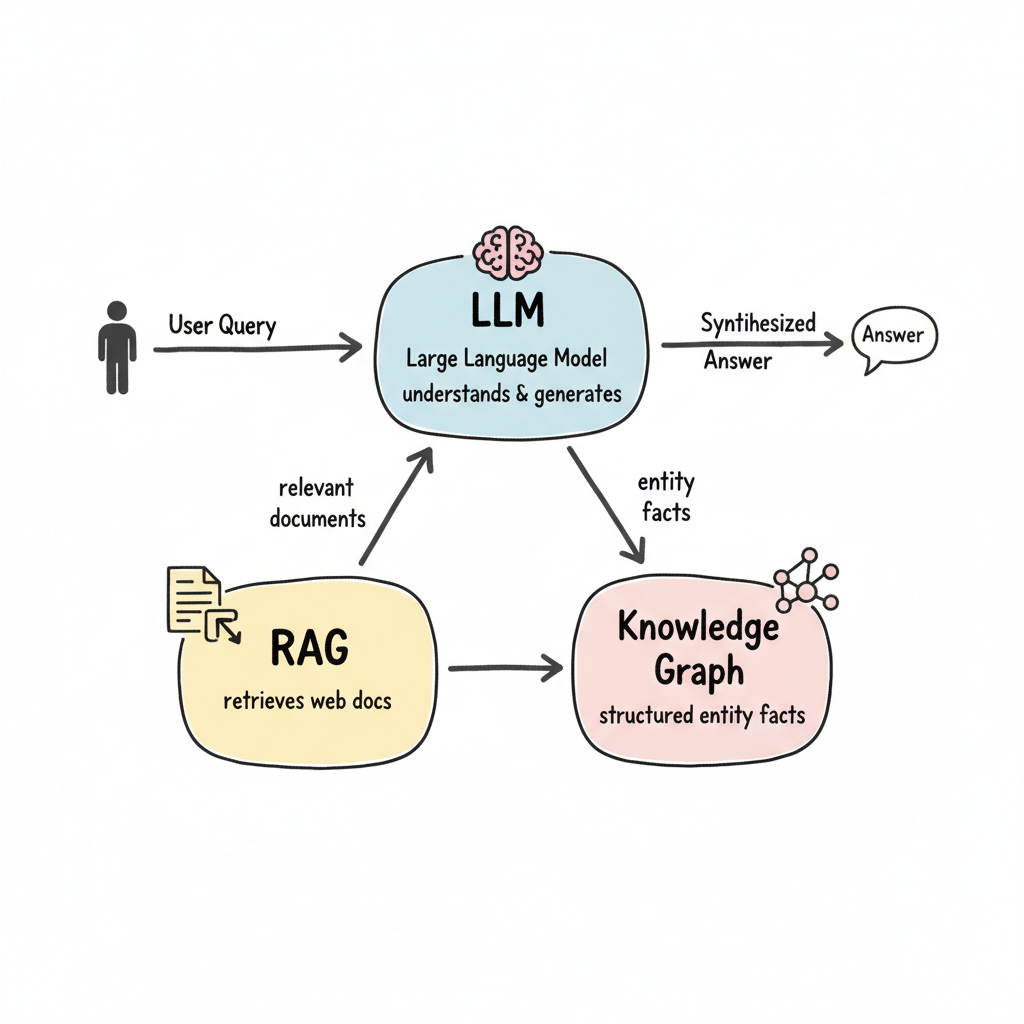
Understanding the technology behind AI search engines helps you optimize content more effectively. Three core technologies power modern AI search, and mastering them is crucial for generative search engine optimization.
Large Language Models (Llms)
LLMs form the brain of AI search engines. These neural networks, trained on vast text corpora, understand language patterns, context, and meaning at a sophisticated level.
How LLMs Process Search Queries:
- Tokenization: Query broken into processable units
- Embedding: Tokens converted to numerical vectors
- Attention Mechanism: Model weighs importance of different query elements
- Generation: Response produced token by token
Major LLMs powering search in 2026:
- GPT-4o and GPT-4.5 (OpenAI/ChatGPT Search)
- Gemini Ultra (Google AI Overviews)
- Claude 3.5 (Perplexity integration)
- Llama 3 (Meta AI, You.com)
Retrieval-Augmented Generation (RAG)
RAG architecture solves a critical LLM limitation: knowledge cutoffs. Pure LLMs only know information from their training data. RAG augments this by retrieving current, relevant information at query time.
RAG Workflow:
User Query → Retrieval System → Relevant Documents → LLM Processing → Synthesized AnswerComponents of RAG Systems:
- Query Processing: Understanding and potentially reformulating the user's question
- Document Retrieval: Finding relevant sources from indexed web content
- Context Window Management: Selecting which retrieved content to include
- Answer Generation: LLM synthesizes response from retrieved context
- Citation Attribution: Linking claims to source documents
This is why AI search engines can provide current information—they're not just relying on pre-trained knowledge but actively retrieving and synthesizing web content.
Knowledge Graphs
Knowledge graphs structure information as interconnected entities and relationships, providing AI search engines with a semantic understanding of the world. This technology underpins effective Wikipedia and Wikidata knowledge graph integration strategies.
Structure of Knowledge Graphs:
- Entities: People, places, organizations, concepts
- Attributes: Properties of entities (founding date, location, etc.)
- Relationships: Connections between entities (CEO of, located in, related to)
Google's Knowledge Graph, launched in 2012, contains billions of facts about millions of entities. AI search engines leverage these structured databases to:
- Understand entity mentions in queries and content
- Verify factual accuracy of generated responses
- Provide rich, contextual information panels
- Connect related topics and concepts
For SEO, this means your content must align with how knowledge graphs represent entities in your industry.
How AI Search Engines Actually Work: From BERT to RAG
While the previous section covered the three core technology pillars, understanding the specific architectures and models that power AI search retrieval is essential for creating content that these systems can effectively parse and cite.
Transformer Architecture & BERT
The transformer architecture, introduced in 2017, revolutionized how machines process language by enabling parallel processing of entire text sequences rather than reading words one at a time. BERT (Bidirectional Encoder Representations from Transformers), released by Google in 2018, applied this architecture to search by introducing bidirectional context understanding—meaning it reads text in both directions simultaneously to grasp the full meaning of a query. Google integrated BERT into search in 2019, and it remains foundational to query interpretation even as newer transformer models like GPT-4o and Gemini Ultra handle the generative response side. For content creators, this means AI search engines understand the semantic relationships between words in your content, not just the keywords themselves. To learn more about BERT and its impact on SEO, see our dedicated guide.
Vector Embeddings & Semantic Retrieval
Vector embeddings are numerical representations of meaning that allow AI search engines to understand content at a conceptual level rather than through literal keyword matching. When a user submits a query, the AI search engine converts both the query and indexed documents into high-dimensional vectors—arrays of numbers that capture semantic meaning. The system then uses cosine similarity to identify which documents are closest in meaning to the query, even if they share no exact keywords. This is the mechanism that powers the retrieval step in RAG architecture: before the LLM generates an answer, the vector search system identifies the most semantically relevant sources from billions of indexed pages. For SEO, this means content built around comprehensive topic coverage and clear entity relationships outperforms keyword-stuffed pages, because vector search rewards meaning over repetition. Modern AI search platforms also leverage distributed indexing across large-scale vector databases to process these similarity calculations at speeds measured in milliseconds.
Top AI Search Engines in 2026 (Perplexity, ChatGPT, You.Com, Felo)
The AI search landscape has consolidated around several key players, each with distinct approaches and capabilities. Understanding these platforms is essential for developing universal AI search tactics.
Perplexity AI
Launch: 2022 Monthly Active Users (2026): 100+ million Key Differentiator: Citation-first approach
Perplexity has emerged as the leading pure-play AI search engine by prioritizing source attribution. Every claim includes inline citations, building trust through transparency. Learn more about optimizing for this platform in our Perplexity AI search engine review and our detailed Perplexity AI optimization strategy.
Features:
- Pro Search for complex, multi-step queries
- Focus modes (Academic, Writing, Wolfram, YouTube)
- Collections for organizing research
- Threads for follow-up conversations
- Real-time web search integration
- Image and file upload capability
SEO Implications: Perplexity heavily favors authoritative, well-structured content with clear factual claims. The platform indexes and cites content that demonstrates expertise and provides unique information value.
ChatGPT Search (SearchGPT)
Launch: Late 2024 (wide release) Monthly Active Users (2026): 200+ million (ChatGPT total) Key Differentiator: Seamless integration with conversational AI
OpenAI's ChatGPT Search integrates web search directly into the conversational interface users already know. Released with real-time browsing capabilities, it combines GPT-4's reasoning with fresh web data. Our comprehensive SearchGPT optimization guide covers advanced tactics.
Features:
- Real-time web browsing within conversations
- Visual search results with image previews
- Publisher partnerships for premium content access
- Deep integration with existing ChatGPT workflows
- Voice search through mobile apps
SEO Implications: ChatGPT Search surfaces authoritative sources prominently and appears to favor content with clear structure, comprehensive coverage, and established domain authority. For more on ChatGPT-specific optimization, see our ChatGPT SEO guide.
Google AI Overviews (Formerly SGE)
Launch: May 2024 (general availability) Coverage: 26%+ of search queries (expanding in 2026) Key Differentiator: Integration with traditional search ecosystem
Google AI Overviews represent the tech giant's integration of generative AI into its core search product. Powered by Google Gemini, AI Overviews now appear for approximately 30% of search queries and synthesize answers from multiple authoritative sources. Being cited requires concise, well-structured, factually accurate content that demonstrates clear E-E-A-T signals. Rather than replacing traditional results, AI Overviews appear above them for qualifying queries. Understanding how Google selects AI Overview sources and AI Overview source selection criteria is critical for visibility.
Features:
- Synthesized answers from multiple sources
- Expandable panels with source citations
- Follow-up question suggestions
- Integration with Knowledge Panels
- Shopping and local information integration
SEO Implications: Data shows pages ranking in top 35 organic positions have higher inclusion rates in AI Overviews. E-E-A-T signals appear critical—Google prioritizes authoritative, experienced sources. Explore Google AI Overview optimization tips for detailed strategies.
You.Com
Launch: 2021 Key Differentiator: Multi-mode search with user control
You.com offers unique flexibility, letting users switch between AI chat, traditional search, and specialized modes. Our You.com AI search optimization strategy guide provides platform-specific tactics.
Features:
- YouChat for conversational AI search
- YouWrite for AI-assisted writing
- YouImagine for image generation
- YouCode for programming assistance
- Privacy-focused modes
- Customizable source preferences
Felo AI
Launch: 2023 Key Differentiator: Multilingual AI search
Felo AI targets the global market with strong multilingual capabilities, particularly excelling at Chinese-English cross-language search.
Features:
- Real-time translation in search
- Cross-language source synthesis
- Voice search in multiple languages
- Academic research focus
- Mobile-first design
Emerging AI Search Platforms to Watch
Beyond the established players, several newer AI search engines are gaining traction and earning visibility in Google's own search results:
- Komo AI is a community-driven AI search engine that combines chat, explore, and search modes into a single interface. It has gained notable visibility by appearing in Google Related Searches for AI search engine queries, signaling growing user interest. Komo's explore mode encourages users to discover topics collaboratively, making it a unique blend of search and social discovery.
- Andi Search takes a visual, ad-free approach to AI search. Rather than generating text from scratch, Andi reads web pages like a human and generates concise answers accompanied by source cards that let users verify claims instantly. It has been cited in Google AI Overviews as an example of next-generation search interfaces.
- Google Gemini (gemini.google.com) has evolved beyond a standalone LLM into a full conversational search platform that competes directly with Perplexity AI for users seeking synthesized, multi-source answers. With deep integration into Gmail, Drive, and the broader Google ecosystem, Gemini represents Google's most direct response to the conversational AI search trend.
Other Notable AI Search Platforms
- Microsoft Copilot: Bing integration with GPT-4
- Brave Search with Leo: Privacy-focused AI search
- Phind: Developer-focused code search
- Consensus: Scientific research synthesis
- Arc Search: Mobile AI browser
AI Search Engine Comparison Table
With so many AI search platforms available, choosing the right one depends on your specific needs. The following comparison highlights the key differentiators across the leading platforms, many of which offer a freemium model with generous free tiers:
Platform | Best For | Free Tier | Citation Support | Unique Strength |
Perplexity AI | General research | Yes (generous) | Inline citations | Citation-first transparency |
ChatGPT Search | Conversational search | Yes (limited) | Source links | GPT-4 reasoning depth |
Google Gemini | Ecosystem integration | Yes | Source cards | Gmail/Drive integration |
You.com | Multi-mode flexibility | Yes | Source panels | User-controlled modes |
Komo AI | Community exploration | Yes | Source links | Social discovery features |
Andi Search | Visual, ad-free search | Yes (fully free) | Source cards | Page-reading AI approach |
Consensus | Academic research | Yes (limited) | Paper citations | Peer-reviewed paper focus |
Phind | Developer/code search | Yes | Code source links | Programming-optimized |
AI Search Engines for Academic Research
Academic research represents one of the most impactful use cases for AI search engines, where the ability to synthesize findings across thousands of papers provides genuine time savings over traditional literature review methods.
Consensus has established itself as the leading research-focused AI search engine by exclusively searching peer-reviewed scientific papers and using AI to synthesize findings across studies. For researchers asking questions like "Does intermittent fasting improve metabolic health?" Consensus provides evidence-based answers drawn directly from published literature, complete with citation counts and study quality indicators.
iAsk is another source-based AI search engine well-suited for students and researchers who need cited, ad-free answers without the noise of commercial content. iAsk draws from authoritative academic and educational sources, making it particularly valuable for undergraduate research and fact-checking assignments.
Semantic Scholar, developed by the Allen Institute for AI, uses vector embeddings to power paper discovery—allowing researchers to find semantically related studies even when different terminology is used across disciplines. This addresses a longstanding challenge in academic search where the same concept may be described using entirely different language in biology versus computer science.
For all research-focused AI search, the demand for accuracy is highest. Fact-checking AI-generated summaries against original papers remains essential, as even citation-backed platforms can misrepresent nuances in study conclusions.
AI Search vs Traditional Search: Key Differences
Understanding the fundamental differences between AI and traditional search helps inform optimization strategies. Our traditional SEO vs AI search optimization comparison explores these distinctions in depth.
Query Processing
Aspect | Traditional Search | AI-Powered Search |
Query Understanding | Keyword matching | Semantic understanding |
Intent Recognition | Basic categorization | Nuanced interpretation |
Context Handling | Session-based | Conversational memory |
Query Refinement | Spelling suggestions | Full query reformulation |
Results Presentation
Aspect | Traditional Search | AI-Powered Search |
Primary Format | Blue links | Synthesized answers |
Information Density | 10 results per page | Single comprehensive answer |
Source Attribution | Implicit (via links) | Explicit (inline citations) |
Follow-up | New search required | Conversational continuation |
User Behavior Implications
Traditional Search User Journey:
- Enter query
- Scan multiple results
- Click through to pages
- Synthesize information manually
- Return to search if needed
AI Search User Journey:
- Enter conversational query
- Receive synthesized answer
- Ask follow-up questions
- Click citations for deeper information
- Continue conversation as needed
This shift dramatically changes how content gets discovered and consumed. Click-through rates from AI search differ significantly from traditional SERP behavior, as detailed in our AI search conversion optimization guide.
Impact on Website Traffic
Research indicates AI search engines can reduce click-through to source websites while simultaneously increasing the value of each visit. Users who do click through from AI search often have higher intent and engagement.
Key metrics shifts:
- Overall CTR: Potentially lower for informational queries
- Qualified Traffic: Higher intent visitors
- Brand Exposure: Increased through citations
- Zero-Click: More common for simple queries
Limitations and Risks of AI Search Engines
While AI search engines offer significant advantages in speed and synthesis, they also introduce risks that users and SEO professionals must understand. Recognizing these limitations is essential for both consuming and optimizing content for AI-driven platforms.
Hallucination & Accuracy Concerns
Hallucination occurs when an AI search engine generates a response that sounds plausible and confident but is factually incorrect. This happens because large language models predict the most probable next token in a sequence rather than verifying facts against a ground-truth database. Even leading platforms like Perplexity AI and ChatGPT Search can produce hallucinated citations—referencing sources that do not actually support the claims made, or in some cases citing sources that do not exist at all. The risk is particularly acute for YMYL (Your Money or Your Life) topics such as medical advice, financial planning, and legal guidance, where incorrect information can cause real harm. Users should always verify AI-generated answers against primary sources before making decisions based on them.
Data Bias & Training Set Limitations
AI search engines inherit biases present in their training data, which can lead to skewed or unbalanced results for certain queries. If the training corpus overrepresents certain viewpoints, geographies, or demographics, the AI's synthesized answers will reflect those same imbalances. Data bias in AI is particularly concerning in news, health, and financial search contexts, where balanced representation of perspectives matters most. For example, health-related queries may surface information biased toward Western medical practices, underrepresenting traditional or alternative approaches studied extensively in other regions. SEO professionals should be aware that AI systems may underweight content from underrepresented sources, making diverse sourcing and inclusive content strategies even more important.
Fact-Checking in AI Search
Several AI search platforms have implemented mechanisms to address accuracy concerns. Perplexity AI and Consensus lead this effort by providing citation-backed answers where every claim links to a verifiable source. Perplexity's inline citations allow users to click through to the original content, while Consensus restricts its sources to peer-reviewed academic papers. However, even citation-backed platforms can misrepresent source material by oversimplifying nuanced findings or taking statements out of context. Ultimately, fact-checking remains a user responsibility—AI search engines are powerful synthesis tools, not infallible oracles.
SEO for AI-Powered Search Engines: Complete Strategy
Optimizing for AI-powered search requires adapting traditional SEO practices while adopting new approaches specific to AI systems. Implementing comprehensive AEO optimization strategies is essential for success.
Foundation: E-E-A-T Optimization
Google's E-E-A-T framework (Experience, Expertise, Authoritativeness, Trustworthiness) has become even more critical for AI search. AI systems prioritize sourcing from authoritative voices.
Experience Signals:
- First-person case studies and examples
- Original research and data
- Practitioner perspectives
- Real-world application examples
Expertise Signals:
- Author credentials and bios
- Technical depth in content
- Industry-specific terminology used correctly
- Citations to authoritative sources
Authoritativeness Signals:
- Domain reputation and history
- Quality backlink profile
- Brand mentions across the web
- Industry recognition and awards
Trustworthiness Signals:
- Factual accuracy
- Transparent sourcing
- Clear editorial policies
- Updated, current information
Content Structure for AI Parsing
AI systems process content differently than traditional crawlers. Structure your content for AI comprehension, following on-page AEO optimization best practices.
Clear Hierarchical Structure:
H1: Main Topic (Primary Keyword)
  H2: Subtopic 1
    H3: Detail 1.1
    H3: Detail 1.2
  H2: Subtopic 2
    H3: Detail 2.1
Direct Answer Patterns: Position clear, direct answers early in sections. AI systems often pull initial sentences as answer candidates.
Example:
"The average cost of Reddit advertising in 2026 ranges from $0.50 to $5.00 per click, depending on targeting and competition."
Structured Data Formats:
- Tables for comparisons (see table featured snippets optimization)
- Bullet points for lists (explore list-based featured snippets)
- Numbered steps for processes
- Definition formats for terms
Topical Authority Building
AI search engines favor comprehensive coverage of topics over thin, keyword-stuffed pages.
Cluster Content Strategy:
- Create comprehensive pillar pages covering broad topics
- Develop cluster articles addressing specific subtopics
- Interlink systematically between pillar and clusters
- Update regularly to maintain freshness
Content Depth Requirements:
- Cover all relevant subtopics
- Address common questions
- Include practical examples
- Provide unique insights or data
Understanding content depth vs brevity for answer engines helps strike the right balance.
How to Optimize for AI Search Engines
AI search engines evaluate E-E-A-T signals differently from traditional search crawlers. Rather than relying primarily on backlinks and keyword density, AI systems look for citable claims backed by data, structured data markup that explicitly defines entities and relationships, and entity-rich content that demonstrates deep topical understanding. Building topical authority through content clusters—where a pillar page links to and from multiple related articles—helps LLMs associate your domain with a specific topic, increasing the likelihood of citation across AI search platforms. For a detailed playbook, see our guide on AI search ranking factors.
Citation Optimization
Since AI search engines cite sources explicitly, optimizing for citation potential is crucial. Learn more about AI Overview citation analysis to improve your visibility.
Strategies for Citation:
- Create quotable statistics and data points
- Develop unique frameworks and methodologies
- Produce original research others will reference
- Write clear, factual statements suitable for direct citation
- Structure information in easily extractable formats
Technical SEO for AI
Technical factors affect AI search visibility. Conducting an AEO technical audit helps identify optimization opportunities.
Crawlability:
- Ensure AI crawlers can access content (many use different user agents)
- Implement proper robots.txt directives
- Provide XML sitemaps
- Use semantic HTML markup
Page Experience:
- Core Web Vitals optimization
- Mobile-first design (see mobile AEO optimization)
- Secure HTTPS implementation
- Accessible design patterns
Schema Markup:
- Organization schema
- Article schema with author information (explore article schema for AI platforms)
- FAQ schema for questions
- HowTo schema for tutorials
- Review schema where applicable
- Use
sameAsandmentionsproperties to explicitly connect your content to known entities (such as BERT, vector embeddings, Perplexity AI, and Google Gemini), improving entity recognition by AI systems. For implementation details, see our guide on structured data for AI search.
AI SEO Software Tools: Features & Selection Guide
The AI SEO software market has exploded with tools designed to help optimize for both traditional and AI search. Our comprehensive guide to the best AI SEO tools provides detailed comparisons.
All-In-One Platforms
Semrush
- Comprehensive keyword research
- Competitive analysis
- Content optimization tools
- Rank tracking across search engines
- AI Writing Assistant integration
- Best For: Agencies and enterprise teams needing full-suite capabilities
Ahrefs
- Industry-leading backlink analysis
- Content gap identification
- Rank tracking
- Site audit capabilities
- Best For: Link building and competitive analysis focus
SE Ranking
- Affordable all-in-one solution
- AI content tools
- Local SEO features
- White-label reporting
- Best For: SMBs and smaller agencies
AI Content Optimization Tools
Surfer SEO
- AI-powered content editor
- NLP-based optimization scores
- SERP analyzer
- Content planner
- Audit functionality
- Pricing: $89-$299/month
- Best For: Content teams focused on on-page optimization
For in-depth comparisons, see our Surfer SEO vs Clearscope analysis.
Clearscope
- Enterprise content optimization
- Content grading system
- Competitive content analysis
- Workflow integrations
- Pricing: $170-$1,200/month
- Best For: Enterprise content teams
Frase
- AI content briefs
- Answer engine optimization
- Content scoring
- SERP research
- Pricing: $15-$115/month
- Best For: Content strategy and brief creation
MarketMuse
- AI content planning
- Topic modeling
- Content inventory analysis
- Competitive gap analysis
- Best For: Large content operations
Our MarketMuse review provides detailed insights into this platform.
AI Search Visibility Tools
A new category has emerged specifically for tracking AI search performance:
OmniSEO
- AI Overview tracking
- Citation monitoring across AI platforms
- Brand mention tracking in AI responses
- Focus: Holistic AI search visibility
Otterly.AI
- AI search answer tracking
- Competitive AI visibility analysis
- Historical AI response tracking
- Focus: Monitoring brand mentions in AI search
Profound
- AI chatbot monitoring
- Brand perception in AI
- Competitive intelligence
- Focus: Enterprise AI brand monitoring
Ahrefs Brand Radar
- AI mention tracking
- Traditional brand monitoring
- Competitive visibility
- Focus: Combined traditional and AI visibility
Learn more about tracking AI Overview performance with these tools.
Tool Selection Framework
When choosing AI SEO tools, consider:
- Primary Use Case: Content optimization vs. technical SEO vs. AI visibility
- Team Size: Enterprise features vs. individual tools
- Budget: Entry-level options vs. full-suite platforms
- Integration Needs: Existing workflow and tool compatibility
- AI Search Focus: Traditional SEO vs. AI-specific optimization
Our AI SEO software guide and AEO software guide provide comprehensive selection frameworks. For mid-market solutions, explore our mid-tier AI SEO software recommendations.
Recommended Tool Stacks
Solo Practitioners/Small Teams:
- Surfer SEO (content) + Ahrefs Lite (links) + Otterly.AI (AI tracking)
Mid-Size Teams:
- Semrush (all-in-one) + Clearscope (content) + Profound (AI monitoring)
Enterprise:
- Full Semrush or Ahrefs suite + MarketMuse + custom AI tracking solution
For automation-focused workflows, see our SEO automation tools guide.
Knowledge Graph Optimization for AI Search
Knowledge graphs provide the semantic foundation AI search engines use to understand entities and relationships. Optimizing for knowledge graphs improves AI search visibility. Our comprehensive Google Knowledge Graph optimization guide covers advanced strategies.
Understanding Entity SEO
Entity SEO focuses on establishing your brand, products, and key concepts as recognized entities within knowledge graphs.
Entity Components:
- Name: Primary identifier
- Type: Category (organization, person, product)
- Attributes: Properties and characteristics
- Relationships: Connections to other entities
Establishing Entity Presence
Step 1: Claim and Optimize Knowledge Panel Triggers
- Google Business Profile
- Wikipedia (if notable enough)
- Wikidata entries
- Industry databases
Addressing Google Knowledge Panel errors is crucial for maintaining accurate entity representation.
Step 2: Consistent NAP Information
- Name, Address, Phone consistency across web
- Structured data on website
- Directory listings alignment
Step 3: Entity Attributes in Content
- Clear, factual statements about your entity
- Founding date, leadership, location
- Products, services, achievements
- Industry categorization
Schema Markup for Entity Recognition
Implement comprehensive schema markup:
{
  "@context": "https://schema.org",
  "@type": "Organization",
  "name": "Your Company Name",
  "url": "https://yourcompany.com",
  "logo": "https://yourcompany.com/logo.png",
  "foundingDate": "2015",
  "founder": {
    "@type": "Person",
    "name": "Founder Name"
  },
  "address": {
    "@type": "PostalAddress",
    "streetAddress": "123 Business St",
    "addressLocality": "City",
    "addressRegion": "State",
    "postalCode": "12345",
    "addressCountry": "US"
  },
  "sameAs": [
    "https://twitter.com/yourcompany",
    "https://linkedin.com/company/yourcompany",
    "https://facebook.com/yourcompany"
  ]
}
Strengthen entity associations through:
- Co-occurrence: Mention related entities contextually
- Structured Relationships: Define relationships in schema
- Authoritative Links: Earn links from entities in your knowledge graph
- Content Hubs: Create comprehensive content around your entity's topic area
Measuring Entity Strength
Indicators of entity recognition:
- Knowledge Panel appearance in Google
- Entity-based search triggers
- AI search engine citations by entity name
- Rich results for entity queries
Google AI Overviews: Impact & Optimization
Google AI Overviews (formerly SGE) represent the most significant change to Google Search in its history. Understanding and optimizing for AI Overviews is essential for 2026 SEO. Our complete Google AI Overviews optimization resource provides comprehensive strategies.
Current AI Overview Statistics (2026)
Based on latest research and AI-powered search engine statistics:
- Query Coverage: 26%+ of searches trigger AI Overviews (expanding)
- Query Types: 59% informational, 19% commercial intent
- Ranking Correlation: Top 35 organic positions correlated with AI Overview inclusion
- Citation Patterns: Average 4-8 sources cited per AI Overview
Which Queries Trigger AI Overviews?
High AI Overview Likelihood:
- Informational queries ("how to," "what is")
- Comparison queries ("X vs Y")
- List queries ("best tools for")
- Definition queries
- Process explanations
Lower AI Overview Likelihood:
- Navigational queries
- Simple factual queries (knowledge panel coverage)
- Highly sensitive topics (YMYL with medical/legal implications)
- Current events (in some cases)
Understanding Google AI mode vs AI Overview distinctions helps target the right features. Additionally, explore Google AI Overview mobile vs desktop differences for device-specific optimization.
Optimization Strategies for AI Overviews
1. Target Information Synthesis Queries Create content that comprehensively answers questions AI Overviews aim to synthesize.
2. Structure for Direct Answers Position clear, direct answers within the first paragraph of relevant sections, following AI Overview content requirements.
3. Provide Unique Value Include information, data, or perspectives not available elsewhere—this creates citation opportunities.
4. Optimize for Featured Snippet Patterns Content that wins featured snippets often gets cited in AI Overviews:
- Clear definitions
- Step-by-step processes
- Comparison tables
- Bulleted lists
For keyword-specific tactics, see our guide on long-tail keywords for featured snippet success.
5. Build Topical Authority Create comprehensive content clusters demonstrating expertise in your domain.
6. Maintain Factual Accuracy AI Overviews appear to verify information across sources. Ensure accuracy to avoid exclusion.
Monitoring AI Overview Performance
Track your AI Overview visibility:
- Manual searches for target queries
- Third-party AI Overview tracking tools
- Citation monitoring across AI platforms
- Traffic pattern analysis for AI-impacted queries
For those who prefer to opt out, explore block AI Overview extensions. If you want to enable the feature, see how to turn on Google AI Overviews.
AI Search Engine Statistics & Market Trends
Understanding the AI search market landscape helps inform strategic decisions. For detailed data, see our AI-powered search features analysis.
Market Size and Growth
AI Search Market (2026):
- Global AI search market: estimated at $12.5 billion (growing 28% annually)
- Enterprise AI search adoption: 47% of Fortune 500 companies
- Consumer AI search usage: 38% of internet users have tried at least one AI search platform
For enterprise-specific insights, explore enterprise AI search Copilot and Copilot enterprise security considerations.
Platform-Specific Statistics
Perplexity AI:
- Monthly Active Users: 100+ million
- Daily Queries: 15+ million
- Year-over-year growth: 300%+
ChatGPT (including Search):
- Monthly Active Users: 200+ million
- Search feature adoption: 42% of active users
- Primary use cases: Research (45%), Writing (30%), Code (25%)
Google AI Overviews:
- Query coverage: 26%+ (expanding to an estimated 30% by mid-2026)
- Click-through impact: Varies by query type
- User satisfaction scores: 71% positive
For international considerations, see Google AI Overview international and Google AI Overview international regional guides.
User Behavior Trends
How Users Interact with AI Search (2026):
- Average queries per session: 4.2 (vs 1.8 traditional search)
- Follow-up question rate: 67%
- Citation click-through rate: 23%
- Session duration: 8.3 minutes average
Query Type Distribution:
- Research/learning: 45%
- Product research: 25%
- Problem-solving: 20%
- Navigation/finding: 10%
Voice-based interactions are also growing; see our voice search optimization for answer engines and voice search AEO optimization guides.
Enterprise Adoption
Businesses are increasingly using AI search tools:
- Internal knowledge search
- Customer support integration
- Research and competitive intelligence
- Content creation assistance
Future of Search: What'S Next for AI & SEO
The AI search landscape continues to evolve rapidly. Understanding the history of AEO provides context for these emerging trends.
Emerging Technology Trends
Multimodal Search Expansion AI search engines are rapidly improving at processing images, video, audio, and documents alongside text. Expect:
- Visual search becoming mainstream
- Video content discovery through AI analysis
- Audio/podcast content indexing and search
- Document and PDF deep search
Agent-Based Search AI agents that can take actions on behalf of users represent the next frontier, driven by agentic AI tools:
- Booking and purchasing through search
- Complex multi-step research tasks
- Automated monitoring and alerts
- Personalized content curation
Personalization at Scale AI enables unprecedented personalization:
- Individual preference learning
- Context-aware results (location, history, preferences)
- Adaptive interface presentation
- Proactive information delivery
SEO Evolution Predictions
Content Quality Bar Rises As AI can easily generate mediocre content, truly valuable content becomes more important. Implementing AI content optimization and generative AI SEO optimization becomes essential:
- Original research and data
- Unique expert perspectives
- Real-world experience documentation
- Interactive and multimedia content
Entity Authority Increases Known entities will increasingly dominate AI search visibility:
- Brand building becomes essential
- Personal brand for content creators
- Industry recognition matters more
- Trust signals gain weight
Technical SEO Shifts
- Schema markup becomes mandatory
- AI-friendly content structuring
- New crawlability considerations
- Performance optimization for AI systems
Understanding the relationship between GEO vs SEO vs AI helps navigate these shifts. Additionally, exploring what is GEO search engine optimization, what is generative engine optimization GEO, and what does GEO stand for in marketing provides crucial context.
Preparing for the Future
Immediate Actions:
- Build entity presence across authoritative platforms
- Develop comprehensive, authoritative content
- Implement thorough schema markup
- Monitor AI search visibility
Medium-Term Strategy:
- Invest in original research and data
- Build expert contributor relationships
- Develop multimedia content capabilities
- Establish thought leadership
Long-Term Positioning:
- Build genuine topical authority
- Create defensible unique value
- Develop direct audience relationships
- Maintain adaptability in strategy
For specific industry applications, explore AEO for eCommerce and track AI search success metrics by industry.
Actionable Takeaways
For Immediate Implementation
- Audit Current AI Search Visibility
- Search your brand in Perplexity, ChatGPT, and Google AI Overviews
- Document current citation frequency and accuracy
- Identify competitors appearing in AI responses
Consider professional AEO audit services for comprehensive analysis.
- Optimize Existing Content
- Add clear, direct answers to key sections
- Implement comprehensive schema markup
- Ensure E-E-A-T signals are prominent
- Begin Entity Optimization
- Claim and optimize Google Business Profile
- Ensure consistent NAP across web
- Implement organization schema
For Strategic Planning
- Develop AI-First Content Strategy
- Create comprehensive pillar content
- Build topical clusters
- Focus on unique value creation
- Invest in Authority Building
- Publish original research
- Build expert contributor network
- Pursue industry recognition
- Implement Monitoring Systems
- Set up AI search tracking (see AEO metrics and KPIs)
- Monitor citation patterns
- Track competitive AI visibility
For platform comparisons, explore our AI search platform comparison, AI search platform selection framework, and AEO platform comparison guides.
Understanding Costs and Benefits
Before investing, review AEO optimization cost, AEO agency pricing and costs, and affordable AEO services options. Use our AEO ROI calculator to project returns. Understand AEO benefits and why it matters, weigh AEO challenges, and decide between in-house vs agency AEO. For career planning, see AEO specialist salary data.
Advanced Strategic Considerations
For businesses operating across search engines, explore Bing SEO vs Google SEO for AEO differences. Understand the nuances of GEO content optimization, GEO in SEO, GEO SEO combined strategy, GEO AI SEO, and GEO SEO generative engine optimization. Access specialized GEO tools for implementation.
Frequently Asked Questions About AI Search Engines
Which Is the Best AI-Powered Search Engine?
The best AI powered search engine depends on your use case. Perplexity AI excels at general research with citation-backed answers and a generous free tier. For academic research, Consensus searches peer-reviewed papers using AI. Google Gemini integrates directly with Google's ecosystem, making it ideal for users who want conversational search alongside Gmail and Drive. Developers often prefer Phind for code-specific queries. For a full breakdown, explore our Perplexity AI optimization strategy and AI search platform comparison.
Do AI Search Engines Hallucinate or Give Wrong Answers?
Yes, all AI search engines can hallucinate—generating confident but factually incorrect responses. This happens because large language models predict probable text rather than verifying facts. Platforms like Perplexity AI and Consensus mitigate this by providing source citations alongside answers, but users should always verify critical information, especially for medical, legal, or financial queries classified as YMYL topics.
How Do I Optimize My Website for AI Search Engines?
Optimizing for AI search engines requires a shift from keyword-focused SEO to entity-rich, authoritative content. Focus on building topical authority through content clusters, implementing structured data with schema markup, and creating concise answers to specific questions. Ensure your content includes citations, clear sourcing, and demonstrates E-E-A-T signals that AI systems use to determine which sources to cite in their answers. For a detailed playbook, see our answer engine optimization best practices.
Are AI Search Engines Replacing Google?
AI search engines are not replacing Google but are reshaping how people search. Google itself has integrated AI through Gemini-powered AI Overviews. Meanwhile, Perplexity AI, ChatGPT Search, and others serve as complementary tools for complex queries that benefit from synthesized answers. The shift is from ten blue links toward direct answers, which means SEO professionals must optimize for both traditional and AI-driven search experiences.
Conclusion
AI-powered search engines have fundamentally transformed how information is discovered and consumed online. In 2026, success requires understanding both the technology powering these systems and the optimization strategies that drive visibility within them.
The key principles remain constant: create genuinely valuable content, demonstrate authentic expertise, and build real authority in your domain. What's changed is how these qualities are measured and surfaced—AI systems are increasingly sophisticated at identifying and prioritizing truly authoritative sources.
For businesses and marketers, the opportunity is significant. Those who adapt their strategies for AI search will capture visibility as these platforms continue to grow. Those who don't risk becoming invisible in the search experiences that increasingly define how users find information.
Start with the fundamentals: optimize for E-E-A-T, implement proper technical SEO, and create content that genuinely serves user needs. Then expand into AI-specific optimizations: entity development, citation optimization, and AI visibility monitoring.
The future of search is AI-powered. The question is whether your content will be part of the answer.