
AI-powered search has evolved far beyond simple keyword matching. In 2026, search engines and AI assistants offer sophisticated capabilities that fundamentally change how we discover, verify, and use information. These AI-powered search features are a subset of the broader generative AI revolution, built on large language models (LLMs) trained via machine learning on massive text corpora. Understanding these features helps both users leverage them effectively and businesses optimize for visibility.
This guide covers the key AI search features available today and their practical applications.
How AI-Powered Search Actually Works: The Technology Stack
Before diving into specific platforms, it helps to understand the core technologies that power modern AI search.
From Keywords to Meaning -- Semantic Search
Semantic search represents the fundamental shift from lexical keyword matching to understanding query meaning. This shift is powered by natural language processing (NLP), which enables machines to parse human language through techniques like tokenization, entity recognition, and intent classification. At its core, AI search engines resolve search intent -- whether a query is informational, navigational, transactional, or commercial -- and deliver results accordingly.
The foundational breakthrough came with BERT, the transformer model that brought contextual understanding to Google Search in 2019. Rather than treating words in isolation, BERT analyzes words in relation to all other words in a sentence. This architecture class -- transformer models -- underpins virtually all modern AI search systems, from Google to Perplexity to ChatGPT.
Vector Embeddings and Retrieval-Augmented Generation (RAG)
Vector embeddings are numerical representations of meaning. Documents and queries are mapped into the same high-dimensional vector space, where similarity is measured by proximity. This is how AI search engines find conceptually relevant results even when exact keywords do not match.
Retrieval-augmented generation (RAG) is the architecture that combines retrieval (finding relevant documents via vector search) with generation (using an LLM to synthesize a coherent answer). When Perplexity or ChatGPT Search shows inline citations alongside a generated summary, RAG is the underlying mechanism making that possible. The LLMs powering the generation half of RAG are trained via machine learning on massive text corpora -- generative AI is the umbrella term for this category of technology.
The Feature Landscape: AI Search in 2026
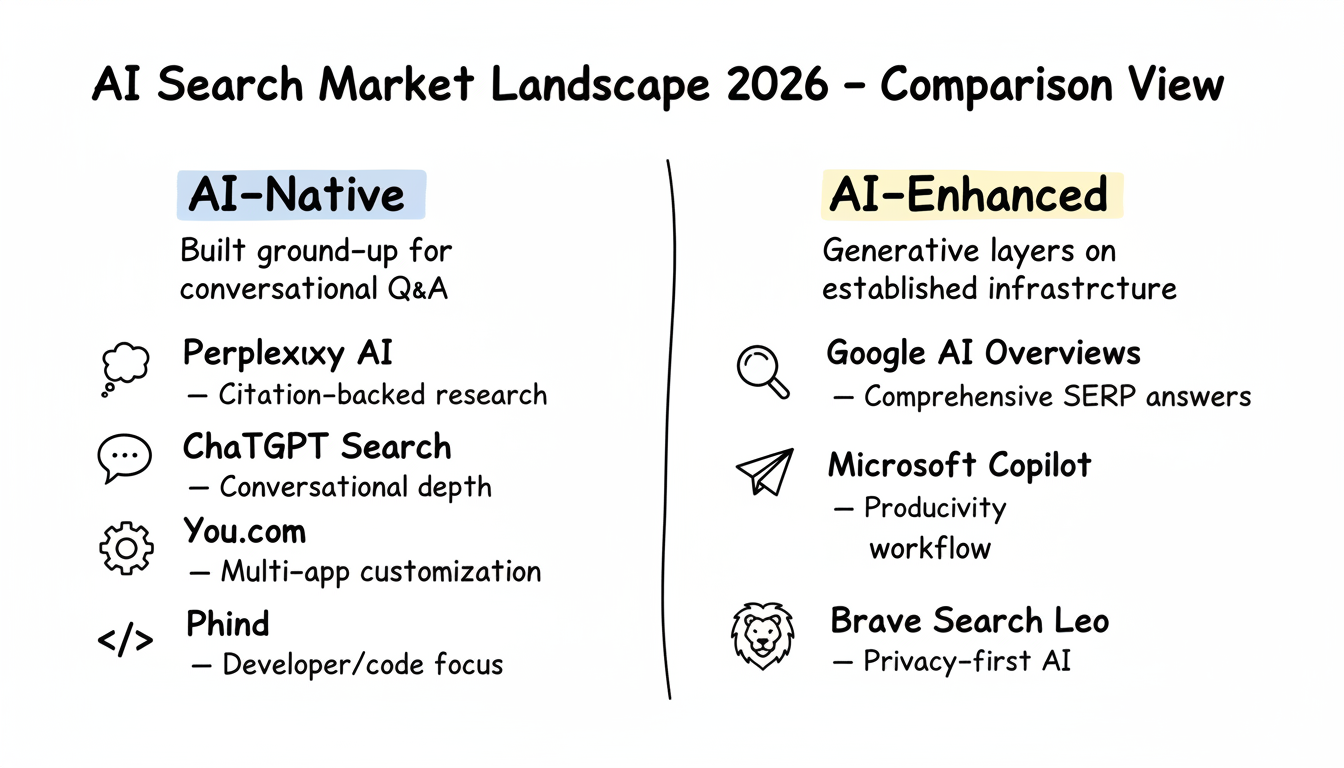
The AI search market has crystallized into distinct categories, each offering different feature sets.
AI-Native Answer Engines
Built from the ground up for conversational Q&A:
Platform | Primary Strength | Key Differentiator |
Perplexity AI | Citation-backed research | Source transparency |
ChatGPT Search | Conversational depth | GPT model reasoning |
Claude (Anthropic) | Reasoning and analysis | 200K-token context window, strong reasoning; powers search in platforms like DuckDuckGo AI Chat |
You.com | Customization | Multi-app interface |
Phind | Developer focus | Code-specific search |
AI-Enhanced Traditional Search
Generative layers integrated with established search infrastructure:
Platform | Integration Approach | Feature Focus |
Google AI Overviews | Embedded in SERP | Comprehensive answers |
Google Gemini | Multimodal LLM powering AI Overviews and AI Mode | Text, image, video, and code understanding |
Microsoft Copilot | Bing integration | Productivity workflow |
Brave Search Leo | Privacy-first AI | Anonymous search |
Core AI Search Features
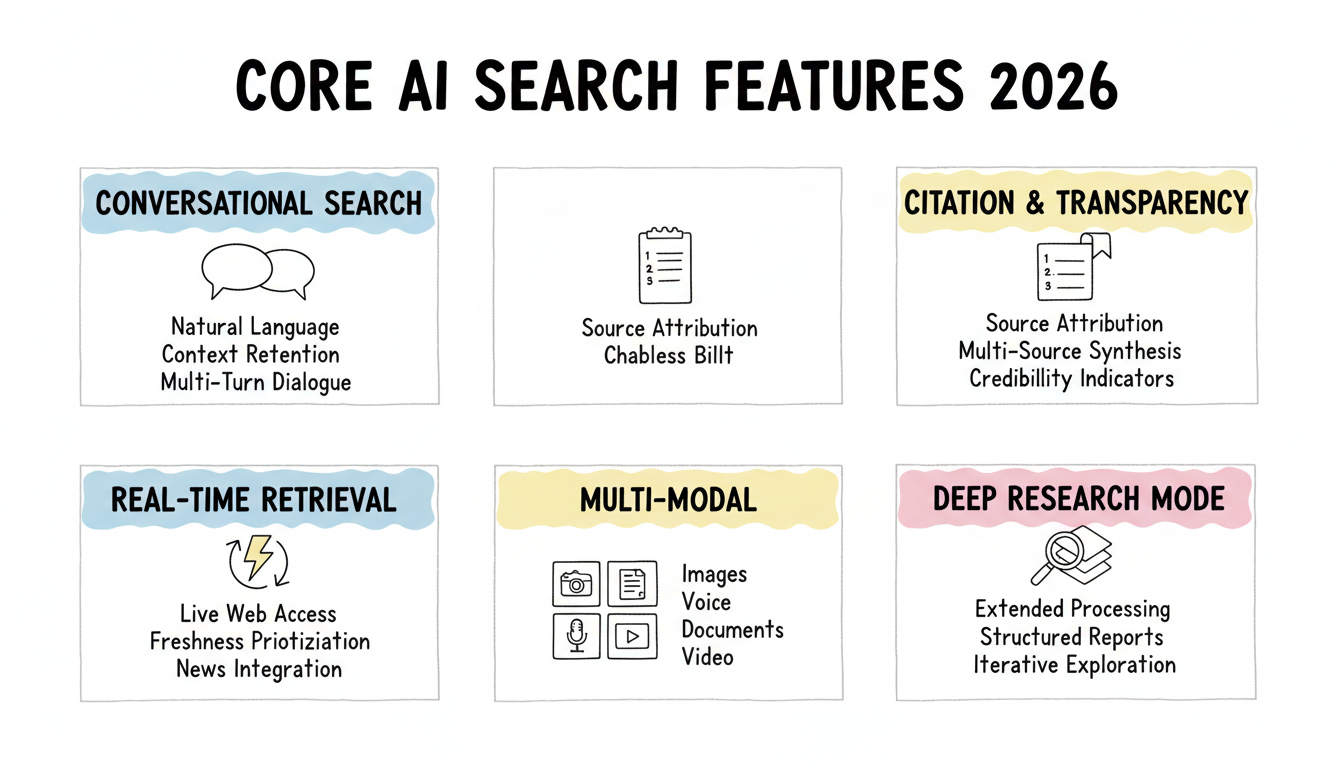
Conversational Search
Natural language queries have replaced keyword strings. Key capabilities include:
Context retention: AI remembers previous queries within a session, allowing follow-up questions without restating context.
Clarifying questions: Advanced systems ask for clarification to better understand intent before delivering answers.
Multi-turn dialogue: Users can refine and redirect searches through conversation rather than starting over.
Example use case: Instead of multiple searches like "best project management tools" → "project management tools for remote teams" → "Asana vs Monday comparison," users can have a single conversation exploring the topic.
Citation and Source Transparency
Modern AI search prioritizes verifiable information:
Source attribution: Answers include numbered citations linked to original sources. Users can click to verify claims.
Multi-source synthesis: AI pulls from dozens of sources to create comprehensive answers while showing which sources contributed.
Credibility indicators: Some platforms show source reputation or recency alongside citations.
This feature addresses the "black box" criticism of early AI systems, making responses trustworthy for research and professional use. Understanding Copilot citation patterns can help businesses optimize content for better visibility in AI-powered results.
Real-Time Information Retrieval
AI search now accesses current information:
Live web access: Responses reflect recent events, not just training data.
Freshness prioritization: Systems can weight recent sources for time-sensitive queries.
News integration: Current events and breaking news appear in relevant responses.
Multi-Modal Capabilities
AI search has expanded beyond text:
Modality | Capability | Use Case |
Image understanding | Analyze uploaded images | Visual search, product identification |
Image generation | Create visuals from descriptions | Content creation, visualization |
Voice interaction | Spoken queries and responses | Hands-free search |
Document processing | Analyze uploaded PDFs and files | Research, document comparison |
Deep Research Mode
Advanced research capabilities for complex queries:
Extended processing: Systems spend more time gathering and synthesizing information for thorough answers.
Structured reports: Outputs include organized sections, summaries, and comprehensive coverage.
Iterative exploration: AI explores multiple angles and sub-topics automatically.
Platform-Specific Feature Highlights
Google AI Overviews
Google's AI integration focuses on comprehensive answers within traditional search. Many factors influence how content appears in these AI-generated summaries, and understanding Google AI Overview ranking factors is crucial for maintaining visibility in this evolving search landscape. AI Overviews are powered by Gemini, Google's multimodal LLM, and content that earns featured snippets is disproportionately cited in these summaries. For a deeper look at the standalone conversational interface, see the section on Google AI Mode vs. AI Overviews below.
- AI-generated summaries at top of results
- Integration with Maps, Images, News
- Shopping recommendations in commercial queries
- Follow-up question suggestions
Perplexity AI
The leading citation-first research platform offers:
Perplexity uses a retrieval-augmented generation (RAG) architecture -- it retrieves relevant web pages via semantic search, then uses an LLM to synthesize and cite them in a coherent answer.
- Inline source citations (numbered references)
- Focus modes for different query types
- Copilot interactive search with clarifying questions
- File upload for document analysis (Pro)
- Image and video generation capabilities
ChatGPT Search
OpenAI's web-enabled search combines conversation with web grounding. ChatGPT Search is powered by GPT-4-class LLMs and uses real-time retrieval (a form of RAG) to ground responses in current web data, competing directly with Google's Gemini-powered features. Businesses looking to appear in ChatGPT results should explore ChatGPT SEO optimization strategies to ensure their content is discoverable and well-positioned.
- Deep conversational reasoning
- GPT model intelligence applied to search
- Multi-file upload and data analysis
- Custom GPTs for specialized search tasks
- Large context windows for complex queries
Microsoft Copilot
Deeply integrated with Microsoft productivity tools. Copilot leverages both OpenAI models and Microsoft's proprietary Prometheus model for Bing integration, and extends into enterprise knowledge management within Microsoft 365 -- bridging consumer and enterprise AI search.
- Bing search integration
- Office 365 workflow connections
- Enterprise data access
- Code assistance features
Google AI Mode vs. AI Overviews: What Marketers Need to Know
While Google AI Overviews appear as summary boxes atop traditional search results, Google AI Mode is a separate conversational search interface that allows multi-turn follow-up questions and deeper exploration. AI Mode launched as a dedicated tab within Google Search, offering an experience closer to ChatGPT than to the familiar ten blue links.
Both features are powered by Gemini, Google's multimodal LLM that replaced earlier PaLM-based systems. Gemini handles text, image, video, and code understanding, making both surfaces increasingly capable of answering complex queries.
For marketers, the key distinction matters: AI Overviews are passive (they appear automatically for relevant queries), while AI Mode is active (users opt in to a conversational experience). Traditional ranking factors still apply to both -- content that earns featured snippets and knowledge panels is more likely to be cited in AI-generated answers across both surfaces. Understanding how Google AI Overviews impact SEO is essential for adapting your strategy to these dual surfaces.
Use Cases by Feature
For Research and Learning
Best features: Citation systems, deep research mode, document analysis
Workflow: Use Perplexity or similar tools with citation transparency. Verify important claims by checking sources. Use deep research for comprehensive topic exploration.
For Business Intelligence
Best features: Real-time data, multi-source synthesis, structured outputs
Workflow: Query competitive landscape, industry trends, or market data. AI synthesizes information from multiple sources into actionable summaries.
For Content Creation
Best features: Conversational dialogue, context retention, multi-modal generation
Workflow: Use ChatGPT or similar for brainstorming, drafting, and refining. Leverage image generation for visual content.
For Technical Work
Best features: Code-specific search, documentation queries, debugging assistance
Workflow: Use Phind or similar developer-focused tools. Query technical documentation, get code examples, debug errors.
Evaluating AI Search Features
When choosing AI search tools, consider these criteria:
Factor | What to Evaluate |
Citation quality | Are sources credible and verifiable? |
Accuracy | Does the platform minimize hallucinations? |
Freshness | How current is the information? |
Privacy | What data is collected and retained? |
Integration | Does it connect with your workflows? |
Cost | Free tier limitations vs. paid features |
Feature Trade-Offs
No single platform excels at everything:
- Perplexity: Best citations, but less conversational depth
- ChatGPT: Best reasoning, but citations less prominent
- Google AI: Best integration, but less transparency
- Brave: Best privacy, but fewer advanced features
The Future: Features in Development
AI search features continue evolving:
Agentic capabilities: AI that executes tasks, not just answers questions. Booking travel, comparing options, completing workflows.
Proactive intelligence: Systems that surface relevant information without explicit queries.
Cross-platform integration: Seamless AI assistance across tools and devices.
Personalization: Responses tailored to user history, preferences, and context. As these technologies mature, organizations will need to track performance through comprehensive AEO measurement and tracking to understand their visibility across AI platforms.
Optimizing Your Site for AI Search Visibility
As AI search engines become primary discovery channels, optimizing your site for their crawlers and citation mechanisms is essential.
Structured Data and Schema Markup
Schema.org structured data gives AI search engines explicit signals about your content's entities, relationships, and type. Implementing key schema types -- Article, FAQPage, HowTo, Organization, BreadcrumbList -- helps your content surface in knowledge panels, featured snippets, and AI-generated citations. For a detailed walkthrough, see our guide on structured data for AI search, and review schema markup priorities for AEO to focus your implementation efforts.
Technical and Content Foundations
Core Web Vitals matter for AI search: fast-loading, visually stable pages are more likely to be crawled and cited by AI systems. Ensure mobile-first indexing parity, as all AI search crawlers index mobile versions of your site.
Content optimization and topical authority are equally critical. Depth and breadth of coverage on a topic cluster signals expertise to AI systems, increasing the likelihood of citation. Consider AB testing for AI search optimization to identify which content structures earn the most AI citations.
Use Google Search Console to monitor impressions from AI Overviews and track click-through rates as AI features reshape CTR patterns. User engagement signals like dwell time and low bounce rates reinforce content quality signals that AI systems factor into citation decisions. For a comprehensive monitoring approach, see our guide on AEO measurement and tracking.
FAQs
Which AI Search Platform Has the Best Features?
It depends on your use case. For research with verifiable sources, Perplexity leads. For deep reasoning and conversation, ChatGPT excels. For privacy, Brave Search is best. Most power users employ multiple tools.
Are AI Search Features Accurate?
Accuracy has improved significantly but varies by platform and query type. Citation-backed platforms allow verification. For important decisions, always check sources rather than trusting AI summaries alone.
How Much Do AI Search Features Cost?
Most platforms offer free tiers with limited usage. Premium plans typically run $15-20 per month, offering higher limits, better models, and advanced features like deep research and file upload.
Can AI Search Replace Traditional Search?
For informational queries, AI search often provides better answers faster. However, traditional search remains valuable for navigating to specific websites, finding local businesses, and accessing diverse perspectives beyond AI summaries.
What Are the Key Features of AI-Powered Search?
AI-powered search uses natural language processing, semantic search, and large language models to understand query intent rather than just matching keywords. Key features include conversational follow-ups, real-time web retrieval, source citations via retrieval-augmented generation (RAG), multimodal understanding (images, documents, code), and personalized results based on context.
How Does AI-Powered Search Differ from Traditional Search Engines?
Traditional search engines rank pages by keyword relevance and backlinks. AI-powered search goes further by using vector embeddings to understand meaning, synthesizing answers from multiple sources, and supporting multi-turn conversations. Instead of returning a list of links, AI search generates direct answers with inline citations.
What Is the Difference Between Google AI Overviews and Google AI Mode?
Google AI Overviews are AI-generated summary boxes that appear above traditional search results. Google AI Mode is a separate conversational interface powered by Gemini that supports follow-up questions and deeper exploration. Both pull from the same index but serve different user needs -- quick answers vs. extended research.
How Can I Optimize My Website for AI Search Engines?
Implement Schema.org structured data (Article, FAQPage, HowTo) so AI systems can parse your content's entities and relationships. Maintain strong Core Web Vitals, build topical authority through comprehensive content clusters, and monitor performance in Google Search Console. Content that earns featured snippets is more likely to be cited in AI-generated answers.