
AI-powered search tools have transformed how people find information. Traditional search engines that return link lists are giving way to AI systems that synthesize answers, cite sources, and engage in conversational research. For marketers, understanding these tools reveals where your audience searches and which platforms to optimize for.
This directory covers the major AI search tools of 2026, comparing features, use cases, and implications for visibility strategy.
The AI Search Landscape in 2026
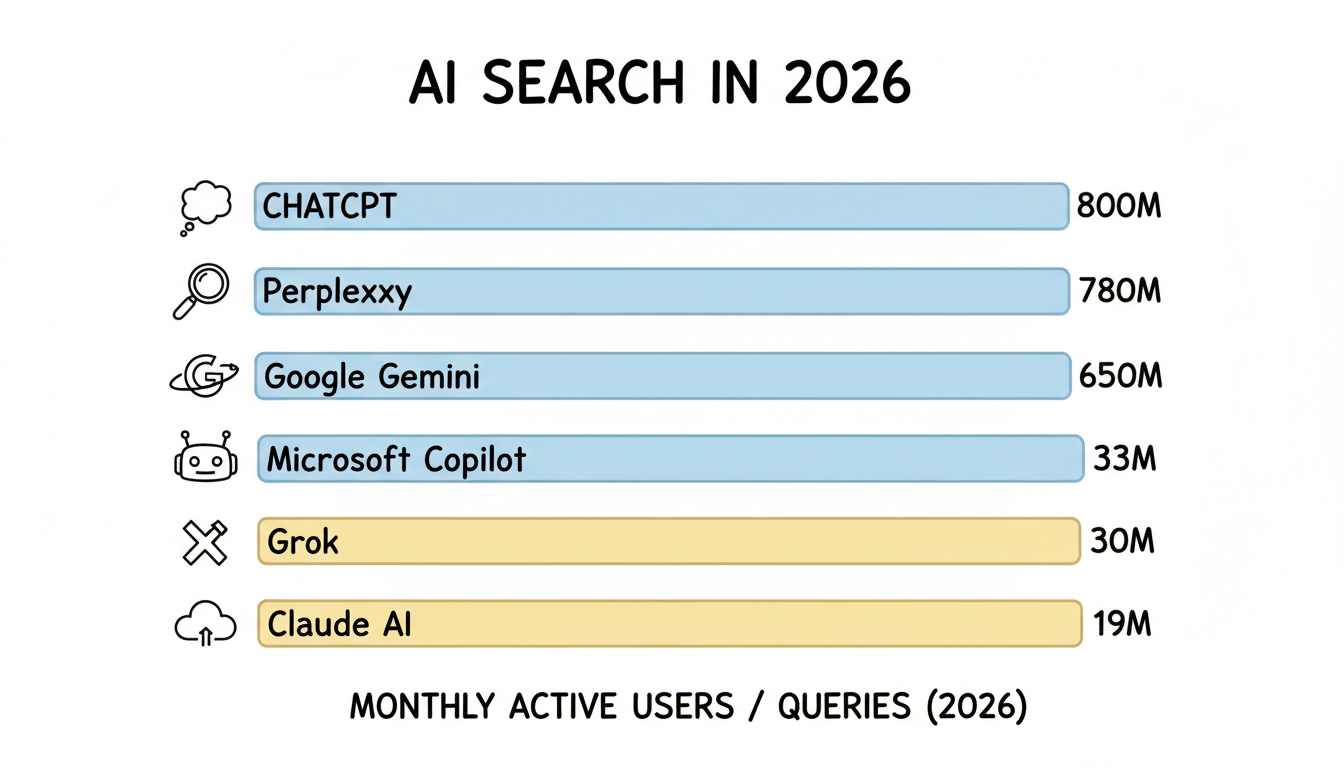
The market has expanded dramatically from early experiments to mainstream adoption. ChatGPT leads with approximately 800 million monthly active users, followed by Google Gemini at 650 million. Perplexity processes over 780 million monthly queries and has become a go-to alternative to traditional search for researchers.
These aren't just chatbots—they're becoming primary information interfaces that compete directly with Google for research, comparison, and discovery queries. Organizations building a comprehensive AI SEO strategy must now account for visibility across multiple platforms beyond traditional search engines.
How AI Search Engines Work: RAG, Vectors, and Semantic Search
Before diving into specific platforms, understanding how AI search engines work under the hood helps marketers optimize for them more effectively.
Most modern AI search engines rely on a technique called Retrieval-Augmented Generation (RAG). Instead of answering purely from memory, RAG-based systems first retrieve relevant documents from the web or an internal index, then feed those documents as context to a large language model that generates a synthesized answer. This two-step process—retrieve then generate—is why AI search responses include citations and can reference up-to-date information that wasn't in the model's training data.
The retrieval step uses vector embeddings and semantic search. When you type a query, the system converts your words into a numerical representation (a vector) that captures meaning, not just keywords. Documents in the index have already been converted into vectors the same way. The system then finds documents whose vectors are closest in meaning to your query—even if they don't share exact keywords. This is why a search for "best tools to track brand mentions in AI answers" can surface content about "AI visibility monitoring platforms" without those exact words appearing.
The generation step typically uses transformer-based models. BERT-style models handle understanding and retrieval, while GPT-style models handle response generation. The interplay between these architectures determines how well an AI search engine understands your query and how coherently it presents its answer.
The practical implication for marketers: because AI search matches on meaning rather than keywords, content structure, topical depth, and authoritative sourcing matter far more than keyword density. Building pages with clear entity definitions, comprehensive coverage, and proper structured data for AI search gives retrieval systems stronger signals. Investing in AI content optimization tools can help ensure your content is structured for these semantic retrieval systems.
Consumer AI Search Engines
ChatGPT Search
Developer: OpenAI
Pricing: Free tier available; Plus at $20/month
Monthly Users: ~800 million
ChatGPT has evolved from conversational AI to full search engine with ChatGPT Search integration. The GPT-4o model powers natural language understanding, while web search capabilities pull real-time information.
Key Strengths:
- Most advanced multi-turn reasoning capabilities
- Custom GPTs allow specialized search agents
- Operators feature enables technical and filtered searches
- Largest user base creates network effects
Best For: General research, complex multi-step queries, creative exploration, users wanting conversational depth.
Optimization Note: ChatGPT citations match Bing's top 10 results 87% of the time. Strong Bing visibility correlates with ChatGPT mentions.
Google Gemini
Developer: Google
Pricing: Free; Advanced at $20/month
Monthly Users: ~650 million
Gemini integrates Google's AI capabilities with its massive search index. AI Overviews now appear in approximately 15% of Google searches, making Gemini the most direct path from traditional SEO to AI visibility.
Key Strengths:
- Seamless integration with Google Workspace (Gmail, Docs, Drive)
- Access to Google's real-time search index
- Strongest connection to traditional search rankings
- 93.67% correlation between AI Overview citations and top 10 organic results
Best For: Google ecosystem users, teams needing workspace integration, queries requiring fresh information.
Optimization Note: Google AI Overviews maintain the strongest correlation with traditional search rankings among AI platforms. Implementing Google Analytics 4 for AI search tracking helps measure performance across both traditional and AI-powered results.
Google has also launched AI Mode as a distinct experience separate from AI Overviews. While AI Overviews appear as summaries within traditional search results, AI Mode is a dedicated conversational search interface that allows multi-turn research with full citations. PCMag rates it their top AI search experience. For marketers, the distinction matters: AI Overviews optimization aligns with traditional SEO, while AI Mode requires the conversational depth strategies used for standalone AI platforms. Understanding the Google AI Overview SEO impact is essential for navigating both surfaces.
Perplexity AI
Developer: Perplexity
Pricing: Free; Pro at $20/month
Monthly Queries: ~780 million
Perplexity has carved out a niche as the citation-first AI search engine. Every answer includes source links, making it particularly valuable for research requiring verification.
Key Strengths:
- Inline citations throughout responses
- Real-time indexing of over 200 billion URLs
- Focus mode for academic, Reddit, or YouTube sources
- Particularly strong for comparative research
Best For: Researchers needing verifiable sources, journalists, analysts, anyone prioritizing citation transparency. Our detailed Perplexity SEO guide covers specific optimization strategies for this platform.
Optimization Note: Reddit accounts for 46.5% of Perplexity citations. Active Reddit presence significantly impacts Perplexity visibility.
Microsoft Copilot
Developer: Microsoft
Pricing: Free; Pro at $20/month; Enterprise pricing varies
Monthly Users: ~33 million
Built on GPT-4, Copilot integrates deeply with Windows and Microsoft 365. It's the most embedded AI assistant within an operating system and productivity suite.
Key Strengths:
- Native integration with Word, Excel, PowerPoint, Outlook
- Can control Windows system settings via natural language
- Enterprise-grade security with data privacy guarantees
- Unified experience across Microsoft ecosystem
Best For: Microsoft 365 users, enterprise teams, Windows power users needing system-level AI assistance.
Optimization Note: Copilot pulls from Bing's index, so Bing SEO directly impacts visibility.
Claude AI
Developer: Anthropic
Pricing: Free; Pro at $20/month
Monthly Users: ~19 million
Claude has become the industry standard for technical work, coding, and document analysis. Its 200,000+ token context window can process entire codebases or lengthy legal documents. For brands looking to appear in Claude's responses, our guide on Claude AI optimization covers the specific strategies that work for Anthropic's platform.
Key Strengths:
- Exceptional code generation and debugging
- Massive context window for long documents
- "Computer Use" capability for autonomous workflows
- More natural, less formulaic writing style
Best For: Developers, legal professionals, anyone working with lengthy technical documents.
Optimization Note: Claude emphasizes accuracy through Constitutional AI principles. Authoritative, well-cited content performs well.
Grok
Developer: xAI
Pricing: Included with X Premium
Monthly Users: ~30 million
Grok operates within the X (Twitter) ecosystem, offering real-time access to social conversations and news.
Key Strengths:
- Real-time access to X posts and trending topics
- Playful, less corporate personality
- Strong for current events and social sentiment
- Integrated with X's content ecosystem
Best For: Social media managers, journalists following breaking news, users wanting real-time social context.
"Deep Research" has emerged as a differentiating feature across consumer AI search engines in 2026. ChatGPT, Gemini, and Perplexity each offer multi-step research modes that autonomously browse dozens of sources and compile structured reports. For marketers, this is significant because deep research outputs generate different citation patterns than standard queries—they tend to surface more authoritative, long-form content and cite a wider range of sources per response.
Privacy-Focused AI Search Engines
A growing segment of users demands AI search capabilities without the tracking and advertising profiles that come with mainstream platforms. For brands in regulated industries—healthcare, finance, legal—and for privacy-conscious audiences, these platforms represent an important visibility channel.
Duckduckgo AI Chat
Pricing: Free
Privacy Model: No login required, no chat history stored
DuckDuckGo AI Chat layers conversational AI on top of DuckDuckGo's privacy-first search engine. Users can access multiple models—including GPT-4o, Claude, and Llama—without creating an account or having queries tracked. DuckDuckGo negotiates with model providers to ensure no user data is retained for training. PCMag named it their top pick for privacy-focused AI search in 2026.
Best For: Users who want AI-powered answers without sacrificing privacy. Strong option for quick research queries where tracking is a concern.
Komo
Pricing: Free tier; Premium from $15/month
Privacy Model: No advertising profile, minimal data retention
Komo is a consumer AI search engine that lets users switch between multiple AI models mid-search and create custom search personas. Featured as the top AI search engine by Zapier and reviewed by PCMag and DigitalOcean, Komo differentiates through model flexibility. Users can compare how different AI models answer the same query, which is useful for researchers and content creators validating information across sources.
Best For: Power users who want control over which AI model processes their search, researchers comparing model outputs.
Andi
Pricing: Free
Privacy Model: Ad-free, no tracking
Andi takes a visual, reader-friendly approach to AI search. Instead of walls of text, Andi summarizes web pages in a conversational sidebar with clean formatting. The interface prioritizes readability over density, making it accessible for users who find traditional AI chat interfaces overwhelming. No ads, no trackers, no account required.
Best For: Users who want quick, clean AI-summarized answers without ad clutter. Good for casual research and quick fact-checking.
Brands in healthcare, finance, and other regulated industries should monitor these platforms. Users who actively choose privacy-focused search tend to be more intentional about the sources they trust, making authoritative content even more important for visibility in this segment.
Specialized AI Search Tools
Phind
Focus: Developer-centric search
Pricing: Free tier; Pro options available
Phind functions as an AI answer engine specifically designed for developers. Technical documentation, code examples, and programming solutions receive priority.
Best For: Software developers seeking coding solutions, technical documentation search.
Brave Search with Leo
Focus: Privacy-first AI search
Pricing: Free; Premium at $3/month
Brave integrates AI capabilities into its privacy-focused browser, offering AI summaries without the tracking common to other platforms. Brave serves as a bridge between privacy-focused search and full AI capabilities—see the Privacy-Focused AI Search Engines section above for more options in this category.
Best For: Privacy-conscious users, those avoiding ad-tech ecosystem.
Consensus
Focus: Academic and research search
Pricing: Free; Premium for institutions
Consensus searches scientific literature specifically, providing AI-synthesized summaries of research findings with proper academic citations.
Best For: Researchers, academics, anyone needing peer-reviewed sources.
Enterprise AI Search Platforms
Enterprise organizations need different capabilities than consumer users—security, governance, integration with internal systems.
Coveo
Key Features: Unifies 55+ content sources, personalized results, permission-aware search
Best For: Large organizations with scattered knowledge bases
Coveo provides AI-powered enterprise search across customer-facing and internal content, respecting existing permission models.
Algolia
Key Features: Fast search infrastructure, AI recommendations, analytics
Best For: E-commerce, content platforms requiring sub-second search
Guru Enterprise Search
Key Features: Integrates with Slack, connects ChatGPT to verified company knowledge
Best For: Teams needing AI search within internal knowledge management
Glean
Key Features: Connects 100+ enterprise data sources (Slack, Drive, Confluence, Jira), RAG-powered answers grounded in company data
Best For: Knowledge management and IT support workflows
Glean is an enterprise AI search platform that uses retrieval-augmented generation to deliver answers grounded in a company's internal data. Its key differentiator is personalized results based on employee role and access permissions—a sales rep and an engineer searching the same query see different results based on what's relevant to their work. Glean integrates across the full enterprise stack, making it particularly strong for organizations with information scattered across dozens of tools.
Moveworks
Key Features: AI-powered IT and HR service desk automation, internal knowledge base search, automated ticket resolution
Best For: Organizations with 1,000+ employees needing automated support triage
Moveworks focuses on AI-powered enterprise search for IT and HR service desks. Beyond searching internal knowledge bases, Moveworks can take action—resetting passwords, provisioning access, filing tickets—making it more of an autonomous support agent than a pure search tool. Best suited for large organizations where repetitive support requests consume significant helpdesk bandwidth.
AI Visibility Monitoring Tools
Understanding how your brand appears across AI search requires specialized monitoring. Traditional rank tracking doesn't capture AI citations. Using dedicated AEO checker tools helps measure performance across multiple AI platforms simultaneously.
Leading Monitoring Platforms
Tool | Platforms Tracked | Starting Price |
SE Visible | ChatGPT, Gemini, Perplexity, Google AIO | $189/month |
Ahrefs Brand Radar | ChatGPT, Claude, Gemini, Google AIO | $129/month |
Semrush AI Toolkit | ChatGPT, Perplexity, Gemini, Google AI Mode | $99/month |
Scrunch AI | ChatGPT, Claude, Perplexity, Gemini, Meta AI | $300/month |
Otterly AI | ChatGPT, Perplexity, Google AIO, Copilot | $29/month |
Key Evaluation Criteria:
- Platform coverage across major AI engines
- Citation and mention tracking accuracy
- Competitor benchmarking capabilities
- Actionable optimization recommendations
The AI visibility monitoring space is evolving rapidly. Newer entrants like Rankability Reporter (tracking visibility across 22+ AI platforms), Peec AI (focused on brand sentiment analysis within AI responses), and LLMrefs (mapping citation graphs across language models) have joined the market since 2025. This category continues to expand as more brands prioritize AI search visibility, and this section will be updated as the landscape matures.
Generative Engine Optimization (GEO): The New Visibility Framework
As AI search platforms proliferate, a new discipline has emerged to address visibility across them: Generative Engine Optimization (GEO). GEO is the practice of optimizing content specifically for inclusion and citation within AI-generated responses—distinct from traditional SEO, which targets organic link rankings on search engine results pages.
GEO differs from Answer Engine Optimization (AEO) in scope. AEO focuses on earning featured snippets and AI Overviews within traditional search engines like Google. GEO targets citation and recommendation across standalone AI platforms—ChatGPT, Perplexity, Claude, and others—where there are no organic link listings at all. The content either gets cited in the AI's synthesized answer or it doesn't appear.
GEO is also referred to as LLMO (Large Language Model Optimization), and it is rapidly becoming the strategic framework that unifies the monitoring tools and optimization tactics discussed throughout this directory. Tools like Rankability Reporter and Writesonic GEO Suite are purpose-built for GEO workflows, helping brands track and improve their presence across AI-generated responses. For a deeper look at the tools available, see our guide to generative engine optimization tools.
The broader point: this directory is not just about which AI search platforms exist. It is about how to get your brand visible across them. GEO provides the framework, and AI citation tracking tools provide the measurement layer to execute against it.
Choosing the Right Tools to Monitor
Not every business needs visibility across all AI search platforms. Consider:
For B2B/Enterprise: Prioritize ChatGPT, Perplexity, and Google AI Overviews. Business research often starts in these platforms.
For Consumer Products: Google Gemini and ChatGPT Search capture the largest audiences. Monitor these first.
For Technical Audiences: Claude and Phind matter more for developer-focused products.
For Local Services: Google AI Overviews maintain the strongest local search integration.
Cross-Platform Optimization Reality
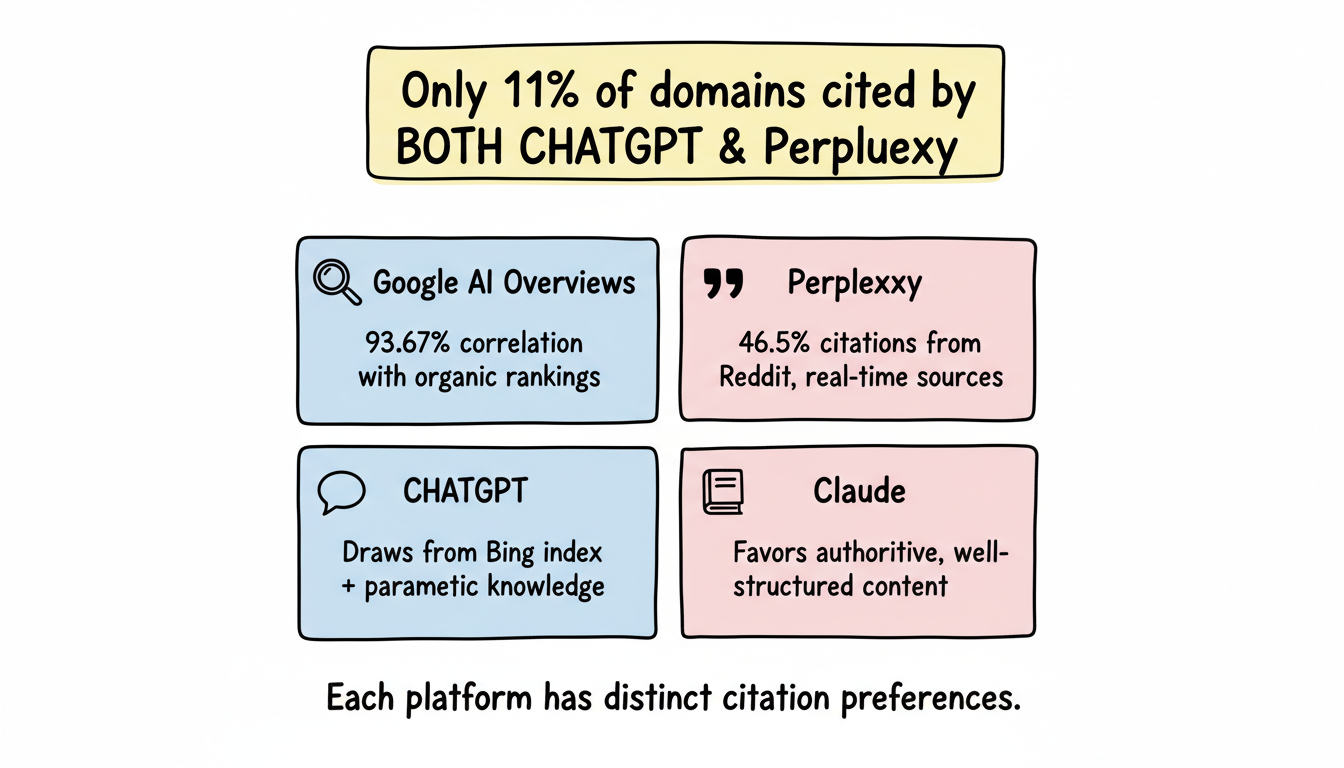
Research reveals only 11% of domains are cited by both ChatGPT and Perplexity. Success on one platform doesn't guarantee visibility on others. Each AI search system has distinct citation patterns:
- Google AI Overviews: Strongest correlation with traditional organic rankings (93.67%)
- Perplexity: Heavy emphasis on Reddit content and real-time sources
- ChatGPT: Draws from Bing's index plus parametric knowledge
- Claude: Favors authoritative, well-structured content
Building visibility across AI search requires understanding each platform's preferences rather than assuming universal optimization works. A multi-platform AI search optimization strategy addresses these distinct citation patterns with platform-specific tactics.
The Evolving AI Search Ecosystem
The AI search market—valued at $43.6 billion in 2025—is projected to reach $108.88 billion by 2032. Analysts predict AI search could capture 30-50% of the search market by 2030.
This represents a fundamental shift in how people discover information. The transition from "search and click" to "ask and receive" changes what content succeeds and which brands gain visibility.
For marketers, the proliferation of AI search tools means expanding optimization beyond Google. The businesses that build visibility across multiple AI platforms now will maintain advantages as these systems mature and capture increasing market share.
Frequently Asked Questions
What Is the Best Free AI Search Engine in 2026?
Perplexity AI offers the strongest free tier for general research, with cited sources and follow-up questions at no cost. DuckDuckGo AI Chat is the best free option for privacy-conscious users, providing access to multiple AI models without tracking or login. ChatGPT's free tier also handles search queries well, though some features require a Plus subscription.
How Do AI Search Engines Differ from Traditional Search Engines?
Traditional search engines return ranked lists of links matching keyword queries. AI search engines use retrieval-augmented generation (RAG) to fetch relevant documents, then synthesize direct answers using large language models. They understand query intent through semantic search rather than exact keyword matching, support conversational follow-ups, and cite sources inline. The trade-off is less browsing diversity since users often accept the synthesized answer.
What Is Generative Engine Optimization (GEO)?
GEO is the practice of optimizing content to appear in AI-generated responses across platforms like ChatGPT, Perplexity, and Claude. Unlike traditional SEO which targets organic link rankings, GEO focuses on earning citations and recommendations within AI answers. Key GEO tactics include structured content with clear entity definitions, authoritative sourcing, and topical depth. It is also referred to as LLMO (Large Language Model Optimization).
Which AI Search Tools Are Best for Enterprise Use?
Glean, Coveo, and Moveworks lead the enterprise AI search category. Glean connects to 100+ workplace data sources and personalizes results by employee role. Coveo specializes in e-commerce and customer-facing search. Moveworks automates IT and HR support workflows. Algolia offers developer-friendly APIs for building custom AI search into products. Choose based on primary use case: knowledge management, customer experience, or internal support automation.