
Traditional SEO analytics don't capture AI search visibility. Google Analytics shows traffic sources, but it can't tell you when ChatGPT mentions your brand or how often Perplexity cites your content. As AI-generated answers become primary search interfaces, measuring performance requires fundamentally different approaches.
AI search analytics has emerged as a distinct discipline—tracking brand mentions, citation frequency, sentiment analysis, and visibility across platforms that generate answers rather than link lists. This guide covers the metrics that matter and the tools that measure them.
Why Traditional Analytics Fall Short
Google Analytics and similar platforms track visitors who click through to your site. But AI search often delivers answers without clicks. A user asking ChatGPT about your product category might receive a response mentioning your brand—without ever visiting your website.
This creates a measurement blind spot. Your brand could be recommended hundreds of times daily in AI responses while your analytics shows declining traffic. Traditional metrics miss the visibility that happens before (or instead of) the click.
The challenge compounds across platforms. Perplexity citations, Google AI Overviews, ChatGPT mentions, and Claude responses each represent distinct visibility channels. Measuring performance requires tracking each platform separately while building a unified view of AI search presence. This growing measurement gap has given rise to Generative Engine Optimization (GEO)—a distinct discipline focused on optimizing content for AI citation and visibility rather than traditional link-based rankings. GEO provides the strategic framework under which the metrics, tools, and workflows in this guide operate.
Core AI Search Metrics to Track
Effective AI search analytics centers on metrics traditional SEO platforms don't measure.
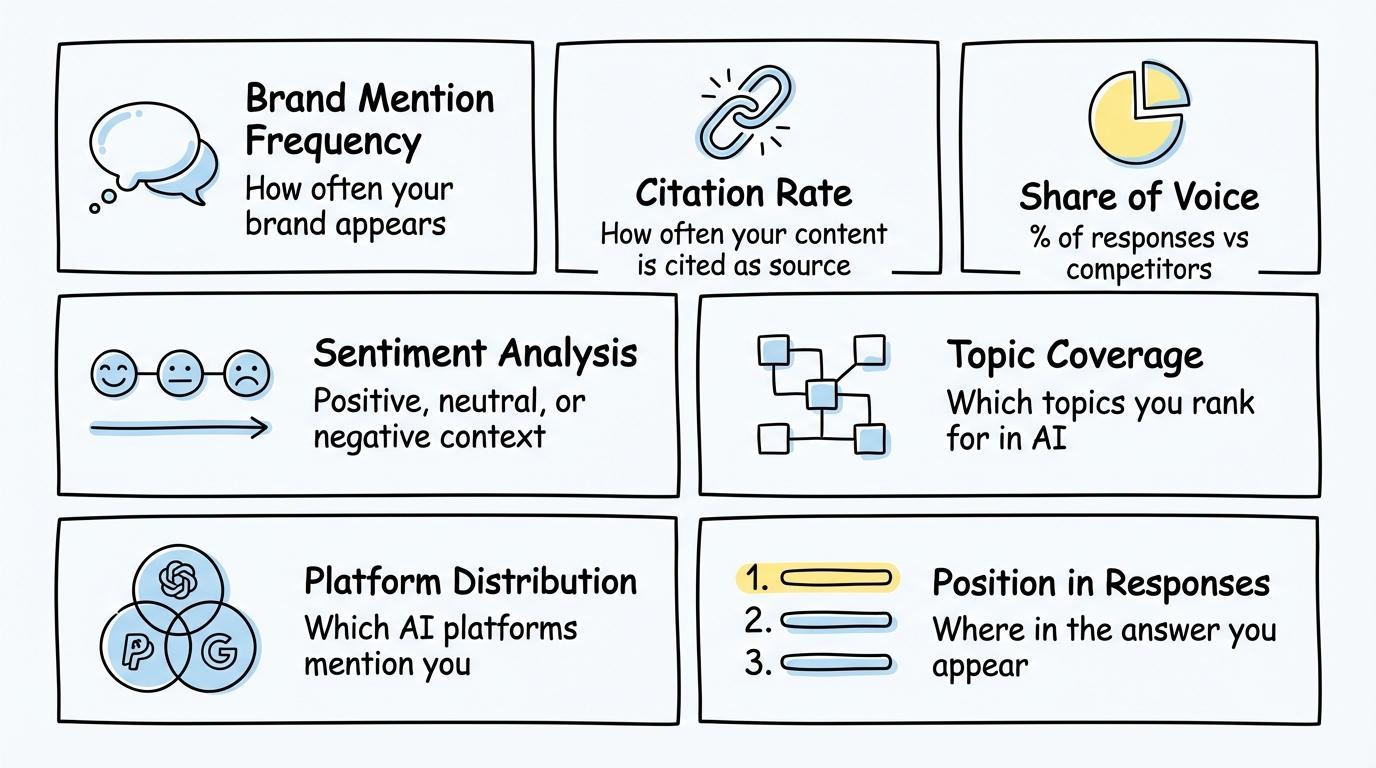
Brand Mention Frequency How often does your brand appear in AI-generated responses? This baseline metric tracks raw visibility—the number of times AI platforms mention your company, products, or content when answering relevant queries. Frequency matters because repeated mentions build recognition and trust.
Citation Rate Beyond mentions, how often do AI platforms cite your content as a source? Citations include linked references that enable users to verify information or explore further. Citation rate indicates whether AI systems consider your content authoritative enough to reference explicitly. Using AI citation tracking tools can help you monitor this metric across multiple platforms systematically.
Share of Voice What percentage of relevant AI responses include your brand versus competitors? Share of voice contextualizes your visibility within the competitive landscape. A brand mentioned in 30% of responses for industry queries holds stronger position than one appearing in 5%.
Sentiment Analysis When AI mentions your brand, is the context positive, negative, or neutral? AI systems synthesize information from multiple sources—including reviews, news, and discussions. Sentiment tracking reveals how AI platforms characterize your brand to users.
Topic Coverage For which topics does your brand appear in AI responses? Topic coverage mapping shows where you have AI visibility and where competitors dominate. Gaps in coverage identify optimization opportunities.
Platform Distribution Which AI platforms mention your brand most frequently? Distribution analysis shows whether your visibility concentrates on Google AI Overviews, spreads across ChatGPT and Perplexity, or skews toward specific platforms requiring targeted optimization. Understanding the AI search platform strengths weaknesses analysis helps you prioritize where to focus measurement efforts.
Position in Responses Where in AI-generated answers does your brand appear? Early mentions in responses carry more weight than passing references buried in lengthy answers. Position tracking assesses visibility quality, not just quantity.
Prompt-Based Tracking: The Core Workflow
Modern AI visibility tracking has shifted from keyword-centric monitoring to prompt-based tracking—a paradigm where you monitor how AI engines respond to full conversational questions rather than short keyword phrases. This reflects how users actually interact with AI search: they ask complete questions, not two-word queries.
The prompt-based tracking workflow follows four steps. First, define target prompts that mirror the questions your customers actually ask AI engines. These prompts are longer and more conversational than traditional keywords—think "What is the best analytics platform for tracking AI search visibility?" rather than "AI analytics tool." Second, select the AI platforms to monitor: ChatGPT, Perplexity, Google AI Overviews, Google AI Mode, Microsoft Copilot, Claude, and Gemini each represent distinct visibility channels. Third, run your prompts on a recurring schedule—daily or weekly—to collect response data. Fourth, analyze whether your brand appears in each response, in what position, with what sentiment, and whether citations link back to your domain.
Prompt-based tracking differs from traditional rank tracking in important ways. AI responses are non-deterministic, meaning the same prompt can yield different answers on different runs. This requires statistical sampling over time to establish reliable visibility baselines rather than treating any single response as definitive. Multi-model variance adds another layer: your brand may appear prominently in ChatGPT responses but be absent from Perplexity for the same prompt, requiring per-platform optimization strategies.
A practical bridge between old and new approaches is prompt-to-keyword mapping—converting your highest-value prompts into keyword targets for traditional SEO. This creates a unified strategy where AI overview optimization and traditional search optimization reinforce each other rather than operating in silos.
AI Search Analytics Tools in 2026
Several platforms now specialize in AI visibility tracking. Each offers different capabilities and price points.
Peec AI Purpose-built for AI search analytics, Peec AI tracks brand visibility across ChatGPT, Perplexity, Google AI Overviews, Google AI Mode, Microsoft Copilot, and Claude. The platform uses prompt-based monitoring to measure keyword-level visibility, competitor comparisons, and citation tracking. Particularly strong for enterprise brands needing comprehensive cross-platform monitoring with native Looker Studio integration for custom reporting.
Ahrefs Brand Radar Ahrefs expanded into AI visibility with Brand Radar, tracking how often brands appear in AI-generated content. Integrates with existing Ahrefs backlink and keyword data, making it convenient for teams already using the platform for traditional SEO.
Semrush AI Toolkit Semrush's AI visibility features include AI Overview tracking and citation analysis. The platform shows which queries trigger AI Overviews featuring your brand, competitor citation patterns, and visibility trends over time.
Profound Focused specifically on AI answer engine visibility, Profound tracks brand mentions and sentiment across major AI platforms. Offers competitive benchmarking, automated alerts when visibility changes significantly, and Agent Analytics for monitoring AI crawler activity on your site.
Scrunch Emphasizes real-time AI visibility monitoring with sentiment analysis. Useful for brands concerned about reputation management in AI responses, with alerts for negative mentions requiring attention.
BrightEdge Enterprise SEO platform with expanding AI search capabilities. Tracks AI Overview appearances and provides recommendations for improving AI visibility alongside traditional search optimization.
Otterly AI Specializes in AI visibility monitoring across ChatGPT, Perplexity, Google AI Overviews, Google AI Mode, and Gemini. Otterly AI provides prompt-based tracking with automated scheduling, competitive benchmarking, and detailed citation analysis with emphasis on actionable optimization recommendations.
SE Ranking AI Visibility Tracker SE Ranking has added dedicated AI visibility tracking that monitors brand appearances across Google AI Overviews, ChatGPT, Perplexity, Microsoft Copilot, and DeepSeek. Integrates with SE Ranking's broader SEO toolkit for teams that want AI visibility data alongside traditional rank tracking, backlink analysis, and site audit capabilities.
Building Your AI Search Dashboard
Effective AI analytics require consolidating data into actionable dashboards.
Visibility Scorecard Create a composite visibility score combining mention frequency, citation rate, and share of voice. Track this score weekly to identify trends. A simple weighted formula—(mentions × 0.3) + (citations × 0.5) + (share of voice × 0.2)—provides a single metric for executive reporting. For practical implementation, most AI visibility tools offer Looker Studio connectors and API or CSV export options that feed directly into custom dashboards—Peec AI, for example, provides native Looker Studio integration for automated reporting.
Competitive Benchmarking Track the same metrics for 3-5 key competitors. Relative performance matters more than absolute numbers in AI search. If your visibility increases 20% but competitors increase 40%, you're losing ground despite improvement.
Platform Breakdown Segment metrics by AI platform. Performance varies significantly across Google AI Overviews, ChatGPT, Perplexity, and others. Platform-level tracking identifies where optimization efforts should focus. Analyzing AI search platform market share comparison 2026 data helps you allocate measurement resources to platforms with the largest user bases.
Topic Heat Map Map topics where your brand has strong AI visibility versus weak or absent visibility. Heat maps reveal content gaps and competitive opportunities. Green indicates leadership, yellow indicates competition, red indicates absence.
Sentiment Trend Track sentiment over time, not just current state. Sentiment shifts can indicate emerging reputation issues before they become crises—or successful brand positioning changes taking effect.
Connecting AI Visibility to Business Outcomes
AI search metrics gain meaning when connected to business results.
AI Traffic Attribution Some AI platforms (particularly Perplexity) send referral traffic that analytics can track. Segment this traffic to understand visitor quality—conversion rates, engagement metrics, and revenue attribution from AI-referred visitors. Implementing Google Analytics 4 for AI search tracking provides the technical foundation for accurate attribution modeling.
Brand Search Correlation AI visibility often correlates with branded search volume. Users who encounter your brand in AI responses may later search directly for your company. Track branded search trends alongside AI visibility metrics to identify correlation.
Assisted Conversions AI mentions may not drive direct clicks but could influence conversions that arrive through other channels. Attribution modeling should consider AI visibility as a potential awareness touchpoint in longer customer journeys.
Share of Voice Impact Higher AI share of voice should correlate with market share over time. Track quarterly business metrics against AI visibility trends to establish correlation—or identify disconnects requiring investigation.
Revenue Attribution & LTV for AI Traffic
Lifetime Value (LTV) offers one of the most meaningful lenses for evaluating AI-sourced visitors. The core question: how much revenue does a visitor who arrives via an AI citation generate over their customer lifecycle compared to visitors from organic search, paid ads, or direct traffic? Early data suggests AI-referred visitors often exhibit higher engagement and intent, but establishing this requires deliberate measurement.
The revenue attribution framework for AI traffic follows a clear chain: map AI visibility (mentions and citations) to site visits using GA4 custom channel groupings for AI traffic, then connect those sessions to conversions, and finally attribute revenue using multi-touch attribution models. This chain transforms abstract visibility metrics into concrete business value that justifies investment in AI brand visibility monitoring tools and optimization efforts.
ROI measurement for AI visibility tools becomes straightforward once the attribution chain is in place. Compare the subscription cost of your monitoring and optimization tools against the incremental revenue attributed to AI-driven traffic. Cohort-based analysis strengthens this further—group AI-sourced visitors into cohorts and track their retention, repeat purchases, and LTV over time to understand the long-term revenue impact beyond initial conversion.
For practical reporting, Looker Studio dashboards that combine AI visibility data from tools like Peec AI with GA4 conversion data provide executives with a unified view of how AI search presence translates to revenue. These dashboards close the loop between visibility investment and business outcomes.
Common Measurement Mistakes
Avoid these pitfalls when implementing AI search analytics.
Measuring Only Citations Citations represent direct attribution, but mentions without citations still build awareness. Don't ignore brand mentions simply because they lack clickable links.
Platform Myopia Focusing exclusively on Google AI Overviews misses visibility on ChatGPT, Perplexity, and emerging platforms. Multi-platform tracking is essential as user behavior fragments across AI interfaces.
Ignoring Sentiment Volume metrics without sentiment context mislead. 1,000 negative mentions harm more than 100 positive mentions help. Always pair frequency metrics with sentiment analysis.
Static Benchmarking AI search evolves rapidly. Benchmarks set in early 2026 may not reflect reality by year-end. Update competitive baselines quarterly to maintain relevant context.
Vanity Metrics Raw mention counts feel impressive but may not indicate business value. Focus on metrics tied to outcomes—qualified traffic, brand search growth, competitive share of voice—rather than absolute numbers.
GEO: Generative Engine Optimization Essentials
Generative Engine Optimization (GEO) is the practice of optimizing content so AI engines select, cite, and accurately represent it in their responses. While traditional SEO targets link-based rankings on search engine results pages, GEO targets citation eligibility across AI answer engines—making it a distinct but complementary discipline. Understanding Generative Engine Optimization strategies is essential for any brand serious about AI search visibility.
A GEO audit evaluates 25 or more on-page factors that influence whether AI systems cite your content. These factors include structured data markup, entity clarity (how unambiguously your content identifies people, products, and concepts), claim attribution (citing sources for statistics and assertions), source linking, and factual density. The audit reveals gaps between your current content and what AI engines need to confidently cite it. Understanding how AI search engines rank content provides the foundation for conducting effective GEO audits.
One emerging technical standard is llms.txt—a file placed at your domain root that tells AI crawlers which pages are most important, how content is structured, and what topics your site covers authoritatively. Think of it as robots.txt for AI systems. While adoption is still early, sites implementing llms.txt report improved citation rates as AI crawlers can more efficiently discover and index relevant content.
AI crawler and bot analytics represent another critical GEO component. Monitoring when AI bots—GPTBot, Google-Extended, ClaudeBot, PerplexityBot—crawl your site reveals which content AI systems are actively ingesting. Tracking crawl frequency, which pages they access, and how patterns change over time informs which content is most likely to appear in AI responses.
GA4 channel classification for AI traffic deserves special attention. By default, visits referred by AI platforms get lumped into generic referral or direct traffic channels. Configuring custom channel groupings that isolate AI-referred visits into their own channel provides accurate measurement of how much traffic AI search actually drives—and how that traffic behaves compared to other channels.
A concise GEO checklist for getting started: implement an llms.txt file, add comprehensive structured data markup, use entity-rich headings, cite statistics with sources, include authoritative external links, and write concise answer-ready paragraphs that AI engines can extract and present directly.
Establishing Baseline Metrics
Before optimizing, establish baseline measurements.
Query your core topics across ChatGPT, Perplexity, and Google with AI Overviews enabled. Document which queries return your brand, how prominently, and with what sentiment. Record competitor appearances for the same queries.
This manual baseline provides context for automated tracking tools. It also reveals immediate optimization opportunities—queries where competitors appear but you don't.
Revisit baseline queries monthly to measure progress. Automated tools track broader patterns, but periodic manual checks verify tool accuracy and surface nuances automated systems miss.
The Measurement Maturity Path
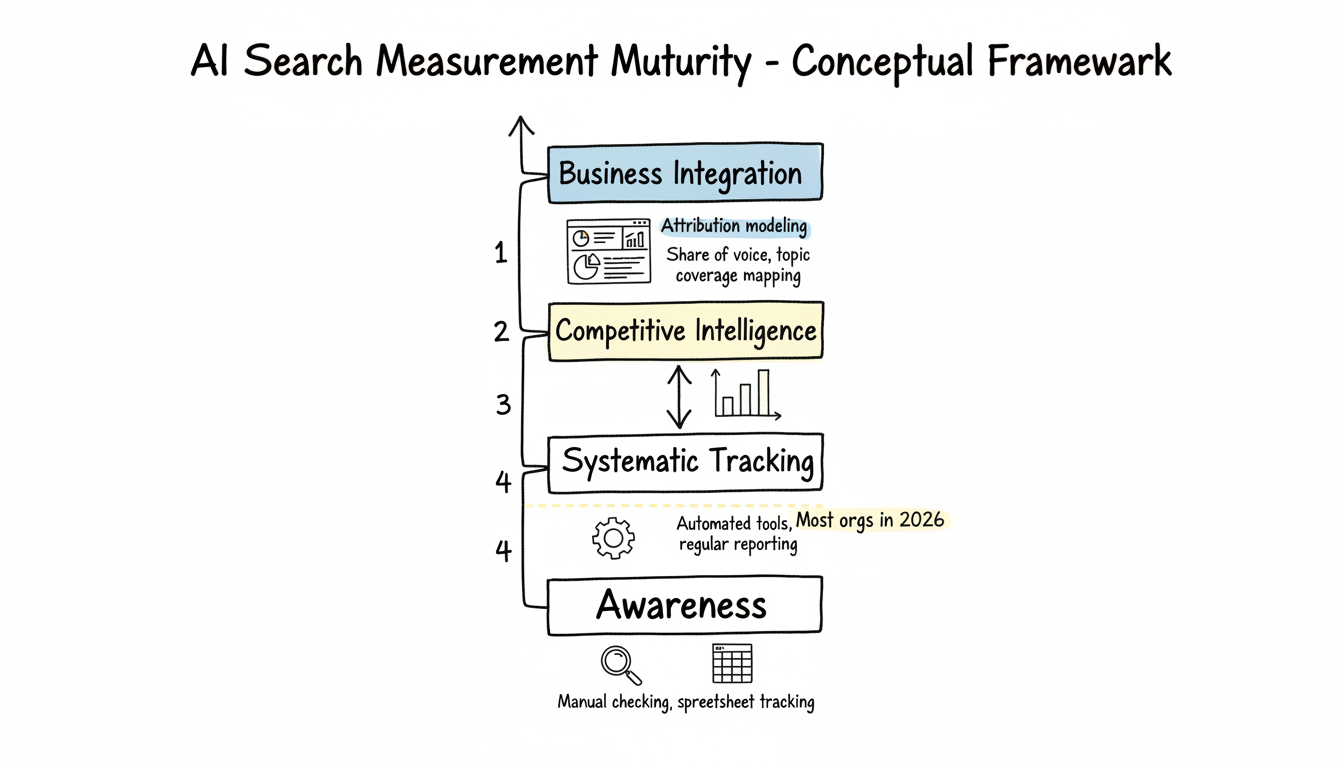
Organizations typically progress through measurement maturity stages.
Stage 1: Awareness Basic monitoring of whether your brand appears in AI responses for key queries. Manual checking, spreadsheet tracking.
Stage 2: Systematic Tracking Automated tools monitoring visibility across platforms including Google AI Overviews, Google AI Mode, ChatGPT, Perplexity, Microsoft Copilot, and DeepSeek. Regular reporting on core metrics—mentions, citations, sentiment.
Stage 3: Competitive Intelligence Comprehensive competitor tracking. Share of voice analysis. Topic coverage mapping.
Stage 4: Business Integration AI visibility metrics connected to business outcomes. Attribution modeling with revenue and LTV attribution as the hallmark of full maturity. Executive dashboards with actionable insights that connect AI search traffic trends to measurable business impact.
Most organizations in 2026 operate between stages 1 and 2. Advancing to stages 3 and 4 creates competitive advantage as AI search becomes primary discovery channel.
AI search analytics remains an emerging discipline. Tools improve monthly. Best practices evolve as platforms change. The organizations investing in measurement infrastructure now—even imperfect measurement—will be positioned to optimize as the landscape matures.
For a deeper look at analyzing the raw conversational logs behind these surfaces, see our guide to conversational analytics.
Frequently Asked Questions
What Is Generative Engine Optimization (GEO)?
Generative Engine Optimization is the practice of structuring content so AI platforms like ChatGPT, Perplexity, and Google AI Overviews select and cite it in their responses. GEO involves technical signals like llms.txt files, structured data, entity-rich headings, and factual density. Unlike traditional SEO that targets link-based rankings, GEO targets citation eligibility across AI answer engines, making it a distinct but complementary discipline.
How Does Prompt-Based Tracking Differ from Keyword Rank Tracking?
Prompt-based tracking monitors how AI engines respond to full conversational questions rather than short keywords. You define prompts that mirror real customer queries, run them across platforms like ChatGPT, Google AI Mode, and Perplexity, then track whether your brand appears, its position, and the sentiment. Results are non-deterministic, so statistical sampling over time is required to establish reliable visibility baselines.
How Do You Measure the ROI of AI Search Visibility?
Connect AI visibility metrics to revenue using multi-touch attribution. Track AI-referred visits in GA4 with a custom channel grouping for AI traffic, then map those sessions to conversions and lifetime value. Compare the LTV of AI-sourced visitors against other channels and measure incremental revenue against the cost of visibility tools and optimization efforts to calculate a clear return on investment.
Which AI Platforms Should You Track for Brand Visibility in 2026?
At minimum, track Google AI Overviews, Google AI Mode, ChatGPT, Perplexity, and Microsoft Copilot—these represent the largest user bases. For comprehensive coverage, add Claude, Gemini, DeepSeek, and Grok. Tools like Peec AI and Otterly AI support multi-platform monitoring. Prioritize platforms based on your audience, since B2B brands may see more visibility on Perplexity while consumer brands skew toward ChatGPT and AI Overviews.