
Traditional SEO analytics track rankings, impressions, and clicks. AI search visibility requires entirely different measurement approaches. When ChatGPT, Perplexity, or Google AI Overviews cite your content, standard analytics tools miss these interactions entirely. Citation tracking—monitoring when and how AI systems reference your brand—has emerged as the essential measurement layer for AI-first search strategies.
According to StubGroup's GEO guide, AI citation tracking monitors how often AI engines mention your brand. Tools like Profound, Superlines, and custom monitoring solutions track brand mentions and citations across ChatGPT, Claude, Gemini, Perplexity, and Google AI Overviews. Share of AI voice is replacing traditional search market share as the primary visibility metric.
Why Citation Tracking Matters
AI search platforms don't provide webmaster tools or analytics dashboards showing your performance.
According to SEO.com's AI search optimization guide, AI search optimization goes beyond keyword optimization - it's about sharing the right information with AI engines to get your business cited in responses. Without effective AI search citation tracking, you're optimizing blind, unable to measure what's working. Citation tracking is the foundation for the next step - being the brand an autonomous agentic search system actually recommends.
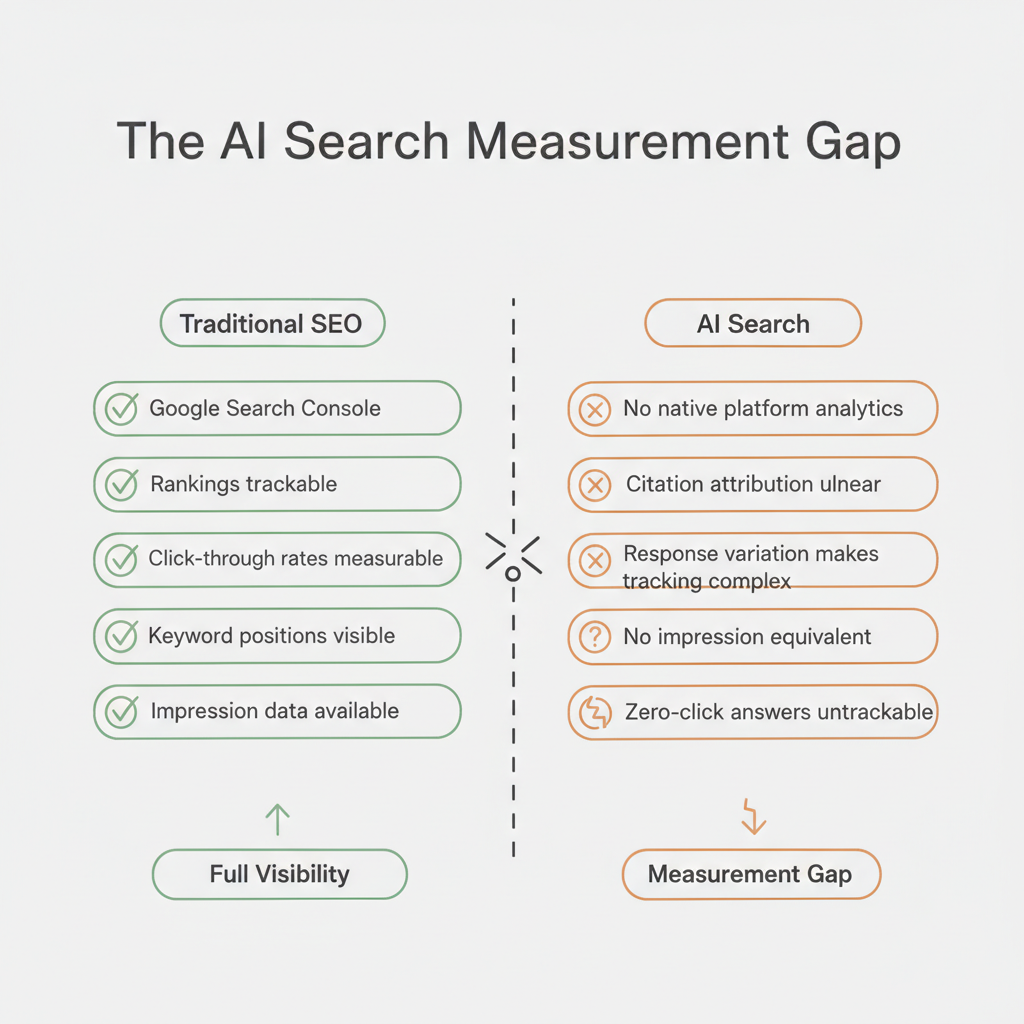
The measurement gap:
Traditional SEO | AI Search |
Google Search Console shows rankings | No native AI platform analytics |
Click-through rates measurable | Citation attribution unclear |
Keyword positions trackable | Response variation makes tracking complex |
Impression data available | No impression equivalent exists |
How Query Fan-Out Complicates Citation Tracking
AI systems do not simply match a user query to a single page. They conduct multiple sub-queries across subtopics, retrieve articles for each, then synthesize a combined answer. This process—known as query fan-out—means a single user prompt may pull from 5 to 15 different sources across different subtopics, making citation tracking fundamentally more complex than keyword rank tracking.
The implication for tracking is significant: monitoring must cover prompt variants and subtopic angles, not just exact-match queries. A single prompt like "best CRM for small businesses" might trigger sub-queries about pricing, integrations, user reviews, and security features—each pulling different sources. This is why a prompt portfolio approach, as outlined in the implementation plan below, is essential for comprehensive coverage. Platforms like AI Overviews make query fan-out particularly visible since you can observe the multiple source cards that feed into a single answer.
Understanding AI Citations vs. Mentions
Citation tracking distinguishes between different types of AI visibility.
According to MarketerMilk's AI monitoring guide, AI monitoring tools track both mentions (direct brand recommendations in responses) and citations (when AI uses your content as a source). These serve different purposes: mentions indicate brand recognition, while citations indicate content authority. Understanding Copilot citation patterns helps reveal how different AI platforms attribute sources differently.
Citation types explained:
AI Visibility Types
├── Direct Citations
│   ├── AI links to your content
│   ├── Explicit source attribution
│   ├── "According to [brand]" references
│   └── Highest trust indicator
│
├── Brand Mentions
│   ├── Name appears in response
│   ├── Recommended as solution
│   ├── Listed among options
│   └── Brand recognition signal
│
├── Indirect References
│   ├── Your data/insights used
│   ├── No explicit attribution
│   ├── Content influenced answer
│   └── Difficult to track
│
└── Sentiment Context
    ├── Positive recommendation
    ├── Neutral mention
    ├── Comparative context
    └── Critical reference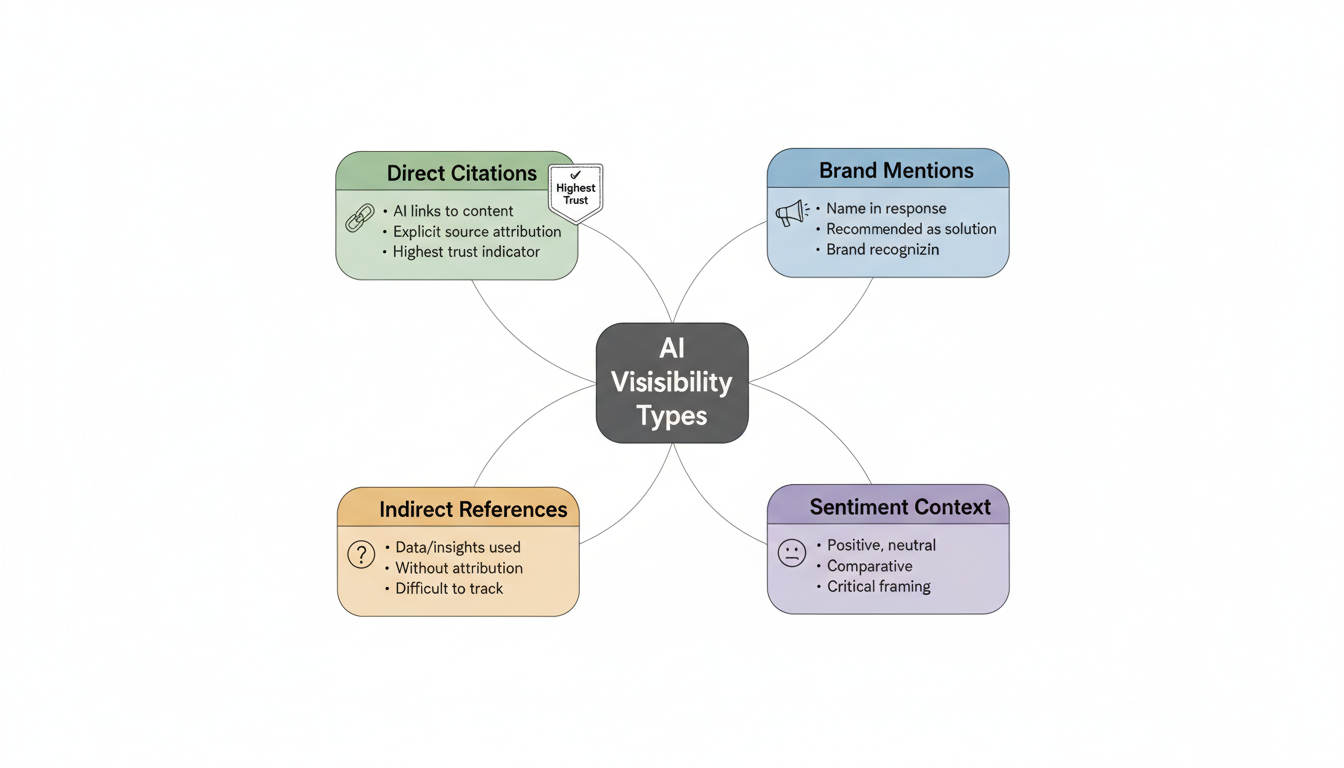
AI Citation Tracking Tools
Several platforms now offer AI visibility monitoring capabilities.
According to LinkedIn's LLM SEO tools comparison, the leading AI visibility tracking tools include Semrush AI Toolkit ($99+/month), Ahrefs Brand Radar ($188+/month), Otterly AI ($29+/month), Writesonic GEO, LLMrefs, and Peec AI. Each offers different coverage across AI platforms and varying feature depth. Many marketers also leverage free AI SEO software tools for basic monitoring before upgrading to paid solutions.
Tool comparison:
Tool | Starting Price | Key Features | Platforms Covered | Data Collection Method |
Otterly AI | $29/month | LLM monitoring, query tracking | ChatGPT, Perplexity, Gemini | API-first |
Semrush AI Toolkit | $99/month | Integrated SEO + AI tracking | Multiple platforms | API-first |
Ahrefs Brand Radar | $188/month | Competitor comparison | ChatGPT, Claude, others | API-first |
SE Visible | Custom | Enterprise features | Comprehensive coverage | API-first |
LLMrefs | Varies | Citation-focused | Major LLMs | Scraping-based |
Peec AI | EUR 89/month | Prompt tracking, competitive benchmarking | ChatGPT, Claude, Gemini, Perplexity | API-first |
Akii | $49/month | Visibility scoring, optimization workflows | ChatGPT, Gemini, Perplexity | API-first |
Promptmonitor | $29/month | Multi-model tracking | ChatGPT, Claude, Gemini, DeepSeek, Grok, Perplexity | API-first |
Similarweb | Custom | Domain influence scores, daily citation changes | Comprehensive coverage | Scraping-based |
Optiview | Custom | 200+ industry taxonomies, context-aware query generation | Major LLMs and AI Overviews | API-first |
For businesses seeking expert guidance on tool selection and implementation, AEO services consultation provides strategic support for citation tracking programs.
Key Metrics for AI Visibility
Citation tracking requires new measurement frameworks beyond traditional SEO metrics.
According to SE Visible's AI tracking guide, in AI results, positions can flip multiple times in a single day—staying visible means constant monitoring and fast tweaks. Key metrics include citation frequency, share of AI voice, sentiment analysis, and competitive positioning. These AEO optimization metrics differ fundamentally from traditional search analytics.
Essential AI visibility metrics:
AI Visibility Metrics Framework
├── Citation Metrics
│   ├── Citation frequency (daily/weekly)
│   ├── Citation rate (% of relevant queries)
│   ├── Source attribution accuracy
│   └── Link inclusion rate
│
├── Share of Voice
│   ├── Brand mentions vs competitors
│   ├── Category visibility percentage
│   ├── Topic-specific share
│   └── Platform-specific share
│
├── Quality Metrics
│   ├── Sentiment analysis (positive/negative)
│   ├── Context accuracy
│   ├── Recommendation strength
│   └── Competitive positioning
│
└── Trend Metrics
    ├── Visibility changes over time
    ├── Query pattern shifts
    ├── Platform-specific trends
    └── Seasonal variations
Effective monitoring requires systematic approach across platforms.
According to Passionfruit's AI brand monitoring guide, AI brand monitoring tools track the continuously changing answers that AI assistants provide. You need to monitor regularly since AI responses vary based on timing, user context, and platform updates. Following a comprehensive AI SEO implementation checklist ensures you establish proper tracking from the start.
Monitoring setup checklist:
Step | Action | Purpose |
1 | Define tracking queries | Cover key topics/questions |
2 | Select monitoring tools | Match budget and needs |
3 | Establish baseline | Know current visibility |
4 | Set tracking frequency | Daily for competitive terms |
5 | Configure alerts | Catch significant changes |
6 | Track competitors | Benchmark performance |
Quantitative Citation Metrics: Formulas That Matter
While the metrics framework above identifies what to track, effective citation tracking demands precise, repeatable formulas. Without quantitative rigor, teams end up with subjective assessments that cannot be benchmarked or trended over time.
Citation Share Formula: Citation share is the most fundamental metric for AI visibility. Calculate it as: (number of AI answers citing your domain) divided by (total answers in your prompt set) multiplied by 100. For example, if you track 100 prompts across ChatGPT and Perplexity and your site appears as a cited source in 15 responses, your citation share is 15%. Track this weekly to measure the impact of content optimizations.
Citation Prominence Scoring: Not all citations carry equal weight. A citation at the top of an answer with a direct link carries far more visibility and click potential than a footnote mention. Use this three-tier rubric to assign position-weighted scores:
Tier | Placement | Score Weight | Example |
A-tier | Named first or top-of-answer with link | 3 points | "According to [Your Brand], the best approach is..." |
B-tier | Mid-answer mention | 2 points | "Other sources like [Your Brand] also suggest..." |
C-tier | Footer or list mention | 1 point | Sources: [Your Brand], Site B, Site C |
Your weighted citation score equals the sum of (tier weight multiplied by number of citations at that tier) across your prompt set. This gives a single number that accounts for both frequency and quality of citations.
Citation Stability Metric: AI answers drift constantly as models update and retrieval indexes change. Citation stability measures your week-over-week citation retention rate for the same prompt set. If you were cited in 20 answers last week and 16 of those same prompts still cite you this week, your stability rate is 80%. Volatility monitoring is as critical as the initial citation count—a high citation share that fluctuates wildly suggests fragile positioning.
Scenario | Citation Share | Stability Rate | Interpretation |
Stable leader | 18% | 90%+ | Strong authority, consistent retrieval |
Volatile presence | 15% | 55% | Content retrieved inconsistently—needs optimization |
Emerging competitor | 8% | 85% | Lower share but reliable—growing authority |
Research from SearchEngineLand analyzing 800+ websites across 11 industries found that organic keyword breadth correlates more strongly (0.41 Spearman coefficient) with AI citation visibility than backlink count (0.37). This challenges traditional SEO assumptions and suggests that topical coverage depth is a stronger lever for earning AI citations than pure link building.
Source Gap Analysis: Finding and Closing Citation Gaps
Even when your brand earns frequent AI mentions, those mentions may not translate into citations. This disconnect—the mention-citation gap—occurs when AI frequently names your brand but never cites your content as a source. It signals a content authority problem: the AI knows who you are but does not trust your pages enough to link to them.
Source Gap Framework: For each target prompt in your monitoring set, list the domains that get cited instead of you. Classify each competing source into one of three categories:
- Outrankable content — Thin, outdated, or superficial pages that currently get cited. These represent immediate opportunities where deeper, more current content from your site can displace them.
- Inclusion targets — Strong, comprehensive content from competitors. You can match or exceed their depth with more detailed treatment, original data, or better structure.
- Authority anchors — Sources like Wikipedia, Reddit, YouTube, and Forbes that dominate cross-industry citations. These are not directly beatable but can be influenced (e.g., contributing to Wikipedia, participating in Reddit discussions).
Prioritization approach: Focus first on prompts where you are mentioned but not cited—these are the lowest-hanging fruit since the AI already associates your brand with the topic. Next, target prompts where competitors with thinner content are cited, as these represent clear content quality gaps you can close. Set realistic expectations for prompts dominated by universal authority anchors.
30-Day Citation Tracking Implementation Plan
Moving from theory to practice requires a structured rollout. This four-week plan takes you from zero to a fully operational citation tracking program.
Week 1 — Prompt Portfolio Build: Construct a set of 50 to 100 monitoring prompts organized into three buckets: money prompts (purchase-intent queries like "best [product] for [use case]"), problem prompts (pain-point queries like "how to fix [issue]"), and proof prompts (comparison and review queries like "[brand A] vs [brand B]"). Tag each prompt by funnel stage, product category, and ideal customer profile segment. For multi-market brands, include geo and language variants—AI responses vary significantly by locale.
Week 2 — Baseline and Tool Setup: Run your full prompt set across ChatGPT, Perplexity, Claude, Gemini, and Google AI Overviews. Record citation share, prominence tier, and competitor citations for each prompt. Select your primary tracking tool from the comparison table above and configure automated monitoring. Establish your baseline numbers—these become the benchmark against which all future optimization is measured.
Week 3 — Content Optimization Sprint: Prioritize pages with mention-citation gaps identified through the source gap analysis. Improve retrieval readiness by adding clear definitions near headings, comparison tables with structured data, evidence hooks (statistics, named studies, specific numbers), and question-mirroring H2 and H3 headings that match the language used in your prompt portfolio. Focus on making your content the most extractable, quotable source on each topic.
Week 4 — Measurement and Iteration: Re-run your complete prompt set and calculate week-over-week citation stability. Identify gains, remaining gaps, and any new competitor entries. Establish your ongoing cadence: weekly prompt runs for competitive terms, monthly source gap reviews, and quarterly prompt portfolio refreshes to account for evolving search behavior and new AI platform features.
Manual Citation Auditing
Supplement automated tools with systematic manual checking.
According to StubGroup, start with a manual baseline: ask chatbots about your niche and note whether they cite you, which page they pull, and how they describe you. Manual auditing catches nuances automated tools miss. This process complements the broader LLM optimization guide strategies for improving AI visibility.
Manual audit process:
- Create list of 20-30 key queries your audience asks
- Test each query across ChatGPT, Perplexity, Google AI
- Document: Are you cited? Which page? What context?
- Note competitor citations in same responses
- Identify patterns and gaps
- Repeat monthly to track changes
Attribution Challenges
AI citation tracking faces inherent measurement limitations.
According to eesel.ai's AI search traffic analysis, AI search attribution remains challenging because many AI interactions don't generate trackable referral traffic. Users may get answers without clicking through, or traffic may be attributed to other sources. Understanding cross-platform AI search ROI helps contextualize these measurement gaps.
Attribution gaps:
- Zero-click answers provide value without measurable traffic
- Some AI platforms don't pass referrer data
- Users may later search for your brand directly
- Multi-touch attribution rarely captures AI influence
- Cookie/privacy restrictions limit tracking
- AI referral traffic from platforms like ChatGPT and Perplexity is growing but remains difficult to attribute accurately in most analytics setups, requiring UTM parameters and dedicated landing pages for reliable measurement
Competitive Intelligence
Citation tracking reveals competitive positioning in AI responses.
According to AIclicks' competitive analysis guide, monitoring competitor AI citations shows which brands AI systems trust for different topics. This intelligence informs content strategy and identifies visibility gaps. Many organizations leverage AI-powered search tools to automate competitive monitoring.
Competitive tracking priorities:
Analysis Area | What to Track | Strategic Value |
Citation frequency | Who gets cited most | Authority benchmark |
Topic coverage | Which topics cite whom | Content gap identification |
Recommendation context | How competitors are described | Positioning intelligence |
Platform variance | Who wins on which platform | Platform-specific strategy |
Acting on Citation Data
Citation tracking only matters if it drives optimization decisions.
According to Grow and Convert's AI SEO strategy, the best approach is to track real AI citations—as well as traffic and leads from AI—then double down on what's working. Citation data should inform content updates, topic prioritization, and authority building efforts. Teams should regularly review AI search KPI goal setting to align citation metrics with business objectives.
Data-to-action framework:
Citation Insights → Actions
├── Low citation rate
│   └── Restructure content for AI extraction
│
├── Competitor winning specific topics
│   └── Create deeper, more authoritative content
│
├── Negative sentiment in mentions
│   └── Address criticism, improve offerings
│
├── High mentions, low citations
│   └── Investigate the mention-citation gap: your brand
│       has recognition but your pages lack the structured
│       evidence and source authority AI needs to cite them.
│       See the Source Gap Analysis section above for a
│       systematic framework to close this gap.
│
└── Platform-specific gaps
    └── Optimize for underperforming platforms
Content freshness matters: AI assistants prefer fresher content—cited URLs average 25.7% newer than those surfaced in traditional search results. Set a 90-day content refresh cadence for your highest-priority pages to maintain citation eligibility. Pages that go stale lose citations to competitors who publish more recently on the same topic.
Connecting citations to revenue: Citation tracking should ultimately tie back to business outcomes. Track referral traffic from AI platforms (ChatGPT, Perplexity, and others now pass referrer data in some cases), measure engagement metrics on cited pages (time on page, scroll depth, conversion events), and map downstream conversions from AI-referred visitors. This creates the attribution chain from citation to revenue that justifies continued investment in AI search optimization.
AI search citation tracking enables data-driven AEO strategies:
- New measurement required - Traditional SEO analytics miss AI visibility entirely
- Tools are maturing - Otterly, Semrush, Ahrefs now offer AI tracking features
- Multiple metrics matter - Citation frequency, share of voice, and sentiment all inform strategy
- Manual audits complement - Systematic manual checking catches what tools miss
- Attribution remains challenging - Accept measurement gaps while optimizing what's trackable
- Competitive intelligence valuable - Understanding who gets cited reveals strategic opportunities
According to LinkedIn's AI search thought leadership, brands must track AI visibility with the same rigor they apply to traditional search rankings. Citation tracking provides the feedback loop necessary for continuous AI search optimization.
Frequently Asked Questions
What Is Citation Share and How Do You Calculate It?
Citation share measures the percentage of AI-generated answers that cite your domain out of a defined prompt set. Calculate it as: (number of answers citing your domain) divided by (total answers in your prompt set) multiplied by 100. For example, if you track 100 prompts and your site is cited in 12 answers, your citation share is 12%. Track this weekly to measure progress.
What Is the Difference Between an AI Mention and an AI Citation?
An AI mention means the model names your brand in its response, while a citation means it links to or attributes a specific claim to your content. Mentions indicate brand recognition; citations indicate content authority. A large gap between mentions and citations signals that AI systems know your brand but do not trust your pages as primary sources.
How Often Should You Run AI Citation Tracking?
Run your full prompt portfolio weekly for competitive terms and biweekly for long-tail queries. AI answers shift frequently due to model updates, new training data, and retrieval index changes. Monthly tracking is too slow to catch volatility. Establish automated alerts for citation drops exceeding 20% so you can investigate and respond before visibility erodes significantly.
Do Backlinks or Content Breadth Matter More for AI Citations?
Research analyzing 800+ websites across 11 industries found that organic keyword breadth correlates more strongly with AI citation visibility than backlink count. This suggests that topical coverage and content depth are more effective levers than traditional link building for earning AI citations. Invest in comprehensive content clusters rather than purely chasing backlinks for AI visibility.