
The competition for digital visibility has shifted. Being cited as a source in AI-generated answers has become the new SEO "win." When ChatGPT, Perplexity, or Google AI Overviews answer a user's question, the sources they reference capture attention at the moment of highest intent—often without requiring a click.
Understanding how AI search citations work—and what drives source selection—determines whether your content becomes the authoritative answer or disappears into algorithmic obscurity.
What Are AI Search Citations?
An AI search citation is a linked source reference displayed within an AI-generated answer to support a claim. Unlike traditional search results that present lists of blue links, AI search engines synthesize information from multiple sources and attribute that information through inline citations.
Citations differ from mentions. A mention occurs when your brand or concept appears in an AI response without a source link. Citations include explicit attribution—a clickable reference back to your content. This distinction matters: citations signal trust and enable verification, while mentions provide brand awareness without direct traffic opportunity.
The mechanics vary by platform. Perplexity displays numbered citations throughout responses with a reference list below. ChatGPT (with browsing enabled) shows citation links within answers. Google AI Overviews display expandable source cards users can explore. Each platform handles attribution differently, but the fundamental goal remains: earn the citation to establish authority and capture qualified traffic.
How AI Platforms Select Sources to Cite
AI citation selection operates differently than traditional ranking algorithms. Research analyzing over 5.5 million AI-generated responses reveals consistent patterns in how platforms choose which sources to reference.
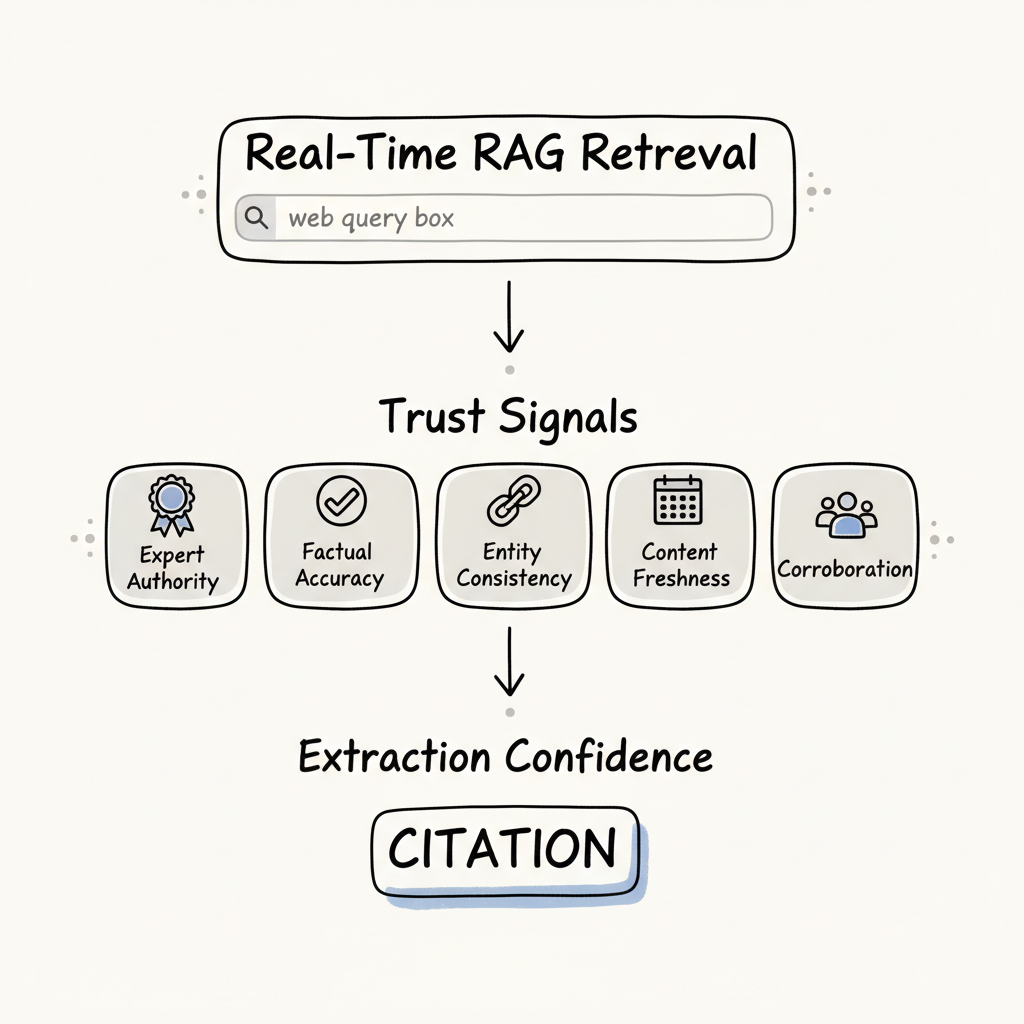
Retrieval-Augmented Generation (RAG) Most AI search platforms use retrieval-augmented generation—they query external sources in real-time rather than relying solely on training data. Perplexity retrieves and cites the broadest number of unique domains per query, achieving citation density 2-3 times higher than parametric models like base ChatGPT. This real-time retrieval creates the citation opportunity.
Trust Signal Evaluation AI platforms evaluate multiple trust dimensions before citing a source:
- Expert authority (verifiable author credentials and domain expertise)
- Factual accuracy (claims that align with authoritative sources)
- Entity consistency (brand information matching across digital properties)
- Content freshness (recently updated information)
- Corroboration (facts confirmed across multiple independent sources)
Extraction Confidence AI systems assess how confidently they can extract specific claims from your content. Pages with clear structure, direct answers, and explicit factual statements earn citations more consistently than content requiring interpretation. Understanding what is AEO in marketing helps you structure content for better extraction confidence.
Domain Convergence for Brand Queries All major AI models converge on official domains for brand-specific queries. Owned properties become the primary citation source for high-intent commercial searches—making your official website essential for brand-related citations.
Platform Citation Comparison
Understanding the quantitative differences between platforms helps prioritize your citation strategy. The following table summarizes per-platform citation behavior based on analysis of millions of AI-generated responses:
| Platform | Avg Citations/Response | Top Source Types | Notable Pattern |
|---|---|---|---|
| ChatGPT (browsing) | 7.92 | Wikipedia (47.9%), news, official domains | Parametric bias toward training-data-heavy sources |
| Perplexity | 21.87 | Reddit (46.7%), forums, niche blogs | Highest citation density; favors recent content |
| Google AI Overviews | 3-5 (visible) | Top organic results, authoritative domains | Query fan-out with reciprocal rank fusion |
Perplexity's higher citation count means more opportunities for niche and emerging content to earn references. ChatGPT's lower count makes each citation slot significantly more competitive, favoring established domains with strong training-data presence. Google AI Overviews occupy a middle ground but apply the most complex retrieval process through query decomposition.
Entity SEO: The Density Metrics That Drive AI Citations
Entity SEO differs fundamentally from keyword SEO. Rather than optimizing for search terms, entity SEO focuses on named entities—people, brands, products, concepts, and organizations—that AI knowledge graphs recognize and associate with authority.
The data is compelling: pages with 15 or more distinct entities achieve 4.8x higher AI citation probability according to Wellows research. Top-cited pages average 20.6% proper noun density, meaning roughly one in five words is a recognized entity reference. This density signals to AI systems that the content is rich in verifiable, interconnected information.
Brand search volume serves as the single strongest predictor of AI citation frequency, with a 0.334 correlation per Evertune.ai data. Brands that people actively search for are brands that AI platforms cite—because search demand signals real-world relevance and authority.
To optimize for entity SEO: audit your entity count per page using best generative engine optimization tools, ensure entity consistency across properties (Google Knowledge Panel, Wikipedia, LinkedIn, Crunchbase), and build brand search demand through PR campaigns, thought leadership content, and industry event participation. Entity density and knowledge graph optimization are now core components of any AI citation strategy.
How Query Fan-Out Changes Your Content Strategy
Google AI Overviews use a process called query fan-out, or sub-query decomposition, to answer complex questions. A single user query is broken into 8-12 parallel sub-queries, each retrieving candidate sources independently. These results are then merged using reciprocal rank fusion to produce the final cited response.
This architecture has a critical consequence for content strategy: traditional page-one ranking no longer guarantees an AI citation. An Ahrefs study of 863,000 keywords found that the correlation between AI citations and organic top-10 rankings dropped from 76% to just 38%. The gap exists because AI platforms evaluate sources against each sub-query independently—your page might rank well for the head query but fail to match the decomposed sub-facets.
The strategic implication is clear: content must answer multiple sub-facets of a topic, not just the primary query. Comprehensive, multi-section pages that address component questions outperform narrow single-answer pages in Google AI Overview citations. This connects directly to the content structure advice throughout this guide—descriptive headers, logical hierarchies, and explicit section organization serve as matching signals for individual sub-queries during fan-out retrieval.
Content Strategies That Earn Citations
Research from Princeton, Georgia Tech, and the Allen Institute tested nine optimization methods across thousands of content samples. The findings point to specific strategies that increase citation probability.
Answer-Ready Content Content directly answering questions within the first 100 words performs significantly better in AI citations. AI systems look for extractable answers—content structured so the platform can pull a clear response without extensive interpretation.
Lead with your answer. Place the direct response to a query in the opening sentences, then elaborate with supporting detail. This inverted pyramid structure makes your content citation-friendly and aligns with AEO content guidelines that prioritize immediate value delivery.
Structured Data and Clear Hierarchies AI prioritizes structured data and clear content hierarchies. Use descriptive headers, logical section organization, and explicit formatting (lists, tables, definition formats) that signal content meaning.
Schema markup—particularly FAQPage, HowTo, and Article schema—helps AI systems understand your content structure and extract relevant claims accurately. Implementing HowTo schema for AI search can significantly improve your citation eligibility.
Statistics Over Qualitative Claims AI systems favor quantifiable claims over vague qualitative statements. "Conversion rates increased 47% after implementation" earns citations more reliably than "conversion rates improved significantly." Specific data points give AI platforms confidence in the accuracy of extracted information.
Write in Atomic Facts for Maximum Extractability
AI systems extract citations at the sentence level—and not all sentences are equally extractable. Research by Shashko found that 92.4% of AI citations map to atomic facts in source content. An atomic fact is a self-contained, single-claim sentence of 6-20 words that can be verified independently.
Consider the difference. A compound sentence like "Our platform increased conversions by 47% and reduced bounce rates while improving page load times across all devices" contains multiple claims that are difficult for AI to extract cleanly. Rewritten as atomic facts: "The platform increased conversion rates by 47%. Bounce rates decreased by 23%. Page load times improved across all device types." Each sentence makes one verifiable claim.
This connects to the information gain principle: AI systems deprioritize content that only restates what other sources already say. Each atomic fact should contribute unique data, a novel framework, or first-hand insight unavailable elsewhere. After drafting content, review each paragraph and confirm it contains at least one atomic fact with original information gain. Tools for AEO optimization examples can help you identify where to strengthen extractability.
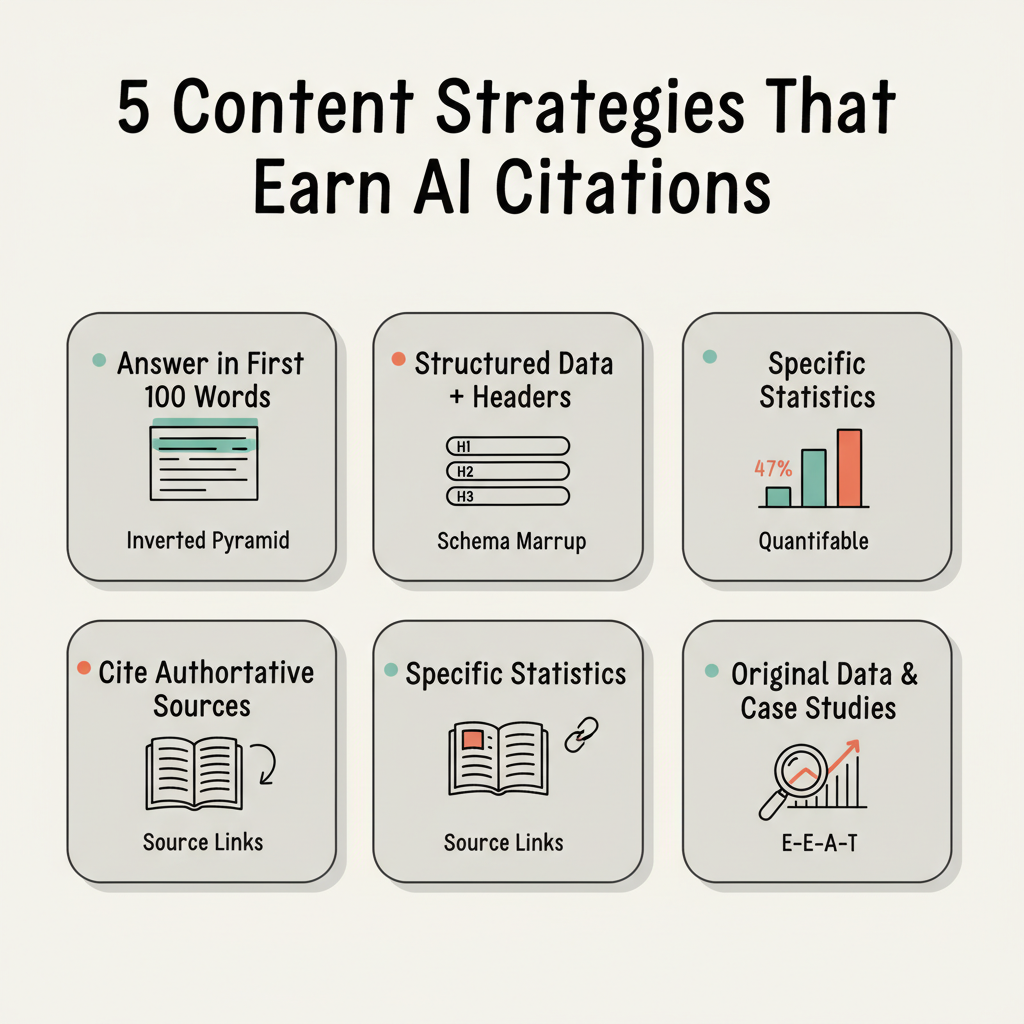
Citations to Authoritative Sources Citing your own sources signals credibility. Pages that reference authoritative external sources demonstrate research rigor and factual grounding—qualities AI systems associate with trustworthy content.
The quantified impact is significant: the Digital Bloom study found that content with explicit source citations achieves 115.1% higher AI visibility compared to unsourced equivalents. This makes adding references to authoritative sources the single highest-ROI content change available—it requires no new research, only proper attribution of existing claims. Every factual statement in your content should link to or reference its original source.
First-Hand Experience and Original Data E-E-A-T signals matter for AI citation. Content demonstrating first-hand experience—case studies, original research, proprietary data—provides information AI platforms can't find elsewhere. Unique contributions earn citations because they offer value unavailable in competing sources. Building AI overview authority signals through original research strengthens your citation potential.
Indirect Citation Strategy: Earning AI Mentions Through Third-Party Platforms
Direct citations to your domain are valuable, but an indirect citation strategy can be equally powerful. AI platforms cite sources they already trust—so getting your brand mentioned on those trusted sources is often more achievable than earning a direct first-page citation.
Wikipedia and Knowledge Panels: Wikipedia appears in 27-47.9% of ChatGPT citations, making it one of the most frequently cited domains across AI platforms. Maintaining an accurate Wikipedia presence—or at minimum, ensuring your brand information is correctly represented on Wikipedia pages relevant to your industry—strengthens AI recognition. Claim and optimize your Google Knowledge Panel and ensure structured data consistency across all authoritative profiles.
Reddit for Perplexity: Reddit accounts for 40-46.7% of Perplexity citations, making it the dominant source for that platform. Authentic participation in relevant subreddits—providing genuinely helpful answers that reference your data, tools, or original research—creates citation pathways that direct optimization cannot replicate. Avoid promotional posting; Perplexity's algorithms favor substantive community contributions.
Review and Directory Platforms: G2, Capterra, and industry-specific directories are frequently cited for commercial and B2B queries. Maintain complete, current profiles with accurate product information, updated screenshots, and active review management. These platforms carry inherent trust signals that AI systems weight heavily.
B2B vs B2C Segmentation: Citation patterns differ significantly by audience type. B2B queries skew toward industry publications and vendor blogs, which account for roughly 17% of AI citations in commercial contexts. B2C queries are dominated by media outlets, consumer review aggregators, and Reddit. B2B brands should prioritize thought leadership on industry platforms and analyst relationships. B2C brands should invest in Reddit community presence and review site optimization. Tailoring your indirect citation strategy by audience type maximizes ROI across platforms.
Technical Requirements for Citation Eligibility
Beyond content quality, technical factors determine whether AI platforms can access and cite your content.
AI Crawler Access Ensure your robots.txt permits AI crawlers:
- GPTBot (OpenAI/ChatGPT)
- PerplexityBot
- Google-Extended
- ClaudeBot (Anthropic)
Blocking these crawlers eliminates citation opportunities entirely. While AI platforms may have cached knowledge, real-time retrieval requires crawler access.
Page Speed and Rendering AI systems testing source quality evaluate load performance. JavaScript rendering issues, slow page speeds, and mobile unfriendliness create extraction barriers. SALT.agency data shows that sub-200ms TTFB (Time to First Byte) correlates with 22% higher citation density. Set this as your performance benchmark—pages exceeding 200ms TTFB face measurable citation penalties.
Schema Markup Impact Implementing structured data for AI search delivers quantified returns. Wellows data shows JSON-LD schema markup increases AI selection rate by 73%. Prioritize FAQPage, HowTo, Article, and Organization schema types. Additionally, multi-modal content—pages with embedded images, video, and infographics—achieves a 156% higher AI selection rate. Include at least one original visual element per major section.
IndexNow Protocol Implement the IndexNow protocol to notify search engines and AI crawlers immediately when content is published or updated. This ensures AI retrieval systems access your freshest content without waiting for standard crawl cycles.
Fresh Content Signals AI search heavily penalizes stale content. Perplexity shows citation decay for content not updated within 2-3 days for fast-moving topics. Update publication dates, add current examples, and refresh statistics regularly.
Clean Extraction Formatting Avoid patterns that complicate extraction: excessive pop-ups, interstitial ads, paywalled content, or complex JavaScript-dependent interfaces. Clean, accessible HTML helps AI systems extract citations confidently.
Tracking AI Search Citations
Traditional SEO platforms don't fully monitor AI search visibility. A growing ecosystem of specialized tools now enables comprehensive citation tracking across AI platforms.
What to Measure
- Citation frequency (how often your content is cited)
- Citation accuracy (whether AI correctly represents your information)
- Sentiment analysis (how favorably your brand appears in citations)
- Share of voice (your citation rate versus competitors)
- Platform distribution (which AI platforms cite you most)
Available Tools SEMrush added AI Overview tracking and citation analysis in 2025. HubSpot's AEO Grader shows how large language models see your brand. For deeper analysis, specialized platforms have emerged: Rankscale.ai for cross-platform citation tracking, Peak.ai for citation analytics dashboards, Profound for AI visibility measurement, and ZipTie.dev for citation benchmarking against competitors. Use AI citation tracking tools to monitor your performance systematically. A critical metric to track: content freshness within a 30-day window delivers a 3.2x Perplexity citation boost, while recently-updated content achieves a 76.4% ChatGPT citation rate.
Manual Testing Protocol Query AI platforms directly with questions relevant to your content. Track which competitors get cited, analyze what citation-earning content has in common, and identify gaps in your coverage.
Common Mistakes That Prevent Citations
The most damaging citation barriers:
Stale Content AI platforms penalize outdated information. A page last updated in 2022 will rarely be cited when 2025 content exists on the same topic.
Over-Optimization AI detects keyword stuffing and formulaic content. Natural, expert-level writing earns citations; manufactured SEO content doesn't.
Thin Coverage AI compares your content against everything available. Shallow articles covering topics superficially rarely earn citations when comprehensive alternatives exist.
Promotional Language AI favors educational over promotional material. Sales-focused content gets skipped for informational alternatives.
Missing E-E-A-T Signals Without verifiable expertise indicators—author credentials, source citations, demonstrated experience—AI platforms can't verify trustworthiness.
Building Citation Authority Over Time
Citation earning compounds. Brands cited consistently build recognition in AI systems. This creates a flywheel: citations signal authority, authority increases citation likelihood, and increased citations reinforce authority.
Multi-Platform Distribution Limiting content to owned properties restricts discovery. Distribute expertise across industry publications, podcasts, video platforms, and social media. AI platforms aggregate signals from multiple sources.
Entity Consistency Ensure brand information matches across all digital properties. Inconsistent entity signals confuse AI systems and reduce citation confidence.
Ongoing Content Updates Fresh content earns citations. Build processes for regular content updates—new statistics, current examples, recent case studies—that signal ongoing relevance.
AI search citations represent the new measure of content authority. The brands earning consistent citations in 2026 aren't just well-optimized—they're genuinely authoritative, clearly structured, and continuously updated. That combination of substance and accessibility determines who gets referenced when AI answers the questions that matter.
Frequently Asked Questions
How Many Sources Does Each AI Platform Cite per Response?
ChatGPT with browsing averages 7.92 citations per response, heavily weighted toward Wikipedia and established news domains. Perplexity averages 21.87 citations, drawing heavily from Reddit (46.7%) and niche content sources. Google AI Overviews typically surface 3-5 visible sources selected through query fan-out and reciprocal rank fusion. Higher citation density on Perplexity means more opportunities for smaller publishers and emerging brands to earn references.
Does Ranking on Page One of Google Guarantee an AI Citation?
No. An Ahrefs study of 863,000 keywords found that AI citation correlation with organic top-10 rankings dropped from 76% to just 38%. AI platforms use independent retrieval systems—including query fan-out and sub-query decomposition—that evaluate sources on entity authority, content freshness, and extraction confidence rather than traditional ranking signals alone. Organic ranking helps but is no longer sufficient.
What Is the Fastest Way to Increase AI Citation Visibility?
Adding explicit source citations to your content delivers the highest immediate ROI—the Digital Bloom study found a 115.1% AI visibility increase for properly cited content. Combine this with JSON-LD schema markup (+73% AI selection rate per Wellows data) and sub-200ms TTFB page load times (+22% citation density per SALT.agency). These are structural improvements that require no new content creation and can be implemented immediately.
Should B2B and B2C Brands Use Different AI Citation Strategies?
Yes. B2B queries produce citations skewed toward industry publications, vendor blogs, and analyst reports—accounting for roughly 17% of citations in commercial contexts. B2C queries are dominated by media outlets, consumer review sites, and Reddit. B2B brands should prioritize thought leadership on industry platforms and maintain strong G2/Capterra profiles. B2C brands should focus on authentic Reddit participation and review site presence to maximize indirect citation opportunities.