AI search engines don't read content the way humans do. They process pages in chunks, extract specific passages, and cite sources that make their job easy. Your content's structure directly determines whether AI systems can find, understand, and cite your information.
According to Yoast's 2025 SEO analysis, structured content outperformed clever content across AI search systems. Clear headings, predictable formats, and direct answers made it easier for AI to extract and reuse information—no shortcuts required.
This guide provides the formatting framework that earns AI citations in 2026.
GEO and AEO: The Disciplines Behind AI Content Structure
Content structuring for AI search is not a standalone tactic — it sits within two emerging disciplines that define how brands earn visibility in AI-powered results. According to SparkToro's 2024 research, over 60% of searches now end without a click. When users receive answers directly from ChatGPT, Perplexity, Gemini, or Google AI Overviews, your content must be the source that AI cites rather than the link users never visit. This zero-click search reality makes AI search optimization essential.
Generative Engine Optimization (GEO) is the broader discipline of optimizing content for generative AI systems. It encompasses discoverability, authority building, content structure, and measurement — every lever that influences whether AI models select your content as a citation source. Content formatting, as covered in this guide, is one critical tactic within the GEO framework.
Answer Engine Optimization (AEO) is a subset of GEO focused specifically on formatting content to appear as direct answers in AI-driven search results. AEO techniques include the BLUF method covered later in this post, question-based headings, and extraction-friendly paragraph structure. Where GEO covers the full spectrum of AI discoverability, AEO zeroes in on answer extraction.
As Danny Sullivan has noted, good SEO fundamentals align with good GEO. The formatting practices in this guide serve both traditional search and AI retrieval — the difference is that AI systems are far less forgiving of poor structure.
Why Structure Matters More Than Ever
AI search systems—ChatGPT, Perplexity, Google AI Overviews—don't process content sequentially. They chunk pages into segments, evaluate each independently, and extract the most relevant passages.
According to PromptWire's LLM optimization research, content that forces a "scroll for value" interaction is often abandoned by retrieval agents. If the model has to parse 500 words of backstory to find the answer, the retrieval attempt typically fails.
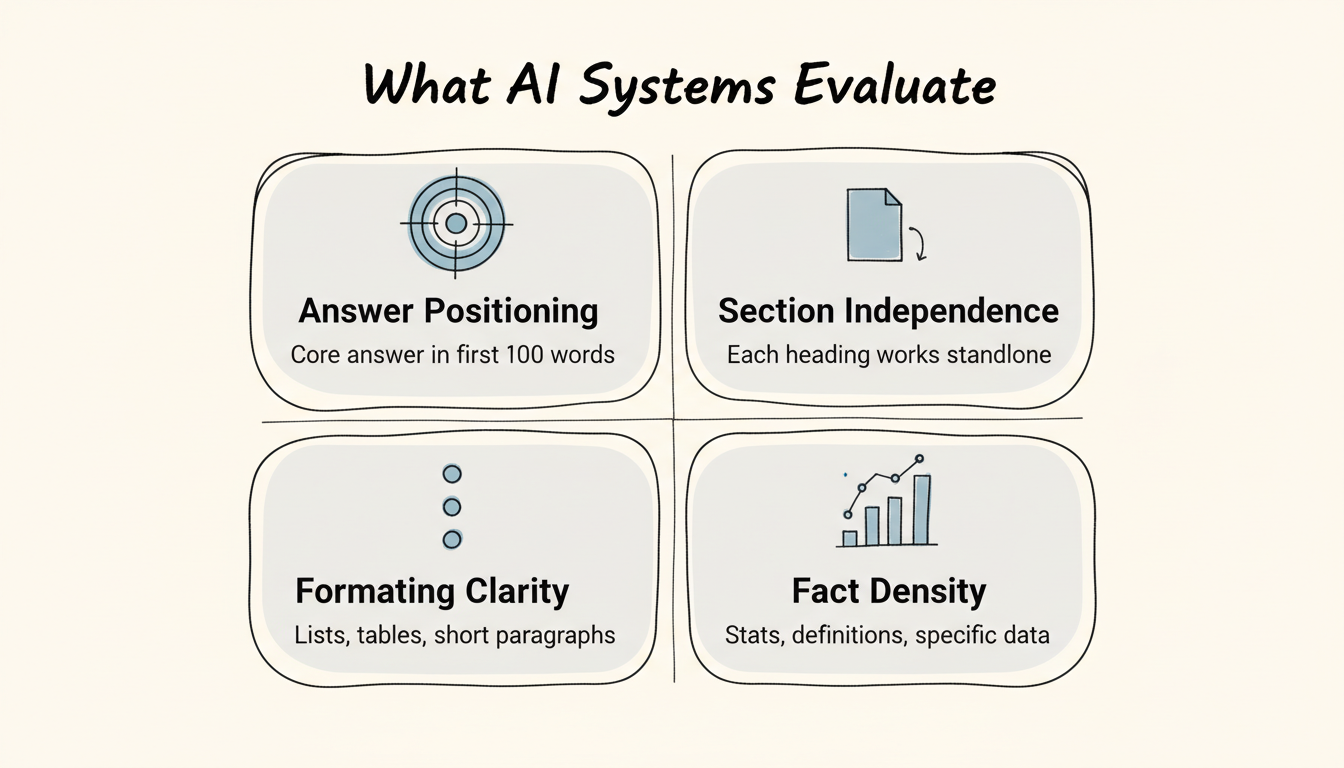
What AI systems evaluate:
Factor | What AI Looks For |
Answer positioning | Core answer in first 100 words |
Section independence | Each heading block works standalone |
Formatting clarity | Lists, tables, and short paragraphs |
Fact density | Statistics, definitions, specific data |
According to Kevin Indig's State of AI Search 2026, structure matters more than keyword density. LLMs extract and cite specific passages, so clear organization makes pages easier to parse and excerpt.
At a technical level, AI retrieval systems convert content into vector embeddings and score relevance via cosine similarity. This is precisely why formatting recommendations — short paragraphs, clear headings, standalone sections — produce measurable results. Cleaner content chunks generate more coherent embeddings that score higher in semantic matching, making well-structured pages disproportionately likely to be retrieved and cited. Understanding the Google AI Overview SEO impact on content selection reinforces why structure is now a ranking factor for AI systems.
The BLUF Method: Answer First
BLUF stands for "Bottom Line Up Front"—a military communication technique that puts the critical information first. This approach aligns perfectly with how AI systems retrieve content, particularly when optimizing for featured snippet optimization for AI.
According to PromptWire, pages that fail to define the core topic immediately are consistently retrieved less frequently for definition-based queries.
Implementation:
- First sentence = direct answer: If your heading asks "What is AI SEO?", your first sentence must be "AI SEO is..."
- First 100 words = complete answer: The opening paragraph should fully answer the section question
- Then expand: Add context, examples, and nuance after establishing the answer
The BLUF method is a core Answer Engine Optimization (AEO) practice. By front-loading the answer, you align with how AI retrieval agents score passage relevance — the first semantic chunk of your section becomes the highest-ranked candidate for citation extraction. When AI systems vectorize your section and compare it against a user query, the opening passage carries disproportionate weight. This is why AEO practitioners treat the first 100 words of every section as the primary citation target, not just a stylistic choice.
Example structure:
## What Is Enterprise AI Search?

Enterprise AI search uses machine learning and natural language processing
to help employees find information across company systems. Unlike keyword-based
search, it understands intent and delivers relevant results from documents,
emails, and databases simultaneously.

[Then expand with implementation details, examples, use cases...]
According to SEO Sherpa's AI optimization guide, Perplexity processes content in chunks, not like a human reading top to bottom. Every heading, subheading, and paragraph must stand alone as a complete, answer-ready unit.
Atomic headline principles:
- Mirror natural queries: Use headings like "What is...", "How does...", "Why should..."
- Be specific: "How Much Does Enterprise Search Cost?" beats "Pricing"
- Match user language: Write headings the way people actually ask questions
Heading structure that works:
Poor Heading | Better Heading |
Background | What Is AI Search and Why Does It Matter? |
Costs | How Much Does AI Search Implementation Cost? |
Benefits | What ROI Can You Expect from AI Search? |
Comparison | ChatGPT vs Perplexity: Which AI Search Is Better? |
According to Firebrand Marketing's GEO guide, modular sections help generative engines parse content. Each section should be independently valuable.
Formatting for Extraction
AI systems prefer scannable, structured content they can easily excerpt. Understanding these aeo optimization techniques conversion principles helps maximize visibility.
Lists and Bullet Points
According to ALM Corp's AI ranking guide, content with bullet points and numbered lists receives more citations than dense paragraphs.
When to use lists:
- Steps in a process (numbered)
- Features or benefits (bulleted)
- Comparisons (parallel structure)
- Quick reference items (bulleted)
Tables for Comparisons
Comparison tables are citation magnets. According to Search Engine Land's AI playbook, comparison tables make differences explicit and scannable—formats that consistently perform well in AI citations.
Optimal Paragraph Length
According to The Digital Bloom's AI visibility report, 40-60 word paragraphs provide optimal chunking for AI extraction. Keep paragraphs focused on single ideas.
Schema Markup for AI
Schema markup acts as a translation layer between your content and AI systems. For a deeper dive into implementation patterns, see our guide on structured data for AI search.
According to Wellows' schema best practices, using specific and accurate schema types helps AI systems match content to the right search intent. FAQ schema plays a key role in improving search visibility for question-led and informational content.
Priority schema types:
Schema Type | Best For |
FAQPage | Question-answer content |
HowTo | Step-by-step guides |
Article | Blog posts, news, analysis |
Organization | Company information |
Implementation tips:
- Use JSON-LD format (preferred by Google)
- Place schema in the page head
- Ensure schema matches visible content
- Validate with Google's Rich Results Test
Beyond schema, Google provides granular preview controls — nosnippet, data-nosnippet, and max-snippet meta tags — for managing how content appears in AI features. Overly restrictive preview settings can exclude content from AI Overviews entirely, so use data-nosnippet selectively on sensitive content while keeping high-value sections fully accessible. It is also worth monitoring the emerging llms.txt standard, a proposed mechanism for signaling which site sections are AI-accessible, similar to how robots.txt governs crawler access.
The Extraction-Friendly Checklist
Before publishing, verify your content meets AI formatting standards. Tracking these aeo optimization metrics ensures consistent performance.
Structure checks:
- Core answer appears in first 100 words of each section
- Headings are formatted as questions when appropriate
- Each section works independently (no dependencies on earlier content)
- Paragraphs stay under 60 words
- Lists used for enumerations and steps
- Tables used for comparisons
Technical checks:
- FAQ schema implemented for Q&A sections
- H-tag hierarchy is logical (H1 → H2 → H3)
- Alt text describes images meaningfully
- Meta description answers a key question
- Page loads under 2.5 seconds
According to SEOprofy's LLM SEO strategies, running pages through readability tools and Google Search Console before publishing flags heading gaps and overly dense text that hurt AI visibility.
Statistics and Citations Boost Visibility
Data-rich content earns more AI citations.
According to The Digital Bloom, adding statistics increases AI visibility by 22%, while quotations boost visibility by 37%.
How to add citation-worthy data:
- Include specific numbers and percentages
- Cite original research with links
- Add expert quotations with attribution
- Reference recent studies (2025-2026)
- Create original data when possible
According to Exploding Topics' AI visibility guide, your content needs to strip back marketing copy and provide genuine facts and figures. If AI cannot easily parse your data, it will not cite it.
E-E-A-T Signals That Influence AI Citations
E-E-A-T — Experience, Expertise, Authoritativeness, and Trustworthiness — is the quality framework AI systems use to select which sources earn citations. When multiple pages answer the same query with equivalent structural quality, E-E-A-T signals become the tiebreaker that determines which content gets cited.
Each dimension contributes differently to citation probability. Experience means first-hand data, original case studies, and proprietary research — content that cannot be replicated by simply aggregating other sources. Expertise is demonstrated through depth of coverage, technical accuracy, and author credentials that signal domain knowledge. Authoritativeness comes from external validation: backlinks from respected publications, brand mentions across trusted ecosystems, and recognition by industry peers. Trustworthiness requires transparent sourcing, accurate claims backed by citations, and consistent factual reliability.
AI systems cross-reference content against knowledge graphs and trusted repositories — Wikipedia, Crunchbase, G2, LinkedIn — to verify entity information. Brands with consistent presence across these ecosystems earn higher citation rates because AI models can corroborate claims against multiple authoritative sources. This is why building a presence in trusted knowledge graphs is not just a branding exercise but a direct AI visibility tactic.
Beyond structure, semantic relevance optimization strengthens citation probability. Use synonyms, related terms, and contextual depth to build topical signals — AI models evaluate semantic richness, not just keyword matches. A page that covers a topic with varied vocabulary and conceptual depth scores higher in relevance assessments than one that repeats the same terms.
Site Architecture: How Content Silos Amplify Page-Level Structure
Page-level formatting is necessary but not sufficient for AI search visibility. AI systems also evaluate site-level topical coherence when determining which sources to trust and cite. A well-structured page on a disorganized site underperforms a well-structured page within a topically coherent content architecture.
Content siloing organizes related content into topical clusters through URL structure (physical silos) and internal linking (virtual silos). For example, a /blog/ai-seo/ hub linking to posts on GEO, AEO, AI citations, and content structure creates a topical authority signal that reinforces every page in the cluster. Each page benefits from the collective authority of its sibling content.
Empirical data supports this approach. Chris Green's chunking study found that Q&A-formatted content within well-organized site structures achieves the highest cosine similarity scores when AI systems vectorize and match content to queries. HTML-aware and semantic chunking methods outperform simple token-based splitting, meaning clear heading hierarchy and section independence at the page level combine with logical site architecture to maximize retrieval accuracy.
Site architecture checklist for AI visibility:
- Group related content under consistent URL paths to create physical silos
- Link between sibling pages with descriptive anchor text to build virtual silos
- Create a hub or pillar page for each topical cluster that links to all related content
- Use breadcrumbs to reinforce hierarchical signals for both users and AI systems
Measuring AI Search Visibility
Traditional analytics — clicks, impressions, CTR — do not capture AI citation performance. When AI systems cite your content in a generated response, the user may never visit your site, yet your brand gains visibility and credibility. This measurement gap requires new approaches.
Emerging metrics for AI search visibility include brand mention frequency across ChatGPT, Perplexity, and Gemini responses, citation share of voice relative to competitors, and AI-referred conversion quality for users who do click through from AI-generated responses. Dedicated AI citation tracking tools are emerging to monitor these signals, alongside brand mention monitors and SERP feature tracking platforms that detect AI Overview inclusions.
As AI search expands to images and video through features like Google Search Live and camera-driven queries, multimodal search optimization becomes increasingly important. Ensure visual assets include descriptive alt text, captions, and VideoObject schema to increase your citation surface area across modalities.
Measurement maturity for AI search is still early. Establishing baseline tracking now — even with imperfect tools — provides a competitive advantage as the tooling ecosystem matures throughout 2026 and beyond.
Common Formatting Mistakes
Avoid these structure errors that kill AI visibility. Many of these issues also affect generative engine optimization performance.
Burying the Answer
Content that builds to conclusions fails AI retrieval. AI systems scan for immediate relevance—they don't read to the end hoping to find answers.
Dependent Sections
According to Semrush's LLM optimization guide, key passages must make sense in isolation. Avoid dependencies on earlier passages or external content. AI extracts chunks, not entire documents.
Marketing-Heavy Language
AI systems prefer factual, direct content. Excessive promotional language and vague claims reduce citation probability.
Inconsistent Formatting
Mixing heading styles, paragraph lengths, and list formats confuses AI parsing. Maintain consistent structure throughout.
Key Takeaways
AI search visibility depends on how well your content structure serves machine retrieval:
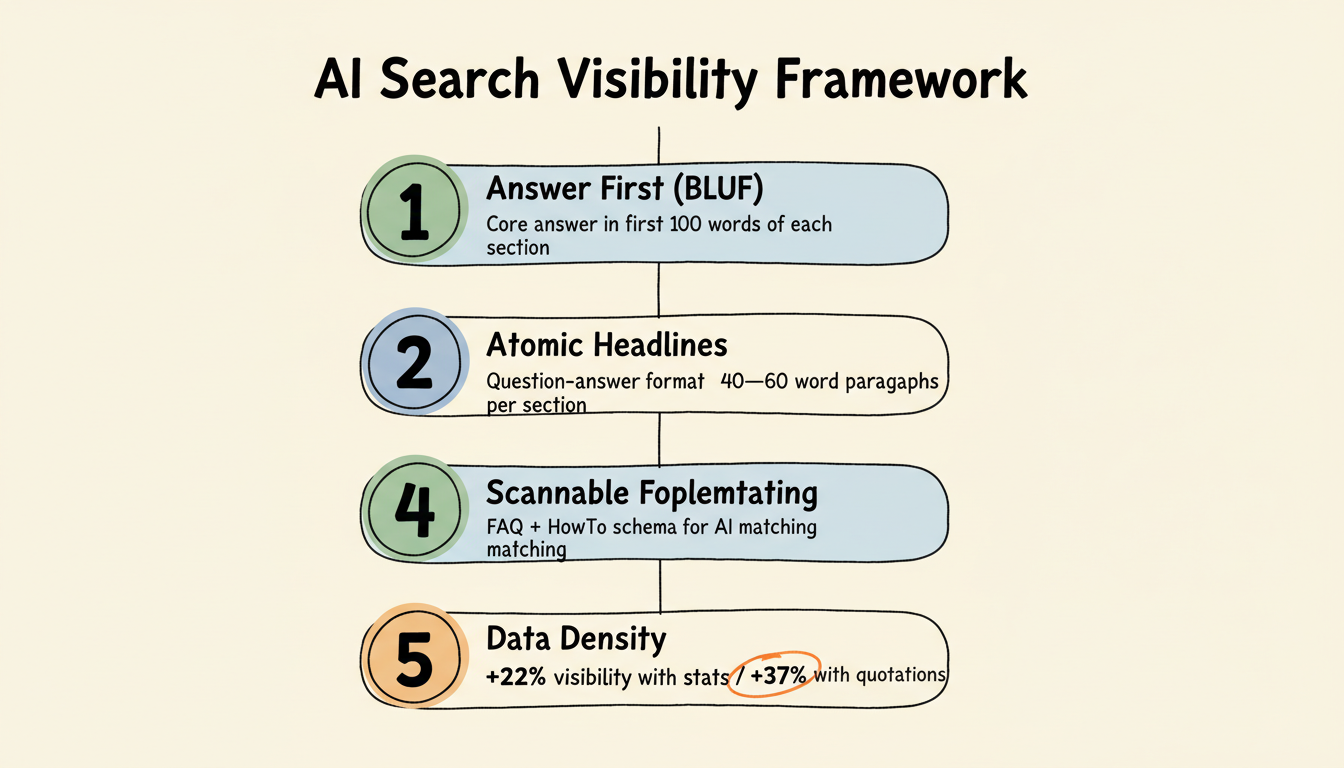
- Answer first (BLUF): Put core answers in the first 100 words of each section
- Atomic headlines: Make each heading a complete, standalone question-answer unit
- Scannable formatting: Use lists, tables, and 40-60 word paragraphs for optimal chunking
- Schema implementation: FAQ and HowTo schema help AI match content to queries
- Data density: Statistics increase AI visibility by 22%; quotations by 37%
- GEO and AEO provide the strategic framework for AI search optimization; formatting is the tactical execution layer
- E-E-A-T signals determine which well-structured content earns AI citations over competing sources
- Site-level architecture amplifies page-level structure — topical silos and internal linking compound individual page quality
- AI citation measurement is an emerging capability — establish tracking baselines now to gain a competitive advantage as tooling matures
The fundamental shift in 2026 is clear: content optimized for human skimming also performs best for AI extraction. Structure your content so any section can stand alone as a complete answer—and AI systems will reward you with citations.
Frequently Asked Questions
What Is the Difference Between GEO and AEO?
GEO (Generative Engine Optimization) is the broad discipline of optimizing content for AI-powered search systems including ChatGPT, Perplexity, and Google AI Overviews. AEO (Answer Engine Optimization) is a subset of GEO focused specifically on structuring content to appear as direct answers. GEO covers the full spectrum of discoverability, authority signals, and measurement, while AEO focuses on answer-first formatting, question-based headings, and extraction-friendly structure that maximizes passage-level citation probability.
How Does E-E-A-T Affect AI Search Citations?
AI systems prioritize sources that demonstrate Experience (original data and case studies), Expertise (deep topical coverage and author credentials), Authoritativeness (recognition by other trusted sources), and Trustworthiness (transparent citations and accurate claims). Content with strong E-E-A-T signals is more likely to be selected as a citation source in AI-generated responses. Author credentials, cited research, and consistent presence in trusted knowledge graphs like Wikipedia, Crunchbase, and G2 all strengthen citation probability.
How Can I Track Whether AI Systems Are Citing My Content?
AI citation tracking is an emerging measurement category. Monitor brand mentions across ChatGPT, Perplexity, and Gemini responses using dedicated tracking tools. Track AI Overview inclusions via SERP monitoring platforms. Measure referral quality from AI-driven pathways in your analytics to understand conversion impact. Establishing baseline measurements now provides a competitive advantage as these tools mature throughout 2026, even if current tracking capabilities are imperfect.
Does Site Architecture Matter for AI Search Optimization?
Yes — AI systems evaluate both page-level structure and site-level topical coherence. Content organized into topical silos with clear internal linking signals semantic consistency and topical authority to AI retrieval systems. Empirical testing shows that well-structured sites produce higher cosine similarity scores when AI systems vectorize content for query matching. Combine strong page-level formatting with logical site architecture, hub pages, and descriptive internal links for maximum AI visibility.