
AI search traffic converts at dramatically higher rates than traditional organic search—but only when your conversion funnel is optimized for how AI visitors behave. Users arriving from ChatGPT, Perplexity, and AI Overviews have already received context about your brand and are further along the buyer journey. Capturing this high-intent traffic requires landing pages, forms, and conversion paths designed specifically for AI-referred visitors.
According to Exposure Ninja's AI traffic analysis, AI search traffic converts at 14.2% compared to Google's 2.8%—a 5x improvement that represents a fundamental shift in how businesses should approach AI visibility optimization. Ahrefs' large-scale analysis found even more dramatic results—AI-referred traffic converting at up to 23x the rate of traditional organic in certain verticals. While the exact multiplier varies by industry and funnel maturity, the directional signal is consistent: AI visitors convert at dramatically higher rates.
Why Zero-Click Search Makes Funnel Optimization Critical
The rise of zero-click search has fundamentally changed how users interact with search results—and why the visitors who do click through to your site are more valuable than ever. According to SparkToro, 58.5% of all searches now end without a single click, as users find answers directly within AI Overviews, featured snippets, and conversational AI assistants like ChatGPT and Perplexity.
This shift is not a temporary trend. McKinsey projects that AI-driven search will influence $750 billion in US revenue by 2028, making conversion funnel optimization for AI traffic a business-critical investment rather than a tactical experiment. When Google's AI Overviews appear—currently in roughly 13% of US queries—they cause a 35% drop in click-through rates to traditional results. But the visitors who do click through have dramatically higher intent, having already evaluated alternatives within the AI response. Understanding the Google AI Overview SEO impact on your traffic is essential for adapting your funnel strategy.
AI citation frequency and reference rates are becoming the new visibility metrics, replacing raw impressions as the key performance indicators for search visibility. When your brand is cited by ChatGPT or Perplexity, the users who then visit your site arrive with pre-built trust and intent. This is exactly why the visitors converting at 14.2% behave differently—and why your funnel must be designed for them.
Why AI Traffic Converts Better
Understanding the conversion advantage informs optimization strategy.
According to Hi Goodie's B2B traffic research, ChatGPT is the most efficient B2B traffic source with nearly 2X the lead-to-close rate of traditional search engines. Users receiving AI-synthesized answers arrive pre-qualified with context about your offering.
AI traffic conversion factors:
Factor | Description | Conversion Impact |
Pre-qualification | AI provided context before click | Higher intent visitors |
Research completion | Users already informed | Shorter decision cycle |
Trust transfer | AI recommended your content | Credibility established |
Specific needs | Long-tail AI queries | Precise matching |
Decision stage | Post-research visitors | Ready to act |
Conversion Rate Benchmarks by Channel
Compare AI traffic performance against other sources.
According to Knotch's organic search analysis, organic search drives 15.6% of total traffic and 26.6% of conversions—1.7x its traffic share. AI search, while smaller in volume, demonstrates even higher conversion efficiency when properly tracked using AI-powered search tools and analytics platforms.
Channel conversion comparison:
Conversion Rates by Traffic Source
├── AI Search Traffic
│   ├── Overall: 14.2%
│   ├── ChatGPT referrals: 12-18%
│   ├── Perplexity referrals: 10-15%
│   └── AI Overview clicks: 8-12%
│
├── Traditional Organic
│   ├── Google organic: 2.8%
│   ├── Bing organic: 2.5%
│   └── Featured snippet clicks: 5-8%
│
├── Paid Search
│   ├── Google Ads: 3.5-4.5%
│   ├── Brand terms: 8-12%
│   └── Non-brand terms: 2-3%
│
└── Other Channels
    ├── Direct traffic: 2-3%
    ├── Social media: 1-2%
    └── Email marketing: 3-5%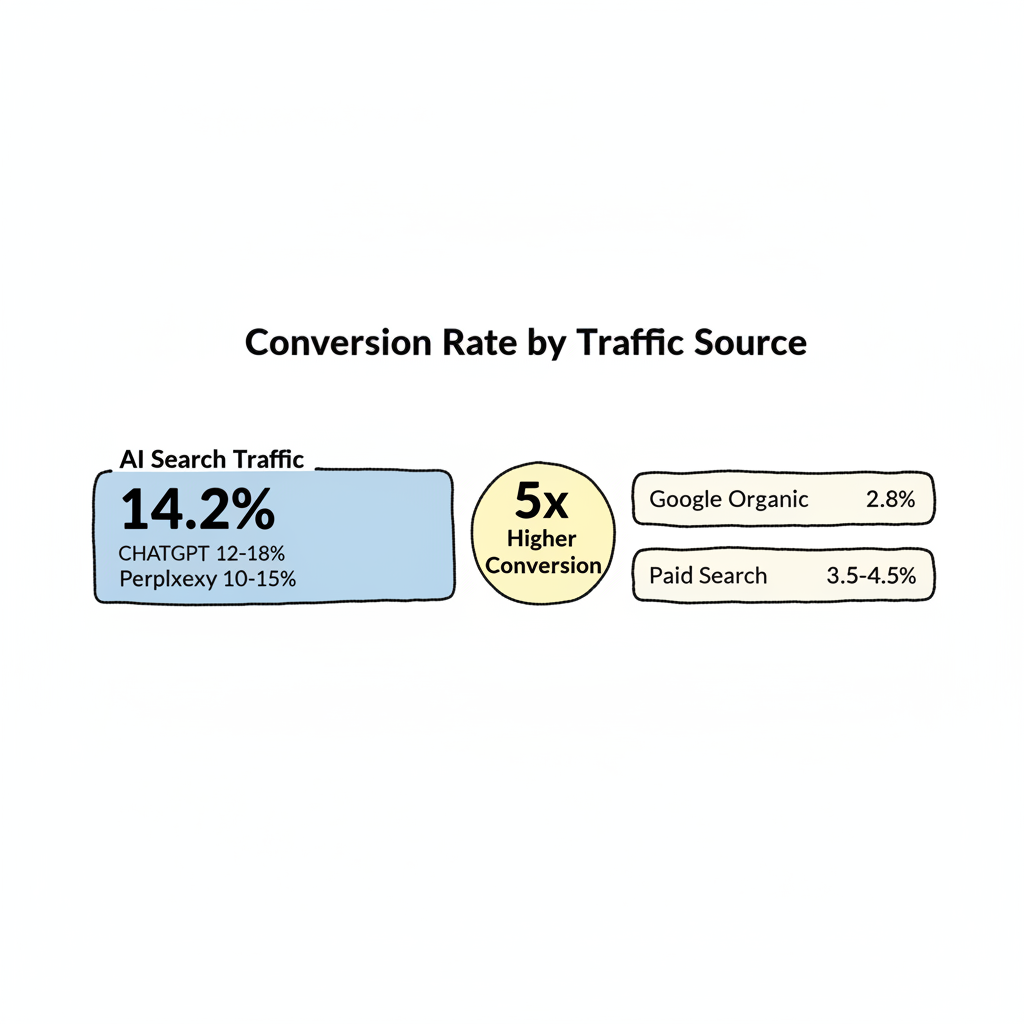
Landing Page Optimization for AI Traffic
Design experiences that match AI visitor expectations.
According to Fibr's landing page research, landing pages that load in less than 3 seconds have a 32% higher conversion rate. For AI traffic specifically, visitors expect immediate validation that they've reached the right destination. This is especially important when optimizing for generative engine optimization strategies.
AI-optimized landing page elements:
Element | Traditional Approach | AI Traffic Optimization |
Headline | Keyword-focused | Context continuation |
Opening | Problem introduction | Solution validation |
Social proof | General testimonials | Specific use case matches |
CTA placement | Below fold acceptable | Immediate visibility |
Page speed | Under 5 seconds | Under 3 seconds |
Mobile optimization | Responsive | Mobile-first |
Conversion Funnel Architecture for AI Visitors
Structure paths that match pre-qualified visitor behavior.
According to Hostinger's landing page guide, a well-designed landing page could increase conversion rates by up to 400%. For AI traffic, streamlined funnels that acknowledge prior research perform best.
It is important to recognize that AI search compresses the traditional multi-touchpoint buyer journey. Visitors arriving from a ChatGPT conversation may have already completed awareness, consideration, and evaluation in a single AI interaction—arriving at your site ready to act. This funnel collapse means the traditional linear model no longer applies to AI traffic. The funnel stages below still matter, but the entry point shifts dramatically downward, which is why mid-funnel and bottom-funnel optimization yield outsized returns for AI-referred visitors.
Optimized funnel structure:
AI Traffic Conversion Funnel
├── Entry Point (Landing Page)
│   ├── Validate AI context
│   ├── Confirm topic relevance
│   ├── Immediate value proposition
│   └── Clear next step
│
├── Engagement Layer
│   ├── Deeper content access
│   ├── Interactive elements
│   ├── Micro-conversions
│   └── Trust building
│
├── Conversion Point
│   ├── Simplified forms
│   ├── Progressive profiling
│   ├── Clear value exchange
│   └── Friction reduction
│
└── Post-Conversion
    ├── Immediate gratification
    ├── Onboarding sequence
    ├── Relationship building
    └── Referral opportunities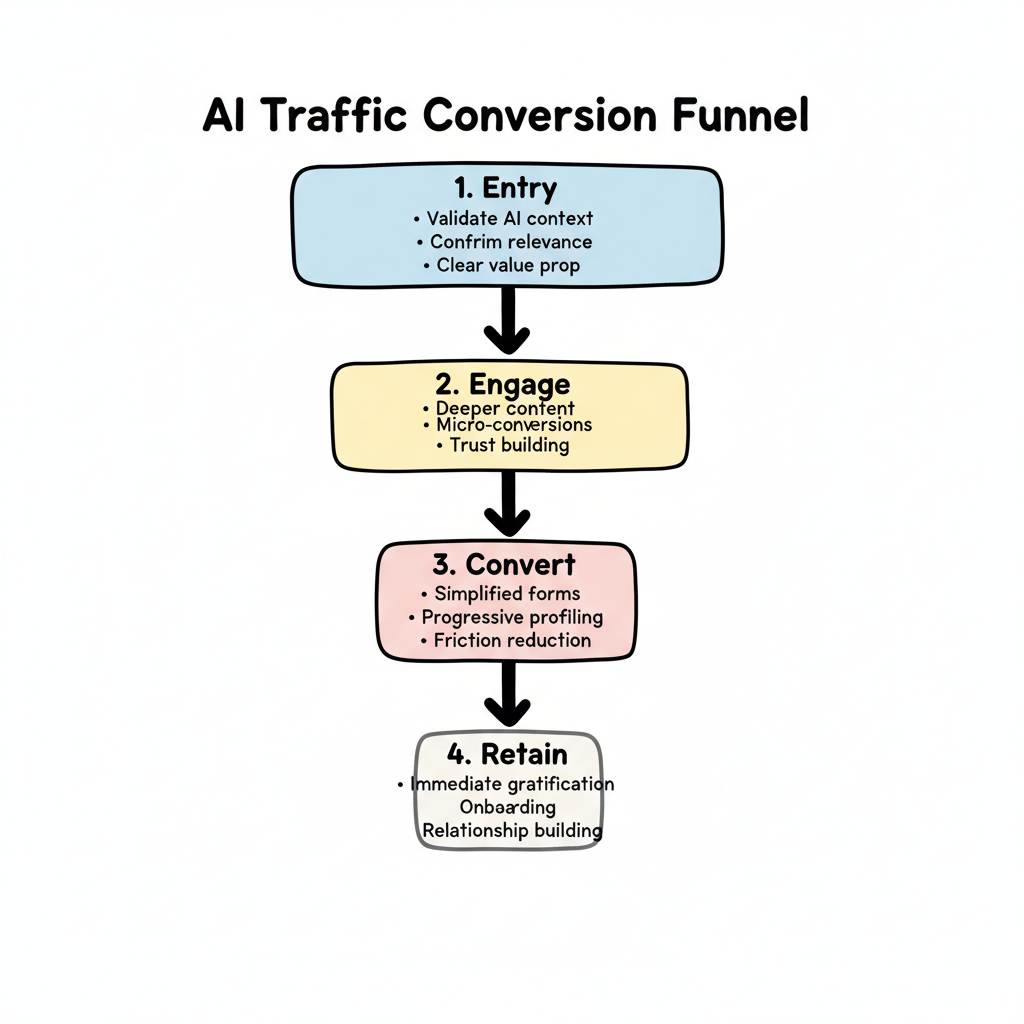
GEO and EEAT: Feeding Your AI Conversion Funnel
Before optimizing what happens after visitors arrive, it is critical to optimize how they find you in the first place. Generative Engine Optimization (GEO) is the discipline of optimizing content to be cited by AI search engines—distinct from but complementary to traditional SEO. While SEO targets rankings on search results pages, GEO targets citations within AI-generated answers from ChatGPT, Perplexity, and Google AI Overviews. Leveraging the right generative engine optimization tools and AEO tools and software accelerates this process significantly.
A dual optimization strategy—maintaining SEO for traditional search while layering GEO tactics that increase AI citation rates—feeds the top of the conversion funnel discussed above. The two approaches are not in conflict; they reinforce each other. Content that ranks well in traditional search and gets cited by AI engines captures traffic from both channels.
The EEAT framework (Experience, Expertise, Authoritativeness, Trustworthiness) plays a central role in AI citability. Research from Princeton and Georgia Tech found that content with expert quotes improves AI visibility by 37%, while authoritative sourcing boosts it by 115%. AI engines prioritize citing sources that demonstrate deep expertise and verifiable authority because their own credibility depends on the quality of their citations.
Intent-based search architecture matters here as well. AI search engines match semantic intent rather than keywords, so landing pages must answer the underlying question rather than simply contain the right phrases. When content is structured around user intent—what they actually need to accomplish—AI engines are more likely to cite it, and visitors who arrive from those citations convert at higher rates because the content directly addresses their goal.
This creates a flywheel effect: GEO increases AI citations, citations drive high-intent visitors, optimized funnels convert them, conversion data proves ROI, and demonstrated ROI justifies further GEO investment.
Form Optimization for AI-Referred Visitors
Reduce friction for pre-qualified traffic.
Form best practices:
- Fewer fields - AI visitors are pre-qualified; don't re-qualify excessively
- Progressive profiling - Gather information across multiple interactions
- Smart defaults - Pre-populate when possible based on context
- Mobile-optimized - Many AI interactions happen on mobile devices
- Clear value exchange - Explain exactly what users receive
- Instant access - Deliver promised content immediately
Field count impact:
Form Fields | Conversion Rate Impact | Best Use Case |
1-2 fields | Highest conversion | Newsletter, content download |
3-4 fields | Moderate conversion | Consultation request |
5-6 fields | Lower conversion | Detailed quote requests |
7+ fields | Significant drop | Only when necessary |
Measuring AI Traffic Conversions in GA4
Track and attribute AI-driven conversions accurately.
According to Wix AI Search Lab's measurement guide, comparing conversion rates across your AI channel grouping and other channels reveals whether AI traffic represents higher quality visitors. Proper measurement requires custom channel configuration and understanding the differences between platforms like Microsoft Copilot vs Bing AI.
GA4 conversion tracking setup:
AI Conversion Measurement Framework
├── Channel Configuration
│   ├── Create "AI Search" custom channel
│   ├── Regex for ChatGPT, Perplexity, Claude
│   ├── Position above Referral in priority
│   └── Test with real-time reports
│
├── Conversion Events
│   ├── Define key conversion actions
│   ├── Tag AI-specific micro-conversions
│   ├── Set up enhanced measurement
│   └── Configure attribution windows
│
├── Reporting Setup
│   ├── AI channel vs other channels
│   ├── Conversion rate comparisons
│   ├── Revenue attribution
│   └── Path analysis
│
└── Optimization Insights
    ├── Landing page performance
    ├── Form completion rates
    ├── Drop-off analysis
    └── A/B test tracking
Beyond GA4, a new generation of AI-specific measurement tools is emerging to track upstream visibility that feeds your conversion funnel. HubSpot's AI Search Grader monitors how often your brand appears in AI-generated answers across major platforms. Semrush's AI Toolkit tracks AI visibility trends over time, showing whether your GEO efforts are translating into increased citations. Consider exploring the full landscape of AI citation tracking tools and AI search tools available. The concept of "citation share"—what percentage of AI-generated answers in your category reference your brand—is becoming a KPI as important as conversion rate itself, because it measures the upstream visibility that determines how much high-intent traffic enters your funnel in the first place.
Schema Markup for AI Citability
Structured data gives AI crawlers machine-readable signals about your content's topic, authority, and structure—making it significantly easier for AI engines to cite your content accurately. Implementing structured data for AI search is one of the highest-leverage technical optimizations you can make for AI visibility.
Three markup types are particularly relevant to conversion funnel optimization. First, FAQPage schema pre-qualifies visitor questions by signaling the specific queries your content answers—AI engines use this to match user intent with your content. Second, HowTo schema structures step-by-step conversion processes in a format AI crawlers can parse and cite directly. Third, Product or Service schema provides commercial context for landing pages, helping AI engines recommend your offering when users express purchase intent.
Implementation checklist for schema markup: validate all structured data with Google's Rich Results Test, ensure schema content matches visible page content exactly (discrepancies can trigger penalties), update the dateModified field whenever content changes, and test across multiple AI platforms to verify citation improvements. Three of the top five ranking competitors for AI conversion funnel queries emphasize schema markup as a critical factor in their AI citability strategy.
Test specifically for AI visitor behavior.
Testing priorities:
Test Element | Hypothesis | Measurement |
Headlines | Context continuation outperforms generic | Conversion rate |
CTA text | Action-oriented beats informational | Click-through rate |
Form length | Shorter forms convert better | Completion rate |
Page layout | Above-fold CTA improves conversion | Scroll depth + conversion |
Social proof | Specific testimonials beat general | Time on page + conversion |
Lead Qualification for AI-Sourced Leads
Score and route AI traffic leads appropriately. Understanding how to allocate your AI search optimization budget effectively requires proper lead qualification metrics.
Lead scoring considerations:
- Source weight - AI referrals indicate higher research investment
- Query context - What question led them to you (if trackable)
- Engagement depth - Pages viewed, time on site post-arrival
- Conversion action - Which form or CTA they completed
- Follow-up behavior - Email opens, return visits
Nurture Sequences for AI-Referred Leads
Customize follow-up based on entry path.
Sequence optimization:
AI Traffic Nurture Strategy
├── Immediate Follow-up
│   ├── Thank you with promised content
│   ├── Acknowledge their research journey
│   ├── Provide additional value
│   └── Soft next-step suggestion
│
├── Early Nurture (Days 1-7)
│   ├── Related content recommendations
│   ├── Case studies matching interest
│   ├── Social proof expansion
│   └── Light CTA progression
│
├── Mid Nurture (Days 8-21)
│   ├── Deeper educational content
│   ├── Comparison/evaluation resources
│   ├── Consultation offers
│   └── Urgency introduction
│
└── Late Nurture (Days 22+)
    ├── Decision-stage content
    ├── Direct sales outreach
    ├── Special offers
    └── Re-engagement campaigns
Avoid errors that waste high-converting traffic.
Mistakes to avoid:
- Generic landing pages - AI visitors expect relevant continuations
- Long forms - Pre-qualified visitors don't need extensive qualification
- Slow load times - Mobile AI users expect speed
- Buried CTAs - Don't make ready-to-convert visitors search
- Ignoring mobile - Significant AI traffic is mobile-originated
- No tracking - Failing to attribute AI conversions separately
- Same nurture - Using identical sequences for all traffic sources
Building Trust with AI-Referred Visitors
The trust-building tactics discussed throughout this article—social proof, testimonials, transparent sourcing, and authoritative content—directly serve Google's EEAT framework (Experience, Expertise, Authoritativeness, Trustworthiness). Google's quality rater guidelines, which inform both traditional ranking and AI citation decisions, explicitly evaluate these four dimensions. When your landing pages demonstrate firsthand experience with the topic, cite expert sources, establish organizational authority, and build user trust through transparency, they satisfy both human visitors and the AI systems deciding whether to cite your content. This makes EEAT optimization a dual-purpose investment: it improves conversion rates for visitors who arrive and increases the AI citation frequency that drives more of them to your site.
Frequently Asked Questions
What Is Zero-Click Search and How Does It Affect AI Conversion Funnels?
Zero-click search occurs when users get their answer directly from the search results page—whether from AI Overviews, featured snippets, or AI assistants like ChatGPT. SparkToro reports 58.5% of searches now end without a click. For conversion funnels, this means the visitors who do click through have higher intent and pre-qualification, which is why AI search traffic converts at 14.2% compared to 2.8% for traditional organic.
What Is Generative Engine Optimization (GEO) and How Does It Relate to Conversion Rates?
GEO is the practice of optimizing content to be cited by AI search engines like ChatGPT, Perplexity, and Google AI Overviews. Unlike traditional SEO which targets rankings, GEO targets citations. It directly impacts conversion funnels because AI-cited brands receive pre-qualified traffic—visitors who already trust the recommendation. A dual optimization strategy maintaining both SEO and GEO ensures visibility across traditional and AI search channels.
How Does EEAT Affect Whether AI Search Engines Cite Your Content?
Google's EEAT framework—Experience, Expertise, Authoritativeness, Trustworthiness—directly influences AI citation decisions. Research from Princeton and Georgia Tech found that content with expert quotes improves AI visibility by 37%, while authoritative sourcing boosts it by 115%. For conversion funnels, EEAT-optimized content gets cited more often by AI engines, driving higher volumes of the pre-qualified traffic that converts at 5-23x traditional rates.
What Structured Data Should I Add to Improve AI Search Visibility?
Implement FAQPage schema for common questions your audience asks, HowTo schema for step-by-step processes, and Organization or Product schema for commercial pages. JSON-LD is the preferred format. Structured data gives AI crawlers machine-readable context about your content's topic and authority, increasing the likelihood of citation. Three of the top five ranking pages for AI conversion funnel topics emphasize schema markup as essential for AI citability.
Key Takeaways
AI search conversion funnel optimization captures high-value traffic:
- AI traffic converts 5-23x better - 14.2% vs 2.8% for traditional Google organic, with some verticals seeing up to 23x improvement
- Zero-click search makes funnel optimization critical - With 58.5% of searches ending without a click, the visitors who do arrive are dramatically more qualified
- GEO and EEAT feed your funnel - Generative engine optimization and EEAT signals increase AI citations, driving more high-intent traffic to your conversion paths
- Landing pages must validate context - Continue the conversation AI started
- Schema markup boosts AI citability - Structured data in JSON-LD format helps AI engines parse and cite your content
- Forms should be streamlined - Don't re-qualify pre-qualified traffic
- GA4 plus AI citation tools required - Track both conversions and upstream AI visibility with tools like HubSpot AI Search Grader and Semrush AI Toolkit
- Nurture sequences need customization - AI visitors have different needs due to funnel compression
According to Superprompt's AI traffic analysis, AI search traffic converts 5x better than Google because users arrive having already received context about your brand and offerings. Optimizing your conversion funnel for this pre-qualified traffic—through faster landing pages, shorter forms, and relevant content continuation—captures the full value of your AI search visibility investment.