
AI search traffic has grown 527% year-over-year according to recent industry data, but raw traffic numbers tell an incomplete story. According to SparkToro's research, 58.5% of all searches now result in zero clicks, making it even more critical to maximize conversion value from every AI-referred visitor who does reach your site. Organizations optimizing for AI visibility must focus not just on citation frequency but on conversion quality—turning AI-referred visitors into customers, subscribers, or leads. This guide explores strategies for maximizing the business value of AI search traffic rather than simply chasing visibility metrics.
The Quality-Quantity Paradigm in AI Search
AI search fundamentally changes the traffic quality equation.
How AI Traffic Differs from Traditional Search
AI-referred visitors arrive with different context than traditional search users.
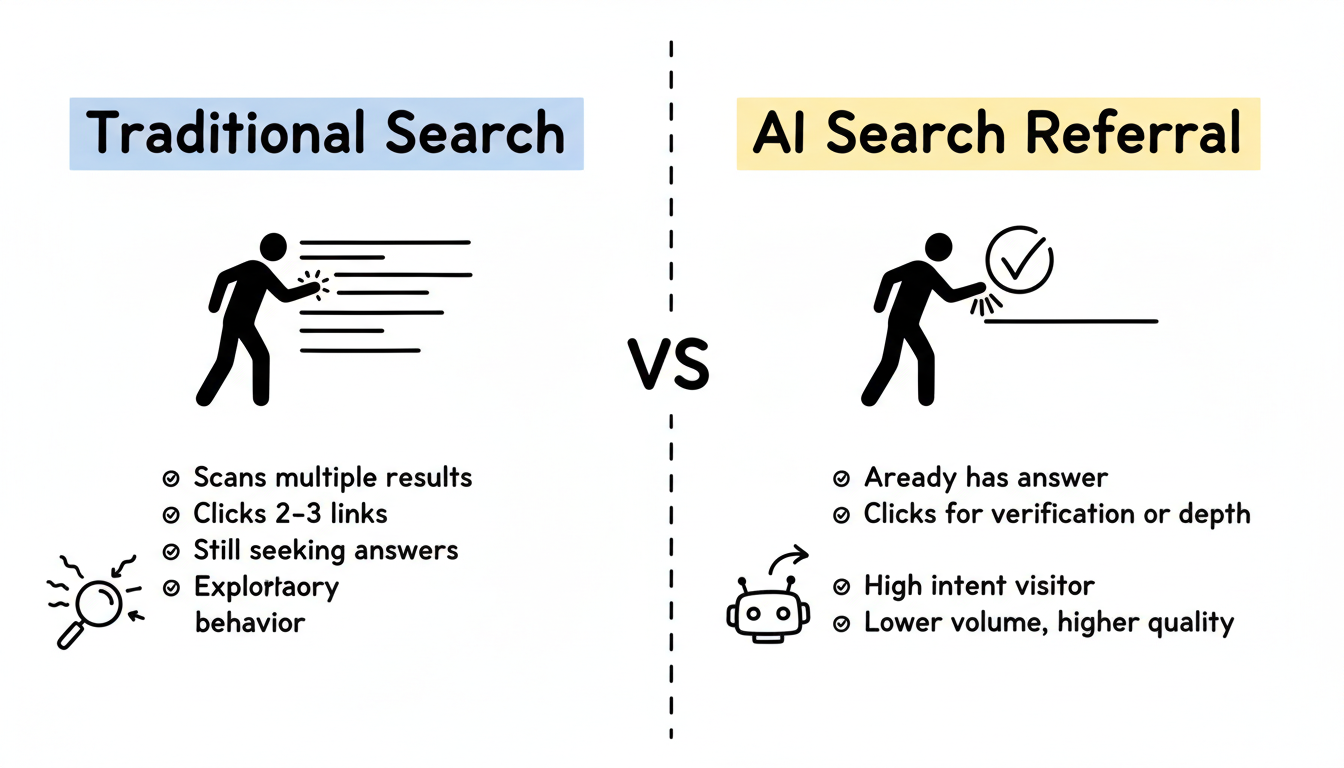
Traditional search behavior:
- Users scan multiple results before clicking
- Often click 2-3 links to compare information
- May not have found their answer yet
- Higher bounce rates but more exploratory behavior
AI search referral behavior:
- Users have already received an AI-generated answer
- Click only for verification, depth, or next steps
- Higher intent—they chose to click despite having an answer
- Lower volume but potentially higher quality
Research indicates ChatGPT drives 89% of measured AI referrals when users do click through, but the click-through rate itself is lower than traditional search. The visitors who do click represent a more intentional audience, which is why understanding AI search platform strengths and weaknesses becomes crucial for optimization.
The Zero-Click Challenge
AI search creates more zero-click experiences where users get answers without visiting source websites.
Implications for conversion strategy:
- Fewer visitors overall but higher intent when they arrive
- Brand exposure occurs within AI responses, not just on your site
- Conversion may happen through brand search after AI discovery
- Traditional funnel metrics need supplementation with AI visibility metrics
Organizations measuring only direct referral traffic miss significant AI-driven business impact that flows through branded search and direct navigation. When developing your AEO strategy framework, it's essential to account for these indirect conversion pathways.
Measuring AI Search Conversion Quality
Effective optimization requires appropriate measurement frameworks.
Traffic Attribution Challenges
Attributing AI search traffic accurately presents technical challenges.
Attribution difficulties:
- Referrer data inconsistent across AI platforms
- Some AI traffic shows as direct or organic
- Multi-touch attribution doesn't capture AI discovery
- Brand lift from AI mentions is difficult to isolate
Measurement approaches:
- Configure GA4 to identify AI platform referrers
- Track branded search volume changes after AI optimization
- Implement UTM parameters where possible
- Survey customers about discovery sources
- Monitor AI citation frequency alongside conversion data
Imperfect attribution is acceptable—directional insights enable optimization even without perfect measurement. For comprehensive tracking methodologies, explore how cross-platform AI search ROI measurement can provide a more complete picture.
Key Conversion Metrics for AI Traffic
Focus on metrics revealing AI traffic quality.
Primary conversion metrics:
- Conversion rate by traffic source (AI vs. traditional)
- Revenue per visitor from AI referrals
- Time-to-conversion for AI-referred users
- Customer lifetime value by acquisition source
Quality indicators:
- Pages per session from AI referrals
- Average session duration
- Return visitor rate
- Email/newsletter signup rate
- Content download rates
AI traffic that engages deeply and converts suggests effective alignment between your content and AI user intent.
Beyond these traditional metrics, track AI citation share—the percentage of AI-generated responses that cite your content for target queries in your topic cluster. This upstream metric serves as a leading indicator of future referral traffic volume and quality. Alongside citation share, monitor sentiment accuracy: whether AI systems represent your brand, products, and offerings correctly when they do cite you. Inaccurate AI representations can drive traffic that converts poorly because visitor expectations don't match reality. Use AI citation tracking tools to measure both metrics systematically.
Establishing Baselines
Before optimization, establish current performance baselines.
Baseline data points:
- Current AI referral traffic volume (by platform)
- Conversion rates for AI vs. other traffic sources
- Bounce rates and engagement metrics
- Post-click behavior patterns
- Average order value or lead quality scores
- Customer acquisition cost by channel
Baseline documentation best practices:
- Capture at least 30 days of data before changes
- Segment by AI platform where volume permits
- Note any external factors affecting baseline period
- Create comparison cohorts for meaningful analysis
Document baselines before implementing optimization changes to measure impact accurately. Organizations without clear baselines cannot distinguish optimization wins from normal variation.
Conversion Optimization Strategies
Apply specific strategies to improve AI traffic conversion.
Landing Page Optimization for AI Traffic
AI-referred visitors have unique needs requiring tailored landing experiences.
Optimization approaches:
Validate and expand on AI answers: Visitors clicking from AI often want verification or deeper detail. Confirm the information they received while providing additional value.
Clear value beyond the AI answer: Demonstrate why visiting your site provides value the AI answer didn't. This might include interactive tools, downloadable resources, expert consultation, or product purchase options.
Reduce friction for high-intent visitors: AI-referred visitors have already researched. Minimize steps between arrival and conversion with prominent CTAs and streamlined forms.
Match content to citation context: Understand what queries drive AI citations to your content and ensure landing pages align with that user intent. Implementing conversational content writing for AEO can help match the natural language patterns AI platforms expect.
Content Depth Strategy
AI traffic arrives after receiving summary answers. Content must provide complementary depth.
Depth approaches:
Comprehensive detail sections: Include sections offering depth AI summaries can't provide—case studies, implementation guides, detailed comparisons, and nuanced analysis. Using descriptive subheadings for AEO helps both AI platforms and human visitors navigate your content effectively.
Interactive elements: Calculators, configurators, quizzes, and assessment tools provide value AI systems can't replicate in text responses.
Expert consultation offers: For complex topics, human expertise remains valuable. Prominent offers for consultation convert AI-referred visitors seeking personalized guidance.
Downloadable resources: Checklists, templates, and guides offer tangible takeaways encouraging email capture and further engagement.
Conversion Path Design
Design conversion paths appropriate for AI-referred visitor psychology.
Effective path elements:
Multiple conversion levels: Not all visitors are ready for high-commitment actions. Offer low-friction options (newsletter signup, content download) alongside primary conversions (demo request, purchase).
Trust reinforcement: AI-referred visitors may be verifying AI information. Display credibility signals prominently—testimonials, credentials, certifications, and third-party validation.
These trust signals directly align with Google's E-E-A-T framework (Experience, Expertise, Authoritativeness, Trustworthiness), which AI systems also evaluate when selecting sources to cite. Ensuring your pages display SSL certificates, trust badges, verified author credentials, and industry certifications strengthens both your E-E-A-T score and the confidence AI-referred visitors feel when deciding to convert.
Clear next steps: AI users are accustomed to direct answers. Provide clear, specific next actions rather than generic "contact us" CTAs.
Mobile optimization: Significant AI usage occurs on mobile devices. Ensure conversion paths function seamlessly across devices.
Platform-Specific Conversion Strategies
Different AI platforms send traffic with different characteristics.
ChatGPT Referral Optimization
ChatGPT drives the largest volume of AI referrals with 89% of measured AI traffic.
ChatGPT traffic characteristics:
- Often research-oriented
- Longer, more complex queries
- Higher engagement with detailed content
- Professional and B2B users overrepresented
Optimization priorities:
- Long-form content that rewards deep reading
- Professional-focused conversion offers
- Resource libraries and comprehensive guides
- Clear expertise demonstrations
Page experience also matters for AI citation selection. Core Web Vitals—including Largest Contentful Paint (LCP), Interaction to Next Paint (INP), and Cumulative Layout Shift (CLS)—increasingly influence whether AI platforms choose to link to your content, as poor page performance reflects badly on the quality of their citations.
Perplexity Referral Optimization
Perplexity demonstrates a 6.2x Referral Efficiency Index—users are far more likely to click citations. For detailed tactics, see our Perplexity optimization guide.
Perplexity traffic characteristics:
- High intent to verify and learn more
- Research-focused behavior
- Quality over quantity orientation
- Willingness to explore cited sources
Optimization priorities:
- Detailed, well-cited content
- Academic or research-quality depth
- Clear information architecture
- Multiple content formats (data, charts, analysis)
As with ChatGPT, ensure your pages meet Core Web Vitals benchmarks. Perplexity's citation algorithm factors in page load speed and mobile usability when ranking potential sources, making technical performance a prerequisite for consistent citation placement.
Google AI Overviews Optimization
Google AI Overviews reach 2 billion users monthly with different referral patterns. Understanding the AI Overview impact helps inform your optimization priorities.
AI Overviews traffic characteristics:
- Familiar Google user behavior
- Mix of informational and commercial intent
- Often seeking quick verification
- May be comparing multiple cited sources
Optimization priorities:
- Fast-loading, mobile-optimized pages
- Clear answers matching AI-cited content
- Strong calls-to-action visible immediately
- Seamless user experience expectations
Beyond Google: Bing Copilot, Gemini, and Emerging AI Platforms
While ChatGPT, Perplexity, and Google AI Overviews dominate current AI search traffic, emerging platforms present growing conversion opportunities that require distinct optimization approaches.
Bing Copilot is deeply integrated into Microsoft Edge and Windows, giving it a captive audience of enterprise and productivity-focused users. Because Copilot draws primarily from Bing's index, ensuring strong Bing SEO fundamentals—including Bing Webmaster Tools verification and IndexNow protocol adoption—directly increases citation likelihood. Conversion behavior from Bing Copilot referrals tends to skew more toward B2B and professional services compared to ChatGPT's broader audience. For context on how Google AI Overview SEO impact compares to Bing Copilot's approach, understanding each platform's citation preferences helps prioritize optimization efforts.
Google Gemini introduces multimodal capabilities that expand optimization beyond text. Pages incorporating structured image alt text, video transcripts, and well-labeled visual content are more likely to be cited in Gemini's multimodal responses. As Gemini evolves, optimizing for image and video search alongside text becomes a conversion quality lever—multimodal citations tend to drive more engaged, higher-converting traffic because users have already interacted with richer content previews.
Personalization also matters across these platforms. AI-referred visitors arrive with different intent signals than traditional organic visitors. Consider adjusting landing page elements—CTAs, content depth, trust signals, and offer positioning—based on the referring AI platform. A visitor from Bing Copilot researching enterprise software has different conversion needs than a Perplexity user exploring product comparisons.
Technical Foundations That Drive AI Conversion Quality
The technical infrastructure of your website plays a direct role in both AI citation likelihood and the quality of traffic those citations deliver. Getting the technical foundations right ensures that AI systems can accurately parse your content and that the visitors they send arrive with well-set expectations.
Schema Markup as a Conversion Tool
Structured data serves a dual purpose in AI search conversion: it increases the probability of being cited by AI systems and improves the quality of traffic that arrives. When you implement structured data for AI search, you give large language models precise, machine-readable information to extract and present to users.
FAQ schema increases citation likelihood for question-based queries by providing clear question-answer pairs that LLMs can directly reference. HowTo schema structures procedural content in a way that AI systems can present as step-by-step guidance, pre-qualifying visitors who need detailed implementation help. Product and Review schema surface pricing, ratings, and availability within AI responses, setting accurate expectations that reduce bounce rates when users click through—visitors arrive already knowing your price point or rating, making them more conversion-ready.
The common thread is that rich snippets powered by structured data set accurate expectations before the click. When AI responses include specific details from your schema markup, visitors who choose to click through have already self-qualified based on that information. This pre-qualification is what transforms schema from a visibility tool into a conversion tool.
Entity Optimization and Knowledge Graph Presence
Building clear entity associations—connecting your brand to specific topics, expertise areas, and industry categories—makes your content more citable by large language models. LLMs rely on entity recognition to determine which sources are authoritative for a given query. When your brand has strong entity associations with your target topics, AI systems are more likely to cite you in relevant responses.
Knowledge graph presence reinforces this authority signal. When Google's Knowledge Graph recognizes your brand as an entity with defined attributes and relationships, this structured understanding propagates to AI systems that reference Google's data. Learn how to get a Google Knowledge Panel to establish this foundational entity presence.
On the technical crawlability side, ensure that AI crawlers can access and parse your content without barriers. Review your robots.txt for unintentional blocks on AI user agents (GPTBot, PerplexityBot, Google-Extended). Avoid noindex or nosnippet directives on pages you want cited. AI systems can only cite content they can access, making crawlability a fundamental prerequisite for AI search conversion.
GEO and E-E-A-T: The Authority Signals AI Systems Reward
Beyond technical foundations, the authority and trustworthiness signals your content carries determine both citation frequency and conversion quality from AI search.
Generative Engine Optimization (GEO) for Conversions
Generative Engine Optimization (GEO) is the emerging discipline that sits alongside Answer Engine Optimization (AEO), specifically focused on how large language models ingest, evaluate, and cite content in AI-generated responses. While AEO targets featured snippets and direct answers across platforms, GEO addresses the unique ranking factors that generative AI systems use when constructing responses. For a deeper look at available solutions, explore the best generative engine optimization tools on the market.
The answer-first framework is central to GEO for conversions. Structure each section of your content so it opens with a direct, concise answer followed by supporting detail, evidence, and nuance. This format increases the likelihood that LLMs will cite your content because it matches how they extract and present information. Crucially, when AI systems cite your answer-first content, the visitors who click through arrive with accurate expectations set by that direct answer—they're clicking for the depth and detail that follows, which represents genuinely conversion-ready traffic.
Modular formatting reinforces this approach. Break content into self-contained, clearly labeled sections that LLMs can parse independently. Each module should be able to stand alone as a citable unit while contributing to the comprehensive whole. This structure increases both the number of potential citation entry points and the relevance of traffic each citation drives.
E-E-A-T Signals That Increase AI Citation and Trust
Google's E-E-A-T framework—Experience, Expertise, Authoritativeness, Trustworthiness—serves as a quality evaluation model that AI systems increasingly use when selecting sources to cite. Content demonstrating firsthand experience, deep subject matter expertise, recognized authority, and verifiable trustworthiness receives preferential citation treatment across ChatGPT, Perplexity, and Google AI Overviews.
The conversion impact of E-E-A-T is direct: visitors arriving via an authoritative AI citation carry higher inherent trust in your brand. When an AI system presents your content as a credible source, it effectively provides a third-party endorsement that shortens the conversion path. These visitors require less on-site trust-building before taking action compared to visitors from anonymous organic search results.
Digital PR and brand mentions across authoritative third-party sites serve as a powerful lever for both E-E-A-T and AI citation frequency. When your brand is mentioned in industry publications, news outlets, and respected blogs, LLMs encounter these references during training and inference, increasing the probability that they cite your brand in relevant responses. A systematic digital PR strategy that generates consistent brand mentions across authoritative domains compounds over time, building the entity authority that AI systems reward with citations.
Optimizing for Different Conversion Types
Different business models require different AI conversion strategies.
E-Commerce Conversions
For product sales, AI traffic optimization focuses on purchase conversion.
E-commerce strategies:
- Product pages cited in AI should have clear purchase paths
- Reviews and social proof prominently displayed
- Comparison content facilitating purchase decisions
- Retargeting AI visitors who don't convert immediately
For e-commerce brands, Google Merchant Center and Google Business Profile data increasingly feed into AI shopping experiences. Ensuring your product feeds are accurate, up-to-date, and richly attributed means AI systems can surface your products with correct pricing, availability, and ratings—driving higher-quality traffic that converts because expectations are set accurately before the click.
Lead Generation Conversions
For B2B and service businesses, lead capture is the primary goal. Organizations can leverage affordable AEO services to enhance their lead generation without excessive investment.
Lead generation strategies:
- Gated content offers for high-intent visitors
- Consultation scheduling with minimal friction
- Demo or trial offers for qualified traffic
- Progressive profiling rather than long forms
Content/Media Conversions
For publishers and content businesses, engagement and subscription matter.
Content strategies:
- Newsletter signups as primary conversion
- Metered access encouraging subscription
- Related content recommendations increasing pageviews
- Membership or premium content offers
Common Conversion Optimization Mistakes
Avoid these errors undermining AI traffic conversion.
Treating AI Traffic Like Traditional Organic
AI-referred visitors have already received answers. Treating them as uninformed browsers misses their actual intent and needs. Understanding the fundamental AEO vs SEO comparison helps avoid this mistake.
Better approach: Acknowledge their research and offer next-level value they haven't yet received.
Ignoring the Pre-Click Brand Exposure
Users seeing your brand cited in AI responses receive impression value even without clicking. This exposure influences later conversion through brand search or direct navigation.
Better approach: Track branded search volume and direct traffic alongside AI referrals to capture full impact.
Over-Optimizing for Volume
Chasing maximum AI citations without considering traffic quality leads to visitors who don't convert. A smaller volume of highly-converting traffic outperforms large volumes of low-intent visitors. Consider using free AEO tools to identify high-value optimization opportunities.
Better approach: Prioritize optimization for topics and queries aligned with conversion intent, not just volume.
Neglecting Post-Conversion Experience
AI-referred customers who have positive post-conversion experiences generate reviews, testimonials, and word-of-mouth that strengthen future AI citations.
Better approach: Invest in customer success and encourage reviews to create virtuous cycles.
Building a Conversion-Focused AI Strategy
Integrate conversion optimization into overall AI search strategy.
Strategy Integration Framework
Align visibility and conversion goals:
- Identify topics where AI visibility aligns with conversion potential
- Prioritize optimization where business value is highest
- Balance brand awareness topics with conversion-focused topics
Create feedback loops:
- Use conversion data to inform content priorities
- Track which cited content converts best
- Iterate based on actual business results
Resource allocation:
- Invest proportionally in optimization versus visibility
- Test and measure conversion optimization impact
- Scale what works, abandon what doesn't
Organizations can accelerate results by partnering with specialized generative engine optimization companies that have proven conversion optimization frameworks.
Continuous Optimization Cycle
AI search optimization is ongoing, not one-time.
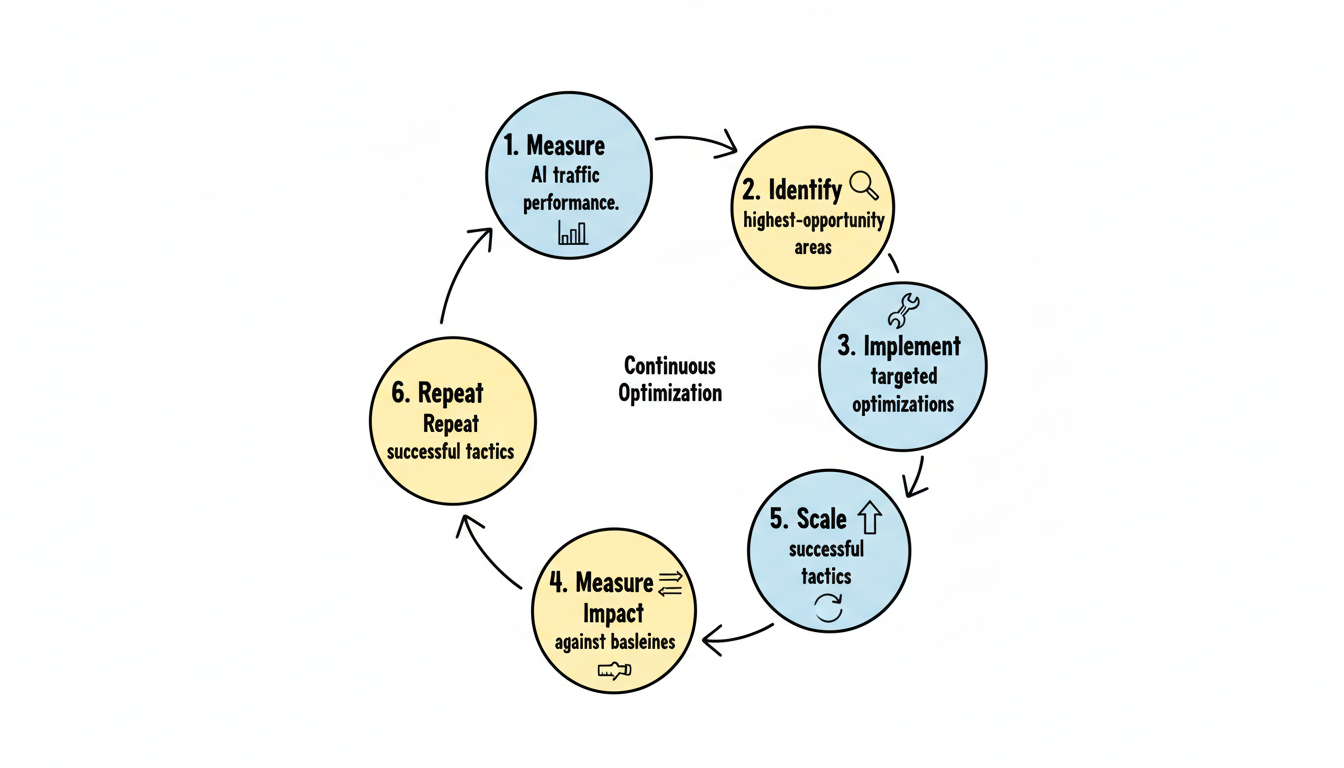
Optimization cycle:
- Measure current AI traffic conversion performance
- Identify highest-opportunity improvement areas
- Implement targeted optimizations
- Measure impact against baselines
- Scale successful tactics, test new approaches
- Repeat
Organizations treating conversion optimization as continuous improve results over time rather than achieving one-time gains. Leveraging specialized AEO tools and software can streamline this iterative process.
Content Freshness and Recency Bias in AI Systems
AI engines show a measurable preference for fresh content, favoring sources approximately 26% fresher than the median competing result. This recency bias means that content which drifts from current query intent over time—a phenomenon known as semantic drift—experiences declining citation rates and lower-quality referral traffic. Statistics become outdated, platform-specific guidance no longer reflects current interfaces, and examples lose relevance.
Establish a monthly update cadence for high-value conversion pages. Refresh statistics, update platform-specific screenshots and guidance, and revise examples to reflect current market conditions. Track AI citation share alongside your update schedule to correlate freshness with citation frequency—pages updated within the past 30 days consistently outperform stale content in AI citation placement. Use AI citation tracking tools to monitor how content freshness impacts your citation share over time.
Testing and Experimentation
Conversion optimization requires systematic testing.
A/B Testing for AI Traffic
Test variations to identify what converts AI visitors best.
Testing priorities:
- Landing page headlines and value propositions
- CTA placement, copy, and design
- Form length and field requirements
- Content depth and format variations
- Trust signal placement and types
Ensure sufficient traffic volume before drawing conclusions—AI referral traffic may require longer testing periods than traditional traffic.
Qualitative Research
Quantitative data alone doesn't explain visitor behavior.
Qualitative approaches:
- User session recordings of AI-referred visitors
- Heatmaps showing engagement patterns
- Post-conversion surveys asking about discovery journey
- Customer interviews exploring decision factors
Qualitative insights complement quantitative data for comprehensive optimization understanding.
FAQs
Is AI Search Traffic Higher or Lower Quality Than Traditional Search?
It depends on alignment. AI-referred visitors who click have high intent—they chose to visit despite receiving an AI answer. However, total volume is lower. When properly optimized, AI traffic often converts at higher rates than traditional search traffic. The key is ensuring your content and conversion paths align with AI-referred visitor needs.
How Do I Know If My AI Traffic Is Converting Well?
Compare conversion rates between AI referral traffic and other sources. Segment by AI platform if volume allows. Also track branded search volume increases that may indicate AI-influenced conversions not captured in direct referral data. Industry benchmarks are still emerging, so focus on improving your own baselines over time.
Should I Optimize for AI Visibility or Conversion First?
Visibility must precede conversion—you can't convert traffic you don't have. However, don't ignore conversion while building visibility. Optimize content for both citation potential and conversion simultaneously. The best approach integrates visibility and conversion optimization from the start rather than treating them as sequential phases.
What Conversion Rate Should I Expect from AI Search Traffic?
Conversion rates vary significantly by industry, offer type, and optimization level. Early data suggests well-optimized AI traffic can convert at 1.5-2x traditional organic rates due to higher visitor intent. However, focus on improving your specific baselines rather than chasing industry averages.
What Is Generative Engine Optimization (GEO) and How Does It Differ from AEO?
GEO focuses specifically on how large language models process, evaluate, and cite content in AI-generated responses. While AEO (Answer Engine Optimization) targets featured snippets and direct answers across all platforms, GEO addresses the unique ranking factors that generative AI systems use, including entity recognition, source authority scoring, and content structure parseability. For a comparison of available solutions, see our guide to AEO tools and software.
What Schema Markup Types Improve AI Search Conversion Rates?
FAQ, HowTo, Product, Review, and Article schema types each serve a different role. FAQ schema increases citation likelihood for question-based queries. Product and Review schema pre-qualify e-commerce visitors by surfacing pricing and ratings within AI responses. Article schema with author credentials strengthens E-E-A-T signals. The common thread is that structured data helps AI systems extract precise, conversion-ready information from your pages.
How Do I Measure AI Citation Share for My Brand?
AI citation share measures how often AI platforms reference your content when answering queries in your topic cluster. Track it by running target queries across ChatGPT, Perplexity, Gemini, and Google AI Overviews weekly, recording whether your brand is cited. Monitor sentiment accuracy alongside volume to ensure AI systems represent your offerings correctly.
Does Content Freshness Affect AI Search Conversion Performance?
Yes. AI systems show a measurable recency bias, preferring sources approximately 26% fresher than the median competing result. Content that drifts from current query intent (semantic drift) sees declining citation rates and lower-quality referral traffic. Establish a monthly update cadence for high-value pages, refreshing statistics, examples, and platform-specific guidance to maintain conversion quality.