
The AI search landscape has fragmented into a competitive market where each platform excels at different tasks. ChatGPT commands nearly 65% of AI chatbot traffic, Google Gemini has surged to 21.5%, and Perplexity has carved out a citation-focused niche. For marketers optimizing content, understanding where and why each platform cites sources is critical for visibility strategy.
Here's how the 8 best AI search platforms compare in 2026—and what it means for your content optimization approach.
Market Share and User Behavior
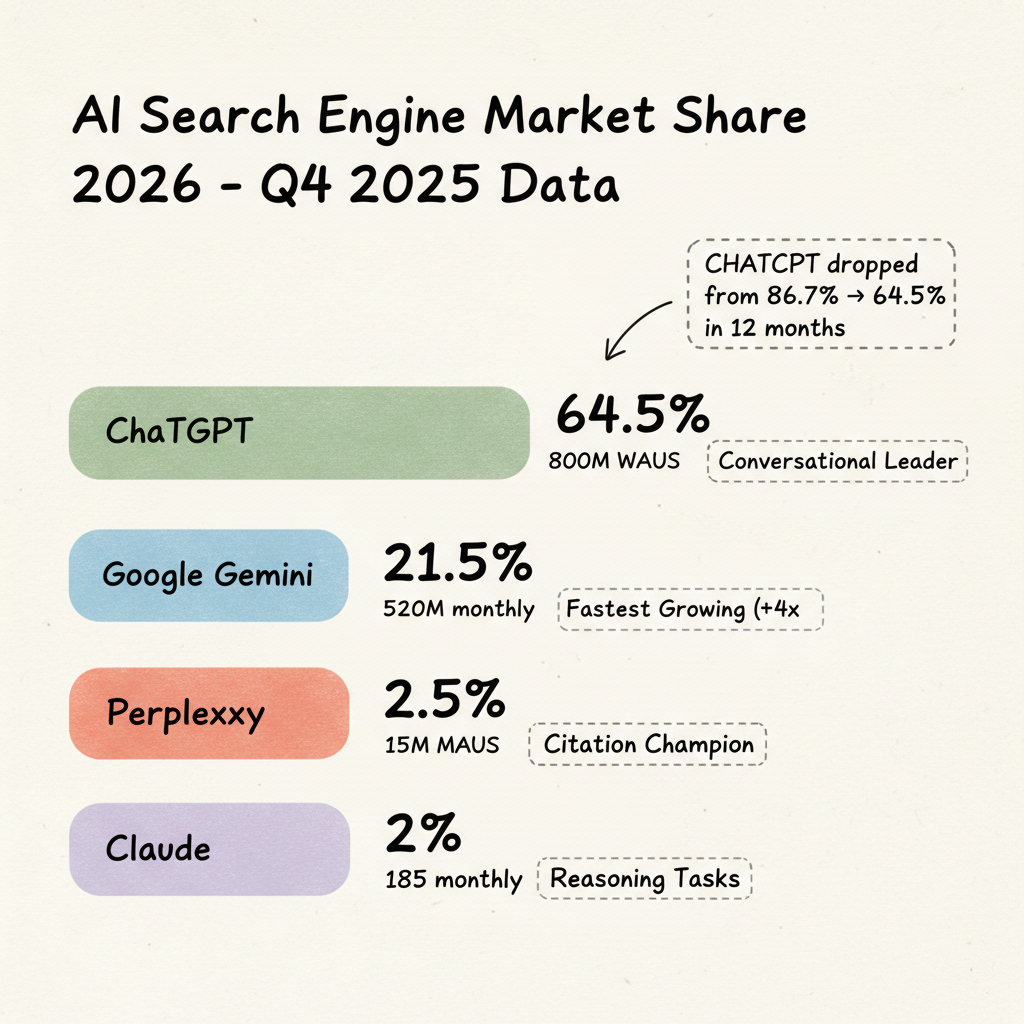
The AI search market underwent dramatic shifts throughout 2025, reshaping the competitive landscape:
Platform | Market Share (Q4 2025) | Monthly Active Users | Key Strength |
ChatGPT | 64.5% | ~800 million WAUs | Conversational depth |
Google Gemini | 21.5% | ~520 million monthly | Ecosystem integration |
Perplexity | 2.5% | ~15 million MAUs | Source citations |
Claude | 2% | ~185 million monthly | Reasoning tasks |
Key trend: ChatGPT's share dropped from 86.7% to 64.5% in twelve months, while Gemini grew nearly 4x. This signals a market maturing beyond first-mover advantage into genuine competition.
Engagement Differences
Session duration reveals how users interact differently with each platform:
- ChatGPT: 13+ minutes average—users engage in extended conversations
- Google Search: 6+ minutes—users browse and compare results
- Perplexity: Shorter, focused sessions—users seek quick verified answers
Longer sessions on ChatGPT indicate deeper engagement but also suggest users may receive less direct answers, prompting follow-up questions.
ChatGPT: The Conversational Leader
ChatGPT remains the dominant AI platform, processing billions of queries weekly through conversational interaction.
Strengths
Conversational depth: ChatGPT excels at multi-turn dialogues. Users can refine queries, ask follow-ups, and explore topics through natural conversation rather than reformulating searches.
Creative generation: For content creation, brainstorming, and ideation tasks, ChatGPT produces more human-like, creative outputs than research-focused competitors. This aligns with broader search engine optimization using AI trends that prioritize natural language processing.
Custom GPTs and agents: The GPT Store allows specialized applications, making ChatGPT extensible for specific workflows from marketing to coding.
Automatic web search: ChatGPT now searches the web automatically for many queries, blending conversational AI with real-time information retrieval.
Weaknesses
Citation transparency: ChatGPT provides fewer source citations by default. Users must often request verification, making fact-checking more difficult.
Freshness lag: Despite web browsing capabilities, ChatGPT sometimes relies on training data rather than live search, potentially surfacing outdated information.
Black box responses: It's often unclear where specific information originated, challenging for users who need verifiable sources.
Best Use Cases
- Long-form content creation and editing
- Brainstorming and ideation sessions
- Code development and debugging
- Multi-step reasoning tasks
- Creative projects requiring iteration
Google Gemini: The Ecosystem Integrator
Google Gemini represents the fastest-growing AI platform, leveraging deep integration across Google's product suite.
Strengths
Ecosystem integration: Gemini works within Gmail, Docs, Chrome, Android, and Google Search. Users access AI assistance without switching platforms.
Multimodal capabilities: Gemini processes text, images, audio, and video together, understanding rich content formats better than text-only competitors.
Real-time web access: Built on Google's search infrastructure, Gemini retrieves current information with the freshness of traditional Google search.
AI Overviews distribution: Gemini powers AI Overviews in Google Search, reaching users who never specifically choose an AI assistant.
Google AI Mode vs. Gemini vs. AI Overviews
Google now offers three distinct AI-powered search experiences, and understanding the differences matters for optimization. The Gemini app is a standalone AI chatbot for open-ended conversations and creative tasks. AI Overviews are automatic AI-generated summaries that appear at the top of regular Google search results without the user opting in. Google AI Mode, launched in 2025, is a separate conversational search tab within Google Search itself where users can ask follow-up questions in a chat-like interface similar to ChatGPT or Perplexity. AI Mode is Google's most direct competitor to Perplexity and ChatGPT Search, offering deep multi-turn research capabilities while AI Overviews provide quick one-shot summaries.
Weaknesses
Less conversational: Gemini feels more like enhanced search than conversation. Multi-turn dialogue is improving but trails ChatGPT.
Source opacity: AI Overviews often feel like a "black box"—users can't always identify which source contributed specific information.
Feature fragmentation: Gemini capabilities vary across products (Search vs. app vs. Workspace), creating inconsistent experiences.
Best Use Cases
- Quick factual lookups with visual results
- Workspace productivity (email, documents, sheets)
- Image and video understanding
- Users already in Google ecosystem
- Mobile and voice queries
Perplexity: The Citation Champion
Perplexity has positioned itself as the citation-first answer engine, prioritizing source transparency over conversational depth.
Strengths
Source citations: Every claim links to its source directly in the response. Users can verify information and explore further without guessing origins.
Real-time accuracy: Perplexity searches the live web for every query, ensuring answers reflect current information rather than training data. This approach closely mirrors what is AEO principles that emphasize answer verification.
Research focus: Deep Research mode performs comprehensive investigations, producing detailed reports with extensive source documentation.
Multi-model access: Pro users can switch between GPT-4, Claude, and other models, selecting the best system for each task.
Weaknesses
Market scale: With only 2.5% market share, Perplexity reaches far fewer users than ChatGPT or Google.
Less creative: Perplexity prioritizes factual accuracy over creative generation. Content creation tasks are better suited to ChatGPT.
Narrower scope: Best for research and fact-finding, less capable for coding, creative work, or complex reasoning.
Best Use Cases
- Academic research requiring citations
- Journalism and fact-checking
- Business intelligence and competitive research
- Users who prioritize source verification
- Quick answers to factual questions
Microsoft Copilot: The Enterprise AI Search Assistant
Microsoft Copilot has evolved from a Bing Chat rebrand into a full-featured AI search assistant deeply embedded across the Microsoft ecosystem. Powered by GPT-4o, Copilot combines real-time web search with enterprise-grade productivity features that set it apart from standalone AI chatbots.
Strengths
Microsoft 365 integration: Copilot works natively inside Outlook, Teams, Word, Excel, and Edge, allowing users to search the web, summarize emails, generate documents, and analyze data without leaving their workflow. For enterprise teams, this seamless integration reduces context-switching and accelerates decision-making.
Real-time web search: Like Perplexity, Copilot searches the live web for every query and provides inline citations. Its search is powered by the Bing index, giving it access to fresh content across the open web.
Voice assistant capabilities: Copilot supports voice queries across mobile and desktop, making it accessible for hands-free search scenarios. Browser integration with Microsoft Edge offers sidebar AI assistance on any webpage.
Enterprise security: Microsoft 365 Copilot operates within an organization's security boundary, keeping enterprise data separate from consumer AI interactions. This makes it the leading choice for companies with strict data governance requirements. Optimizing for LLM SEO best practices is especially relevant for content targeting Copilot's enterprise audience.
Weaknesses
Ecosystem dependency: Copilot delivers its best experience within the Microsoft stack. Users outside the Microsoft ecosystem get a more limited experience compared to ChatGPT or Perplexity.
Citation transparency: While Copilot provides source links, its citation format is less granular than Perplexity's numbered inline citations, making source verification slightly more difficult.
Best Use Cases
- Enterprise productivity workflows (email, documents, presentations)
- Bing-powered web research with citations
- Voice-driven search on mobile and desktop
- Organizations already invested in Microsoft 365
- Teams needing AI search within security compliance boundaries
Brave Search, Kagi & More: Privacy-First Alternatives
Beyond the major platforms, a growing category of privacy-first and independent AI search engines offers compelling alternatives for users who prioritize data ownership and ad-free experiences. For marketers, understanding these platforms is essential for search everywhere optimization strategies that extend visibility beyond Google.
Brave Search
Brave Search stands out as one of the few search engines with a fully independent index, meaning it does not rely on Google or Bing results. Brave Leo, the browser-integrated AI assistant, provides conversational search directly within the Brave browser. The platform is entirely ad-free by default, with no user tracking or profiling. For privacy-conscious users, Brave Search delivers AI-assisted answers without requiring an account or collecting personal data.
Kagi
Kagi takes a radically different approach by charging users directly ($10/month for the Ultimate plan) instead of monetizing through advertising. This paid model eliminates ads entirely and removes any incentive to track or sell user data. Kagi offers AI summarization, personalization controls that let users boost or block specific domains, and consistently fast results powered by a blend of its own index and licensed data.
Phind and You.Com
Phind is built specifically for developers, featuring VS Code integration and code-aware AI search that understands programming contexts. You.com takes an agent-based approach with over 30 specialized AI agents for different tasks including research, writing, and coding. Both platforms offer free tiers with optional paid upgrades for heavier usage.
Other notable privacy-focused alternatives include DuckDuckGo AI Chat, which provides anonymous AI-powered search at no cost, as well as newer entrants like Andi and Komo that focus on conversational, ad-free search experiences.
AI Search Engine Pricing Comparison
Pricing varies significantly across AI search platforms, and choosing the right tier depends on your use case and budget. Here is how the major platforms compare:
Platform | Free Tier | Paid Plan | Price | Key Paid Features |
ChatGPT | Yes (limited) | Plus / Pro | $20/mo / $200/mo | GPT-4o, voice, image gen, deep research |
Google Gemini | Yes | Advanced | $19.99/mo | Gemini Ultra, 1M context, Workspace integration |
Perplexity | Yes (limited) | Pro | $20/mo | Unlimited Pro searches, file upload, multi-model |
Microsoft Copilot | Yes | Pro / M365 Copilot | $20/mo / $30/user/mo | Priority GPT-4o, M365 integration, enterprise |
Brave Search | Yes (unlimited) | N/A | Free | Full AI search included at no cost |
Kagi | No | Ultimate | $10/mo | Unlimited searches, AI summary, zero ads |
Phind | Yes | Pro | $20/mo | Unlimited queries, VS Code, priority models |
You.com | Yes | Pro | $15/mo | Unlimited AI agents, priority access |
For most individual users, the free tiers of ChatGPT, Perplexity, and Copilot provide sufficient AI search capabilities. Paid tiers become worthwhile for power users who need unlimited deep research, multi-model access, or enterprise integrations. Brave Search offers the best value for privacy-focused users since its full AI-assisted search experience costs nothing. Understanding these tradeoffs helps when evaluating AI content for SEO investments and tool selection.
Privacy and Accuracy: How AI Search Engines Handle Your Data
As AI search engines become primary research tools, understanding how each platform handles user data and factual accuracy is increasingly important for both users and marketers.
Privacy Comparison
Platform | Data Stored | Ad-Supported | Anonymous Mode |
ChatGPT | Conversations stored by default | No (subscription model) | Temporary chat mode |
Google Gemini | Activity stored, linked to Google account | Yes (ad ecosystem) | Activity controls opt-out |
Perplexity | Search history stored | Limited (sponsored answers) | No dedicated mode |
Microsoft Copilot | Conversations stored by default | No | Enterprise data boundary |
Brave Search | No user data stored | No | Private by default |
Kagi | No query tracking | No (paid model) | Private by default |
Accuracy and Hallucination Risks
Factual accuracy varies significantly across AI search platforms, and the risk of hallucinations remains a critical concern. Perplexity leads in citation accuracy due to its source-first architecture, which forces every claim to link back to a verifiable source. Brave Search and Kagi also perform well on accuracy because they draw from independent indexes rather than relying solely on AI-generated summaries.
ChatGPT and Copilot can produce confident-sounding but difficult-to-verify claims, particularly for nuanced or recent topics. Research from SE Ranking found notable overlap in sources cited across platforms, suggesting that authoritative, well-structured content gets surfaced regardless of which AI engine a user chooses. Understanding generative engine optimization helps content creators structure information in ways that AI engines can accurately extract and cite. Applying GEO strategies further reduces the risk of your content being misrepresented or hallucinated by AI systems.
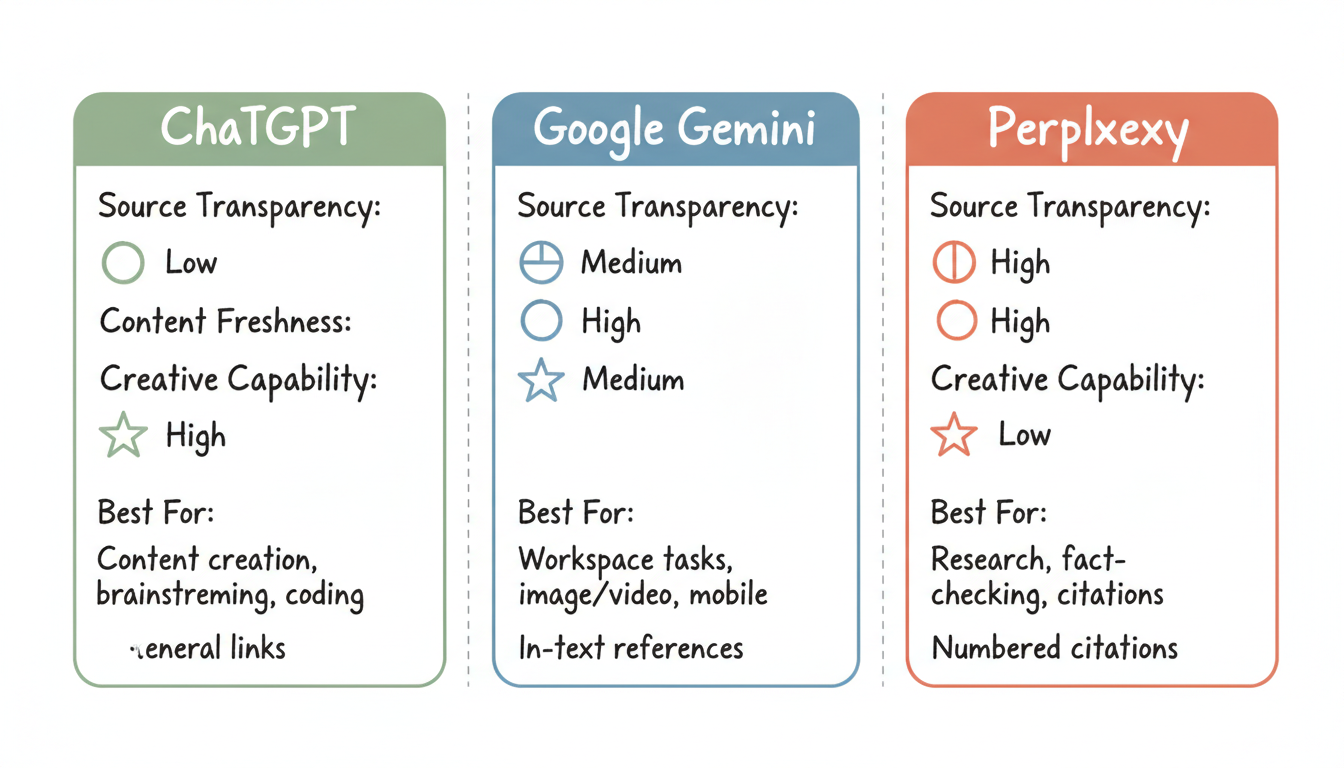
Head-To-Head Comparison
Factor | ChatGPT | Google Gemini | Perplexity | Microsoft Copilot | Brave Search |
Primary output | Conversation | Search + AI summary | Cited answers | AI assistant + search | Private AI search |
Source transparency | Low | Medium | High | Medium | Medium |
Content freshness | Variable | High | High | High | High |
Creative capability | High | Medium | Low | Medium | Low |
Ecosystem integration | Standalone | Deep (Google) | Standalone | Deep (Microsoft) | Brave browser |
Best for research | No | Moderate | Yes | Moderate | Moderate |
Best for content creation | Yes | Moderate | No | Moderate | No |
Citation format | General links | In-text references | Numbered citations | Inline links | Source cards |
Pricing (free tier) | Yes (limited) | Yes | Yes (limited) | Yes | Yes (unlimited) |
Privacy level | Low | Low | Medium | Medium (enterprise: High) | High |
Hallucination risk | Medium-High | Medium | Low | Medium | Low-Medium |
Implications for Content Optimization
Each platform's characteristics shape optimization strategies, and understanding the differences between SEO vs GEO vs AEO is essential for comprehensive visibility.
For ChatGPT Visibility
- Build authority through backlinks and reputation (ChatGPT cites trusted sources)
- Optimize for Bing rankings (powers parts of ChatGPT search)
- Create comprehensive content that answers follow-up questions
- Focus on topical depth over answer formatting
For Google Gemini Visibility
- Implement schema markup (Gemini uses structured data heavily)
- Optimize for Google rankings (AI Overviews draw from search results)
- Create multimodal content (images, video with transcripts)
- Maintain content freshness with regular updates
For Perplexity Visibility
- Structure content with answer-first formatting
- Cite authoritative sources within your content
- Update content frequently (Perplexity prioritizes freshness)
- Create clear, extractable answers to specific questions
For Microsoft Copilot Visibility
- Optimize for Bing rankings since Copilot's web search is powered by the Bing index
- Structure content with clear, direct answers that work well in enterprise contexts
- Use schema markup and structured data that Bing's crawler can parse efficiently
- Create content that addresses professional and business-oriented queries, as part of a broader SEO strategy for AI search platforms
For Brave Search Visibility
- Submit your site to Brave's Web Discovery Project for inclusion in their independent index
- Ensure your site loads fast and avoids intrusive ads or trackers, which Brave penalizes
- Focus on privacy-respecting content practices—avoid aggressive cookie banners and data collection
- Build quality content that earns organic links, since Brave's independent index relies heavily on link signals
Universal Principles
Across all platforms, certain fundamentals apply:
- Authority matters: All AI platforms prefer established, trusted sources
- Structure helps: Clear headings and organized content improve extraction
- Freshness signals: Current, maintained content ranks better than static pages
- Quality wins: Well-researched, accurate content earns more citations
Choosing Your Optimization Focus
For most businesses, a prioritized approach works best:
- Google first: Still 77.9% of digital queries—foundation for all AI visibility
- ChatGPT second: Largest AI platform with highest engagement
- Perplexity third: Important for B2B, research, and verification-focused audiences
Content that performs well in traditional search typically earns AI citations across platforms. The platforms draw from similar authority signals, making good SEO the foundation for AI visibility. Companies specializing in AI SEO can help navigate these overlapping optimization requirements.
FAQs
Should I Optimize for All AI Search Platforms?
Focus on Google and ChatGPT first—they command 95%+ of combined query volume. Add platform-specific optimizations (like citation formatting for Perplexity) only after establishing fundamentals. Most content best practices work across platforms.
Which Platform Converts Traffic Best?
Early data suggests ChatGPT-referred traffic converts higher than Google traffic, potentially because users arrive with more specific intent. However, volume from Google far exceeds AI platforms, making total conversions higher from traditional search.
Will One AI Search Platform Dominate in the Future?
The market is fragmenting rather than consolidating. Experts predict ChatGPT stabilizing around 50-55%, Gemini reaching 25-30%, and specialists like Perplexity capturing 15-20% collectively. Different use cases favor different platforms.
How Do I Track Visibility Across Multiple AI Platforms?
Use specialized tools like Otterly.AI, SE Visible, or Semrush AI Toolkit that monitor citations across ChatGPT, Perplexity, and AI Overviews simultaneously. Manual monitoring through regular platform queries supplements automated tracking.
What Is the Most Accurate AI Search Engine?
Perplexity leads in citation accuracy due to its source-first design. Kagi and Brave Search also score well because they rely on independent indexes rather than AI-generated summaries alone. ChatGPT and Copilot can produce confident-sounding but unverifiable claims. For accuracy-critical tasks like academic research or medical queries, always cross-reference AI answers with primary sources.
Are There Any Free AI Search Engines Worth Using?
Several AI search engines offer strong free tiers. Brave Search provides unlimited AI-assisted search with no account required. Perplexity's free tier includes basic AI answers with citations. ChatGPT and Copilot both offer free access with usage limits. DuckDuckGo AI Chat provides anonymous AI search at no cost. Paid tiers unlock deeper research modes and higher usage limits.
Which AI Search Engine Is Best for Privacy?
Brave Search and DuckDuckGo lead on privacy with no user tracking, no ad profiling, and no query storage. Kagi's paid model means no ads or data monetization. ChatGPT, Gemini, and Copilot all store conversation data by default, though each offers opt-out settings. If privacy is a priority, choose platforms with transparent data policies and no advertising model.
How Is Google AI Mode Different from AI Overviews?
AI Overviews appear automatically at the top of regular Google search results as brief AI-generated summaries. Google AI Mode is a separate conversational search tab where users can ask follow-up questions in a chat-like interface similar to ChatGPT or Perplexity. AI Mode provides deeper, multi-turn research capabilities while AI Overviews offer quick one-shot summaries.