
Last Updated: March 2026
The AI search landscape has undergone its most dramatic transformation since ChatGPT's launch. ChatGPT's near-monopoly has fractured, Google Gemini has emerged as a formidable challenger, and specialized platforms like Perplexity and Claude have carved out significant niches.
This analysis breaks down the current market share data and what it means for your AI search strategy.
Current AI Search Market Share (March 2026)
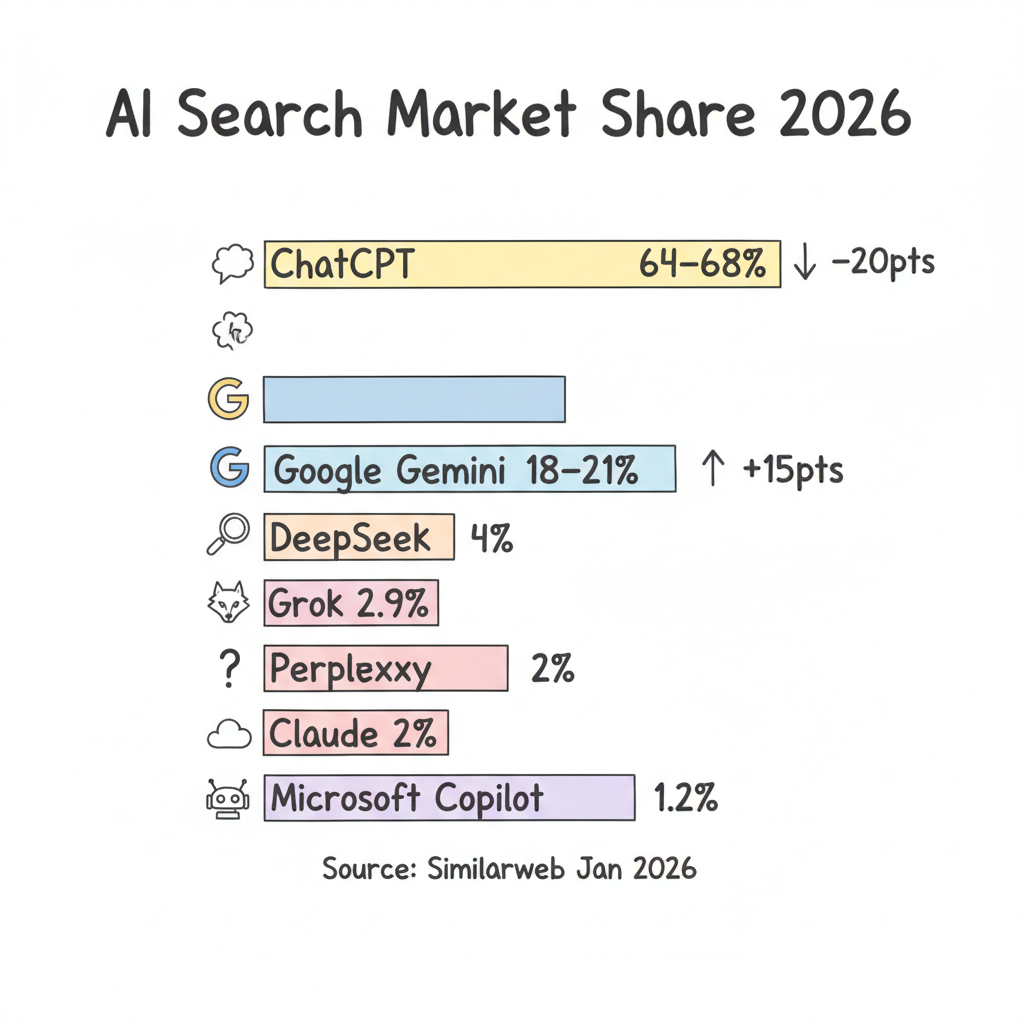
According to data combining Similarweb, Graphite, and FirstPageSage sources for March 2026, the AI chatbot market has redistributed significantly:
Platform | Market Share (Jan 2026) | Market Share (Jan 2025) | YoY Change |
ChatGPT (OpenAI) | 64.5-68% | 86.7-87.2% | -19 to -22 pts |
Google Gemini | 18.2-21.5% | 5.4-5.7% | +13 to +16 pts |
DeepSeek | 4% | <1% | +3+ pts |
Grok (X.AI) | 2.9% | <1% | +2+ pts |
Perplexity | 2% | <1% | +1+ pts |
Claude (Anthropic) | 2% | <1% | +1+ pts |
Microsoft Copilot | 1.2% | ~1% | Stable |
ChatGPT's 19+ percentage point decline represents the most significant market shift in generative AI history—signaling the end of OpenAI's near-monopolistic position.
Total AI Search Sessions: 45 Billion and Counting
AI platforms now generate 45 billion sessions per month worldwide, according to Graphite and Similarweb research combining web and mobile app data. This figure dwarfs earlier estimates that relied solely on browser-based analytics.
The critical insight: 83% of AI usage happens through mobile apps (ChatGPT app, Gemini app), not web browsers. Web-only analytics dramatically undercount AI adoption, meaning most published market share figures tell only a fraction of the story.
Access Method | Share of AI Sessions | Monthly Sessions |
Mobile App | 83% | ~37.4 billion |
Web Browser | 12% | ~5.4 billion |
API Access | 5% | ~2.3 billion |
Not all AI sessions are search-related. The Asking/Doing/Expressing prompt taxonomy reveals that only 52% of AI prompts are search-related ("Asking"), while 30% are task execution ("Doing") and 18% are creative or social ("Expressing"). Understanding how AI chatbots are changing search behavior is essential for interpreting these figures correctly.
The implication for marketers is significant: the search pie is growing, not shrinking. Combined search and AI query volume is up 26% globally year-over-year. AI is additive to search, not purely cannibalistic.
ChatGPT Market Share Breakdown: Still Dominant but Fragmenting
ChatGPT's 64.5-68% share requires nuance. That range reflects web session data, where ChatGPT commands roughly 89% of all AI web sessions. However, when mobile app data is included, ChatGPT's effective share drops to approximately 55%, as competitors like Gemini benefit from pre-installed mobile distribution.
Microsoft Copilot deserves separate treatment from ChatGPT despite both using OpenAI models. In methodologies that distinguish them, Microsoft Copilot for enterprise search holds 12.9-13.2% market share, driven primarily through enterprise Microsoft 365 integration. ChatGPT's dominance, by contrast, is consumer-driven.
Quarterly growth rates paint a picture of fragmentation accelerating:
- ChatGPT: +6% YoY (slowing as the base grows)
- Claude: +14% quarterly growth (fastest quarterly rate among major platforms)
- Gemini: +237% YoY (benefiting from Google's distribution advantage)
For context, Google's traditional search still holds 89.87% of the conventional search engine market, framing a dual-market reality where AI search and traditional search coexist rather than replace each other.
Monthly Active Users by Platform
The raw user numbers tell a compelling story about scale:
Platform | Monthly Active Users |
Google Search | 5 billion |
ChatGPT | 800-858 million |
Google Gemini | 650 million |
Perplexity | 45 million |
Microsoft Copilot | 33 million |
Grok | 30 million |
Claude | 19 million |
Growth Rates
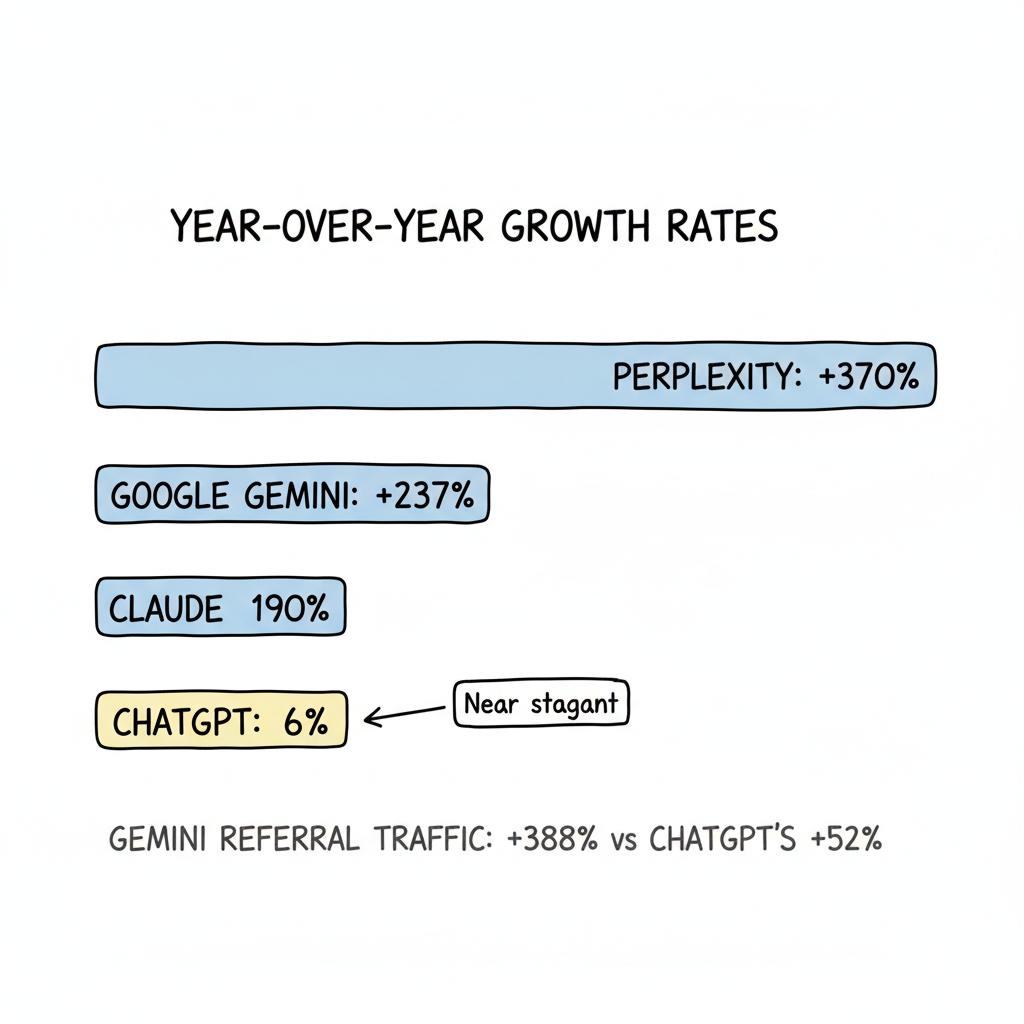
Year-over-year growth reveals which platforms are gaining momentum:
- Google Gemini: +237% YoY growth (fastest among major platforms)
- Perplexity: +370% YoY growth
- Claude: +190% YoY growth
- ChatGPT: +6% YoY growth
- Gemini referral traffic: +388% YoY vs ChatGPT's +52%
Gemini's referral traffic growth outpaces ChatGPT by more than 7x, making it an increasingly important web entry point.
Market Share by User Intent
Different platforms dominate different query types. Understanding what is an answer engine helps explain why these platforms excel at different intents:
Query Type | Google Share | ChatGPT Share |
Navigational | Higher | Lower |
Informational | Moderate | Higher |
Transactional | Higher | Growing |
Local | Dominant | Minimal |
ChatGPT shows particular strength in informational and creative queries, while Google maintains dominance in navigational and local search.
Market Share by Demographics
Age significantly influences platform preference:
Age Group | Google Share | ChatGPT Share |
13-24 | 74% | 17% |
25-44 | 80% | 13% |
45-64 | 86% | 8% |
65+ | 89% | 5% |
Younger users adopt AI-native platforms faster, while older demographics remain Google-centric.
Device Usage Patterns
Platform | Desktop Share | Mobile Share |
Google Search | 37% | 63% |
ChatGPT | 62% | 38% |
ChatGPT sees stronger desktop engagement (suggesting professional and research use), while Google dominates mobile usage among casual and on-the-go users.
Zero-Click Searches and AI Overviews: Impact on Organic Traffic
Gartner forecasts that traditional search volume will decline 25% by 2026 due to AI chatbots cannibalizing informational queries. The data on zero-click search trends supports this trajectory.
Currently, 43% of all searches result in zero clicks -- the user finds their answer directly in the search results without visiting any website. When Google AI Mode is active, that figure jumps to 93%, effectively eliminating organic traffic for those queries. The rise of Google AI Mode and its impact on rankings represents the most significant shift in search behavior since mobile-first indexing.
AI Overviews now appear on 18% of all Google searches and 57% of long-tail queries. When an AI Overview is present, organic click-through rates drop from 1.76% to 0.61% -- a 61% decrease. For publishers and brands relying on organic traffic, this shift demands immediate strategic adaptation.
However, the picture is not entirely bleak. AI referral traffic -- visitors who click through from AI-generated responses -- converts at 14.2% compared to just 2.8% for traditional organic traffic. That means AI-referred visitors are 5x more likely to convert because they arrive with higher intent and better context about what they need.
The business implication is clear: fewer clicks, but significantly higher-quality clicks. Brands need to shift their primary metrics from traffic volume to conversion-weighted visibility, measuring the revenue impact of each visit rather than raw session counts.
Key Trends Shaping 2026
1. ChatGPT'S Stabilization
Despite losing nearly 20 percentage points, ChatGPT isn't collapsing—it's stabilizing. Projections suggest ChatGPT will settle around 50-55% market share as it loses casual users but retains engaged power users.
2. Google'S Distribution Advantage
Google's integration of Gemini directly into Search and Workspace generates millions of interactions per second. This distribution advantage creates a data flywheel that improves the model without additional training. The shift from Google AI Overview vs traditional SERP has fundamentally changed how users encounter AI-powered results.
3. Specialized Platform Growth
Niche players are thriving by avoiding direct competition with giants:
Perplexity (370% growth): Positioned as an AI-first search engine rather than a general chatbot, targeting research and citation-heavy use cases.
Claude (190% growth): Focused on enterprise customers prioritizing responsible AI deployment, generating $2.2 billion in projected 2025 revenue.
4. Regional Market Fragmentation
Markets outside the US show different patterns:
- DeepSeek dominates in Asian markets through competitive pricing
- Chinese platforms (Doubao, Quark AI, Yuanbao) collectively serve hundreds of millions of users
- Regional champions are maintaining dominance in localized markets
5. The Agentic AI Shift
The transition from chatbots to AI agents is resetting competitive dynamics. Platforms that can execute actions—not just answer questions—are gaining strategic advantage.
6. Long-Tail AI Platforms
Beyond the major players, emerging platforms like Brave Leo, Komo, and Andi each hold 0.1-0.6% market share individually. Collectively, these long-tail platforms represent approximately 2-3% of AI search activity and are growing steadily as users seek specialized alternatives.
For businesses pursuing Generative Engine Optimization (GEO) strategies, monitoring these platforms is important. Early adoption channels often provide outsized visibility before competition intensifies. Implementing schema markup and JSON-LD structured data ensures content is discoverable across all AI crawlers, regardless of platform size.
What This Means for AI Visibility Strategy
Multi-Platform Optimization Is Now Mandatory
With no single platform dominating, optimizing for just one AI search engine means missing significant traffic. The fragmented market requires presence across multiple AI-powered search tools:
- ChatGPT (largest user base)
- Google AI Mode/Gemini (fastest growth, distribution advantage)
- Perplexity (research-focused users, strong citation behavior)
- Claude (enterprise, professional users)
Different Platforms, Different Requirements
Each platform evaluates content differently. Developing a comprehensive AEO strategy means tailoring your approach to each platform's unique ranking factors:
- Perplexity demands aggressive freshness (2-3 day updates)
- ChatGPT weights authority and brand recognition
- Google AI Mode correlates with traditional SEO factors
- Claude emphasizes accuracy and depth
Younger Audiences Require AI-Native Strategies
The 17% of 13-24 year-olds using ChatGPT today represents future search behavior. Brands targeting younger demographics need AI visibility now.
Enterprise vs. Consumer Markets Differ
ChatGPT's desktop dominance (62%) suggests professional usage patterns. Enterprise-focused businesses should prioritize ChatGPT and Claude visibility, while consumer brands need broader coverage including mobile-dominant Google.
GEO and Structured Data as Competitive Advantages
Generative Engine Optimization (GEO) is emerging as a distinct discipline alongside Answer Engine Optimization (AEO). Implementing structured data for AI visibility -- including JSON-LD and FAQ schema -- improves discoverability by AI crawlers across all platforms. With AI-referred traffic converting at 5x the rate of traditional organic traffic, investing in multi-platform optimization through GEO and structured data delivers measurable ROI.
Market Predictions for Late 2026
Based on current trajectories:
- ChatGPT: Stabilizing at 50-55% as competition intensifies
- Gemini: Reaching 25-30% through continued ecosystem integration
- Microsoft Copilot: Reaching 15-18% if Microsoft continues its enterprise integration push across Microsoft 365 and Edge
- Specialized players: Collectively capturing 15-20% by dominating specific use cases
- Regional champions: Maintaining dominance in localized markets
- Gartner's 25% search volume decline forecast serves as the anchor prediction for the industry, reshaping how brands allocate search marketing budgets
Model capabilities are becoming commoditized. Differentiation is shifting toward integrations, user experience, and specialized capabilities rather than raw model quality.
Frequently Asked Questions
Which AI Search Engine Has the Largest Market Share in 2026?
ChatGPT holds the largest AI search market share at 64.5-68% of web sessions as of March 2026. However, when mobile app data is included, the picture shifts -- AI platforms collectively generate 45 billion monthly sessions, with 83% occurring through mobile apps. Google Gemini is the fastest-growing challenger at 18.2-21.5%, driven by deep integration across Google Search and Workspace products.
How Do AI Overviews Affect Organic Search Click-Through Rates?
AI Overviews significantly reduce organic click-through rates. When an AI Overview appears in search results, organic CTR drops from 1.76% to 0.61% -- a 61% decline. AI Overviews currently appear on 18% of all Google searches and 57% of long-tail queries. The zero-click rate reaches 93% when Google AI Mode is fully active, meaning most users get their answer without clicking any result.
Is AI Search Replacing Traditional Google Search?
Not entirely -- the search market is growing rather than being replaced. Total combined search and AI query volume is up 26% globally year-over-year. Gartner forecasts traditional search volume will decline 25% by 2026, but AI referral traffic converts at 14.2% compared to 2.8% for traditional organic traffic. Google still holds 89.87% of the conventional search engine market while simultaneously expanding its AI capabilities through Gemini.
What Is the Difference Between Microsoft Copilot and ChatGPT Market Share?
Although both use OpenAI's underlying models, Microsoft Copilot and ChatGPT serve distinct markets. ChatGPT holds 64.5-68% of AI chatbot market share, while Microsoft Copilot holds 12.9-13.2% in methodologies that separate them. Copilot's share comes primarily through enterprise Microsoft 365 integration, while ChatGPT's dominance is consumer-driven. Claude shows the fastest quarterly growth at 14%, suggesting the market continues fragmenting.
The Bottom Line
The AI search market has fragmented permanently. ChatGPT's monopoly era is over, replaced by a competitive ecosystem where Google Gemini, Perplexity, Claude, and others each control meaningful market share.
For businesses optimizing for AI visibility, this fragmentation means more work—but also more opportunity. Brands that build visibility across multiple platforms gain competitive advantages that single-platform optimizers miss.
The winners in 2026 and beyond will be those treating AI search as a multi-platform discipline, not a single-channel tactic.