
Knowing what metrics to track is step one. Knowing what numbers represent success—and how to progress from basic tracking to sophisticated measurement—separates organizations with actionable AI search programs from those with dashboards full of data but no direction. This framework provides specific benchmarks by industry, maturity-based KPI targets, and the measurement infrastructure needed at each stage.
The goal isn't measuring everything—it's measuring the right things at the right level of sophistication for your current capabilities.
Zero-Click Search and the Visibility Measurement Shift
Zero-click search has fundamentally altered how measurement works. When AI systems like Google AI Overviews and ChatGPT provide complete answers directly in the search interface, users get what they need without ever visiting your website. This means traditional click-based metrics systematically undercount your brand's actual influence in the market.
The shift demands a new primary KPI: visibility and entity presence rather than clicks and sessions. Share of SERP presence—an evolution of traditional share of voice—accounts for your brand's appearance across AI Overviews, Knowledge Panels, featured snippets, and other zero-click surfaces. Organizations that only measure click-through rates miss up to 60% of their actual search influence, according to recent AI Overview CTR data.
It is critical to distinguish between Google AI Mode and Google AI Overviews as two separate measurement surfaces. AI Overviews appear within traditional search results and may still generate clicks, while AI Mode provides a fully conversational interface where brand visibility behaves differently—closer to how ChatGPT or Perplexity surface citations. Each requires its own tracking methodology.
Generative Engine Optimization (GEO) has emerged as the discipline that complements AEO for optimizing across these surfaces. Where AEO targets structured answer features like featured snippets, GEO focuses on the generative AI systems that synthesize responses from multiple sources. Your measurement framework needs to account for both, because each surface has distinct citation behaviors and retrieval mechanisms that affect how your brand appears.
The Measurement Maturity Model
Organizations progress through distinct measurement maturity stages. Attempting advanced measurement without foundational capabilities wastes resources and produces unreliable data. Implementing a clear AEO optimization metrics framework ensures you track what matters most at each stage.
Maturity Stage Definitions
Stage 1: Foundation (0-6 months)
Capability | Description | Infrastructure Required |
AI traffic identification | Separate AI referrals from organic | GA4 channel grouping |
Basic citation tracking | Manual query sampling | Spreadsheet + query set |
Platform awareness | Know which platforms send traffic | Referral source reports |
Stage 2: Structured (6-12 months)
Capability | Description | Infrastructure Required |
Systematic citation monitoring | Regular sampling across platforms | Monitoring tool or API access |
Competitive benchmarking | Track relative position | Competitor query tracking |
Attribution modeling | Credit AI touchpoints | Multi-touch attribution |
Trend analysis | Track changes over time | Historical data storage |
Stage 3: Advanced (12+ months)
Capability | Description | Infrastructure Required |
Predictive modeling | Forecast AI visibility impact | Statistical analysis capability |
Revenue attribution | Connect citations to revenue | CRM + analytics integration |
Real-time monitoring | Continuous visibility tracking | API-based monitoring system |
Cross-platform optimization | Platform-specific strategy | Per-platform performance data |
Progression Requirements
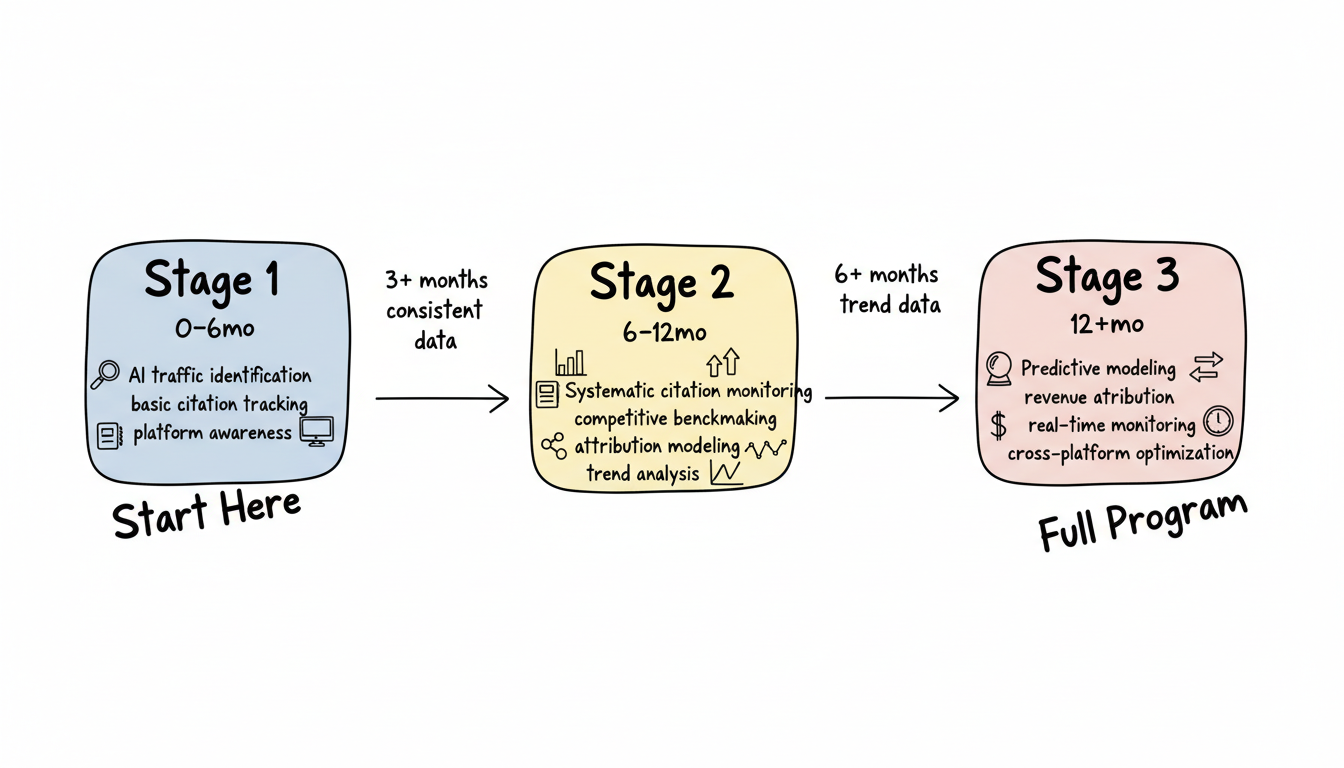
Move to the next stage only when current stage metrics are reliable.
Stage advancement criteria:
From | To | Requirements |
Foundation | Structured | 3+ months consistent data, validated tracking accuracy |
Structured | Advanced | 6+ months trend data, proven attribution model |
Industry Benchmark Data
Benchmarks vary significantly by industry. Generic targets mislead more than they help. Understanding what is AEO and how it differs from traditional SEO helps contextualize these benchmarks for your organization.
Citation Rate Benchmarks by Industry
Citation rate measures how often your brand appears when AI responds to relevant queries.
2026 citation rate benchmarks:
Industry | Below Average | Average | Above Average | Top Performer |
B2B SaaS | <5% | 5-15% | 15-30% | >30% |
E-commerce | <3% | 3-10% | 10-20% | >20% |
Professional services | <8% | 8-20% | 20-35% | >35% |
Healthcare information | <4% | 4-12% | 12-25% | >25% |
Financial services | <3% | 3-10% | 10-20% | >20% |
Technology/Software | <6% | 6-18% | 18-32% | >32% |
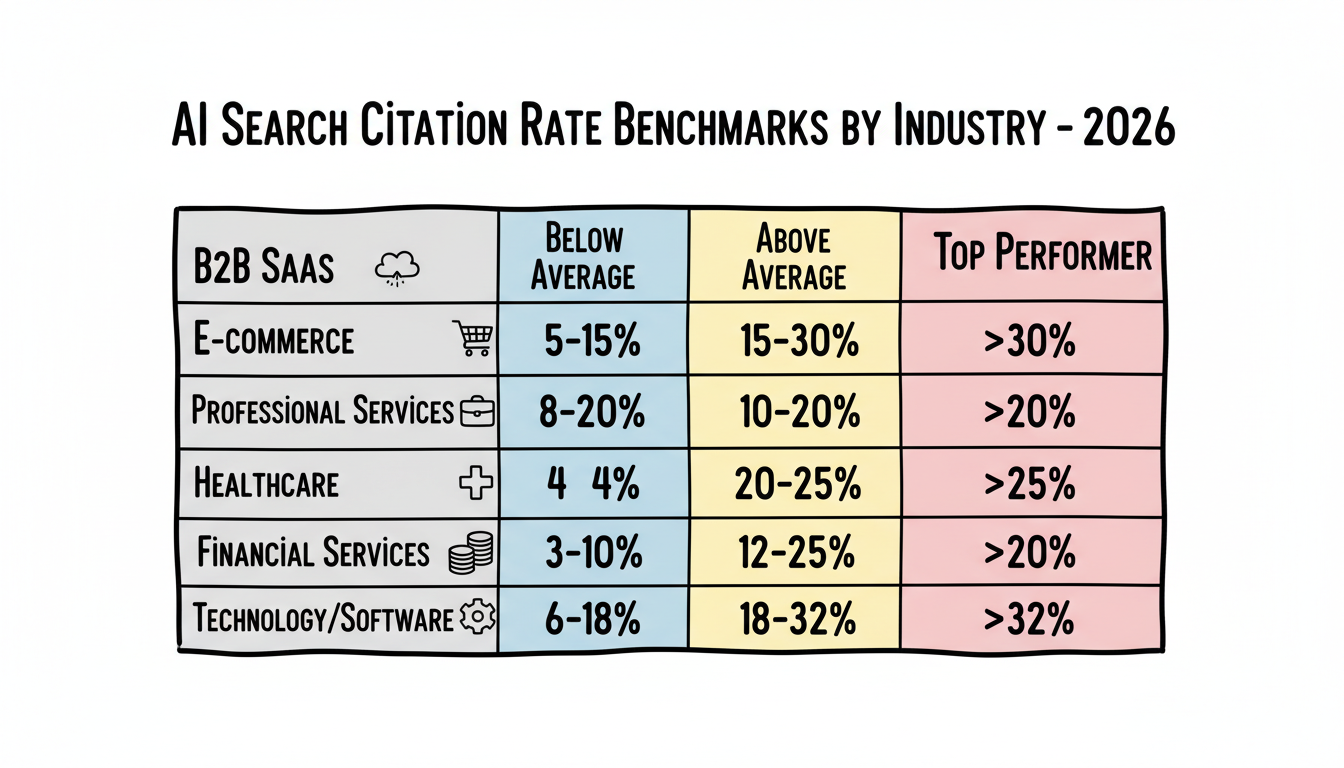
Interpretation notes:
- Professional services benchmarks are highest due to query specificity
- E-commerce faces more competition from marketplaces
- Healthcare requires E-E-A-T compliance for visibility
- Rates measured across 50+ relevant queries per company
Share of Voice Benchmarks
Share of voice measures your citations relative to competitors for the same queries. A comprehensive generative engine content strategy helps you gain competitive visibility in AI-powered search results.
Share of voice targets by market position:
Position | Description | Target SOV | Action Focus |
Market leader | #1-2 in category | 30-45% | Defend and expand |
Strong competitor | #3-5 in category | 15-25% | Target leader's gaps |
Emerging player | #6-10 in category | 5-15% | Niche dominance |
New entrant | Outside top 10 | 2-8% | Establish presence |
Traffic Quality Benchmarks
AI-referred traffic typically shows higher quality metrics than generic organic.
Expected performance lift from AI traffic:
Metric | AI Traffic vs. Organic Baseline | Top Performer Lift |
Bounce rate | 15-25% lower | 35%+ lower |
Bounce rate | 15-25% lower | 35%+ lower |
Pages per session | 20-40% higher | 50%+ higher |
Session duration | 25-50% longer | 60%+ longer |
Conversion rate | 40-80% higher | 100%+ higher |
If your AI traffic underperforms these benchmarks, investigate landing page alignment with AI-query intent.
Entity-Based Measurement: Tracking Brand Presence in AI Responses
Beyond citation rates, measuring how AI systems represent your brand requires tracking entity coverage, entity presence, and entity salience as distinct measurement dimensions. Entity-based SEO and topical authority form the foundation for how AI systems identify and reference your brand.
Entity coverage measures whether your brand exists as a recognized entity across AI knowledge systems. Knowledge Graph and Knowledge Panel presence serve as foundational infrastructure for AI retrieval—brands recognized as entities in Google's Knowledge Graph get cited significantly more often across all AI platforms. Entity presence tracks whether you appear in responses for relevant queries, while entity salience measures how prominently you feature relative to other entities mentioned.
The Brand Canon concept provides the measurement rubric for AI accuracy. A Brand Canon is a documented source of truth containing your brand facts, product details, key messaging, and competitive positioning. When AI platforms generate responses about your brand, you score them against the Canon to calculate your Answer Accuracy Rate—the percentage of AI responses that correctly represent your brand without hallucinations, factual errors, or misrepresentations.
Citation sentiment adds another critical dimension beyond simple citation rate. Each brand mention in an AI response carries a sentiment—positive, negative, or neutral. Being mentioned negatively in an AI response is often worse than not being mentioned at all, because AI-generated answers carry high perceived authority with users. Track the ratio of positive-to-negative mentions alongside your overall citation rate to get a complete picture of brand health in AI search.
The distinction between primary and secondary entity matters for measurement. When your brand is the primary entity in a response (the main subject), visibility impact is significantly higher than when you appear as a secondary reference. Track both, but weight primary entity appearances more heavily in your KPI calculations.
Measuring Across AI Platforms: ChatGPT, Perplexity, Gemini, Copilot, and Claude
Each major AI search platform—ChatGPT Search, Perplexity, Google Gemini, Microsoft Copilot, and Claude—uses different retrieval mechanisms, training data, and citation behaviors. A brand that ranks well on Perplexity may be invisible on ChatGPT, making cross-platform citation tracking essential for comprehensive measurement.
The AI Signal Rate metric captures the frequency of your brand mentions across AI-generated responses for a defined prompt set. To measure it systematically, build structured prompt sets: Seer Interactive recommends allocating 80% unbranded queries and 20% branded queries to balance discovery measurement with accuracy monitoring. Run these prompts regularly across all five platforms and score each response for citation presence, citation position, and citation sentiment.
Understanding how RAG (Retrieval-Augmented Generation) determines which content gets surfaced is essential for interpreting your measurement data. RAG-based systems decompose queries, retrieve relevant passages, and synthesize responses—making passage relevance and passage structure critical input metrics. Content that is well-structured with clear, self-contained passages performs better in RAG retrieval than content that buries key information across multiple paragraphs.
Query fan-out adds complexity to measurement. AI systems often decompose a single user query into multiple sub-queries, each retrieving different content. This means a single search interaction may evaluate dozens of your pages, expanding the content surface area that influences whether your brand appears in the final response. Track which pages get retrieved most frequently across platforms to understand your actual content assets for AI visibility.
KPI Selection by Maturity Stage
Different maturity stages require different KPI focus. Proper AI search KPI goal setting ensures you measure the right indicators for your current maturity level.
Stage 1: Foundation Kpis
Start with metrics that establish baseline understanding.
Foundation KPI set:
KPI | Target Range | Tracking Method | Review Cadence |
AI referral traffic | Establish baseline | GA4 channel report | Weekly |
Platform identification | 100% of AI sources | Referral analysis | Monthly |
Citation presence | Present/absent | Manual query testing | Bi-weekly |
AI traffic conversion | Compare to organic | Conversion tracking | Monthly |
Foundation success criteria:
- Accurately identify 100% of AI referral sources
- Establish 3-month baseline for all metrics
- Validate tracking accuracy with manual verification
Stage 2: Structured Kpis
Add competitive and trend dimensions. Working with a generative engine optimization agency can accelerate your progression through these stages with proven methodologies.
Structured KPI set:
KPI | Target Range | Tracking Method | Review Cadence |
Citation rate | Industry benchmark | Systematic sampling | Weekly |
Share of voice | Market position target | Competitor tracking | Monthly |
Citation sentiment | >80% positive/neutral | Response analysis | Monthly |
Platform coverage | Present on 3+ platforms | Cross-platform checks | Bi-weekly |
Trend direction | Improving trajectory | Historical comparison | Monthly |
To score citation sentiment effectively, apply a simple rubric to each AI-generated mention of your brand: positive (recommends, praises, or highlights strengths), negative (criticizes, warns against, or highlights weaknesses), or neutral (factual mention without valence). Target at least 80% positive-or-neutral citations. When negative sentiment appears, investigate the source content that AI platforms are drawing from—often a single negative review or comparison article can disproportionately influence AI responses across multiple platforms.
Structured success criteria:
- Citation rate at or above industry average
- Positive SOV trend over 3+ consecutive months
- Platform presence across priority AI systems
Stage 3: Advanced Kpis
Connect AI visibility to business outcomes. Advanced AEO services agency offerings typically include sophisticated attribution models and revenue tracking capabilities.
Advanced KPI set:
KPI | Target Range | Tracking Method | Review Cadence |
Revenue attribution | % of revenue from AI | Attribution modeling | Monthly |
Customer acquisition cost | Compare AI vs. other channels | CAC by source | Quarterly |
Lifetime value | AI-attributed customers | Cohort analysis | Quarterly |
Predictive visibility | Forecast accuracy | Model validation | Quarterly |
Real-time citation alerts | <24hr detection | Monitoring system | Continuous |
Advanced success criteria:
- Revenue attribution model with <15% error rate
- Demonstrated ROI from AI visibility investment
- Predictive model accuracy >70%
Attribution Models for AI Search
AI search complicates attribution because influence occurs before and without clicks.
The Attribution Challenge
Traditional attribution limitations:
Attribution Type | Works For | Fails For AI Because |
Last-click | Direct conversions | Misses AI awareness influence |
First-click | Channel acquisition | Can't track AI exposure |
Linear | Multi-touch journeys | Doesn't account for zero-click influence where AI provides the answer without generating a click |
Position-based | Important touchpoints | AI touchpoint often invisible |
Recommended Attribution Approaches
Hybrid attribution model for AI search:
AI-Adjusted Attribution Formula:

Conversion Credit =
  (Direct AI Referral × 0.40) +
  (AI-Influenced Organic × 0.25) +
  (Post-AI Direct × 0.20) +
  (Traditional Organic × 0.15)

Where:
- Direct AI Referral = Traffic from AI platform referrers
- AI-Influenced Organic = Organic clicks on AI Overview queries
- Post-AI Direct = Direct visits within 7 days of AI query exposure
- Traditional Organic = Non-AI organic search
Attribution model by conversion type:
Conversion Type | Recommended Model | AI Credit Weight |
Lead generation | Position-based | 30% to AI touchpoints |
E-commerce | Data-driven | Varies by path analysis |
Content engagement | Time-decay | Recent AI exposure weighted |
High-consideration purchase | Multi-touch | Distributed across journey |
Implementing AI Attribution
Setup requirements:
- Identify AI-influenced sessions - Tag traffic from AI referrers
- Track query AI status - Flag queries showing AI Overviews
- Build user journey data - Connect sessions across time
- Model AI influence - Assign credit based on exposure
- Validate with holdout tests - Compare modeled vs. actual
Measurement Infrastructure Requirements
Build infrastructure aligned with maturity stage. Leveraging free AEO tools can help you establish foundational tracking before investing in enterprise platforms.
Stage 1 Infrastructure
Minimum viable measurement:
Component | Purpose | Recommended Solution |
Analytics platform | Traffic tracking | GA4 with custom channel groupings |
Query tracking | Citation monitoring | Spreadsheet + manual checks |
Data storage | Historical records | Google Sheets/Airtable |
Create custom channel groupings in GA4 to separate AI referral traffic from generic referral buckets. Configure rules to identify traffic from ChatGPT (chatgpt.com, chat.openai.com), Perplexity (perplexity.ai), Google Gemini (gemini.google.com), and Microsoft Copilot (copilot.microsoft.com) as distinct channels rather than lumping them into "Referral" alongside unrelated sources.
Estimated setup time: 2-4 hours Ongoing maintenance: 2-3 hours/week
Stage 2 Infrastructure
Structured measurement setup:
Component | Purpose | Recommended Solution |
Citation monitoring | Automated tracking | Scrunch, DemandSphere, or Semrush AI Visibility Index |
AI visibility platform | Cross-platform citation tracking | Scrunch or Semrush AI Visibility Index |
Competitor tracking | SOV measurement | Same tool + competitor config |
Reporting dashboard | Visualization | Looker Studio/Tableau |
Data warehouse | Centralized storage | BigQuery/Snowflake |
Estimated setup time: 20-40 hours Ongoing maintenance: 4-6 hours/week
Stage 3 Infrastructure
Advanced measurement capabilities:
Component | Purpose | Recommended Solution |
Real-time monitoring | Continuous tracking | API-based custom system |
Attribution platform | Revenue connection | CRM + analytics integration |
Predictive analytics | Forecasting | Statistical modeling tools |
Automated alerting | Change detection | Custom or platform alerts |
Estimated setup time: 80-160 hours Ongoing maintenance: 8-12 hours/week
Technical Performance for AI Crawlers
Speed-to-meaning measures how quickly AI crawlers can extract meaningful content from your pages. Unlike traditional page speed metrics that focus on user experience, AI crawler performance determines whether your content gets indexed and retrieved by RAG systems in the first place. Structured data optimized for AI search plays a key role in accelerating this extraction process.
Target TTFB (Time to First Byte) under 800ms and LCP (Largest Contentful Paint) under 3 seconds for pages you want AI crawlers to index reliably. AI crawlers evaluate rendered content differently than traditional bots—they often compare the initial server response against the fully rendered output to detect content that only appears after JavaScript execution. Content hidden behind client-side rendering may be partially or fully invisible to AI retrieval systems.
Synthetic query rankings provide an advanced measurement technique: craft queries that should surface your content, run them through AI platforms, and track whether your pages appear in the responses. This creates a repeatable test suite for measuring content retrievability over time. Combine this with relevance engineering—the practice of structuring content specifically for AI retrieval pipelines by using clear headings, self-contained paragraphs, and explicit entity references that help RAG systems match queries to your content.
Setting Targets and Tracking Progress
Translate benchmarks into specific targets for your organization. Understanding the relationship between AEO and SEO helps you set realistic targets that complement your existing search optimization efforts.
Target-Setting Framework
SMART targets for AI search:
Element | Definition | Example |
Specific | Defined metric and scope | Citation rate for 50 priority queries |
Measurable | Quantifiable outcome | Increase from 12% to 20% |
Achievable | Realistic given resources | Based on industry benchmarks |
Relevant | Aligned with business goals | Supports demand generation |
Time-bound | Clear timeline | Within 6 months |
Progress Tracking Cadence
Recommended review schedule:
Metric Type | Review Frequency | Decision Trigger |
Traffic volume | Weekly | >20% change requires investigation |
Citation rate | Bi-weekly | Consistent decline triggers optimization |
Share of voice | Monthly | Competitive shift requires response |
Revenue attribution | Quarterly | Informs budget allocation |
Benchmark comparison | Quarterly | Adjusts targets for next period |
Course Correction Protocols
When metrics miss targets:
Gap Size | Response | Timeline |
<10% below target | Minor optimization | Within current period |
10-25% below target | Strategy adjustment | 2-4 weeks |
>25% below target | Comprehensive review | Immediate |
Key Takeaways
Build AI search measurement with structure and benchmarks:
- Match measurement to maturity - Foundation before advanced; don't skip stages
- Use industry-specific benchmarks - Generic targets mislead; B2B SaaS differs from e-commerce
- Progress KPIs with capability - Foundation metrics first, revenue attribution last
- Adapt attribution models - Traditional last-click misses AI influence entirely
- Build infrastructure incrementally - Start simple, add complexity with proven need
- Set SMART targets - Specific, measurable goals based on realistic benchmarks
- Review at appropriate cadence - Weekly traffic, monthly SOV, quarterly revenue
- Track entity presence and citation sentiment, not just citation rate — AI visibility requires measuring how accurately and favorably your brand is represented across ChatGPT, Perplexity, Gemini, Copilot, and Claude
- Adopt GEO alongside AEO — Generative Engine Optimization extends your measurement framework to cover the full spectrum of AI-powered search surfaces
Measurement frameworks fail when they're either too simple to provide insight or too complex to maintain. Build for your current stage, validate accuracy before adding complexity, and let benchmarks—not aspirations—guide your targets. For organizations ready to scale their measurement capabilities, exploring generative engine optimization services can provide the infrastructure and expertise needed to advance through maturity stages efficiently.
Frequently Asked Questions
What Is the Difference Between GEO and AEO in Search Measurement?
GEO (Generative Engine Optimization) focuses on optimizing content for generative AI systems like ChatGPT and Perplexity that produce synthesized answers. AEO (Answer Engine Optimization) targets structured answer features like Google AI Overviews and featured snippets. Your measurement framework should track both because each surface has different citation behaviors, retrieval mechanisms, and brand visibility patterns.
How Do You Measure Brand Visibility in Zero-Click Search Results?
Track entity coverage across Knowledge Graph entries and AI-generated responses using systematic prompt sets. Measure your AI Signal Rate by querying platforms like ChatGPT, Perplexity, Gemini, and Copilot with branded and unbranded prompts, then score each response for citation presence, citation sentiment, and answer accuracy against your Brand Canon.
What Is a Brand Canon and Why Does It Matter for AI Measurement?
A Brand Canon is a documented source of truth containing your brand facts, product details, key messaging, and competitive positioning. It serves as the rubric for evaluating AI answer accuracy. When AI platforms generate responses about your brand, you score them against the Canon to detect hallucinations, factual errors, and misrepresentations that damage credibility.
Which AI Search Visibility Tools Should I Use for Measurement?
Start with GA4 custom channel groupings to separate AI referral traffic from generic referrals. For systematic citation tracking, evaluate Scrunch, DemandSphere, or the Semrush AI Visibility Index. Advanced teams can build custom monitoring via platform APIs combined with structured prompt sets to test visibility across ChatGPT, Perplexity, Gemini, Copilot, and Claude at scale.