
Documenting AI search optimization success requires different metrics and storytelling than traditional SEO case studies. Where conventional case studies track ranking positions and organic traffic, AI search case studies must capture citation frequency, AI brand mentions, and visibility across multiple AI platforms. A well-structured case study template ensures you capture the right data from the start and present results in ways that demonstrate genuine business impact.
According to Marketing Experts Hub's AEO agency guide, proven case studies should provide a verifiable list of companies helped with AI visibility, along with evidence of how they attribute business impact to AEO efforts. This attribution evidence separates credible case studies from vanity metrics.
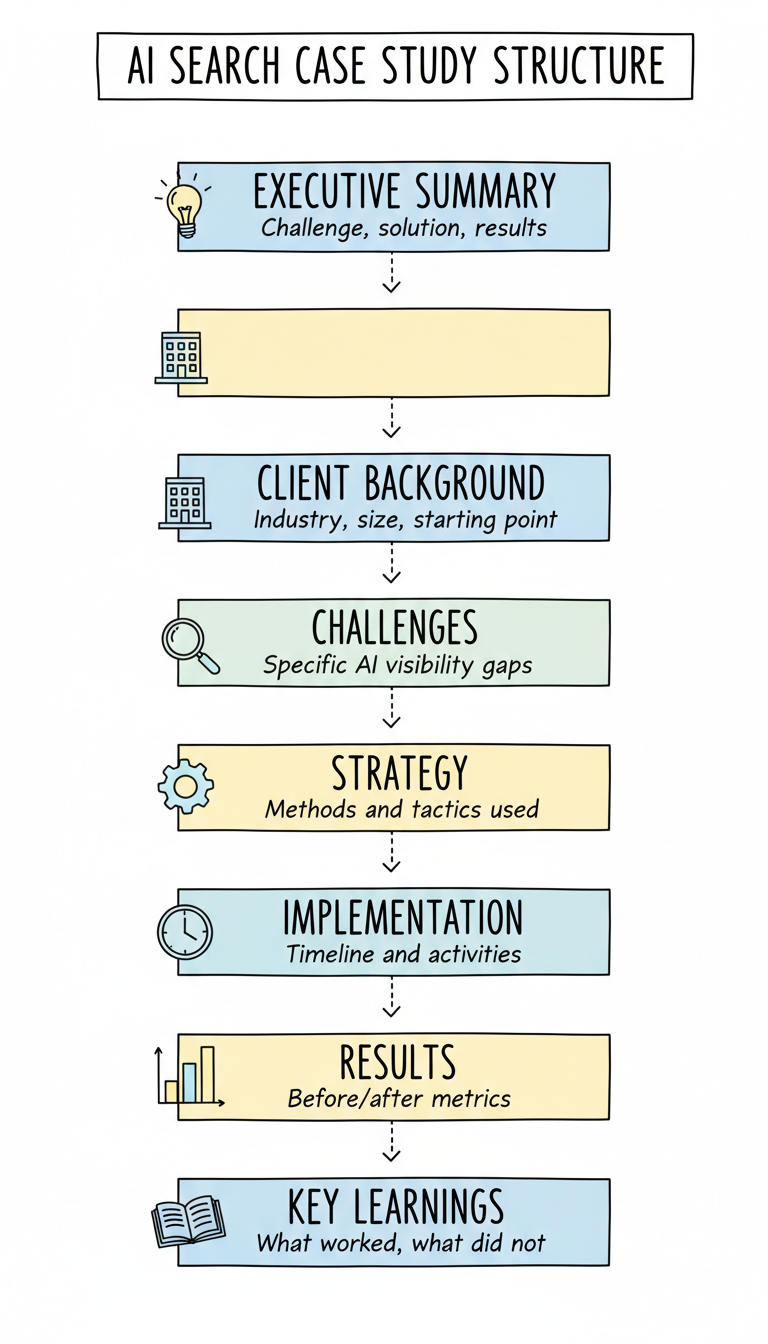
Case Study Template Structure
Organize information for maximum impact and credibility.
According to AI For Marketings' SEO portfolio guide, effective SEO case studies show traffic, rankings, and other results before and after changes to explain what worked. For AI search specifically, the structure must capture AI-unique metrics alongside traditional measures.
Essential case study sections:
Section | Purpose | Key Elements |
Executive Summary | Quick overview | Challenge, solution, results |
Client Background | Context setting | Industry, size, starting point |
Challenges | Problem definition | Specific AI visibility gaps |
Strategy | Approach explanation | Methods and tactics used |
Implementation | What was done | Timeline and activities |
Results | Outcomes achieved | Before/after metrics |
Key Learnings | Insights gained | What worked, what didn't |
Before/After Metrics Framework
Capture baseline and improvement data systematically.
AI search metrics to document:
Case Study Metrics Template
+-- AI Visibility Metrics
|   +-- Citation frequency (before/after)
|   +-- AI brand mentions per month
|   +-- Platform coverage (ChatGPT, Perplexity, etc.)
|   +-- AI Overview appearances
|   +-- Featured snippet ownership
|
+-- Traffic Metrics
|   +-- AI referral sessions
|   +-- Traffic by AI source
|   +-- New users from AI channels
|   +-- Engagement rate (AI vs overall)
|
+-- Conversion Metrics
|   +-- Conversions from AI traffic
|   +-- Conversion rate comparison
|   +-- Lead quality indicators
|   +-- Revenue attribution
|
+-- Authority Metrics
    +-- Brand mention sentiment
    +-- Citation context quality
    +-- Competitor comparison
    +-- Share of voice changes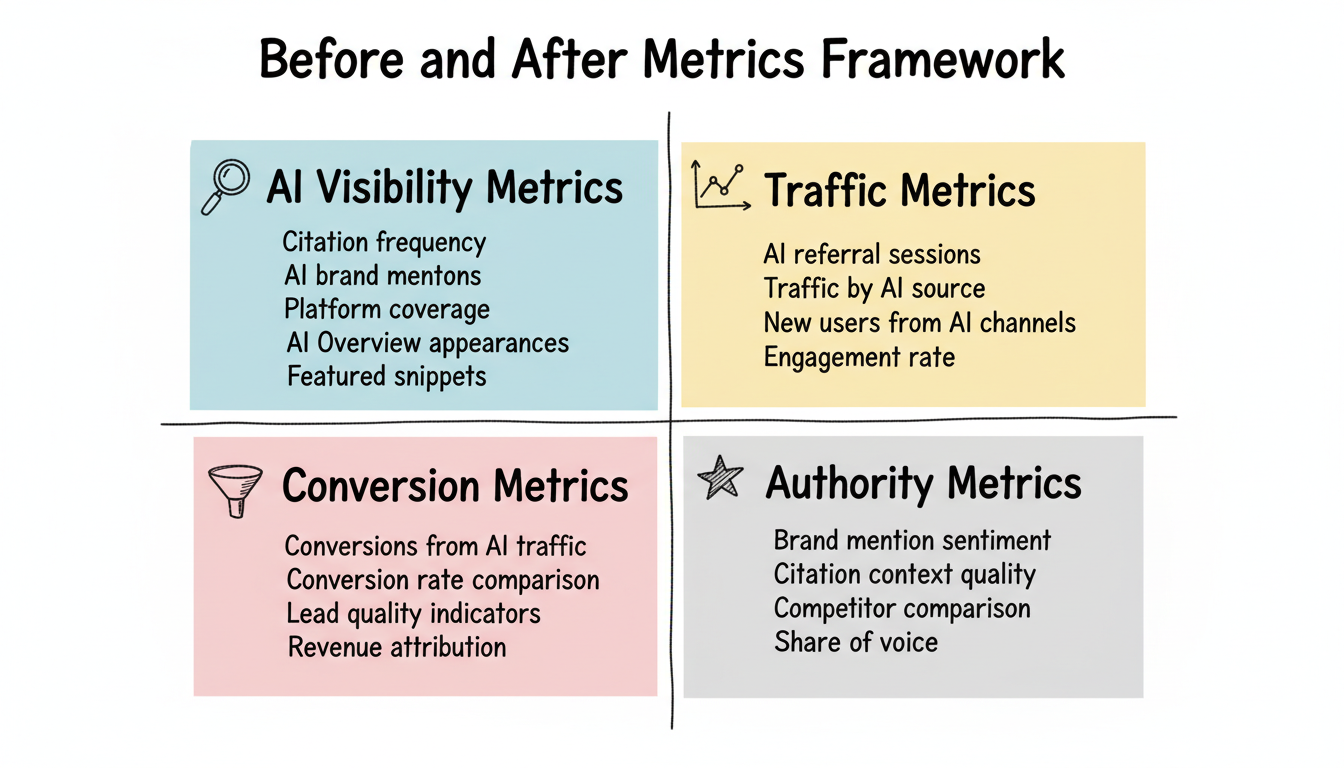
Executive Summary Template
Lead with results for busy readers.
According to The Spearpoint's AEO guide, citation frequency and AI brand score represent core AEO metrics - tracking how often your brand gets mentioned and cited across answer engines provides directional indicators of visibility and authority recognition.
Executive summary structure:
Executive Summary Template
+-- Client Overview
|   +-- [Company type] in [industry] with [context]
|
+-- Challenge Statement
|   +-- [Specific AI visibility problem]
|
+-- Solution Applied
|   +-- [High-level approach taken]
|
+-- Key Results
|   +-- [Primary metric improvement]
|   +-- [Secondary metric improvement]
|   +-- [Business impact metric]
|
+-- Timeframe
    +-- [Duration from start to documented results]
Example format:
"[Company] increased AI search visibility by 340% over 6 months through strategic content restructuring and schema implementation. AI referral traffic grew from 127 to 2,340 monthly sessions, with conversion rates 4.2x higher than traditional organic traffic."
Challenge Documentation
Frame the problem clearly and specifically.
Challenge section elements:
Element | Description | Example |
Starting visibility | Baseline AI citation rate | "Zero AI citations in Q1" |
Competitive gap | How competitors performed | "Top 3 competitors cited 8x more" |
Business impact | What poor visibility cost | "Missing 15% of qualified traffic" |
Specific barriers | What prevented success | "No schema, thin content, weak entity signals" |
Understanding the specific barriers to AI search platform visibility allows you to develop targeted solutions that address root causes rather than symptoms.
Strategy and Implementation Documentation
Show the methodology that produced results.
According to Conductor's AEO/GEO Benchmarks Report, measuring AI referral traffic, AI search market share, and performance in Google's AI Overviews enables benchmarking against industry-specific KPIs. Case studies should detail which strategies addressed which metrics.
Strategy documentation template:
Strategy Section Structure
+-- Research Phase
|   +-- AI visibility audit methods
|   +-- Competitor citation analysis
|   +-- Query/topic identification
|   +-- Technical assessment
|
+-- Strategic Priorities
|   +-- Priority 1: [Focus area]
|   +-- Priority 2: [Focus area]
|   +-- Priority 3: [Focus area]
|
+-- Tactical Implementation
|   +-- Content changes made
|   +-- Schema implementations
|   +-- Entity optimization
|   +-- Authority building activities
|
+-- Timeline
    +-- Phase 1: [Dates] - [Activities]
    +-- Phase 2: [Dates] - [Activities]
    +-- Phase 3: [Dates] - [Activities]
Make outcomes clear, credible, and compelling.
Results presentation guidelines:
- Use specific numbers - "340% increase" not "significant improvement"
- Show before/after - Side-by-side comparisons add credibility
- Include timeframes - "Over 6 months" provides context
- Segment by platform - ChatGPT results may differ from Perplexity
- Connect to business outcomes - Citations to traffic to conversions to revenue
- Acknowledge limitations - What couldn't be measured or attributed
When documenting improvements in answer engine optimization, separating results by platform helps identify which tactics work best for specific AI systems.
Results visualization options:
Visualization Type | Best For | Example |
Bar charts | Before/after comparisons | Citation count growth |
Line graphs | Trend over time | Monthly AI traffic |
Pie charts | Platform distribution | Traffic by AI source |
Tables | Multiple metrics | Complete KPI summary |
Screenshots | Citation evidence | AI response examples |
Attribution and Credibility Elements
Build trust in your documented results.
According to Siege Media's GEO guide, GEO focuses on making content easier for AI systems to find, interpret, and surface. Case studies should demonstrate how specific optimizations led to measurable citation improvements.
Credibility builders:
- Third-party verification - GA4 screenshots, Search Console data
- Methodology transparency - How metrics were collected
- Timeframe honesty - Realistic timelines, not cherry-picked windows
- Context acknowledgment - Market changes, algorithm updates
- Reproducibility signals - Strategies others could apply
Key Learnings Section
Extract actionable insights for readers.
Learning categories to include:
Key Learnings Template
+-- What Worked Best
|   +-- Highest-impact tactic
|   +-- Unexpected win
|   +-- Efficiency discovery
|
+-- What Didn't Work
|   +-- Failed hypothesis
|   +-- Resource waste
|   +-- Course corrections made
|
+-- Recommendations
|   +-- For similar situations
|   +-- What to do differently
|   +-- Success factors identified
|
+-- Future Opportunities
    +-- Unexplored areas
    +-- Scaling potential
    +-- Next phase plans
Effective case studies incorporate lessons from LLM optimization best practices to demonstrate how targeted content improvements translate to measurable AI visibility gains. Similarly, applying insights from generative AI for SEO helps future-proof your optimization strategy.
How to Keep a Case Study Credible
Credibility lives in the numbers and the method, not the adjectives. Show the before state, the action taken, and the after state with the same unit of measure, so a reader can follow the logic without trusting your framing. A case study that hides the baseline invites disbelief and earns no citation.
Attribute the result to the specific change, and name what you did not do, because overclaiming a single tactic for a broad lift is the fastest way to lose trust. Honest boundaries around the finding are what make the study reusable by someone else facing a similar problem.
What to Include for AEO Value
A case study meant to be cited should answer the question directly near the top: what was the outcome and how was it reached. Models pull the clear summary, then the detail supports it, so structure the page as answer-first with the evidence beneath, exactly as you would any citation-worthy post.
Use comparison tables and labeled sections so the key figures are extractable. A wall of prose hides the numbers a model would cite; a tight before-and-after table makes the result easy to lift. The format is part of the optimization, not decoration.
Publishing and Maintaining the Study
Date the study and set a review flag, because a result from two years ago can mislead if presented as current. A reader or a model that surfaces a stale figure damages the very authority the study was meant to build, so freshness is part of the asset's value.
Link the study from the pillar it supports and from any related how-to posts, so it sits inside a coherent cluster rather than alone. The internal context tells both readers and systems where the evidence belongs, which raises the odds it is cited in the right moment.
Key Takeaways
AI search optimization case studies require purpose-built templates:
- Structure around AI-specific metrics - Citation frequency, AI brand mentions, platform coverage
- Document before/after clearly - Baseline measurements enable credible improvement claims
- Lead with executive summary - Busy readers need results upfront
- Show methodology - Strategy details make results reproducible
- Include attribution evidence - Screenshots and third-party data build trust
- Extract actionable learnings - What worked, what didn't, what to do next
According to Omnius GEO Industry Report, GEO is about making sure that your content is understood, trusted, and referenced by AI. Case studies that demonstrate this understanding, trust-building, and reference-earning with clear evidence help agencies prove value and help brands benchmark their own optimization efforts. A well-documented case study becomes both a sales tool and a learning resource that compounds in value over time.