
Last Updated: January 2026
AI search optimization requires specialized tools that traditional SEO platforms don't provide. You need to track how often AI systems cite your brand, monitor visibility across multiple AI platforms, and identify optimization opportunities. This guide covers the essential tool categories and leading platforms for AI search visibility in 2026.
Categories of AI Search Optimization Tools
AI search tools serve different functions. Understanding these categories helps you build a complete toolkit.
AI Visibility Monitoring Tools
These platforms track your brand's presence in AI-generated responses across ChatGPT, Perplexity, Google AI Overviews, and other platforms.
Core capabilities:
- Run automated queries across AI platforms
- Track citation frequency over time
- Monitor competitor visibility
- Alert you to visibility changes
Without monitoring tools, you can't measure AI search performance or demonstrate improvement.
Citation and Share of Voice Tools
These tools go beyond basic monitoring to provide competitive analysis:
Core capabilities:
- Compare your citation frequency against competitors
- Track share of voice for target topics
- Identify which queries cite you vs. competitors
- Analyze citation context and sentiment
This competitive intelligence guides optimization priorities.
Content Optimization Tools
These platforms help create and restructure content for AI extraction:
Core capabilities:
- Analyze content extractability
- Generate AI-optimized content
- Recommend structural improvements
- Implement schema markup
Content tools translate visibility insights into actionable optimization.

Leading AI Search Optimization Platforms
Comprehensive Monitoring Platforms
Ahrefs Brand Radar
Launched in early 2025, Brand Radar extends Ahrefs' capabilities into AI visibility tracking. The platform provides what Ahrefs calls a "360 deg view of your brand" by tracking visibility across AI search and traditional search together.
Key features:
- Multi-platform AI monitoring (ChatGPT, Perplexity, Google AI)
- Share of voice tracking against competitors
- Cited URL analysis showing which pages AI references
- Integration with existing Ahrefs SEO data
Best for teams already using Ahrefs who want unified SEO and AEO visibility data.
SE Visible (SE Ranking)
SE Ranking's AI visibility tool runs queries across major LLM chatbots and tracks brand mentions over time. The platform provides historical data showing how AI visibility changes.
Key features:
- LLM answer presence tracking
- AI brand mention monitoring
- Trend analysis over time
- Competitor comparison
Best for teams wanting straightforward AI visibility monitoring without complexity.
Conductor Intelligence
Conductor offers enterprise-grade AI visibility as part of its broader platform. The tool connects AI visibility to content execution, helping teams act on insights.
Key features:
- Enterprise-scale AI monitoring
- Connection between visibility data and content strategy
- Integration with traditional SEO workflow
- Executive reporting capabilities
Best for enterprise teams wanting to eliminate tool sprawl and connect AI visibility to content execution.
Specialized AI Visibility Platforms
Profound
Profound focuses specifically on AI visibility for enterprise organizations. The platform provides detailed analysis of how AI systems represent your brand.
Key features:
- Deep AI citation analysis
- Brand representation monitoring
- Sentiment tracking in AI responses
- Enterprise security and compliance
Best for large organizations requiring dedicated AI visibility intelligence.
Scrunch AI
Scrunch provides prompt-level, multi-engine monitoring with advanced topic clustering capabilities. The platform organizes AI visibility into meaningful topic groups.
Key features:
- Prompt-level monitoring detail
- Topic clustering for gap identification
- Multi-engine tracking
- Content opportunity identification
Best for teams wanting granular analysis of AI visibility patterns.
Otterly.AI
Otterly focuses on practical AI visibility tracking with features designed for ongoing monitoring and reporting.
Key features:
- Citation frequency tracking
- Platform-specific visibility reports
- Alert systems for changes
- Straightforward reporting
Best for teams wanting focused AI monitoring without overwhelming features.
Peec AI
Peec provides AI visibility tracking with features supporting GEO/AEO optimization workflow. Many organizations combine tools like Peec with a broader generative-engine-optimization-guide to improve AI visibility across platforms.
Key features:
- AI visibility monitoring
- Citation tracking
- Competitive analysis
- Integration with optimization workflow
Best for teams looking for dedicated GEO/AEO tools outside traditional SEO platforms.
Content Optimization Platforms
Jasper
Jasper serves as an AI writing assistant with content generation capabilities useful for AEO-optimized content creation.
Key features:
- AI-powered content generation
- Template library for structured content
- Brand voice training
- Workflow integration
Best for content teams needing generation assistance alongside optimization.
AirOps
AirOps provides content creation and optimization tools that help teams produce AI-optimized content at scale. When implementing optimizing-faq-schema-google-ai-overviews, tools like AirOps can help structure content for maximum AI extractability.
Key features:
- Content optimization recommendations
- AI-friendly structure guidance
- Schema implementation assistance
- Scale content production
Best for teams combining monitoring with active content optimization.
Traditional SEO Platforms with AI Features
Semrush
Semrush has added AI visibility features to its comprehensive SEO platform, providing entity tracking, snippet monitoring, and emerging AI visibility capabilities.
Key features:
- AI visibility alongside traditional SEO
- Entity recognition tracking
- Featured snippet monitoring
- Unified platform experience
Best for Semrush users wanting AI visibility without new tools.
Quattr
Quattr connects traditional SEO performance with AI visibility signals, offering an execution-focused approach. The platform helps teams understand aeo-vs-seo performance differences and optimize for both.
Key features:
- SEO and AEO integration
- Performance connection between search types
- Execution-focused recommendations
- Unified visibility tracking
Best for teams wanting tight integration between SEO and AI search efforts.
Building Your Tool Stack
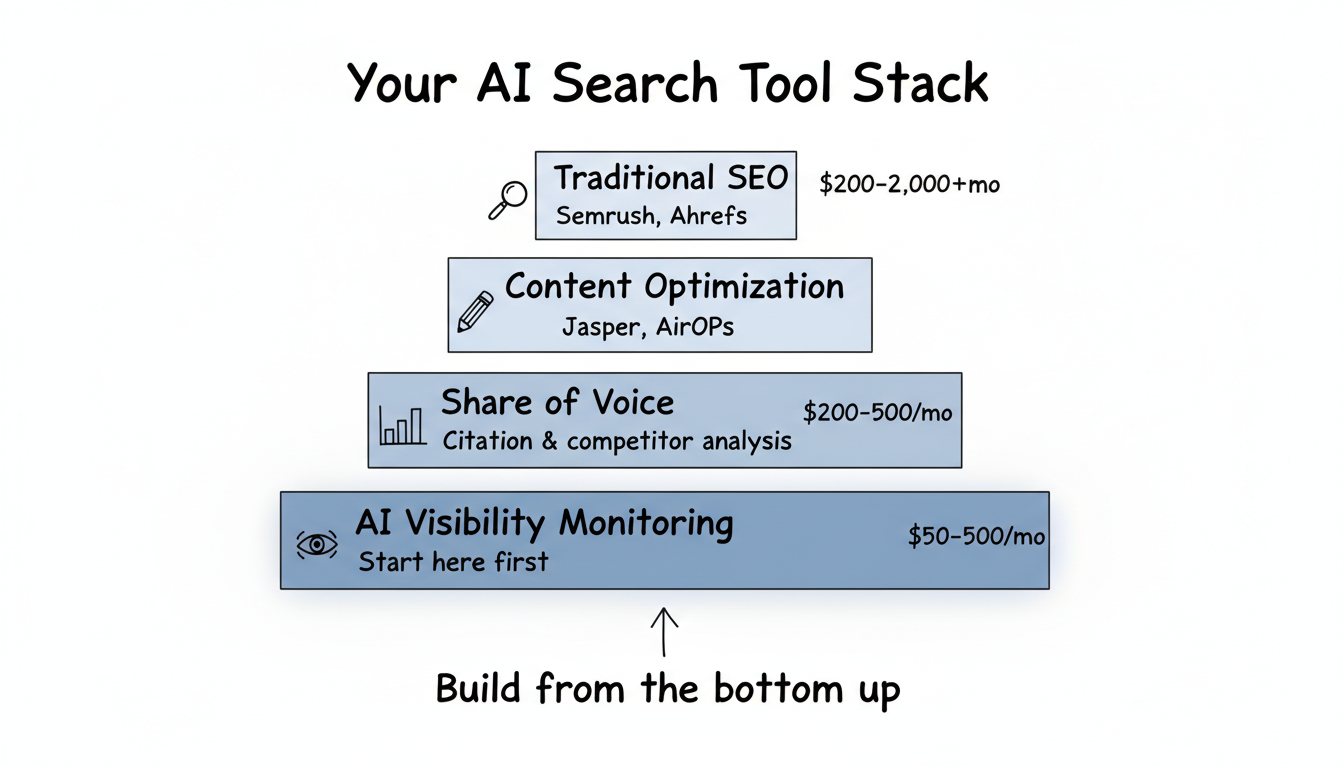
Most effective AI search strategies combine multiple tools:
Essential Stack Components
- Monitoring platform: Track visibility across AI platforms (choose one comprehensive option)
- Competitive intelligence: Understand share of voice vs. competitors
- Content optimization: Create and restructure AI-friendly content
- Traditional SEO tool: Maintain foundational SEO alongside AEO
Integration Considerations
Consider how tools work together:
- Data exports and API availability
- Reporting consolidation
- Workflow fit with existing processes
- Team training requirements
When evaluating geo-optimization-tools, prioritize platforms that integrate with your existing workflow and provide actionable insights rather than just data.
Budget Allocation
Tool investments vary significantly:
Tool Type | Typical Cost Range |
Basic AI monitoring | $50-200/month |
Mid-tier platforms | $200-500/month |
Enterprise solutions | $500-2,000+/month |
Content optimization | $100-500/month |
Start with monitoring capabilities and add optimization tools as you act on insights.
Key Takeaways
AI search requires specialized tools. Traditional SEO platforms don't track AI visibility. Dedicated tools fill this gap.
Monitoring is foundational. You can't measure what you don't track. Start with citation tracking across AI platforms.
Multiple tool categories serve different needs. Monitoring, competitive analysis, and content optimization require different capabilities.
Integration matters. The most effective strategies combine monitoring with optimization tools, often alongside traditional SEO platforms.
How to Evaluate a Tool Before Buying
Judge a tool by the decision it changes, not its feature list. Ask what report or action it produces that you lack today, and whether that output is worth the cost and the integration effort. A tool that generates a pretty dashboard you will not read is a subscription, not a capability.
Test it on your own data before committing. A trial on a real query list reveals whether the tool finds gaps you care about or only vanity metrics, and the difference decides the purchase. The proof is in the specific insight, not the marketing claim about coverage.
Avoiding Tool Stack Bloat
More tools mean more logins, more cost, and more signals that rarely agree. Consolidate where one platform covers two jobs well, and cut tools that duplicate a capability you already own, because overlapping metrics confuse the team more than they inform it. A lean stack is easier to trust.
Set an owner for each tool so it is actually used. The most common failure is a paid tool nobody runs, which is worse than not having it, because the spend implies coverage that does not exist. Named ownership turns the license into a habit.
Free Versus Paid Tools
Start with free or low-cost checks to prove the workflow before spending. Manual citation checks and a spreadsheet catch most drift, and they teach the team what to look for, so when you do buy, you know exactly which gap the paid tool must fill. Paying early often buys the wrong thing.
Use paid tools for scale and consistency, not for discovery of the basics. Once the routine is set, automation earns its keep by running the checks you would skip under pressure; until then, the discipline matters more than the software behind it.
FAQs
Do I Need Separate AI Search Tools If I Already Use Semrush or Ahrefs?
Major SEO platforms have added AI visibility features, but dedicated tools often provide more depth. Evaluate whether your current platform's AI features meet your needs or if specialized tools offer meaningful advantages for your use case.
Which AI Search Tool Should I Start With?
Start with a monitoring tool that tracks your visibility across ChatGPT, Perplexity, and Google AI. Understanding your current visibility is essential before optimization. Options like Otterly.AI, SE Visible, or Ahrefs Brand Radar provide this foundation.
How Much Should I Budget for AI Search Optimization Tools?
For mid-size organizations, expect $300-800/month for comprehensive AI visibility monitoring. Enterprise needs may require $1,000-2,000+/month. Start with monitoring before adding optimization tools, scaling investment as you see results.