
The AI search landscape has shifted dramatically from ChatGPT's near-monopoly to a competitive multi-platform market. Understanding current market share distribution - and what's driving changes - helps brands allocate AI search optimization resources strategically. This analysis breaks down the latest platform statistics and their implications for visibility strategy.
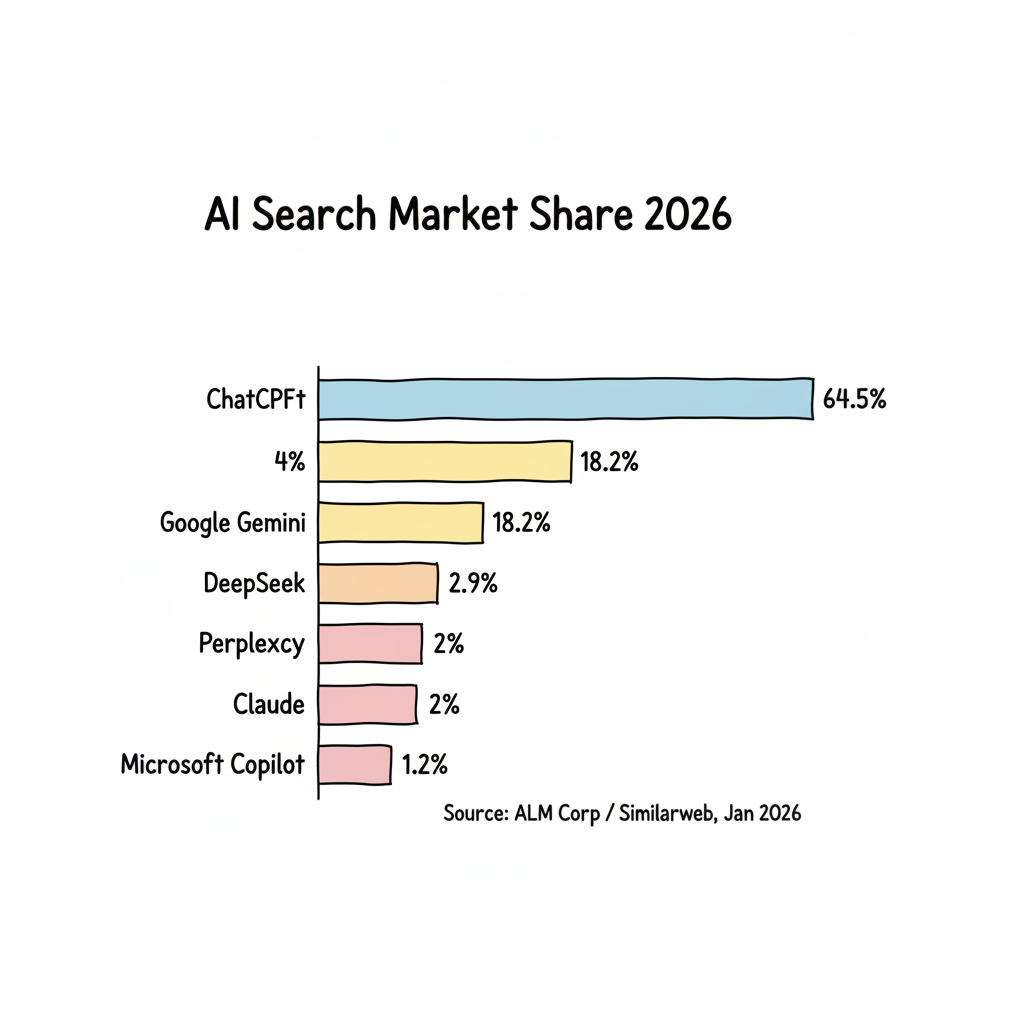
According to ALM Corp's market analysis, ChatGPT's traffic share among generative AI chatbot websites dropped from 86.7% in January 2025 to 64.5% in January 2026 - a staggering decline marking the end of OpenAI's monopolistic era and the beginning of a genuinely competitive AI chatbot market.
Current Market Share Distribution
January 2026 data reveals a significantly more fragmented market.
According to Vertu's Similarweb analysis, market share now distributes across multiple platforms: ChatGPT at 68%, Google Gemini at 18.2%, DeepSeek at 4%, Grok at 2.9%, Perplexity at 2%, Claude at 2%, and Microsoft Copilot at 1.2%.
2026 market share breakdown:
Platform | Market Share | YoY Growth | Key Differentiator |
ChatGPT | 64.5-68% | -19% share | Largest user base |
Google Gemini | 18.2-21.5% | +237% | Ecosystem integration |
DeepSeek | 3.7-4% | New entrant | Asian markets, pricing |
Grok | 2.9-3.4% | New entrant | X platform integration |
Perplexity | 2% | +370% | Citation-first approach |
Claude | 2% | +190% | Enterprise, coding |
Microsoft Copilot | 1.2% | Modest | Enterprise productivity |
ChatGPT: Still Dominant but Declining
ChatGPT maintains leadership while losing market share to competitors.
According to Superlines' statistics compilation, ChatGPT receives 5.72 billion monthly visits with over 800 million weekly active users and 190 million daily users - maintaining 81% market share in what's termed the "Agentic Internet."
ChatGPT key metrics:
ChatGPT Platform Statistics (2026)
+-- User Base
|   +-- Weekly active: 800-900 million
|   +-- Daily active: 190 million
|   +-- Monthly visits: 5.72 billion
|   +-- U.S. users: 77.2 million MAU
|
+-- Market Position
|   +-- Global share: 64.5-68%
|   +-- U.S. share: 66%
|   +-- YoY change: -19 percentage points
|   +-- Daily queries: 1+ billion
|
+-- Growth Context
    +-- Still adding users
    +-- Losing relative share
    +-- Retaining power users
    +-- Casual users exploring alternatives
Understanding what is an answer engine helps contextualize how platforms like ChatGPT differ from traditional search engines in their approach to information retrieval.
Google Gemini: Fastest-Growing Major Platform
Gemini's ecosystem integration drives unprecedented growth.
According to Business Insider's traffic analysis, Gemini web traffic increased 28.4% month-over-month in December 2025 while ChatGPT decreased 5.6%. Year-over-year, Gemini traffic grew 563.6% compared to ChatGPT's 49.5%.
Gemini growth drivers:
Factor | Impact | Optimization Implication |
Android integration | Default AI on billions of devices | Mobile-first optimization |
Chrome integration | Browser-level access | Website performance |
Google Workspace | Enterprise penetration | Business content |
YouTube connection | Video in AI results | YouTube SEO critical |
Search integration | AI Mode, Overviews | Traditional SEO overlap |
According to Vertu's analysis, Gemini referral traffic grew 388% year-over-year, demonstrating that AI platforms have emerged as legitimate discovery and traffic channels requiring dedicated optimization strategies. Learning how to use Google AI Overview has become essential for marketers looking to capitalize on this growth.
Perplexity: Citation-First Differentiation
Perplexity's research focus creates unique optimization opportunities.
According to Search Engine Journal's enterprise SEO analysis, Perplexity AI is a conversational search engine that generates answers using web sources and cites links within text responses - differentiating through transparent sourcing that traditional chatbots lack.
Perplexity characteristics:
- 370% YoY growth - Fastest-growing small platform
- Citation-backed responses - Always shows sources
- Real-time web search - Current information
- Research-focused features - Academic and professional use
- Mobile app transformation - "Year of the app" in 2025
Claude: Enterprise and Developer Focus
Anthropic's Claude pursues high-value segments despite smaller share.
According to Vertu's market breakdown, Claude achieved 190% year-over-year growth with $2.2 billion projected 2025 revenue (159% growth). This demonstrates that specialized positioning targeting high-value customers generates substantial revenue despite smaller overall market share.
Claude market position:
- Strong enterprise adoption
- Technical and coding excellence
- Long-context capability
- Responsible AI positioning
- Premium revenue per user
Regional and Demographic Variations
Market share differs significantly by geography and user segment.
According to TipRanks' Cloudflare analysis, ChatGPT and Claude see more weekday traffic (workday use), while Grok, Perplexity, and DeepSeek see more weekend traffic - indicating different use case patterns.
Regional variations:
Market | ChatGPT Share | Key Competitor | Note |
Global | 64.5% | Gemini (21.5%) | Gemini gaining |
United States | 66% | Gemini (growing) | Sophisticated multi-platform use |
Asian markets | Lower | DeepSeek strong | Regional pricing advantage |
Enterprise | Higher | Claude gaining | Professional tools |
Referral Traffic and Discovery Metrics
Beyond market share, referral traffic reveals optimization opportunities.
According to Digiday's referral traffic analysis, despite ChatGPT's dominance in referral traffic volume, Google's Gemini is catching up. AI platforms are fundamentally changing where, how, and how much referral traffic gets sent to publishers' sites.
Referral traffic implications:
AI Platform Referral Impact
+-- ChatGPT
|   +-- Highest volume
|   +-- 89% of measured AI referrals
|   +-- Strong click-through for citations
|
+-- Google Gemini
|   +-- 388% YoY referral growth
|   +-- Catching up rapidly
|   +-- Search integration advantage
|
+-- Perplexity
|   +-- Highest citation click rates
|   +-- 6.2x Referral Efficiency Index
|   +-- Research-focused users click sources
|
+-- Total AI Referrals
    +-- 1.1 billion monthly visits
    +-- Growing discovery channel
    +-- Requires dedicated optimization
Brands can leverage free AI SEO software tools to begin tracking their visibility across these emerging platforms without significant upfront investment.
Optimization Strategy Implications
Market share data informs resource allocation decisions.
According to Semrush's technical SEO study, analysis of 5 million cited URLs reveals AI platforms consistently cite pages with strong technical foundations. Google AI Mode tends to cite pages with higher engagement than ChatGPT Search, particularly for page views and purchases per visit.
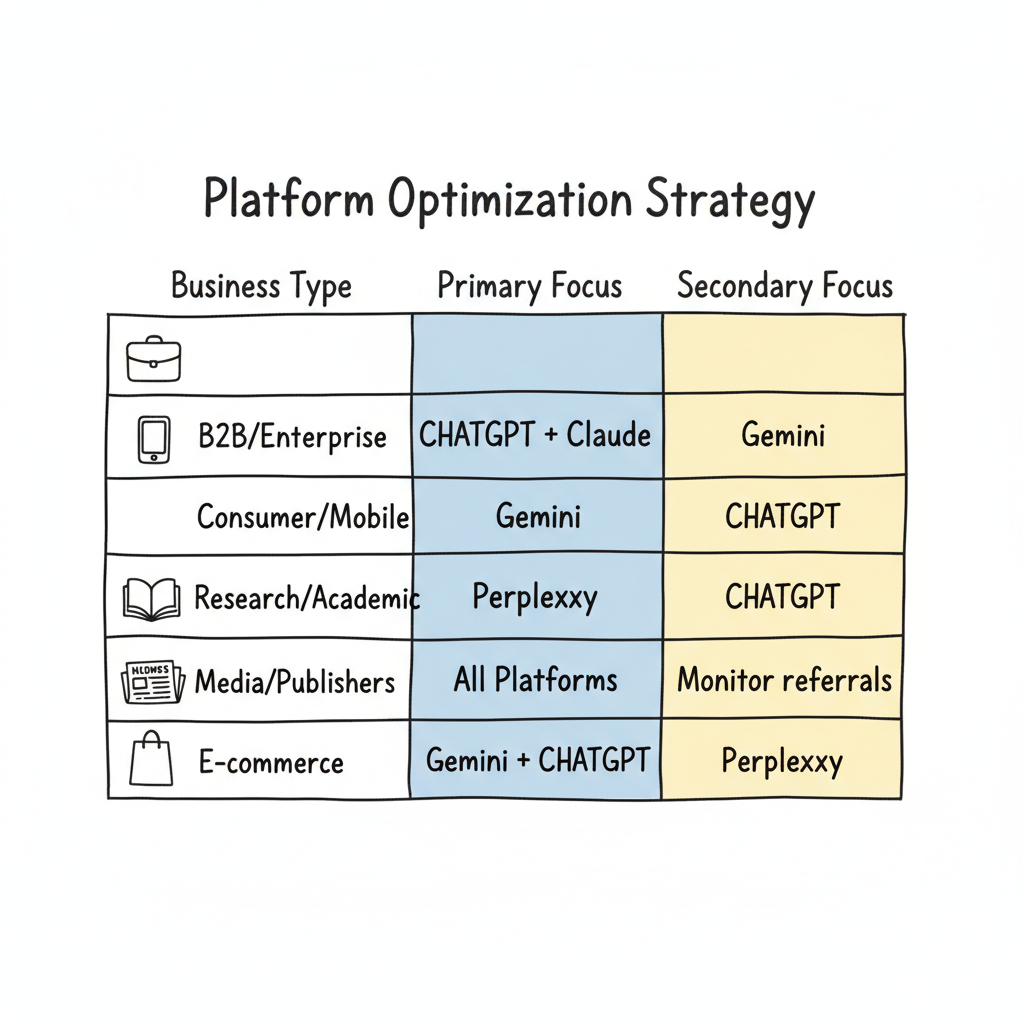
Strategic allocation framework:
Business Type | Primary Focus | Secondary Focus | Rationale |
B2B/Enterprise | ChatGPT + Claude | Gemini | Workday usage patterns |
Consumer/Mobile | Gemini | ChatGPT | Android integration |
Research/Academic | Perplexity | ChatGPT | Citation importance |
Media/Publishers | All platforms | Monitor referrals | Traffic diversification |
E-commerce | Gemini + ChatGPT | Perplexity | Shopping integrations |
Organizations seeking comprehensive visibility should implement AEO optimization strategies that span multiple platforms rather than focusing exclusively on traditional search engines.
How to Read Market Share for Strategy
Share tells you where the audience is, not where your content should be by default. Weight the platforms by which ones your buyers actually use to research, because a dominant platform in a category you do not serve is less relevant than a smaller one your buyers live in. The strategy follows the buyer, not the headline number.
Track the trend, not the snapshot. A platform declining in overall share can still be rising among your segment, and a fast-growing one may not yet reach your audience, so read the movement against your own data rather than the market average alone. The directional read beats the static percentage.
Optimization Implications by Platform
Different platforms cite differently, so one page rarely fits all. A ChatGPT-friendly answer leads with clear prose and evidence; a Perplexity-friendly answer benefits from citation-worthy structure and sources; a Gemini answer leans on the broader Google ecosystem. Write once, then tune the extractable parts per surface.
Avoid over-fitting to a single platform's quirks. The stable practice is answer-first content with accurate structure and schema, which travels across surfaces better than tricks aimed at one. Platform-specific tuning is a refinement on top of a sound base, not a replacement for it.
Regional and Demographic Nuances
Share shifts by region and age, so a global plan needs local reads. A platform dominant in one market can be absent in another, and the demographic that researches on it may not be yours, so segment the strategy by where and who before allocating effort. The nuance is the difference between relevant and wasted.
Use the regional variation to sequence the work. Win the platform and region where your buyers concentrate first, then extend to adjacent ones as budget allows, rather than spreading thin across every market at once. Concentration earns the early citation that justifies the later expansion.
Key Takeaways
AI search market share distribution guides optimization priorities:
- ChatGPT still leads at 64.5-68% - Remains primary optimization target despite declining share
- Gemini is fastest-growing at +237% YoY - Ecosystem integration demands attention
- Market fragmentation is accelerating - No single platform dominates all use cases
- Perplexity leads citation efficiency - 6.2x referral efficiency makes it valuable despite 2% share
- Claude captures enterprise value - $2.2B revenue shows premium positioning works
- Multi-platform strategy required - 1.1 billion monthly AI referrals come from diverse sources
The marketers succeeding in AI search all built strong traditional SEO first, then expanded to multi-platform AI visibility as these market share shifts created new opportunities.