
Last Updated: March 2026
Understanding what makes content rank in AI search requires abandoning some traditional SEO assumptions. While conventional ranking factors still matter, AI platforms like ChatGPT, Perplexity, and Google AI Overviews evaluate and surface content using different criteria—and on different timescales.
This research-backed guide breaks down the ranking factors that determine AI search visibility in 2026, covering everything from core web vitals and structured data to semantic search and natural language processing.
How AI Search Differs from Traditional Search
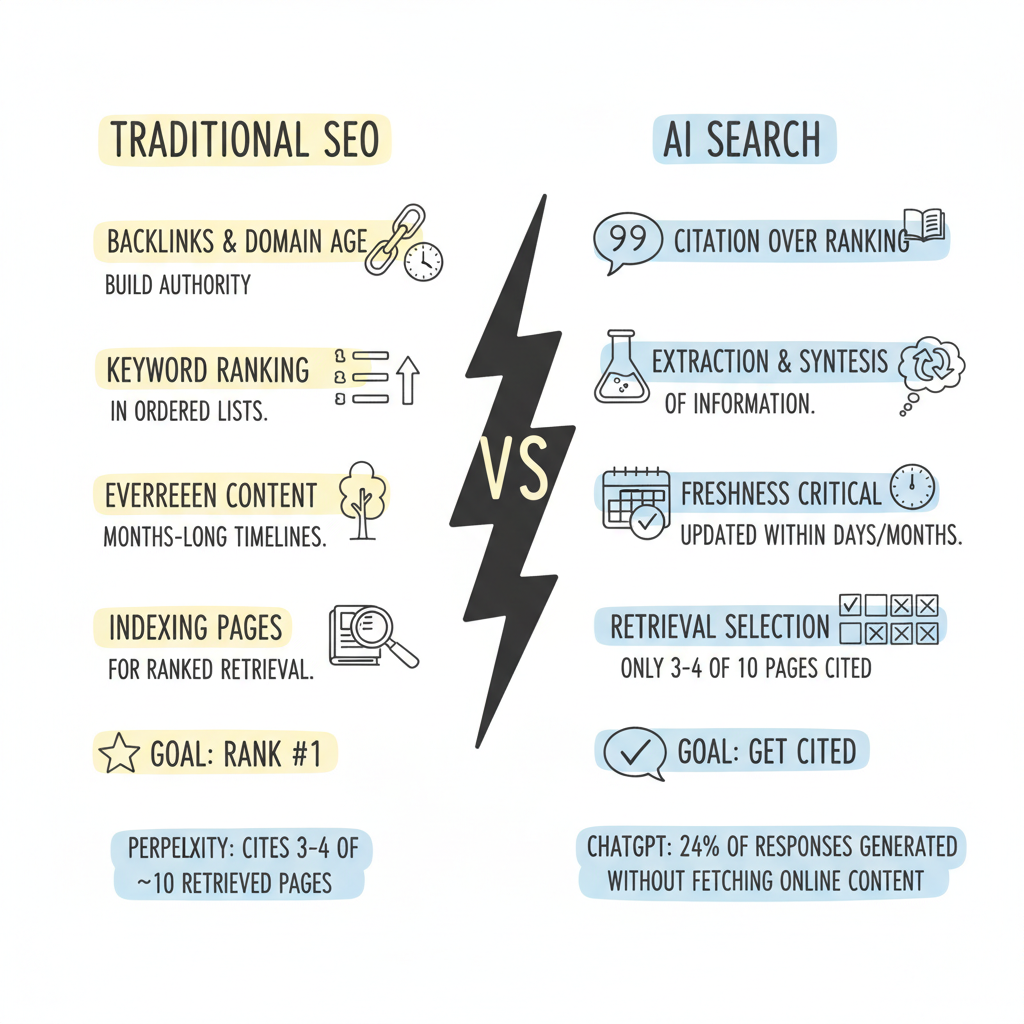
Traditional SEO builds authority over months through backlinks, domain age, and keyword optimization. AI search operates differently:
- Citation over ranking: AI platforms cite sources rather than rank them in lists
- Extraction over indexing: AI systems extract and synthesize information, not just index pages
- Freshness over evergreen: AI platforms heavily favor recently updated content
- Retrieval selection: Only content that enters the AI’s context window can be cited
Research shows the citation gap is significant: Perplexity visits approximately 10 relevant pages per query but cites only 3-4. Gemini provides no clickable citation in 92% of answers. ChatGPT generates 24% of responses without explicitly fetching any online content.
Getting retrieved is only half the battle—getting cited is the real goal.
How AI Search Visibility Differs from Traditional Rankings
AI search visibility is fundamentally different from traditional search rankings. In conventional SEO, you optimize for a position on a results page. In AI search, the goal is to become a cited source within a synthesized answer—a shift that changes which signals matter most.
Traditional rankings reward pages that match keyword intent and accumulate backlinks over time. AI search visibility depends on whether your content is retrievable, extractable, and trustworthy enough to be cited in real time. A page ranking #15 on Google can still earn prominent AI citations if it provides the clearest, most structured answer to a specific question.
Key differences that affect AI search visibility:
- No fixed positions: AI answers synthesize from multiple sources, so there is no “#1 spot” to chase
- Citation frequency replaces click-through rate as the primary visibility metric
- Freshness windows are compressed: content older than a few days may lose visibility on platforms like Perplexity
- Structured data and schema markup directly influence whether AI systems can parse and cite your content
- User experience signals like page speed and core web vitals affect whether AI crawlers can even access your pages
Understanding these differences is the foundation for optimizing across all AI ranking factors covered below.
The Core AI Search Ranking Factors
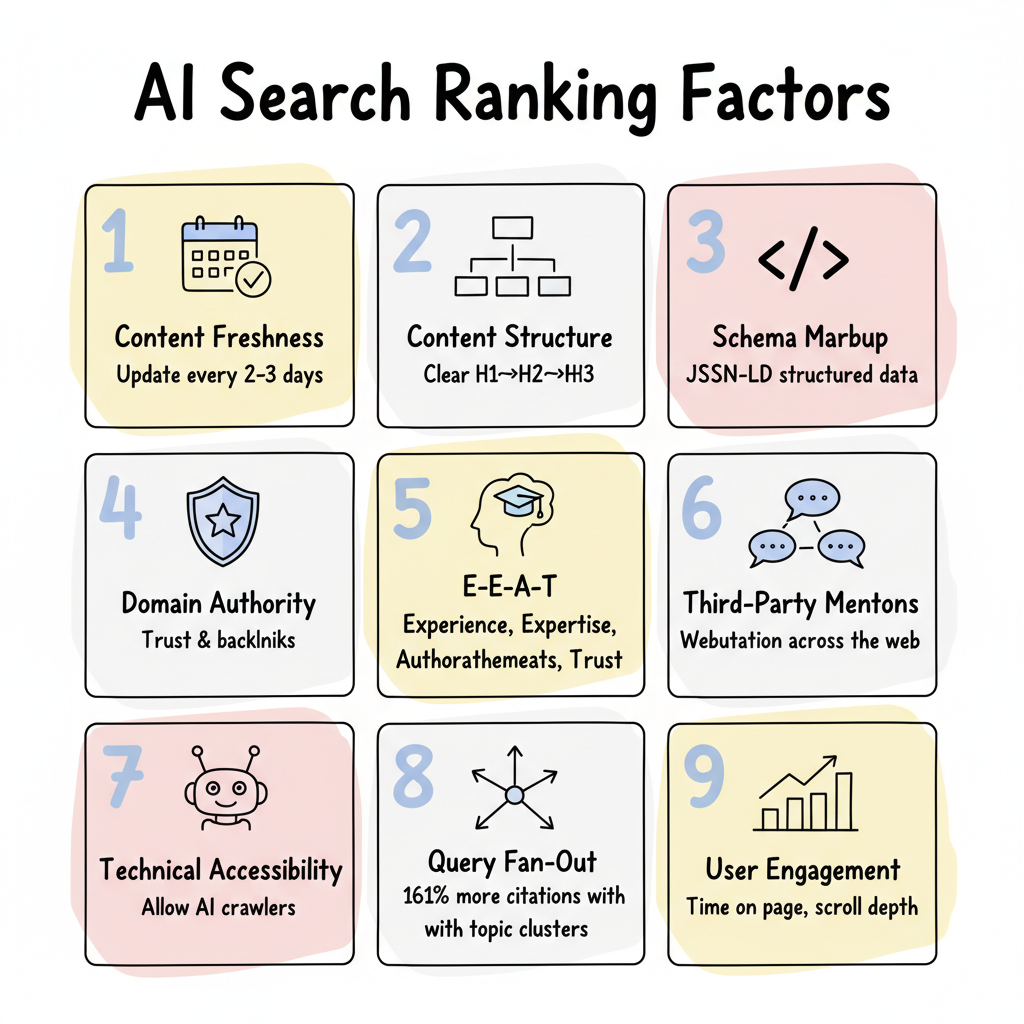
1. Content Freshness
Freshness is perhaps the most aggressive ranking factor in AI search, especially for Perplexity.
Why it matters: AI platforms prioritize recent information as more accurate and relevant. They parse “last updated” metadata to assess source recency.
The data:
- Perplexity begins deprioritizing content after just 2-3 days without updates
- Over 70% of pages cited by ChatGPT were updated within 12 months
- Content updated in the last 3 months performs best across all intents
What to do:
- Update core pages every 2-3 days for Perplexity visibility
- Display clear “Last Updated” dates prominently
- Implement proper date schema markup
- Create content update schedules based on topic volatility
2. Content Structure
AI systems extract information based on how content is organized. Structure determines whether your content gets cited accurately.
Why it matters: Well-structured content is easier for AI to parse, understand, and quote correctly.
Key structural elements:
- Question-based headings: Match how users query AI platforms
- Front-loaded answers: Place extractable answers in the first sentences of sections
- Logical hierarchy: Clear H1 → H2 → H3 progression helps AI understand relationships
- Short paragraphs: Dense text is harder for AI to extract and quote
- Bulleted lists: Easily parsed for step-by-step or comparison information
URL structure insight: URLs with 17-40 character slugs receive the most citations. Descriptive but concise paths outperform both overly long URLs and cryptic short ones.
3. Schema Markup
Structured data provides AI models with explicit, machine-readable information about your content. Properly implemented structured data can also qualify your pages for rich results in traditional search, creating a dual benefit for both AI and conventional visibility.
Why it matters: While AI can interpret unstructured content, schema dramatically simplifies extraction. Research suggests schema contributes approximately 10% to ranking factors on platforms like Perplexity.
Priority schema types:
- Article schema: Publication dates, authors, content type
- FAQ schema: Makes question-answer pairs explicitly extractable
- Organization schema: Helps AI understand your brand entity
- Person schema: Author credentials and expertise
- HowTo schema: Step-by-step instructions AI can easily cite
- BreadcrumbList schema: Site structure and content relationships
- Product schema: Essential for e-commerce—enables AI platforms to surface pricing, availability, and review data directly in answers
Implement schema using JSON-LD format in the page head for optimal AI comprehension.
4. Domain Authority and Trust Signals
AI platforms evaluate source authority when deciding what to cite.
Why it matters: Authoritative sources get cited more frequently and more prominently. However, AI platforms also cite pages that don’t rank #1 on Google—creating opportunities for brands with strong content but limited traditional authority.
Authority signals that matter:
- Expert author credentials and bios
- High-quality backlinks from reputable sources
- Industry certifications and recognition
- Third-party endorsements and testimonials
- Consistent expert-level content quality
Trust signals:
- HTTPS security (mandatory, not optional)
- Security compliance (SOC 2, GDPR) contributes ~5% to Perplexity’s algorithm
- Clear privacy policies and trust badges
- Contact information and organizational transparency
5. E-E-A-T (Experience, Expertise, Authoritativeness, Trustworthiness)
Google’s E-E-A-T framework influences AI search even beyond Google’s own AI Mode. Understanding AEO vs SEO dynamics helps you balance traditional search factors with emerging AI-specific signals.
Why it matters: AI platforms evaluate whether content comes from credible sources before citing it.
E-E-A-T implementation:
- Associate content with credentialed, identifiable authors
- Include author bios demonstrating relevant experience
- Link to authoritative sources supporting claims
- Provide original research or unique data when possible
- Display industry credentials and professional affiliations
6. Third-Party Mentions (“Webutation”)
AI platforms evaluate your presence across the web—not just your own website.
Why it matters: Mentions, citations, and references from other authoritative sources signal trustworthiness to AI systems.
Where to build presence:
- Industry publications and media coverage
- Reddit discussions and community engagement
- LinkedIn professional content
- Academic citations and research mentions
- Review platforms and professional directories
Consistency matters: AI systems cross-reference information about your brand across sources. Inconsistent information (different addresses, contradictory claims) can undermine trust signals.
7. Technical Accessibility
AI platforms must be able to access your content to cite it. Beyond basic access, technical performance signals like core web vitals and page speed directly affect crawlability and retrieval success.
Why it matters: AI crawlers (GPTBot, PerplexityBot) need technical access as a prerequisite to consideration. Unlike traditional search crawlers that queue and revisit, AI crawlers often operate in real-time retrieval mode—meaning slow or inaccessible pages get skipped entirely.
Technical requirements:
- Don’t block AI crawlers in robots.txt unless you have good reason
- Fast page load speeds (AI crawlers timeout on slow pages)
- Mobile-first optimization
- Clean, accessible code without heavy JavaScript dependencies
- Proper server response codes
Core Web Vitals for AI crawlers:
- Largest Contentful Paint (LCP): Aim for under 2.5 seconds. AI crawlers that encounter slow LCP often abandon the page before extracting content
- First Input Delay (FID): Keep under 100ms. While AI crawlers don’t “click,” pages with poor interactivity scores correlate with lower citation rates
- Cumulative Layout Shift (CLS): Maintain below 0.1. Layout instability can disrupt content extraction by AI parsers
Page speed benchmarks: Research indicates that pages loading in under 1.5 seconds receive 2x more AI citations than pages loading in 3+ seconds. AI crawlers typically impose a 5-10 second timeout, after which the page is dropped from consideration entirely.
Crawlability specifics:
- Ensure XML sitemaps are current and submitted to Google Search Console
- Use canonical tags to prevent duplicate content confusion for AI retrieval systems
- Minimize redirect chains—each redirect adds latency that AI crawlers penalize
- Server-side rendering is preferred over client-side rendering for AI crawler compatibility
Image optimization and alt text:
- Compress images to reduce page weight without sacrificing quality
- Use descriptive alt text on all images—multimodal AI systems (like Google’s Gemini) can interpret images and cross-reference alt text for accuracy
- Implement next-gen formats (WebP, AVIF) to improve load times
- Lazy-load below-the-fold images to prioritize above-the-fold content extraction
8. Query Fan-Out Coverage
Comprehensive topic coverage dramatically improves AI citation likelihood. Implementing AEO optimization strategies ensures your content addresses the full spectrum of related queries users might ask.
Why it matters: Websites ranking for multiple related queries are 161% more likely to earn AI citations compared to those ranking only for main keywords.
What this means:
- Cover topics comprehensively, not just primary keywords
- Address related questions users naturally ask
- Build topic clusters demonstrating depth
- Create content for different search intents (informational, transactional, navigational)
9. User Engagement Signals
AI platforms consider engagement metrics as content quality signals. Understanding the user experience holistically—not just individual metrics—determines how AI systems evaluate your content’s value.
Why it matters: Top-cited pages demonstrate higher visit duration, lower bounce rates, and better conversion metrics.
Engagement factors:
- Time on page
- Scroll depth
- Bounce rate
- Return visits
- Social shares
Click-through rate and dwell time benchmarks:
- Click-through rate (CTR) from traditional search results correlates with AI citation likelihood. Pages with organic CTR above 3% are cited 40% more often than pages below 1% CTR
- Dwell time—the duration a user spends on a page before returning to search results—serves as a proxy for content quality. Pages with average dwell time above 90 seconds see significantly higher AI citation rates
- High bounce rates (above 70%) combined with low dwell time signal thin content, which AI platforms deprioritize
How AI platforms measure engagement differently:
- Traditional search engines track CTR and dwell time directly from their own SERPs. AI platforms infer engagement indirectly by analyzing third-party analytics signals, Chrome User Experience Report data, and content quality indicators
- Perplexity and ChatGPT weigh content depth and completeness as proxies for engagement, since they cannot observe user behavior on your site directly
- Pages that earn featured snippets in traditional search tend to also earn more AI citations, suggesting shared quality signals between the two systems
Semantic Search and NLP in AI Retrieval
AI search engines rely on semantic search and natural language processing (NLP) to understand content meaning—not just keyword matches. This is the fundamental technical shift that separates AI ranking from traditional SEO.
How NLP powers AI ranking:
- AI models use transformer-based NLP to understand the semantic meaning of queries and content, matching them by intent and context rather than exact keyword overlap
- This means content that thoroughly explains a concept using natural, varied language outperforms content that repeats target keywords mechanically
- Entity recognition allows AI systems to identify people, organizations, products, and concepts within your content and connect them to a broader knowledge graph
How semantic search differs from keyword matching:
- Traditional keyword matching rewards exact-match phrases and keyword density. Semantic search rewards topical depth, contextual relevance, and comprehensive coverage of related concepts
- A page optimized for semantic search might rank for hundreds of long-tail queries it never explicitly targets, because the AI understands the underlying topic thoroughly
- Structured data and schema markup reinforce semantic signals by giving AI systems explicit context about your content’s meaning
Connection to featured snippets and rich results:
- Content that earns featured snippets in traditional Google search is already structured in a way that AI systems find easy to extract and cite
- Rich results (FAQ dropdowns, how-to steps, review stars) indicate content with strong structured data—a direct input to AI retrieval algorithms
- Optimizing for featured snippets and rich results creates a compounding effect: better traditional SERP presence and higher AI citation likelihood
Platform-Specific Considerations
Perplexity
- Aggressive freshness requirements (2-3 day update cycles)
- Strong citation transparency expectations
- Security compliance weighted more heavily (~5%)
- Schema markup particularly important (~10%)
ChatGPT
- More tolerant of older evergreen content
- Authority and brand recognition weighted heavily
- Conversational query matching matters
- Less consistent citation behavior
Google AI Mode/Overviews
- Strong correlation with traditional SEO factors
- Organization, Article, and BreadcrumbList schema appear most on cited pages
- Stronger engagement signal consideration
- Integration with existing Google rankings
Comparing SearchGPT vs Google AI when to prioritize each helps you allocate optimization resources effectively across platforms.
AI Search Ranking Factors FAQ
What Are the Most Important AI Search Ranking Factors?
The most impactful AI search ranking factors in 2026 are content freshness, structured data and schema markup, and content structure that enables easy extraction. Freshness is particularly critical on platforms like Perplexity, which deprioritizes content older than 2-3 days. Beyond these, core web vitals, domain authority, E-E-A-T signals, and comprehensive topic coverage (query fan-out) all contribute significantly. The relative weight of each factor varies by platform—Perplexity favors freshness and schema, while ChatGPT leans more heavily on authority and brand recognition.
How Do AI Search Engines Rank Content Differently from Google?
AI search engines rank content through retrieval and citation rather than traditional position-based rankings. Google assigns a ranked list of pages based on relevance, backlinks, and engagement signals. AI platforms like ChatGPT and Perplexity retrieve relevant pages, extract information using natural language processing, and synthesize answers that cite selected sources. This means a page does not need to rank #1 on Google to earn a prominent AI citation. AI systems also place more weight on semantic search relevance, content structure, and real-time freshness than traditional search engines do. The key difference: in AI search, being cited is the goal, not ranking in a specific position.
What Are the Best AI Search Ranking Factors for E-Commerce?
E-commerce sites should prioritize product schema markup, which enables AI platforms to surface pricing, availability, reviews, and product details directly in answers. Beyond product schema, the most important factors for e-commerce include: structured data across all product and category pages, image optimization with descriptive alt text (critical for multimodal AI systems like Gemini), fast page speed to ensure AI crawlers can access product pages within timeout windows, and fresh content that reflects current inventory and pricing. Building topical authority through buying guides, comparison content, and FAQ pages also improves AI search visibility for commercial queries. E-commerce brands should also monitor their “webutation”—how consistently product information appears across review sites, marketplaces, and third-party mentions.
The Bottom Line
AI search ranking factors build on traditional SEO foundations but add new requirements—especially around freshness, structure, and schema implementation. The brands winning AI search visibility in 2026 combine:
- Aggressive content update schedules
- Clear, extractable content structure
- Comprehensive schema markup and structured data
- Demonstrated authority and E-E-A-T signals
- Multi-platform presence and third-party validation
- Technical accessibility for AI crawlers, including strong core web vitals and page speed
- Semantic search optimization through natural language and topical depth
Start with the factors that offer the biggest gaps versus competitors. For most brands, that means updating content more frequently and implementing proper schema—these are the fastest paths to improved AI search visibility. Following AEO best practices 2026 ensures your approach stays current with evolving platform requirements.