
AI Search Tools Software Comparison: 7 Platforms (2026)
Choosing between AI visibility tools requires comparing specific capabilities, not marketing claims. This AI search tools software comparison provides head-to-head analysis across the features that matter: platform coverage, citation tracking depth, pricing structure, and workflow integration. Use this AI search tools software comparison to identify which platform matches your requirements.
What Are AI Visibility Tools?
An AI visibility tool is a platform that queries AI systems at scale to track how often they cite your brand across 5+ AI search platforms.
What Is Citation Tracking?
Citation tracking is a feature that records mention frequency, context, and sentiment across platforms like ChatGPT, Perplexity, and Google AI Overviews.
What Is Share of Voice?
Share of voice is a metric that measures your brand mentions relative to competitors across AI search results -- typically reported as a percentage of total citations.
AI Platform Coverage
Most AI visibility tools track between 3 and 5 AI platforms, with enterprise options like Profound and Conductor covering 5 or more including Copilot and Claude.
How AI Visibility Tools Work
AI visibility tools monitor and optimize how your brand appears in AI-powered search -- ChatGPT, Perplexity, Google AI Overviews, Microsoft Copilot, and Claude. Unlike AI search engines, they track citations, analyze context, and measure your share of voice against competitors.
AI Visibility as a Platform Category
AI visibility tools differ from AI search engines by focusing on monitoring and citation tracking rather than answering user queries.
AI visibility tools are a distinct category of software designed to monitor and optimize how your brand appears in AI-powered search experiences -- ChatGPT, Perplexity, Google AI Overviews, Microsoft Copilot, and Claude. Unlike AI search engines themselves (such as Perplexity or ChatGPT Search), AI visibility tools sit on the monitoring side: they track whether AI systems cite your brand, analyze the context of those citations, and measure your share of voice against competitors.
The Traditional SEO Gap in AI Monitoring
Traditional SEO platforms measure clicks and impressions from search results but cannot track how AI systems cite or describe your brand.
These tools emerged because traditional SEO platforms were not built to track AI-generated responses. Google Search Console shows clicks and impressions from traditional search, but it cannot tell you whether ChatGPT recommends your product or how Perplexity describes your brand. AI visibility tools fill that gap by querying AI platforms at scale and reporting on citation frequency, sentiment, and competitive positioning.
Why AI Search Visibility Matters
The market is growing rapidly. As AI search adoption accelerates -- with Perplexity surpassing 100 million monthly queries and Google AI Overviews appearing on over 30% of informational searches -- tracking your brand's presence in these systems has become a critical component of any AI search optimization strategy.
How We Evaluated These AI Visibility Tools
We conducted this AI search tools software comparison by evaluating each platform across six core criteria for consistent, comparable assessments:
Evaluation Criteria
- Platform coverage breadth -- How many AI platforms does the tool monitor? We verified support for ChatGPT, Perplexity, Google AI Overviews, Microsoft Copilot, and Claude.
- Citation tracking depth -- Does the tool simply count mentions, or does it analyze citation context, sentiment, and positioning within AI responses?
- Historical data retention -- How far back can you analyze trends? Ranges vary from 3 months to 12+ months across tools.
- Integration ecosystem -- Can the tool connect with your existing analytics stack (Google Analytics, Search Console, Slack, CMS platforms)?
- Pricing transparency -- Are pricing tiers clearly published, or does the tool require custom quotes?
- Implementation complexity -- How quickly can a team go from purchase to actionable data?
Core Feature Comparison Matrix
Compare essential capabilities across leading AI visibility platforms.
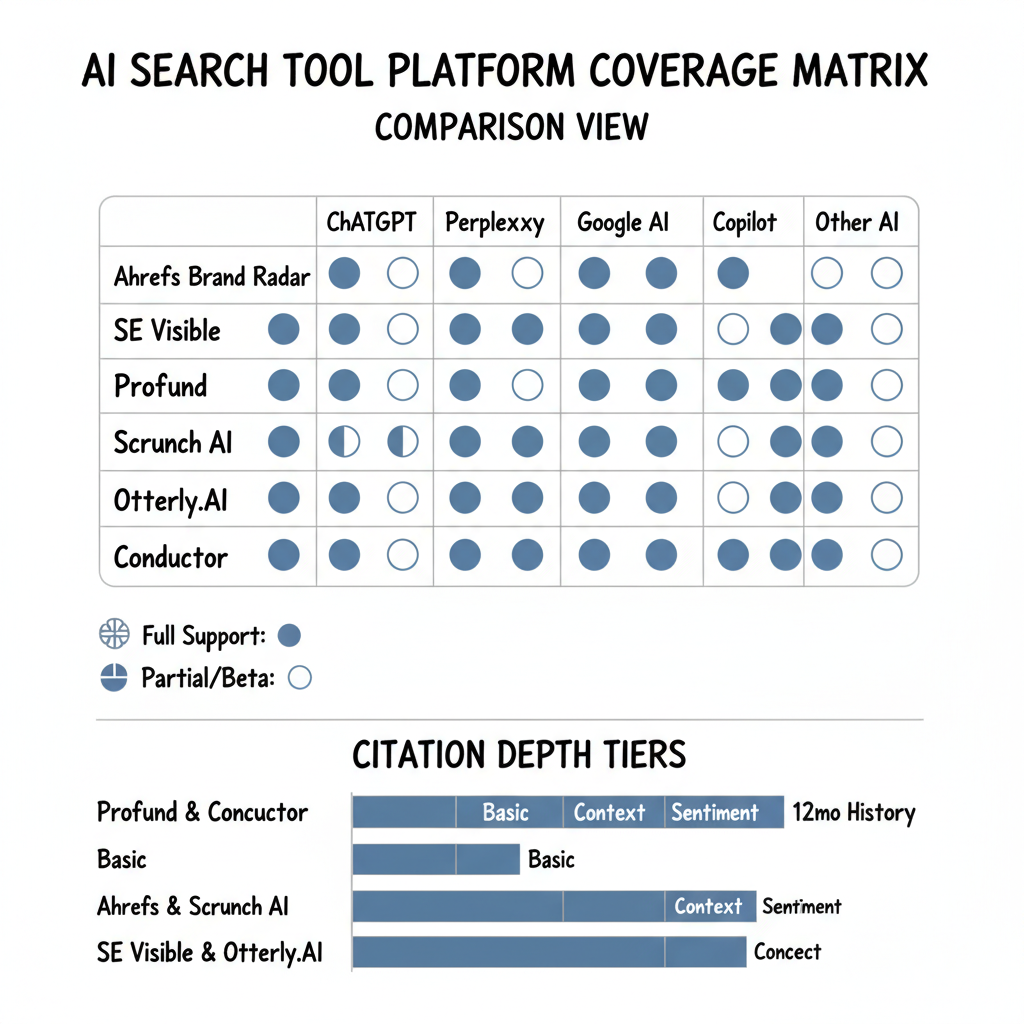
Platform Coverage Comparison
Platform coverage comparison:
Tool | ChatGPT | Perplexity | Google AI | Copilot | Claude | Other AI |
Ahrefs Brand Radar | ✓ | ✓ | ✓ | ✓ | ○ | Limited |
SE Visible | ✓ | ✓ | ✓ | ○ | ○ | No |
Profound | ✓ | ✓ | ✓ | ✓ | ✓ | Yes |
Scrunch AI | ✓ | ✓ | ✓ | ✓ | ○ | Limited |
Otterly.AI | ✓ | ✓ | ✓ | ○ | ○ | No |
Conductor | ✓ | ✓ | ✓ | ✓ | ○ | Limited |
Platform Coverage Key
✓ = Full support | ○ = Partial/beta support
Citation Tracking Depth Comparison
Citation tracking depth:
Tool | Basic Citations | Citation Context | Sentiment Analysis | Historical Data |
Ahrefs Brand Radar | ✓ | ✓ | ○ | 6 months |
SE Visible | ✓ | ○ | ○ | 3 months |
Profound | ✓ | ✓ | ✓ | 12 months |
Scrunch AI | ✓ | ✓ | ○ | 6 months |
Otterly.AI | ✓ | ○ | ○ | 3 months |
Conductor | ✓ | ✓ | ✓ | 12+ months |
Citation Depth Analysis
Deeper citation context reveals how AI systems describe your brand, not just whether they mention it. Understanding the difference between AEO vs SEO vs GEO helps clarify why citation context matters for modern search optimization.
Head-To-Head Comparisons
Six head-to-head comparisons across the leading AI visibility tool pairings.
The market is split between two buyer types: teams extending existing SEO platforms (Ahrefs, Semrush, SE Ranking) and teams buying dedicated AI visibility tools (Profound, Scrunch AI, Otterly.AI). Your starting point determines which comparison matters most.
Ahrefs Brand Radar vs SE Visible
For teams already using traditional SEO platforms, this comparison matters most.
Feature Comparison
Feature comparison:
Capability | Ahrefs Brand Radar | SE Visible |
AI platform coverage | 4+ platforms | 3 platforms |
Traditional SEO integration | Deep (same platform) | Deep (same platform) |
Competitive tracking | Included | Add-on |
Share of voice | Yes | Yes |
Cited URL analysis | Yes | Limited |
Query-level data | Yes | Yes |
Pricing | Included with Ahrefs | $49-149/month add-on |
Best Fit
Best fit:
Choose Ahrefs Brand Radar If | Choose SE Visible If |
Already use Ahrefs | Already use SE Ranking |
Need 4+ platform coverage | Budget is primary concern |
Want cited URL details | Basic citation tracking sufficient |
Require competitive share of voice | Don't need competitive features |
Ahrefs vs SE Visible: Verdict
Verdict: Ahrefs Brand Radar offers more depth; SE Visible wins on value if you're in SE Ranking's ecosystem.
Profound vs Scrunch AI
Enterprise buyers evaluating dedicated AI visibility platforms.
Feature Comparison
Feature comparison:
Capability | Profound | Scrunch AI |
Target market | Enterprise only | Mid-market to enterprise |
AI platform coverage | 5+ platforms | 4+ platforms |
Topic clustering | Basic | Advanced |
Prompt-level detail | Yes | Yes (specialization) |
Custom reporting | Yes | Yes |
Security/compliance | SOC 2, enterprise | Standard |
Implementation time | 2-4 weeks | 1-2 weeks |
Pricing | Custom ($1,500+/month) | Custom ($500+/month) |
Best Fit
Best fit:
Choose Profound If | Choose Scrunch AI If |
Require enterprise security | Mid-market budget |
Need brand representation tracking | Topic clustering is priority |
Have compliance requirements | Faster implementation needed |
Sentiment analysis is critical | Prompt-level granularity matters |
Profound vs Scrunch AI: Verdict
Verdict: Profound for enterprise security requirements; Scrunch AI for topic-focused analysis at lower price point.
Conductor vs Semrush AI Visibility
For teams choosing between enterprise-grade platforms, understanding how to do GEO SEO becomes critical when evaluating which platform offers better workflow integration.
Feature Comparison
Feature comparison:
Capability | Conductor Intelligence | Semrush AI Toolkit |
AI visibility tracking | Yes (dedicated module) | Yes (integrated) |
Content execution connection | Tight | Moderate |
Traditional SEO features | Comprehensive | Comprehensive |
AI platform coverage | 4+ platforms | 4+ platforms |
Workflow automation | Advanced | Moderate |
Team collaboration | Enterprise | Team plans available |
Pricing | Custom ($2,000+/month) | $249-499/month |
Best Fit
Best fit:
Choose Conductor If | Choose Semrush If |
Enterprise team size | Small-to-mid size teams |
Need content execution workflow | Traditional SEO + AI visibility |
Budget allows enterprise pricing | Cost efficiency matters |
Require white-glove onboarding | Self-service is acceptable |
Conductor vs Semrush: Verdict
Verdict: Conductor for enterprises needing execution workflows; Semrush for teams wanting AI visibility with comprehensive SEO.
Pricing Model Comparison
Understand how each AI visibility tool structures costs. Budget range: SE Visible add-on from $49/mo, Otterly.AI from $79/mo, Ahrefs Lite from $99/mo, Semrush Pro from $129/mo, Scrunch AI from $299/mo, and enterprise platforms Profound and Conductor from $1,500/mo and $2,000/mo respectively.
Pricing Structure Overview
Pricing structures:
Tool | Model | Entry Price | Mid Tier | Enterprise |
Ahrefs Brand Radar | Included in plans | $99/mo (Lite) | $199/mo (Standard) | $399/mo (Advanced) |
SE Visible | Add-on | $49/mo | $99/mo | $149/mo |
Profound | Custom | - | - | $1,500+/mo |
Scrunch AI | Tiered | $299/mo | $599/mo | Custom |
Otterly.AI | Tiered | $79/mo | $199/mo | $499/mo |
Conductor | Custom | - | - | $2,000+/mo |
Semrush | Included in plans | $129/mo (Pro) | $249/mo (Guru) | $499/mo (Business) |
Hidden Cost Factors
Hidden cost considerations:
Factor | What to Watch |
Query limits | Monthly tracked queries caps |
Competitor slots | How many competitors included |
Historical data | How far back data extends |
User seats | Per-user vs unlimited pricing |
API access | Extra charges for automation |
Support tier | Premium support as add-on |
Hidden Pricing Considerations
Always request full pricing breakdown before committing.
Integration Capability Comparison
AI visibility tools must fit into existing workflows.
Integration Availability
Integration availability:
Tool | Google Analytics | Search Console | Slack | API Access | Exports |
Ahrefs Brand Radar | Indirect | Yes | No | Yes | CSV, PDF |
SE Visible | Yes | Yes | Yes | Yes | CSV |
Profound | Yes | Yes | Yes | Yes | Multiple |
Scrunch AI | Yes | Yes | Yes | Yes | Multiple |
Otterly.AI | Limited | Limited | Yes | Limited | CSV |
Conductor | Yes | Yes | Yes | Yes | Enterprise |
Semrush | Yes | Yes | Yes | Yes | Multiple |
CMS and Workflow Integrations
CMS and workflow integrations:
Tool | WordPress | HubSpot | Contentful | Google Docs | Notion |
Ahrefs Brand Radar | Via plugin | No | No | No | No |
Conductor | Yes | Yes | Yes | Yes | Yes |
Semrush | Yes | Yes | Via API | No | Via API |
Others | Limited | Limited | No | No | No |
Integration Landscape Summary
Enterprise tools offer broader integration; dedicated platforms focus on core functionality. For teams implementing comprehensive knowledge graph SEO implementation, API access becomes essential for syncing structured data across platforms.
Emerging AI Visibility Tools to Watch
Beyond the six core platforms compared above, several emerging AI visibility tools are worth monitoring as the market matures.
Tool | Focus Area | Best For | Pricing |
Brightedge | Enterprise AI SEO + visibility | Large enterprises with existing Brightedge contracts | Custom (enterprise only) |
seoClarity | AI search visibility analytics | Teams needing deep SERP intelligence alongside AI tracking | Custom ($3,000+/mo) |
Surfer SEO | Content optimization with AI features | Content teams optimizing for both traditional and AI search | $89-299/mo |
Peec AI | AI citation monitoring | Startups wanting lightweight AI visibility tracking | Early-stage pricing |
Lantern | AI search intelligence | Teams focused on AI Overview and featured snippet optimization | Early-stage pricing |
Emerging Tools Maturity Assessment
These tools are at varying stages of maturity. Brightedge and seoClarity are established enterprise platforms adding AI visibility features, while Peec AI and Lantern are purpose-built for AI search monitoring from the ground up. Evaluate them alongside the core platforms if your use case aligns with their specializations.
Free Tiers and Budget Options
Not every team needs an enterprise AI visibility platform from day one. Several tools offer free tiers or trial periods that let you validate the category before committing budget.
Tool | Free Tier | Trial Length | What You Get Free |
Otterly.AI | Yes (limited) | 14 days full access | Basic citation tracking, limited queries |
Scrunch AI | No | Demo available | Guided demo with sample data |
Semrush | Limited free plan | 7-day trial | 10 queries/day, basic AI visibility |
Ahrefs | Webmaster Tools (free) | No trial for paid | Limited site audit, no Brand Radar |
Profound | No | Custom demo | Enterprise demo only |
Conductor | No | Custom demo | Enterprise demo only |
For teams on tight budgets, start your 14-day free trial with Otterly.AI or use Semrush's limited free plan to build a baseline understanding of your AI visibility. My top pick for early-stage teams is Otterly.AI -- accessible pricing, no enterprise commitment required. Always compare plans & pricing carefully before committing to a long-term contract. Manual monitoring -- running branded queries in ChatGPT and Perplexity weekly -- remains a viable zero-cost alternative for early-stage companies.
Use Case Recommendations
Match AI visibility tools to specific scenarios.
Scenario 1: Startup with Limited Budget
Requirements: Basic AI visibility tracking, under $200/month total
Recommended Setup
Recommended stack:
Primary: Otterly.AI ($79/mo)
└── Core citation tracking across major platforms

Secondary: Manual monitoring
└── Weekly ChatGPT/Perplexity query checks
Why This Stack Works for Startups
Why: Affordable entry point with essential tracking. Add sophistication as budget grows.
Scenario 2: Agency Managing Multiple Clients
Requirements: Multi-client tracking, competitive analysis, client reporting
Recommended Setup
Recommended stack:
Primary: Semrush Guru or Business ($249-499/mo)
└── AI visibility + comprehensive SEO per client

Alternative: SE Ranking + SE Visible
└── Lower cost with solid AI visibility
Why This Stack Works for Agencies
Why: Per-client scalability with established reporting infrastructure.
Scenario 3: Enterprise Brand Protection
Requirements: Comprehensive tracking, sentiment analysis, compliance
Recommended Setup
Recommended stack:
Primary: Profound or Conductor
└── Enterprise security, advanced analytics

Supporting: Ahrefs (if additional backlink data needed)
└── Competitive intelligence depth
Why This Stack Works for Enterprises
Why: Enterprise requirements demand enterprise tools. Security and compliance aren't negotiable.
Scenario 4: Content Team Focus
Requirements: Connect AI visibility to content optimization
Recommended Setup
Recommended stack:
Primary: Conductor Intelligence
└── Direct content execution integration

Alternative: Semrush + Surfer SEO
└── AI visibility + content optimization separately
Why This Stack Works for Content Teams
Why: Content teams need insights that translate to action, not just dashboards. Consider exploring best generative engine optimization platforms for AI search results for additional workflow options.
Decision Framework
Use this framework to evaluate AI visibility tools.
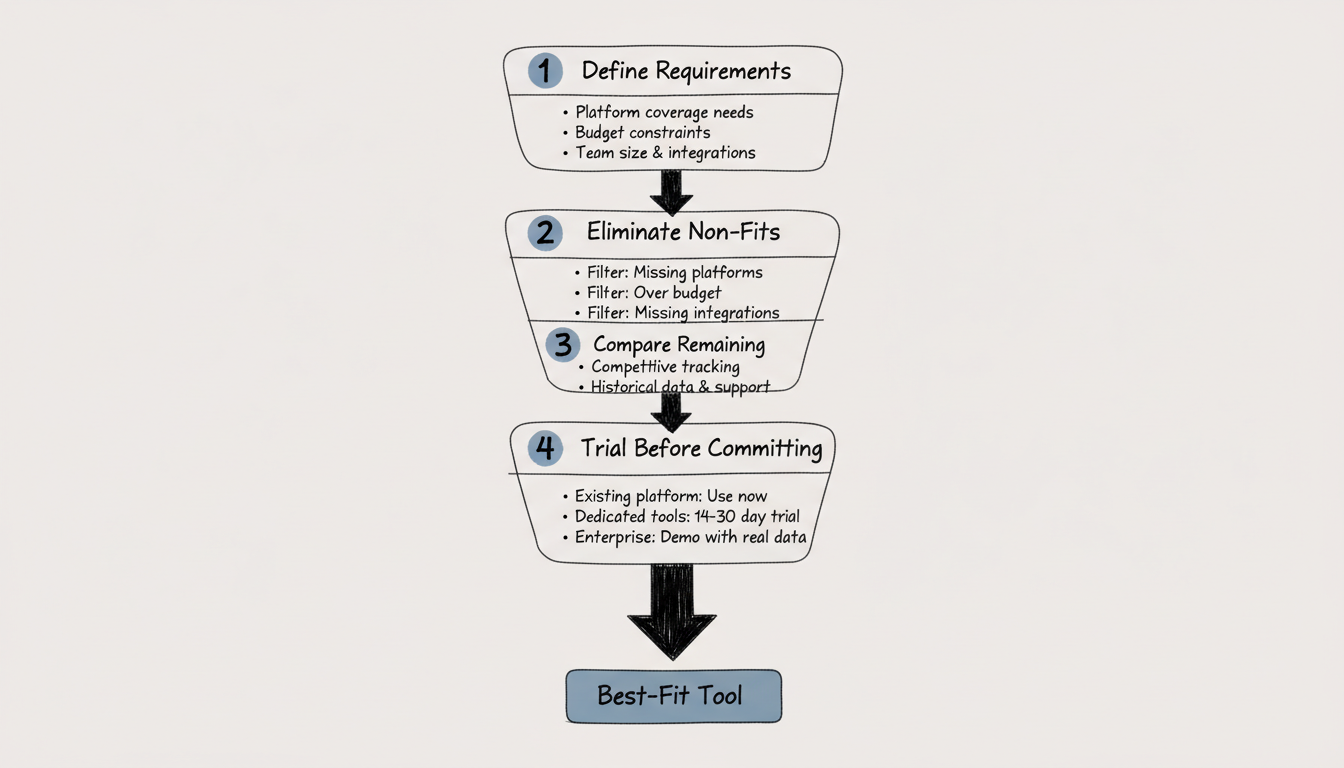
Most teams fail to evaluate AI visibility tools against their actual query volume and platform mix. Define your must-have AI platforms first, then filter by budget — not the other way around.
Step 1: Define Must-Have Requirements
Step 1: Define must-have requirements
Requirement | Questions to Answer |
Platform coverage | Which AI platforms matter for your audience? |
Budget constraints | What's the realistic monthly budget? |
Team size | How many users need access? |
Integration needs | What existing tools must it connect with? |
Data depth | Citation counting vs context analysis? |
Step 2: Eliminate Non-Fits
Step 2: Eliminate non-fits
Filter 1: Platform coverage
└── Remove tools missing critical platforms

Filter 2: Budget
└── Remove tools exceeding budget

Filter 3: Essential integrations
└── Remove tools lacking required connections
Step 3: Compare Remaining Options
Step 3: Compare remaining options
Focus Comparison Areas
Focus comparison on:
Key Comparison Factors
- Depth of citation analysis
- Competitive tracking capabilities
- Historical data availability
- Support and onboarding quality
- Roadmap and development velocity
Step 4: Trial Before Commitment
Step 4: Trial before commitment
Tool Type | Trial Recommendation |
Included in SEO platform | Use existing subscription |
Dedicated AI tools | Request 14-30 day trial |
Enterprise platforms | Schedule demo with real data |
How Stackmatix Helps with AI Search Optimization
Stackmatix combines AI visibility monitoring with structured content optimization to help startups earn citations in ChatGPT, Perplexity, and Google AI Overviews.
Full-Service AI Search Optimization
Stackmatix goes beyond tracking to execute the content and schema changes that earn AI citations.
Choosing the right AI visibility tool is only the first step. Stackmatix AI SEO services help venture-backed startups get cited in AI search results -- not just tracked. Our team combines AI visibility monitoring with structured content optimization, internal linking, and schema implementation to improve your brand's citation rate across ChatGPT, Perplexity, and Google AI Overviews.
Stackmatix AI Search Advantage
Unlike standalone monitoring platforms, Stackmatix provides end-to-end execution: from analyzing which AI platforms cite your competitors to publishing content that earns citations. Get started with Stackmatix to build an AI search optimization strategy alongside your visibility tracking stack.
Key Takeaways
Choosing AI visibility tools:
Selection Checklist
- Platform coverage varies significantly - Verify tools track the AI platforms your audience uses
- Pricing models differ - Some bundle AI features; others charge separately
- Integration depth matters - Enterprise tools offer more connections; specialized tools focus on core features
- Citation depth vs counting - Basic tools count mentions; advanced tools analyze context and sentiment
- Match tool to use case - Startups need different tools than enterprises
- Trial before committing - Request trials or demos with your actual data
- Budget for the full stack - AI visibility often supplements, not replaces, existing SEO tools
The right AI visibility tool depends on your specific requirements, budget, and existing technology stack. Use this AI search tools software comparison as a reference rather than marketing claims to make your decision. Bookmark this AI search tools software comparison and revisit it when your platform needs change. Every AI search tools software comparison should be evaluated against your specific use case, not a generic checklist.
Frequently Asked Questions
Common questions about AI visibility tools, pricing, and platform selection.
What Is the Best AI Visibility Tool?
For most teams: Otterly.AI for startups, Scrunch AI for mid-market, or Profound and Conductor for enterprise depending on budget and compliance needs.
Selecting by Company Size
Match tool selection to team size: Otterly.AI for startups, Scrunch AI for agencies, Profound or Conductor for enterprises with compliance needs.
The best AI visibility tool depends on your team size, budget, and use case. For startups, Otterly.AI offers the most accessible entry point at $79/month with core citation tracking. For mid-market teams, Scrunch AI provides advanced topic clustering and prompt-level detail. Enterprise teams with compliance requirements should evaluate Profound or Conductor, which offer SOC 2 compliance and 12+ months of historical data.
How Do I Track My Brand in AI Search?
Use an AI citation tracking tool to monitor citation frequency across ChatGPT, Perplexity, and Google AI Overviews, then set up branded query tracking for your company name and key products.
Setting Up AI Brand Tracking
Configure brand name, product names, and competitor names as tracked queries within your chosen AI visibility platform.
To track your brand in AI search, use an AI visibility tool that monitors citation frequency across platforms like ChatGPT, Perplexity, and Google AI Overviews. Set up branded query tracking for your company name and key products. The tool will report how often AI systems mention your brand, in what context, and how your share of voice compares to competitors. Start with 10-20 core branded queries and expand as you identify patterns.
Are AI Visibility Tools Worth It?
Yes, especially for B2B companies with high customer lifetime values where a single AI-driven referral can justify months of tool costs.
Calculating AI Visibility ROI
For B2B companies, a single AI-cited lead can exceed monthly tool costs, making ROI calculation straightforward for high-LTV products.
AI visibility tools are worth the investment when AI search drives meaningful discovery for your audience. If your prospects use ChatGPT, Perplexity, or Google AI Overviews to research solutions in your category, you need to know whether those systems recommend you or your competitors. The ROI case is strongest for B2B companies with high customer lifetime values, where a single AI-driven referral can justify months of tool costs.
What Is the Difference Between AI Visibility Tools and AI Search Engines?
AI search engines answer user queries. AI visibility tools (Ahrefs Brand Radar, Scrunch AI, Profound) monitor how those search engines reference your brand.
Search Engines vs Visibility Tools
AI search engines answer user queries; AI visibility tools monitor how those engines cite and reference your brand.
AI search engines (Perplexity, ChatGPT Search, Google AI Mode) are consumer-facing products that answer questions using AI. AI visibility tools (Ahrefs Brand Radar, Scrunch AI, Profound, Otterly.AI) are monitoring platforms that track how those AI search engines reference your brand. Think of it like the difference between Google Search and Google Search Console -- one is the search product, the other is the analytics tool that shows how your content performs within it.
Which AI Visibility Tools Offer Free Trials?
Otterly.AI (14-day free trial), Semrush (7-day trial), and Ahrefs Webmaster Tools (free forever). Enterprise platforms like Profound and Conductor offer demo-only access.
Free Trial Options Detail
Otterly.AI and Semrush offer the most accessible trials; enterprise platforms (Profound, Conductor) require demo-only access with no self-serve trial.
Otterly.AI offers a limited free tier plus a 14-day full-access trial. Semrush provides a 7-day trial that includes its AI visibility features. Ahrefs offers free Webmaster Tools, though Brand Radar requires a paid plan. Enterprise platforms like Profound and Conductor do not offer self-serve trials but provide custom demos with your actual data upon request.
What Is an AI Search Engine?
An AI search engine uses large language models to generate direct answers from multiple sources rather than returning a list of links. ChatGPT Search, Perplexity, and Google AI Mode are leading examples of this shift in how people find information online.
Is Google an AI Search Engine?
Yes. Google AI Overviews now appear on over 30% of informational searches, making Google an AI search engine for most high-intent queries in practice. Traditional link-based results remain alongside these AI-generated summaries.
Is Deep Research AI Search?
Yes. Deep research tools are a specialized subset of AI search that conducts multi-step investigation across many sources, unlike standard single-query AI search responses.
Deep Research vs Standard AI Search
Deep research tools synthesize across dozens of sources autonomously; standard AI search responds to single queries without extended research cycles.
Deep research tools are a specialized subset of AI search. Understanding what is deep research helps contextualize this category: these platforms conduct multi-step investigation across many sources. When choosing the right deep research tool, key metrics include number of sources retrieved, speed and inference time, reliability, and text quality and style. A deep research tools overview reveals significant variation across platforms -- use a standard test setup and document a test summary and key insights before committing to any platform.