
The shift to AI-powered search has created measurable winners and losers in digital marketing. This article examines documented AI SEO case studies from 2026, revealing the strategies that delivered traffic growth, citation increases, and revenue gains.
According to DemandSage's 2026 AI SEO statistics, AI-driven SEO campaigns produce a 45% increase in organic traffic and a 38% rise in e-commerce conversions on average. These aggregate numbers tell only part of the story - individual case studies reveal far more dramatic results.
Case Study 1: E-Commerce Traffic Revival
The Challenge
An e-commerce business experienced declining organic traffic as AI Overviews captured clicks that previously went to their product pages. Traditional SEO rankings remained stable, but traffic continued falling.
The Strategy
Growth.pro documented how their AI Citation Engineering approach addressed this challenge through:
- Structured data optimization: Implementing comprehensive Product, Review, and FAQ schema
- Answer-first content: Restructuring product descriptions to lead with direct answers
- Cross-platform presence: Building citations across review sites and industry publications
The Results
- 472% traffic growth through AI search channels
- 1,340% increase in ChatGPT-referred traffic
- 472% more orders attributed to AI search visibility
The key insight: as traditional organic clicks declined, AI-referred traffic more than compensated when properly optimized.
Case Study 2: Multi-Platform Content Strategy
The Challenge
A retail brand saw fragmented visibility across different AI platforms - appearing in some ChatGPT responses but absent from Perplexity and Google AI Overviews.
The Strategy
The team implemented a multimodal content strategy targeting all major AI search platforms:
- Platform-specific optimization: Tailoring content format for each AI system's preferences
- Visual search integration: Adding image optimization for Bing and Google visual search
- Authority signal building: Earning citations across Reddit, YouTube, and industry forums
The Results
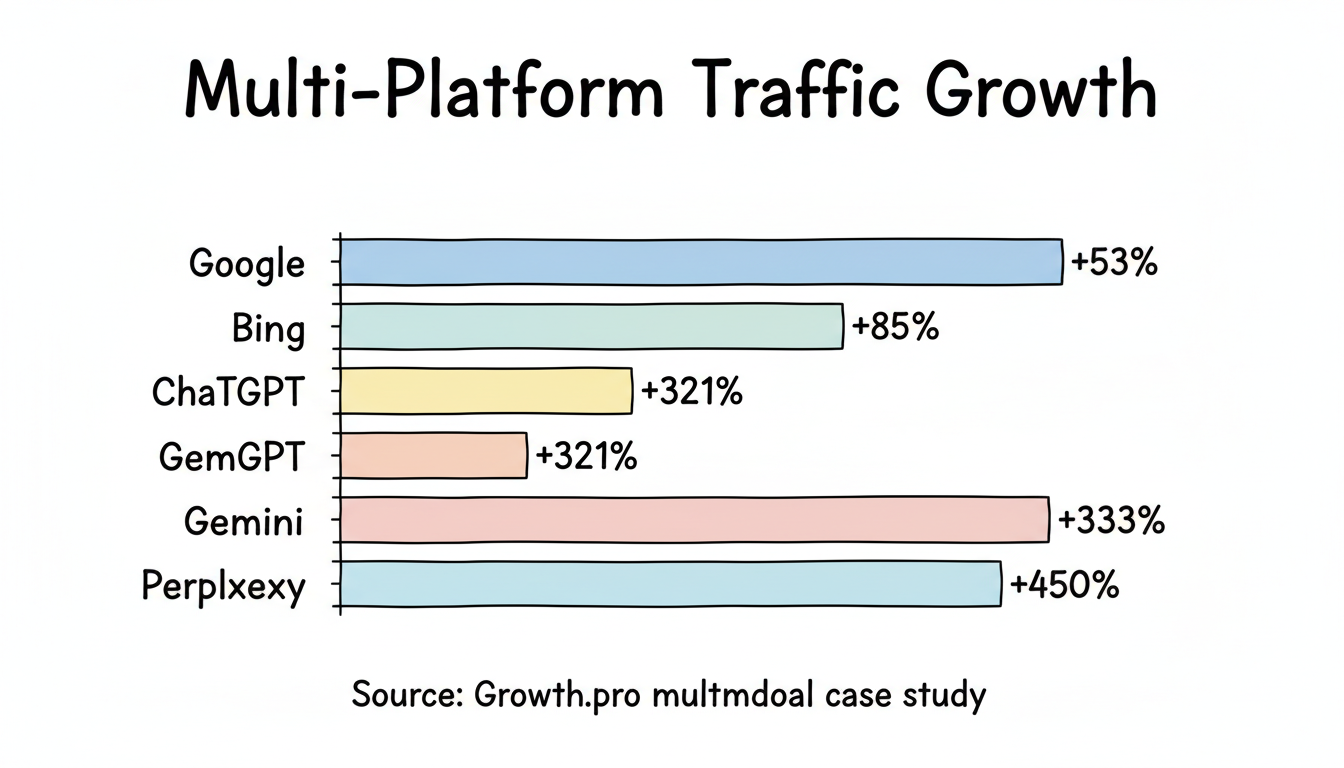
According to Growth.pro's multimodal case study:
- 53% more clicks on Google
- 85% growth on Bing
- 321% increase on ChatGPT
- 333% increase on Gemini
- 450% increase on Perplexity
The data confirms that AI search optimization requires multi-platform thinking, not single-channel focus.
Case Study 3: B2B Lead Generation
The Challenge
A B2B software company found that AI Overviews appeared on 25% of their target informational queries, according to The Ad Firm's 2026 analysis. Prospects researching solutions encountered AI summaries before reaching vendor websites.
The Strategy
The company restructured their content strategy around citation-worthiness:
- Original research publication: Releasing quarterly industry reports with unique data
- Expert positioning: Publishing thought leadership with named authors and credentials
- Schema implementation: Marking up all content with Article, Organization, and FAQ schema
The Results
- 527% increase in AI search traffic
- 35%+ CTR increase for pages cited in AI Overviews
- 91% higher paid CTR for brands mentioned in AI responses
This case demonstrates that B2B companies can leverage AI search visibility to capture high-intent prospects earlier in the research process.
Industry-Wide Performance Data
Beyond individual case studies, aggregate data reveals consistent patterns across AI SEO implementations.
Enterprise Adoption Results
According to DemandSage's 2026 research:
- 83% of large organizations report measurable SEO gains from AI integration
- Only 6.22% saw no improvement from AI SEO implementation
- 68% report increased content marketing ROI directly attributable to AI
Citation Impact on Performance
Semrush's analysis of 10 million keywords found:
- Sites cited in AI Overviews see 35%+ CTR increases
- AI Overviews now appear on approximately 16% of all queries after stabilization
- Multi-platform content strategies capture visibility across the fragmented search landscape
Common Success Factors
Analyzing these case studies reveals consistent elements across successful AI SEO campaigns:
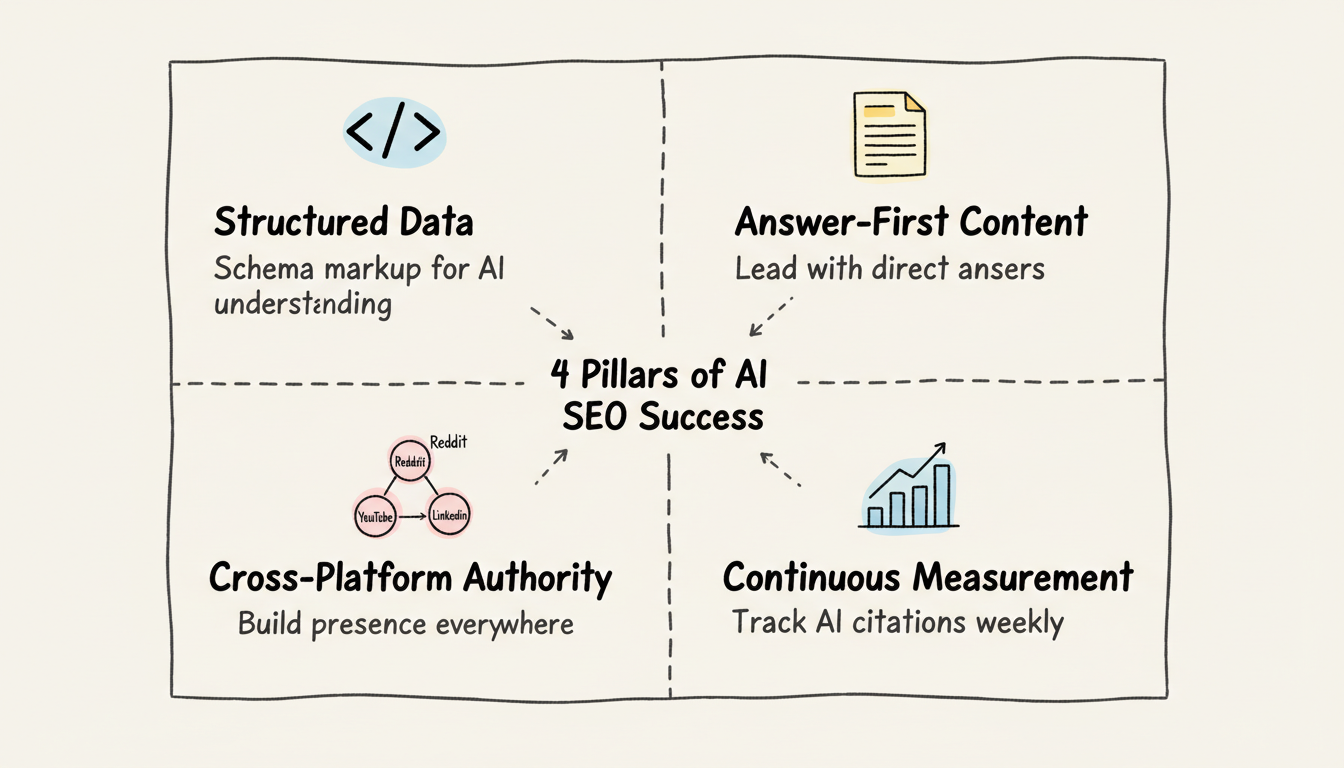
1. Structured Data Implementation
Every successful case study featured comprehensive schema markup. JSON-LD formatted structured data helps AI systems understand and cite content correctly.
2. Answer-First Content Architecture
Content that leads with direct, concise answers to specific questions consistently outperformed traditional SEO content in AI visibility.
3. Cross-Platform Authority Building
Success required presence across multiple platforms - not just website optimization but active engagement on Reddit, YouTube, LinkedIn, and industry-specific communities.
4. Continuous Measurement and Iteration
Top performers tracked AI citations weekly, monitoring which content earned mentions and adjusting strategy based on data.
Lessons for Implementation
These case studies offer actionable guidance for businesses beginning their AI SEO journey:
Start with technical foundation: Schema markup and site structure must be in place before content optimization can deliver results.
Focus on citation-worthy content: Original research, expert quotes, and specific statistics earn citations. Generic content does not.
Think multi-platform: AI systems pull from diverse sources. Building authority across platforms creates compounding visibility.
Measure AI-specific metrics: Track brand citations, share of voice in AI responses, and referral quality from AI platforms - not just traditional rankings.
How to Start an AI SEO Case Study Program
Brands that produced the results above did not guess; they instrumented before they optimized. Begin by claiming your brand's presence in the AI engines you care about: test the same set of target queries in ChatGPT, Gemini, Perplexity, and Google AI Overviews weekly, and record whether your domain appears and in what position. The baseline is the measurement that makes every later change attributable, and without it you cannot tell a real gain from seasonal noise. A simple spreadsheet of query, engine, cited-or-not, and snippet text is enough to start.
Next, pick three to five pages that already rank for high-intent queries and treat them as the pilot cohort. Add the schema the case studies credit, restructure the intros to lead with the direct answer, and earn one external citation per page from a forum or publication the engines already trust. Re-test the cohort after four weeks and compare against the baseline. The program compounds: each validated tactic rolls out to the next cohort, and the citation footprint that made the 300-500% cases possible builds one page at a time rather than all at once.
Mistakes That Sank the Failed Minority
The 6.22% of organizations that saw no improvement from AI SEO shared predictable failures. The first was chasing rankings instead of citations: optimizing for blue links while ignoring whether the engines quoted the content. The second was thin content dressed in schema; markup on a 300-word page does not make it citation-worthy. The third was single-platform focus, so a brand invisible on Perplexity counted its Google wins as victory while a third of its audience moved elsewhere. Each mistake is avoidable by measuring citations directly and writing the answer the engine would quote, not the page that would rank.
Measuring What the Engines Actually Quote
Vanity dashboards hide the real signal. The metric that matters is whether your domain appears in the answer when a high-intent query is asked, not your traditional rank for that keyword. Track share of cited answers across the four engines weekly, and weight the ones tied to revenue pages over informational ones. A brand that owns the answer on three of four engines for its money queries has more durable visibility than one ranking position two on Google alone, because the citation travels with the user into the chat interface where the next decade of search is happening.
Conclusion
The case studies from 2026 demonstrate that AI SEO delivers measurable business results when implemented systematically. Traffic increases of 300-500% are achievable, but they require strategic focus on what makes content citation-worthy across AI platforms.
The brands succeeding in AI search share a common characteristic: they've become so authoritative on their topics that AI systems cannot provide quality answers without referencing them.