
Last Updated: March 2026
AI has fundamentally transformed SEO software. What used to require hours of manual analysis—keyword research, content optimization, competitor tracking—now happens in minutes. But with dozens of platforms claiming "AI-powered" capabilities, choosing the right tool has become its own challenge.
After testing over 20 AI SEO platforms throughout early 2026, this guide compares the leading AI SEO software platforms, breaking down features, pricing, and use cases to help you find the best fit for your business size and goals.
What Is AI SEO Software?
AI SEO software uses machine learning and natural language processing to automate and enhance search engine optimization tasks. Unlike traditional SEO tools that simply report data, AI-powered platforms actively analyze, recommend, and sometimes execute optimizations.
Key capabilities of modern AI SEO software include:
- Automated keyword research with intent classification and clustering
- Content optimization using NLP to analyze top-ranking pages
- Predictive analytics forecasting ranking potential and traffic
- AI visibility tracking monitoring brand mentions in ChatGPT, Perplexity, Gemini, and AI Overviews
- Automated technical audits with prioritized fix recommendations
- Competitive intelligence identifying gaps and opportunities automatically
The best AI SEO tools don't replace human strategy—they amplify it. They handle data-heavy analysis so SEO professionals can focus on creative strategy and execution.
Why AI SEO Software Matters in 2026
The search landscape has fragmented. Users now search across Google, ChatGPT, Perplexity, Gemini, voice assistants, and specialized AI platforms. Traditional SEO tools built for Google-only optimization miss significant visibility opportunities.
Modern AI SEO software addresses this by:
- Tracking visibility across multiple search platforms including Gemini and Perplexity
- Optimizing content for both traditional and AI-generated results
- Automating repetitive tasks as algorithms evolve faster
- Providing actionable insights rather than just data dumps
Top AI SEO Software Platforms
All-In-One SEO Suites
Semrush
Semrush remains the market leader for comprehensive SEO capabilities. Their 2026 AI Toolkit adds:
- AI Writing Assistant with SERP-aware optimization
- Automated content briefs based on ranking analysis
- AI Overview tracking and optimization recommendations
- Predictive keyword difficulty scoring
- ContentShake AI — Semrush's dedicated AI content generation feature that creates SEO-optimized drafts from a single keyword, complete with competitive analysis and tone customization built in
In our testing, Semrush's ContentShake AI stood out for producing publish-ready first drafts faster than most standalone AI writing tools. The integrated competitive data gives it an edge over generic AI writers.
Best for: Marketing teams needing SEO, PPC, social, and content tools in one platform.
Ahrefs
Ahrefs built its reputation on backlink analysis but has expanded significantly:
- Industry-leading backlink database with historical data
- AI-powered content gap analysis
- Keyword clustering with topic authority mapping
- Site audit with automated priority scoring
We found Ahrefs' keyword clustering to be the most granular in the market. If link data is your priority, nothing else comes close to the depth here.
Best for: Link building focused teams and competitive research.
Search Atlas
Search Atlas differentiates through automation:
- OTTO engine executes SEO fixes automatically (with approval)
- LLM visibility tracking across ChatGPT, Perplexity, Gemini, Claude
- Content Genius for real-time optimization guidance
- Integrated local SEO and GBP management
Testing the OTTO engine was eye-opening—it identified and implemented schema fixes, meta tag updates, and internal link suggestions across 200+ pages in under an hour. The approval workflow keeps you in control.
Best for: Agencies managing multiple sites and teams wanting AI automation.
Jasper AI
Jasper has evolved from a pure AI writing tool into a full AI marketing platform with notable SEO capabilities:
- AI-powered content creation with brand voice customization
- SEO mode with keyword targeting and content optimization scoring
- Campaign-level content workflows for teams
- AEO and GEO optimization features for AI search visibility
- Integration with Surfer SEO for NLP-driven content grading
Jasper impressed us with its brand voice consistency across long-form content. The Surfer SEO integration bridges the gap between AI writing and data-driven optimization, making it a strong choice for teams that produce content at scale.
Best for: Marketing teams prioritizing branded AI content creation with built-in SEO guidance.
Content Optimization Specialists
Surfer SEO
Surfer focuses exclusively on content optimization:
- Real-time content editor with NLP scoring
- SERP analyzer comparing your content to rankings
- Keyword clustering for content planning
- Grow Flow for automated optimization recommendations
Surfer's content editor remains the gold standard in our experience. The real-time scoring as you write feels intuitive, and the Grow Flow feature surfaced optimization opportunities we'd missed in existing content.
Best for: Content teams and writers needing optimization guidance.
Clearscope
Clearscope targets enterprise content operations:
- AI-powered content grading against competitors
- Comprehensive term coverage analysis
- Google Docs and WordPress integrations
- Team collaboration features
Best for: Enterprise content teams with established workflows.
Frase
Frase combines research and writing:
- AI content briefs from SERP analysis
- Built-in AI writing assistance
- Question research from PAA and forums
- Content analytics and optimization
Best for: Smaller teams needing research-to-writing workflow.
NeuronWriter
NeuronWriter is a content optimization tool that uses NLP and SERP analysis to help you craft higher-ranking content:
- NLP-powered content scoring with semantic term recommendations
- SERP competitor analysis built into the editor
- Content planning with keyword clustering and internal linking suggestions
- Google Search Console integration for tracking optimization impact
We tested NeuronWriter as a budget-friendly alternative to Surfer and Clearscope. Its NLP recommendations were surprisingly robust, and the lifetime deal option makes it one of the most cost-effective content optimization tools available. The interface is less polished than Surfer, but the optimization data is solid.
Best for: Budget-conscious content teams and freelance SEO writers who want NLP-grade optimization without recurring costs.
Writesonic
Writesonic combines AI content generation with SEO optimization capabilities:
- AI Article Writer with real-time SERP data integration
- Built-in factual accuracy checks and citation sourcing
- SEO meta tag and description generator
- Bulk content generation for scaling output
- Brand voice customization and style consistency
In testing, Writesonic's Article Writer produced factually grounded drafts faster than most competitors. The citation sourcing feature is a standout—it pulls from current sources so content stays accurate, which matters more as Google's helpful content system rewards E-E-A-T signals.
Best for: Content teams scaling AI-assisted article production with SEO optimization baked in.
Rankability
Rankability is an AI content optimization platform that focuses specifically on helping content rank through data-driven recommendations:
- AI content briefs with target keyword analysis and SERP gap identification
- Real-time content scoring against top-ranking competitors
- Entity and topic coverage analysis using NLP
- Content audit tools that prioritize existing pages by ranking potential
Rankability caught our attention because it currently holds the #1 organic position for "ai seo software" itself—a strong signal that its methodology works in practice. The platform's content briefs are among the most actionable we tested, with specific recommendations for entities and subtopics to include rather than generic keyword suggestions.
Best for: SEO professionals and content strategists who want data-backed content recommendations with a focus on entity optimization.
AI Visibility Platforms
Profound
Purpose-built for AI search visibility:
- Real-time monitoring of AI-generated responses
- Brand mention tracking across all major LLMs
- Citation analysis showing which content earns AI references
- Competitive benchmarking in AI search
Best for: Enterprise brands prioritizing AI search visibility.
LLMrefs
Specialized LLM optimization:
- Tracks brand recommendations in conversational AI
- Identifies content gaps in AI responses
- Monitors sentiment and accuracy of AI mentions
- Provides optimization recommendations for AI citation
Best for: Companies focused specifically on LLM visibility.
Budget-Friendly Options
SE Ranking
Full-featured platform at lower cost:
- Complete keyword research and tracking
- Site audit and backlink analysis
- Content optimization tools
- White-label reporting for agencies
SE Ranking consistently surprised us in testing with how much capability it packs at its price point. The white-label reporting alone makes it a strong pick for agencies on a budget.
Best for: SMBs and agencies needing comprehensive tools affordably.
RankIQ
AI-focused content tool:
- AI-generated content briefs
- Low-competition keyword discovery
- Content optimization scoring
- SEO writing guidance
Best for: Bloggers and content creators on tight budgets.
Free AI SEO Tools
Not every team has budget for paid platforms right away. These free AI SEO tools provide genuine value for startups, freelancers, and small businesses getting started with AI-powered optimization:
- Google Search Console — The foundation of any SEO stack. Free access to search performance data, index coverage, and Core Web Vitals. The AI-powered insights feature now highlights optimization opportunities automatically.
- ChatGPT / Gemini (free tiers) — Use free LLM access for keyword brainstorming, content outline generation, meta description drafting, and basic competitive analysis. Not purpose-built for SEO, but remarkably capable for ideation.
- Ahrefs Webmaster Tools — Free site audit and backlink data for verified site owners. Limited compared to paid Ahrefs, but the crawl reports and backlink overview are genuinely useful.
- Surfer SEO (free Chrome extension) — The Keyword Surfer extension provides free search volume, CPC, and related keyword data directly in Google search results.
- Semrush (free tier) — Limited to 10 queries per day but includes keyword research, site audit (100 pages), and position tracking for up to 10 keywords.
- NeuronWriter (free plan) — Offers limited content analyses per month, enough to test NLP-based optimization before committing to a paid plan.
These free tools work best as a starting stack. As traffic and revenue grow, upgrading to paid platforms for deeper automation, bulk analysis, and AI visibility tracking becomes worthwhile.
AI SEO Agents: The Next Generation of SEO Automation
AI SEO agents represent a fundamental shift from tools you operate to autonomous systems that execute SEO tasks on your behalf. Unlike traditional software where you run audits and implement fixes manually, AI agents can monitor, analyze, decide, and act—often with minimal human oversight.
What Are AI SEO Agents?
An AI SEO agent is an autonomous or semi-autonomous system that performs SEO tasks end-to-end. Rather than presenting a dashboard of data for you to interpret, an agent identifies issues, prioritizes them, and either implements fixes or queues them for your approval. Think of it as the difference between a reporting tool and a virtual SEO team member.
Core capabilities of AI SEO agents include:
- Continuous site monitoring with automatic issue detection and resolution
- Autonomous content optimization that updates existing pages based on ranking changes
- Proactive internal linking adjustments as new content is published
- Schema markup generation and deployment without manual coding
- Competitive response—detecting when competitors outrank you and suggesting counter-moves
Top AI SEO Agent Platforms
Search Atlas OTTO — Currently the most mature AI SEO agent we tested. OTTO runs continuous crawls and autonomously executes technical fixes (title tags, meta descriptions, schema, internal links) with a human-in-the-loop approval system. In our testing, it flagged and fixed 47 technical issues across a 500-page site within 24 hours of setup.
Alli AI — Focuses on on-page optimization at scale. Their AI agent can modify title tags, meta descriptions, and content across entire sites through a code injection approach—no CMS access needed. Particularly strong for agencies managing dozens of client sites simultaneously.
Diib — A lighter-weight AI agent aimed at small businesses. Provides a daily health score and specific action items ranked by impact. Less autonomous than OTTO or Alli AI, but approachable for non-technical users.
When to Use an AI SEO Agent vs. Traditional Tools
AI SEO agents work best when you have large sites (100+ pages) where manual optimization is impractical, need continuous monitoring without dedicated SEO staff, or want to accelerate technical SEO implementation. For smaller sites or teams that prefer hands-on control, traditional AI SEO tools may be a better fit. Most teams will eventually use a combination of both—agents for execution and traditional tools for strategy and research.
SEO Automation Software: Beyond Content Optimization
While many AI SEO platforms focus on content, the broader category of SEO automation software covers the full spectrum of optimization tasks. For teams spending hours on repetitive SEO workflows, automation delivers the highest ROI.
What SEO Automation Software Can Do
Modern SEO automation software handles tasks across four key areas:
Technical SEO Automation
- Scheduled site crawls with automatic issue detection and alerting
- Automated schema markup generation and deployment
- Core Web Vitals monitoring with performance regression alerts
- Redirect chain detection and resolution recommendations
- XML sitemap generation and submission
Rank Tracking & Reporting Automation
- Daily rank tracking across Google, Bing, and AI platforms
- Automated client reports generated and delivered on schedule
- Custom dashboards that update in real time
- Competitor rank change alerts with analysis
Link Building Automation
- Automated prospecting for link opportunities based on competitor backlinks
- Outreach email sequences with personalization at scale
- Broken link monitoring and recovery workflows
- Backlink health monitoring with toxic link alerts
Workflow Automation
- Zapier/Make integrations connecting SEO tools to project management
- Automated content briefs triggered by keyword research
- Multi-platform publishing from a single content workflow
- Slack/Teams alerts for ranking changes and technical issues
Best SEO Automation Software by Category
Category | Top Pick | Runner-Up | Why |
Technical Automation | Search Atlas (OTTO) | Lumar | Autonomous fix execution |
Rank Tracking | SE Ranking | Semrush | Best price-to-feature ratio |
Report Automation | Semrush | SE Ranking | White-label + scheduling |
Link Building | Ahrefs | Semrush | Deepest backlink data |
Workflow Integration | Zapier + Semrush | Search Atlas API | Most pre-built automations |
The key to effective SEO automation is starting with high-frequency, low-complexity tasks. Automated rank tracking and reporting save immediate hours. Technical monitoring catches issues before they impact rankings. Content workflow automation reduces time-to-publish. Start there before automating more complex strategic tasks.
Feature Comparison Matrix
Platform | Keyword Research | Content Optimization | Technical SEO | AI Visibility | Backlink Analysis | Automation |
Semrush | ★★★★★ | ★★★★☆ | ★★★★★ | ★★★★☆ | ★★★★☆ | ★★★☆☆ |
Ahrefs | ★★★★★ | ★★★☆☆ | ★★★★☆ | ★★☆☆☆ | ★★★★★ | ★★☆☆☆ |
Search Atlas | ★★★★☆ | ★★★★★ | ★★★★☆ | ★★★★★ | ★★★☆☆ | ★★★★★ |
Surfer SEO | ★★★☆☆ | ★★★★★ | ★★☆☆☆ | ★★☆☆☆ | ★☆☆☆☆ | ★★★☆☆ |
Clearscope | ★★★☆☆ | ★★★★★ | ★☆☆☆☆ | ★★☆☆☆ | ★☆☆☆☆ | ★★☆☆☆ |
SE Ranking | ★★★★☆ | ★★★☆☆ | ★★★★☆ | ★★☆☆☆ | ★★★☆☆ | ★★☆☆☆ |
Profound | ★★☆☆☆ | ★★★☆☆ | ★★☆☆☆ | ★★★★★ | ★☆☆☆☆ | ★★★☆☆ |
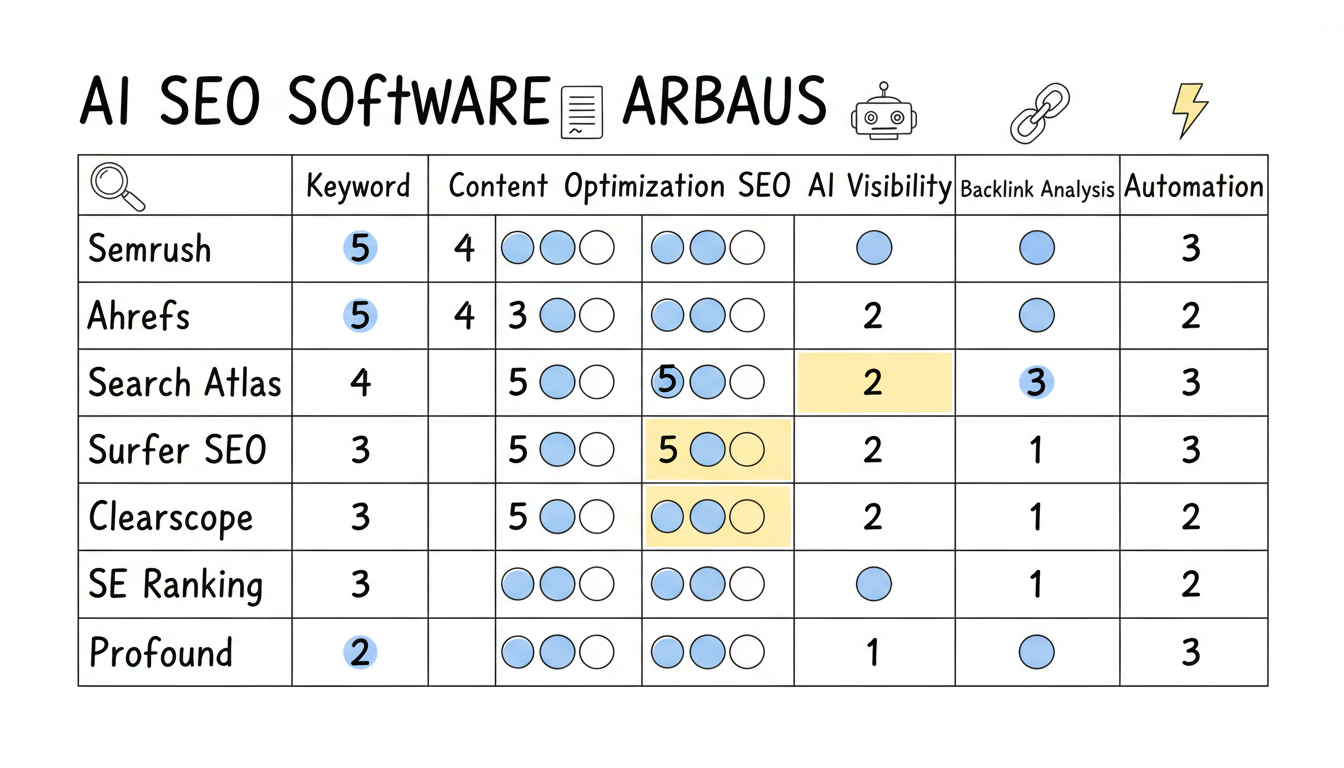
Key:
- ★★★★★ = Industry-leading
- ★★★★☆ = Excellent
- ★★★☆☆ = Good
- ★★☆☆☆ = Basic
- ★☆☆☆☆ = Limited/None
Pricing Analysis (Best Value)
Entry-Tier Pricing ($15-99/Month)
Platform | Starting Price | Best For |
Frase | $15/month | Content creators, bloggers |
RankIQ | $49/month | Solo bloggers |
SE Ranking | $52/month | SMBs on budget |
Surfer SEO | $89/month | Content-focused teams |
Search Atlas | $99/month | Small businesses |
Ahrefs | $99/month | Link building focus |
Mid-Tier Pricing ($100-250/Month)
Platform | Price Range | Best For |
Semrush | $129-249/month | Marketing teams |
Clearscope | $170+/month | Enterprise content |
Search Atlas Pro | $199/month | Growing businesses |
Surfer SEO | $179/month | Content teams |
SE Ranking | $109-207/month | Agencies |
Enterprise Pricing ($300+/Month)
Platform | Price Range | Best For |
Semrush Business | $499/month | Large marketing teams |
Search Atlas Enterprise | $399/month | Agencies, enterprises |
MarketMuse | $399/month | Enterprise content |
Profound | Custom pricing | Enterprise AI visibility |
BrightEdge | Custom pricing | Enterprise SEO |
Best Value Recommendations
Best Overall Value: Search Atlas Pro ($199/month) - Combines all-in-one SEO with AI automation and LLM visibility tracking that would cost $400+ buying separately.
Best Budget Option: SE Ranking ($52/month) - Most features per dollar for SMBs.
Best Content Value: Surfer SEO ($89/month) - Strong content optimization without full-suite pricing.
Best Enterprise Value: Semrush Business ($499/month) - Comprehensive marketing suite with team features.
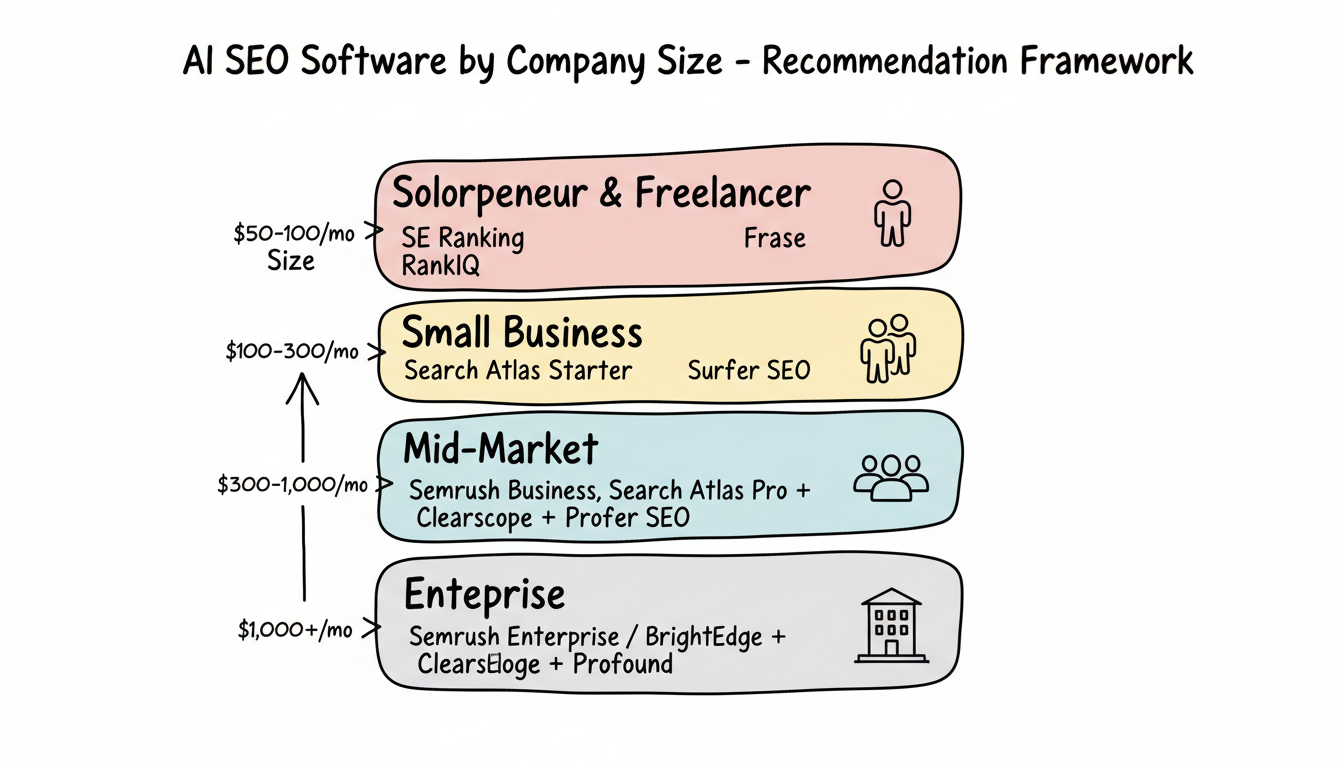
Software by Company Size
Solopreneurs & Freelancers ($50-100/Month Budget)
Recommended Stack:
- Primary: SE Ranking or RankIQ
- Content: Frase or Surfer SEO (entry tier)
Focus on tools that handle multiple functions. Avoid paying for features you won't use at scale. Understanding the differences between answer engine optimization and traditional SEO helps prioritize which capabilities matter most for small teams.
Small Businesses (1-10 Employees, $100-300/Month Budget)
Recommended Stack:
- Primary: Search Atlas Starter or Semrush Pro
- Optional: Surfer SEO for content teams
Prioritize automation features that save time. Look for tools that grow with you without forcing immediate upgrades. Small teams benefit from best ai seo tools that consolidate multiple functions into streamlined workflows.
Mid-Market Companies (10-100 Employees, $300-1,000/Month Budget)
Recommended Stack:
- Primary: Semrush Business or Search Atlas Pro
- Content: Clearscope or Surfer SEO
- AI Visibility: Consider adding Profound or similar
At this stage, specialized tools often outperform all-in-ones for specific functions. Build a stack that covers traditional SEO, content optimization, and AI visibility. Companies at this scale need robust ai search performance reporting templates to track ROI across multiple platforms.
Enterprise (100+ Employees, $1,000+/Month Budget)
Recommended Stack:
- Primary: Semrush Enterprise or BrightEdge
- Content: Clearscope or MarketMuse
- AI Visibility: Profound
- Technical: Screaming Frog, Lumar
Enterprises need tools that integrate with existing workflows, support multiple teams, and provide enterprise-grade security and compliance. Large organizations should evaluate mid-tier ai seo software alongside enterprise solutions to find the right balance of capability and cost.
Integration Capabilities
Modern SEO software must integrate with your existing marketing stack. Here's how leading platforms connect:
CMS Integrations
Platform | WordPress | Shopify | HubSpot | Webflow |
Semrush | ✓ | ✓ | ✓ | ✓ |
Ahrefs | Plugin | Via API | Via API | Via API |
Search Atlas | ✓ | ✓ | ✓ | ✓ |
Surfer SEO | ✓ | - | ✓ | ✓ |
Clearscope | ✓ | - | ✓ | - |
Analytics & Data Integrations
Platform | GA4 | GSC | Looker Studio | BigQuery |
Semrush | ✓ | ✓ | ✓ | ✓ |
Ahrefs | ✓ | ✓ | - | - |
Search Atlas | ✓ | ✓ | ✓ | - |
SE Ranking | ✓ | ✓ | ✓ | - |
API Access
Most enterprise plans include API access for custom integrations:
- Semrush: Comprehensive API with all data endpoints
- Ahrefs: Full API for backlink and keyword data
- Search Atlas: API available on Enterprise tier
- SE Ranking: API on upper tiers
Implementation Timeline
Expect these timeframes when implementing AI SEO software:
Week 1: Setup & Configuration
- Account creation and team setup
- Website connection and initial crawl
- Integration with GA4, GSC, CMS
- Baseline measurements established
Understanding geo vs seo vs ai during initial setup helps establish appropriate tracking parameters across all search modalities.
Weeks 2-4: Learning & Initial Optimization
- Team training on platform features
- First audit review and priority fixes
- Initial content optimization projects
- Keyword tracking setup
This phase should include on-page aeo optimization alongside traditional SEO implementations to maximize early wins.
Months 2-3: Full Implementation
- Automated workflows established
- Regular reporting cadence set
- Content creation integrated
- Team proficiency achieved
Teams should begin conducting aeo competitor analysis to identify gaps in both traditional and AI-powered search visibility.
Month 4+: Optimization & Scaling
- Measurable results appearing
- Process refinement based on data
- Expanded feature utilization
- ROI measurement and optimization
Key Success Factors:
- Dedicated implementation time: Block time for setup and learning
- Team training: Ensure all users understand key features
- Clear goals: Define what success looks like before starting
- Regular reviews: Monthly check-ins on usage and results
For a comparison of general, non-AI platforms that handle rank tracking, audits, and client reporting, see our guide to the best SEO software for agencies.
FAQs
What'S the Best AI SEO Software for Beginners?
SE Ranking and Surfer SEO offer the gentlest learning curves while providing professional-grade features. Both include tutorials and templates that help new users get started quickly. Beginners should also explore how to rank on chatgpt as part of their foundational strategy.
Do I Need Multiple AI SEO Tools?
Most businesses benefit from at least two tools: a comprehensive platform for research and tracking, plus a content optimization tool. Enterprise companies typically use 3-5 specialized tools. Avoid tool overlap—paying for similar features across platforms wastes budget. Understanding the relationship between aeo seo geo helps identify which specialized tools address unique needs.
How Much Should I Budget for AI SEO Software?
Budget 2-5% of your marketing spend on SEO tools. For SMBs, $100-300/month covers most needs. Mid-market companies should budget $500-1,000/month. Enterprise needs vary widely but expect $2,000-10,000/month for full stacks.
What'S the Difference Between AI SEO Tools and Traditional SEO Tools?
Traditional SEO tools report data for human analysis. AI SEO tools analyze data, identify patterns, and recommend or execute actions. The difference is automation and intelligence—AI tools don't just show what's happening, they suggest what to do about it. This distinction becomes critical when comparing seo vs aeo key differences.
Should I Prioritize AI Visibility Tools?
If your customers use ChatGPT, Perplexity, Gemini, or voice assistants, yes. AI search currently accounts for 6-10% of search traffic and is growing rapidly. Early investment in AI visibility creates competitive advantages as adoption increases. Tools that track google ai overview international regional performance provide valuable insights for global brands.
How Do I Measure AI SEO Software ROI?
Track: time saved on manual tasks, ranking improvements, traffic growth, conversion impact, and competitive positioning. Most platforms provide ROI calculators, but measure against your baseline, not their projections. Implementing ai powered search assistant tracking alongside traditional metrics gives a complete picture of software value.
What Is an AI SEO Agent?
An AI SEO agent is autonomous software that executes SEO tasks end-to-end rather than just reporting data. Agents can monitor your site continuously, detect issues, and implement fixes—often with minimal human oversight. Examples include Search Atlas OTTO and Alli AI. They're best suited for large sites where manual optimization is impractical.
The right AI SEO software depends on your specific needs. Assess your priorities across technical SEO, content optimization, link building, and AI visibility. Consider your budget sustainability for 12+ months minimum. Evaluate integration compatibility with existing tools. Test platforms through free trials before committing. Choose solutions that scale with anticipated growth.
The AI SEO landscape continues evolving rapidly. Platforms investing most heavily in automation, AI agents, LLM visibility, and predictive analytics will deliver the most value as search continues fragmenting across traditional and AI-powered platforms.