
Amazon PPC advertising has become essential for sellers looking to compete on the world's largest e-commerce platform. With over 70% of Amazon sellers now using Amazon Ads and competition intensifying every year, working with a specialized Amazon PPC agency can mean the difference between profitable growth and wasted ad spend.
This guide covers everything you need to know about Amazon PPC agency services—from what agencies actually do and how much they cost to key metrics like ACoS and TACoS that determine campaign success.
Why Amazon Sellers Need PPC in 2026
Organic visibility on Amazon is increasingly difficult to achieve. The algorithm favors products with strong sales velocity, which creates a chicken-and-egg problem: you need sales to rank, but you need visibility to get sales. Amazon PPC bridges this gap.
Key reasons Amazon PPC is essential:
- Immediate visibility: Appear at the top of search results while building organic rank
- Sales velocity: Paid sales contribute to organic ranking improvements
- New product launches: The only reliable way to get initial traction
- Competitive defense: Protect your brand from competitors bidding on your keywords
- Data insights: Search term reports reveal exactly what customers are searching for
According to industry data, Amazon advertising revenue exceeded $56 billion in 2025 and is projected to surpass $65 billion in 2026, reflecting how central PPC has become to seller success. Sellers who don't advertise are essentially invisible on many competitive search terms, much like businesses that lack a comprehensive PPC advertising strategy across other platforms.
Amazon PPC vs Microsoft/Google Ads
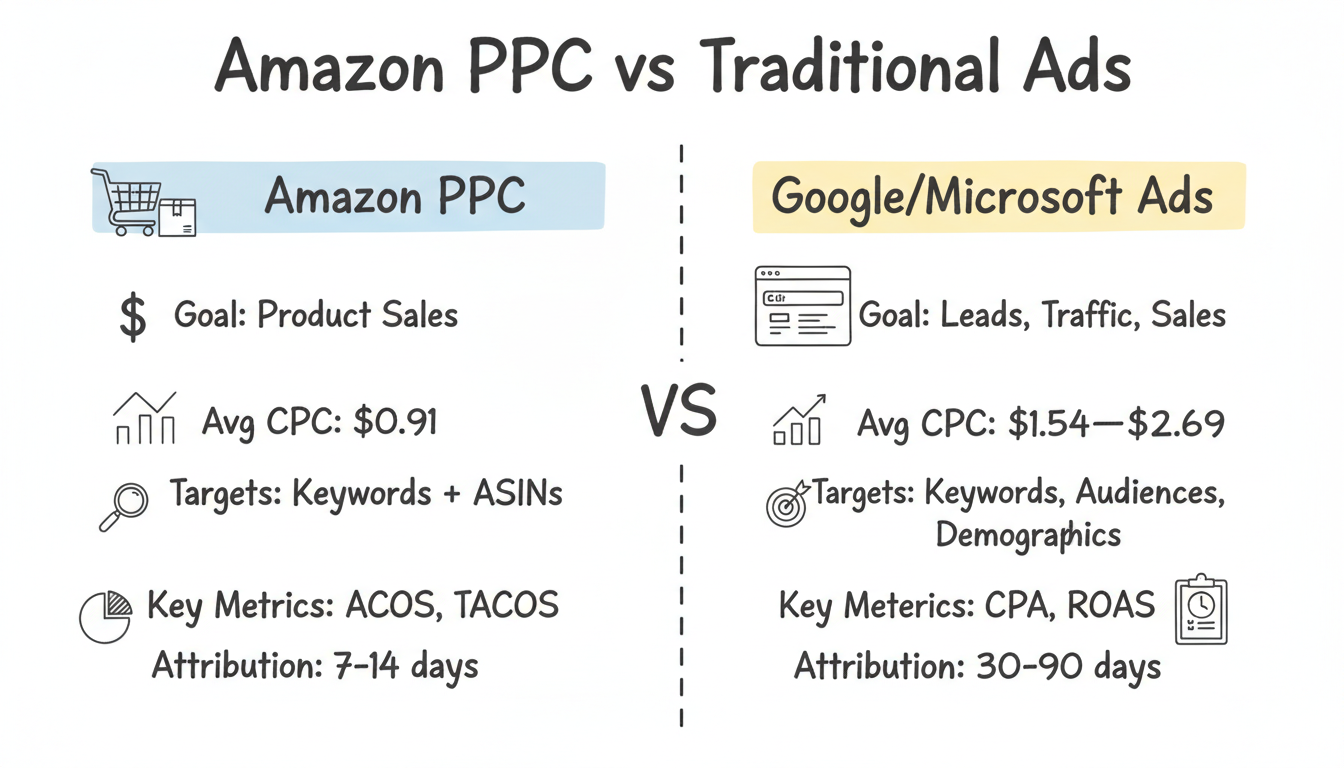
While the fundamentals of PPC apply across platforms, Amazon advertising has unique characteristics that require specialized expertise.
Feature | Amazon PPC | Microsoft/Google Ads |
Primary goal | Product sales | Leads, traffic, sales |
Average CPC | $0.91 | $1.54 - $2.69 |
Targeting basis | Product keywords, ASINs | Keywords, audiences, demographics |
Conversion tracking | Automatic (Amazon sales) | Requires setup |
Attribution window | 7-14 days typical | 30-90 days typical |
Key metrics | ACoS, TACoS, ROAS | CPA, ROAS |
Why Amazon PPC requires specialized skills:
- Catalog integration: Campaigns must align with inventory, pricing, and listing optimization
- Organic-paid relationship: PPC strategy directly impacts organic rankings
- Amazon algorithm knowledge: Understanding A10 algorithm factors
- Competitive dynamics: ASIN targeting and brand defense strategies
- Retail readiness: Ads waste money if listings aren't optimized to convert
A Google Ads expert won't automatically succeed with Amazon campaigns—the ecosystem is fundamentally different. The distinction is similar to choosing between Microsoft Ads vs Facebook Ads, where each platform demands platform-specific expertise.
Amazon Ad Types Explained
Amazon offers several ad formats, each serving different purposes in your advertising strategy. Understanding when to deploy each format is crucial for PPC advertising management best practices.
Sponsored Products
The workhorse of Amazon advertising. These appear in search results and product detail pages.
Aspect | Details |
Budget allocation | 70%+ of most ad budgets |
Best for | Direct product sales, keyword ranking |
Targeting | Keywords, product targeting (ASINs) |
Typical CPC | $0.50 - $1.50 |
Sponsored Brands
Banner ads featuring your brand logo, headline, and multiple products.
Aspect | Details |
Budget allocation | 15-25% of budget |
Best for | Brand awareness, product portfolio |
Targeting | Keywords, categories |
Requirements | Brand Registry enrollment |
Sponsored Display
Retargeting and audience-based ads that appear on and off Amazon.
Aspect | Details |
Budget allocation | 5-15% of budget |
Best for | Retargeting, conquesting competitors |
Targeting | Audiences, product views, interests |
Reach | Amazon + third-party sites |
Amazon DSP (Demand-Side Platform)
Programmatic display and video advertising with advanced audience targeting.
Aspect | Details |
Minimum spend | $50,000 for managed service |
Best for | Enterprise brands, full-funnel marketing |
Targeting | Amazon shopping data, lookalike audiences |
Ad formats | Display, video, OTT |
Amazon PPC Strategy Basics
Effective Amazon PPC requires a strategic approach that accounts for product lifecycle, competition, and business goals. These fundamentals align with broader paid search advertising platforms principles but with Amazon-specific nuances.
Campaign Structure Best Practices
Organize campaigns for clarity and control:
- Auto campaigns: Discovery and keyword mining
- Manual exact match: Top-performing, proven keywords
- Manual phrase/broad: Expansion and testing
- Product targeting: Competitor and complementary product placements
Keyword Strategy by Match Type
Match Type | Purpose | When to Use |
Broad | Discovery | New products, keyword mining |
Phrase | Balance | Mid-funnel, capturing variations |
Exact | Precision | Top performers, tight budget control |
Bid Strategy Considerations
Amazon offers several bidding strategies:
- Dynamic down only: Conservative, lowers bids in low-conversion scenarios
- Dynamic up and down: Aggressive, adjusts bids based on conversion likelihood
- Fixed bids: Manual control, useful for testing
According to Amazon advertising research, starting with dynamic down-only bidding provides a good balance of performance and control while you gather data. This approach is particularly important when following Bing ads strategy advanced tactics adapted for Amazon's ecosystem.
Acos, Tacos & ROAS Benchmarks for 2026
Understanding these metrics is critical for evaluating Amazon PPC performance and making decisions about when to work with PPC agency services.
Acos (Advertising Cost of Sales)
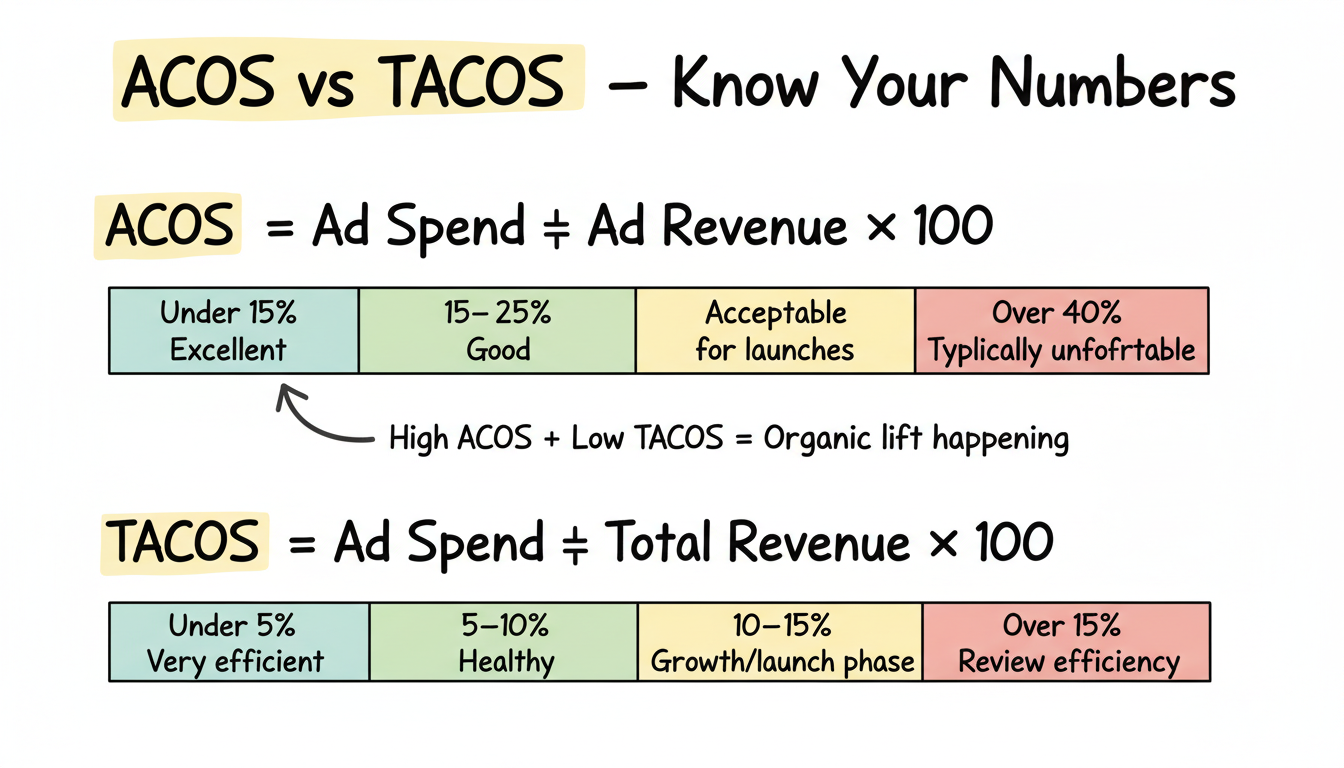
ACoS measures ad spend as a percentage of attributed ad revenue.
Formula: ACoS = (Ad Spend / Ad Revenue) × 100
ACoS Range | Interpretation |
Under 15% | Excellent (most products) |
15-25% | Good |
25-40% | Acceptable for launches/growth |
Over 40% | Typically unprofitable |
Important context: According to industry analysis, "good" ACoS depends entirely on your margins and goals. A 40% ACoS might be excellent for a new product launch but terrible for a mature product with thin margins.
Tacos (Total Advertising Cost of Sales)
TACoS measures ad spend against total revenue (organic + paid).
Formula: TACoS = (Ad Spend / Total Revenue) × 100
TACoS Range | Interpretation |
Under 5% | Very efficient |
5-10% | Healthy benchmark |
10-15% | Growth/launch phase |
Over 15% | Review efficiency |
Why TACoS matters more: TACoS reveals the true advertising burden on your business. A product with 30% ACoS but 8% TACoS is performing well because advertising is driving organic growth. This metric is particularly useful when calculating your PPC budget across multiple platforms.
ROAS (Return on Ad Spend)
ROAS is the inverse of ACoS and measures revenue generated per dollar of ad spend. While ACoS is the standard Amazon metric, ROAS is widely used across other advertising platforms and is increasingly referenced in Amazon reporting tools in 2026.
Formula: ROAS = Ad Revenue / Ad Spend
You can also convert between the two: ROAS = 1 / (ACoS / 100). For example, a 25% ACoS equals a 4.0x ROAS.
ROAS | Equivalent ACoS | Interpretation |
7x or higher | Under 15% | Excellent |
4x - 7x | 15-25% | Good |
2.5x - 4x | 25-40% | Acceptable for launches |
Under 2.5x | Over 40% | Typically unprofitable |
When evaluating agencies, ask whether they report in ACoS, ROAS, or both. Top agencies in 2026 typically target a minimum 4x ROAS (25% ACoS) for mature products and use ROAS trending to demonstrate campaign improvement over time.
Scaling Amazon PPC Profitably
Scaling Amazon advertising without sacrificing profitability requires systematic optimization, similar to approaches used in complete guide Microsoft advertising PPC campaigns.
The Scaling Framework
- Optimize first: Ensure current campaigns hit target ACoS before adding budget
- Expand keywords: Graduate winners from auto to manual campaigns
- Add match types: Test phrase and broad once exact performs well
- Product targeting: Target competitor ASINs with strong conversion potential
- New ad types: Add Sponsored Brands and Display once Products are profitable
Common Scaling Mistakes
Mistake | Why It Hurts | Solution |
Scaling too fast | Inflates ACoS, loses control | Increase budgets 20-30% weekly max |
Ignoring negative keywords | Wastes spend on irrelevant clicks | Weekly search term analysis |
Single campaign structure | Limits optimization ability | Segment by match type and purpose |
No bid adjustments | Overpays for low-value placements | Use placement modifiers strategically |
When to Scale vs. Optimize
- Scale when: ACoS is below target, impression share is limited, profitable keywords exist
- Optimize when: ACoS exceeds target, conversion rates are declining, spend is not converting
Understanding when to pivot between these modes is a core competency, whether you're managing campaigns in-house or working with Bing ads management services providers who also handle Amazon.
Amazon PPC Software vs Agency: Which Is Right for You?
One of the most common decisions Amazon sellers face in 2026 is whether to manage PPC with software tools or hire a dedicated agency. Both approaches have merits, and the right choice depends on your budget, catalog complexity, and in-house expertise.
Popular Amazon PPC Software Tools
Several platforms offer automated bid management and campaign optimization:
- Helium 10 Adtomic: Keyword research plus automated PPC management, starting around $99/month
- Jungle Scout: Product research suite with PPC automation features
- PacVue: Enterprise-grade platform with rule-based bidding and dayparting
- Quartile: AI-driven campaign management across Amazon and other marketplaces
- Perpetua: Automated Sponsored Products, Brands, and Display optimization
Head-To-Head Comparison
Factor | PPC Software | PPC Agency |
Monthly cost | $99 - $500/month | $501 - $3,000+/month |
Time investment | 5-15 hours/week (you manage) | 1-2 hours/week (review reports) |
Strategic input | Automated rules, limited nuance | Human expertise, market context |
Best for | Small catalogs, experienced sellers | Large catalogs, scaling brands |
Listing optimization | Not included | Often included |
AMC/DSP access | Limited or none | Full access via managed service |
Choose software if you have PPC experience, a small product catalog (under 50 ASINs), and want to keep costs low while maintaining direct control. Choose an agency if you have a growing catalog, limited time, or need advanced capabilities like Amazon DSP and Amazon Marketing Cloud.
What Amazon PPC Agencies Offer in 2026
Professional Amazon PPC agencies provide comprehensive management that goes beyond simple bid adjustments, similar to specialized PPC advertising software tools but with human strategic oversight.
Core Agency Services
Service | What's Included |
Campaign setup | Account structure, keyword research, targeting strategy |
Daily management | Bid adjustments, budget allocation, negative keywords |
Reporting | Performance dashboards, ACoS/TACoS/ROAS tracking, recommendations |
Strategy | Launch planning, competitive analysis, growth roadmaps |
Optimization | A/B testing, search term mining, placement analysis |
Advanced Services
Many agencies also offer:
- Listing optimization: Titles, bullets, images, A+ content
- Amazon DSP management: Programmatic advertising
- Amazon Marketing Cloud (AMC): Advanced analytics and audience insights
- Brand store development: Custom Amazon storefronts
- Review strategy: Vine enrollment, follow-up sequences
- Inventory planning: Stock forecasting based on ad performance
Amazon Marketing Cloud (AMC)
Amazon Marketing Cloud is a secure, privacy-safe, cloud-based clean room solution that enables advertisers to run custom analytics across Amazon advertising signals. In 2026, AMC has become a key differentiator between basic PPC management and truly advanced Amazon advertising strategy.
What AMC enables:
- Cross-channel attribution: Understand how Sponsored Products, Sponsored Brands, DSP, and organic interactions work together to drive conversions
- Custom audience creation: Build highly targeted audiences based on shopping behavior, purchase history, and ad engagement patterns
- Path-to-purchase analysis: Map the full customer journey from first impression to purchase across multiple touchpoints
- New-to-brand metrics: Identify and measure the acquisition of first-time customers at a granular level
- Overlap reporting: See which ad types and campaigns are reaching the same audiences to reduce wasted spend
Not all agencies offer AMC access—it requires API integration and data science expertise. When evaluating agencies, ask specifically about their AMC capabilities and how they use clean room insights to optimize campaign performance.
Agency Pricing Models in 2026
According to industry surveys, Amazon PPC agencies typically charge fees comparable to PPC agency pricing for other platforms:
Pricing Model | Typical Range | Best For |
Flat monthly fee | $501 - $3,000/month | Predictable budgets |
Percentage of spend | 10-15% of ad budget | Aligned incentives |
Percentage of sales | 3-8% of attributed revenue | Performance-based |
Hybrid | Base fee + percentage | Balance of both |
Total Amazon PPC costs: Including ad spend, most businesses invest $50 - $3,000/month for Amazon advertising, though larger catalogs and aggressive growth strategies can reach $10,000-$50,000+ monthly. Understanding Microsoft advertising cost pricing can provide helpful context for budgeting across platforms.
Choosing an Amazon PPC Partner
Selecting the right agency requires evaluating their expertise, approach, and fit for your business. The criteria differ significantly from choosing providers for PPC advertising for attorneys or other industry-specific campaigns.
Key Evaluation Criteria
Criteria | What to Look For |
Amazon specialization | Dedicated Amazon team, not generalist PPC |
Proven results | Case studies with specific ACoS/TACoS/ROAS improvements |
Transparent reporting | Real-time dashboards, not just monthly PDFs |
Strategic approach | Beyond bid management to full-funnel strategy |
AMC capabilities | Access to Amazon Marketing Cloud for advanced analytics |
Communication | Dedicated account manager, regular strategy calls |
Questions to Ask Potential Agencies
- What's your campaign structure approach? (Look for segmentation strategy)
- How do you handle new product launches vs. mature products?
- What's your process for negative keyword management?
- How do you coordinate PPC with listing optimization?
- What reporting cadence and metrics do you provide?
- Do you offer Amazon Marketing Cloud (AMC) analytics?
- What's your minimum contract length?
Red Flags to Watch
- Guaranteed results: No agency can guarantee specific ACoS or sales numbers
- No Amazon-specific expertise: Treating Amazon like Google Ads
- Black-box reporting: Unwillingness to share search term data
- Long contracts without performance clauses: Should allow exit for poor performance
- One-size-fits-all approach: Every account is different
Consider whether you need a consultant who can provide strategic guidance similar to a Microsoft advertising consultant, or a full-service agency that handles day-to-day management. You might also want to hire a Bing Ads expert who understands cross-platform synergies.
Frequently Asked Questions
How Much Does an Amazon PPC Agency Cost?
Amazon PPC agency fees typically range from $501 to $3,000 per month for flat-fee arrangements, or 10-15% of your monthly ad spend for percentage-based pricing. Total investment including ad spend ranges from $1,000 to $50,000+ monthly depending on catalog size and growth goals.
What Is a Good Acos for Amazon PPC?
A good ACoS depends on your profit margins and goals. Generally, 15-25% ACoS is considered good for established products, while new product launches may accept 30-40% ACoS to build ranking. Calculate your break-even ACoS based on your profit margin before advertising.
What Is a Good ROAS for Amazon PPC?
A good ROAS for Amazon PPC is typically 4x or higher (equivalent to 25% ACoS or lower). This means you earn $4 in ad-attributed revenue for every $1 spent. New product launches may accept 2.5x-3x ROAS while building ranking momentum, while mature products should aim for 5x-7x or higher.
How Long Does It Take to See Results from Amazon PPC?
Most sellers see initial data within 1-2 weeks, but meaningful optimization requires 4-8 weeks of data. Full campaign maturation—where organic ranking improvements compound with advertising efficiency—typically takes 3-6 months of consistent management, similar to timelines seen with Google PPC advertising campaigns.
What Is Amazon Marketing Cloud (AMC)?
Amazon Marketing Cloud is a privacy-safe analytics environment that lets advertisers run custom queries across their Amazon advertising data. AMC enables cross-channel attribution, custom audience building, and path-to-purchase analysis. Access typically requires working with an agency or partner that has AMC API integration.
Amazon PPC represents just one component of a comprehensive digital marketing strategy. Sellers looking to maximize their reach should also consider SEO SEM strategies integrated marketing approaches and understand the broader landscape of types of digital marketing available to e-commerce businesses.