
Answer engine optimization (AEO) is the practice of structuring content to appear in direct-answer results from AI assistants, voice search, and featured snippets. When users ask Siri a question, query Alexa, or get a direct answer in Google, AEO determines which content provides that response.
This guide covers what AEO means, how it differs from traditional SEO, and how to start optimizing for answer engines.
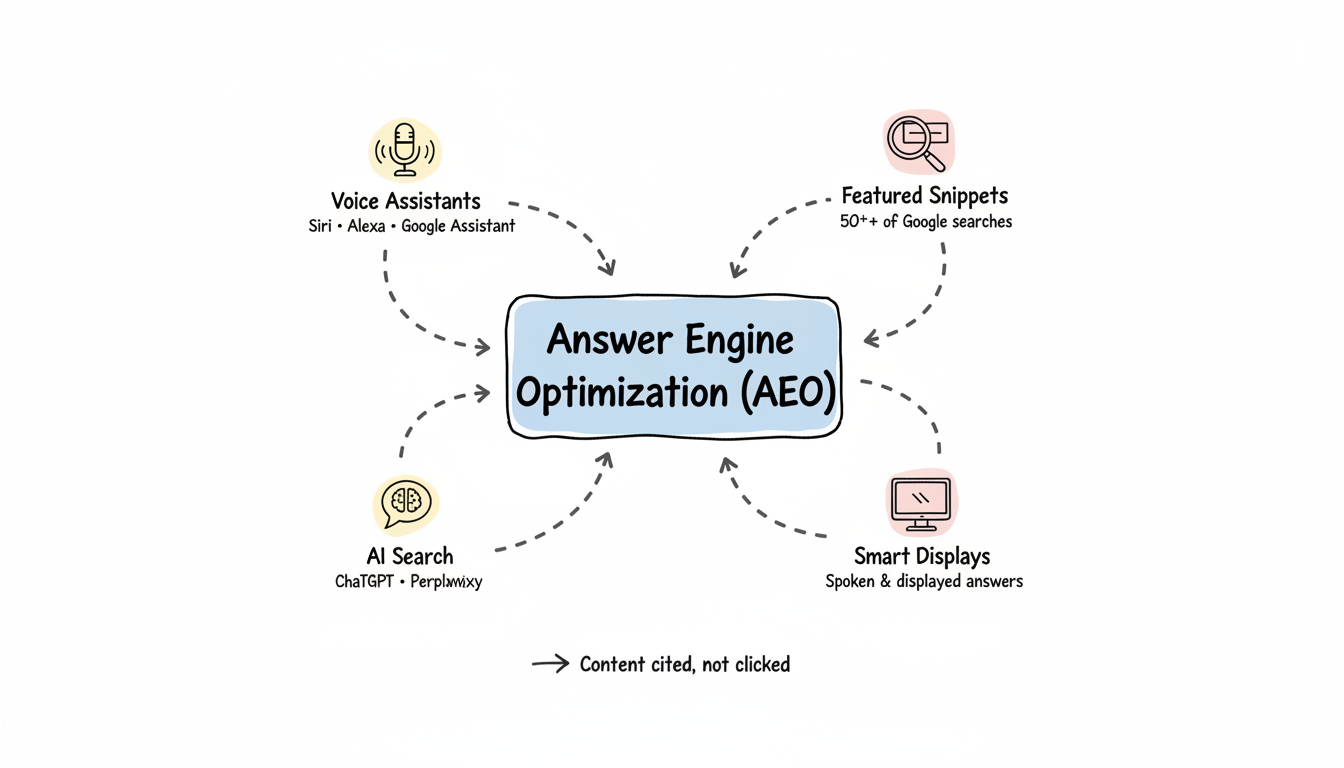
What Is Answer Engine Optimization?
Answer engine optimization focuses on becoming the source that AI systems and search engines use when providing direct answers to user questions. Rather than optimizing to rank as a blue link users click, AEO optimizes for selection as the definitive answer.
Answer engines include:
- Voice assistants: Siri, Alexa, Google Assistant
- Featured snippets: Direct answer boxes in Google search results
- AI search platforms: ChatGPT, Perplexity, Google AI Overviews
- Smart displays and devices: Any interface providing spoken or displayed answers
When optimized correctly, your content becomes what these systems cite - even when users never visit your website directly.
AEO vs Traditional SEO
While AEO and SEO share the goal of visibility, their approaches differ significantly.
Traditional SEO optimizes to rank highly in search results, driving clicks to websites. Success means appearing on page one where users can choose to click your listing.
Answer engine optimization focuses on being selected as THE answer, not just appearing as an option. Success means your content is the source cited in direct responses.
The key differences:
Aspect | Traditional SEO | AEO |
Goal | Rank high in results | Be the selected answer |
User action | Click through to site | Receive answer directly |
Content format | Full pages optimized for engagement | Extractable answer-ready content |
Success metric | Rankings, traffic | Citations, answer selection |
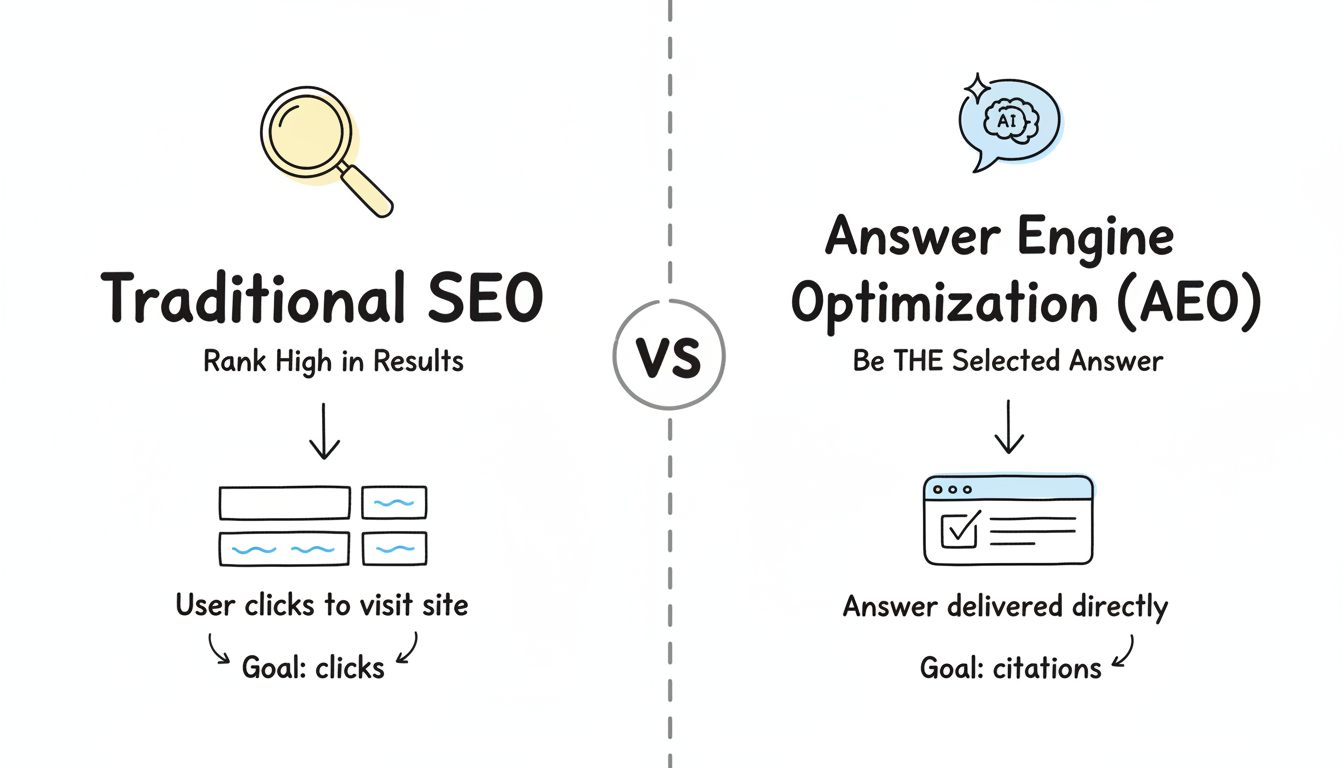
In practice, both matter. Strong SEO often supports AEO success since authoritative, high-ranking content tends to be selected as answers. Understanding the differences between SEO, AEO, and GEO helps determine which optimization strategy to prioritize for specific content goals.
Why AEO Matters
User behavior has shifted toward expecting immediate answers:
- Voice search continues growing across devices
- Featured snippets appear in over 50% of Google searches
- AI assistants handle billions of queries monthly
- Users increasingly prefer direct answers over browsing search results
Content that doesn't optimize for direct answers loses visibility in these growing channels. As AI search expands, AEO becomes essential for maintaining discoverability.
Core AEO Optimization Techniques
Effective answer engine optimization uses specific techniques to increase selection probability.
Structure Content as Direct Answers
Answer engines extract complete, standalone answers from content. Structure appropriately:
- Begin sections with the direct answer, then elaborate
- Write in complete sentences that make sense extracted alone
- Answer the specific question asked, not just related information
- Keep answer-ready paragraphs under 50-60 words when possible
Balancing content depth and brevity for answer engines ensures your content satisfies both AI extraction requirements and user comprehension needs.
Use Question-Based Formatting
Match how users phrase queries:
- Include exact questions as headers (H2, H3 tags)
- Create FAQ sections with clear Q&A formatting
- Use conversational phrasing that matches voice search patterns
- Cover both short and long-form question variations
Implement Structured Data
Schema markup helps answer engines understand your content:
- FAQ schema for question-answer content
- HowTo schema for instructional content
- Article schema with proper author attribution
- Organization schema for brand information
Build Topical Authority
Answer engines prefer sources with established expertise:
- Create comprehensive content covering topics thoroughly
- Maintain consistent accuracy and update outdated information
- Build presence across platforms where AI systems crawl
- Establish expert attribution for content creators
Getting Started with AEO
For teams beginning answer engine optimization, start with achievable steps.
Identify Answer Opportunities
Research which questions your audience asks:
- Use tools like AnswerThePublic or AlsoAsked
- Review "People Also Ask" boxes in search results
- Analyze voice search patterns for your industry
- Identify questions where you have genuine expertise
Implementing an AEO checker into your workflow can help systematically identify which content is positioned for answer engine selection and which requires optimization.
Audit Existing Content
Evaluate current content for answer-readiness:
- Can direct answers be extracted from your content?
- Are questions explicitly addressed with clear answers?
- Is structured data properly implemented?
- Does formatting support AI extraction?
Create Answer-Optimized Content
When creating new content:
- Start with the answer, elaborate after
- Include multiple question variations
- Structure for both short and detailed answers
- Implement appropriate schema markup
Establishing a comprehensive AI search measurement framework enables you to track which optimization efforts drive actual answer engine selection and citation performance.
Key Takeaways
Answer engine optimization positions your content as the source AI systems and voice assistants cite when providing direct answers.
The fundamental shift: Users increasingly receive answers without clicking through to websites. Content must be optimized for extraction and citation, not just ranking.
Where to start: Identify question opportunities relevant to your expertise, audit existing content for answer-readiness, and structure new content with direct answers prominently formatted.
The relationship to SEO: AEO complements traditional SEO. Strong SEO performance supports AEO success, but additional optimization specifically for answer extraction is required.
Organizations that optimize for answer engines now capture visibility in channels growing rapidly while traditional search evolves.
Writing Answer-Ready Intros That Get Extracted
The first sentence under each heading does the heaviest lifting. Answer engines pull the opening lines as the canonical answer, so we lead with the direct response and only then add context. A section titled "What is AEO" should open with the definition, not a story about why the term exists. Keep that lead paragraph under sixty words and free of dependent clauses so it survives extraction on its own. Readers still get the depth below; the AI system gets a clean block to cite. This single habit - answer first, explain second - outperforms most other formatting tweaks we have tested.
Schema Combinations That Actually Move Citations
Not all schema is equal for answer engines. FAQ schema helps on question pages but Google has narrowed how it renders, so we pair it with Article and breadcrumb markup for context. For product and how-to content, HowTo and Product schema give engines structured steps and attributes they can surface directly. The combination we rely on is Article plus Organization plus the page-specific type, all consistent with what the visible text says. Schema that contradicts the body text erodes trust faster than no schema at all, so we audit every field against the copy before publishing.
Monitoring Citations Without Living in the Tools
Manual checking across ChatGPT, Perplexity, and AI Overviews does not scale past a handful of queries. We seed a weekly report with the twenty questions that matter most to each client, then use citation trackers to flag where their domain appears or drops out. The output is a delta list, not a dashboard to babysit - we only act when a priority query loses its citation. That keeps monitoring cheap while catching the movements that affect visibility. When a tracked query slips, we trace it to the specific section that lost the answer slot and revise just that block.
Frequently Asked Questions
What'S the Difference Between AEO and GEO?
AEO (Answer Engine Optimization) focuses broadly on direct answers across voice search, featured snippets, and AI assistants. GEO (Generative Engine Optimization) specifically targets AI-powered search platforms like ChatGPT and Perplexity. GEO is essentially a subset of AEO focused on generative AI.
Does AEO Replace SEO?
No. AEO complements traditional SEO. Content that ranks well in traditional search often performs better in answer engines because authority signals transfer. The best approach integrates both optimization strategies.
How Do I Measure AEO Success?
Track featured snippet appearances, voice search mentions, and AI citations. Tools like Semrush track featured snippet positions. For AI citations, manually test relevant queries across platforms like ChatGPT and Perplexity.
What Content Types Work Best for AEO?
Definitional content ("What is X"), how-to guides, FAQ pages, and comparison content perform well. Any content providing clear, factual answers to specific questions has AEO potential.