
Answer Engine Optimization (AEO) and Generative Engine Optimization (GEO) represent different stages in the evolution of AI search optimization. Understanding this relationship helps organizations build on existing AEO investments while preparing for generative AI visibility.
This guide explains how AEO evolved into GEO and provides a practical migration path for organizations making the transition.
The Evolution from AEO to GEO
AEO: The Foundation (2015-2022)
Answer Engine Optimization emerged as featured snippets, voice search, and direct answer boxes became prominent in search results. AEO focused on getting content extracted as the definitive answer to user queries.
Original AEO targets:
- Google featured snippets
- Voice assistant responses (Alexa, Siri, Google Assistant)
- People Also Ask expansions
- Knowledge panels
Core AEO principle: Structure content so machines can extract and display it as the direct answer.
The Generative Shift (2022-2024)
When ChatGPT launched in late 2022, search behavior began shifting. Users started asking AI assistants directly instead of searching Google. These systems didn't just extract answers—they generated synthesized responses from multiple sources.
What changed:
- AI creates original responses, not just extractions
- Multiple sources get combined into single answers
- Citations became important for credibility
- New platforms (ChatGPT, Perplexity) emerged alongside Google
GEO: The Current State (2024-Present)
Generative Engine Optimization addresses this new reality. GEO targets citation in synthesized AI responses across multiple platforms, not just extraction in featured snippets.
GEO expands AEO to include:
- ChatGPT, Claude, Perplexity visibility
- Google AI Overviews (formerly SGE)
- Cross-platform citation tracking
- Entity authority beyond Google's ecosystem
Key Differences in Practice
While AEO vs GEO: Key Differences share foundational techniques, practical differences matter for implementation.
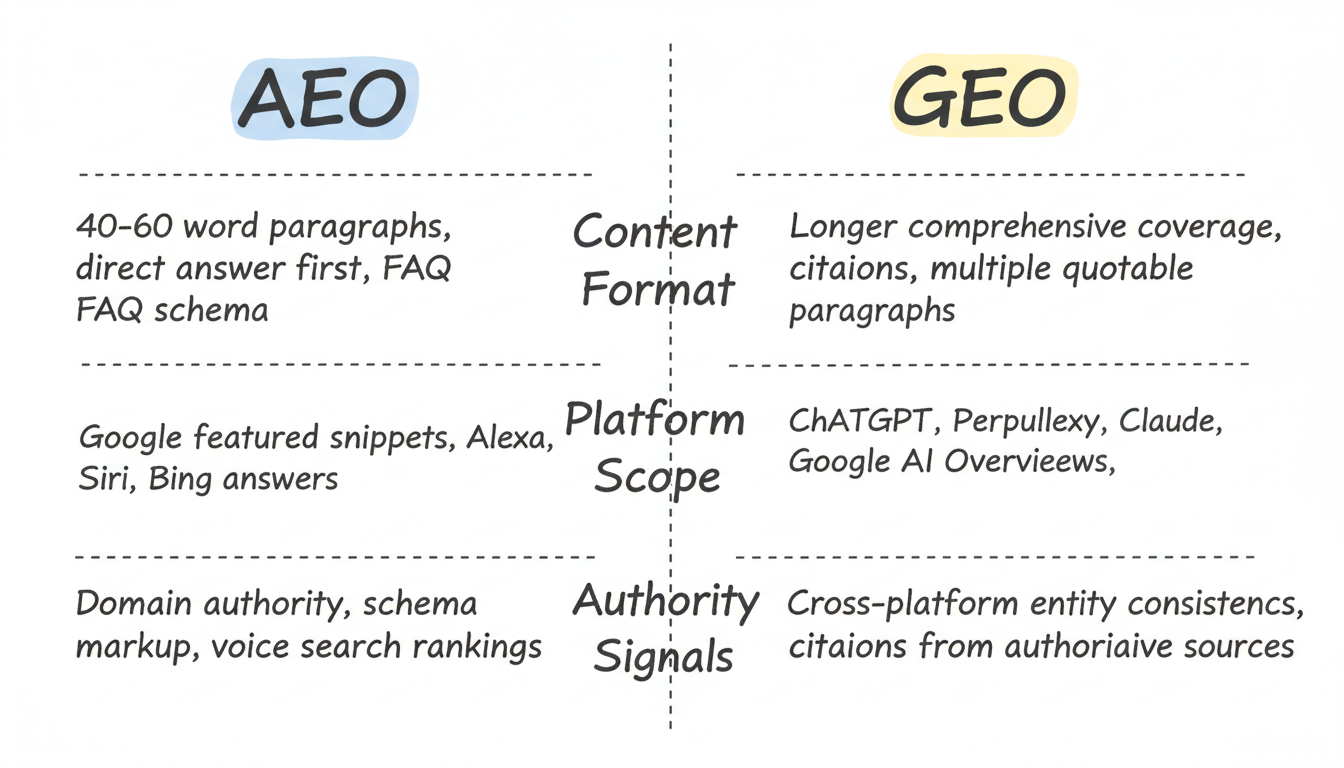
Content Format Differences
AEO content optimization:
- 40-60 word paragraphs for featured snippet extraction
- Direct answer in first sentence after question headers
- FAQ schema for voice assistant matching
- Concise, extractable statements
GEO content optimization:
- Longer, more comprehensive coverage for synthesis
- Supporting evidence and citations throughout
- Multiple quotable paragraphs per topic
- Entity-focused information enabling cross-referencing
Practical implication: AEO-optimized content often needs expansion for GEO success. A 50-word featured snippet answer may be too thin for generative AI citation.
Platform Scope Differences
AEO platforms:
- Google Search (featured snippets, PAA)
- Voice assistants (Alexa, Siri, Google Assistant)
- Bing answer features
GEO platforms (adds):
- ChatGPT with search
- Perplexity AI
- Claude
- Google AI Overviews
- Microsoft Copilot
- Industry-specific AI assistants
Practical implication: GEO requires monitoring multiple platforms. AEO success in Google doesn't guarantee GEO success in ChatGPT.
Authority Signal Differences
AEO authority signals:
- Domain authority (traditional SEO)
- Featured snippet history
- Schema markup implementation
- Voice search rankings
GEO authority signals (adds):
- Cross-platform entity consistency
- Citations from other authoritative sources
- Information accuracy verification
- Presence in AI training data
Practical implication: GEO requires broader authority building beyond Google's ecosystem, which is where knowledge graph optimization becomes critical for establishing entity relationships across platforms.
Migration Path: From AEO to GEO
Organizations with existing AEO programs can systematically expand into GEO.
Phase 1: Audit Current AEO Assets
Before expanding, understand what you have:
AEO asset inventory:
- Which pages hold featured snippets?
- What FAQ content exists?
- Where does voice search traffic come from?
- What schema markup is implemented?
GEO baseline assessment:
- Do these same pages appear in ChatGPT responses?
- Which competitors get cited in AI platforms?
- Are there platform-specific gaps?
This audit reveals where AEO success translates to GEO success—and where gaps exist. Consider conducting a comprehensive AEO content audit to identify optimization opportunities.
Phase 2: Expand High-Performing AEO Content
Start with content that already performs in AEO and optimize for GEO:
Expansion tactics:
- Add depth to existing featured snippet content
- Include statistics and citations for AI verification
- Create additional quotable paragraphs beyond the snippet
- Add cross-references to establish entity relationships
Example transformation:
Original AEO content (featured snippet optimized): "Email marketing ROI averages $42 for every $1 spent, making it one of the highest-return digital channels."
Expanded for GEO: "Email marketing ROI averages $42 for every $1 spent according to DMA research, making it one of the highest-return digital channels. This return exceeds social media advertising (typically $2-5 per dollar) and paid search (average $2-3 per dollar). The high ROI results from low distribution costs, direct audience access, and measurable conversion paths. Organizations implementing segmentation and personalization often exceed the $42 average, with some B2B companies reporting returns above $70 per dollar invested."
The expanded version provides more citable information, supporting evidence, and context for AI synthesis.
Phase 3: Build Cross-Platform Authority
AEO focuses primarily on Google. GEO requires broader authority:
Authority expansion actions:
- Ensure entity consistency across Wikipedia, LinkedIn, Crunchbase
- Seek citations from industry publications
- Participate in platforms AI systems likely crawl
- Create citable research or original data
Why this matters: Generative AI systems evaluate source credibility differently than Google. Broader presence increases citation likelihood.
Phase 4: Implement Platform-Specific Monitoring
AEO monitoring focuses on Google features. GEO requires multi-platform tracking:
Monitoring expansion:
- Test priority queries in ChatGPT monthly
- Check Perplexity visibility for target topics
- Monitor Google AI Overviews separately from featured snippets
- Track competitive visibility across platforms
Measurement differences:
- AEO: Featured snippet capture rate, voice search appearances
- GEO: Citation frequency across platforms, mention accuracy, share of voice
Tools like those covered in our Google AI Overviews optimization playbook can help track visibility across multiple AI platforms effectively.
Phase 5: Maintain Both Capabilities
GEO doesn't replace AEO—it extends it. Maintain both:
Ongoing AEO maintenance:
- Protect existing featured snippets
- Continue FAQ schema implementation
- Monitor voice search performance
GEO additions:
- Expand content depth for AI synthesis
- Build cross-platform authority
- Track multi-platform citations
Common Migration Mistakes
Abandoning AEO for GEO
Featured snippets and voice search still drive traffic. Don't sacrifice AEO success while building GEO capabilities.
Assuming AEO Success Transfers Automatically
Content ranking in featured snippets may not get cited by ChatGPT. Platform-specific optimization remains necessary.
Ignoring Platform Differences
ChatGPT, Perplexity, and Google AI Overviews weight factors differently. One-size-fits-all optimization underperforms.
Treating GEO as Separate Initiative
Integration works better than parallel programs. The same content team should handle both AEO and GEO.
Resource Allocation Guide
For organizations balancing AEO and GEO:
Current State | Recommended Allocation |
Strong AEO, no GEO | 60% AEO maintenance, 40% GEO development |
Moderate AEO, no GEO | 50% AEO improvement, 50% GEO development |
Strong AEO, emerging GEO | 40% AEO, 60% GEO expansion |
Mature both | 30% AEO, 70% GEO (as AI search grows) |
Adjust quarterly based on traffic sources and business impact.
E-E-A-T: The Foundation for Both AEO and GEO
E-E-A-T stands for Experience, Expertise, Authoritativeness, and Trustworthiness. Originally a Google quality rater framework, E-E-A-T has become the credibility standard that both answer engines and generative AI platforms use to evaluate sources for citation.
Experience: First-Hand Knowledge
Both AEO and GEO reward content that demonstrates direct experience with a subject. For answer engines, experience signals help content win featured snippets for how-to and review queries. For generative engines, first-hand experience makes content more likely to be cited as a primary source rather than a secondary aggregator.
Practical signals: case studies with specific results, original screenshots, author bios with relevant credentials, and dated examples showing ongoing engagement with the topic.
Expertise: Depth of Knowledge
Expert-authored content performs better across both AEO and GEO. AI systems increasingly evaluate whether content comes from subject matter experts or generalist writers. Pages with clearly attributed expert authors, supporting data citations, and technical depth receive higher citation rates in generative responses.
For YMYL (Your Money or Your Life) topics in finance, health, and legal verticals, expertise signals are non-negotiable. AI platforms are especially cautious about citing sources for YMYL queries without strong expertise indicators.
Authoritativeness: Recognized Credibility
Authority in AEO traditionally meant domain authority and backlink profiles. GEO expands this to cross-platform authority: is your brand or author recognized as authoritative across Wikipedia, industry publications, LinkedIn, and other platforms AI systems crawl? Consistent entity presence across these platforms strengthens citation likelihood.
Trustworthiness: Accuracy and Transparency
Generative AI platforms prioritize trustworthy sources to avoid generating inaccurate responses. Trust signals include: accurate statistics with cited sources, transparent authorship, clear publication and update dates, editorial standards, and correction policies. Content that cites primary research rather than secondary sources earns higher trust scores from both answer engines and generative platforms.
Entity Optimization: A Shared Tactic
Entity optimization is the practice of defining and connecting the people, organizations, concepts, and relationships in your content so that both answer engines and generative AI systems can accurately understand and cite your information.
Structured Data Implementation
Structured data provides machine-readable context that powers both featured snippet extraction (AEO) and AI citation (GEO). The most impactful schema types for AEO and GEO include:
- Article schema: Defines authorship, publication dates, and topic categorization
- FAQ schema: Marks up question-answer pairs for direct extraction and AI training
- Organization schema: Establishes brand entity identity across platforms
- Person schema: Connects expert authors to their credentials and affiliations
Implementing these schema types consistently across your site creates a structured knowledge layer that AI systems can parse and reference with confidence.
Entity Consistency Across Platforms
Generative AI systems cross-reference entity information across multiple sources. If your organization's name, description, founding date, or key personnel differ between your website, LinkedIn, Crunchbase, and Wikipedia, AI platforms may reduce citation confidence. Maintaining consistent entity data across all public-facing platforms strengthens your authority signal for both AEO and GEO.
Knowledge Graph Connections
Building connections between entities in your content helps AI systems understand the relationships in your domain. Internal linking between related topics, co-occurrence of related entities within content, and structured data that defines entity relationships all contribute to stronger knowledge graph optimization that benefits both answer engine and generative engine visibility.
The Data Behind AI Search
The shift from traditional search to AI-powered search is not speculative. Multiple data points confirm the acceleration and scale of this transition.
Traditional Search Volume Decline
Gartner projects a 25% drop in traditional search volume by 2026 as users migrate to AI-powered alternatives. This projection aligns with observable trends: ChatGPT reached 100 million users faster than any consumer application, and Perplexity AI processes millions of queries daily with year-over-year growth exceeding 300%.
AI Overviews Prevalence
Up to 47% of Google searches now feature AI-generated overviews, fundamentally changing how users interact with search results. For informational queries, AI Overviews often satisfy user intent without requiring a click, contributing to the rise of zero-click searches that now account for over 60% of all Google searches.
Case Study: Measurable Impact
Sprout Social's SEO transformation demonstrates what happens when organizations adapt to AI search. By restructuring content for AI citation, implementing comprehensive schema markup, and building cross-platform entity authority, they achieved measurable improvements in both traditional organic traffic and AI platform visibility. Their approach combined existing SEO fundamentals with GEO-specific tactics like statistical citation optimization and multi-platform authority building.
Zero-Click Search Implications
The zero-click trend means that even when your content ranks well traditionally, users may never visit your site. Both AEO and GEO address this by ensuring your brand gets attribution in the answer itself, whether through featured snippet branding (AEO) or generative citation with source links (GEO). Tools like AnswerThePublic and Semrush can help identify question-based queries where zero-click optimization matters most, while HubSpot's AEO Grader provides a starting assessment of content readiness for answer engine formats.
SEO, AEO, and GEO: The Triple Threat
The question "What is AEO vs GEO vs SEO?" appears frequently in People Also Ask boxes, and the answer reveals why organizations need all three working as complementary layers rather than competing initiatives.
SEO: The Foundation Layer
Traditional SEO remains the bedrock of all search visibility. Without proper crawlability, indexing, site architecture, and on-page optimization, neither AEO nor GEO can succeed. SEO handles the technical infrastructure: robots.txt, sitemaps, Core Web Vitals, meta tags, internal linking, and backlink authority. Every AEO and GEO strategy starts with solid SEO fundamentals.
AEO: The Answer Layer
AEO builds on SEO by structuring content specifically for direct answer extraction. This includes question-based headings, concise answer paragraphs, FAQ formatting, and schema markup. AEO targets the "position zero" opportunities: featured snippets, voice search responses, and People Also Ask boxes. Content optimized for AEO is formatted for machines to extract, display, and attribute.
GEO: The Generative Layer
GEO extends both SEO and AEO into the generative AI landscape. While AEO optimizes for extraction, GEO optimizes for synthesis and citation. GEO content needs depth, supporting evidence, cross-platform authority, and entity consistency. The goal shifts from being the extracted answer to being a cited source in AI-generated responses.
Why All Three Matter
Organizations that treat these as separate, competing initiatives lose efficiency and miss compounding benefits. A single piece of content can serve all three layers: SEO-optimized structure gets it indexed and ranked, AEO formatting wins featured snippets, and GEO depth earns generative citations. The triple-threat approach means every content investment works three times as hard.
Technical Implementation Checklist
Technical optimization ensures that AI crawlers can access, understand, and cite your content. Without proper technical foundations, even the best content may be invisible to generative AI platforms.
AI Crawler Access Configuration
AI platforms use specific crawlers to index content for their models. Your robots.txt must explicitly allow these crawlers:
- OAI-SearchBot: OpenAI's crawler for ChatGPT search features
- ClaudeBot: Anthropic's crawler for Claude's web access
- PerplexityBot: Perplexity AI's content indexer
- Google-Extended: Google's AI training crawler (separate from Googlebot)
Review your robots.txt to ensure none of these are blocked. Some organizations inadvertently block AI crawlers with broad disallow rules intended for other bots.
The Llms.Txt Standard
The emerging llms.txt standard provides a structured way to communicate with AI systems about your site's content. Similar to robots.txt for search engines, llms.txt tells AI platforms what your site is about, what content is most authoritative, and how to properly cite your organization. Implementing llms.txt is an early-mover advantage for GEO visibility.
Core Web Vitals and Page Speed
While AI crawlers are less affected by page speed than human users, Core Web Vitals still matter. Google uses page experience signals in ranking (which feeds AI Overview selection), and some AI crawlers have timeout thresholds. Ensure Largest Contentful Paint under 2.5 seconds, First Input Delay under 100ms, and Cumulative Layout Shift under 0.1.
Javascript Rendering Considerations
Many AI crawlers do not execute JavaScript. If your content is rendered client-side via JavaScript frameworks, AI crawlers may see empty pages. Ensure critical content is available in the initial HTML response through server-side rendering (SSR) or static site generation (SSG). Test your pages with JavaScript disabled to verify content accessibility.
Semantic HTML Best Practices
Proper semantic HTML helps AI systems understand content structure and hierarchy. Use heading tags (H1-H6) in logical order, semantic elements like article, section, nav, and aside, and descriptive alt text for images. Semantic structure gives AI systems confidence in extracting and citing specific sections of your content.
Frequently Asked Questions
What Is the Difference Between Answer Engine Optimization and Generative Engine Optimization?
Answer Engine Optimization (AEO) focuses on getting content extracted and displayed as direct answers in featured snippets, voice assistants, and People Also Ask boxes. Generative Engine Optimization (GEO) extends AEO to target citation in synthesized AI responses across platforms like ChatGPT, Perplexity, Claude, and Google AI Overviews. The key distinction: AEO optimizes for extraction of your exact content, while GEO optimizes for citation when AI generates new synthesized responses from multiple sources.
What Is AEO vs GEO vs SEO?
SEO (Search Engine Optimization) is the foundation, focusing on ranking in traditional search results through on-page optimization, backlinks, and technical performance. AEO (Answer Engine Optimization) builds on SEO by structuring content for direct answer extraction in featured snippets and voice search. GEO (Generative Engine Optimization) extends both by optimizing for citation in AI-generated responses across ChatGPT, Perplexity, and Google AI Overviews. Organizations need all three working together as complementary layers for comprehensive search visibility in 2026 and beyond.
What Are the Best Options for Answer Engine Optimization in AI?
The most effective approaches for AEO in AI include: structuring content with clear question-and-answer formatting, implementing comprehensive schema markup (FAQ, Article, Organization), building E-E-A-T signals through expert authorship and cited statistics, ensuring entity consistency across platforms, optimizing for AI crawler access via robots.txt and llms.txt, and using tools like AnswerThePublic for question-based keyword discovery, HubSpot AEO Grader for content readiness assessment, and Semrush for competitive answer engine analysis.
Is AEO Replacing SEO?
No. AEO is not replacing SEO. AEO builds on top of SEO fundamentals, and without strong SEO, AEO cannot succeed. Traditional SEO remains essential for crawlability, indexing, domain authority, and organic rankings. AEO adds a layer of optimization for direct answer extraction. Similarly, GEO adds optimization for generative AI citation. The most effective strategy treats all three as complementary layers: SEO as the technical and authority foundation, AEO as the answer extraction layer, and GEO as the generative citation layer.
Key Takeaways
Answer Engine Optimization and Generative Engine Optimization represent evolution, not replacement. AEO built the foundation—structured content, FAQ formatting, direct answers—that GEO extends.
The migration path: Audit existing AEO assets, expand successful content for GEO, build cross-platform authority, implement multi-platform monitoring, maintain both capabilities.
The strategic reality: Organizations with strong AEO programs have advantages in GEO. The foundational skills transfer. The expansion requires additional scope, not entirely new capabilities.
For organizations planning their approach, remember the triple-threat framework: SEO provides the foundation, AEO captures direct answer opportunities, and GEO earns generative AI citations. Combined with strong E-E-A-T signals, entity optimization, and proper technical implementation for AI crawlers, this layered strategy positions content for visibility across every search surface that matters in 2026.