
Article schema has evolved from a rich results optimization tactic into a critical signal for AI search visibility. As AI systems like Google AI Overviews, ChatGPT, and Perplexity process web content, structured data provides explicit context that eliminates ambiguity. Research indicates schema markup contributes approximately 10% to Perplexity's ranking factors and significantly improves citation likelihood across all major AI platforms.
Why Article Schema Matters for AI Search
AI systems process content through multiple stages where structured data plays a crucial role.
How AI uses structured data: AI platforms crawl content, parse meaning, and determine citation worthiness. Schema markup accelerates each stage by providing machine-readable context that natural language processing alone cannot match. Instead of inferring meaning through text analysis, AI systems read your explicit declarations about content type, authorship, and publication context.
The comprehension advantage: When AI systems encounter schema-marked content, they understand with certainty what they're processing. An Article schema tells the system exactly what it's analyzing - the headline, author, publication date, modification date, and content category. This clarity increases the probability of accurate citation, which is why schema-markup-alignment-visible-content is essential for maintaining consistency across your structured data implementation.
Trust signal amplification: Article schema supports E-E-A-T signals (Experience, Expertise, Authoritativeness, Trustworthiness) by explicitly declaring author credentials, organizational backing, and publication provenance. AI systems evaluating source credibility gain additional confidence from properly structured author and publisher information.
Essential Article Schema Properties
Implement these properties for maximum AI platform effectiveness.
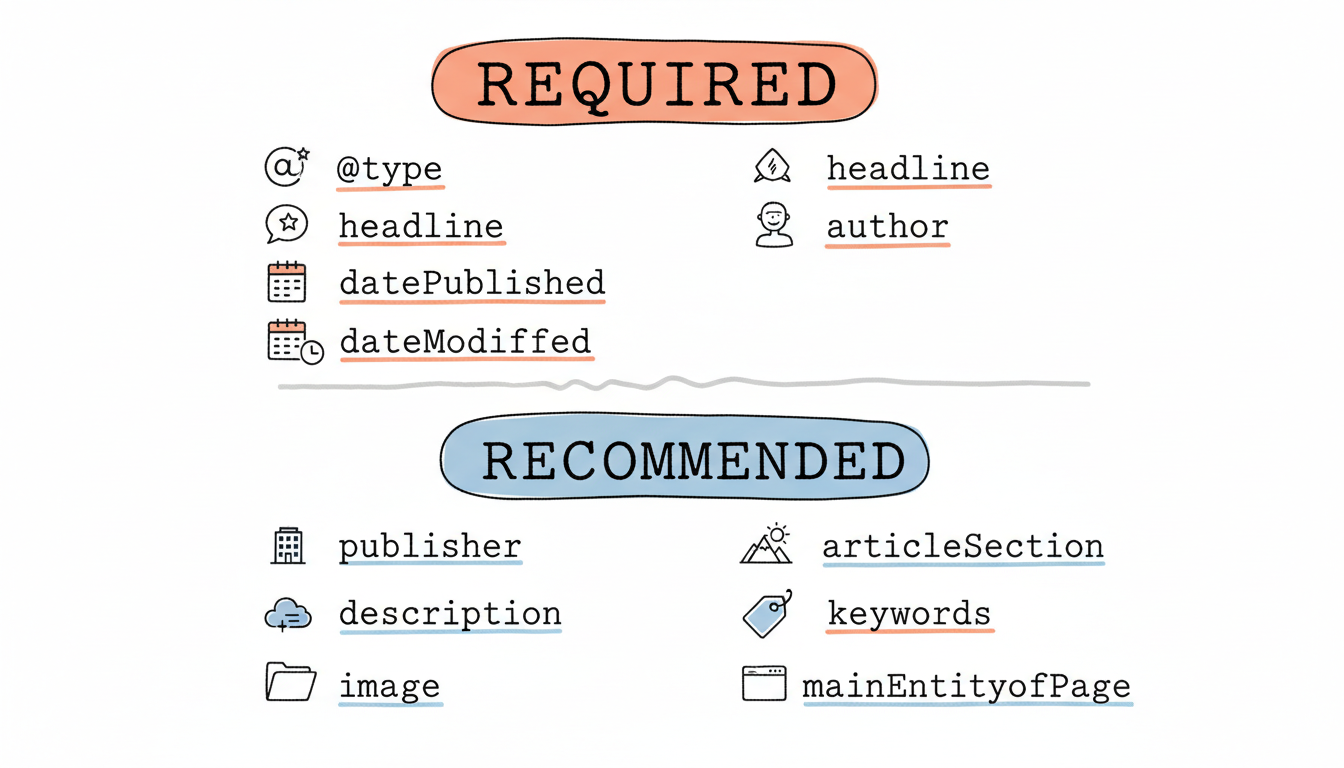
Required properties:
- @type: "Article", "BlogPosting", or "NewsArticle" depending on content type
- headline: Article title (exact match with visible H1)
- author: Person or Organization entity with name and URL
- datePublished: ISO 8601 format publication date
- dateModified: Last update timestamp for freshness signals
Recommended properties:
- publisher: Organization with name and logo
- description: Article summary (match meta description)
- image: Featured image with dimensions
- articleSection: Content category
- keywords: Relevant topic tags
- mainEntityOfPage: URL of the article
Enhanced author markup: Expand author schema beyond basic name. Include author URL linking to a bio page, organizational affiliation, and social profiles. Comprehensive author markup strengthens expertise signals AI systems evaluate.
Implementation Example
Proper Article schema for AI optimization follows this structure.
{
  "@context": "https://schema.org",
  "@type": "Article",
  "headline": "Article Schema Optimization for AI Platforms",
  "description": "Technical guide for implementing Article schema that earns AI citations.",
  "author": {
    "@type": "Person",
    "name": "Author Name",
    "url": "https://example.com/author/name"
  },
  "publisher": {
    "@type": "Organization",
    "name": "Company Name",
    "logo": {
      "@type": "ImageObject",
      "url": "https://example.com/logo.png"
    }
  },
  "datePublished": "2026-01-13T08:00:00+00:00",
  "dateModified": "2026-01-13T10:00:00+00:00",
  "mainEntityOfPage": {
    "@type": "WebPage",
    "@id": "https://example.com/article-url"
  },
  "articleSection": "AI SEO",
  "keywords": ["schema markup", "ai search", "structured data"]
}
Placement guidance: Insert schema in the page's <head> section using JSON-LD format. JSON-LD separates structured data from HTML content, making implementation cleaner and reducing markup conflicts.
Platform-Specific Considerations
Different AI platforms weight schema signals differently.
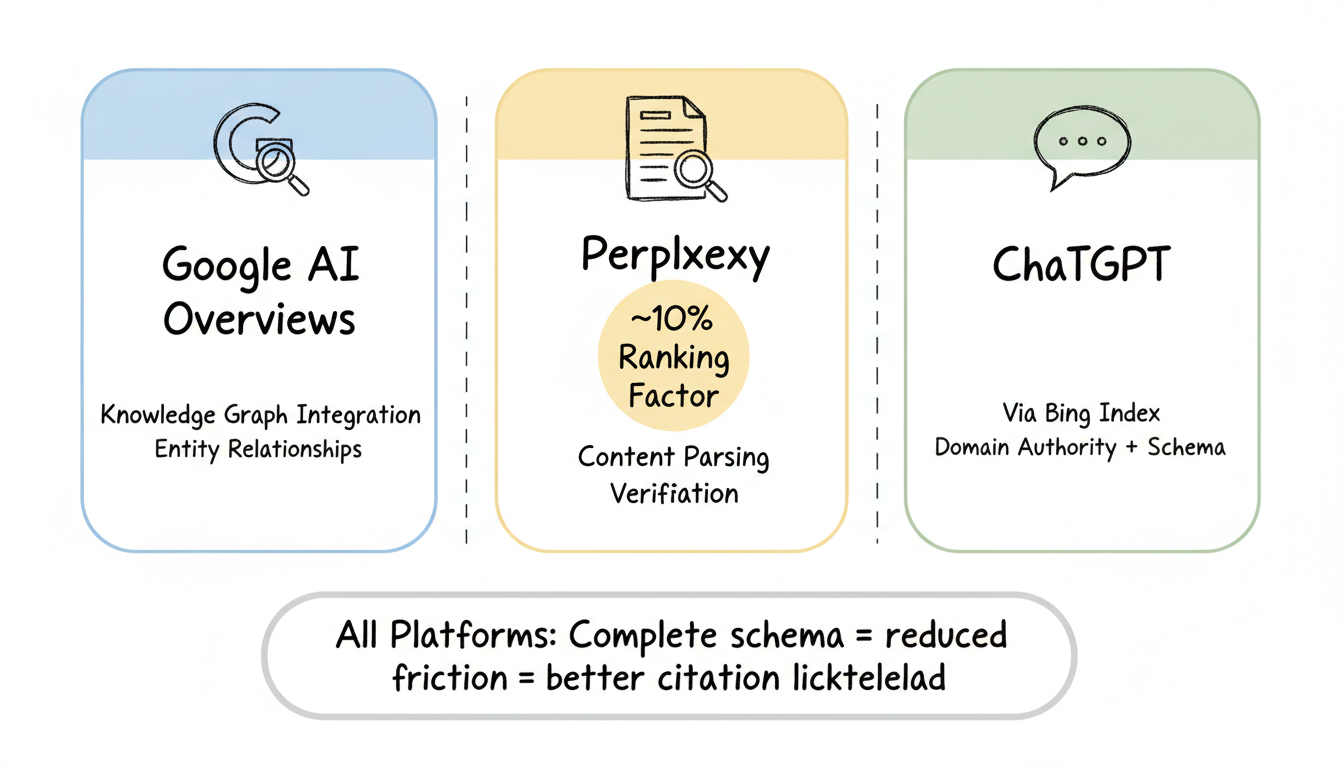
Google AI Overviews: Google processes schema through its existing knowledge graph infrastructure. Article schema connects your content to Google's understanding of authors, publishers, and topics. Strong entity relationships through schema improve AI Overview citation likelihood.
Perplexity: Research indicates schema contributes up to 10% of Perplexity's ranking factors. Perplexity rewards content that's easy to parse and verify. Complete schema markup signals content quality and reduces processing friction.
ChatGPT: ChatGPT accesses web content through Bing's infrastructure. Schema helps Bing index and understand your content accurately, which flows through to ChatGPT's web search features. Domain authority and schema completeness work together for ChatGPT visibility.
Combining Article Schema with Other Types
Article schema works best within a comprehensive structured data strategy. Understanding how different schema types work together is fundamental to answer-engine-optimization, as AI platforms increasingly rely on structured data to process and cite content.
Complementary schema types:
- FAQ Schema: Mark up question-answer sections within articles
- HowTo Schema: Structure step-by-step instructions
- Organization Schema: Establish publisher credibility
- Person Schema: Build author entity profiles
Nested relationships: Connect Article schema to Organization and Person schema through entity relationships. When your Article references a known author entity with established credentials, AI systems can verify expertise claims against broader knowledge graph data.
Avoid over-markup: Don't add schema types that don't match content. Marking non-procedural content with HowTo schema or adding FAQ schema without actual questions degrades trust rather than building it.
Validation and Testing
Ensure schema implementation works correctly before deployment.
Validation tools:
- Google Rich Results Test: Confirms schema renders correctly
- Schema.org Validator: Checks syntax and property accuracy
- Search Console: Reports schema issues affecting indexed pages
Common errors:
- Missing required properties (headline, author, datePublished)
- Mismatched dates between schema and visible content
- Invalid date formats (must use ISO 8601)
- Broken URLs for author or publisher references
- Schema type mismatch with actual content
Testing process: Validate schema on staging before production deployment. Monitor Search Console for emerging errors after launch. Check rich result appearance in Google search to confirm implementation success.
Maintenance Requirements
Schema requires ongoing maintenance for continued effectiveness.
Date accuracy: Update dateModified whenever content changes significantly. AI systems use freshness signals; outdated modification dates undermine credibility. Automate dateModified updates through your CMS when possible.
Author verification: When authors leave organizations or URLs change, update author schema references. Broken author links or references to departed team members create trust inconsistencies.
Schema evolution: Schema.org vocabulary expands regularly. Monitor for new properties relevant to your content type. Early adoption of useful new properties can provide competitive advantages as AI systems learn to process them. Following aeo-best-practices-2026 ensures you stay current with emerging schema standards that AI platforms prioritize.
Measuring Schema Impact
Track schema's contribution to AI visibility.
Tracking approaches:
- Monitor AI citation mentions before and after implementation
- Compare indexed content with and without schema
- Track rich result appearances in Search Console
- Measure referral traffic from AI platforms
Attribution challenges: Schema impact is difficult to isolate - it works alongside content quality, authority signals, and technical performance. Focus on ensuring schema implementation is complete and accurate rather than attributing specific traffic gains to schema alone.
Platform-Specific Schema Nuances
Each AI platform reads structured data through its own parser, so the same Article schema can be interpreted with slightly different emphasis. The safe practice is correct, complete, and matching-the-visible-text markup, because the platforms that diverge still agree on the basics, and the basics are what earn the citation.
Avoid over-engineering for one surface. Tricks aimed at a single parser break the moment it updates, while accurate schema travels. The stable advantage comes from markup that honestly describes the page, not from gaming a current quirk that will not last.
Maintaining Schema Over Time
Schema drifts when the page changes and the markup does not, so tie the update to the edit, not to a separate annual task. Every time the body is rewritten, confirm the fields still match, because misalignment is the most common and most damaging schema defect, and it is preventable by habit.
Keep a short validation step in the publish flow. A quick check that the JSON-LD parses and matches the visible text catches most drift before a model ever sees it. The few seconds of validation protect the citation far better than a quarterly scramble to fix a backlog of mismatches.
Measuring Schema Impact
Schema impact is indirect, so measure it as part of the whole AEO picture. Track citation presence on a fixed query list before and after a schema correction, and read the movement alongside content depth and structure, because markup alone rarely moves a page. The combined view is the honest one.
Avoid crediting schema for wins it did not cause. Many factors affect whether a page is cited, so report corrected markup as one input among several. The discipline of measuring the whole keeps the schema program defensible and stops teams from over-investing in tags while the writing stays thin.
FAQs
Does Article Schema Guarantee AI Citations?
No. Schema improves AI systems' ability to understand and verify your content but doesn't guarantee citations. Content quality, authority signals, and relevance remain primary factors. Schema provides a foundation that makes other signals more effective rather than replacing them.
Which Article Schema Type Should I Use?
Use "Article" for general content, "BlogPosting" for blog posts, and "NewsArticle" for time-sensitive news content. Match the schema type to your content's actual nature. Using "NewsArticle" for evergreen content sends inaccurate signals.
How Often Should I Audit Article Schema?
Review schema quarterly at minimum, and immediately after site redesigns or CMS changes. Automated monitoring catches syntax errors, but manual review ensures schema accurately represents current content structure and author information.